
Fortissimo is an apt description of Greco's miniatures and of a curious game in I.A. Horowitz, Chess Openings: Theory and Practice (1964). I know of two other books that contain this game: Irving Chernev, The 1000 Best Short Games of Chess (1955),* and Leonard Barden and Wolfgang Heidenfeld, Modern Chess Miniatures (1960).
The game is said to have been played in Mar del Plata, Argentinia in 1946. Both Cesar Juan Corte (1914-1996) and Jacobo Bolbochan (1906-1984) played in a major tournament in Mar del Plata in 1946, but this game was not from that event. It may have been part of another event that year, or it could have been a off-hand game.
Chernev claimed that he went through 15-20,000 games in order to select the 1000 for his classic text (see Edward Winter, "Irving Chernev," http://www.chesshistory.com/winter/extra/chernev.html [updated 14 December 2014]). However, he offered no documentation of his sources. I have not seen a copy of Barden and Heidenfeld, but would be surprised if it offers documentation of sources. It would likely take many hours of digging through late-1940s chess publications in order to locate a primary source for this game, and possibly more information concerning the circumstances of play.
It is an instructive game, nonetheless. It is no surprise that Horowitz saw fit to include it in his opening encyclopedia.
Corte,Cesar Juan -- Bolbochan,Jacobo [C54]
Mar del Plata, 1946
1.e4 e5 2.Nf3 Nc6 3.Bc4 Bc5
I found four other games in which Bolbochan played the Black side of the Italian. He played 3...Nf6 in two of them. In the two other instances when he played 3...Bc5, one is an Evans Gambit, and in the other White played 4.d4.
4.c3 Nf6 5.d4 exd4 6.cxd4 Bb4+ 7.Nc3 Nxe4 8.0–0 Nxc3
A few years later, Corte faced the line preferred by modern theory: 8...Bxc3 9.d5 (9.bxc3 d5 White lacks compensation for the pawn. Black's chances are better.) 9...Bf6 10.Re1 Ne7 11.Rxe4 0–0 Corte,C -- Martin,P, Mar del Plata 1949 was drawn in 67 moves.
9.bxc3 Bxc3 10.Ba3!
This move was recommended by James Macrae Aitken in an article in British Chess Magazine (1937). Horowitz mentions it as a suggestion of Aitkin, and opines that it is stronger than Greco's 10.Qb3.
Black to move

10...d5
This reply is best.
A game in the Mar del Plata International Tournament of 1946 continued 10...Qf6 11.Qe2+
(11.Rc1 is better. 11...Ba5 12.d5 d6 13.dxc6+-)
11...Kd8 12.Rad1
For the cost of two pawns, White has all of his pieces mobilized. Nonetheless, Black went on to win after a long struggle, Reinhardt,E -- Maccioni Seisdedos,A, Mar del Plata 1946.
11.Bb5 Bxa1 12.Re1+ Be6 13.Qa4
Stockfish 6 prefers 13.Qc2 Qd7 14.Ne5 Nxe5 15.Bxd7+ Nxd7 16.Rxa1.
Horowitz gives the moves to this point in practical variation 1, stating that White has a winning attack.
Black to move
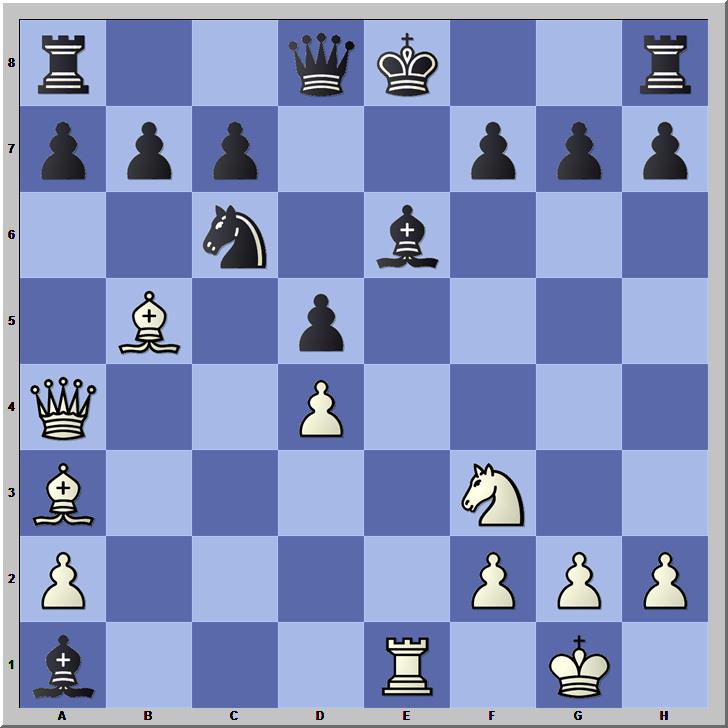
13...Rb8??
13...Qb8 is equal according to my chess engine 14.Bxc6+ bxc6 15.Qxc6+ Kd8 16.Rxe6 fxe6 17.Ne5 Qb1+ 18.Bc1.
14.Ne5 Qc8 15.Bxc6+ bxc6 16.Qxc6+ 1–0
*See "My First Chess Book."


