In his exceptional biography of Capablanca, Miguel A. Sánchez has annotations to games 1, 2, and 5, then offers: "After the fifth game there were four draws, and then" [he annotates game ten] (247).* Earlier in the text, he described criticism of the many draws in the 1909 match between Capablanca and Frank Marshall, criticism that included a cartoon published in The Chess Weekly (Brooklyn, NY) on 26 June 1909 after the match had ended. Edward Winter appends the same cartoon to the top of "Chess Draws," Chess Notes (updated 14 August 2020).

At the time, according to Sánchez, Lasker addressed the complaints with a defense of draws:
From Europe, where the match and the criticism of the repeated draws were well known, Lasker wrote that although the public pays to see a chess master play, it has no right to coerce him to do it poorly. Each master plays as he knows and can. Capablanca was playing excellent chess. That's the most he could be asked to do, emphasized Lasker. (119)I opined in my notes to game 7 that the process of making small changes in the opening is of vital importance in a match of many games. What looks to spectators as an easy draw is often carefully crafted intelligence gathering.
Capablanca,José Raúl -- Lasker,Emanuel [D34]
World Championship 12th Havana (9), 06.04.1921
[Capablanca/Lasker]
1.d4 d5 2.Nf3 e6 3.c4 c5
"This, too, from Dr. Tarrasch strongly recommended, is playable. Of course, Black has to accept the isolation of his queen's pawn." (Lasker)
4.cxd5 exd5 5.Nc3 Nc6 6.g3 Nf6 7.Bg2
Black to move

7...Be6
A more common move order that reaches a position similar to the game continues 7...Be7 8.O-O O-O 9.dxc5 Bxc5 10.Bg5 d4. Here, I think, having castled may be more useful to Black than having a bishop on e6.
8.0-0 Be7 9.dxc5 Bxc5 10.Bg5 d4
"The idea for this fine move, or at least the further development of the idea, is due to Dr. Tarrasch." (Lasker)
And so, Lasker presents Capablanca with a small problem. There have been 21 games reaching this position of sufficient quality to merit inclusion in PowerBook 2020. These split almost evenly between the two options that Capablanca considered.
A more common move order that reaches a position similar to the game continues 7...Be7 8.O-O O-O 9.dxc5 Bxc5 10.Bg5 d4. Here, I think, having castled may be more useful to Black than having a bishop on e6.
8.0-0 Be7 9.dxc5 Bxc5 10.Bg5 d4
"The idea for this fine move, or at least the further development of the idea, is due to Dr. Tarrasch." (Lasker)
And so, Lasker presents Capablanca with a small problem. There have been 21 games reaching this position of sufficient quality to merit inclusion in PowerBook 2020. These split almost evenly between the two options that Capablanca considered.
White to move

11.Ne4
"I had never seen this variation before and I therefore thought for a long time in order to make up my mind as to whether I should play 11.Bxf6 or 11.Ne4. I finally decided upon the latter move as the safest course." (Capablanca)
11...Be7 12.Nxf6+
"The continuation of the Bilguer is 12.Bxf6 Bxf6 13.Qa4 Bd5 14.Nxf6+ Qxf6 15.Rfd1 0-0-0 16.Rac1 Kb8 I believe that Black can hold the position." (Lasker)
Lasker's "the Bilguer" must be a reference to Handbuch des Schachspiels, the standard opening reference of the day, edited in early editions by Paul Rudolf von Bilguer.
12...Bxf6 13.Bxf6 Qxf6
"I had never seen this variation before and I therefore thought for a long time in order to make up my mind as to whether I should play 11.Bxf6 or 11.Ne4. I finally decided upon the latter move as the safest course." (Capablanca)
11...Be7 12.Nxf6+
"The continuation of the Bilguer is 12.Bxf6 Bxf6 13.Qa4 Bd5 14.Nxf6+ Qxf6 15.Rfd1 0-0-0 16.Rac1 Kb8 I believe that Black can hold the position." (Lasker)
Lasker's "the Bilguer" must be a reference to Handbuch des Schachspiels, the standard opening reference of the day, edited in early editions by Paul Rudolf von Bilguer.
12...Bxf6 13.Bxf6 Qxf6
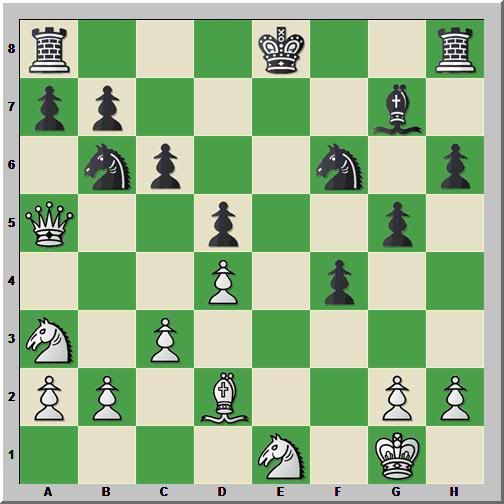
White to move

"It is my impression that this position is not good for Black, though perhaps there may be no way to force a win." (Capalanca)
14.Qa4 0-0
"This seemed better to me than Be6-d5. Black is now quite good. The queen's pawn has been threatened, but Black has counter threats." (Lasker)
15.Qb5
"Threatening not only 16.Qxb7 but also 16.Qg5 exchanging Queens." (Capablanca)
Both 15.Rfd1 and 15.Nd2 have been played in the three games to reach this position in Mega 2020.
15...Rab8 16.Rfd1 h6
"Secures the important Be6 against the white knight." (Lasker)
White did get an advantage in Mamoshin,V. -- Olenin,N., Tula 2004, one of the games with 15.Rfd1, continuing 15...d3 16.exd3 Qxb2 17.Ng5 Rad8 18.Qe4 g6 19.Nxe6 fxe6 and White eventually won.
17.Ne1 Rfe8
14.Qa4 0-0
"This seemed better to me than Be6-d5. Black is now quite good. The queen's pawn has been threatened, but Black has counter threats." (Lasker)
15.Qb5
"Threatening not only 16.Qxb7 but also 16.Qg5 exchanging Queens." (Capablanca)
Both 15.Rfd1 and 15.Nd2 have been played in the three games to reach this position in Mega 2020.
15...Rab8 16.Rfd1 h6
"Secures the important Be6 against the white knight." (Lasker)
White did get an advantage in Mamoshin,V. -- Olenin,N., Tula 2004, one of the games with 15.Rfd1, continuing 15...d3 16.exd3 Qxb2 17.Ng5 Rad8 18.Qe4 g6 19.Nxe6 fxe6 and White eventually won.
17.Ne1 Rfe8
White to move

18.Rd2
"Of course 18.Bxc6 is inadequate, as the Be6 would then come into its own." (Lasker)
18...Bg4 19.Rc1 Re5 20.Qd3
"If 20.Rc5 Qg5 with a winning game." (Capablanca)
20...Rbe8 21.Bf3
"If 21.Bxc6, then 21...Bxe2 with advantage." (Lasker)
21...Bxf3
"Black could have tried to keep up the attack by playing 21...h5 The text move simplifies matters and easily leads to a draw." (Capablanca)
22.Nxf3 Re4 23.Rc4
"Of course 18.Bxc6 is inadequate, as the Be6 would then come into its own." (Lasker)
18...Bg4 19.Rc1 Re5 20.Qd3
"If 20.Rc5 Qg5 with a winning game." (Capablanca)
20...Rbe8 21.Bf3
"If 21.Bxc6, then 21...Bxe2 with advantage." (Lasker)
21...Bxf3
"Black could have tried to keep up the attack by playing 21...h5 The text move simplifies matters and easily leads to a draw." (Capablanca)
22.Nxf3 Re4 23.Rc4
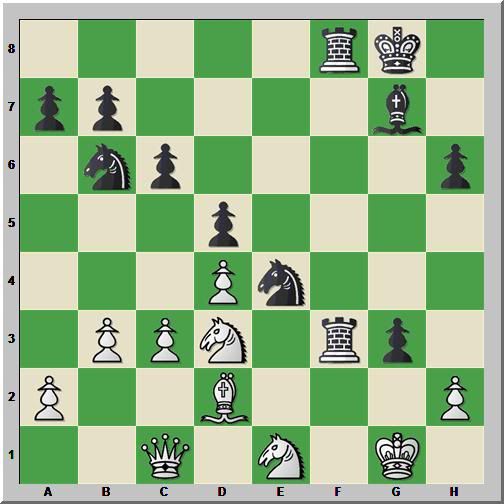
Black to move

23...Qe6
"Pity! Black still had a lot of time to draw. With 23...Qg6 Black would have posed a problem for the opponent, since then Re4xe2 threatened. For example 24.Kf1 Qg4 25.Kg2 Qe6 26.Nxd4 Qd5." (Lasker)
24.Nxd4 Nxd4 ½-½
"The game was simply clear here. 24...Qd6 would be bad because of 25.Qc3." (Lasker)
"Pity! Black still had a lot of time to draw. With 23...Qg6 Black would have posed a problem for the opponent, since then Re4xe2 threatened. For example 24.Kf1 Qg4 25.Kg2 Qe6 26.Nxd4 Qd5." (Lasker)
24.Nxd4 Nxd4 ½-½
"The game was simply clear here. 24...Qd6 would be bad because of 25.Qc3." (Lasker)
Capablanca 1:55 - Lasker 1:37
*Miguel A. Sánchez, José Raúl Capablanca: A Chess Biography (Jefferson, NC: McFarland, 2015).