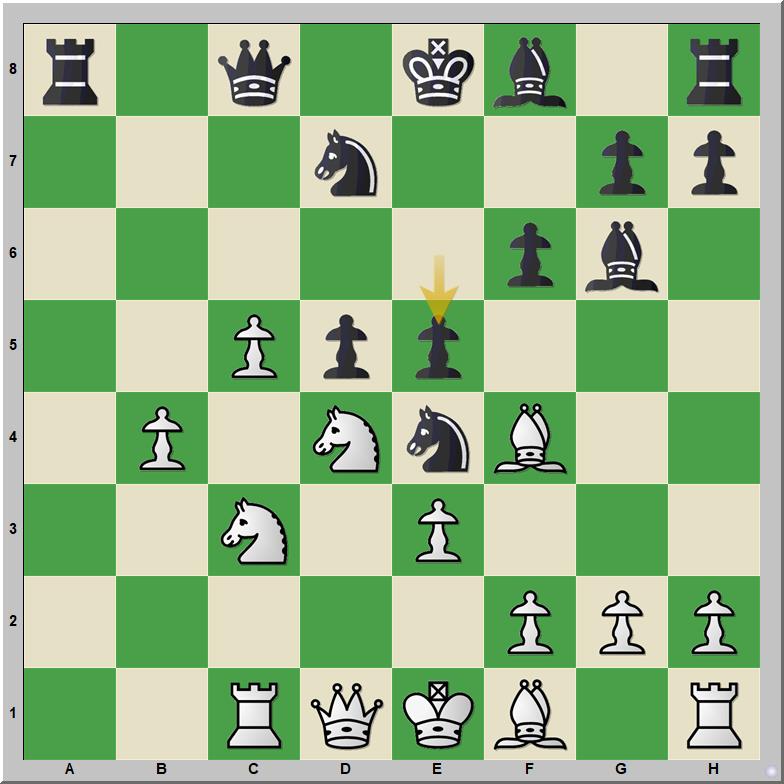
Showing posts with label pattern recognition. Show all posts

25 February 2025

Recognizing Known Positions

Earlier this month at a youth tournament that I ran, I watched one of my students miss an elementary checkmate in two moves. It was a ladder mate (or rolling barrier, as it is called in Bruce Pandolfini, Pandolfini's Endgame Course [1988]). But, a few moved later, this same player executed the checkmate. When he was successful, he controlled the first and second rank. He missed it when the mate could have occurred on the h-file with the g-file also under control.

I suspect that known patterns may be harder for young students to recognize when they are rotated 90°.

Last night, I reached a position where I had to execute a checkmate with knight and bishop. It was the first time that I had such a position that was not due to seeking it, such as when I underpromote a pawn. After I captured my opponent's last piece, I had very nearly the position that I have used in training. The checkmate took me 32 moves, but there were a couple of times when my move extended the distance to mate by six. My opponent answered these with moves that helped me get back on course.

Black to move
I played 107...Nd6, one of two optimal moves.

After 108.Ka5, Kc6 would have kept me on a known path, but I played 108...Bc5, which is equally good in terms of distance to mate. The move I played shows that I was not recognizing the pattern.

Several moves later, White's king has ventured into territory that I might have controlled.

Black to move
116...Nc3+ extends the distance to mate by one move.

Had I played 116...Be3, forcing White's king to the edge, I would have been following advice I've given students dozens of times, usually while teaching two bishops against a lone king. Here, that is the best move. Then again:

Black to move
I was feeling confused when I missed the mate in eleven that forces in three moves a position that I know.

118...Bc3 119.Kb3 Kd3 120.Ka4 Kc4 121.Ka3

Black to move
121...Bb4+ forcing White to the second rank when 122.Kb2 Ne3 sets up the barrier that I studied in Pandolfini's Endgame Course the first time that I learned this elementary checkmate.

White to move

Alas, I made a knight move and it was still mate in 18, as it had been since my move 116.

Nonetheless, I finally reached a position where I was able to draw on memory and calculation only two to three moves deep to finish the job.

Black to move, mate in nine

My work studying Thomas Engqvist, 300 Most Important Chess Positions (2018) resumes today with this position from Timman,J. -- Lutz,C., Wijk aan Zee 1995.
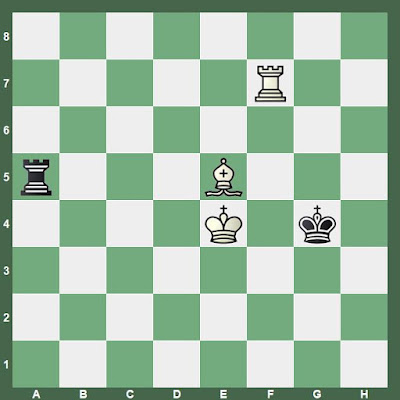
Black to move

Here, Black must defend successfully, avoiding the position analyzed by François-André Danican Philidor in 1849, which I spent some time working on Friday, and between rounds in a Swiss tournament this past weekend. It was the previous position in Engqvist's excellent book.

The 90° rotation might vex me the same way it did my young student.


17 January 2025

Building Pattern Understanding

My intention with my after school club on Thursday was to reinforce some opening principles by showing the students some short games where king safety or piece mobility was horribly neglected by one player. Nonetheless, most of the miniatures that I shared from memory concerned a weakened e1-h4 diagonal--an important pattern.

The first two were exceptions, but both involved quick knockouts of the Caro-Kann Defense, which should be solid. The first game was played over-the-board in 2011 when I arrived twenty minutes late for round two. 

Stripes,J. -- Opponent
Eastern Washington Open, 1 October 2011

1.e4 c6 2.d4 d5 3.Nc3 dxe4 4.Nxe4 Bf5 5.Ng3 Bg6 6.Nf3 h6

6...e6 or 6...Nf6 would be normal.

7.Ne5 Bh7 8.Bc4 e6 9.Qh5 Qe7

This unfortunate blocking in of the bishop is the computer's top recommendation to my surprise.

10.O-O Nf6 11.Qe2 Nbd7 12.Bf4

I wanted to maintain a piece on e5.

12...O-O-O??

12...Nxe5 13.Bxe5 and White is slightly better.

White to move
I asked the students to find my move.

13.Nxc6 and Black resigned facing checkmate or the loss of his queen.

The second game was played online. A catastrophic blunder spoiled a difficult but playable position that I have done well against.

Stripes,J. -- Internet Opponent
Chess.com 3 April 2024

1.e4 c6 2.d4 d5 3.e5 Bf5 4.h4 h6?!

4...h5 and 4...c5 both get played against me regularly.

5.g4!? Be4 6.f3 Bh7 7.e6! fxe6

7...Qd6 might be best here. I've seen it once.

8.Bd3 Bxd3 9.Qxd3

Black to move
9...Nd7??

9...e5 or 9...Qd6 are playable.

10.Qg6#

Then, I showed the students the first game in Irving Chernev, The 1000 Best Short Games of Chess (1955).

Gibauld -- Lazard
Paris 1924

1.d4 Nf6 2.Nd2 e5 3.dxe5 Ng4 4.h3??

Black to move
4...Ne3 and White resigned.

After showing this game to some online students one morning in 2021, I played the following game that afternoon. Pulling the game from my database reminded me that I played an identical game again in 2023.

Stripes,J.--Internet Opponent
Chess.com 7 October 2021

1.d4 Nf6 2.Nd2 e5 3.dxe5 Ng4 4.Ngf3 d6

Watch what develops as it will appear in another game, too.

5.exd6 Bxd6 6.h3??

Black to move
6...Ne3 7.fxe3 Bg3#

The next game was presented to the students as one that I saw at the Mead High School Chess Club about 2006, but others have played it, too. It seems that I even played it on chess.com once in 2009.

A Visitor -- A Mead Team Member
Mead High School c.2006

1.f4 e5 2.fxe5 d6 3.exd6 Bxd6 

White to move
4.Nc3??

When I've had the diagram position against Michael Cambareri, he has played 4.Nf3 or 4.d5. I usually end up losing after a battle.

My students found the conclusion quickly.

4...Qh4+ 5.g3 Qxg3+

5...Bxg3+ 6.hxg3 Qxg3# is more common.

6.hxg3 Bxg3#

This next game is the source for the banner at the top of the page. It was played online in less than a minute during my lunch break while teaching chess in elementary school classrooms.

Internet Opponent -- Stripes,J.
Chess.com 18 January 2012

1.e4 e6 2.f4 c5 3.Nf3 Nc6 4.d4 cxd4 5.Nxd4 Nf6!? 6.e5 Ne4 7.Bd3 Qh4+ 8.g3 Nxg3 9.Nf3

Black to move
9...Qg4??

9...Qh3 was best.

10.hxg3

10.Rg1 was slightly better.

10...Qxg3+ 11.Ke2??

11.Kf1 and White is much better.

11...Qg2+

White to move
12.Ke3?

Moves into checkmate. 12.Ke1 loses the rook, but holds out longer.

12...Bc5+ 13.Ke4 f5+ 

With students, I always ask them to find the only move to get out of check. En passant is difficult for young chess players.

14.exf6 d5#

The last game appears in Emanuel Lasker, Common Sense in Chess (1917), has been played by Eric Rosen more than once, and appears in his video and Lichess Study on the Stafford Gambit. I have played the entire game nine times on chess.com.

Several Players -- Stripes,J.
chess.com November 2022 - October 2024

1.e4 e5 2.Nf3 Nf6 3.Nxe5 Nc6 4.Nxc6 dxc6 5.d3 Bc5 6.Bg5??

Black to move
6...Nxe4

I played 6...O-O the first time that I found myself in this position and won after a long battle.

7.Bxd8?

White still loses with 7.Be3, the best option. Eric Rosen's study offers the variations and I showed the main ones to my students.

7...Bxf2+ 8.Ke2 Bg4#

I hope my students will guard the diagonal leading to their king and also will exploit the vulnerability when their opponent fails to do so.


30 April 2024

Inspired by Ruy Lopez

This morning I had a familiar position although the opening moves were not anything I recall playing before. The position was familiar because it had the same critical elements (pattern) found in a game Ruy Lopez played in 1560 and that appears in my book, Checkmates and Tactics (2019). The exercises in this book are those I've been using with scholastic chess players since 2006 as part of my award curriculum.

I had White in the 10 minute game.

1.e4 e6 2.c4 c5 3.Nf3 d5 4.exd5 exd5 5.d4 dxc4?! 6.Bxc4 Bg4?

Bad pins often backfire.

White to move
7.Bxf7+ Kxf7 8.Ne5+ creates a discovery against the bishop as well as forking king and bishop.

8...Ke8 9.Qxg4 Nf6 10.Qe6+

The game is continuing along the path shown by Lopez.

10...Qe7

White to move
11.Qc8+ Qd8 12.Qxd8

I considered 12.Qxb7, which Stockfish prefers, but reasoned that Lopez's combination was good enough to give me a clear advantage.

12...Kxd8 13.Nf7+

What we have of Lopez's game ends with this fork.

13...Ke8 14.Nxh8

My opponent made me play all the way to checkmate. Along the way, I won the other rook through another combination.

White to move
24.Rxe6

24.Rxb7+ is simpler and better.

24...Kxe6 25.Nc7+ Kf5 26.Nxa8

It's not often that I get to fork both rooks with my knights in the same game.

Lopez's game started with a King's Gambit Declined. His opponent is given in ChessBase Mega as Giovanni Leonardo da Cutri (spelling and name sequence differs from source to source).

1.e4 e5 2.f4 d6 3.Bc4 c6 4.Nf3 Bg4

The bad pin.

White to move
This position is number 21 in Checkmates and Tactics, available through Amazon both in print and Kindle versions. It is the third exercise in my Bishop Award set.

6.Bxf7+ Kxf7 7.Nxe5+ Ke8 8.Qxg4 Nf6 9.Qe6 Qe7 10.Qc8+ Qd8 11.Qxd8

Lopez's move is best, which differs from my game.

11...Kxd8 12.Nf7+


11 September 2022

Quality

When I was just starting out (I was an instant chess addict!), I used game collections, tournament books, and eventually Chess Informants to zip through anywhere from 200 to 500 games a day, every day. That’s not too amazing when you consider that I only used 20 to 40 seconds a game.
Jeremy Silman, "Studying Master Games and Berkmaster's First Over-The-Board Tournament Battle," Chess.com (21 January 2014)
When I started my effort to quickly go through every game in the back half of Chess Informant 152, I went through the 39 games and game fragments classified as ECO A in two sessions of 20-30 minutes. That is much slower than Jeremy Silman claims to have been his practice as a young player, but much faster than my pace so far through ECO B. This morning I went through game numbers 40-45, which, including annotations, was nine whole games and one fragment. My wife says I was at my computer about an hour. Six minutes per game is still very fast and superficial, of course.

As I went through games 40-45 in Informant 152 this morning on my computer, I made notes in the margins of the print edition. Every game has at least one note. Two tactical positions are marked as possible material to use with my students.

From Lupulescu,C.--Nanu,C., Romania 2022, 152/44

White to move
From Zhang,Zhong--Li,Di, Hangzhou 2022, 152/43

White to move
I marked Erdos,V.--Babula,V., Corte 2022 152/41 as "pins and forks". The next game, Esipenko,A.--Moiseenko,A., Deutschland 2022, "use every piece".

Silman asserts that quantity of games develops knowledge of patterns--"positional patterns, tactical patterns, structural patterns, piece placement patterns, timing patterns."* He suggests that to become an IM or GM, a player needs to look at 100,000 games. 

My ambitions to become a titled player, if I ever had them, dissipated a few years prior to my 60th birthday. Nonetheless, I enjoy the process of learning and seek a range of approaches to this process. I know that I have played through many thousands of games over the years, many very quickly and others that I have studied for many hours. A few years ago, I played through every available game on chessgames.com played by Rezső Charousek, of which there are only 171. The process took a week. The biggest impact on my play came from detailed study of a game that he lost. It inspired me to try my hand with the opening in that game (see "Losing My Virginity with the Ponziani" [2014]). This study of Charousek's games was influenced by Silman's claims.

I have played through a substantial percentage of Paul Morphy's games and have used at least thirty regularly in my teaching. I have been through more games credited to Gioachino Greco than can be found in any database, including my own because my hard drive crashed a few months after entering the 168 variations in William Lewis, Gioachino Greco on the Game of Chess (1819). Several years later, I entered all of the games from Francis Beale, The Royall Art of Chesse-Play (London 1656), which contains 94 games, many of which are not in the databases most people use.

As I work through these games with the objective of getting through all soon enough that Informant 153 does not arrive first, I am pulled one way by Silman's assertions that quantity and speed are beneficial. At the same time, slowing a little seems to offer better prospects of quality.


*Jeremy Silman, "Snarky Silman Presents: Reader's Questions," Chess.com (14 January 2014).

17 November 2021

Textbook Coordination

Black has a problem in this position, which could appear as part of the position in a game.

Black to move
White threatens Qxh7#

White's four pieces are well-coordinated for the final assault on the king. A position like this one could arise with additional defensive resources that would tip the balance in Black's favor. Without them, Black is near lost.

I put this position on the demonstration board at the start of the lesson for my after school chess club on Tuesday, noting that White's light-squared bishop could be anywhere along the diagonal from a2 to d5. We looked at several possibilities for Black's defense and White's attack, most leading to either checkmate or the loss of Black's queen.

Then, I showed the students two games. The first appears in several of Gioachino Greco's manuscripts, and is well-known from its inclusion in the usual databases. David Levy and Kevin O'Connell, Oxford Encyclopedia of Chess Games, Volume 1 1485-1866 (1981) has this as Greco 11 (2).

Greco,Gioacchino -- NN [C53]
Greco Europe, 1620*

1.e4 e5 2.Nf3 Nc6 3.Bc4 Bc5 4.c3 d6 5.d4 exd4 6.cxd4 Bb4+ 7.Nc3 Nf6 8.0-0 Bxc3 9.bxc3 Nxe4 10.Re1 d5 11.Rxe4+ dxe4 12.Ng5 0-0 13.Qh5

Black to move
13...h6 14.Nxf7 Qf6

We also looked at 14...Rxf7, which is a better defense. This move and the subsequent 15.Bxf7 precede Greco, appearing in the Regole MS, which some scholars have credited to Giulio Cesare Polerio and dated to the late sixteenth century (see Peter J. Monté, The Classical Era of Modern Chess [2014], 158-160, 465.)

15.Nxh6+ Kh8

15...Kf8 was also examined by Greco, but is not so credited in the ChessBase database. The line appears as an annotation in Levy and O'Connell, as three variations appear in Professor Hoffman, The Games of Greco (1900). This line merits a separate post. It was not part of the lesson at the youth chess club.

16.Nf7+ Kg8 17.Qh8# 1-0

The second game had been played that morning.

Stripes,J -- Internet Opponent [C70]
Live Chess Chess.com, 16.11.2021

1.e4 e5 2.Nf3 Nc6 3.Bb5 a6 4.Ba4 b5 5.Bb3 Bb7 6.c3

Inaccurate?

6.0-0 Nf6 7.c3 Nxe4 8.d4 Na5 9.Bc2 is normal.

6...Bc5 

Probably a mistake.

7.0-0 Nf6 8.d4

Black to move
8...exd4

This move accelerates White's attack.

8...Bb6 9.Re1 d6 10.a4 0-0 has appeared in a game between masters.
8...Bd6 9.Bg5 is an engine suggestion.

9.cxd4 Bb6 10.e5 Nd5

Simply giving away the knight. Black's position is near hopeless already in any case.

10...Ng8 11.d5+-

11.Bxd5 0-0 12.Ng5 Bxd4

12...h6 may be the last chance.

13.Qh5

We arrive at the basic pattern from Greco and his predecessors.

Black to move

13...h6 14.Nxf7 1-0

My opponent resigned here.

The game might have continued 14...Rxf7 (14...Qe7 15.Nxh6+ Kh7 16.Nf5#) 15.Bxf7+ Kh8 16.Bxh6 and the engine points out that 16...Qg8 is the only move.


*The game appears in Greco's Godolphin manuscript, an undated MS from the London sojourn, so should be dated 1623. It also appears in several MSS 1624-1625 produced in France.

15 September 2021

Memory

An exercise from Chess.com this morning was made simple because I remembered one that I composed for my book, Essential Tactics: Building a Foundation for Chess Skill (2017).

White to move


The decision to trade rooks in Exercise 1289523 hinges on whether White can seize the opposition. 

White to move

White must outflank with Kg5. All other moves draw.

Exercise 14 in Essential Tactics begins with a tactical sequence.

White to move

After forcing the exchange of bishop and rook for Black's queen, White faces an elementary queen and pawn endgame. However, those who have learned the principle of opposition poorly--thinking opposition is the end, rather than the means to an end--can fail. The White king must outflank Black's king.

White to move

In this case, the distant diagonal opposition is sufficient. Black's king is one square closer to the pawn than in this morning's exercise. This difference suggests perhaps that it was a faulty memory that helped me solve the exercise on Chess.com.

26 July 2020

Slow Down

Over the past twenty years, I have played at least 100,000 games, most at three minutes with no increment (3 + 0). Adding games at five minutes, or with an increment, and adding bullet, which includes a great many 2 + 1 (more time than three minute when the game exceeds sixty moves), pushes the number over 150,000.

These crude minimums belie the point that I do not know the total number of online blitz games I've played. I have played online blitz regularly since 1998, often dozens of games in a day. I play a few games most days. My personal database currently holds 103,382 games. It excludes most bullet games, although I make an exception for 2 +1. It also has many games at longer time controls, including many hundreds of correspondence games. I have not been able to save every game, and have also lost tens of thousands through database errors.

When I started saving my games in a database, I was using Chessmaster 7000. About 2001, I began learning the free versions of ChessBase and Chess Assistant, both limited to database not exceeding 15,000 games. I recall that CB was more restricted than CA. In 2003, I bought CB 8 and attempted to gather all of my online games into one database.

What has been the impact of this massive amount of online blitz on the quality of my play?

The database contains a near endless supply of instructive positions that arise from sloppy play. Exactly the sort of play that my students see in their games.

It has certainly given me ample practice with pattern recognition, and may have developed my intuitive feel for many types of positions. It has given me immense experience in playing my favored openings, such that it is very difficult for an opponent to surprise me with something that I have not seen before.

Performing elementary checkmates with minimal time on the clock is gratifying, and helps me reinforce the skill in my teaching. But, it is also humbling that I have stalemated my opponent with queen and king against king more than once.

The most important detrimental impact has been that unsound risky play has been rewarded in such a way that it has become second nature. Making the effort to switch to 3 + 2, or even the 5 + 2 that I am currently playing in USCF online blitz rated tournaments has been rough. It is much more difficult to win lost positions on the clock when there is an increment. In my OTB games, I have bouts of impatience where blitz thinking interferes with careful calculation.

Last week, I had White and this position.

White to move

Confidently assuming that I had a strategic advantage, I was blind to tactics. I had plenty of time, but did not use it.

22.Bg2?? Rxd2 and I resigned.

The Morning Membership tournaments are short and fun, and they are at a time that is good for me both in terms of schedule and capabilities. Unlike the stereotypical late-night chess player, I am a morning person. These events last about an hour, are played at 5 + 2 on Chess.com, and draw 30-40 players. They begin at 8:00 am in my west coast time zone, which is late morning on the east coast.

In my first event on July 8, I was the third highest rated player, tied with two others with perfect scores, and won the first place trophy on tiebreaks. The free membership extensions that are awarded after the event are based on a random drawing, not performance. I played three more this week. The blunder presented above was my first loss. I scored 2/4 on Monday, lost my last round game on Wednesday, and on Friday, when I was the top rated player, gave up a draw in the second round.

My online blitz rating is going down. Nonetheless, I have signed up for the next sixteen--every one through the end of August. Learning to pace myself in slower blitz may be good for my game.

In "The Soul of Philidor", I presented a position where I was happy with my choice because it reflected the application of recent study. Strategically, it was a nice game and I was happy with my performance. Postgame analysis, however, quickly revealed to me that I missed several opportunities. Using the engine to check my postgame analysis revealed more missed opportunities. As I learn to slow down, perhaps I will increase my alertness to tactical chances. Intuitive play has its place, but some calculation is necessary for improving my game.

In each of these five positions, I had a better move than the one I played. Although I dominated most of the game and managed to win, I did concede the advantage and was even worse through part of the game.

White to move

I played 10.a3??

A couple of weeks ago, I was examining the tactics in a Grandmaster game that involved the type of position that occurs after the superior 10.b5!

White to move

15.Nd4?? walked into a fork, although that was not fatal and my pawns proved to be compensation for the knight. But 15.Nxe4 or 15.Bb5 were both better choices

White to move

16.Bg3?? turned out okay in the game, although Black now has a clear advantage. After 16.Nxd5 exf4 17.f3, White has a decisive advantage.

White to move

22.b5 Na4 23.Ra3 Nc2 leads to the next position, and I again have an advantage. However, 22.Re3 wins a piece. I also could have played 21.Re3, but 21.Bf3 was good enough to regain the advantage.

White to move

24.Rxa8! was a move that I considered, but without adequate calculation. Black is busted.

I played the seemingly safer 24.Qb3. A few moves later, my opponent returned the sacrificed piece which left me a clear pawn ahead. My bishops also controlled the squares my passed b-pawn needed.
I can play better.

05 November 2019

Positions from Recent Lessons

[T]actics flow from a positionally superior game.
Bobby Fischer, My 60 Memorable Games (1969)

My posting here has been sporadic lately. Between work and home maintenance, I've barely had enough time in the woods for hunting. As a consequence, there is no time for writing. Nonetheless, I've been teaching several individual students and running an after-school chess club. The positions below are from some classic games that were part of my instruction in October.

White to move

William Steinitz (still spelled Wilhelm at the time) did not make the computer's choice here, but it was a decisive move that forced matters. It also set up the theme for the next two positions. From Steinitz -- Mongredien, London 1862.

White to move

From Steinitz -- Mongredien, London 1863.

White to move

This was the position where Fischer made the comment in the epigraph above. From Fischer -- Sherwin, 1957.

06 January 2019

Aggression and Objectivity

The positions below all come from an online game characterized by egregious blunders by both players. White played all out for a checkmate that was not there. In the end, Black was threatening checkmate in one, and overlooked a defensive resource for White. With an objective assessment of each position, the correct and only move reveals itself.

White to move

White to move

White to move

Black to move

08 July 2017

Three Tactics

A pin, decoy, and fork often work together to exploit an elementary error. Sometimes, exploitation of the error is complex, but it remains rooted in a fundamental pattern that should be well-known.

A few days ago in an online blitz game, I had this position.

White to move

I executed the pin. Rather than capturing my bishop (the decoy) and facing the resulting fork, my opponent resigned.

The pattern appeared in Greco.

White to move

Greco's game concludes: 12.Bb5 Qc5 13.Be3 Qxb5 14.Nxc7+ Kd8 15.Nxb5 1-0

This game deserves inclusion in all packages of instructive material to be used with beginners. My search of my largest database for positions with a White knight on d5, a Black queen on c6, and the move Bb5 (including all mirror positions with colors reversed) turned up well in excess of 400 games. Most led to defeat for the player whose queen was attacked, but not in every case.

I turned up this interesting position from the women's championship of France in 1931, the game Bastin -- Freeman, Paris 1931.

White to move

I posted this position in several fora on Facebook, but few responses identified the key move that begins the winning sequence.

9.b4 and the queen is trapped. 9...Qc6 10.Bb5 and Black resigned because 10...Qxb5 offer White the choice of capturing the queen--an error--or checkmating the Black king.

In Fries Nielsen -- Liersch, Germany 1980, White won Black's queen. However, Black gained more than sufficient material compensation for the queen and went on to win.

White to move

14.Bb5 axb5 15.axb5 Qxd5! 16.exd5 Rxa1 and Blkack has a rook and three minor pieces for a queen and two pawns.

23 May 2017

Seeing Patterns

Tal's Winning Chess Combinations (1979) has influenced my perception. Last week, I read the first chapter of this book by Mikhail Tal and Victor Khenkin, which exists under several titles with and without Tal's authorship. This chapter concerns the rook and corridor checkmates and checkmate threats. These corridor vulnerabilities are most often back-rank weaknesses, but there are other corridors, including a position where a rook must be given up to avoid checkmate between two walls of pawns alongside the f-file.

The large number of deflection combinations to threaten checkmate has made me more alert to these possibilities when going through other games. Of course, these ideas are not new to me. I was familiar with the idea even before Lev Alburt's Chess Training Pocket Book (1997), which I read fifteen years ago, stimulated my imagination for the maneuvers with this exercise.

White to move

Alburt gives the exercise the title, "Defection Detection". It is number 93 in the book.

This morning, I was reading Baskaran Adhiban's annotations to his draw against Wesley So at the Tata Steel Chess Tournament in January when the deflection motif jumped into my perception. After 25.Bxa7, So could have played 25...Rxa7. He did not, playing 25...Bxc3 instead.

What if he had grabbed the bishop?

White to move

Immediately, I saw 26.Qd5+ Kh8 27.Qxe5. However, nothing compels the suicidal 27...Rxe5. So would have had choices: 27...Raa8, 27...Qb6+, and others. In Adhiban's case, his offer of a bishop wins So's bishop, but no more. The game, as he points out, was, "[a]n exciting draw with lots of interesting twists!" (Chess Informant 131, 49).

12 February 2017

Patterns and Calculation

If we fail to make an idea work, we need to stop and ascertain the cause of the failure (i.e. answer the question 'why?'), and then attempt to correct our design.
Paata Gaprindashvili, Imagination in Chess (2004), 40.
A chess problem that cropped up in tactics training yesterday immediately reminded me of a game I had seen working through the compositions of Gioachino Greco, but the solution in Greco fails. Noting the failure, I considered why it failed and calculated the remedy. The whole process required about 23 seconds.

This elementary exercise serves to supplement my posts, "Patterns and Calculation" (23 December 2016), "Patterns: Some Evidence" (11 January 2017), and to highlight my endorsement of Paata Gaprindashvili, Imagination in Chess (see "Imagination in Chess").

White to move

The position arose in a correspondence game on Chess.com and was presented to me through the tactic trainer there. That game was a Ponziani in which Black blundered early.

Greco's game arose via a King's Gambit. I present it as it appears in Francis Beale, Royall Game of Chesse Play (1656).

Gambett LIII (Greco) [C37]
1656

1.e4 e5 2.f4 exf4 3.Nf3 g5 4.Bc4 h6 5.h4 f6 6.Ne5 fxe5 7.Qh5+ Ke7 8.Qf7+ Kd6 

White to move

9.Qd5+ Ke7 10.Qxe5# 1–0

The checkmate pattern in both games is the same, except that there is an alternative checkmate in the tactics problem if Black moves the king after White's initial move. The key difference, however, is that Black's knight guards e5 in the tactics problem. Hence, applying Gaprindashvili's advice, White must first lure this knight to e5, then execute the winning queen maneuver.

Instant recognition of patterns can be trained and aids in the development of chess strength. The same pattern often occurs in seemingly dissimilar games. Recognizing the pattern offers a plan, but calculation remains a necessary component to verify that the pattern has application.