Showing posts with label Tal (Mikhail). Show all posts

06 December 2024

Poor Development

Konstantin Sakaev and Konstantin Landa, The Complete Manual of Positional Chess: Opening and Middlegame (2016) begins with development. They state, "everyone is aware of the rule [rapid development], but when it comes to practical play, one often sees players struck by 'amnesia'" (18). The first three examples show Mikhail Tal exploiting this amnesia when it afflicts normally strong players.

Wolfgang Uhlmann, the victim in the first example, annotated the game for Chess Informant 12. Tal's annotations appear in Life and Games of Mikhail Tal (1997). Prior to the game, Tal prepared a surprise for Uhlmann: his fifth move, which had appeared in some previous games and had been recommended by Alekhine.

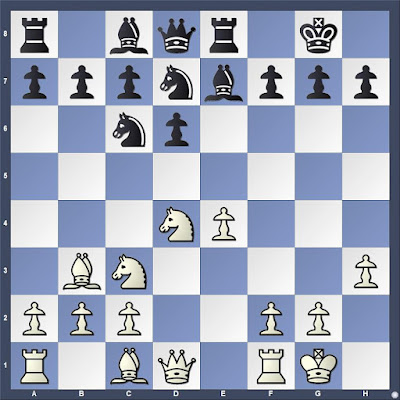
1.e4 e6 2.d4 d5 3.Nd2 c5 4.Ngf3 Nc6 5.Bb5

The surprise! Uhlmann gives the move !? and the same annotation to his reply, which Tal reports that took more than twenty minutes off Uhlmann's clock (437).

Black to move
5...dxe5

Sakaev and Landa assert that this move is dubious.

6.Nxe4 Bd7 7.Bg5!

Tal, Uhlmann, and the authors of The Complete Manual of Positional Chess all agree on the excellence of this move, developing with tempo.

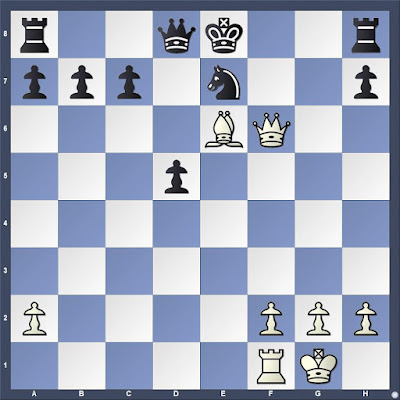
Other examples of amnesia recently came up in my reading and play. Leonid Stein fell to a beautiful attack by the relatively unknown Leonid Remeyuk in the 1959 Ukranian Championship. The game is annotated in P.H. Clarke, 100 Soviet Chess Miniatures (1963).

White to move
White played 10.Bxb5+ and Stein resigned nine moves later.

Clarke writes, "White is so indignant at the sight of the text move, which disdains the principle he himself has been so careful to keep, that he there and then determines to punish the offender" (78).

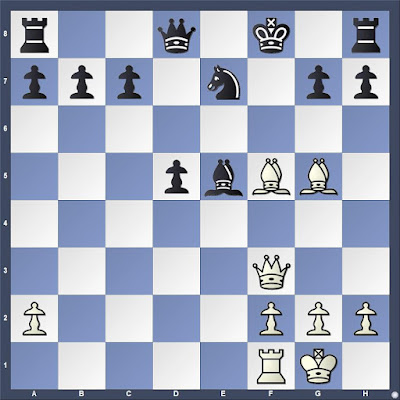
Another example was selected yesterday by my advanced students in an after school chess club. They started by looking for Adolf Anderssen's final assault in his first game against Howard Staunton at the 1851 London tournament.

White to move
Staunton's problems began early.

1.e4 c5 2.d4 cxd4 3.Nf3 e6 4.Nxd4 Bc5

4...a6 or a knight move is normal today.

5.Nc3 a6

5...Qb6 would at least apply some pressure on the knight.

6.Be3 Ba7 7.Bd3

White's lead in development should be abundantly clear. I tried to tell the students that Staunton had taken a journey through time on the T.A.R.D.I.S., met Ilya Kan, and learned some of Kan's ideas in the Sicilian Defense, but did not absorb the lessons well. They did not believe my story, finding time travel unlikely.

Black to move
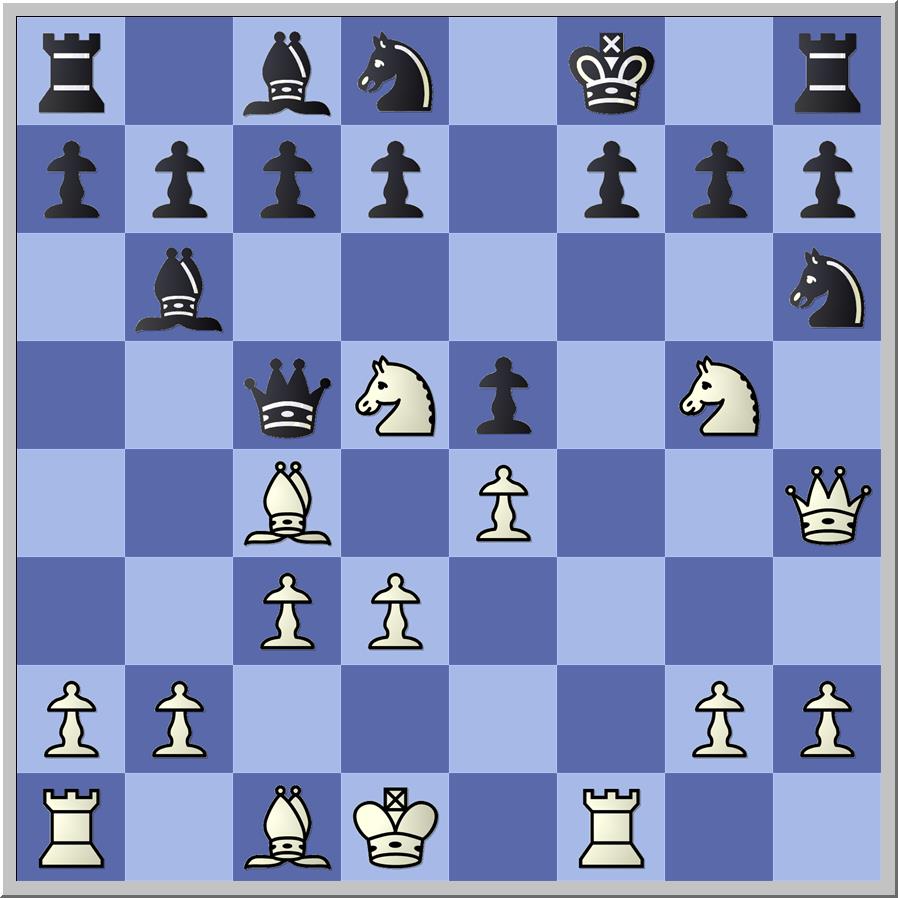
In a rapid game this morning, I was presented with the opportunity to apply the lessons from these games.

White to move
15.Nxd5 Nxd5 16.Bg3?

And I blew it immediately. 16.Nxe6 rips open the center and defends the attacked bishop. Black's best response would have been 16...Nxf4, when White has several winning lines.

16...g5?? 17.Bh5

Again, Nxe6 is best, but this time my move is good enough to secure a decisive advantage.

17...Bg7 18.Nxe6! Qf6

White to move
I did not always find the best move with such a smorgasbord of winning choices, but I punished Black for poor development nonetheless. 


15 March 2022

Progressive Tactics

Some of the worksheets for my after school students the past two weeks have been Progressive Tactics 1 and 2. The idea behind these worksheets is to present simple exercises such as a mate in one, followed by slightly more difficult mate in two, then longer mates or a combination with mate threats that wins material against best defense. What is "progressive" about the sequence is that they are taken from a single game, or a couple of closely related games. Students learn to visualize the combination by solving problems from simple to complex.

I have used this idea in the past and presented such worksheets in my "Lesson of the Week" on Chess Skills in March 2014: "Progressive Tactics" (11 March 2014) and "Progressive Tactics" (20 March 2014).

These are the current sets in use. 

Progressive Tactics 1

White to move

White to move

White to move

White to move

White to move

White to move

There are two source games from these six exercises, but in teaching the solutions to the students, I also reference Von Holtzhausen,W. -- Tarrasch,S. Frankfurt 1912, a game which has received some attention from Edward Winter (see Chess Notes 6382).

Piter,Slawomir (2070) -- Murach,T (1800) [C50]
POL-chT2 U18 Augustow, 1996

1.e4 e5 2.Nf3 d6 3.d4 exd4 4.Bc4 Be7 5.Nxd4 Nf6 6.Nc3 Nc6 7.0-0 0-0 8.Bb3 Re8 9.h3 Nd7 10.Bxf7+ Kxf7 11.Ne6 Kxe6 12.Qd5+ Kf6 1-0

Tal,Mihail -- Straicher [B06]
Riga-ch Semifinal Riga, 08.1950

1.e4 d6 2.d4 Nd7 3.Bc4 g6 4.Nf3 Bg7 5.Bxf7+ Kxf7 6.Ng5+ [6.Ng5+ Kf6 (6...Kf8) 7.Qf3#]  1-0

Progressive Tactics 2

White to move

White to move

White to move

White to move

White to move

White to move

The source game is Greco's best known. Most of the positions are derived from variations, some of which also appear in Greco's manuscripts.

Greco,Gioacchino [C54]
France and England, 1622-1625

1.e4 e5 2.Nf3 Nc6 3.Bc4 Bc5 4.c3 Nf6 5.d4 exd4 6.cxd4 Bb4+ 7.Nc3 Nxe4 8.0-0 Nxc3 9.bxc3 Bxc3 10.Qb3 Bxa1 11.Bxf7+ Kf8 12.Bg5 Ne7 13.Ne5 Bxd4 14.Bg6 d5 15.Qf3+ Bf5 16.Bxf5 Bxe5 [16...g6 17.Bh6+ Ke8] 17.Be6+ Bf6 [17...Ke8] 18.Bxf6 Ke8 [18...gxf6 19.Qxf6+ Ke8] 19.Bxg7 1-0


13 February 2022

Two Old Books (and one new)

Koltanowski, George, and Milton Finkelstein. Checkmate! The Patterns of the Winning Mating Attacks and How to Achieve Them. New York: Doubleday and Co., 1978.
Tal, Mikhail, and Victor Khenkin. Tal’s Winning Chess Combinations: The Secrets of Winning Chess Combinations Described and Explained by the Russian Grandmaster Mikhail Tal, trans. Hanon W. Russell. New York: Simon and Schuster, 1979.


Checkmate! (1978) and Tal’s Winning Chess Combinations (1979) are remarkably similar in approach. Each takes an individual piece and offers game conclusions where that piece delivers the check that is mate. Then, individual chapters concern certain groups of pieces: both texts have chapters on two rooks, rook and bishop, rook and knight, two bishops, two knights, and queen and knight. Tal and Khenkin* continue this scheme with queen and bishop, queen and knight, and three pieces. In contrast, Koltanowski and Finkelstein offer chapters on certain patterns—Boden’s Mate, Epaulettes Mate, Long Diagonal Mates, Greco and Damiano Mates, and a chapter on double check. These pattern-oriented chapters are followed by chapters arranged by the piece that is sacrificed to set-up checkmate. There are additional chapters on pawn promotion, drawing resources, and how masters use checkmate threats.

There is a difference in the expectation of the target audience evident in advice about how to read the books. Koltanowski and Finkelstein repeatedly suggest that a reader should set up the position on a board and play through the moves in order to plant the patterns into memory. Tal and Khenkin, in contrast, suggest that readers study the book without a chess board to improve visualization skills, using a chess board "when you're really stymied" (14).

Legall’s Mate appears in both books. Tal and Khenkin have it in the chapter on three pieces, while Koltanowski and Finkelstein place it under queen sacrifices. These books differ on the game score of Legall — St. Brie, as well as the date. Tal’s Winning Chess Combinations has the game played in 1787 when Legall was 85 years old (351). Checkmate! states that the opening trap was first recorded about 1750, but does not explicitly state the game was played then (197-198). Koltanowski’s penchant for dubious stories makes its appearance here in the claim, “Légal was one of the first players to record his games” (197). If he recorded his games, what happened to them? Today, we cannot even be certain of the moves in the sole surviving example of Legall's play.

Checkmate!

Checkmate! was brought to my attention in response to my assertion in the Facebook group Chess Book Collectors that the best books for teaching checkmate patterns are George Renaud and Victor Kahn, The Art of the Checkmate; and Victor Henkin, 1000 Checkmate Combinations (see below). My claim provoked some interesting discussion. One commenter identified Checkmate! as a book that helped him learn these skills. Bruce Pandolfini also commented that Milton Finkelstein "was a wonderful chess teacher". On the strength of such recommendations, I found a copy and bought it.

The chapters in Checkmate! typically begin with some elementary illustrations and an impressive combination from master play. The authors describe conditions and rules for executing the checkmate in question, often producing numbered lists. For instance, the "four conditions necessary for mate with a rook":
1. The enemy king lacks escape squares.
2. A rook can attack it on a rank or a file.
3. The rook is immune from capture.
4. The rook check cannot be blocked by the interposing of a protected piece or pawn. (41)
The bulk of each chapter consists of exercises with a number of blanks on which a student can write the moves--workbook style. The introduction of each exercise typically offers clues, and in some cases the final position is shown. The book contains a bit over 550 exercises in total. Answers are in the back of the book. Here is an example from the chapter, "Boden's Mate", that is simple when you know the pattern, but has vexed many of my students over the years (151).

White to move

Often there are historical anecdotes about a player whose combination is featured. These anecdotes in Checkmate! are entertaining, but unreliable. We learn, for instance, that Akiba Rubinstein was confined to Berlin during World War I, "went bankrupt and then developed a persecution mania that broke his powers of concentration" (47). A more credible work, Akiba Rubinstein: Uncrowned King (1994) by John Donaldson and Nikolay Minev, places Rubinstein in Warsaw, limited to a playing local opponents in that city and in Lodz. Donaldson and Minev offer crosstables and games from the war period. They also note that Rubinstein married in 1917 and had a son born in 1918, both events taking place in German occupied Warsaw (254). There should be no question that Rubinstein's postwar play was inconsistent, as suggested by Koltanowski and Finkelstein, but they leave the impression that he did not play at all after the war. In fact, he won several strong tournaments in the 1920s. His performance in St. Petersburg in 1914 suggests that inconsistency cannot be wholly pinned on difficulties during the war years.

Historical errors are distracting, but do not destroy the book's pedagogical value for learning checkmate patterns. Nor do the errors in Checkmate! make the book unique. The list of errors that could be produced from thorough fact checking of Renaud and Kahn also would be lengthy (see "Pillsbury's Mate").

One of the simple illustrations of a final check by a rook in Checkmate! is identical in concept to one that I use often with my beginning students, and with which I became acquainted through Bruce Pandolfini, Pandolfini's Endgame Course (1988).

White to move

Classifying and organizing checkmate patterns is not a simple matter. In my own efforts, guided by half a dozen books and a few websites, I separated the dovetail and swallowtail checkmates from epaulette, listing all three as checkmates with the queen. Renaud and Kahn use the term Guéridon for the two bird mates and include this pattern with epaulette. Koltanowski and Kinkelstein lump them together under epaulette mate, but do not limit the pattern to a final check with the queen. This position credited to a Russian player surnamed Usachev illustrates (67-68).

Black to move

1...Bc3 2.Ke2

Black could avoid checkmate at the cost of a rook, the authors note. Stockfish shows that both rooks will disappear if Black plays the superior move 2.Kc1. After 2.Ke2, Black has a mate in two that starts with a queen sacrifice and ends with a knight check. Four White pieces occupy the king's escape squares, serving as ornament rather than protection.

Checkmate! includes a substantial number of checkmate examples. Had I acquired it when it was first published during my teen years and devoted myself to working through the book, I may have become a much stronger player.

Unfortunately, whatever the merits of the book, the authors were ill-served by their publisher. The very first diagram in the text is wrong (2). It appears that the image negative was flipped before printing--there is a dark square in the lower-right corner. Black's 4...K-K4 is an illegal move as there is a pawn on that square. The mismatch between the original position and the final position showing checkmate with a pawn alerts the attentive reader to the problem, so the error can be overcome. The publisher also exercised poor quality control over the printing process. Too much ink was allowed to flow, creating many pages where the dark squares are so dark that the Black pieces on them nearly disappear. Many pages have crystal clear diagrams, but a large percentage are dark and even blurred from inattention by the printer. These problems will be even worse in the Ishi Press reprints, which are notorious for poor print quality. 

Tal's Winning Chess Combinations

My Facebook assertion in favor of the value of Henkin, 1000 Checkmate Combinations was grounded in study of Tal and Khenkin, Tal's Winning Chess Combinations, which I have found quite good. My view also stems from superficial examination of the newer translation in Kindle format. Others have assured me that the newer edition is a better translation of The Last Check (more on that below).

Tal's Winning Chess Combinations is more challenging than Checkmate! This position from Adams -- Torre, New Orleans 1920 (given as 1921 in the text) and the winning idea is richer than most of the combinations in Koltanowski and Finkelstein (19).** 

White to move

White offered his queen for six consecutive moves in the effort to divert Black's queen from the defense of e8. The idea reappears as exercise 8 (37) from Guldin -- Bagdatev (1963), a position I remember from Lev Alburt, Chess Training Pocket Book, 2nd ed. (2000).

The initial example in each chapter of Checkmate! is usually comparable, but the rest of each chapter is less demanding. It did not take me more than ten minutes to blaze through the 13 exercises in the rook chapter, and every example was a forced checkmate. In many of the examples in Tal's Winning Chess Combinations, mate threats can be parried with significant sacrifice, still leading to a lost game.

Tal's Winning Chess Combinations also has a clearer demarcation between the instructive section and the exercises. Each chapter begins with diagrams showing the elementary pattern, and then proceeds through instructive and entertaining examples. Most chapters repeat this sequence with more checkmate patterns and game fragments. The object is showing a range of possibilities with the piece or pieces in question. As in Checkmate!, Tal's Winning Chess Combinations presents game endings where a queen did not deliver the final check in an epaulette mate.

This one is presented as Korchnoy -- Petrosyan 1965 (281).

White to move

White has a forced checkmate in four moves with a queen sacrifice on the second.

The bulk of the book is devoted to instructive examples. An idea is presented, then a few position, then a variations on the idea and more illustrations. The Adams -- Torre position above is the ninth instance of a combination exploiting a weak back rank in the chapter on the rook. This chapter begins with a simple illustration of a back rank checkmate. The instructive portion offers fifteen combinations to divert defenders from protecting the vulnerability. Diversion is combined with a second threat in some combinations. Further examples offer other tactical ideas, such as "line interference" in Reti -- Bogoljubow 1924 (22).

White to move
After 24.Bf7+ Kh8 25.Be8, Black resigned.

Tal's Winning Chess Combinations is notable for how it builds understanding of many possibilities related to a simple pattern. Applying what we know from backrank checkmates, the author notes that kings can be hemmed in by their own pieces on a file as well as rank. Even a file away from the edge of the board can become a deadly corridor. Goldenov -- Zakharian 1960 is a memorable example (34).

Black to move
1...g4 2.Kf4 Ra5 3.e5 Ra4+ 4.e4 Ra3 and White resigned.

Tal and Khenkin's chapter on the rook offers 45 instructive positions and then 17 exercises at the end of the chapter for the reader to solve. This abundance contrasts with a total of 13 exercises following four instructive examples in Koltanowski and Finkelstein. Checkmate!, however, offers 25 chapters to the 14 in the other text. The total of 271 exercises in Tal's Winning Chess Combinations are far fewer than more than 550 found in Checkmate!, but many offer greater challenge. On balance, I prefer Tal's Winning Chess Combinations, but expect to lift some examples from Checkmate! while creating worksheets for my students.

The New Book

Henkin, Victor. 1000 Checkmate Combinations, trans. Jimmy Adams and Sarah Hurst. London: Batsford Chess, [2011] 2022.


1000 Checkmate Combinations is a newer translation of the same Russian book as Tal’s Winning Chess Combinations. As such, the two books have considerable overlap. However, the differences are extensive. Both books have the same fourteen chapters, although the sequence differs. Each chapter offers a series of instructive game fragments and studies and then conclude with exercises at the end of the chapter. Tal’s Winning Chess Combinations has a total of 271 exercises, but the newer translation expands these to 456. 1000 Checkmate Combinations was published just over ten years ago, but has been out of print most of that time, although a Kindle edition was available. It was brought back into print in February 2022.

I cannot assess the quality of the translation. I lack both the resources (a copy of the Russian edition of The Last Check) and the competence (knowledge of Russian). However, I prefer the recent Batsford edition for several reasons. Tal's Winning Chess Combinations blurs the lines between Khenkin's work and Tal's contribution. 1000 Checkmate Combinations explicitly states that the book is Henkin's work. The title page reveals that Victor Henkin owns the text copyright. Batsford also asserts copyright ownership. The publisher owns all rights in the 1979 translation by Hanon Russell; there is no mention of the authors on the copyright page.

Tal’s Winning Chess Combinations begins with an Introduction: “Don’t Reinvent the Wheel”, co-authored by Tal and Khenkin (9-14). 1000 Checkmate Combinations has “Don’t Reinvent the Bicycle” by Tal (5-6) followed by “Before You Open the Book” by Henkin (7-9). The joint introduction in the earlier translation contains most of the content presented in the two introductions in the later text. In addition to clarifying authorship, the most notable differences are that Tal ended his introduction in the Batsford edition with a quote from Richard Réti, Masters of the Chessboard. This quote is absent from Russell’s translation. Russell also inserts Legall’s game into the introduction, while Adams and Hurst do not.

In Tal's introduction to the Batsford edition, we find:
There hasn't been a book like this before in our chess literature. The author has done an enormous amount of work selecting and systematizing the material. An experienced master, who in the recent past himself participated in competitions and had a reputation as a staunch tactician, he has retained a particular taste for the last check. (6)
This text is absent from Tal's Winning Chess Combinations. 1000 Checkmate Combinations is clearly the work of Henkin, lauded by Tal. Henkin's authorship is attested in Vladimir Barsky, A Modern Guide to Checkmating Patterns (2020), which is dedicated to Viktor Khenkin, whose pioneering organization in The Last Check is the model for Barsky's text.

Tal's Winning Chess Combinations presents a decisive mating combination played by Vera Menchik against George Thomas in 1932, and then imitated by David Bronstein against Paul Keres 18 years later (32-33). In both books this combination follows Capablanca -- Raubitschek 1906, to which it is comparable. 1000 Checkmate Combinations adds Tal -- Andersson 1976, where Tal's threats to bring about Menchik's combination provoked a series of exchanges that simplified into an ending with queen against knight and rook (25).

White to move
After the immediate 25.Qh6, the combination falters because Black's resources with 25...Rg8 and 26...Nf8 hold the position together. Tal first set out to remove the knight.

25.Bb6 Rc8 26.Qh6 Rg8 27.Rd4!

Henkin writes, "So Ulf Andersson gives up his queen for rook and bishop, which, however, doesn't save the game" (25).

27...Nxb6 28.Rxd5 Nxd5 29.Rf3

With Tal renewing the mating threat, Anderrson is forced to exchange rooks.

29...Rc3 30.Rxc3 Nxc3 31.Qe3 b4 32.Qa7 Rf8 33.Qc5 Rb8 34.Qd6 1-0

This long combination with checkmate threats parried, but still leading to a decisive advantage is a characteristic of Henkin's work. Both translations of his work bring this out, but the more recent text does so in greater abundance.

Detailed comparison of the first chapter of both books shows that the 45 positions in Tal and Khenkin expands to 62 in 1000 Checkmate Combinations. I count five in the older translation that are missing from the newer edition. My count of 15 in the Batsford edition that are absent from Tal's Winning Chess Combinations reveals there is something askew with my counting (15+5 > 17). But there is no doubt that the newer edition has more material. The 1979 text has three sets of basic patterns followed by examples from games and studies. The Batsford edition has four. Above, I credit Tal's Winning Chess Combinations with showing corridor mates on files as well as ranks. The idea is there, but is is made more explicit in the section found only in the newer book.
Mating situations in which the rook delivers a linear blow can also arise on the files. In these cases it is as if the board does a 90-degree turn. (20).
At the end of the chapter on rooks, the exercises have expanded from 17 to 43 in 1000 Checkmate Combinations.

Although many passages in the two books make it abundantly clear that they are derived from the same Russian text, the language employed differs. The familiar term luft is found in Russell's translation, but becomes "the little window" in the work of Adams and Hurst. Diversion becomes deflection. Line interruption becomes interference.

Some readers will object to the small size of the diagrams in 1000 Checkmate Combinations. They are indeed small at 35 mm. Only a few books have smaller diagrams, such as the training positions in Antonio Gude, Fundamental Checkmates (2016), measuring 34 mm. Other chess books typically have diagrams from 40-50 mm, and the main part of Gude's book comes in at 45 mm. Diagrams in Tal's Winning Chess Combinations are 41 mm. They are 43 mm in Checkmate!

In the Kindle edition of Henkin, the figurines in the notation are a larger font than the text. I have found this ebook difficult to read, but the print text is a delight, even with the small diagrams. At least the diagrams are very clear with appropriate shading of the dark squares and clear pieces.


Notes

*Both Khenkin and Henkin appear as the spelling of this writer's name in different places. I favor the spelling used by the book under discussion. Vladimir Barsky dedicates A Modern Guide to Checkmating Patterns (2020) to Viktor Lvovich Khenkin and offers The Last Check as the English title of the Russian work upon which both Tal's Winning Chess Combinations and 1000 Checkmate Combinations are based. Barsky's book follows the general outline of these two, but with far less instructive material. Rather the instruction is provided as exercises. While Khenkin is the spelling on the cover and title page of Tal's Winning Chess Combinations, games played by the author are presented in the text with the spelling Henkin.

**In all likelihood, this game was analysis, possibly by the alleged victim of the combination as instruction for the alleged victor. See Edward Winter, "Adams v Torre -- A Sham?" Chess Notes (updated 14 December 2021).

12 November 2020

Checkmating Patterns

I recently added to my bookshelf A Modern Guide to Checkmating Patterns (2020) by Vladimir Barsky. This book extends the work of two older books that are scarce and therefore expensive: Victor Henkin, 1000 Checkmate Combinations (2011), and Mikhail Tal and Victor Khenkin, Tal's Winning Chess Combinations (1979). The latter two books were published in Russian sometime before the English editions came out. I have a hunch it was a single book with two English editions. Tal's introduction "Don't Re-invent the Wheel" in the 1979 text appears as "Don't Reinvent the Bicycle" in the 2011 version with some differences. 

I have a hardback copy of Tal's Winning Combinations that I bought in the past decade, but passed up a chance to buy the Batsford edition, 1000 Checkmate Combinations. My recollection of when and where I looked at it does not correspond to the publishing date because I think it was a few years before 2011. I failed to comprehend then the significance of my opportunity. There is a Kindle version of the Batsford edition. The diagrams are a bit pixilated, but clear enough on my iPad.

All of these books arrange checkmate patterns according to which pieces effect the execution of the enemy king. Barsky credits Viktor Khenkin, The Last Check with the "methodology" (7). A Modern Guide to Checkmating Patterns is wholly new. Barsky assembles illustrative positions and exercises exclusively from the twenty-first century. This one caught my eye this morning in the opening chapter.

White to move


The position arose in Lenderman,A. -- Gareyev,T., Mesa 2010. Lenderman played 30.Rd6 and Black resigned. The rook's interferes with the defensive contact between Black's queen and rook, threatening Qxb8#.  White's queen is safe from capture because of Black's weak back rank. Any move of Black's rook dooms the knight. Barsky gives 30...Rc8 31.Ra6 Nc4 32.Qxc4 Rxc4 33.Ra8+ with mate to follow (12-13).

A few years ago, when I was reading Tal's Winning Chess Combinations, I was struck by the quality of the examples. Barsky's examples also seem rich with possibilities. The book serves not only to teach elementary patterns, but also to stimulate the imagination.

Khenkin's original approach to discerning and organizing checkmate patterns is worthy of attention. It varies slightly in the three books that I have before me. Listing the table of contents of each of the three will serve to highlight the continuities while also marking slight differences in the approach.

Tal's Winning Chess Combinations Contents:

1. The Rook
2. The Bishop
3. The Knight
4. The Queen
5. The Pawn
6. Two Rooks
7. Queen and Bishop
8. Queen and Knight
9. Rook and Bishop
10. Rook and Knight
11. Two Bishops
12. Two Knights
13. Bishop and Knight
14. Three Pieces

1000 Checkmate Combinations Contents

1. The Rook
2. The Bishop
3. The Queen
4. The Knight
5. The Pawn
6. Two Rooks
7. Rook and Bishop
8. Rook and Knight
9. Two Bishops
10. Two Knights
11. Bishop and Knight
12. Queen and Bishop
13. Queen and Knight
14. Three Pieces

The first two books offer the same chapters, but the sequence differs. The content is similar, but the Batsford edition contains more exercises. In the new book by Barsky, the number of chapters is reduced by combining pawns and the three chapters featuring minor pieces into a single chapter.

A Modern Guide to Checkmating Patterns Contents

1. The Rook
2. The Queen
3. The Minor Pieces and Pawns
4. Two Rooks
5. Rook and Bishop
6. Rook and Knight
7. Queen and Bishop
8. Queen and Knight
9. Queen and Rook
10. Three Pieces

04 August 2017

Smother Checkmate

As I work my way slowly through Tal's Winning Chess Combinations (1979) by Mikhail Tal and Victor Khenkin, I am combing my databases for additional examples. In this way, I am building a database of exercises for personal training, teaching, and hopefully a revision of my pamphlet "A Checklist of Checkmates" with work of such quality that I can interest a legitimate publisher.

I posted a clever smother checkmate from Tal and Khenkin's book two days ago. Since then, I have played through all of the moves in every game published in Chess Informant that ended with checkmate by a knight. There are only 47 such games, although certainly smother checkmate threats led to resignation in many other cases.

I found one instance of a the textbook classic checkmate in five. There were also a few variations on the theme. Below are four checkmate exercises from games published in Informant.


White to move
From Timman -- Short, Tilburg 1990 Informant 50/120

White to move
From Peters -- Lombardy, Lone Pine 1977 Informant 24/296

Black to move
From Steingrimsson -- Arnason, Island 1990 Informant 50/578

White to move
From Jorczik -- Strunski, Deutschland 2010 Informant 109/227

Leave your answers in the comments below. I usually reply.

02 August 2017

Alekhine -- Lugowski 1931

An unusual smother checkmate piqued my interest. It is presented in Mikhail Tal and Victor Khenkin, Tal's Winning Chess Combinations (1979), where it is credited as Alekhin -- Lugovsky 1931 (58). Due to spelling variances, my initial efforts to turn up the game score fell short. However, the game is in ChessBase database with the spelling Lugowski, and also on Chessgames.com. The game appears in John Donaldson, Nikolay Minev, and Yasser Seirawan, Alekhine in Europe and Asia (1993), spelled Lugovski.

The game was played as part of a simul during Alekhine's tour of Yugoslavia between two blitz tournaments in Ljubljana (12 December 1930) and Zagreb (25 January 1931). Alekhine in Europe and Asia contains 47 games from this tour and a table compiling his score through 555 games in 17 events (70-76).

Alekhine,Alexander -- Lugowski,S [C25]
Belgrade 1931

1.e4 e5 2.Nc3 Nc6 3.Bc4 Bc5 4.Qg4

Already, Black must make an unpleasant choice.

Black to move

4...Qf6

I do not agree with the Chessgames.com user who identifies this move as the losing one.

4...g6 is the most popular try, and was played in Larsen -- Portisch, Santa Monica 1966, which continued 5.Qf3 Nf6 6.Nge2 d6 (here ECO recommends 6...Bf8) 7.d3 Bg4 8.Qg3 h6 9.f4 Qe7 10.Nd5 Nxd5 11.Qxg4 Nf6 12.Qh3 Larsen went on to win in 53 moves.

4...Kf8 has been tried fairly often. Of note is a game won by Viswanathan Anand when he was a teenager 5.Qg3 d6 6.Nge2 Nd4 (6...h5 might be better) 7.Nxd4 exd4 8.Na4 Be6 9.Bxe6 fxe6 10.Nxc5 dxc5 11.Qb3 Qc8 12.Qf3+ Ke7 13.Qg3 Kf7 14.Qf4+ Kg6 15.Qg4+ Kf6 16.d3 Anand,V (2405) --Ravisekhar,R (2390), New Delhi 1986 (57 moves).

4...Nd4 5.Qxg7 Qf6 6.Qxf6 Nxf6 7.Bd3 has occurred in a few games.

4...Bf8 led to a miniature worthy of analysis. 5.Qg3 d6 6.Nge2 Nf6 7.f4 exf4 8.Nxf4 Nd4 9.Qd3 Nc6 10.Qg3 Nd4 11.0–0 g6 12.Qf2 Nxc2 13.d4 Nxa1 14.Nfd5 Bg7 15.Bg5 0–0 16.Nxf6+ Bxf6 17.Bxf6 Qd7 18.Qf4 1–0 Genzling,A (2408) -- Migot,T (2257), Belfort 2012.

5.Nd5 Qxf2+

There is no better option. Here also, the comments on Chessgames.com are less than helpful.

5...Qg6 is no good. 6.Qxg6 hxg6 7.Nxc7+ Kd8 8.Nxa8+-.
5...Bxf2+ is just as bad 6.Kf1 Qg6 7.Qxg6 hxg6 8.Nxc7+ Kd8 9.Nxa8 Bxg1+-.

6.Kd1 Kf8

6...Bf8 was played in Lengyl -- Ruck in the 1995 championship of Hungary and Black won. Lengyl played 7.Nh3, but a better line seems 7.Nxc7+ Kd8 8.Nxa8 d5 9.Qe2 Qxe2+ 10.Bxe2 when White has the upper hand.

7.Nh3 Qd4?

7...h5! 8.Qg5 Qd4 9.d3 and White's threats are not yet decisive.

8.d3

Black to move

8...Bb6?

Black defends c7, but the knight on d5 also targets e7.

8...d6 was played by none other than Mikhail Chigorin, who also lost quickly. 9.Qh4 Bxh3 10.Qxh3 Na5 11.Rf1 Nxc4 12.Qd7 f6 13.Nxf6 Qf2 14.Rxf2 Bxf2 15.Nh5 1–0 Mieses,J (2467) -- Chigorin,M (2546), Ostend 1906.

8...h5 still seems worthwhile. 9.Qf3 d6

8...Nf6 9.Nxf6 d5 10.c3 Bxg4+ 11.Nxg4 dxc4 12.cxd4 is better than was played against Alekhine.

9.Rf1 Nd8

A sad looking move, but Black is already lost.

10.c3 Qc5 11.Ng5

White has five pieces attacking Black's king.

11...Nh6

A defensive fork

11...f6 seems reasonable, but also loses.

12.Qh4

Threatening a discovered attack against the knight with a fork of king and queen.

Black to move

12...d6 1–0

12...Ke8 would have held out longer.

According to Donaldson, et al., Alekhine announced a checkmate in four (74). This checkmate is what caught my interest in Tal and Khenkin's book.

Do you see it?

12 June 2017

One by Leonid Kubbel

In Tal's Winning Chess Combinations (1979) by Mikhail Tal and Victor Khenkin, each section concludes with several exercises. There are six at the end of chapter II, "The Bishop". Five gave me minimal difficulties. That is, I solved most quickly and all accurately. The sixth, however, vexed me. I looked at it several times over the course of two evenings. Finally, having given up, I entered it as a position in Stockfish on the iPad and played the side that was supposed to lose--Black. The game was drawn by repetition because I could not find a way to convert my material advantage.

The failure of Stockfish lessens my pain.* The exercise was composed by Leonid Kubbel (1891-1942).

White to move

The authors of Tal's Winning Chess Combinations offer, "it all happens in six moves" (53).


*Stockfish on my desktop computer solved the exercise in about five seconds.

11 June 2017

Rook versus Bishop

When I think that I understand something, I expect to be able to execute the maneuver in mere seconds. Sometimes, my understanding of the patterns is not strong enough. It is well-known that rook versus bishop is usually a draw, but that a few positions favor the rook. One such position is an exercise in my Essential Tactics: Building a Foundation for Chess Skill (2017).

White to move

The tactic is simple. 1.Kf6, forcing the bishop to move. But then, the finish takes me more time than I think it ought. I want to execute the moves to checkmate in ten seconds or less, but find that the calculation can require a minute or more. Each White move must contain a concrete threat of a) checkmate, b) capture of the bishop, or c) the final threat that pins the bishop on the back rank, creating zugzwang. One slip and a drawn bishop versus rook ending is reached.

In rare instances, usually with more pieces on the board, the bishop dominates the rook. This composed problem came to my notice via Mikhail Tal, and Victor Khenkin, Tal's Winning Chess Combinations (1979).

White to move

White need only check the king from a square where the bishop cannot be captured. Alas, both the immediate 1.Bh3 and 1.Bg4 fail. A zwischenzug is necessary to divert the rook from control of these squares.

23 May 2017

Seeing Patterns

Tal's Winning Chess Combinations (1979) has influenced my perception. Last week, I read the first chapter of this book by Mikhail Tal and Victor Khenkin, which exists under several titles with and without Tal's authorship. This chapter concerns the rook and corridor checkmates and checkmate threats. These corridor vulnerabilities are most often back-rank weaknesses, but there are other corridors, including a position where a rook must be given up to avoid checkmate between two walls of pawns alongside the f-file.

The large number of deflection combinations to threaten checkmate has made me more alert to these possibilities when going through other games. Of course, these ideas are not new to me. I was familiar with the idea even before Lev Alburt's Chess Training Pocket Book (1997), which I read fifteen years ago, stimulated my imagination for the maneuvers with this exercise.

White to move

Alburt gives the exercise the title, "Defection Detection". It is number 93 in the book.

This morning, I was reading Baskaran Adhiban's annotations to his draw against Wesley So at the Tata Steel Chess Tournament in January when the deflection motif jumped into my perception. After 25.Bxa7, So could have played 25...Rxa7. He did not, playing 25...Bxc3 instead.

What if he had grabbed the bishop?

White to move

Immediately, I saw 26.Qd5+ Kh8 27.Qxe5. However, nothing compels the suicidal 27...Rxe5. So would have had choices: 27...Raa8, 27...Qb6+, and others. In Adhiban's case, his offer of a bishop wins So's bishop, but no more. The game, as he points out, was, "[a]n exciting draw with lots of interesting twists!" (Chess Informant 131, 49).

25 February 2016

Outpost: Threat and Execution

In the 1990s, I read Peter Romanovsky's subchapter, "The Eternal Knight", in Chess Middlegame Planning (1990) and found it a useful beginning towards the understanding of outposts. Michael Stean's discussion in Simple Chess (1978) takes my understanding a step further. At the end of his first illustrative game, Stean notes:
Particularly noteworthy was the terrible restraining influence exerted on Black by the continual threat of Nd5. Having completed his development very harmoniously. Black found it difficult to undertake any active plan without allowing the inevitable Nd5. Indeed, he only had to decentralise one piece (20...Na5) and the White knight jumped down his throat.
Stean, Simple Chess, 18.
This game, Tal -- Bronstein, USSR Championship 1959, was my lesson of the week for my advanced students. We started with this postion.

White to move

With a definition of outposts written on the white board, I asked students to identify the outposts in this position.

An outpost is a square that might be occupied by one's own piece, ideally supported by one's pawn, and that cannot be attacked by an enemy pawn. With some guidance, the students were able to see that d5 was an outpost for White's pieces, and that d3 was a potential outpost for Black.

We then went through the bulk of the game and Stean's comments.

The diagram above is prior to 14.Nf1. The knight finally occupies the critical outpost of d5 on move 22.

White to move

Stean comments:
The moment we've all been waiting for, not to mention the white queen, rook, and bishop who have been patiently queuing up behind the e-pawn for some time. White's decision to play his trump card now is prompted by the fact that Black's knight has been drawn out of play to a5. This may not seem to be very significant, but with the rapid opening up of the position which must surely follow, the abscence of even a single piece from the central field of battle will cause great difficulties for Black. Stean, Simple Chess, 16.
The game as whole is interesting and serves as a good example of employing the threat of an outpost as a strategic and tactical weapon. Restraining the opponent's choices via the threat to occupy an outpost is a notion less evident in Romanovsky's treatment of this topic.


Beginning Students

My beginning students this week solved the problems in Beginning Tactics 9 (see "Lesson of the Week" [13 December 2012]). When they stumbled on the seventh problem, I showed them the game Mayet -- Anderssen 1851 (see "Sacrificial Attack").

09 January 2016

Using Pins

ChessBase indices offer instructive access to the high quality games published in Chess Informant. Using the endgame index in my database of all Informants, I found this instructive position where Mikhail Tal simplified into an elementary pawn ending. The game was published as Informant 2/539 (1966) and was annotated by Aleksandar Matanović, founding editor of the publication.

White to move

Tal played 48.b5! threatening bxc6 and the pinned bishop. Perhaps b5-b6 was also a threat if Black tried 48...Kd8.

Petar Trifunovic played 48...Rxc5.

49.Bxh3 piling on the pinned bishop.

49...f5 50.bxc6 Rxc6 51.Bxf5 Rd6

White to move

Black's pieces are immobile.

52.Kg3 Ke8

Finally, Black steps out of the pin.

53.Rxd7 Rxd7 54.Bxd7+ Kxd7 55.Kg4

I wanted to say that White had only one winning move here, but 55.Kh4 works just as well.

55...Ke6 56.Kg5 Kf7 57.Kf5 1-0

In the final position, Black is in zugzwang--a common motif in pawn endings. See "Six Pawn Endings".

20 December 2014

An Unplayed Brilliancy

This was a betrayal of myself.
Mikhail Tal
There is a line of the Alekhine Defense in which the Black king strolls towards the center after White's knight sacrifice. The line resembles the Fried Liver Attack, but is more often played by Grandmasters.

In one game, Bent Larsen defended the Black side well and won a nice miniature against Mikahil Tal. In another game, Tal worked out the variations all the way to checkmate before sacrificing the knight. The Black king was driven to a1 where it was checkmated with White's few remaining pieces.

These games are fantasy variations that stem from a war of nerves in which Larsen scored an important victory against the master of attack, but still lost the Candidate's Match against the former World Champion. Tal spent fifty minutes contemplating the knight sacrifice, trusted his opponent's preparation, and opted for a safer route. He ended up in a worse position, but managed to salvage a draw in the endgame.

My interest in this line was provoked by Yasser Seirawan's excellent recent lecture at the Chess Club of Saint Louis, "A History of Chess Openings". Near the end of the lecture, Seirawan indicates that he may have mixed up the moves of Tal -- Larsen, but goes on to make some astute comments concerning opening preparation. He had spent several days been looking at "the conservative and the super sharp lines" of this opening. Tal's trapped queen and another quieter game he showed first illustrate the possible varieties. Seirawan predicts that the Alekhine Defense, like the early queen exchange in the Berlin Defense, could become a new hot trend in Grandmaster play.

Here is the game that Seirawan remembered.

Tal,Mikhail -- Larsen,Bent [B04]
Candidates Semi-Final Bled (4), 1965

1.e4 Nf6 2.e5 Nd5 3.d4 d6 4.Nf3 dxe5 5.Nxe5 Nd7

Larsen offered Tal an opportunity to drive his king to the center with a knight sacrifice.

6.Nxf7 Kxf7 7.Qh5+ Ke6 8.c4 N5f6 9.d5+ Kd6 10.Qf7 Ne5 11.Bf4 c5

White to move

12.Nc3

12.b4 is the main line in my edition of Encyclopedia of Chess Openings.

12...a6 13.0–0–0

See the next game for 13.Rd1

13...g5 14.Bg3 Bh6 15.Re1

Seirawan does not offer 15.d6, which has been played in similar positions (after 13...g6 and no 14.Bg3).

15...g4+ 16.Kb1 Bf5+ 17.Ka1 Rf8 18.Bxe5+ Kd7

White to move

Unable to rescue his queen, it is time for White to resign.

0–1

In Attack with Mikhail Tal, trans. Ken Neat (1994), Tal explains his thinking after Larsen's shocking 5...Nd7.
My intuition insistently kept telling me that the sacrifice had to be correct, but I decided to calculate everything "as far as mate", spent some 50 minutes, but then in one of the innumerable variations I found something resembling a defense, and ... rejected the sacrifice. This was a betrayal of myself, I saved the game only by a miracle after the adjournment.

Here is the variation that Tal presents in the opening section of his book.

Tal,Mikhail -- Larsen,Bent [B04]
Candidates Semi-Final Bled (4), 1965

1.e4 Nf6 2.e5 Nd5 3.d4 d6 4.Nf3 dxe5 5.Nxe5 Nd7 6.Nxf7 Kxf7 7.Qh5+ Ke6 8.c4 N5f6 9.d5+ Kd6 10.Qf7 Ne5 11.Bf4 c5 12.Nc3 a6 13.Rd1 g6 14.Bxe5+ Kxe5 15.d6 g5 16.Rd2 Bf5 17.Re2+

Black to move

17...Kd4 18.Re4+ Bxe4 19.Qe6

Black to move

Perhaps the defense that he found in his calculations was 19...Qd7, covering h3 or 19...Qb6, covering b3.

White's threat, according to Tal is 20.Ne2+ Kd3 21.Qh3+ Kc2 22.Qb3+ Kb1 23.Nc3+ Ka1 24.Bd3 Bxd3 25.Kd2+ Bb1 26.Rxb1# 0–1

Here is the game that was actually played.

Tal,Mikhail -- Larsen,Bent [B04]
Candidates Semi-Final Bled (4), 1965

1.e4 Nf6 2.e5 Nd5 3.d4 d6 4.Nf3 dxe5 5.Nxe5 Nd7 6.Bc4

Black to move

6...e6 7.Qg4 h5 8.Qe2 Nxe5 9.dxe5 Bd7 10.0–0 Bc6 11.Rd1 Qe7 12.Nc3 Nxc3 13.bxc3 g6 14.a4 a6 15.Rb1 Qc5 16.Be3 Qxe5 17.f4 Qf5 18.Bd3 Qg4 19.Qf2 Be7 20.Bd4 0–0 21.Be2 Qf5 22.Bd3 Qg4 23.Be2 Qh4 24.g3 Qh3 25.Bf3 Rad8 26.Bxc6 bxc6 27.Be5 Qf5 28.Qe2 Bd6 29.Rd3 Bxe5 30.fxe5 Rxd3 31.cxd3 Rd8 32.Rd1 c5 33.c4 Qg4
White to move

34.Qxg4 hxg4 35.Kf2 Rb8 36.Rd2 Kg7 37.Ke3 g5 38.d4 Rb3+ 39.Kf2 cxd4 40.Rxd4 Kg6 41.Rxg4 Rb2+ 42.Kg1 Kf5 43.Rd4 Kxe5 44.Rd7 f5

White to move

Black must be better here with an active king and a pawn majority on the kingside.

45.Rxc7 Ke4 46.Rd7 Rc2 47.Rd6 e5 48.h4 gxh4 49.gxh4 Rxc4 50.h5 Kf3 51.Rd3+ Kg4 52.h6 Rc7 53.Rd6 e4 54.Kf2 a5 55.Rg6+ Kh5 56.Ra6 f4 57.Re6 Rc2+ 58.Ke1 Rc1+ 59.Kd2 Rh1 60.Rxe4 Kg4 61.Re6 Kg3 62.Rf6 f3 63.Ke3 Re1+ 64.Kd3 Re7 65.Rg6+ Kf4 66.Rf6+ Kg3 67.Rg6+ Kf4 68.Rf6+ Kg4 69.Kd4 Kg3 70.Rg6+ Kh3 71.Rg7

Black to move

71...Rxg7 72.hxg7 f2 73.g8Q f1Q 74.Qe6+ Kh4 75.Kc5 Qb1 76.Qc4+ Kg3 77.Qc3+ Kf2 ½–½

All three games are instructive. This is as true of the game played as of the two unplayed fantasies.