Showing posts with label Von der Lasa (Tassilo). Show all posts

20 June 2020

Monumental Scholarship

Notes Towards a Book Review

Peter J. Monté, The Classical Era of Modern Chess (McFarland 2014) is a work of monumental scholarship. It does not replace H. J. R. Murray, A History of Chess (Oxford 1913) because it is of more limited chronological scope. Rather, it summarizes in a few pages (1-24) a good portion of Murray's text and what scholarship has contributed in the century since Murray. Monté then expands Murray's 26 page chapter XII "From Lopez to Greco" to a full length work of over 400 pages. The second and third parts of The Classical Era of Modern Chess add more than one hundred pages of detailed documentation of the sources of games and problems from this era.

My first impression of the book was that it is impressive scholarship which will serve as a frequently consulted reference work sitting beside Murray; Hooper and Whyld, The Oxford Companion to Chess, 2nd ed.; and a few other texts on a shelf next to the desk in my office. Also, I might read it. Although documented at least as well as Murray (probably better), and often concerned with the minutia of manuscript details, it remains quite readable.

When the book arrived two days ago, I immediately opened it to the chapter on Greco and skimmed that 36 page chapter. It begins with a discussion of his life, including how much we think is known relies upon a short passage by Alessandro Salvio of dubious credibility. Monté presents the whole of Salvio's passage in Italian, followed by a clear English translation. A couple of weeks ago, I had been trying to make sense of this same passage using Google Translate.

Following three and one-half double-column pages on Greco's life, Monté turns to his manuscripts. These include not only those listed by Antonius van der Linde (1874), J. A. Leon (1900), Murray (1913), and J. G. White (1919); but the list is expanded through more recent work by Monté, assisted in great measure by Alessandro Sanvito, who published a list in Italian (2005). Monté includes a manuscript that is no longer known to exist, but that may have been a source for Francis Beale. Beyer's MS, as he names it, was described briefly by August Beyer in Memoriae historico-criticae librorum rariorum (1734); Beyer gave it a date of 1632. Scholars have long assumed that Beyer transposed two numbers and that the missing MS should be dated 1623. A critical point emphasized in The Classical Era of Modern Chess, however, is that Beyer mentions that the MS was presented to King Charles I, who ascended to the throne in 1625. Monté finds it quite plausible that Greco was back in London in 1632. If so, William Lewis's assertion (1819) that Greco died at an advanced age, and which has long been dismissed on the authority of Salvio's brief passage, might be correct. Monté does not overstate his case, rather suggesting ways that future scholarship might confirm (or deny) Salvio's assertion.

Following detailed discussion of Greco's MSS, which remain the best sources for information about his life, the book turns to a discussion of Greco's sources, greatly expanding Murray's claim that Greco learned chess from the works of Lopez and Salvio (the 1604 text, which is much more credible), and also extending Tassilo von der Lasa's remark that Greco also learned from Polerio.

Monté then turns to publications of Greco's work, which begins with Beale's The Royall Game of Chesse-Play (1656). The chapter concludes with discussion of Greco's lists of rules, his openings, and his problems and endings. I posted one of Greco's endgame compositions a week ago (see "A Greco Composition").

Other chapters follow a similar pattern, There are chapters on Lucena, Damiano, Ruy Lopez, Annibale Romei (see below), Polerio, Gianutio, Salvio, and Carrera, as well as chapters devoted to particular manuscripts. The end of Part I includes three chapters: "The Pawn's Leap", and "From the King's Leap to Castling", and "Epilogue". The Epilogue offers a nice summary of how Monté views the contributions of his this book.

Useful

After less than an hour with The Classical Era of Modern Chess in my possession, I put it to work. About a week ago, I discovered an apparent error in the Wikipedia article on Greco. The information was from a web source of dubious credibility. I removed the "error" and challenged the source. Discussion ensued. A better source was found (Murray), but I pointed out that Murray's phrasing was less than clear. The "error" was put back into the article, but in a better framework (paraphrasing Murray). It all hinged on whether Cusentino, which appears in the title of the Corsini MS, possibly Greco's first, is a surname in the modern sense of the word, as some read Murray.
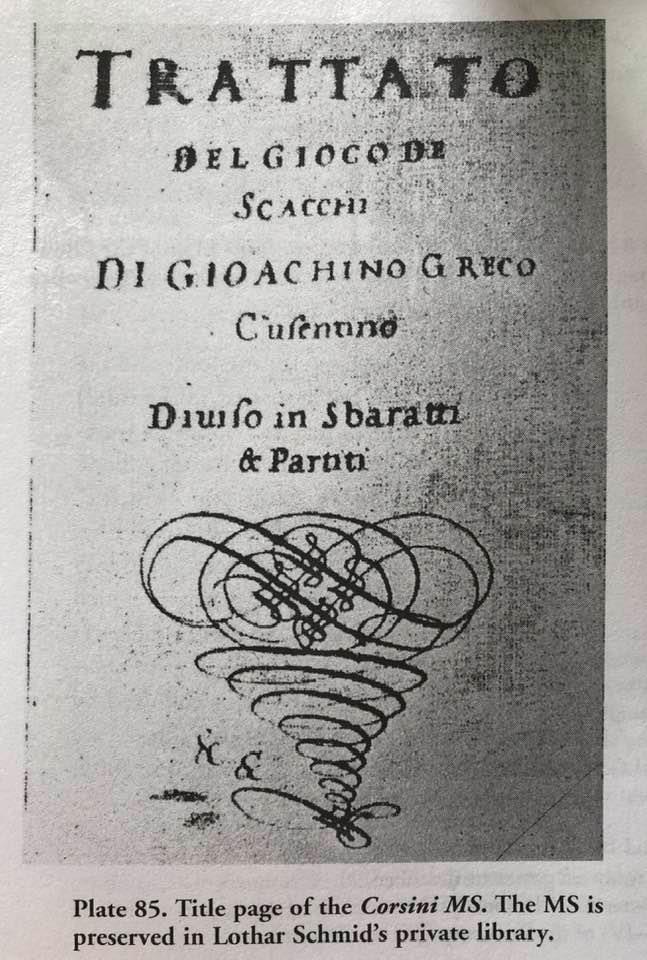
Title page of Greco's first MS
 from Monté (2014), 324
Monté references work published in Italian by Alessandro Sanvito, noting, "[t]he adjective 'Cusentino' in the title refers to the Calabrian province Cosenza, and Celico (mentioned in the Libretto) belongs to it" (324). Hence it is a surname in the same sense that we might call Adelard of Bath, Mr. Bath (something I've never seen done). Bath was his hometown.

Further Wikipedia edits followed with information from the monumental text.

This morning I started another project--something I've poked at without substantially helpful resources for seven years--that is now made easy, albeit time consuming, with Part II. Openings and Games of the Classical Era of Modern Chess (439-530). This section documents the earliest known, as well as subsequent occurrences, of every move that can be found in manuscripts from this era. For instance, 1.e4 e5 was recorded by Damiano, who lauded the moves as "best" (439).

From this section, I now know that a well-known opening trap credited to Greco (and the notorious loser Nomen Nescio) in ChessBase Mega 2020 and nearly every other database on chess players' computers, as well as websites like Chessgames.com, was something that Greco copied into his manuscripts from the work of others.

Greco,Gioacchino -- NN [C54]
Greco Europe, 1620

1.e4 e5 2.Nf3 Nc6 3.Bc4 Bc5 4.c3 Nf6 5.d4 Bb6 6.dxe5 Nxe4 7.Qd5

This game appears Levy and O'Connell, Oxford Encyclopedia of Chess Games, vol. 1 1485-1866 (1981) as G-5. Greco likely copied it from Polerio. It’s earliest known appearance is in a manuscript by Annibale Romei (c. 1565-1568). This MS was discovered in 1939 by the scholar Adriano Chicco. Romei offers the line 7.Bxf7+ Kxf7 8.Qd5+ with the suggestion that 7.Qd5 is an improvement (460).

Likewise, the assertion found in many places that in London, Greco began extending what had been collections of openings or opening traps to the conclusions or near conclusions of games, can be understood in greater specificity.

Greco,Gioacchino - NN [C41]
Greco Europe, 1620

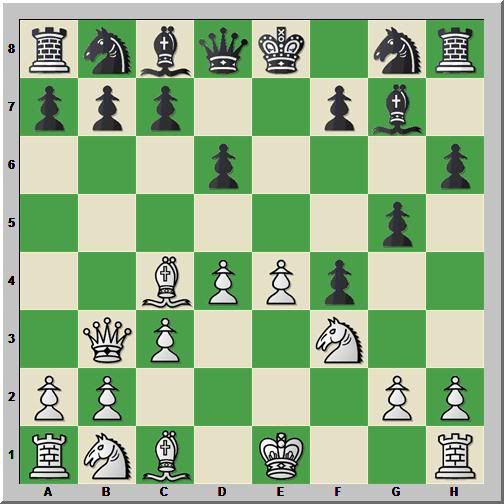
1.e4 e5 2.Nf3 d6 3.Bc4 Bg4 4.h3 Bxf3 5.Qxf3 Nf6 6.Qb3

The opening to this point is recorded in several manuscripts by Polerio. The rest is Greco's contribution.

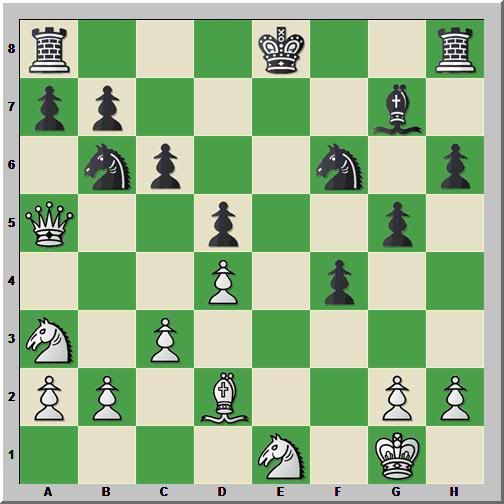
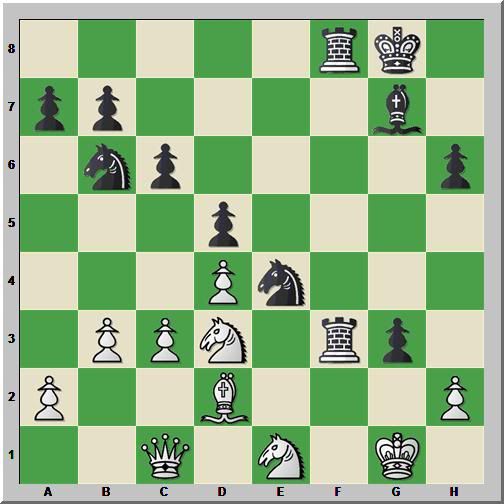
Black to move

6...Nxe4 7.Bxf7+ Kd7 8.Qxb7 Ng5 9.Bd5 Na6 10.Qc6+ Ke7 11.Qxa8 1-0

This game appears Levy and O'Connell, Oxford Encyclopedia of Chess Games, vol. 1 1485-1866 (1981) as G-17. The earliest known record of the moves from 6...Nxe4 is in the Mountstephen MS, which Monté dates to 1623 (447).


21 March 2017

A Greco Miniature

Lesson of the Week

Most of the games of Gioachino Greco (1600-1634) are miniatures (games lasting few moves, 20-25 moves being the longest that might be so labeled). What can a young chess player learn from such games? Are they of any value to players who are no longer beginners?

Greco has been called the first chess master. In his day, players did not record their games while playing. However, Greco undoubtedly could remember his games after they finished. The games that he recorded in his notebooks, and periodically listed in small books that he game as gifts to his patrons may resemble games that he played. They certainly offered instruction in basic tactics to those players who sought instruction from him.

Greco,Gioachino -- Greco's Pupil [C36]
Model Game, 1620

1.e4 e5 2.f4 d5

This game is the oldest one in the ChessBase database with this move. Of course, there are very few games before Greco's, so that is no surprise. Nonetheless, there are two games in said database with White's second move, showing that the King's Gambit is indeed a very old opening. The next two with 2...d5 were played in 1837 by Baron Heydebrand Tassilo von der Lasa, once as White and once as Black. Those two games deviate from this one on White's fifth move.

3.exd5 Qxd5

The first important lesson that a novice chess player might gain from study of this Greco game is the danger of bringing the queen out too early. White gains time kicking the queen around. In ChessBase's PowerBook, which cuts out old games and games between weak players, there is only one instance of 3...Qxd5. White won in 17 moves. See comments at move 5.

3...e4 is better.

Angelo Lewis (Professor Hoffman) classes this Greco game as King's Gambit declined, offering 3...e4 as an improvement, which he calls the Falkbeer Counter-Gambit.* The Oxford Companion to Chess gives 2...d5 as the Falkbeer, and 3...e4 4. Bb5+ as the Nimzowitsch variation. There are other named variations proceeding after 3...e4. Falkbeer's loss to Anderssen in 1851 is the oldest in the database with this move. Howard Staunton also played the move in 1851, winning with Black.

3...exf4 is more popular among masters today.

White to move

4.Nc3 Qe6

Black threatens a discovered check that wins a pawn.

5.Nf3

Greco is willing to sacrifice the pawn for rapid mobilization. Who said that Paul Morphy was the first chess player to understand this idea? See "Principle of Development: Early History".

5.fxe5 was played both by and against the Baron 5...Qxe5+ 6.Be2 Bd6 and the Baron won with Black in 52 moves.

6...Bg4 and the Baron won with White in eighteen moves. The only game in PowerBook with 3...Qxd5 continued from this point 7.d4 Qe6 8.Qd3 c6 9.Bf4 Nf6 10.0–0–0 Bxe2 11.Ngxe2 Bd6 12.d5 Nxd5 13.Nxd5 cxd5 14.Qg3 Bxf4+ 15.Nxf4 Qh6 16.Rhe1+ Kf8 17.Qa3+ 1–0 Tolush,A (2496) -- Alatortsev,V (2482), Moscow 1948. The game was played in the Soviet Championship.

5...exf4+ 6.Kf2

6.Be2 would allow White to castle, but Greco has another idea in mind.

Black to move

Whose king is more vulnerable?

6...Bc5+

The temptation to check the opponent whenever possible is the cause of a great many positional errors that are routine in the games of beginning players. Perhaps this tendency could serve as the definition of a beginner: no matter how long you have played chess, if you play a move that checks the opponent without also having a second purpose, then you are a beginner.

6...Nf6 threatens Ng4+
6...Be7 might be best.

7.d4

White blocks the check, attacks Black's pawn on f4, and drives the bishop back.

7...Bd6

Black moves the bishop to safety and defends the attacked pawn.

8.Bb5+

This check has a second purpose: now the rook can move to e1, pinning the queen.

8...Kd8

Moving the king to get out of check is not required. Often, as in this instance, it is possible to block the check. Sometimes the checking piece can be captured.

8...Kf8 is presented as the move in this game in the ChessBase database. Francis Beale's collection of Greco games offers both Kd8 and Kf8 with the same concluding moves. Angelo Lewis (Hoffman's real name) also offers both.

8...c6 is better, but already Black's position is horrid.  9.Re1 Qxe1+ (9...Be5 10.Rxe5) 10.Qxe1+ Ne7 11.Bd3.

White to move

9.Re1 Qf5

9...Qxe1+ fights on longer. 10.Qxe1 c6 11.Bd3 and White has an overwhelming material advantage.

10.Re8# 1–0

This is the same checkmate pattern that we saw in Morphy's Opera Game.


*The standard print edition of Greco's games remains Professor Hoffman [Angelo Lewis], The Games of Greco (London 1900). This book is the source for the games in David Levy, and Kevin O'Connell, Oxford Encyclopedia of Chess Games, vol. 1 1485-1866 (Oxford 1981). Hoffman's main lines, but not his variations, are the games of Greco that can be found in databases and online. An older text offers many games and variations not found in Hoffman: Francis Beale, The Royall Game of Chesse-Play (London 1656).

13 October 2016

Fried Liver Attack

In the second week of after school chess club, my beginning group doubled in size and includes several who have never played chess. While emphasizing how the pieces move and other first things, I showed the group Gibaud -- Lazard 1924, then offered assistance as the students paired off and played.

The advanced group saw this game, but not with all of the annotations presented here.

Von der Lasa,Tassilo -- Mayet,Carl [C57]
Berlin Berlin, 1839

1.e4 e5 2.Nf3 Nc6 3.Bc4 Nf6 4.Ng5

White's aggressive move immediately presents Black with some problems.

4.d3 is the main line and scores best.

4...d5

4...Bc5 is the other principal way of meeting White's threats. 5.Nxf7 Bxf2+ 6.Kf1 and White should be better 6...Qe7 7.Nxh8; 4...b5 5.Bxf7+ Ke7 6.Bb3.

4...h6 5.Nxf7 Qe7 6.Nxh8 was played in De Wit -- Soylu 1999.

5.exd5 Nxd5

Accepting the Fried Liver gives White strong practical chances. Black is okay, and probably better, but it is much easier for Black to err. Moreover, errors are often fatal.

5...Na5 is a recommended alternative, as we saw last week.

White to move

6.Nxf7

6.d4 is an alternative, leading to:

a) 6...Bb4+ 7.c3 Be7 8.h4 Bxg5 9.Bxg5 Qd7 10.dxe5 Nb6 and was drawn in 47 moves Stoltz,G (2487) -- Karaklajic,N (2436), Belgrade 1952.

b) 6...exd4 7.0–0 Be6

7...Be7 was played against Paul Morphy when he was playing blindfold 8.Nxf7 Kxf7 9.Qf3+ Ke6 10.Nc3 dxc3 11.Re1+ Ne5 12.Bf4 Bd6 13.Bxe5 Bxe5 14.Rxe5+ Kxe5 15.Re1+ Kd4 16.Bxd5 Rf8 17.Qd3+ Kc5 18.b4+ Kxb4 19.Qd4+ 1–0 Morphy,P -- Amateur,New Orleans 1858.

8.Re1 Qd7 9.Nxf7 Kxf7 10.Qf3+ Kg8 11.Rxe6 is the line recommended by Tartakower and Du Mont, 500 Master Games of Chess (1952). Last week's game also came from this book.

6...Kxf7 7.Qf3+ Ke6

Beginners sometimes play 7...Ke8 8.Bxd5 Qf6 9.Bxc6+ bxc6 10.Qxf6 gxf6 11.d3 and White has a clear advantage with both material and positional superiority.

8.Nc3

Black to move

8...Nce7

8...Ncb4 is Black's principal alternative, and one that I prefer as Black.

White's main responses are:

a) 9.Qe4 c6 10.a3 Na6

Alternately, Black can return the material in hopes of finding a secure home for the king 10...Nxc2+ 11.Qxc2 Kf7.

11.d4 Nac7 12.Bf4 Kf7 13.Bxe5 Be7 14.0–0–0 with a clear lead in development for White.

b) 9.Bb3 c6 10.a3 Na6 and Black is surviving for now.

c) 9. a3 Nxc2+ 10.Kd1 Nxa1 11.Nxd5 Kd6 12.d4 Be6

In a correspondence game ten years ago, I played 12...b5 13.Ne7!? and I spent several hours finding Bg4.

The knight is untouchable:


13...Bxe7 14.Qd5#
13...Kxe7 14.Qf7+ Kd6 15.Qd5+ Ke7 16.Qxe5+ Be6 17.Qxe6#
13...Qxe7 14.Qd5#

13.Re1 b5 14.Nb4 bxc4 15.Qc6+ Ke7 16.Bg5+ Kf7 17.Bxd8 Rxd8 18.Qxc7+ Rd7 19.Qxe5 Rd6 20.d5 Bd7 21.Qf4+ Kg8 22.Qxc4 a5 23.Nd3 a4 24.Nc5 h5 25.Nxd7 Rxd7 26.d6+ Kh7 27.Re6 g6 28.Rxg6 1–0 Shirov,A (2709) -- Sulskis,S (2544), Tromso 2014.

9.d4 b5 10.Nxb5 

Black to move

10...c6

Students were asked to find White's refutations of 10...Ng6.

11.Bxd5+ Qxd5 12.Nxc7+

11.Nc3 Qb6

11...Bb7 is met by 12.Ne4.

12.dxe5 Bb7 13.Ne4 Qb4+?

13...Kd7 may be Black's best chance.

14.Bd2 Qxc4

White to move

This position offers a good example of materialism vs. piece activity and coordination. White has sacrificed two minor pieces, netting three pawns, but has a decisive attack.

15.Qg4+! Kxe5 

15...Kf7 16.Nd6+ Kg8 17.Qe6#
15...Nf5 16.Ng5+ Kd7 17.Qxc4+-.

16.f4+ Kd4 

16...Kxe4 17.Qe6+ Kd4 18.Be3+ Nxe3 19.Qe5#.

17.c3+ 

17.0–0–0 wins as quickly.

17...Nxc3 18.Bxc3+

Black to move

18...Kxe4

18...Qxc3+ 19.bxc3+ Kc4 20.Qe2+ Kd5 21.0–0–0+ Ke6 22.Ng5+ Kf5 23.Qe6+ Kxf4 24.Nh3#.

19.f5+

Von der Lasa missed a quicker checkmate:19.0–0–0 Qd3 20.f5+ Kd5 21.Rxd3+ Kc5 22.Qb4#.

19...Kd5 20.0–0–0+ Kc5 21.b4+ Kb5 

21...Kb6 22.Qxc4

22.a4+ 1–0

White regains far more material than he sacrificed to create an attack against the king.

22 June 2014

Vulnerability on f7

In the King's Gambit, White seeks to attack the vulnerable f7 square immediately. In the nineteenth century, this was business as usual among top chess players. As chess players learned to defend, these immediate assaults and the King's Gambit itself faded from popularity.

Below the top levels, however, the King's Gambit remains a potent weapon. I play it with some regularity every few years, then shift to other openings. Many of the instructive games that I use with youth chess players are King's Gambits.

Black to move

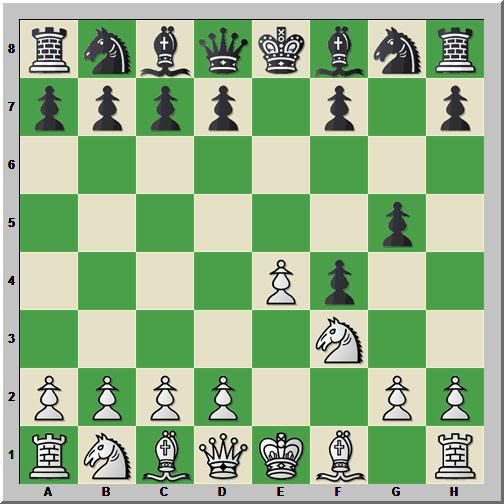
This position arises after the moves 1.e4 e5 2.f4 exf4 3.Nf3 g5 4.Bc4 Bg7 5.d4 d6 6.c3

White's intention with 6.c3 is obvious: bring the queen to b3 to construct a battery against f7. How should Black play?

This position occurred twice in the series of McDonnell -- De Labourdonnais matches in 1834. White won one and Black the other. McDonnell was White in both games. William Lewis had it in one recorded game. Tassilo von der Lasa had the position at least four times, three as White, before he was on the Black side in a game against Adolf Anderssen (one of the featured games in tomorrow's chess camp).

ChessBase Online contains 74 instances of this position. Black scores well with most moves. What is Black's best reply? Stockfish's top choice has been rare. Is the engine's second or third choice superior on positional grounds?

21 June 2014

Camp Warm-Up

My annual chess camp is next week. The young players are greeted each morning with a warm-up exercise. Due to he range of skill levels, I will use two warm-up exercises each day.

This position from a game we will examine Monday morning will be the harder of Monday's two warm-ups.

Who stands better? Explain why.

White to move

12 June 2014

Match Wits with Anderssen

This position arose in Anderssen -- Von der Lasa, Berlin 1851.

White to move

Adolf Anderssen played 9.Nf2, which seems sensible and sound. I wonder, however, whether he considered 9.d4. Is this position a good one for contemplating the sacrifice of a knight?

I am preparing some notes on this game, as well as several others, for my Dragon Chess Camp.

109: Dragon Chess Camp
Instructor:  James Stripes
Camp Location: Lower School
Dates: June 23-27
Times: 9:00am - 12:00pm
Dragon Chess Camp is fifteen hours of fun learning and practicing chess skills, as well as testing them in competition. Participants in chess camp will improve all aspects of their chess game: opening principles, middlegame strategy, tactics, endgame technique. There will be puzzle solving contests and lessons from great masters of the past. Awards will be based on camp points which are earned through each of the camp activities. Each participant will receive a camp workbook packed with chess tips, problems, and instructive games.
Grades: K-6
Tuition: $150
http://www.sgs.org/student-life/summer_programs_2014/index.aspx

27 November 2013

Morphy Defense: First Book Lines

Before Paul Morphy played 3...a6 in response to Adolf Anderssen's Spanish Opening, or Ruy Lopez, published analysis had appeared in Handbuch des Schachspiels (Berlin, 1852).

The Handbuch, often called the German Handbook in English publications set the standard for opening reference in the nineteenth century and was still in use well into the twentieth century. It went through eight editions: 1843, 1852, 1858, 1864, 1874, 1880, 1891, and 1912-1916. It's first editor, Paul Rudolf von Bilguer (1815-1840) died before the first edition was published. Tassilo von Heydebrand und der Lasa (1818-1899) saw the first five editions through publication, retaining Bilguer's name as editor.

The 1852 edition was the first to include what would come to be known as the Morphy Defense. The lines presented in the Handbuch (1852) are reproduced here. There are two notes to line 3 that I have not yet translated, but that I may add later.

After 3...a6
Line 1.

1.e4 e5 2.Nf3 Nc6 3.Bb5 a6* 4.Bxc6 dxc6 5.Nxe5 Qd4 6.f4** Qxe4+ =

Line 2.

-- -- -- -- 5.0–0 Bd6 6.d4 exd4 7.Qxd4 f6 8.Re1 Ne7 9.e5 fxe5 10.Nxe5 0–0 11.Bg5*** Qe8 12.Nc4 Nf5

White to move

13.Rxe8 Nxd4 14.Rxf8+ Kxf8 15.Nxd6 Nxc2 16.Nxc8 Rxc8 17.Na3 Nxa1 =/+

Line 3.

-- -- -- -- -- -- -- -- -- -- -- -- 13.Qc3 Qg6 14.Nxd6 cxd6 =

Line 4.

White to move
Position for Lines 4 and 5

-- -- -- -- -- -- -- -- -- -- -- 12.Nd2 Nf5 13.Qc3 Qh5 =

Line 5.

-- -- -- -- -- -- -- -- -- -- -- 12.Bxe7 Qxe7 13.Nd2 Be6 =

Line 6.

[1.e4 e5 2.Nf3 Nc6 3.Bb5 a6] 4.Ba4 Bc5 5.c3 b5 6.Bb3

After 6.Bb3 in Lines 6 and 7
6...d6 7.d4 exd4 8.cxd4 Bb6 9.Bd5 Nge7 10.Nc3 Bg4 11.Be3 Bxf3 12.gxf3 =

Line 7.

6...Qe7 7.a4 Rb8 8.axb5 axb5 9.0–0 Nf6 10.d4 Bb6 11.Bg5 d6 12.Qd3 Bd7 =

Line 8.

-- -- -- - 4...Nf6 5.d3 b5 6.Bb3 Bc5 7.c3 d6 8.d4 Bb6 +/=

White to move


*This move, described by Anonimo Modenese [that is, Domenico Ercole del Rio; see "Morphy Defense: Early History"] could possibly occur. But if White would take Nc6 immediately, Black then will be a bit better developed with 3. Ng8 to f6 instead a7 to a6 because of his threat towards e4.

** White also can play the knight to d3, f3, or g4 with the same result.

*** Reference to Cozio ending here with the remark that White has a beautiful game. The game, however, as shown in the following lines is not unfavorable for Black.


24 November 2013

The Berlin Defense: History

The Berlin Defense (ECO C65-C67) in the Spanish Opening (or Ruy Lopez) is a major alternative to the more common Morphy Defense. It was popular in the nineteenth century, but passed out of favor in the early twentieth. Fifty years ago, the Berlin was described as "fundamentally too passive" (Leonard Barden, The Ruy Lopez [1963], 145). Even so, the opening had adherents, such as GM Arthur Bisguier.

Vladimir Kramnik's use of the Berlin Defense in his World Championship match with Garry Kasparov revived the opening. It has retaken its position as an important opening played regularly in top tournaments. It appeared in four of the ten games in the 2013 World Championship. Magnus Carlsen employed it three times, and Viswanathan Anand played it once. Although the opening has a reputation for being drawish, it often creates imbalances that allow either side to play for an advantage long into the endgame. Carlsen scored one of his victories in the match when Anand faltered in a long and difficult endgame that began with the Berlin Defense.

The opening's name stems from it having been recommended in Handbuch des Schachspiels (Berlin 1843), edited by Tassilo von Heydebrand und der Lasa and Paul Rudolph von Bilguer. Bilguer began the project, but died before bringing it to publication. Lasa completed the project and continued updating it through four more editions (1852, 1858, 1864, 1874). The so-called Morphy Defense (3...a6) does not appear in the first edition of the Handbuch, but is treated in the 1852 edition, where Lasa asserts the superiority of 3...Nf6.
Dieser Zug, welchen der Anonimo Modenese angiebt, kann sehr gut geschehen. Hätte Weiss aber die Absicht, sogleich Sc6 zu nehmen, so würde Schwarz durch 3.Sg8 nach f6 statt a7-a6 dann wegen des Angriffs auf e4 noch etwas besser entwickelt sein.
Tassilo von der Lasa, Handbuch (1852), 162.*
The Ruy Lopez opening received its name from the Handbuch des Schachspiels using the term, "The Knight's Game of Ruy Lopez," according to Howard Staunton (The Chess-Player's Handbook [1847], 147).

The Berlin Defense was considered a standard response to the Spanish in 1889 when Wilhelm Steinitz advocated the system (3...d6) that would come to bear his name (Steinitz, The Modern Chess Instructor [1889], 1). There, the Morphy Defense (3...a6) was considered an alternate main line. Johann Jacob Lowenthal, however, asserted two decades earlier that Morphy's move is "generally considered best" (The Chess Player's Magazine, vol. 1, New Series [1865], 45). According to Lowenthal, Domenico Ercole del Rio had first suggested the move that became associated with Morphy following his match with Adolf Anderssen.

Lowenthal's assessment differs from that of Max Lange a mere five years earlier. Lange wrote in Paul Morphy: A Sketch from the Chess World, trans. Ernest Falkbeer (1860) that 3...Nf6 "would be stronger" than Morphy's 3...a6, as played in games two and four of his match with Anderssen. White's bishop is "well placed" at a4 and "if Black, in order to dislodge him, should venture upon advancing the [b-pawn], the queen's side will be exposed" (256). Lange refers his readers to "elaborate analysis" in Sammlung neuer Schachpartien (1857).

There Lange offers the history that Ruy Lopez de Segura recommends 3.Bb5 against the knight's defense of the pawn on e5, which the clergyman considered better protected by the pawn move 2...d6. Lange explains that the opening is called the Spanish Game or Ruy Lopez due to this analysis offered by the priest in 1561. His reasoning does not match the Spanish master's, he notes. Rather, he asserts that Black's efforts to drive away the bishop allow it to take up residence on b3 with no loss of time, while also weakening Black's queenside. However, the recommendation of the Berlin School offers Black compensation (43-44).
Die allgemeine Theorie ist aber spater jenem Rathe des spanischen Meisters nicht vollkommen beigetreten; sie hat vielmehr nach Aufrechterhaltung der Vertheidigung 2. Sb8 — c6 nun bei 3. Lfl — b5 durch die von der Berliner Schule vorgeschlagene Entgegnung 3. Sg8 — f6 die Spiele schnell auszugleichen empfohlen.
Lange, Sammlung neuer Schachpartien (1857), 43
The importance of the Spanish Opening is revealed, Lange asserts, in the attention it receives from Tassilo von der Lasa, Carl Friedrich Jaenisch, and Howard Staunton.


Lasker's Advocacy
Truth derives its strength not so much from itself as from the brilliant contrast it makes with what is only apparently true.
Emanuel Lasker, Common Sense in Chess (1917), 25
The Morphy Defense first surpassed the Berlin system in popularity, according to the ChessBase database, in the 1870s.** However, they remained close to equal through the 1880s and 1890s, and then in the first decade of the twentieth century, the Morphy variation was played three times as often as the Berlin. In the next decade, 3...a6 appeared five times as often as 3...Nf6.

The Berlin Defense to the Spanish Opening had reached it peak of popularity, while the Morphy Defense dramatically increased its adherents at the same time that Emanuel Lasker presented his lectures that would be published as Common Sense in Chess. The lectures were presented in spring 1895 and the first edition of the book appeared in 1896. After several editions by several publishers, a corrected edition was published by David McKay in 1917. That edition was reprinted as a cheap Dover paperback in 1965 that remains widely available today.

Lasker's central purpose in the lectures and book were to lay out general principles for all phases of the game. His opening principles are put forth in "Lasker's Rules". These conclude the first lecture. In the second lecture, he offered two games and variations that illustrate these rules at work in the Spanish Opening. In the third lecture, he offered some discussion of the Morphy Defense, which he notes at the outset violates one of his opening principles. The Berlin Defense conforms to Lasker's rules.

In his first illustrative game in the second lecture, we have the moves 1.e4 e5 2.Nf3 Nc6 3.Bb5 Nf6 4.O-O Nxe4 5.Re1 Nd6

White to move

Lasker observes of 5.Re1, "[n]ot the best move, but one that most naturally suggests itself" (19). Nonetheless, Carlsen played this very move in game 8 of his match with Anand. That game followed a line that had been employed in the first official match for the World Championship in 1886, deviating only with 12...Ne8.

Lasker's continuation from the diagram has been rare (24 games in ChessBase Online).

6.Nc3

6.Nxe5 is the overwhelmingly most popular choice, followed by 6.Bxc6 in roughly one-quarter of the games.

6...Nxb5 7.Nxe5

"Cunning play." Lasker observes, "If Black now takes one of the knights he loses" (19).

Lasker presents some lines after 7...Nxc3 in which White either gains a piece or generates a mating attack against the king. These seem useful instruction for developing players. In his main line, after 7...Be7, Black ends up with a better game.
And Black's game is, if anything, preferable. You see how quickly White's attack has spent itself out. But then he did not make the best of his position at move 5.
Lasker, Common Sense, 21
Lasker returns to the main line after 4.O-O Nxe4, offering what remains today White's most popular move.

5.d4

Black to move

Here, 5...Nd6 has become Black's most popular response. Lasker continued with 5...Be7, the second most popular move today.

6.Qe2 Nd6 7.Bxc6 bxc6 8.dxe5 Nb7

After 5...Be7, the rest of Lasker's moves remain the top choices in this line.

White to move

Lasker's comments on the diagram ring true today:
We have no come to a critical stage. Black's pieces have retired into safety, ready, with one single move, to occupy points of importance. White, on the contrary, has the field to himself, but he can do nothing for the present, as there is no tangible object of attack. Various attempts have been made to show that White has here the superior position. I do not believe that White has any advantage, and am rather inclined to attribute the greater vitality to the party that has kept its forces a little back. (23)
The Berlin Defense offers several prospects for interesting and dynamic play. It can produce a tactical melee, a positional squeeze, or a cold and lifeless position that leads to an early draw. I was happy to see several variations of this old and new opening system deployed in the recently completed World Championship match.


*I received assistance translating this passage from a member of Chess.com, hauntedgarage2000. He offered: "This move, described by Anonimo Robenese, could possibly occur. But if White would take Nc6 immediately, Black then will be a bit better developed with 3. Ng8 to f6 instead a7 to a6 because of his threat towards e4." Another member of the site, Kevin Hermann, helped by translating a passage from the 1843 text.

Corrections to my transcription to this passage were made 27 November 2013. Thanks to additional help from McHeath on Chess.com for pointing out four spelling errors. In addition, Anonimo Robenese should be Anonimo Modenese, a name associated with Domenico Ercole del Rio (see also "Morphy Defense: Early History").

**The more time that I spend reading nineteenth century chess books and periodicals, the more I realize that ChessBase and other electronic databases are woefully incomplete as historical references. Aside from the most highly publicized matches and tournaments, and the records of the best known players, the games in nineteenth century publications are mostly absent from databases.

14 October 2011

Learning from Errors: Adolf Anderssen

Prodigal Pawn laments the absence of well-annotated game collections focused on many players of the past, and present. He issues a call to such chess writers as John Nunn, Andrew Soltis, Nigel Davies, Neil McDonald, and others to write books on such chess greats as Adolf Anderssen, Harry Pillsbury, William Steinitz, and others.

My skills are far below Nunn and company, but I did write a pamphlet on Adolf Anderssen last year. Each year for the past several, I put on a brief chess camp for elementary chess players. In order to keep the camp fresh, and to give the participants something to take home, I change the theme each year. In 2010, the theme was "Attacking with Anderssen". I spent many hours poring through Anderssen's games looking for simple skewers, forks, decoys, and other tactical motifs in order to create problem sets. I also sought games to illustrate strategic themes, and other useful elements in Anderssen's chess career.

Last summer, the theme was "Studying with Smyslov" and we did some strong work on the endgame.

What follows was printed in the first three pages of instruction in the 2010 camp workbook.


Learning from Errors

Anderssen's first important match was against Tassilo von der Lasa. Von der Lasa was a Prussian diplomat who spent his spare time with chess. He accumulated an impressive library of chess books and also finished work begun by Paul Rudolf von Bilguer, editing Handbuch des Scachspiels (Handbook of Chess). The Handbuch became the dominant opening reference until the twentieth century.

Anderssen's six game match with Von der Lasa took place 1845-1846. Anderssen suffered some instructive losses in the beginning. As White, he favored the King's Gambit, an immensely popular opening in his day.

Match with Von Der Lasa
Game 1

Anderssen, A -- Von der Lasa, T [C38]
Breslau, 1845

1.e4 e5 2.f4 exf4 3.Nf3 g5

White to move


4.Bc4

For 4.h4 see Anderssen -- Von der Lasa, Berlin 1851 (also included in the workbook).

4...Bg7 5.d4 d6 6.c3 h6 7.Qb3?

7.O-O transposes into a line with some popularity, but that favors Black.


Black to move


White has pressure against f7 with the battery, but Black's kingside is secure. This error looks logical. However, on b3 the queen might become hemmed in by her own pawns--loss of mobility. She also could become vulnerable to attack.

7...Qe7 8.O-O Nd7 9.Na3

Thirty years later, Anderssen would try 9.a4 Anderssen -- Riemann, Breslau 1875.


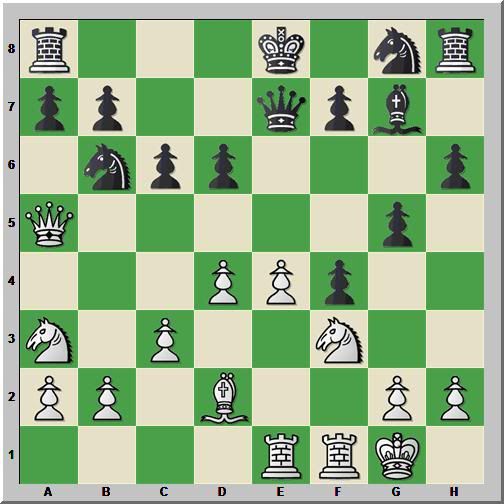
9...Nb6 10.Bd2 Bd7 11.Rae1 Ba4 12.Bb5+ forced 12...Bxb5 13.Qxb5+ c6 14.Qa5

Black to move


The queen has no scope. Black's problem was not that 14.Qa5 was an error, but that this move is a consequence of a bad plan. 7.Qb3 brought the queen out where its vulnerability led to poor mobility. Even before then, Anderssen played moves that gave him minimal prospects of success.

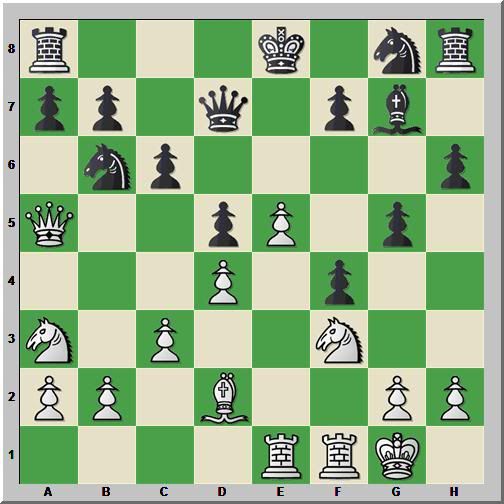
14...Qd7 15.e5 d5

White to move


16.e6?

Anderssen offers a clever sacrifice that leads to a material imbalance, but one that favors Black. He should have hunkered down and tried to defend. Let Black play the aggressor. He might have sought better squares for his queen and the a3 knight.

16...fxe6 17.Rxe6+ Qxe6 18.Re1 Qxe1+ 19.Nxe1 Nf6

White to move


Black's pieces are better placed; the White queen has far less potential in this position than the Black rooks.

20.Nd3

Alternatives are worse: 20.Qc5 Ne4-+; 20.Qb4 Ne4 21.Bc1 O-O-O-+.

20...Ne4 21.Be1 O-O 22.b3 Rf7 23.Nc2 g4 Black's pawns are potent 24.Qa3 g3 25.Qc1 The misplaced queen arrives back in action too late. 25...Raf8 26.Bd2 f3 27.gxf3 Rxf3 28.Nce1 28.Ne3 might be better.

Black to move


Now, Black converts his advantage. He trades the greater mobility and coordination of his forces for a clear material advantage and an easy endgame.

28...Rf1+ Black has a forcing combination 29.Kg2 Nxd2 29...R1f2+ may be stronger 30.Qxd2 R1f2+ 31.Nxf2 Rxf2+ 32.Qxf2 gxf2 White is down a piece 0-1

Anderssen's positional error in the placement of his queen was as significant as tactical blunders. He squandered the initiative early and never recovered. In the middlegame, he initiated a forcing combination that gave his opponent a clear advantage.