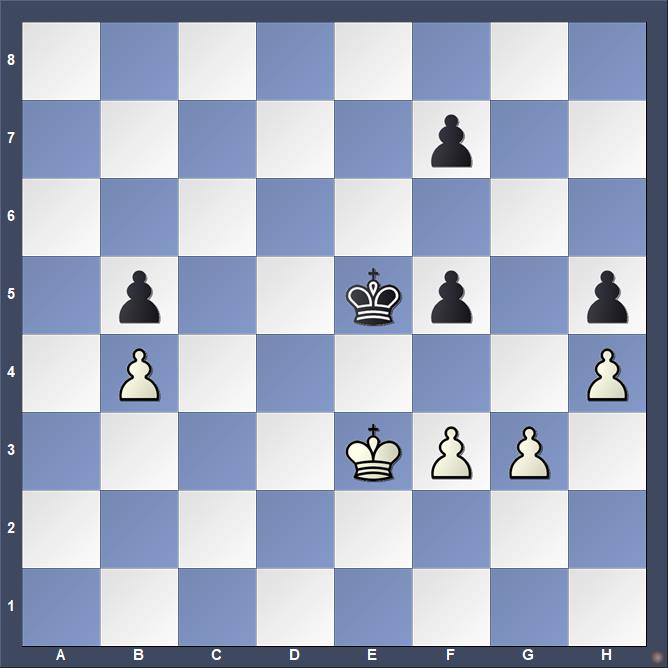
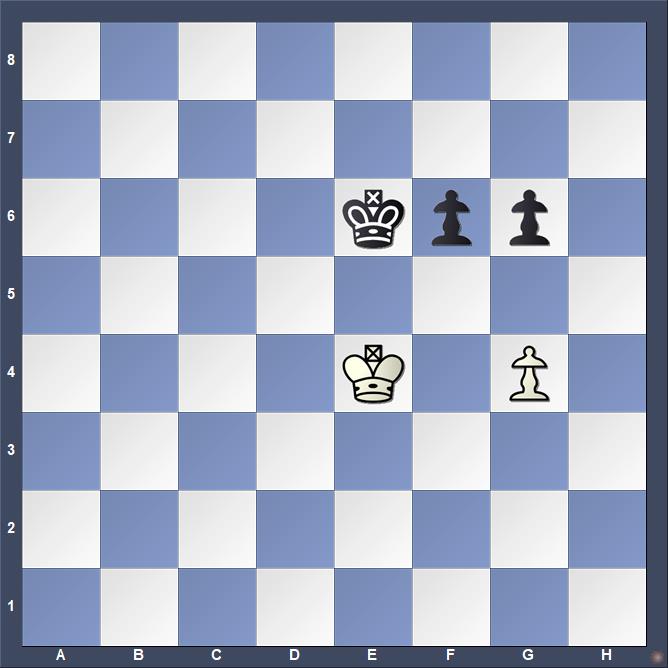
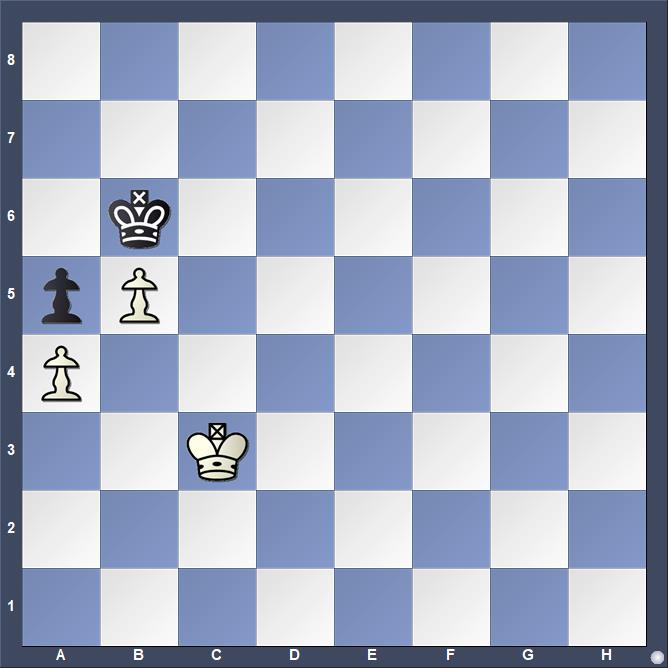
Showing posts with label opposition. Show all posts

07 March 2025

Equal is not yet Drawn

In "Playing Drawn Endings", I noted some cases where grandmasters played on in technically drawn endings. Sometimes a draw offer was made and refused. Sometimes a player erred and lost.

When I awoke this morning, foremost on my mind were memories of a game when my lower rated opponent offered a draw in an equal position with plenty of play. It happens almost every day in online chess. One in particular took me some time to find in my history. It is notable because a position was reached that I use in training my students. Needless to say, I know how to win it. My opponent could have avoided this technically lost position with better endgame play.

Internet Opponent -- Stripes,J [C00]
Live Chess Chess.com, 05.03.2025

White to move

42.Ke3 Kd6 43.Nb4 Nd5+ 44.Nxd5 Kxd5 45.Kd3

Now a pawn ending that is equal, but offers plenty of chances to err. Perhaps it was at this point that my opponent offered a draw. 

45...b5 46.b3 g5 47.h3

Stockfish slightly favors 47.g4, but both moves maintain equality.

47...h5

White to move

48.Kc3

Should one doubt the difficulty of playing this ending correctly, I might note that Komodo 13 sees 48.Ke3 as just as good, while Stockfish 16 sees Kc3 as the only move that holds equality. 

48...f5 49.Kd3

After 49.b4 h4 50.gxh4 gxh4, there is only one move that holds, but it is not difficult to find 51.Kd3

49...Kc5

White to move

50.g4??

This move loses. White had five other choices that are equal.

50...fxg4-+ 51.fxg4

51.hxg4 h4

51...hxg4 52.hxg4 Kd5 53.Ke3 Ke5 54.a4 bxa4

54...b4 is a shorter distance to mate

55.bxa4

Black to move

55...a5

The only winning move is easy to find because the position is nearly identical to one reached in Example 27 in Capablanca, Chess Fundamentals (1921), which I have studied carefully. Capablanca's position, which is not original with him, is a standard training position that I use to teach and test students on understanding opposition and outflanking.

56.Ke2

56.Kd3 is more stubborn 56...Kf4 57.Kc4 Kxg4 58.Kb5 Kf4 59.Kxa5 g4 60.Kb5 g3 61.a5 g2 62.a6 g1Q and Black's queen controls the next square for White's pawn.

56...Ke4

56...Kf4 is more accurate

57.Kd2 Kd4 58.Ke2 Ke4 59.Kd2 Kf4 60.Kc3 Kxg4 61.Kd2 Kf4

White to move

White can resign, but played on until the clock ran out.

62.Ke2 Ke4 63.Kf2 Kd4 64.Ke2 Kc4 65.Kf3 Kb4 66.Kg4 Kxa4 67.Kxg5 Kb3 Black won on time 0-1

26 December 2024

60 Days, 300 Positions: Day One

Thomas Engqvist, 300 Most Important Chess Positions (2018) has been in my possession about five years. I bought it early in 2019 (see “A New Book and a Morphy Game”). Often it sits on the shelf, but I read bits from time to time. I’ve studied some of the positions for my own edification, and used some with my students. This afternoon, I resolved to read the whole book in 60 days.

Failure may be expected. Life offers many opportunities that disrupt a disciplined schedule of study, as well as occasional challenges. But, perhaps, perseverance will get me through. I do not expect to blog the process every day and certainly will present only a fraction of the positions here. Readers who wish to know the contents of Engqvist’s book should buy a copy. It is not my intention to violate the author’s intellectual property.

Going through this book in 60 days is violation enough of the author’s work. He suggests five positions per week, not five per day. In my defense, I will note, however, his advice that a student needs “to integrate the positions into your conscious chess thinking as early as possible in your life” (6-7). I am 64 years old and have been reasonably serious about studying as well as playing chess since 1975.

Because of the nature of the book, I will not read it in sequence. Today, I did positions 151-155, the first five endgame positions. I use two of them routinely in my teaching. The ideas in the other three also occur while I’m working with students via other positions.

One of today’s positions intrigued me enough that I set it up to play against the computer on chessdotcom. Usually, I’ll play set-positions against Stockfish on my iPad or against one of several engines on my notebook computer with ChessBase and Fritz software installed. The website’s computer gave me the same frustration I usually find with elementary endgames on other devices: it did not make the moves that are most testing. The position is a Nikolai Grigoriev composition.

White to move

Unhappy with the computer’s move on chessdotcom, I also played this position on my iPad. That early version of Stockfish running on a weak processor started with the line Engqvist gives in the book, presumably the most testing.

1.Kg3 is White's only drawing move. Why?

If I could calculate deeply enough, I might recognize this square as the only one that assures I will be able to step onto b4 after Black plays Kxb6. White must take the opposition at that point.

1.Kh3 takes the distant diagonal opposition. Why does this effort fail? Black's shouldering manuever leaves the White king too far from the b-fil when the pawn on b6 falls. 1...Kc2 2.Kg4 Kd3 3.Kf3 Kc4 4.Ke4 White has taken the opposition with each move, but will no longer be able to maintain it when it matters.

Although Engqvist does not mention it, Kg3 begins an outflanking maneuver.

1...Kc2 is Black's critical try, as it leaves White only one drawing move. Chessdotcom's computer played 1...Kb2, giving me three three viable moves, including the option of seizing the distant opposition. Only after the subsequent 2.Kf2 Kc3 3.Ke3 Kc4, was there a single drawing move. In this case, it is an elementary outflanking maneuver. 4.Kd2.

2.Kf2 is the only move.

2...Kd3, is testing in the sense that White again has a single drawing move is offered in a variation in 300 Most Important Chess Positions.

2...Kd2 also leaves White a single drawing move.

3.Kf1 Kd3 4.Ke1 Kc4

Black to move
5.Kd2

It is clear that White's king will be able to reach b4 at the critical moment.

For the fifth time, White had only one move that draws. It would be nice if chess engine programmers could create an algorithm that has the computer choose the move that leaves the opponent a single choice to maintain the evaluation. Engines would become better training partners for this sort of endgame that way.


15 April 2024

Elementary Technique

Josef Kling and Bernhard Horwitz, Chess Studies, or Endings of Games (London, 1851) was one of the earliest books to emphasize chess endings. It was written in English descriptive notation, so even the presence of a free digital version does not make it particularly accessible to today’s chess players. Happily, Carsten Hansen has brought out a new edition containing the text of the 1851 edition, an expanded edition Horwitz was preparing when he died, and thorough analysis of their work. Hansen’s edition is published as part of his Alexander Game Books Classics series, available through Amazon.

A position in the original 1851 edition will serve as part of my lessons with young chess players this week, as it offers some elementary instruction in techniques that every chess player needs.
Kling and Horwitz note the beginner’s tendency to prematurely push a pawn—something I’ve observed in many hundreds of youth games over the past couple of decades. They note that rooks can be forced off the board, leading to an easily won pawn ending. When I played it against Stockfish, I reached a position that is also reached when playing the first and most elementary position in the book.

After the moves given by Kling and Horwitz, 1.Re3+ Rxe3 2.fxe3, Black is in zugzwang. Black loses because required to move. Were it White’s move, the game would be drawn.

Black to move
2…Kxe3

This move is marginally more testing than 2…Kxg3. In both cases, White will employ the same technique to bring the remaining pawn close to promotion. But, with the g-pawn, there will be stalemate dangers that do not surface while trying to promote the e-pawn.

Here, again, the beginner must learn not to hastily push the pawn. Rather, White’s king must work its way in front of the pawn to control the key squares.

3.Kg2 Ke4 4.Kh3 Kf5 5.Kh4 Kg6

White to move
The beginner’s game begins to improve when they learn to move the king in front of the passed pawn. Such placement is as vital for the defender as for the stronger side. 

6.Kg4 Kf7 7.Kg5 Kg7

Black, seizing the opposition, puts up the most stubborn defense. Now, and only now, White may advance the pawn. In this case, that takes the opposition from Black.

8.g4 Kh7

White to move
Once beginners have learned to curb the tendency to push the pawn too soon, and have learned the concept of gaining the opposition, the next step is to understand that opposition is only a means to an end. Here, taking the opposition fails to make progress. White must perform an outflanking maneuver to gain control of one of the key squares—f7, g7, h7.

9.Kf6 Kh6 10.g4+ Kh7

This is the first position in Kling and Horwitz, Chess Studies.

11.Kf7 Kh8

White to move
Now, White must be wary of the stalemate danger.

12.Kg6

12.g6 would leave Black no legal moves, ending the game with a draw.

12…Kg8 

White to move
13.Kh6

13.Kf6 does not spoil the win, but the game must return to the same position for another opportunity to play the correct move.

13…Kf7

The engine opts for the longest distance to mate. While testing students, I choose 13…Kh8 so they must show that they understand that pushing the pawn works here. 14.g6 Kg8 15.g7 Kf7 16.Kh7.

For my beginning students, we are likely to continue all the way to checkmate.


20 September 2023

Speed Kills

While playing this ending, I first thought that we had reached a simple drawn position. Then, my opponent erred. I sensed (correctly) that I was now winning, but managed to throw it away. Later analysis showed that it should have been drawn until my error gave my opponent a winning opportunity, but perhaps not an easy one to find.

Black to move
41...f6??

I rejected hastily 41...f4+, although it should have been clear to me that 42.gxf4+ Kf5 43.Kd4 Kxf4 leads to a pawn race where both players promote on the same move--a draw.

Stepping back with 41...Ke6 also allows Black to regain the opposition if White tries to advance his king.

42.Kd3

My first clue that I had missed something instructive in this ending was the website's game analysis calling this move a miss. Using the retry function, I found the idea, but further analysis showed that it was more intricate than I then thought.

White's winning idea is to transfer the king to h3, then create a passed pawn.

42.Kf2! Kd5 43.Kg2

Black to move
Analysis diagram
43...Ke5

If Black tries 43...Kc4, White's breakthrough takes place instantly for Black's king cannot get back into the square of the pawn. The pawn on f6 blocks the diagonal route after 44.g4 fxg4 45.fxg4 Kd4 46.gxh5.

44.Kh3

Without some calculation, I assumed that Black's b-pawn would promote before White's kingside pawns could break through, but the variation just above shows that is not true. Instead. Black's king must stay on the kingside. This also fails.

a) 44...Ke6 45.g4! f4 46.gxh5 Kf5 47.h6

Black to move
Analysis diagram
47...Kg6 48.Kg4 Kxh6 49.h5 f5+ 50.Kxf4 Kxh5 51.Kxf5+-

b) 44...f4 45.g4 f5 46.g5 and now Black's king is tied down to stopping the passed g-pawn allowing White's king to run to the b-file.

42...Kd5

I was thinking that we would shuffle our kings back and forth and agree to a draw.

43.g4??

Black to move
43...fxg4 44.fxg4 hxg4 45.h5 f5??

I hallucinated that my king could stay in the square.

45...Ke6 leads to an easy win.
45...g3 also leaves Black with a decisive advantage

46.h6+-

I blitzed out a few more moves because my opponent was low on time, but resigned when it became clear that my opponent would finish easily with the 20 seconds or so remaining.


23 April 2023

Fails

It seems that I pick up The Manual of Chess Combinations, vol. 2 by Sergey Ivashchenko once every other week to work a page of exercises. A few days ago, half a page occupied part of my morning. I solved three successfully. This morning, the fourth one on the page did not present difficulty, but the last two did. I also managed to err in the sixth exercise on each of the the next two pages.

Exercise 144 struck me as a study in corresponding squares on first glance, but I gave too little attention to the simplicity of Black's ability to gain and maintain the opposition. Had I considered the possibility of a sacrificial breakthrough, I might have more quickly perceived the floating square idea. I spent some time teaching the floating square to a couple of students last week and should have seen it.

White to move
1.Kf2 (or any other king move) fails. 1...gxh4 2.gxh4 Kg6 3.Ke3 Kf5 4.Kf3 Ke5 and Black can shuffle the king back and forth.

Instead, 1.g4! wins 1...hxg4 2.h5 (also 2.d6). 

Before that one, I thought I had correctly solved number 143, but had also overlooked something simple.

White to move
I tried 1.Kg5, overlooking that I had nothing after 1...e6 2.Kf6 Ke8 3.Kg7 Ke7 and somehow I had hallucinated there being possible an outflanking maneuver. After 1.Kg7 Ke8 2.e6! fxe6 3.Kg8 Kd8 4.Kf8 Kd7 5.Kf7 Kd6 6.Ke8, White has successfully outflanked the Black king.

Number 150 was familiar and I instantly knew the correct answer, but could not perceive the reason the rook had to move to d2 instead of d1, so I tried Rd1 against Stockfush. Again, simple opposition gives Black a draw.

White to move
1.Rd2! wins 1...d4 2.Rd1! Kd5 3.Kd7 Ke4 4.Kc6 d3 5.Kc5 Ke3 6.Kc4 d2 7.Kc3 and the rook captures the pawn on the next move. After 1.Rd1 d4 2.Kd7 Kd5, White can try 3.Rd2 Kc4 4.Ke6 Kc3 5.Rd1 d3 6.Ke5 Kc2 and the rook must be given up for the pawn.

My error in number 156 stemmed from failing to recognize the possibility of Black achieving a Philidor position.

White to move
Black got a Philidor-type position after 1.Kc4 Rg8 2.Kc5 Rg1 3.dxe6 Rc1+.

White wins easily either with 1.dxe6 fxe6 2.Ra7 Rf8 3.Ra8+ Kd7 4.Rxf8 or with 1.Ra7 straight away.


17 April 2023

Thomas Engqvist's Study Plan

"Less is more", writes Thomas Engqvist in 300 Most Important Chess Positions: Study Five a Week to be a Better Chess Player (2018). His 300 positions are more positionally oriented than the 300 in Lev Alburt, Chess Training Pocket Book: 300 Most Important Positions and Ideas, 2nd. ed. (2000) and also include a larger number of endgame positions. I wrote about the first position in this book the week after I acquired it in 2019 (see "A New Book and a Morphy Game"), but have not been following his recommendation to study five per week. Nor have I followed any other disciplined training regimen. Even so, Engqvist's book has been a frequent reference and valued.

Study by J. Hasek

Although Engqvist asserts, "the less you know the less you'll forget. ... it will be easier to remember 300 positional ideas rather than, let's say, 1000" (7), his 300 series now constitutes a trilogy and contains 900 positions. The motivation to select five per week for serious study has been growing for me.

The fourth endgame position in 300 Most Important Chess Exercises (2022) caught my interest last Friday and again this morning because I set it up incorrectly Saturday morning while trying to show the critical idea to some youth players at a chess tournament.

At first glance, White's task appears hopeless (see photo). Going straight for the a-pawn leads to stalemate. Going after the f-pawn leads to a trebuchet (a position lost for White). The draw is better than a loss, but I had the sense that White should win this with a technique I was missing. After some trial and error playing against Stockfish on the iPad, I found the win, posted on social media the position that arose after two moves, and mentally questioned a response that identified the solution as one of taking the opposition.

The exercise is a study composed by Josef Hasek and published in Deutsche Schachzeitung (1928). Engqvist identifies the themes as "triangulation and corresponding squares" (222). I think it also bears similarity to the famous Reti study in which White draws by attempting simultaneously to accomplish two impossible tasks (see "Endgame Calculation"). Such is the power of the double attack.

Stripes, J -- Stockfish
14.04.2023

1.Kc6 Ke5 2.Kc7 Kd5

White to move

3.Kd7!

Yes, this move seizes the opposition and prepares an outflanking maneuver. But triangulation is a more precise term for White's idea.

3...Ke5

If Black tries 3...Kc5, the diagonal opposition is best because it threatens the f-pawn. 4.Ke7! From the initial position, White cannot imagine going after the f-pawn, but now this threat is what makes it possible to gain the a-pawn without getting trapped on the a-file.

4.Kc6

Because of triangulation, the position that has been reached is the same as after the first move, except that it is Black's move.

4...Kxf5

White to move

5.Kb7

Other moves draw. Black's king is now too far away to trap White's king on the a-file and White's pawn promotes long before Black's can make any progress.

1-0

300 Most Important Chess Exercises is divided into four sections of 75 exercises each. The first two sections are opening and middlegames with tactics emphasized in the second set. The last two sections are endgames, again with tactics emphasized in the final set.

I could see myself developing some consistency with Engqvist's study plan of five positions per week if these five come from all three books, instead of always following only one of them. Coming up soon in Exercises is the following position, the sixth endgame exercise. 

White to move
I have seen this position in other books and have trained with this it on chess.com. I know the idea--corresponding squares. Nonetheless, this is an exercise that I find difficult. The cases of correspondence which must be worked out encompass more than half of the board.


28 October 2022

Problem of the Week

Elementary checkmates

Several years ago, I developed the habit of posting a portion of each week's chess lessons for youth players on Chess Skills. These were labeled with "Problem of the Week". After a few years, I stopped doing these posts weekly, but would post one from time to time. I seem to be slipping back towards the regular habit.

My students this week in the after school club were presented with some checkmate positions.

On Tuesday I presented the first ten moves of a game that I played online the day prior, then asked students to work out the forced checkmate in five. Although the position differs slightly, the five move sequence is identical to one found in Vladimir Vukovic, The Art of Attack in Chess (1965).

Stripes,J. -- Internet Opponent [C10]
Live Chess Chess.com, 17.10.2022

1.e4 e6 2.d4 d5 3.Nc3 dxe4 4.Nxe4 Nf6 5.Bd3 Nxe4

5...Nbd7 has been my choice with Black.

6.Bxe4 Bd6

Both 6...c5 and 6...Nd7 are better.

7.Nf3 0-0 8.Bxh7+?

In this instance, the classic bishop sacrifice leads only to equality with best play.

8...Kxh7 9.Ng5+
Black to move
9...Kg8??

9...Kg6 was necessary 10.h4 Kf6 is best 11.Nh7+ Ke7 12.Nxf8 Kxf8 is best with equality.

10.Qh5+- Re8

Moves into forced checkmate

Black's woes are illustrated by the computer's suggested alternatives:
10...Bb4+ 11.c3; or
10...Qxg5 11.Bxg5

White to move

On Thursday, I first presented a situation that led to a draw in the previous Saturday's youth tournament. After more than a dozen moves, a young player with rook and knight against a lone king admitted inability to force checkmate. I asked a few students to show how they would find checkmate from this position.

White to move
After students showed their methods, I reviewed the process of keeping the Black king in an ever shrinking box. Then I presented a common exercise that Bruce Pandolfini has in his Pandolfini's Endgame Course (1988), 27.

White to move
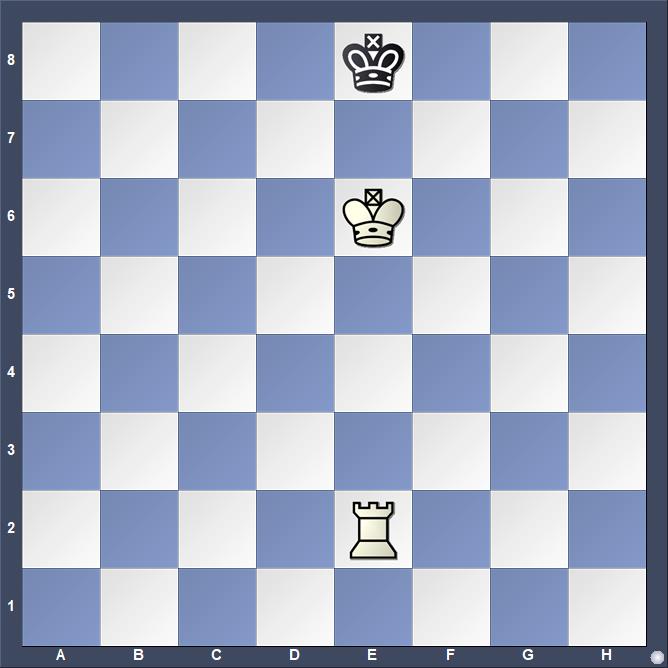
Any rook move begins the process of delivering checkmate by force in three moves.

White has a mate in three with the rook on any square marked in yellow.

The real challenge was in solving a puzzle that dates from the mid-fifteenth century (before the bishop and queen gained the power they have now). 
White to move
Checkmate must be delivered in 12 moves or less. The rook can only move once was a stipulation of the problem. This problem shows that chess players know how to use opposition and outflanking more than 570 ago.


12 July 2022

Coaching: Constructing a Lesson

I had been coaching youth chess for a couple of years when I decided to keep a clear record of what I did each week with the students at the elementary school where my youngest was no longer a student. While he was enrolled there, I was a parent volunteer helping with the after school chess club. When he moved on to another school, I returned to his old elementary as a paid chess coach. The year was 2004. Chess club started in late September.

I began the year with a position from a game I had played a day or two earlier on the Chessmaster Live server. Although Black had a one pawn advantage in a king and pawn endgame, it should be drawn with correct play.

White to move
My opponent erred with 46.Kc5?? We both promoted pawns, but then my opponent blundered theirs away. Had we continued in a queen ending, White might have held out long enough to run me short of time. Black was technically winning with QPP vs. QP and Black's king closer to the pawns.

Instead, play might have continued:

46.Ke4 Kf7 47.Ke5 Ke7 48.Kd4 Kd6 49.Ke4

Black to move
Here Black can err with the same flawed idea that White pursued in the game: 49...Kc5?? Correct play would be either 49...Kd7 or 49...Ke7 and a technical draw.

In the lesson, I sought to introduce to the students the concept of opposition in pawn endings. I followed this position from a recent game with a number of other positions, mostly composed, that had fewer pawns and presumably simpler continuations.

The school chess club ends the year with the Washington State Elementary Chess Championship in April. The last session before state, I showed the students a pawn ending that had been played at the Spokane Chess Club the week prior.

Black to move
After the game ended as a draw, I spent some time with others at the club, including the one who had Black, arguing about whether Black had a win. The next day, I checked some of our ideas on my computer. If we had the same argument today, someone would pull up Stockfish on their phone or a tablebase site and end the debate. My phone then was a RAZR flip phone. It's chess app was a version of Chessmaster that I could beat on its top level.

Had any of us read with sufficient comprehension José R. Capablanca, Chess Fundamentals (1921), we would have known how to use triangulation to secure the win after 1...g5. I had nearly forgotten this lesson until I was playing through an ending presented in C.G. Van Perlo, Van Perlo's Endgame Tactics, new, improved and expanded edition (2014). The ending came up in my study as I was comparing endgame books for "To Know a Position", which I wrote last weekend.

For the children headed to state, I hoped to reinforce some lessons I thought they should have absorbed in September. It is always hard to measure results, but both the elementary team (grades 1-5) and the sixth graders from the middle school brought home trophies--individual and team. School officials perceived me as a successful coach and I have continued to coach youth players.

The lessons I employed that first year as a chess professional at an elementary school were compiled into a booklet that I printed at the school and then had bound at Kinkos. I have learned a lot in the years since. My skills as a teacher have improved. My chess playing ability also rose. I have also learned to print my lessons through Amazon, where I get better quality binding at lower cost, and also am able to make them available to others.

10 July 2022

To Know a Position

Two pawns against one when the stronger side has one that is both passed and protected is generally a win. There are exceptions when the pawns are too close to the edge of the board with one of the pawns (stronger or weaker side) on its starting square. Having a pawn on a rook file also limits the stronger side's chances. The position of the kings often proves critical.

This position, ending no. 107 in Pandolfini's Endgame Course (1988), also arises while playing through examples 8 and 9 in José R. Capablanca, Chess Fundamentals (1921). Josef Kling and Bernhard Horwitz, Chess Studies, or the Endings of Games (1851) presents a study that reaches this position after the first two moves.

White to move
Sacrificing the forward pawn allows White to win Black's pawn after a few moves using opposition and outflanking maneuvers, resulting in a standard position that Bruce Pandolfini covers earlier in the book (endgames 60-62).

The diagram position is important enough in Lev Alburt's view that it appears in Chess Training Pocket Book: 300 Most Important Positions and Ideas (1997). Alburt writes that to become a strong tournament player one needs to know only 12 key pawn endings, promising that the right 12 are in the book (9). A similar position appears in Rashid Ziyatdinov, GM-RAM: Essential Grandmaster Knowledge (2000), but did not make the cut for Thomas Engqvist, 300 Most Important Chess Positions (2018).

Lest there be any doubt about the practical value of understanding how White should play, consider the ending from Polgar,I.--Ciocaltea,V., Baja 1971, which is presented in C.G. Van Perlo, Van Perlo's Endgame Tactics, new, improved and expanded edition (2014).

White to move
54.Kg3

54.Kg5 fails to make progress, Van Perlo notes.

54...Kf7 55.Kf3 Ke7 56.Ke3 Kd7 57.Ke4 Ke6

White to move
Flip the side to move, remove White's f-pawn and place a Black pawn on f6, and the position is identical to one that appeared at the Spokane Chess Club in April 2005 between two of the group's strongest players. Black pushed the unopposed pawn and the game was dead drawn, yet the game continued for many moves more because the weaker side has very little time left on the clock.

58.g5!

"Depriving the black king of some vital squares in the tempo battle" (Van Perlo 25).

58...Kd6 59.f5 Ke7 60.f6+

Now White has a passed pawn.

60...Kf7 61.Ke5 Kf8

We have reached the position at the top of this post.

62.f7

Black resigned.

We can move the initial position right or left, up or down. In most cases, the stronger side has an easy win.  Sacrifice of the forward pawn is the easiest method when the blocked pawn is on the fifth rank, but this fails when the pawn is further back.

Two key positions are analyzed in Johann Berger, Theorie und Praxis der Endspiele (1890), referencing the earlier work of George Walker, A New Treatise on Chess (1841).

No. 483
Das Spiel ist leicht zu gewinnen
It is an easy win, regardless of who has the move, Berger explains.

No. 484
Weiss gewinnt nur mit dem Zuge.
White wins only with the move.

Mark Dvoretsky, Dvoretsky's Endgame Manual, 5th ed. (2020) offers one full page of analysis with one winning and two drawing positions, plus a well-known 1921 study by Nikolai Grigoriev earlier in the chapter. Grigoriev's study, "underscore[s] that a system of corresponding squares certainly does not have to always be 'straight line', as with the opposition. Each case demands concrete analysis" (23). Alex Fishbein, King and Pawn Endings (1993) offers two positions, both of which are Grigoriev compositions. Reuben Fine, Basic Chess Endings (1941) has seven diagrams over a little more than three pages. Karsten Müller and Frank Lamprecht, Fundamental Chess Endings (2001) offer two positions from games, one winning and one drawing. Comparable positions do not appear in Jeremy Silman, Silman's Complete Endgame Course (2007), unfortunately.

Paul Keres, Practical Chess Endings (1974) offers the most thorough discussion with 11 diagrams over six pages. He begins with Berger's no. 483 (see above).

After nine moves in Keres' analysis, the following position is reached.

White to move
"White would spoil everything with 10.b6?" Keres notes (34).

10.Kd5! Kc7 11.Ke6 Kb6 12.Kd6

This outflanking idea is another standard technique.

12...Kb7 13.Kc5

Keres then turns to the most important technique for endgame book authors: shifting the position. Shift everything up on rank and White can no longer win because of the same stalemate threat noted after 10.b6? Shift one square down, and White still wins. Two squares down and it matters who has the move. White must have the move to win.

Moving the position one file to the right and one rank up, White wins, even when Black has the move.

Black to move
1...Kd6 2.Ke4 Ke6 3.Kf4 Kd6 4.Kf5 Kc7 5.Ke6 Kc8

White to move
6.c7!

The pawn must be sacrificed, as we should know from Capablanca and Pandolfini.

Continuing the shift to the right and this time down a rank, Keres sets the kings in a manner optimal for Black. After a few moves, the following position is reached.

White to move
To secure the win, White must use threats of moving to either side of the mass of pawns to perform the opposition and outflanking maneuvers.

6.Kc1!

Working out the rest is good training. Keres book is helpful, too. It was when I reached this position in my reading yesterday morning that I started playing against Stockfish from this position and then many other variations with the same arrangement of pawns across the range of possibilities.

Shift the starting position one rank down and this resource no longer exists for White.

Knowing a position well is knowing an arrangement of pieces that may be, in fact, many hundreds of possible positions. Some of these have arisen in my games in the past and can be expected to do so again. 


05 June 2022

Corresponding Squares

When I was studying a position from Paul Keres, Practical Chess Endings, trans. John Littlewood (1974) this morning, it was familiar. I thought the winning idea was rooted in understanding corresponding squares, especially because Keres placed it in that section of the book (he uses the term "related squares"). Nonetheless, I struggled to calculate the solution without working out all critical cases of correspondence, and only through trial and error against Stockfish did I discover the correspondence between a5 (Black) and d2 (White), highlighted in red below.

White to move
I solved the exercise before reading Keres' solution and discussion of related squares, but could not avoid seeing the paragraph below the diagram: "White's task is made extremely difficult by the fact that his passed pawn is on the rook's file and that he has no manoeuvring space for his king to the left of this pawn" (28). Hence, the general idea was clear from the outset if I did not already know that.

Initially, I thought triangulation would allow me to reach the same position, but with Black to move, calculating 1.Ka3 Kb6 2.Kb2 (distant opposition). But if Black plays 1...Ka6, do I still go to b2? This scenario did not occur in my play against Stockfish. Keres notes, as I learned later, that when the Black king is on a6 or b6, White's king can move to c1, c2, or c3 because all three squares allow Kd2 should Black play Ka5.

My play against Stockfish on the iPad follows.

1.Ka3 Kb6 2.Kb2 Ka5 3.Kb3

Already, I have successfully reached the diagram position above with Black to move.

3...Kb6 4.Kc3 Ka5

White to move
An advantage of playing against the computer is that you can learn immediately when you have gone astray. If the engine suddenly shows an evaluation of 0.00, it is clear that an error has been made. Here, 5.Kd3 seems tempting because after 5...Kb4, White has the resource 6.a3. However, it takes little calculation to see that 7.Ke5 fails because Black has 7...Kb3 8.Kd5 Kb4 and suddenly Black is winning.

I may have tried it anyway, but I do recall that I tried 5.Kc2 and watched the evaluation hit 0.00. What then? Going back to the b-file clearly makes no progress. Hence, there is only one move and I would have found it sooner had I more thoroughly considered all sets of corresponding squares instead of trying to see everything through brute force calculation.

5.Kd2! Kb6 6.Ke3

6.Kd3 is as good. Both squares lead to e4.

6...Kc6 7.Ke4

Tablebases indicate that 7.a3 and 7.Kf4 are both equally good, but taking the opposition in such positions is practically routine.

Black to move
7...Kd6 8.Kf5

This simple outflanking maneuver is not superior to 8.a3. However, it is easier to understand. I am reminded of Vladimir Kramnik's words in the Foreword to the 5th edition of Dvoretsky's Endgame Manual (2020): "it is impossible to attain real endgame mastery by just working with a computer. An explanation of why an endgame is winning, ... described in words and in language that a person understands (as opposed to computer variations), is needed" (12).

8...Kd7 9.Ke5 Kc6 10.Ke6

Continuing with moves that alternate between taking the opposition and outflanking is relatively simple and something I've done hundreds of times. Nevertheless, I spent a fair amount of additional time with this exercise after completing it. 

From the starting position, Stockfish notes that it is checkmate in 26 moves. My first effort following the discovery of 5.Kd2 led to checkmate with two queens on the 28th move. I knew that I could do better.

Where else have I seen this position?

I thought that the diagram Keres presents was familiar, but do not find it in Dvoretsky's Endgame Manual. Dvoretsky does have a similar position as a diagram that reaches a nearly identical position after three plies. it is a variation stemming from inaccurate play from a composition by Franz Sackmann (1913).

Black to move
After 10...Kb7 11.Kb4 Ka6, the position in the diagram from Keres is reached one square up the board. The solution follows the same process. Dvoretsky discusses it in the section on mined squares, noting that the d4 square is mined.

Perhaps this derivative from Sackmann's study was sufficiently lodged in my memory to recognize it, especially if I played out Dvoretsky's analysis.

I did find the original position in Alex Fishbein, King and Pawn Endings (1993), where it is no. 126 and credited to George Walker. However, I bought this book with unrealized intentions and have spent very little time studying it. Walker, A New Treatise on Chess (1841) has the position, which Walker states came up in a game that he observed. It is interesting that in Walker, the position is reached with black to move, but White did not know how to play it. Nor did Walker find the correct way. According to Johann Berger, Theorie und Praxis der Endspiele (1890), it was Josef Kling who pointed out the correct manner of play.

From Walker, A New Treatise on Chess
Walker's line follows.

White to move
1.Ka3 Kb6 2.Kb2 Ka5 3.Kb3

Here, we have the diagram at the top of this post, but with Black to move. It is the position I had to produce via triangulation.

3...Ka6 4.Kc3 Ka5 5.a3?

Walker does not give this move the question mark, I do. My memory fades on whether this was one of my errors this morning. I know I certainly considered it.

5...Ka4 6.Kd3 Kxa3 7.Ke4

Can we call this an example if hope chess? Even if Black plays 7...Ka4, the best White gets is a draw.

Black to move
7...Kb3

Now, White must fight for a draw. To Walker's credit (and the player of the White pieces), the drawing method is demonstrated.

8.Kd3

"Best", according to Walker. These days, the move gets a box--only move.
8...Kb4 9.Kd2 Kxc4 10.Kc2 

White draws by holding the opposition, as noted by Walker.