Showing posts with label Mamedyarov (Shakhriyar). Show all posts

29 January 2016

Mamedyarov -- Caruana, Tata Steel 2016

Can Fabiano Caruana catch Carlsen?

With three rounds to play, Fabiano Caruana stands one-half point behind Magnus Carlsen in the Tata Steel Chess Tournament in Wijk aan Zee. In today's games, Carlsen has White against Hou Yifan. She opted for a Petroff Defense, which often functions well as a drawing weapon. Caruana has the Black pieces against Shakhriyar Mamedyarov and played the Sicilian Defense. Mamedyarov opted for the Alapin variation.

When I awoke this morning, the games had been going for nearly two hours. My morning begins with making coffee, feeding dogs, and creating the beginning of this blog post. Once I am caught up with the action in the Netherlands, I will attempt to follow the games live and record my observations here through frequent updates.

Mamedyarov,Shakhriyar (2747) -- Caruana,Fabiano (2787) [B22]
78th Tata Steel GpA Wijk aan Zee (11), 29.01.2016

1.e4 c5 2.c3 Nf6 3.e5 Nd5 4.Nf3 e6 5.d4 cxd4 6.cxd4 d6

White to move

7.Bd3

The fourth most popular move with just over 300 games in my database. Mamedyarov asks Caruana, "just how deep is your preparation in this line that is new to both of us?"

7.Bc4 leads in popularity.

7...dxe5

A few dozen reference games. Only one with a player above 2600.

8.dxe5 Nb4

Sam Shankland has played this move.

9.Be4 Qxd1+ 10.Kxd1 Nd7

Reference Game:
Fruebing,Thomas (2187) -- Shankland,Samuel L (2539) [B22]
Dresden ZMD op 20th Dresden (1), 06.08.2011
10...N8a6 11.a3 Nc5 12.Nc3 Nxe4 13.Nxe4 Nd5 14.Nd4 Bd7 15.Bg5 h6 16.Bh4 Rc8 17.Rc1 Rxc1+ 18.Kxc1 Nf4 19.Bg3 Nd3+ 20.Kc2 Nc5 21.Nc3 Be7 22.b4 Na4 23.Ne4 0–0 24.Rc1 Nb6 25.Nc5 Bxc5 26.bxc5 Rc8 27.Kb3 Nd5 28.Kb2 Bc6 29.Kb3 Kf8 30.a4 a6 31.h4 Ke7 32.Bh2 h5 33.g3 Kd7 34.Bg1 Kc7 35.f4 Ne7 36.Rc3 Rd8 37.Bf2 Be4 38.Rc1 Nc6 39.Kc3 Rd5 40.Nxc6 Rd3+ 41.Kc4 Kxc6 42.Rb1 Ra3 43.Rb6+ Kc7 44.Rd6 Rxa4+ 45.Kb3 Ra1 46.Bd4 Rb1+ 47.Bb2 Bd5+ 48.Kc2 Be4+ 49.Kb3 a5 50.Ka2 a4 51.Rd4 Re1 52.Bc3 Re2+ 53.Rd2 Bd5+ 54.Kb2 Re3 55.f5 a3+ 56.Kc2 Be4+ 57.Kb3 a2 0–1

White to move

There are still four games in my database with this position.

11.Bd2N a5 12.a3 Nc5 13.axb4 Nxe4

Black has created a minor piece imbalance.

14.Be1 b6 15.Nc3 Nxc3+ 16.Bxc3

White could undouble his pawns, but that would give Black a passed pawn and White's c-pawn would be backwards. The doubled b-pawns have strength.

16...a4 17.Nd2 Bb7 18.f3 Bd5 19.Kc1

Black to move

19...b5 20.b3 a3

Caruana has a passed pawn, but any hopes it cherishes of promotion are in the distant future.

21.Kb1 Be7 22.Ka2

The king blockades the passer, freeing White's rook for action.

22...O-O 23.Rac1

Black to move

Caruana has a achieved a middlegame with dynamic prospects to create winning chances.

I was looking at 23...Ra4 to pile on the b4 pawn, but 24...Bxb4 25.Bxb4 Rxb4 drops the a-pawn. Bad ideas are the curse of the class player. On the other hand, keeping the a-pawn on the board ties down one of Black's rooks. What else can he do?

23...Rfc8 24.Nb1 Bg5

Attack the rook. That's what Black can do.

25.Bd2 Rxc1!

Mamedyarov was ahead a few minutes on the clock until the amount of time that he spent on this position. While he thought, I looked at some tactical threats that Black might have in mind. Once I concluded that they did not work, they were played rapidly on the board.

26.Rxc1

Black to move

26...Bxb3+

That's the move I was looking at!

27.Kxb3 a2 28.Na3

When I found this move, I concluded that Black's combination failed. Somehow I overlooked that White's bishop on d2 was now undefended and that losing the a-pawn did not eliminate all of Black's winning chances. There are other vulnerable pawns in White's position. On the other hand, Black must watch his back rank.

28...Bxd2 29.Ra1 Bf4 30.h3 Bxe5 31.Rxa2 Rb8

White to move

32.Rc2

Nxb5 is threatened.

32...Bd6

Black can block a check, so the pawn is safe for now. With most of White's pawns on light squares, the bishop has few targets. But the crucial pawn is on a dark square. The pawns for both players on the kingside are mobile. In this position, the bishop is still a better piece that the knight.

Black is one pawn ahead.

33.Rc6 Be7 34.Rc7 Bf8

34...Bd6 might lead to a repetition, but one repetition gets closer to the time control.

35.Ra7 g6

Black's king gets some air.

36.Ra5

Black to move

Black cannot keep the b-pawn.

36...Rd8

But, an active rook is essential in this endgame and White has other pawns that can be threatened. Will Black be forced to give up the bishop to stop White's b-pawn?

Hou and Carlsen are still playing, but the commentators think that it is headed to a draw.

37.Rxb5 Rd2 38.Rb8

Black to move

38...Kg7

This move may have been necessary. If 38...Rxg2 39.Rxf8 Kxf8 40.b5 and White's pawn will promote.

39.Nc4 Rxg2 40.b5 Rg1 41.Rxf8! Kxf8 42.b6

Black to move

Uh-oh. Caruana is in trouble. How will he stop that pawn? Caruana will be fighting for a draw. Meanwhile, Carlsen continues to force Hou to play chess. That game is not drawn yet.

The commentators are convinced that Black must play 42...Rd1. It seems to me that 42...Rg5 might be worth considering. In any case, Caruana is using a lot of time to think. His tournament hangs in the balance. If he cannot draw this game, Carlsen will be out of reach.

After a little more than 30 minutes:

42...Rg5

White's king and knight will work together to try and prevent the rook's exchange for the pawn.

43.Kb4 Rg1

Now Mamedyarov is thinking. Watching the live video feed, I see Wei Yi stop by to look at the game, Then Carlsen came by. This game is drawing some interest. It is a significant game for the final standings, and it is also an interesting ending.

44.Nd2

White keeps the rook off b1. Now what can Black do?

44...Rd1 45.b7 Rxd2 46.b8Q+

Black to move

White must win this ending. Or, can Black construct a fortress?

46...Kg7 47.Qe5+ Kg8 48.Qb8+ Kg7 49.Qe5+ Kg8 50.Qb8+ 1/2-1/2

I am surprised at this draw. But perhaps Black could have created a fortress with his king on g7 and the rook shuffling among d5, f5, and h5. On the other hand, in such a position White would checkmate with king on e7 and queen on f8. The fortress might not be possible.

Carlsen won his game. Caruana falls a full point behind the leader.

27 January 2016

Tata Steel Chess 2016, Round Ten

Caruana Closes the Gap!

I like blogging Grandmaster games while watching them live on the internet, but it can be exhausting. This morning, I considered blogging Navara -- Mamedyarov in this manner. They are playing in the Tata Steel Masters that is holding today's round in the Railway Museum in Utrecht, Netherlands. After the first six moves, the players reached a position that I had in one of my most memorable games (see "Pawn Wars").

1.e4 e5 2.Nf3 Nc6 3.Bb5 g6 4.c3 a6 5.Ba4 d6 6.d4 Bd7

White to move

I was playing for a draw because I was tired from the prior round and inadequate sleep the night before, because I was playing the highest rated player in my city, and because I did not feel that I understood the position very well after 3...g6. Also, with a draw, I would finish in a tie for second place in the tournament. After liquidation of most of the pieces, my opponent and I brought our rooks to the open file and repositioned our knights. We repeated the position once, and then my opponent struck with a pawn break that we both thought should favor him. We were wrong. I won the game and finished in second place alone. That tournament pushed my rating over 1900 for the first time.

David Navara castled here and the game was drawn after a short fight that concluded in a rook endgame with two pawns each. I am sure that the game would have been instructive to follow live.

The game of the day, however, must be Caruana -- Wei. When the round began, Fabiano Caruana trailed Magnus Carlsen by one point. Carlsen drew his game against Anish Giri and Caruana beat Wei Yi.

The Tata Steel Masters shares an exciting feature with the K-12 section of the youth tournament that I ran on Saturday. In the youth tournament, three players finished with 4.0/5. The second seed beat the first, but lost to a newcomer. The first seed beat the newcomer. In Tata Steel, Navara beat Caruana, but lost to Wei, who then lost to Caruana.

Caruana's win brought him one-half point closer to Carlsen with three rounds remaining. Caruana faces Shakhriyar Mamedyarov, Loek Van Wely, and Evgeny Toashevsky. Carlsen has yet to play Hou Yifan, Wesley So, and Ding Liren. Perhaps Caruana's remaining games are slightly easier, especially as Tomashevsky seems out of form.

I wrote most of these annotations without reference to the commentary before watching the two minute postgame interview with Caruana. After watching that video, I added two quotes to my annotations. Most of my variations seem worse for Black than in the game. I have not checked any part of the game or variations with an engine.

Caruana,Fabiano (2787) -- Wei ,Yi (2706) [C83]
78th Tata Steel GpA Utrecht (10), 27.01.2016

1.e4 e5 2.Nf3 Nc6 3.Bb5 a6 4.Ba4 Nf6 5.0–0 Nxe4
It is logical for Black to take an unprotected pawn, with the idea that while White is recapturing it Black gets a stake in the center. The chief disadvantage is that Black's position becomes a trifle loose. Nick DeFirmian, Modern Chess Openings, 13th ed. (1990), 27. 
5...Be7 is the most popular move. Wei's choice was slightly more popular in the nineteenth century, and was a favorite of Victor Korchnoi in the 1960s and 1970s.

6.d4 b5 7.Bb3 d5 8.dxe5 Be6 9.c3

9.Nbd2 is second most popular. The effort to gain the two bishops with  9...Na5 runs aground to  10.Nxe4 Nxb3 11.axb3 dxe4 12.Ng5 Qxd1 (12...Bd5 13.Qe2 and Black is losing a pawn; 12...Bd7?? 13.Qd5+-) 13.Rxd1 Bf5 when Black's other weaknesses more than compensate for the two bishops.

9...Be7 10.Bc2

"A rare move." Caruana

10.Nbd2 is played vastly more often; 10.Re1 is also popular.

10...Bg4

This sharp move appears in sixteen games in my database. White has done well.

10...0–0

11.h3

Black to move

11...Bh5

Wei spend over 40 minutes on this move.

11...Bxf3 wrecks White's kingside pawns 12.gxf3 Nc5 13.f4 Qd7 14.Qf3 Rd8 15.Rd1 f5 16.Be3 Qe6 17.Nd2 0–0 18.Nb3 Na4 19.Rab1 Rd7 20.Kh1 g6 21.Bd3 Bh4 22.Bf1 Rdd8 23.Bg2 Ne7 24.Nd4 Qf7 25.Qe2 g5 26.Rg1 c5 27.Nf3 Ng6 28.fxg5 f4 29.Bd2 Qf5 30.b3 Nb6 31.Rbe1 Rfe8 32.Bf1 d4 33.cxd4 cxd4 34.Ba5 Qe6 35.Rg4 Rd5 36.Qd2 Nd7 37.Nxh4 Ndxe5 38.Bg2 1–0 Polgar,J (2540) -- Huebner,R (2620), Munich 1991.

12.g4 Bg6 13.Nd4!N

Caruana's novelty appears to create problems for Black that are more difficult to solve than the loss of a pawn. The bishop on g6 may be vulnerable to a pawn storm, for instance. It is instructive that White's king seems impervious to attack even with all of the kingside pawns marching forward.Caruana has still been playing extremely fast, spending only a few seconds per move. According to the move times at ChessBase News, his longest move time up to this point was 35 seconds for 9.c3.

13.Bb3 wins a pawn 13...Na5 14.Bxd5 c6 15.Bxe4 Bxe4 16.Qxd8+ Rxd8 17.Nbd2 Bd5 18.Re1 h5 19.Ne4 hxg4 20.hxg4 Nc4 21.Kg2 Be6 22.b3 Nb6 23.Be3 Nd5 24.Kg3 f6 25.Bc5 f5 26.Nd6+ Bxd6 27.exd6 Kd7 28.Ne5+ Kc8 29.Nxc6 f4+ 30.Kg2 Ne3+ 31.Kg1 Bd5 32.Ne7+ Kd7 33.fxe3 Rh1+ 34.Kf2 Rh2+ 35.Kf1 Bf3 36.Ng6 Be4 37.Ne5+ 1–0 Fischer,R -- Olafsson,F, Havana 1966.

13...Qd7

13...Nxe5 14.f4
13...Nxd4 14.cxd4

14.f4 Nxd4 15.cxd4

Black to move

15...f5

This move seems forced.

15...h6 16.f5 Bh7 17.Bxe4 dxe4 18.d5.
15...f6?? 16.f5 Bf7 17.e6+-.

16.Be3 0–0 

16...fxg4 17.hxg4.

17.Nc3

Black to move

17...c6?

The critical error, according to Caruana.

17...Nxc3 18.bxc3 may give Black better chances than in the game. White has more space and a passed pawn on the e-file.

18.Bxe4! dxe4

The e-pawns are both passed!

18...fxe4 19.f5 Be8.

19.d5 b4

19...cxd5 20.Qxd5+ Qxd5 21.Nxd5 Bd8.

20.dxc6 Qxd1

20...Qxc6 21.Qd5+ Qxd5 22.Nxd5 Bd8.

21.Nxd1 Rfd8 22.Rc1 Rd3

White to move

23.Bc5 Bd8

23...Bxc5+ 24.Rxc5.

24.e6 Rc8

24...Bc7 25.Nf2 Rf3.

25.e7 Ba5 26.gxf5 Be8

26...Bxf5

27.Nf2 Rd5 28.Nxe4 Bxc6 29.Bxb4 Bxb4

White to move

30.Rxc6! Re8

30...Rxc6 31.e8Q+ Bf8 32.Qxc6.

31.f6 Rd4

31...gxf6 32.Nxf6+ Kf7 33.Nxd5 Bxe7 34.Rc7.

32.Re6 1–0

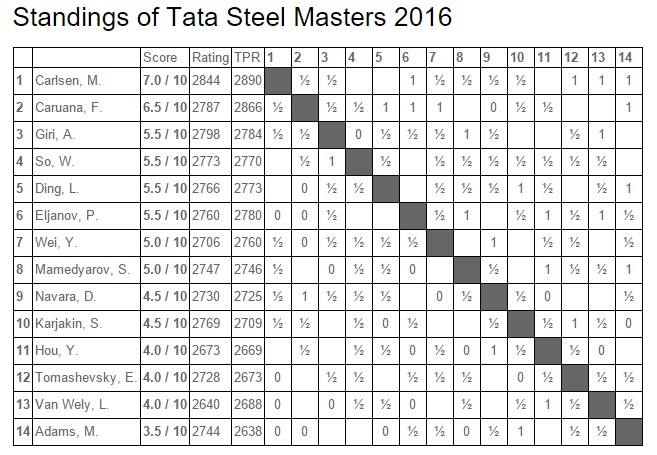
Standings after ten rounds.


16 January 2016

Tata Steel Chess 2016, Round One

Last night, in preparation for today's opening round of the Tata Steel Chess Tournament, I reviewed previous encounters for each of the pairs of contestants. Although the overall strength of this year's event is down from prior years, there will be some interesting match-ups. In the Tata Steel Masters, there are three players from China and only two from Russia. The future is thus well represented.

Hou -- Karjakin

I found one game in the database between these two players, and it was a game that I remember watching live three years ago. It was played during the Tata Steel Chess tournament. Hou Yifan played the French Defense and chose an obscure line of the Steinitz variation designed to immediately swap off her bad bishop. Against a player of Sergey Karjakin's caliber, this strategy was fatal. Too much time was spent in the exchange. Karjakin built up his attack and forced the Black king to remain in the middle of the board. That was enough for a lasting advantage.

Today's game was drawn after both players reached the time control. Each had two rooks and four pawns remaining.

So -- Giri

Anish Giri had White in his first meeting with Wesley So in the Corus C-Group of the 2009 Wijk aan Zee tournament. That game was agreed drawn after it was reduced to a pawn ending. Both players were elevated to the B-Group the following year. Giri won with the Petroff. Later in 2010, Giri beat So again in Biel. Their next two encounters were draws, one in the 2014 Tata Steel Masters. In last year's Tata Steel Masters, Giri won a marathon battle of 111 moves. So then scored a win against Giri in the Vugar Gashimov Memorial in April. They played six more games against one another in 2015, with So winning one of the blitz games and the others all drawn.

So won a symmetrical English that left Black's minor pieces inferior to White's.

Ding -- Adams

The only prior encounter between these two players in my database was at the 2013 Alekhine Memorial. Ding Liren played 4.f3 against Michael Adams' Nimzo-Indian Defense. Most of the pieces came off in a tactical melee, and the players agreed to a draw in a balanced endgame.

Ding Liren won an ending that featured a knight, rook, and pawns on each side. Eventually, Adams lost his knight with a stalemate trap that Ding easily saw through.

Navara -- Carlsen

According to my database, David Navara has an even score against Magnus Carlsen, but all but one of these games were played before Carlsen ascended to the top of the rating list. Navara was over 2700, and ranked above Carlsen when he beat the future World Champion with a Grunfeld Defense at Wijk aan Zee 2007. The previous year, they drew their game in the B-Group. Carlsen's win against Navara came in 2008 at the Dresden Olympiad. Two other games, most recently in 2012, ended as draws.

David Navara gave a nice interview with Yasser Seirawan where he described how he avoided the sort of strategic complications that would have favored the World Champion. In the end, Carlsen forced a draw by repetition.

Caruana -- Eljanov

All of the games between these two players have been decisive with Pavel Eljanov leading 3-2. Two games were played in the World Blitz Championship in 2010. Caruana won with White, but lost in three moves from the Black side. There must have been an illegal move or some other irregularity. The only clue that I could find in ten minutes of searching was Mark Crowther's comment (The Week in Chess, theweekinchess.com, 18 November 2010) that some games were incomplete. Perhaps the game score is incomplete due to problems with the DGT boards. Fabiano Caruana's sole classic time control win against Eljanov came against the Berlin Defense in 2011. Later that year, Eljanov opted for the Caro-Kann and won. Will Eljanov opt to test Caruana in the Berlin once again?

Caruana told Seirawan that he was worse early on in this Queen's Gambit, but his attack began to gain ground after a coupld of time wasting moves by Eljanov. The score between these two players is now even.

Wei -- Tomashevsky

If Wei Yi and Evgeny Tomashevsky have played one another prior to today, the game is not in my database. Nor do any games from the usual online database appear via a Google search.

This 23 move draw was the shortest game of the round.

Mamedyarov -- Van Wely

These two have seventeen prior encounters at my fingertips. Shakhryar Mamedyarov leads Loek Van Wely 7-7-3 (W-D-L). Two of these games were played at Wijk aan Zee.

If you showed this position to any Grandmaster and mentioned that Black has a win, he or she would find it in under two minutes. Alas, there is no such voice of assistance in a tournament game and Loek van Wely missed his chance. The game was drawn after a long ending where White was unable to convert a small advantage.

Black to move


20 August 2013

Kamsky -- Mamedyarov, FIDE World Cup 2013

Gata Kamsky won a stunning game against a formidable Shakhriyar Mamedyarov this afternoon. Commentator Lawrence Trent calls it the "game of the tournament," as does ChessBase News. Many more able commentators than myself will be looking at this game, which may be remembered for many years.


Kamsky,Gata -- Mamedyarov,Shakhriyar [B82]
FIDE World Cup 2013 Tromsø NOR (4.8), 20.08.2013

1.e4 c5 2.Nf3 e6 3.d4 cxd4 4.Nxd4 Nc6 5.Nc3 Qc7

The most popular move, and played by Mamedyarov at least six times in 2010. It seems likely that Kamsky would have looked at these games in preparation.

6.f4

The fourth most popular move has the highest scoring percentage for White.

Black to move

6...d6

6...a6 is the main line. It is interesting to look at statistics through the opening phase of this game. White's winning percentage continues to increase as they approach the end of theory. Even so, there appear to be excellent resources in Black's position.

7.Be3 Nf6 8.Qf3 a6

Reference Game: 8...Be7 9.0–0–0 0–0 10.Rg1 Nxd4 11.Bxd4 e5 12.fxe5 dxe5 13.Qg3 Rd8 14.Be2 Rxd4 15.Rxd4 Bc5 16.Rc4 Be6 17.Rd1 Bxc4 18.Bxc4 Rd8 19.Nd5 Nxd5 20.Bxd5 Kh8 21.Rf1 f6 22.Kb1 b5 23.Qf3 b4 24.g4 Qb6 25.h4 Be3 26.g5 Bf4 27.gxf6 Qxf6 28.h5 a5 29.a4 Qg5 30.Qe2 Rf8 31.Rh1 Qe7 32.Qa6 Qc5 33.Bb3 Rd8 34.Ka2 Bg5 35.Rf1 Bf4 36.Rd1 Qf8 37.Bd5 Qc5 38.Bb3 Qf8 39.Rh1 Ra8 40.Qb6 Qd8 41.Qe6 Qe8 42.Qd5 Qd8 43.Qb5 Qe8 44.Qe2 Rd8 45.Qa6 Ra8 46.Qb7 Rb8 47.Qc7 Qd8 48.Qc4 Qd6 49.Rh3 Rd8 50.Rd3 Qf8 51.Rd5 Ra8 52.Rd7 Rd8 53.Ra7 Ra8 54.Rf7 Qd6 55.Qb5 Bh6 56.Rd7 Qf6 57.Qd5 1–0 Leko,P (2751) -- Ivanchuk,V (2779) Nice 2009

9.Bd3

Reference Game: 9.0–0–0 Bd7 10.Nb3 Rc8 11.Kb1 b5 12.Bd3 Nb4 13.g4 Bc6 14.g5 Nd7 15.Qf2 g6 16.Rhf1 Bg7 17.f5 Ne5 18.Bb6 Qd7 19.Be2 Qb7 20.Na5 Qb8 21.f6 Bf8 22.a3 Nxc2 23.Kxc2 Bxe4+ 24.Kb3 Ba8 25.Ba7 Qc7 26.Qb6 Qxb6 27.Bxb6 h6 28.Nxb5 Kd7 29.Bd4 Bd5+ 30.Ka4 axb5+ 31.Bxb5+ Bc6 32.Bxe5 Bxb5+ 33.Kxb5 Rc5+ 34.Kb6 Rxe5 35.Rc1 Rxa5 36.Rc7+ Kd8 37.Rfc1 Rc5 38.R1xc5 dxc5 39.Kc6 1–0 Kramnik,V (2807) -- Topalov,V (2743) Monte Carlo 2003

9...Be7 10.0–0 0–0 11.Kh1 Bd7 12.Rae1 b5 13.a3 Rab8

Reference Game: 13...Nxd4 14.Bxd4 Bc6 15.Qg3 g6 16.Qh3 e5 17.Be3 Qb7 18.f5 a5 19.Bh6 Rfe8 20.Bg5 Nh5 21.f6 Bf8 22.Qe3 Rac8 23.Bh6 Bxh6 24.Qxh6 Re6 25.Qg5 b4 26.axb4 axb4 27.Nd1 h6 28.Qh4 Kh7 29.Ne3 Nf4 30.Ng4 h5 31.Nf2 Kh6 32.Nh3 Nxh3 33.Qxh3 d5 34.Qe3+ Kh7 35.g4 dxe4 36.Bc4 Bd5 37.Bxd5 Qxd5 38.gxh5 Rg8 39.Qxe4 Qxe4+ 40.Rxe4 gxh5 0–1 Xu Yuhua (2501) -- Ioseliani,N (2499) Shanghai 2001

13...Rac8 has been played as well.

14.Nxc6 Bxc6 15.Qh3

Black to move

15...Rfd8?N

Stockfish 3 dislikes Shak's move, suddenly evaluating that White has a one pawn advantage.

15...Rbd8 has been played in a handful of games 16.Bd4 e5 17.fxe5 dxe5 18.Nd5 Bxd5 19.Bxe5 Qxe5 20.exd5 Qxb2 21.Rxf6 g6 22.Rxa6 Rxd5 23.Qf3 Re5 ½–½ Borghi,H (2335) -- Varela,G (2273) Buenos Aires 2000

16.Bd2!

This move is of the sort that sets masters apart form the rest of us.

16...d5

"This is the critical moment." Lawrence Trent, Official Website Commentary, with Susan Polgar.

17.e5 Ne4 18.f5!

Kamsky's bishop sacrifice was the only move that maintains an advantage.

Black to move

18...Nxd2

Mamedyarov could have refused the offer of a bishop 18...exf5 19.Qxf5 Bf8 or Rf8 and a complex battle (19...Nxd2?? 20.Qxh7+ Kf8 21.Qh8#). Trent and Polgar thought that 18...Nxd2 was obligatory.

19.fxe6 Ne4 20.exf7+ Kh8 21.Nxd5 Bxd5

White to move

22.Rxe4 g6

22...h6? 23.Qf5+-.
22...Qc6?? leads to the sort of position that one finds in tactics books for beginning players.

23.Ref4?!

Trent thought that 23.Re3 was an easy move to find.

23...Kg7??

23...Qc6 was suggested during Trent and Polgar's commentary following 23.Re3, and was still the correct move after Ref4, according to my engine.

24.e6 Rf8 

24...Bg5 25.f8Q+ Rxf8 26.Rf7+ Qxf7 27.exf7 Rxf7 28.Rxf7+ Bxf7 29.Qd7+-

25.Qe3!

Kamsky shows that his queen can access the long diagonal at many points, and then it is curtains for Black.

Black to move

25...Bc5 26.Qe1 Bd6

Was 26...Be7 better? 27.c4 bxc4 28.Qc3+ Kh6 29.Bxc4.

27.Rh4 Be7 28.Qe3

White's advantage is overwhelming.

Black to move

28...h5

28...Bxh4 29.Qd4+ Kh6 30.Qxh4+ Kg7 31.Qf6+ Kh6 32.Rf4+-.

29.Qd4+

29.Rxh5 was a quicker win 29...gxh5 30.Qd4+ Kh6 31.Rf6+ Kg7 32.Rg6+ Kh7 33.Qg7#

29...Kh6 30.Rxh5+ 1–0

02 March 2012

Spanish Opening, Steinitz, Bronstein Variation C76

Despite more than 50,000 online blitz games, my first game in ECO code C76 was Sunday's round 5 game in the 20th Dave Collyer Memorial tournament. I opted for the Spanish Opening (Ruy Lopez) as White. My opponent, Expert Tim Moroney, played a deferred Steinitz Defense, Bronstein variation. I was on my own without any book knowledge on move 4, a fairly uncommon experience in the Spanish Opening. Nevertheless, the game's novelty came on my opponent's move 9.

We chose an unusual move order, but ended in an opening system played with success by David Bronstein as Black in the 1950s, employed by Boris Spassky in the 1980s also with success, and in the years 2006-2008 by Shakhriyar Mamedyarov but with a negative score, although he drew Viswanathan Anand in one game. In game 22 of the 1929 World Championship, Alexander Alekhine won with Black against Efim Bogoljubov using this system.

1.e4 e5 2.Nf3 Nc6 3.Bb5 a6 4.Ba4 d6 5.c3 Bd7 6.d4 g6

White to move

My game Sunday reached this position via the move order 1.e4 e5 2.Nf3 Nc6 3.Bb5 g6 4.c3 a6 5.Ba4 d6 6.d4 Bd7.

7.O-O is the most popular move and is the main line give in ECO.
7.Bg5 was my move, and is the other ECO line.

Bogoljubov played 7.Bg5.

That game continued 7...f6 8.Be3 Nh6

White to move

Here, Bogoljubov castled, 9.O-O. I played 9.dxe5, a move appearing in Big Database 2011 in five games.

My opponent's 9...Nxe5 rendered our game unique.

Bogoljubov -- Alekhine continued 9...Bg7 10.h3 Nf7 11.Nbd2 O-O 12.dxe5. Here Alekhine comments:
White--rightly--recognises that a further maintaining of the tension in the centre would be rather to Black's advantage and aims at simplification. The problem of the defence has been solved in this game in quite a satisfactory way.
Alekhine, My Best Games of Chess, 1924-1937 (1965), 63.
My opponent commented after our game that his opening choice must be deemed a success because he very easily achieved equality.

Had Moroney played 9...dxe5, our game would have transposed to a line with some history, including Bronstein -- Sakharov 1960, played in the 27th Soviet Championship. Bronstein -- Sakharov began with the move order 1.e4 e5 2.Nf3 Nc6 3.Bb5 a6 4.Ba4 d6 5.c3 Bd7 6.d4 g6 7.dxe5 dxe5 8.Bg5 f6 9.Be3 Nh6.

Black's opening choice does appear to offer good prospects for equality.

I was playing for a draw with White. In the late middlegame, my opponent and I repeated a position once. Instead of extending the draw offer that I invited by this repetition, my opponent broke open the game into an endgame that made a draw unlikely. Lucky for me, he incorrectly assessed the resulting pawn endgame and I won. See "Pawn Wars" for the endgame critical position.

ECO Code is a trademark of Chess Informant