Showing posts with label outposts. Show all posts

24 June 2022

Outpost

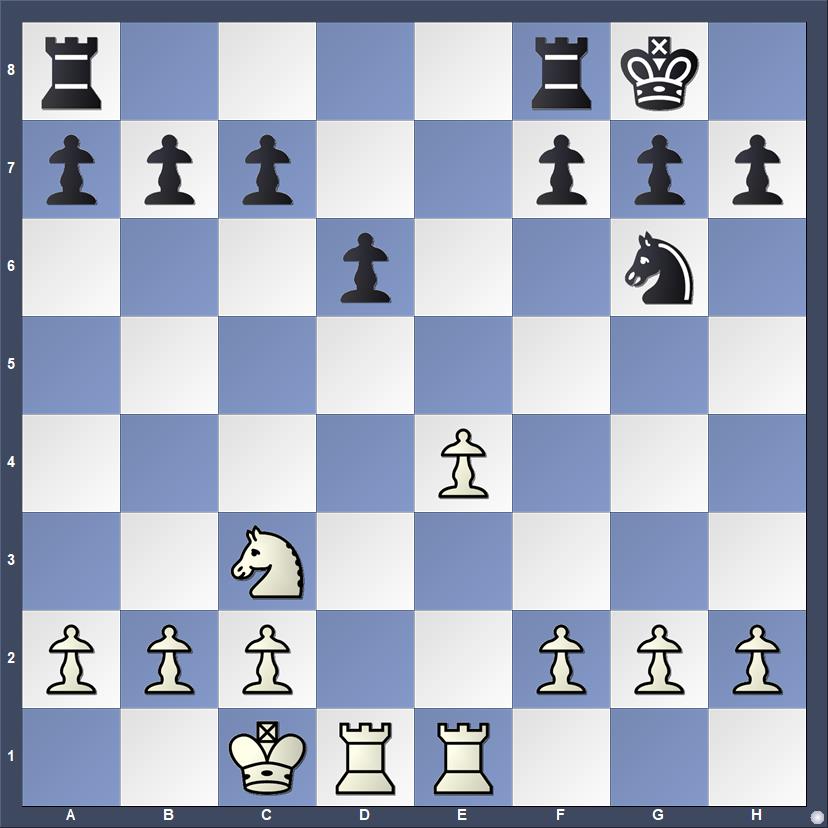
The concept of an outpost square in chess varies somewhat in chess literature. Aron Nimzowitsch often gets credit for introducing the  concept in My System (1925).* For Nimzowitsch, outposts are connected to play on open files. He presents the following position.

White to move
The key move, Nimzowitsch writes, is Nd5, "and the knight here placed we call the outpost; by which we mean a piece, usually a knight, established in an open file in enemy territory, and protected (of course by a pawn)" (32). This move provokes black to drive the knight back with c6, a move which weakens the d-pawn.

A contrasting definition of outpost is given by David Hooper and Kenneth Whyld in The Oxford Companion to Chess (1992). In their definition, an outpost is a square, "guarded by a pawn but cannot be attacked by an enemy pawn, especially such a square on an open file" (285). That the square cannot be assailed by an enemy pawn is central to Peter Romanovsky's description of the "eternal knight". In Chess Middlegame Planning, trans. Jimmy Adams (1990), Romanovsky suggests conditions when a piece might be placed permanently on a weak point in the opponent's position:
And so the potential weakness of a square arises as a result of the impossibility of attacking it with pawns. However, such a square should only be considered a real weakness when an enemy piece, which it will not be possible to drive away or eliminate by an exchange, threatens to take up a position. (37)
Such a position was reached in a game presented by Romanovsky, Izmailov -- Kasparian, Moscow 1931. After 25...Nd4, Black's knight is unassailable.

White to move
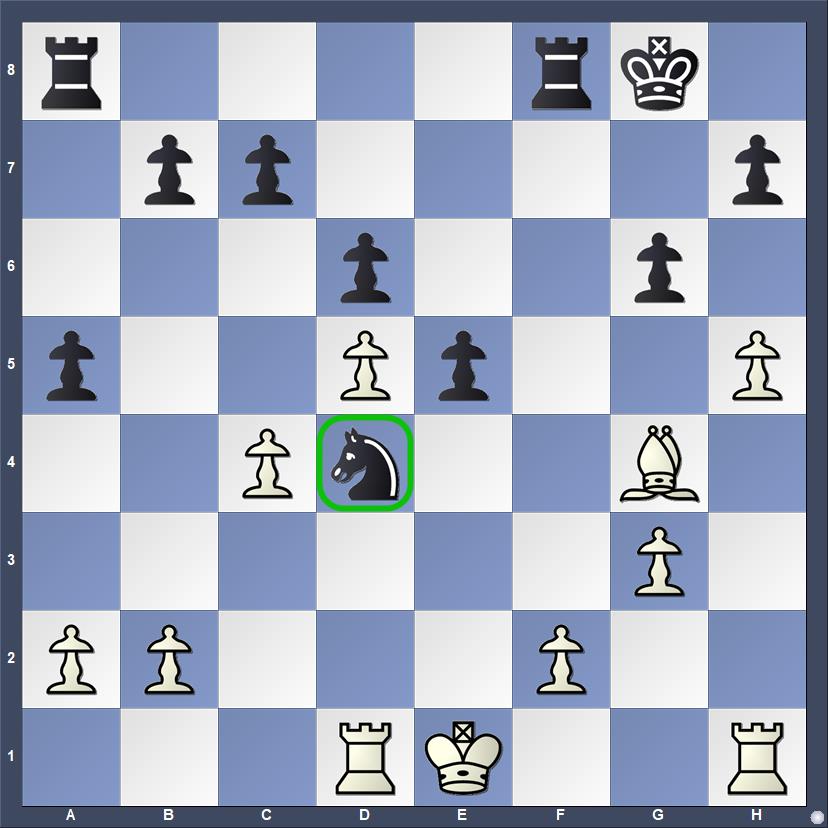
The knight does not sit on an open file, as Nimzowitsch's definition would lead us to expect. Romanovsky does not employ the term outpost, but highlights the concept through "weak squares" and the "eternal knight".

Hooper and Whyld also refer readers to their entry on the concept of "hole", "a square on a player's third rank or beyond that cannot be guarded by a pawn" (175). The concept, they state originates from the writing of Wilhelm Steinitz. He writes in The Modern Chess Instructor (1889) that he first used the term in The International Chess Magazine (November 1886). In Steinitz, we find the concept of an outpost square, albeit without the term later used by Nimzowitsch:
...not alone the weakness on one single pawn but also that of one single square into which any hostile man can be planted with commanding effect, will cause great trouble, and often the loss of the game, and that by proper management of the pawns such points of vantage need not be opened for the opponent. (xxxix)
Steinitz gives the opening moves 1.e4 e5 2.c4 as creating permanent weaknesses for White on d3 and d4, even anticipating Nimzowitsch's focus on open files: "A hole or a weak square are still more troublesome when the opponent is enabled to open the file on which they are situated for his queens and rooks" (xxxix).

The Lesson

Several of my students this past week were presented a lesson concerning outposts that I extracted from Michael Stean, Simple Chess (1978). Stean offers a nuanced definition: "a square at the forefront of your position which you can readily support and from where you can control or contest squares in the heart of the enemy camp," mentioning both a supporting pawn and that the opponent cannot attack the position with pawns (13). He offers five illustrative games with informative annotations. I selected one position from each game, presented the position to my students, and we played from there. Then we looked at the game as played.

In Stean's first illustrative game, Tal -- Bronstein, Tbilisi 1959, Black contested White's efforts to establish a knight on d5. When the knight went there anyway, it provoked a series of exchanges that led to a superior endgame for Tal. The second game, Benko -- Najdorf, Los Angeles 1963, offers a well-placed forward knight on f5 and an open h-file for White's heavy pieces.

White to move
Benko opened a line for the queen to join the rooks on the h-file with 24.f4! Najdorf resigned a couple of moves later. A couple of my students tried 24.Rh7, and one was able to beat me in a queen and pawn ending after quite a few moves.

Stean's selection shows a range of tactical opportunities that were facilitated through battles focused on outposts and concludes with Unzicker -- Fischer, Varna 1962 where Fischer successfully prevented Unzicker's efforts to deploy a knight to a d5 outpost.


*I am using the 1947 David McKay edition, translated by Philip Hereford and revised by Fred Reinfeld.

25 February 2016

Outpost: Threat and Execution

In the 1990s, I read Peter Romanovsky's subchapter, "The Eternal Knight", in Chess Middlegame Planning (1990) and found it a useful beginning towards the understanding of outposts. Michael Stean's discussion in Simple Chess (1978) takes my understanding a step further. At the end of his first illustrative game, Stean notes:
Particularly noteworthy was the terrible restraining influence exerted on Black by the continual threat of Nd5. Having completed his development very harmoniously. Black found it difficult to undertake any active plan without allowing the inevitable Nd5. Indeed, he only had to decentralise one piece (20...Na5) and the White knight jumped down his throat.
Stean, Simple Chess, 18.
This game, Tal -- Bronstein, USSR Championship 1959, was my lesson of the week for my advanced students. We started with this postion.

White to move

With a definition of outposts written on the white board, I asked students to identify the outposts in this position.

An outpost is a square that might be occupied by one's own piece, ideally supported by one's pawn, and that cannot be attacked by an enemy pawn. With some guidance, the students were able to see that d5 was an outpost for White's pieces, and that d3 was a potential outpost for Black.

We then went through the bulk of the game and Stean's comments.

The diagram above is prior to 14.Nf1. The knight finally occupies the critical outpost of d5 on move 22.

White to move

Stean comments:
The moment we've all been waiting for, not to mention the white queen, rook, and bishop who have been patiently queuing up behind the e-pawn for some time. White's decision to play his trump card now is prompted by the fact that Black's knight has been drawn out of play to a5. This may not seem to be very significant, but with the rapid opening up of the position which must surely follow, the abscence of even a single piece from the central field of battle will cause great difficulties for Black. Stean, Simple Chess, 16.
The game as whole is interesting and serves as a good example of employing the threat of an outpost as a strategic and tactical weapon. Restraining the opponent's choices via the threat to occupy an outpost is a notion less evident in Romanovsky's treatment of this topic.


Beginning Students

My beginning students this week solved the problems in Beginning Tactics 9 (see "Lesson of the Week" [13 December 2012]). When they stumbled on the seventh problem, I showed them the game Mayet -- Anderssen 1851 (see "Sacrificial Attack").