Showing posts with label Gligoric. Show all posts

02 June 2024

A Mednis Error

Edmar Mednis, Practical Rook Endings (1982) is proving its value as I am using positions from it with a student who wisely requested a focus on rook endgames. Last week, I spent one early morning studying Mednis’s analysis of Ljubojevic — Gligoric, 1979. Ljubomir Ljubojevic won game nine of their match when Svetozar Gligoric missed a critical defensive resource. However, this resource was possible because of an inaccurate move by Ljubojevic.

After finding the analysis instructive, I set up the game to play against Stockfish. The engine showed me that had Ljubojevic played the recommended move, there was another defensive resource available to Gligoric. This resource refutes Mednis’s claim that Ljubojevic missed a win when he pushed his g-pawn before playing 68. c4!

Mednis’s analysis begins after 66…Rg4.

White to move

The game concluded 67.g7 Kb7 68.c4 Rg2 69.Kc3 and Gligoric resigned.

According to Mednis, White should have played 67.c4, when White wins after 67…Rg3+ 68.Kc2 Kb7 69.g7 Ka7 (there is a typo in the book giving Kc7, which the prose makes clear is not the intended line, as it loses immediately to 70.Ra8) 70.Kd2.

Black to move
From Mednis's Analysis

The idea is that White’s king will move towards the rook, up the f-file, and then over to capture Black’s c-pawn. All of this is explained clearly and accurately by Mednis. White’s c-pawn then destroys Black’s defensive fortress with the king safe from skewers by remaining on a7 and b7.

However, Stockfish, which relies on deeper calculation rather than endgame principles, showed that Black can play 68…Kd7!! Playing this position out leads to a drawn pawn ending.

My game against Stockfish from the diagram at the top of this post went thus:

67.c4 Rg3+ 68.Kc2 Kd7! 69.g7 Ke7 (69...Ke6 is also drawing)

White to move
70.Ra8 

I might have tried 70.Kd2 Kf7 71.Rf8+ Kxg7 72.Rf5, but exploring this line later showed that all roads lead to a draw. Still, Black must either understand the needs of the position or calculate with the sort of depth employed by Stockfish.

70...Rxg7 71.Ra7+ Kf6 72.Rxg7 Kxg7 73.Kb3

Black to move

73...Kf6 74.Ka4 Ke5 75.Ka5 Kd6 76.Kb5

Black to move
All of my students learn early on how to draw this position with Black.

76...Kd7 77.Kxc5 Kc7=

Having played against the computer many of the positions from Mednis, Practical Rook Endings, I have observed that his analysis usually holds up to computer checking. In this particular ending, however, he did not look deep enough into a possible pawn ending had Gligoric opted to ignore the usually prudent movement of the king to the crucial a7 and b7 squares.

While ruminating over this analysis during my morning walk with my dog, it occurred to me that analysis presented by Mednis may not have originated with him. A quick check of the endgames published in Chess Informant confirmed my hunch. All of Mednis's analysis appeared in the endgame section of Informant 27. There it is credited to two of the founding members of CI's editorial team: Borislav Milic and Aleksandar Bozic.


18 January 2014

Aronian -- So, Tata Steel 2014

The Tata Steel Grandmaster tournament in Wijk aan Zee has a history that goes back to the 1930s when it was first organized as a small, local chess tournament for workers at the Hoogoven Steelworks. Players from outside the Netherlands first joined the event in 1946. Alberic O'Kelly de Galway (1911-1980) from Belgium won the main tournament in that year. From 1952, players from eastern European countries have participated, and Vasja Pirc (1907-1980) from Yugoslavia shared first in 1954.

In the 1970s, I bought a book that has all of the games from the 1975 Grandmaster Tournament, won by Lajos Portisch (1937- ). I learned a lot about chess openings, tactics, and strategy from this book. It also made me familiar with the names of some Grandmasters, including Jan Timman, playing again this year in the B group. Playing through the games in the tournament book led me to buy a copy of Svetozar Gligoric's (1923-2012) selected games and play through some of the games in it as well. By the time that I started college in 1979, I had amassed a library of perhaps a dozen chess books, some of which I still have today.

In 2000, I followed the games live on the Internet Chess Club. Since then, I have often devoted a fair portion of my early mornings in January to watching live games on my computer screen. I have used ICC, the Playchess server, and in recent years the official tournament site. Some years I have tried to watch as many as nine games at once, and sometimes switching which nine through the course of the day. The past couple of years, I have tried to focus on one key game each day, trying to understand it as if I were there in the players' seats.

Some years I have followed closely the commentary, even giving Yasser Seirawan (1960- ) advice concerning cough drops as his voice grows weary through the broadcast. For the most part this year, I am ignoring the commentary and avoiding the engine evaluations. I want to assess the games for myself before I look to these other terrific resources.

I usually follow the A group, although I recall looking at the games of a young player who won the C group in 2004--Magnus Carlsen.

This year I am following Levon Aronian's games. He has White against Wesley So today. Aronian is the tournament leader after five rounds. So is one of two players 1/2 point behind. Today's game will prove important for the final standings.

Aronian,Levon (2812) -- So ,Wesley (2719) [A16]
Tata Steel Wijk aan Zee (6), 18.01.2014

1.c4 Nf6 2.Nf3 g6 3.Nc3 d5 4.cxd5 Nxd5 5.e4 Nxc3 6.bxc3 Bg7 7.Be2 c5 8.0–0 Nc6 9.Qa4 Bd7 10.Qa3 Qa5

White to move

11.Rd1 0–0 12.Rb1

This game started from an English Opening, but it resembles a Grunfeld Defense in certain respects. Maybe certain variations of the English often resemble the Grunfeld. I do not know. I have not thought about it before. Learning such patterns may become an important element in my training if I am to rise above my present level. Players below 1800 do not need to study openings beyond elementary opening principles. However, I have been over 1800 for nearly five years. I should know more about openings.

12...b6 13.d4 Qxa3 14.Bxa3 Bg4 15.dxc5 Bxc3 16.Ba6

I awoke at 5:00 am turned on my iPad and opened the website for this tournament, but then decided to close my eyes for more sleep. When I awoke the second time, this was the position on the board.

Black to move

16...Rab8 17.Rdc1 Bxf3 18.gxf3 Bd2 19.Rd1 Bc3 20.Kg2 bxc5 21.Bxc5 Bb4 22.Be3 Bd6

White to move

With my blog post begun, the game more or less up-to-date, and coffee in my cup, I can begin the task of thinking alongside Aronian.

Are doubled f-pawns a weakness? How valuable is the bishop pair against a bishop and a knight with rooks on the board?

Aronian is close to 40 minutes ahead on the clock, which seems to a pattern in his play in this tournament. It is nice to have an opponent in time pressure, as it helps him to make errors. So has just over one minute plus the thirty second increment for each move until the game reaches move 40.

23.Rbc1 Nb4 24.Bc4 Rfc8

I glanced at Black's unprotected a-pawn and quickly realized that 25.Bxa7 Ra8 26.Bd6 allows Black to capture the pawn on a2. If White has prospects of an advantage in this game, there will need to be pawns on both sides of the board.

Aronian appears to be thinking for a long time. I am certain that he has a much better notion than I do concerning how to proceed to apply pressure. He wants to give So a chance to err in a position that is probably equal, although there are imbalances.

Sometimes when it seems that a player goes into an exceptionally long think, there are problems with the broadcast. Later, I discover that many moves have been played. Even so, this position does seem to be one that merits deep analysis.

White to move

Trying to swap one set of rooks is one idea that occurs to this patzer. Pushing the forward f-pawn is another.

It was a problem with the broadcast, or with my home internet. Aronian used less than four minutes to play one of my candidate moves. He used more than five minutes on the next move, and then sixteen on the move after that.

25.f4 Kf8 26.a3 Nc6 27.Ba6 Bxa3

So. perhaps I was wrong about the importance of keeping this pawn.

28.Rc4 Rd8 29.Ra1 Bb2 30.Raa4 Rd6 31.e5 Re6 32.Rc2

Black to move

32...Nd8 33.Bxa7 Ra8 34.Bb5 Bxe5 35.fxe5 Rxe5 36.Be3 1-0

I did not find Aronian's ideas today. His play in this event is impressive. Studying these games may well prove useful in learning how to maneuver bishops for advantage.

Aronian extended his lead today unless Anish Giri manages to keep pace 1/2 point behind. Giri is playing Boris Gelfand, who so far is having a horrible event.

30 August 2012

Elementary Tactics: Discovery

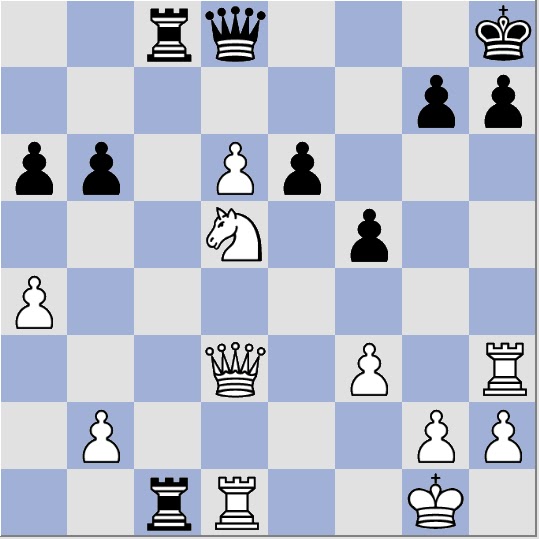
In Gligoric -- Averbakh, 1966, Black did not play 32...Qxd6. Why not?

Black to move

2rq3k/6pp/pp1Pp3/3N1p2/P7/3Q1P1R/1P4PP/2rR2K1 b - -


21 August 2012

Svetozar Gligoric, 1923-2012

Grandmaster Svetozar Gligoric passed away 14 August 2012. He was among the top players in the 1950s and '60s. Gligoric was a top chess commentator, an innovative openings theorist, a fierce competitor, and a true gentleman. He avoided psychological ploys against perceived weaknesses in his opponents, preferring as he put it, to "play against pieces."

When I started reading chess books in the mid-1970s, Gligoric was a regular at top GM tournaments, and an excellent chess writer.