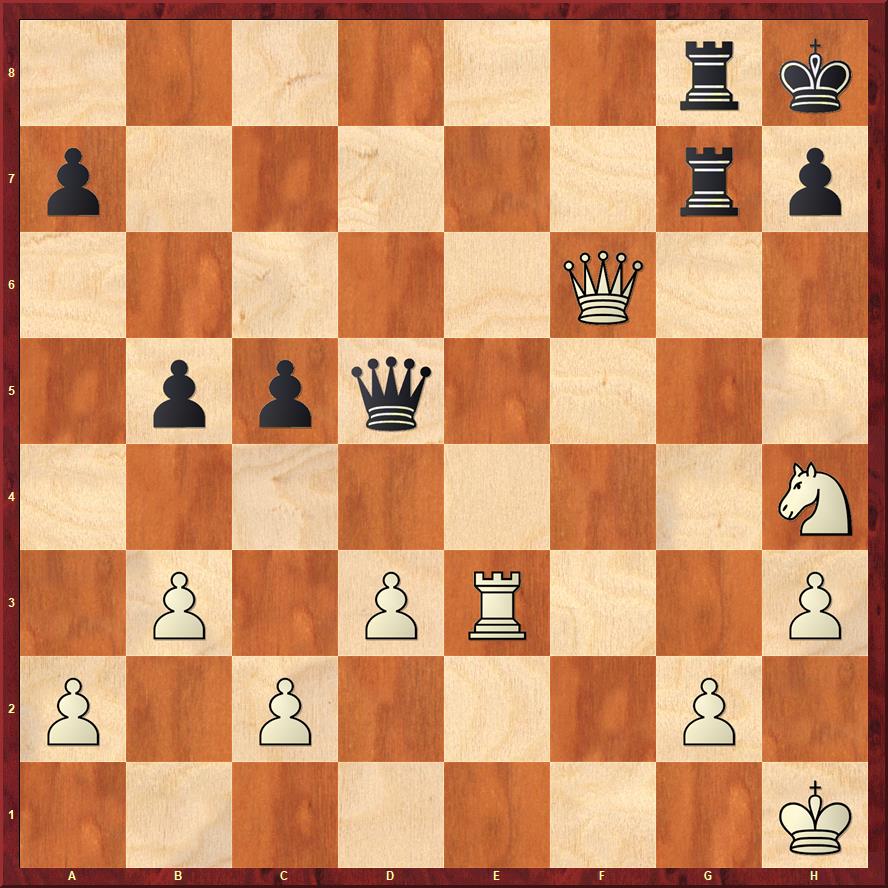
When I read this book last year, I was already familiar with both the concept and a different Caro-Kann game from having seen them yoked in John Watson, Secrets of Modern Chess: Advances since Nimzowitsch (1998). Watson cites as an example of rule independence a game that Andy Soltis presents in The Art of Defence where Black's first ten moves included seven pawn moves. Yet, somehow I remember it as the same line presented by McDonald (maybe it, too, is in Watson's book).
After McDonald's explication, however, I began playing this line against the Caro-Kann in my online games. I've trapped several bishops when my opponent strayed from the best course. In other games, I've also sacrificed a pawn on e6 to lock in Black's dark-square bishop. These games turned out to be good preparation for a tournament game when my opponent attempted to play the Nimzo-Larsen Attack. But there was more: inspiration from a game I looked at nine years ago.
A game in Chess Informant 124 (2015) inspired me such that I have been meeting 1.b3 with 1...a5 ever since with good results. That game is Rapport -- Adly, Tsaghkadzor 2015. Sometimes I enjoy creating chaos at the board, but I always find it useful to remove my opponents from their comfort zone.
Both these games inspired and guided me during my round four game against David Griffin in the Inland Classic last weekend.
Griffin,David (1522) -- Stripes,James (1873) [A04]
Inland Classic Rathdrum (4), 25.02.2024
1.Nf3 Nc6 2.b3 a5N
A novelty inspired by Rapport -- Adly. Rapport is a devotee of 1...b3. I call this move a novelty because the position does not appear in my usual databases. However, further research shows that the move in the present position has been played 902 times on Lichess.
I did have an OTB game against Griffin Herr in 2019 that began 1.Nf3 Nf6 2.b3 a5. Before the game, Griffin had asked me how I responded to 1.b3. I told him the truth, not knowing that we would be paired.
3.Bb2 e6 4.e3 a4
Inland Classic Rathdrum (4), 25.02.2024
1.Nf3 Nc6 2.b3 a5N
A novelty inspired by Rapport -- Adly. Rapport is a devotee of 1...b3. I call this move a novelty because the position does not appear in my usual databases. However, further research shows that the move in the present position has been played 902 times on Lichess.
I did have an OTB game against Griffin Herr in 2019 that began 1.Nf3 Nf6 2.b3 a5. Before the game, Griffin had asked me how I responded to 1.b3. I told him the truth, not knowing that we would be paired.
3.Bb2 e6 4.e3 a4
White to move

5.Be2
5.a3 seems important, as I suggested to David after the game.
5...a3
5...Nf6 6.0-0 Be7 7.d4 0-0 8.c4 d5 9.bxa4 b6 10.Nc3 Na5 0-1 (34) Shytaj,L (2459)--Ponkratov,P (2613) Riadh 2017.
6.Bc3 Nf6 7.0-0 d5=
5.a3 seems important, as I suggested to David after the game.
5...a3
5...Nf6 6.0-0 Be7 7.d4 0-0 8.c4 d5 9.bxa4 b6 10.Nc3 Na5 0-1 (34) Shytaj,L (2459)--Ponkratov,P (2613) Riadh 2017.
6.Bc3 Nf6 7.0-0 d5=
White to move

8.Nd4
8.d4 has been popular on Lichess, where this position has occurred in 114 games. David wanted to avoid this move because his bishop's scope on the long diagonal was his intended manner of play.
8.d4 has been popular on Lichess, where this position has occurred in 114 games. David wanted to avoid this move because his bishop's scope on the long diagonal was his intended manner of play.
8...Nxd4 9.Bxd4
9.exd4 Bd6 and I would have continued with somewhat more normal development, perhaps seeking to take advantage of the absence of White's king's knight.
9...c5 10.Be5
10.Bb5+ Bd7 11.Bxf6 gxf6=
10.Bxf6 gxf6= (10...Qxf6 would be a mistake).
10...h5
I am aiming to trap the bishop. After my a-pawn push, I suspect Griffin did not assess the concrete analysis behind this move.
11.Nc3
11.h3 was David's suggestion after the game.
11.d4 is also good.
11...Nd7
We have reached the game's critical position. Both sides still have chances. After White's next move, Black gets the upper hand and carries it to the end.
White to move

12.Bg3??
12.f4! Qb6 (12...f6? 13.Bxh5+ Ke7 14.Qg4 Qa5 15.Qg6 fxe5 16.Qe8+ Kd6 and White is better) 13.Na4 Qc6 and White is slightly better.
I anticipated 12.Bb5 f6 13.Bg3 h4 with a slight edge for Black.
12...h4-+
I'm winning the bishop.
13.Bf4 g5
Here, I wrote 9/13 in the margins of my scoresheet and then went and asked the tournament director whether I had broken the rules by doing so.
14.Re1!
Perhaps David's strongest move of the game. The bishop cannot be saved, but Black might yet be punished for an inordinate number of pawn moves and a king that likely will remain in the center.
14...gxf4 15.exf4 d4 16.Nb5 Nf6
White to move

17.Bc4
17.f5 seems best and principled. Black's material advantage remains, but White has good chances to create some play in the center.
17...Qb6
Finally! After eleven pawn moves and five knight moves, I develop another piece. Already, I am looking towards some checkmate ideas.
18.Qc1
David's focus on removing my a-pawn did not help his game.
18...h3 19.g3 Qc6 20.Bf1
Forced. There cannot be very many positions in the database where Black has pawns on h3 and a3 on move 20.
Black to move

20...Bd7
I wanted to avoid White's bishop pinning my queen against my king with the knight on a3. Also, I might get an opportunity to create a bishop and queen battery along the long diagonal.
21.Nxa3 Bd6
Targeting the unprotected pawn on f4
Stronger was 21...Qf3 22.Qd1 Qxd1 23.Raxd1 Rxa3-+
22.Nc4
22.f5 Qf3
22...Bxf4 23.Ne5
23.gxf4 Rg8+ and checkmate follows.
23...Bxe5 24.Rxe5 Ng4
White to move

25.Re1
25.Qe1 is best, then 25...Qf3 26.Rxc5 Rh5! a deflection that I might have missed 27.Qe2 (27.Rxh5 Bc6 and White can only delay checkmate) 27...Qxe2 28.Bxe2 Rxc5.
25...Qf3
Bc6 will be decisive
26.Qd1? Qxf2+ 0-1
Although my play was unorthodox, it worked because David did not adapt his plans to the needs of the position. The early a5 thrust by Black is not dangerous, but it is disruptive if White does not meet it appropriately.
25.Qe1 is best, then 25...Qf3 26.Rxc5 Rh5! a deflection that I might have missed 27.Qe2 (27.Rxh5 Bc6 and White can only delay checkmate) 27...Qxe2 28.Bxe2 Rxc5.
25...Qf3
Bc6 will be decisive
26.Qd1? Qxf2+ 0-1
Although my play was unorthodox, it worked because David did not adapt his plans to the needs of the position. The early a5 thrust by Black is not dangerous, but it is disruptive if White does not meet it appropriately.