Showing posts with label Evans (William Davies). Show all posts

21 July 2015

Counting Tempi

During a lesson with one of my top students last week, he observed that a particular candidate move lost a tempo. I opined that tempi did not seem as vital in this variation of the Pirc Defense as in certain open positions. The conversation brought to my recollection something that I had read in John Watson's Secrets of Modern Chess Strategy (1998) more than a dozen years ago.

Later in the week, I pulled Modern Chess Strategy off the shelf to revisit the half-remembered passage. Watson's book drove me back into Aron Nimzowitsch, My System (1930). After spending idle moments of three days rereading Modern Chess Strategy and My System, I started digging through other books on the shelf. William Steinitz. The Modern Chess Instructor (1889) did not offer anything to my inquiry, although he mentions a move "losing time" as early as 1873 in The Field.* Seigbert Tarrasch, The Game of Chess (1935) was published after My System, even though it seems to precede Nimzowitsch theoretically.

In order to illustrate his point concerning tempi, Nimzowitsch presents a curious position that has arisen in very few games. Watson carries the position further through logical moves as a critique of Nimzowitsch.

1.e4 e5 2.d4 exd4 3.c3 Nf6

Black's third move does not appear in the Encyclopedia of Chess Openings (ECO). My database does have three instances of this position prior to publication of My System. All three games were played in 1839 by William Davies Evans, inventor of the Evans Gambit. Evans had White against three different opponents, the best known of which was Pierre Charles Fournier de Saint-Amant. One of these games reached this position by transposition (1.e4 e5 2.c3 Nf6 3.d4 exd4).

Concerning this unusual 3...Nf6, Nimzowitsch states, "Black lets what will happen, and this is what every beginner should do in order to gain experience of the consequences of an advance in the center" (12).

4.e5 Ne4


White to move

"The knight can maintain himself here, for Bd3 will be answered by a developing move of full value, namely d5" (Nimzowitsch, 12-13). Nimzowitsch suggests that after 5.Bd3, Nc5 would be an error because the continuation 6.cxd4 Nxd3+ 7.Qxd3 "would yield an advantage of four tempi to White" (13). The resulting position appears once in my database--a seventeen move draw, perhaps one of those notorious arranged draws that plays out an obscure line from a book for a few moves.

Watson states concerning this advantage of tempi in Nimzowitsch's line:
Four tempi or not, 7...d5! leaves Black with two bishops and a healthy share of the centre (and it is White's 'good' bishop which has just been devoured). Most players would be quite content here as Black. (14)
After 4.e5, Captain Evans faced 4...Ne4 against George Perigal, 4...Qe7 against Saint-Amant, and 4...Nd5 against F.L. Slous.

Watson describes as "egregious", Nimzowitsch's assessment after 1.e4 e5 2.d4 exd4 3.c3 Nf6 4.e5 Nd5.

White to move

Nimzowitsch offers the continuation: 5.Qxd4 c6 6.Bc4 Nb6 7.Nf3. He states, "White has here six tempi as against two or one and a half, for the knight is not better placed at b6 than at f6, and the pawn at c6 is not really a whole tempo, since no move of a central pawn is here in question" (13).

Black to move

Watson asks, what has become of those valuable tempi after the logical 7...Nxc4 8.Qxc4 d5? Again, Black has the two bishops and is about to catch up in the number of minor pieces developed. He asserts that White is struggling for equality (15).


Tarrasch

For his part, Siegbert Tarrasch claims that counting tempi originated with Semion Alapin and him.
It is a very good thing, from time to time at least, to balance an account of the tempi visible on the board. This tempi reckoning originated with Alapin and myself. To be sure Alapin, as indeed is quite correct, included in his reckoning such moves as a4/a5, whilst I include only the developing moves and ignore the others--a system which, in my opinion based on my experience, gives results of greater practical value.
The Game of Chess, 228-229
Tarrasch offers a diagram to illustrate.


From his discussion of earlier positions, we learn that center pawns that have cleared out of the way of the pieces can be counted even if they have been captured. In this position, however, he does not count the pawns because both players have advanced both center pawns, making matters equal.

He explains further that a queen that has moved off the back rank counts as one tempo, regardless of how many times it has moved or where it stands. A rook is counted only if it has some space to move. Both of White's rooks have squares in front of them, and so count. Black's rook on g8 has moved, but is blocked and so does not count. Tarrasch does not count the rook on a8 because it has not moved, although perhaps he might consider it developed if the a-pawn were advancing against some target. Knights are more valuable when further advanced. The knight on c3 is one tempo. A knight on the fourth or fifth rank would count as two tempi, and Tarrasch counts three tempi for the knight on e6. Each bishop counts as one tempo when developed no matter how many moves were required to reach its present post.

Tarrasch thus finds that in this diagram, White has nine tempi to Black's five.

Most useful in Tarrasch's discussion, however, is the relationship of Time to Force and Space. "By good play tempi once gained are never lost," he asserts, "but rather are ultimately transformed into a gain in Space or Force" (231).

He is worth quoting at length.
These three factors of Force, Space and Time work together at every move. The whole art of the Opening consists in bringing into action pieces which are first shut in, in freeing pieces by a very few pawn moves, and in getting them to favourable positions and that as quickly as possible. Each tempo must be fully utilised for development, and one must advance one's game. (231)
Although Tarrasch is considered the dogmatist among classical chess theorists, I see the beginnings of modern dynamic chess in his discussion of the balancing of tempi with material and board control.


*See Sid Pickard, The Collected Works of William Steinitz (2003), CD for Steinitz's magazine annotations.

30 June 2014

Three Fighting Draws

McDonnell -- De La Bourdonnais 1834

The chess games of Alexander McDonnell (1798-1835) offer abundant instruction in tactics. McDonnell, born in Belfast, Ireland, is considered to have been the strongest chess player in Great  Britain during the early 1830s. He is most often remembered, however, for his matches with Louis-Charles Mahé de La Bourdonnais (1795-1840). McDonnell lost more than half of their 85 games played during six matches. He was thus the runner-up in the first unofficial world chess championship. He also won 27 of those games, however.

For the past several days, I have working through McDonnell's games during my morning coffee. My intention is to go through all of his available games (ChessBase has 110; chessgames.com has 105). Most of his play was at odds, as was customary in his day, so the selection of available games in databases is small. There are 35 games in addition to the match games against Bourdonnais. Two of these are short losses to Captain William Davies Evans, including what is probably the oldest recorded instance of the Evans Gambit. Most of the rest are games played during simuls.

After going through these 35 games neither as fast as Jeremy Silman claims was his habit as a young player, nor slow enough to understand every nuance, I reached the La Bourdonnais match games this morning. They appeared to play by a rule that would remain common for the next several decades: draws do not count and must be replayed. Hence, La Bourdonnais had White through the first four games. Each draw led to another game with the same colors.

Although all drawn, the first three games were battles from the first moves to the finish.

De Labourdonnais,Louis Charles Mahe -- McDonnell,Alexander [C21]
London m1 London (1), 1834

1.e4 e5 2.d4 exd4 3.Nf3 c5 4.Bc4 Nc6 5.c3 Qf6 6.0–0 d6 7.cxd4 cxd4 8.Ng5 Nh6 9.f4 Be7 10.e5 Qg6 11.exd6 Qxd6 12.Na3 0–0 13.Bd3 Bf5 14.Nc4 Qg6 15.Nf3 Bxd3 16.Nce5 Bc2 17.Nxg6 Bxd1

White to move

18.Nxe7+

18.Nxf8? loses material. 18...Bxf3. After the text, White remains down only the sacrificed pawn and retains a slight initiative.

18...Nxe7 19.Rxd1 Nhf5 20.g4 Ne3 21.Bxe3 dxe3 22.Rd7 Rfe8 23.Re1 Ng6 24.f5 Nf4 25.Rd4 Nh3+ 26.Kg2 Nf2 27.Rc4 Rad8 28.h3 h6 29.Re2 b5 30.Rd4 Rxd4 31.Nxd4 a6

La Bourdonnais's aggressive play has led to exchanges and an ending where Black retains the advantage of one pawn, albeit one that will fall.

White to move

32.Kf3 Nxh3 33.Rxe3 Ng5+ 34.Kf4 Rxe3 35.Kxe3

And now it is a knight ending with pawns on both sides. Such knight endings are often sought by players substantially stronger than their opponents because they offer better prospects of victory than rook endings.

35...g6 36.fxg6 fxg6 37.Nc6 Ne6 38.Ke4 Kf7 39.Ke5 h5 40.gxh5 gxh5

White to move

McDonnell has the advantage, but La Bourdonnais has the draw well in hand. As long as he holds, he gets another game with the White pieces.

41.Kf5 Nc7 42.b3 Ke8 43.a4 bxa4 44.bxa4 Nd5 45.Kg5 Ne7 46.Nb8 a5 47.Na6 Ng6 48.Kxh5 Nf4+ 49.Kg5 Ne6+ 50.Kf5 Kd7 51.Ke5 Nd8 ½–½

De Labourdonnais,Louis Charles Mahe -- McDonnell,Alexander [C44]
London m1 London (2), 1834

1.e4 e5 2.Nf3 Nc6 3.d4 exd4

Switching the move order of the first game has led to the Scotch Gambit, an opening occasionally employed as a surprise weapon in our day.

4.Bc4 Qf6 5.c3 d3 6.Qxd3

This time, White recovers the pawn quickly.

6...d6 7.0–0 Qg6 8.Bf4 Be7 9.Nbd2 h5 10.Rfe1 Bh3

McDonnell, too, shows some aggression.

White to move

11.Nh4 Bxh4 12.Qxh3 Bf6 13.e5 dxe5 14.Bxe5 Bxe5 15.f4 Nge7 16.fxe5

This time, it is White who has a vulnerable e-pawn that is far advanced.

16...Qg4 17.Qxg4 hxg4 18.Nb3 Ng6 19.e6 f5 20.Rad1 Nge5 21.Bd3 Rh5 22.Bc2

Black to move

22...Ke7 23.Nd4 Kf6 24.Rf1 Ne7 25.b4 Rah8 26.Ne2 Rxh2

McDonnell wins a pawn.

27.Ng3 g6 28.Bb3 Kg5 29.Rde1 Nd3 30.Re3 Nf4 31.Rf2 R2h7 32.Rd2 Nh5 33.Nxh5 Rxh5 34.Kf2 f4 35.Re5+ Nf5 36.e7 Re8 37.Rd7

Black to move

La Bourdonnais is positioned to win back a pawn, but McDonnell finds the way to another ending with a one pawn advantage.

37...Rh7 38.Rxc7 Rhxe7 39.Rcxe7 Rxe7 40.Rxe7 Nxe7

White to move

The players reach a minor piece ending where the bishop must contend with a knight that fights alongside a superior number of pawns.

41.a4 Kf5 42.a5 Ke5 43.Bd1 g3+ 44.Kf3 Nd5 45.Bc2 g5 46.b5 Nxc3 47.b6 axb6 48.axb6 Nb5 49.Kg4 Nd6 50.Bd3 Ne4 51.Be2 Kd5 52.Bf3 Ke5 53.Be2 Kf6 54.Bf3 Nf2+ 55.Kh5 g4 56.Bxg4 Ke7 57.Bc8 Kd6 58.Bxb7 Kc5 ½–½

The Frenchman survives again.

De Labourdonnais,Louis Charles Mahe -- McDonnell,Alexander [C44]
London m1 London (3), 1834

1.e4 e5 2.Nf3 Nc6 3.d4 exd4 4.Bc4 Qf6 5.0–0 d6 6.c3 d3 7.Qxd3 Qg6 8.Bf4 Be7 9.Nbd2 Nh6

McDonnell deviates from the previous game.

White to move

10.Rae1 0–0 11.Nd4 Ne5 12.Bxe5 dxe5 13.N4f3 Bd6 14.h3 Kh8

Preparing to thrust the f-pawn forward.

15.Nh4 Qh5 16.Qg3 f5 17.Nxf5 Nxf5 18.exf5 Bxf5 19.Ne4 Bxe4 20.Rxe4 Rf6 21.Rh4 Qf5 22.Qe3 Qd7

White to move

The tension builds in the match as the players keep their queens on the board longer than the first two games.

23.Bd3 g6 24.Be4

La Bourdonnais sets the stage for Aron Nimzovich to articulate the concept of blockade.

24...Raf8 25.Qg3

The g-pawn is threatened.

25...Qg7 26.b4 a5 27.a3 axb4 28.axb4 c5 29.Rb1 cxb4 30.cxb4 Bc7 31.Kh1

Black to move

31...Rb6

31...Rxf2? 32.Bxg6

32.b5 Bd8 33.Rg4 g5 34.Bf3 h5 35.Re4 g4 36.hxg4 hxg4 37.Qxg4 Rh6+ 38.Kg1 Qh7

White to move

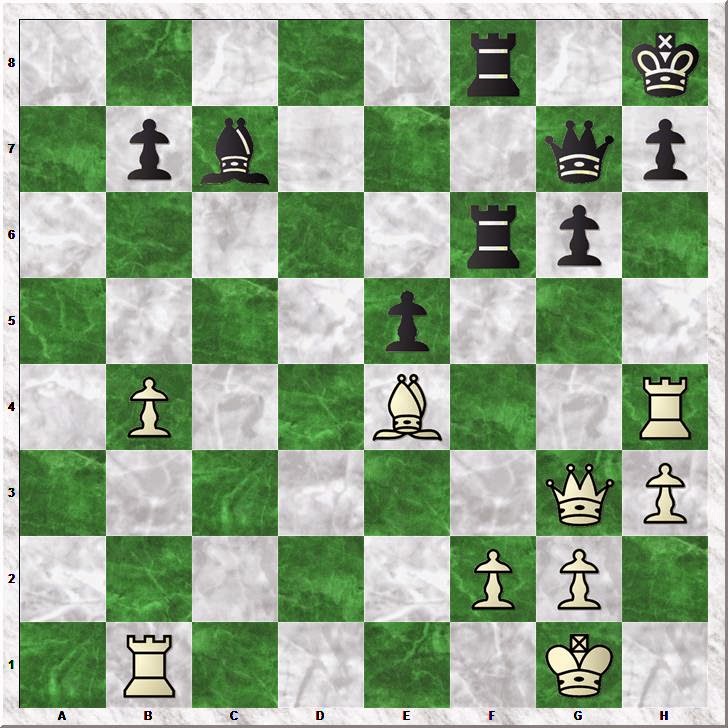
39.g3 Rg8 40.Qc8 Bb6 41.Qc3 Rxg3+

Exploiting the pinned f-pawn, and the continuation of tactical actions aimed at the rook on b1.

42.Kf1 Bd4 43.Qc8+ Rg8 44.Qc4 Rh1+ 45.Ke2 Rxb1

Black wins the rook

46.Rxd4

White takes a bishop in exchange.

46...Rb2+

46...exd4 appears to lead to a draw by repetition due to perpetual checks by White's queen.*

47.Rd2 Rxd2+ 48.Kxd2 Rd8+ 49.Ke2 Qh6 50.Qc3 Qg7 51.Be4 Kg8 52.Qb3+ Kf8 53.Qf3+

Black to move

Again, perpetual check appears to be a resource for White.

53...Qf7 54.Bxb7 Qxf3+ 55.Kxf3 ½–½

After three games without gaining a clear advantage with White, the Frenchman will find his way to victory in game 4 (see "McDonnell Blunders").

*It is my intention to go through these games and write my own comments without reference to engine analysis. I will check my analysis after completing a pass through all games.