Showing posts with label Alekhine (Alexander). Show all posts

12 March 2025

Fingerslip

Playing chess on the iPad, I will drop a piece one square short of its intended destination from time to time. Often this fingerslip is fatal to the game. Likewise, playing on the computer, mouseslips are a constant danger. One day, I had five mouseslips in five games. When I flipped the rodent over for examination, I discovered that a dog hair had lodged itself where it partially covered the optical reader. Removing the dog hair improved my play.

In Nottingham 1936 (1936), Alexander Alekhine claimed his 4.Bd2 in the first round against Salo Flohr was a "lapsus manus", a slip of the hand (17). He says that his intent was to play 4.e5 and 5.f4, as he had against Aron Nimzowitsch six years earlier. David Hooper and Kenneth Whyld doubt Alekhine's explanation, pointing to the move having been played against him in 1910 (Oxford Companion to Chess, 2nd ed. [1996], 136)It is from Alekhine's remark, apparently, that the Fingerslip variation gets its name:

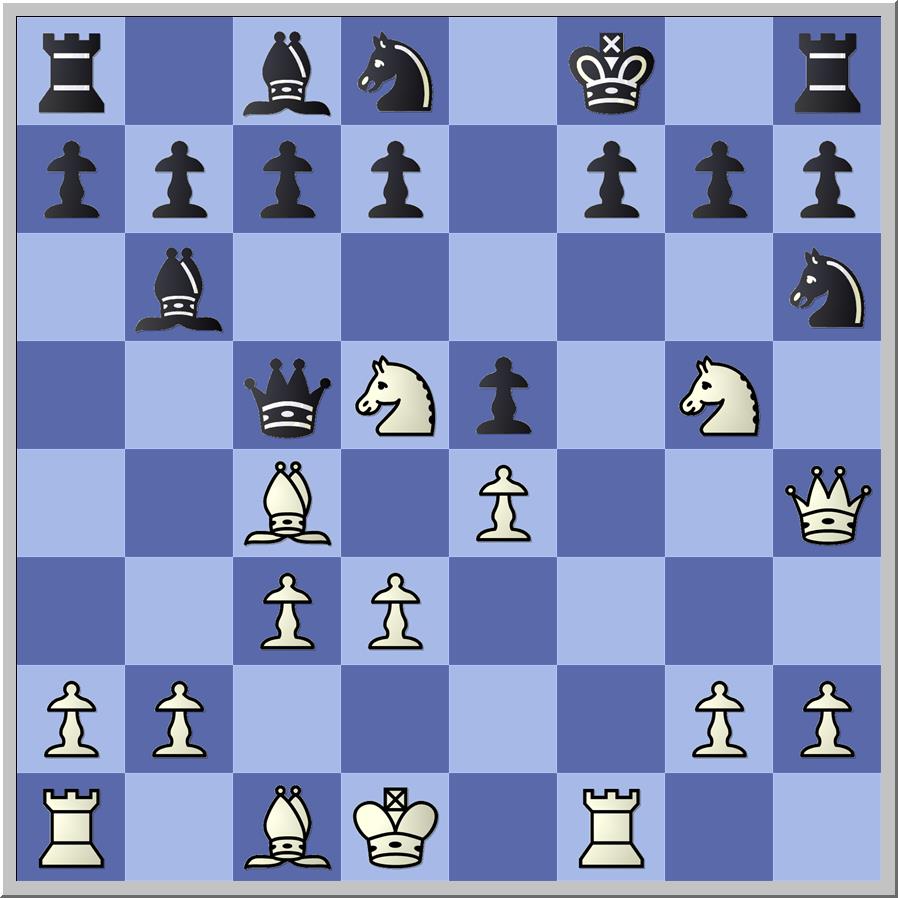
1.e4 e6 2.d4 d5 3.Nc3 Bb4 4.Bd2!?

This variation was brought to my attention by two games in P.H. Clarke, 100 Soviet Chess Miniatures (1963), both games won by White with rapid assaults on an uncastled king.

Black to move
According to ChessBase Mega 2024, this move appears in just over 2% of French Winawer games.

The usual continuation leads to messy tactics and a material advantage for Black.

4...dxe4 5.Qg4 Qxd4

5...Nf6 is safer, according to Clarke, and is more commonly played according to the database. 5...Qxd4 was played in both Soviet miniatures in the text. Both games continued:

6.O-O-O f5 7.Bg5

Black to move
Here they diverge.

Kunin,V.--Ochsengoit, Moscow 1958 continued:

7...Qe5 8.Rd8+ Kf7 9.Nf3

ChessBase Mega does not have the game, but it can be found on chessgames.com. Clarke notes that the game was published in Shakhmaty v SSSR (2 Nov. 1959).

Black to move
9...Qa5

Clarke writes, "Black has failed--and who can blame him?" (54).

Clarke offers 9...exf3 10.Qxb4 and then analyzes three possibilities, none of which include 10...Nf6, which Stockfish finds equal. The game ended quickly after Black's ninth move.

10.Bb5 Nc6 11.Ne5+ and Black resigned.

Black struggled longer in the second game, also absent from ChessBase Mega but on chessgames.com: Serebriany -- Ivanov, Magnitogorsk 1959. Mato Jelic also offers the game on his YouTube channel, but incorrectly states that it was played in the Soviet Championship. Perhaps it was a regional qualifier for the championship. Clarke indicates that is was the championship of Magnitogorsk, a city east of the Southern Ural Mountains.

Black continued:

7...Qxf2

White to move
8.Qh3 Bd6

Clarke states that this move is an error, but offers no alternative.

9.Bb5+ Bd7

Clarke offers some analysis of variations after 9...Nc6.

"Now Black gets a nasty shock" (Clarke, 96).

10.Nxe4

Black to move
10...Bf4+?

Clarke notes correctly that this is a fatal error. He recommends, 10...Qb6, when it is not clear that White can win after 11.Bxd7 Nxd7 12.Nxd6+ cxd6 13.Nf3. However, White has 11.Nxd6+ cxd6 12.Be2 and there are still possibilities of making the Black king uncomfortable.

11.Kb1+- Qe3 12.Nf3 Qb6 13.Bxf4 Bb5

White to move
14.Bxc7!

Eliminates a defender.

14...Qxc7 15.Nd6+ Kf8 16.Nxb5 Qe7 17.Rhe1

All of White's pieces are in play while Black's knights and rooks remain on their starting squares.

17...Nc6 18.Nbd4 Nd8


White to move
19.Nxf5! Qc5 20.Ne5 Nf6 21.Nd6 Kg8 22.Nxb7 1-0


23 July 2023

Chess Set Inquiries

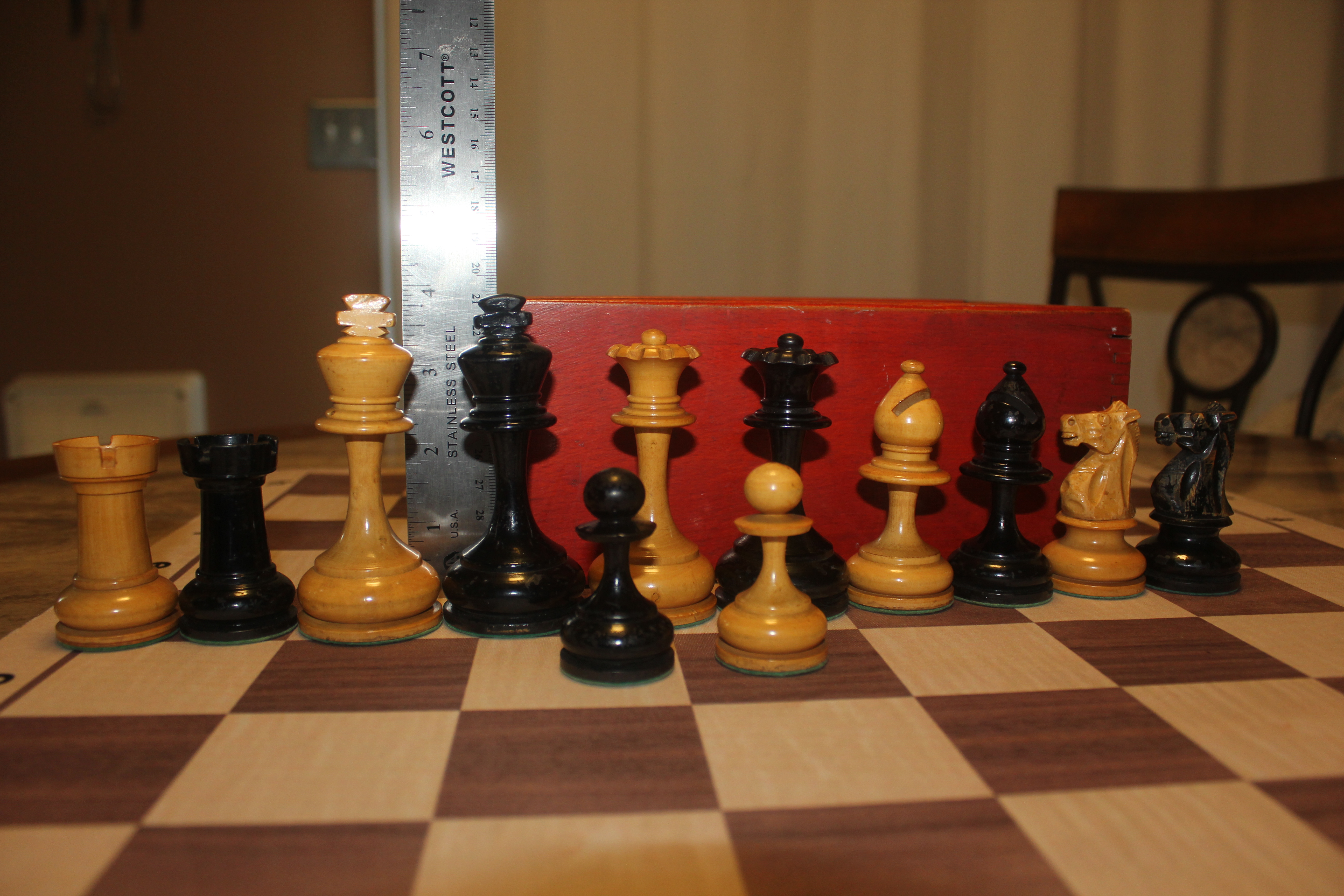
Two chess sets in my possession have raised questions. When were they made? By whom?

After several years of attending estate sales at Owen’s Auction and seeing many chess sets, I bid on one. It  differed somewhat from familiar sets, but remained within the general Staunton pattern required for tournament play. It became mine. That was 2018. I have told people it was made in the 1960s, although I had no evidence for the statement.

In mid-July this year, it was set-up on a library table as I waited for my opponent for the Spokane Contenders Tournament. I posted a photo to “Post Your Chess Sets” on chess.com. Another poster identified it as resembling sets made in the 1930s and 1940s, much older than I had imagined. He said he had a similar set and had been interested in mid-century French sets for several years. The wide bases and narrow stems of my set are uncommon, I learned.

That evening, my wife and I sat on the patio and put our phones to work as we conducted research. There were several lines of inquiry and my pursuit continued a couple of days. I conversed with the poster who had a similar set. He shared some useful links to research on chess sets. One link identified the set’s box as having been used by Lardy in the 1930s: “Chess Boxes” at The Chess Museum.

Under the tissue paper inside the box were four newspaper clippings with five chess games. These games were played September 1937 to August 1938. The games are Keres, P.—Reshevsky, S., Semmering/Baden 1937; Euwe,M—Alekhine,A., rd. 21, Amsterdam 1937; two games from the US Championship in April 1938: Fine,R.—Shainswit,G. and Simonson,A.—Suesman,W.; and MacMurray,D.—Platz,J., Cazenova, 1938, played at the NY State Chess Association Championship.

World Chess Championship 1937, Game 21

On the back side of game 21 between Max Euwe and Alexander Alekhine in the World Chess Championship was a notice of a wedding that took place. Pursuing wedding details provided a location for the newspaper itself—New York City. In the New York Times I found an announcement of the engagement that led to the wedding. That article identified the groom as a stockbroker. Also easily located in other  articles were some biographical details about the bride’s parents.

It seems reasonable to conclude that someone who owned this chess set clipped and saved these games, which all seem to me worthy of study. Likely, it was the set’s first owner. I believe the set may have been sold new in 1937 in New York City. The set had been imported from France. Of course, there is plenty of uncertainty.

There are no clues to the set’s subsequent journey after August 1938, but there should be no doubt that it has been well-used. All the pieces show signs of wear. It is most apparent on the Black knights.

Coming to terms with the age of the set, I wanted a newer old French set. My bidding on one advertised as a French Lardy set was successful and it arrived Saturday evening, 22 July.


I shared photos of the new set on “Post Your Chess Sets”, which provoked the expected discussion. One poster has a set that appears very similar and has been identified as a Chavet set, rather than Lardy.  Another agreed that it appeared to be a Chavet. Both directed me towards other threads with a great deal of detail concerning Chavet chess sets. I spent Sunday morning reading these threads.

The longest thread, “Chavet N° 8” made clear to me why others regard Walterbiensur as a trusted resource and authority concerning Chavet chess sets. He has posted images of many primary sources, is himself a collector of these sets, and his own quest to learn more is ongoing. Walter identified the set most like mine as Chavet. For now, that’s the best information that I have.

Most Chavet knights clearly differ from those in my new set, but one thread has a 1932 catalog from Chavet with a similar knight. There are a small number of others known to be Chavet sets with similar knights. The poster with a set close to mine drew attention to the relative heights of the base and the carved head. Lardy sets have a higher base, he wrote.

My inquiry has just begun.

In the meantime, the new set appears newer, sturdier, and less fragile than my 1937 set. It now resides in my tournament bag.


24 February 2023

Derived from Alekhine

Alexander Alekhine gave a cute checkmate idea that did not occur in his game with Arthur West, Portsmouth 1923.*

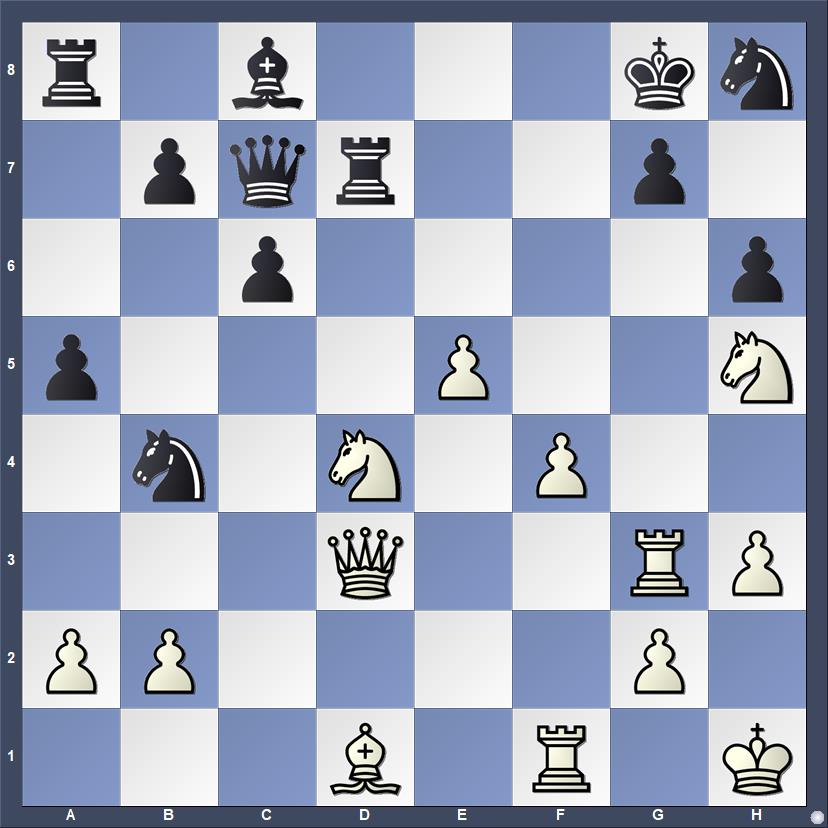
The hypothetical position makes a good puzzle, except that there are two ways to achieve checkmate in four moves. Sergey Ivashchenko improved the puzzle by removing a pawn and shifting Black's rook one square to the left. Alekhine's solution remains mate in four, but the alternate idea now takes five moves. Encountering Ivashchenko's puzzle in The Manual of Chess Combinations, vol. 2, no. 65 this morning, I chose the alternate idea, failing the puzzle (I gave myself half-credit).

White to move
The game reached this position after 27 moves.

White to move
28.Bxd5 was played.

28.Bd1 Nb4 leads to the position where White has two ways to force checkmate.

White to move
Analysis diagram

28...exd5

Black needed to address the threats to his king instead of capturing the bishop, but even then his game is lost.

29.Nf6+ and Black resigned.

What was the idea that Alekhine rejected?


*I do not know where Alekhine discussed this game. My source is a comment on the game by Sally Simpson on chessgames.com.


02 August 2017

Alekhine -- Lugowski 1931

An unusual smother checkmate piqued my interest. It is presented in Mikhail Tal and Victor Khenkin, Tal's Winning Chess Combinations (1979), where it is credited as Alekhin -- Lugovsky 1931 (58). Due to spelling variances, my initial efforts to turn up the game score fell short. However, the game is in ChessBase database with the spelling Lugowski, and also on Chessgames.com. The game appears in John Donaldson, Nikolay Minev, and Yasser Seirawan, Alekhine in Europe and Asia (1993), spelled Lugovski.

The game was played as part of a simul during Alekhine's tour of Yugoslavia between two blitz tournaments in Ljubljana (12 December 1930) and Zagreb (25 January 1931). Alekhine in Europe and Asia contains 47 games from this tour and a table compiling his score through 555 games in 17 events (70-76).

Alekhine,Alexander -- Lugowski,S [C25]
Belgrade 1931

1.e4 e5 2.Nc3 Nc6 3.Bc4 Bc5 4.Qg4

Already, Black must make an unpleasant choice.

Black to move

4...Qf6

I do not agree with the Chessgames.com user who identifies this move as the losing one.

4...g6 is the most popular try, and was played in Larsen -- Portisch, Santa Monica 1966, which continued 5.Qf3 Nf6 6.Nge2 d6 (here ECO recommends 6...Bf8) 7.d3 Bg4 8.Qg3 h6 9.f4 Qe7 10.Nd5 Nxd5 11.Qxg4 Nf6 12.Qh3 Larsen went on to win in 53 moves.

4...Kf8 has been tried fairly often. Of note is a game won by Viswanathan Anand when he was a teenager 5.Qg3 d6 6.Nge2 Nd4 (6...h5 might be better) 7.Nxd4 exd4 8.Na4 Be6 9.Bxe6 fxe6 10.Nxc5 dxc5 11.Qb3 Qc8 12.Qf3+ Ke7 13.Qg3 Kf7 14.Qf4+ Kg6 15.Qg4+ Kf6 16.d3 Anand,V (2405) --Ravisekhar,R (2390), New Delhi 1986 (57 moves).

4...Nd4 5.Qxg7 Qf6 6.Qxf6 Nxf6 7.Bd3 has occurred in a few games.

4...Bf8 led to a miniature worthy of analysis. 5.Qg3 d6 6.Nge2 Nf6 7.f4 exf4 8.Nxf4 Nd4 9.Qd3 Nc6 10.Qg3 Nd4 11.0–0 g6 12.Qf2 Nxc2 13.d4 Nxa1 14.Nfd5 Bg7 15.Bg5 0–0 16.Nxf6+ Bxf6 17.Bxf6 Qd7 18.Qf4 1–0 Genzling,A (2408) -- Migot,T (2257), Belfort 2012.

5.Nd5 Qxf2+

There is no better option. Here also, the comments on Chessgames.com are less than helpful.

5...Qg6 is no good. 6.Qxg6 hxg6 7.Nxc7+ Kd8 8.Nxa8+-.
5...Bxf2+ is just as bad 6.Kf1 Qg6 7.Qxg6 hxg6 8.Nxc7+ Kd8 9.Nxa8 Bxg1+-.

6.Kd1 Kf8

6...Bf8 was played in Lengyl -- Ruck in the 1995 championship of Hungary and Black won. Lengyl played 7.Nh3, but a better line seems 7.Nxc7+ Kd8 8.Nxa8 d5 9.Qe2 Qxe2+ 10.Bxe2 when White has the upper hand.

7.Nh3 Qd4?

7...h5! 8.Qg5 Qd4 9.d3 and White's threats are not yet decisive.

8.d3

Black to move

8...Bb6?

Black defends c7, but the knight on d5 also targets e7.

8...d6 was played by none other than Mikhail Chigorin, who also lost quickly. 9.Qh4 Bxh3 10.Qxh3 Na5 11.Rf1 Nxc4 12.Qd7 f6 13.Nxf6 Qf2 14.Rxf2 Bxf2 15.Nh5 1–0 Mieses,J (2467) -- Chigorin,M (2546), Ostend 1906.

8...h5 still seems worthwhile. 9.Qf3 d6

8...Nf6 9.Nxf6 d5 10.c3 Bxg4+ 11.Nxg4 dxc4 12.cxd4 is better than was played against Alekhine.

9.Rf1 Nd8

A sad looking move, but Black is already lost.

10.c3 Qc5 11.Ng5

White has five pieces attacking Black's king.

11...Nh6

A defensive fork

11...f6 seems reasonable, but also loses.

12.Qh4

Threatening a discovered attack against the knight with a fork of king and queen.

Black to move

12...d6 1–0

12...Ke8 would have held out longer.

According to Donaldson, et al., Alekhine announced a checkmate in four (74). This checkmate is what caught my interest in Tal and Khenkin's book.

Do you see it?

20 April 2017

Creating the 300

In GM-RAM: Essential Grandmaster Knowledge (2000), Rashid Ziyatdinov offers his version of the legendary 300 positions that a player must know to become a strong chess player. I have written about this book on several prior occasions, especially "Hitting the Books" (March 2015); "The Training Standard" (January 2015); "To Know a Position" (December 2014); "Morphy's Fingerprints" (December 2014); "Fingerprints" (April 2010); and my initial review of the book, "GM-RAM: Essential Knowledge" (February 2010).

Ziyatdinov leaves 47 of the 300 to the reader. I am tentatively and slowly adding critical positions from my study in search of 47 that matter to me. I have so far added:

Alekhine -- Levenfish 1912

White to move
After 14...Qxb2
Carlsen -- Tomashevsky 2016

White to move
After 12...Ng6
Byrne -- Fischer 1956

Black to move
After 11.Bg5

07 April 2017

Bogoljubov -- Alekhine, Hastings 1922

Alexander Alekhine gave up three queens to beat Efim Bogoljubow in their last round game at Hastings Six Masters in 1922. The game featured some spectacular tactics and a textbook finish with a near zugzwang position giving way to an elementary pawn ending. Many chess enthusiasts consider it one of  the greatest games ever played. I included it among my ten candidates in the list created for my Spring Break Chess Camp class on the subject of the best game ever played.

Alekhine needed a win to finish first in the tournament as he was tied with Akiva Rubinstein going into the last round. This need drove his choice of the Dutch Defense, which he characterized as risky. Many recent accounts of this game confuse this event, held September 1922, with the Hastings International Chess Congress, held December 1922 -- January 1923. Rubinstein won the latter. Alekhine did not participate. The Six Masters event was a double round robin featuring two British masters--George A. Thomas and Frederick Yates--and four of the leading masters from outside Britain--Alekhine, Rubinstein, Seigbert Tarrasch, and Efim Bogoljubow.

The round-by-round results with links to the games are posted on Chessgames.com. I looked at crosstables for this event and for the Hastings Chess Congress in John Donaldson, and Nikolay Minev, The Life and Games of Akiva Rubinstein, vol. 2: the Later Years, 2nd. ed. (2011).

A. Alekhine from Wikimedia Commons*
Alekhine considers this game against Bogoljubow, alongside his win against Richard Reti (Baden-Baden 1925), as "the most brilliant wins of [his] chess career" (Alekhine, My Best Games of Chess, 1924-1937 [1965], 13). Irving Chernev also calls this game, "the most brilliant game ever played" (The Most Instructive Games of Chess Ever Played [1965], 67). Chernev annotates this game in The Chess Companion (1968) and in Twelve Great Players and Their Best Games (1976). The former is quoted on the website Master Chess Open:
Alekhine's subtle strategy involves manoeuvres which encompass the entire chessboard as a battlefield. There are exciting plots and counterplots. There are fascinating combinations and brilliant sacrifices of Queens and Rooks. There are two remarkable promotions of Pawns and a third in the offing, before White decides to capitulate.
Chernev, The Chess Companion (as quoted at Master Chess Open).
Andrew Soltis lists this game as number four in The 100 Best Chess Games of the 20th Century, Ranked (2006).

Despite such praise, Bogoljubow -- Alekhine, Hastings 1922 is absent from Graham Burgess, John Nunn, and John Emms, The World's Greatest Chess Games (1998). Burgess does include it in Chess Highlights of the 20th Century (2000), but that book contains 270 games. The editors of The World's Greatest Chess Games carefully culled their list to one hundred. Their criteria were:
Quality and brilliance of play by both contestants.
Historical value.
Historical significance.
Burgess, Nunn, and Emms (1998), 7.
Bogoljubow's play falls short of this standard. He makes several positional errors in the opening and middle game, which Alekhine then exploits brilliantly. Even then, however, Alekhine may have eschewed the clearest path to victory in favor of artistic chess.

Annotations to this game are found in many books, websites, and YouTube videos. Most annotators start with Alekhine's own comments in My Best Games of Chess, 1908-1923 (1927) or in W.H. Watts, The Book of the Hastings International Masters' Chess Tournament 1922 (1924). A. J. Goldsby offers detailed annotations on his website and also a YouTube video. While going through this game, I studied annotations in S. Tartakower, and J. DuMont, 500 Master Games of Chess (1975); Max Euwe, From Steinitz to Fischer (1976); and Garry Kasparov, My Great Predecessors, Part 1 (2003). The game without annotations is included in Rashid Ziyatdinov, GM-RAM: Essential Grandmaster Knowledge (2000), which I mention frequently on Chess Skills. There are three middlegame positions in GM-RAM from this game.

In my annotations, I aim to highlight the critical moments of this game, rather than creating a compendium of all that has been said by others.


Bogoljubow,Efim -- Alekhine,Alexander [A90]
Hastings Six Masters, Hastings, 21 September 1922

1.d4 f5 2.c4 Nf6 3.g3 e6 4.Bg2 Bb4+ 5.Bd2 Bxd2+ 6.Nxd2

6.Qxd2 offers White much better prospects. This game well-illustrates how this capture leads to a misplaced knight and reduces White's influence in the center. As long as this knight stands on d2 it prevents White's rooks from controlling the d-file and it stands as a potential target should Bogoljubow seek exchanges in the center. Tartakower suggests 6.Qxd2 and Nc3. Kasparov concurs.

6...Nc6 7.Ngf3 0–0 8.0–0 d6 9.Qb3 Kh8

White to move

While running a youth chess tournament at the end of our Spring Break Camp, I spent my idle moments going through this game. The position in the diagram above was on my board for much of the day. I asked many of the youth players and coaches whether they agreed with Alekhine's assessment that Black already has the upper hand. The first youth to face this question suggested 10.d5 and thought White was better. Tartakower also prefers 10.d5 to the move Bogoljubow played in the game.

Black's queen knight on c6 is more active than its counterpart on d2. White's queen is temporarily more mobile than Black's, but knowing how the game continued makes it hard to evaluate the position objectively. Black's queen proved to have more influence in the game. Perhaps the White queen is somewhat misplaced on the queenside. White's rooks are connected. Many youth players suggested that White has a lead in development and cannot be worse.

Alekhine annotated this game from the perspective of having won a brilliant victory. He might not have been particularly objective in his assessment of the game up to this point. We know that Black's queen made a foray to the kingside, where it provoked weaknesses, then returned to e8 to support action in the center and on the queenside. From the standpoint of the game's whole, Black's queen proved much more flexible and effective.

After 9.Qb3, Alekhine wrote, "This manoeuvre does not prevent Black from realising his plan, but it is already difficult to suggest a satisfactory line of play for White (Alexander Alekhine's Best Games [2012], eBook, loc 2665). Presumably, it is this comment that Euwe translated into the Informant symbol for Black has the upper hand in From Steinitz to Fischer. But, it seems to me that Alekhine might be annotating by result.

Tartakower and DuMont, 500 Master Games of Chess offer several improvements to White's play over the next several moves. Most of these suggestions are repeated by Kasparov in My Great Predecessors. I think the game is still balanced at this point, but that Black has a clear edge after move 18. Kasparov quotes Alekhine's "already difficult ... for White," adding "Why?"

10.Qc3

After 10.d5, Kasparov offers two lines that the young players and I examined at the youth tournament.

10...Na5 11.Qc3 c5
10...exd5 11.cxd5 Ne7

In both cases, it does not seem that Black has an advantage. Kasparov states, "Black would have faced a thankless defence" (365).

10...e5 11.e3

Alekhine points out the vulnerability of White's knight on d2. If 11.dxe5 dxe5 12.Nxe5 Nxe5 13.Qxe5 and the knight on d2 is en prise. Tartakower, Euwe, and Kasparov all repeat this line.

11...a5

Upon seeing this move, I might agree that Black has a slight edge after White's failure to play 10.d5.

White to move

12.b3 Qe8 13.a3 Qh5

At this point, Kasparov quotes Alexander Kotov, "The start of a deep strategic plan. First of all Black creates threats on the kingside and provokes a weakening of the opponents pawns" (Kasparov, 365).

A defect of My Great Predecessors is the absence of documentation. The whole series is full of quotes from other chess writers. Parts IV and V offer bibliographies, but not the sort of documentation that is desirable for a work that is so much a digest of the work of others. The first three parts offer less.

Kotov wrote several books about Alekhine in Russian (I saw the number six somewhere). One book exists in English, put out by R.H.M. Press: Alexander Kotov, Alexander Alekhine, tran. K. P. Neat (1975). I am tempted to buy this book. There are used copies floating about, and also an Ishi Press reprint.

14.h4

Alekhine writes, "A good defensive move, which secures new squares for his f3-knight and revived the threat of 15.dxe5" (loc 2682). I do not see why 14.dxe5 was not possible. Tartakower rejects it because after 14...dxe5 15.Nxe5 drops a piece. It seems to me that White could open the center and does not need to follow-up by blundering away a knight. The h2-h4 push can be played later.

I considered 14.Rab1 to support b3-b4. The immediate 14.b3-b4 drops a pawn because after 14...e4 15.Ne1, the rook is skewered through White's a-pawn.

14...Ng4 15.Ng5 Bd7

White to move

16.f3

Alekhine sought to provoke a weakening of White's kingside, and did so. But, Bogoljubow might have been a little too cooperative. I am tempted to regard 16.f3 as a mistake. Alekhine suggested in comments to 15.Ng5 that 15.b4 was preferable. Kasparov repeats Alekhine's suggestion.

Here Alekhine offers a tactical line that is even worse for White: 16.Bxc6 Bxc6 17.f3 exd4 18.fxg4 dxc3 19.gxh5 cxd2 with a better endgame for Black.

16...Nf6 17.f4

Black threatened 17...f4, which would have pried open White's pawn shield.

e4 18.Rfd1

18.d5 was White's last chance to be slightly worse.

18...h6 19.Nh3 d5

White to move

Black clearly has the upper hand now, in my view. Where did White fail? On moves 10-18, Bogoljubow had several opportunities to open the center and possibly create a balanced struggle. He opted instead to close the kingside and close the center. As a consequence, his pieces lost their mobility and became passive. His long-term plan seemed oriented towards action on the queenside, but the game's subsequent course revealed surprising resources for Black there.

Kasparov offers another juicy quote from Kotov, which highlights the success of Alekhine's long-term strategic plan. Kasparov's note preceding the game highlights the centrality of Kotov's commentary.
The last of the wins is one of the most grandiose Alekhine canvases. It once again shows that his amazing combinations did not arise out of thin air, but were the fruit of very deep strategic preparation.
Kasparov, My Great Predecessors, 364.
20.Nf1

This position is the first of the three in GM-RAM from this game.

Ne7 21.a4

This position is the second in GM-RAM from this game.

Now, Boguljubow weakens his queenside, offering Black a nice outpost for his knight. Could he have tried to close matters there, too, and then hunkered down inside a fortress? To wit, 21.c5 Qg6 22.Qe1 Neg8 23.Kh2 Nh5 24.Ng1 Ngf6. White has no play, but how will Black break through?

21...Nc6 22.Rd2 Nb4 23.Bh1

This bishop could be useful preventing Black's knight for employing d3 as an outpost. Alas, there is no way to maneuver the bishop to such a useful square so long as the knight on f1 must guard the weak g-pawn. Perhaps White could redeploy his knights to h1 and h2 to guard g3 and g4? Surely, that would offer Black some opportunities elsewhere on the board.

Maybe 23.c5 is no worse than White's other choices. the tension between c4 and d5 only benefits Black. 23.cxd5 looks suicidal.

23...Qe8!

White to move

Now, c4-c5 is not possible due to b6. The problems with 24.cxd5 are worse than before.

24.Rg2 dxc4 25.bxc4 Bxa4

Alekhine has won a pawn. More significant than the pawn, however, is the preponderance of force for Black on the queenside as things open up. Half of White's army is sitting in the bleachers with their monarch, watching the game.

26.Nf2 Bd7 27.Nd2 b5 28.Nd1 Nd3

Alekine rejected 28...bxc4 because it would bring a White knight to e5.

29.Rxa5

White has won back the pawn, but his position is now much worse than it was a few moves ago. Now the game enters the phase where Alekhine's flashy tactical brilliance shines. Black has several ways to win, but the manner he chose elevates this game in the opinions of many chess students.

29.cxb5 and Alekhine offers 29...Bxb5 30.Rxa5 Nd5 31.Qa3 Rxa5 32.Qxa5 Qc6 with a winning attack for Black.

Black to move

29...b4! 30.Rxa8

Ziyatdinov's third position in GM-RAM from this game has now been reached.

30...bxc3!! 

This brilliant move was not necessary to win. 30...Qxa8 31.Qb3 (Alekhine's suggestion) 31...Qa1 (Kasparov's improvement over Alekhine's 31...Ba4) 32.Qb1 Ra8 and Black has a technical win.

31.Rxe8 c2 

The point of Black's last few moves.

32.Rxf8+ Kh7 33.Nf2 c1Q+ 34.Nf1 Ne1

Threatening smother checkmate.

35.Rh2 Qxc4 36.Rb8 Bb5 37.Rxb5 Qxb5

White's moves 30-37 are the computer's top choice. Alternatives lose much quicker.

White to move

38.g4 Nf3+ 39.Bxf3 exf3 40.gxf5 Qe2

White to move

What can White do? He is in zugzwang. Pawn moves delay the end.

41.d5

41.Nh1 Ng4 42.Rxe2 fxe2 and after sacrificing two queens. Black will gain one more to sacrifice.

41...Kg8 42.h5 Kh7 43.e4

Now White's remain pawn moves lose pawns.

43...Nxe4 44.Nxe4 Qxe4

White to move

45.d6 cxd6 46.f6 gxf6 47.Rd2 Qe2

Alekhine threatens checkmate in one.

48.Rxe2 fxe2 49.Kf2 exf1Q+

Alekhine's third queen sacrifice in this game.

50.Kxf1 Kg7 51.Kf2 Kf7 52.Ke3 Ke6 53.Ke4 d5+ 0–1

There is not much to criticize in Bogoljubow's moves after about move 20. But, his inaccurate play in the early game deprives this game of some of its merit. Alekhine's strategic preparation and tactical execution deserve study.


*George Grantham Bain Collection (Library of Congress) derivative work: Jesus Angel Rey, Public Domain, https://commons.wikimedia.org/w/index.php?curid=16985493.

13 January 2017

Teaching Endgames

My advanced group and a few from the beginning group met together this week becuase of a schedule change for another after school activity. They struggled to find the moves in a game played by Alexander Alekhine when he was a young man. A few recognized the zugzwang theme, but could not put all the elements together correctly.

White to move
From Alekhine -- Yates, Hamburg 1910

43.e4

Alekhine's move is the only one that wins.

My students went for the pawn race, queening first.

43.Kc3 Ke7

It seems that a few recognized why 43...Ke6 loses due to 44.Kd4.

44.Kb4 Ke6 45.Kxb5 Kxe5 46.Kxa4 Ke4 47.b4 Kxe3 48.b5 f4 49.b6 f3 50.b7 f2 51.b8Q f1Q

White to move
Analysis diagram after 51...f1Q
As long as Black avoids trading queens unless his king is in front of the a-pawn, this position should be drawn.

We spent a lot of time with this variation, finding a few cases where even Black could win after a blunder that allows a skewer. With careful play, however, neither side can make progress.

Before going into this pawn race, a student found Alekhine's first few moves.

43...f4

Most of the students knew how to win after 43...Ke6 44.exf5+ Kxf5 45.Kd4. One of them event named the idea, "fox in the chicken coop" (see "Fox in the Chicken Coop").

44.Ke2 Ke6

White to move

After making it this far, the young player blundered with 45.Kf3, and after 45...Kxe5 went on to lose. We came back to this position after exhausting every one's ideas to try to extract a win for White from the pawn race described above.

45.Kf2!

Alekhine played the correct move.

45...Kxe5 46.Kf3

Black is in zugzwang.

Once we had seen how Alekhine won, we examined this elementary position.

Black to move

Black is also in zugzwang here, and must lose the pawn. However, in this case, the loss of the pawn does not mean loss of the game. For most of the students, defending the Black side here was simple.

10 January 2017

Alekhine -- Levenfish 1912

Reading Alexander Alekhine's Best Games (1996) this morning, I became caught up studying a miniature. Alekhine -- Levenfish, St. Petersburg 1912 was decided in nineteen moves. Naturally, Levenfish's errors merit attention for anyone who plays the Benoni Defense, and perhaps also for players of the Modern.

After 14...Qxb2
Alekhine,Alexander -- Levenfish,Grigory [A43]
St Petersburg Winter-B St Petersburg, 1912

1.d4 c5

Alekhine criticizes this move, claiming, "White at once obtains a great positional advantage by simply advancing the centre pawns."

2.d5 Nf6 3.Nc3 d6 4.e4 g6 5.f4 Nbd7?!

5...Bg7 is the normal move.

6.Nf3 a6?!

With this move, this game becomes unique in the database.

6...Bg7 7.e5 dxe5 8.fxe5 Ng4 9.e6 fxe6 has been played at least eleven times. Alekhine gives this line to 9.e6, but then has 9...Nde5 10.Bb5+. His line has been played at least twelve times with ten White wins. It seems that 9...fxe6 may be better, although here, too, White has done well.

White to move

7.e5

White already has a clear advantage, according to Branko Tadic, and Goran Arsovic, Encyclopedia of Chess Miniatures (2015), where this game is number 166. Irving Chernev, The 1000 Best Short Games of Chess (1955) has it as well, but the annotations are limited to the last two moves. Tadic and Arsovic mark Black's fifth and sixth moves as dubious. Anyone seeking to play this line as Black would be well to note the urgency of playing Bg7 straight away.

7...dxe5 8.fxe5 Ng4 9.e6

Searching positions with 6...Bg7 in the ChessBase database this morning brought up several games that reached the position via a move order from the Modern Defense. White did well in those games, too, and this e5-e6 thrust was frequently played in those games.

9...Nde5 10.Bf4

Black to move

10...Nxf3+

Black might have tried 10...Bg7. Here Tadic and Arsovic offer 11.Nxe5 Nxe5 12.Qe2 with advantage for White. For his part, Alekhine offers 11.Qe2 Nxf3+ 12.gxf3 Nf6 13.exf7+ Kxf7 14.O-O-O "with an overwhelming advantage for White." John Nunn, who converted Alekhine's games to algebraic and culled from the two volumes of My Best Games to produce Alexander Alekhine's Best Games, suggests an improvement for Black in the line Alekhine gives. Instead of 12...Nf6, Nunn recommends 12...Bxc3+ 13.bxc3 Qxd5 as "more testing". But even here, White gets a strong attack with 14.fxg4! Qxh1 15.O-O-O Qc6 16.exf7+ Kxf7 17.Bg2.

11.gxf3 Nf6 12.Bc4 fxe6

While my coffee was still hot this morning, I spent a little time looking at 12...b5 13.Nxb5 axb5 14.Bxb5+. White ends up a pawn ahead with a strong position.

13.dxe6

Black to move

13...Qb6

Alekhine presents the alternative 13...Qxd1+ 14.Rxd1 Bg7 15.Bc7 O-O 16.Bb6, where, "White wins a pawn, at the same time maintaining all his pressure."

13...Qa5 might be playable, although White still has an edge.

The computer likes Black's move until it sees Alekhine's brilliant fifteenth move.

14.Qe2! Qxb2?

Tadic and Arsovic give 14...Bg7 15.O-O-O with a clear advantage for White. Certainly, Black's last chance was to resist the poisoned pawn.

15.Nb5!!+-

Black to move

Alekhine's double rook sacrifice had to be calculated before playing 14.Qe2. Black, too, needed to see the consequences in order to avoid 13...Qb6

15... Qxa1+

Perhaps Black can survive with 15...Bg7 16.O-O-O O-O 17.Bd6!

Now, we have finish that is reminiscent of Anderssen's Immortal Game.

16.Kf2 Qxh1 17.Nc7+ Kd8 18.Qd2+ Bd7 19.exd7 1–0

Black can delay, but no longer prevent checkmate.

01 July 2015

Solve This

As I am working through Anderssen -- Paulsen, Vienna 1873, which is in GM-RAM: Essential Grandmaster Knowledge, I came across a reference game from a simul conducted by Alexander Alekhine in 1933.

White to move

Alekhine found the winning tactical shot here.

11 March 2015

Hitting the Books

Context

A distinctive element of GM-RAM: Essential Grandmaster Knowledge (2000) draws in some readers and pushes many others away. Rashid Ziyatdinov's book contains diagrams without analysis. The author explains that the book is more of an exam than an instructional book. As such, it is an open book exam that can be taken and retaken until the desired score is achieved. Co-author Peter Dyson suggests that GM-RAM, "can be thought of as both a study outline and as an evaluation tool" (9).

Fifty-nine "classic games" are the source for 120 middlegame positions. Ziyatdinov addresses the definition of "classic". Games are not classic merely because they were played a long time ago. The games in GM-RAM:
...have been analyzed in great detail by many strong players from different periods, different schools of chess, and different ages and generations. It is only after a game has withstood these many different perspectives--these "tests of time"--that it can be considered a classic. (77)
Ziyatdinov directs his readers to analysis of these games by other writers. Alternately, he writes, "a chess trainer can help teach the necessary knowledge" (13). He provides a list of references. This list offers a secondary curriculum. Most, if not all, of the the endgame positions in GM-RAM can be found in Yuri Averbakh's Comprehensive Chess Endings, which comprises the bulk of the texts listed for endgame study.

The middlegame books listed are another matter. Most of the games are from the nineteenth century, but the recommended middlegame books include the two volumes of My Best Games of Chess by Alexander Alekhine; and Bobby Fischer, My 60 Memorable Games. Also listed are Averbakh, Chess Middlegames: Essential Knowledge; Paul Keres, and Alexander Kotov, The Art of the Middle Game; and Hans Kmoch, Pawn Power in Chess. There is minimal analysis of the games of Adolf Anderssen and Paul Morphy in these books.

Practice

For the past few months, I have been systematically working through Ziyatdinov's fifty-nine games at the rate of one each week. This past week, my game has been Bird -- Morphy, London 1858 (chessgames.com link). I have not done well on my study of this game. The week has been filled with activities that interfere with personal study, and an exciting new book arrived as well, Encyclopedia of Chess Combinations, 5th ed. (2014), putting my chess study time on another course. Hence, my study of this game will carry over another week. I will press on, though, adding this week's game: Morphy's Opera Game.

I have print editions of three good books on Paul Morphy: Philip W. Sergeant, Morphy's Games of Chess (1957); Macon Shibut, Paul Morphy and the Evolution of Chess Theory (2004); and Valeri Beim, Paul Morphy: A Modern Perspective (2005). In addition, I have the Kindle edition of David Lawson, Paul Morphy: The Pride and Sorrow of Chess, new. ed. (2010) and access to older books, such as Frederick M. Edge's 1859 Paul Morphy: The Chess Champion, via GoogleBooks. Other books that contain analysis of Bird -- Morphy include Garry Kasparov, My Great Predecessors, part I (2003); and Max Euwe, The Development of Chess Style (1968).

Kasparov's book offers a good entry point to the most important historical analysis and sometimes modern computer evaluation of this analysis. It behooves me to invest the time to work through the analysis of this week's and last week's games in all of these books.

Analysis

Ziyatdinov's GM-RAM contains two essential middlegame positions from Bird -- Morphy. These are separated by a single move. The positions are before 17...Rxf2 and after 17...Rxf2 18.Bxf2. Studying Kasparov's analysis last night focused my attention much earlier in the game.

White to move
After 5...d5
Kasparov credits Johannes Zukertort with having pointed out the improvement from this position that refutes Morphy's dubious opening choice. Bird could have gained an advantage had he properly applied knowledge from the ancient work of Pedro Damiano.

Euwe does not offer a source, but notes, "Nowadays it is known that the answer to Black's chosen variation is 6.Nxe5! dxe4 7.Qh5+, White getting an irresistable attack in return for the sacrificed piece" (29).

03 February 2015

Perceiving Threats

Lesson of the Week

Youth chess students in the after school clubs that I coach will be looking at a position from a game played by a young player who would go on to become World Champion. Many chess scholars regard Alexander Alexhine (1892-1946) as the best to ever play the game of chess. This position comes from a correspondence game against Konstantin Alekseyev Vygodchikov, who was Alekhine's age. Alekhine had Black. In 1928, Vygodchikov would share first place with two others in the Belarusian Championship. Alekhine had become World Champion one year earlier.

This game was played 1909-1910.

Black to move

What did Alekhine play? Why?

Some students may see a second position from this game.

Black to move
After 29.Rxg6
Who stands better? Why?

02 March 2012

Spanish Opening, Steinitz, Bronstein Variation C76

Despite more than 50,000 online blitz games, my first game in ECO code C76 was Sunday's round 5 game in the 20th Dave Collyer Memorial tournament. I opted for the Spanish Opening (Ruy Lopez) as White. My opponent, Expert Tim Moroney, played a deferred Steinitz Defense, Bronstein variation. I was on my own without any book knowledge on move 4, a fairly uncommon experience in the Spanish Opening. Nevertheless, the game's novelty came on my opponent's move 9.

We chose an unusual move order, but ended in an opening system played with success by David Bronstein as Black in the 1950s, employed by Boris Spassky in the 1980s also with success, and in the years 2006-2008 by Shakhriyar Mamedyarov but with a negative score, although he drew Viswanathan Anand in one game. In game 22 of the 1929 World Championship, Alexander Alekhine won with Black against Efim Bogoljubov using this system.

1.e4 e5 2.Nf3 Nc6 3.Bb5 a6 4.Ba4 d6 5.c3 Bd7 6.d4 g6

White to move

My game Sunday reached this position via the move order 1.e4 e5 2.Nf3 Nc6 3.Bb5 g6 4.c3 a6 5.Ba4 d6 6.d4 Bd7.

7.O-O is the most popular move and is the main line give in ECO.
7.Bg5 was my move, and is the other ECO line.

Bogoljubov played 7.Bg5.

That game continued 7...f6 8.Be3 Nh6

White to move

Here, Bogoljubov castled, 9.O-O. I played 9.dxe5, a move appearing in Big Database 2011 in five games.

My opponent's 9...Nxe5 rendered our game unique.

Bogoljubov -- Alekhine continued 9...Bg7 10.h3 Nf7 11.Nbd2 O-O 12.dxe5. Here Alekhine comments:
White--rightly--recognises that a further maintaining of the tension in the centre would be rather to Black's advantage and aims at simplification. The problem of the defence has been solved in this game in quite a satisfactory way.
Alekhine, My Best Games of Chess, 1924-1937 (1965), 63.
My opponent commented after our game that his opening choice must be deemed a success because he very easily achieved equality.

Had Moroney played 9...dxe5, our game would have transposed to a line with some history, including Bronstein -- Sakharov 1960, played in the 27th Soviet Championship. Bronstein -- Sakharov began with the move order 1.e4 e5 2.Nf3 Nc6 3.Bb5 a6 4.Ba4 d6 5.c3 Bd7 6.d4 g6 7.dxe5 dxe5 8.Bg5 f6 9.Be3 Nh6.

Black's opening choice does appear to offer good prospects for equality.

I was playing for a draw with White. In the late middlegame, my opponent and I repeated a position once. Instead of extending the draw offer that I invited by this repetition, my opponent broke open the game into an endgame that made a draw unlikely. Lucky for me, he incorrectly assessed the resulting pawn endgame and I won. See "Pawn Wars" for the endgame critical position.

ECO Code is a trademark of Chess Informant

11 November 2011

Castling Queenside in the Queen's Gambit

I won my game in the Turkey Quads last night, but I was not happy with my opening. It seemed to me that Black too easily gained equality, and perhaps even had chances for the advantage. My opponent missed these chances, but lingering doubts concerning my play through the first ten moves or so haunt me. Hence, I was digging into the Encyclopedia of Chess Openings when I found a curiosity: 10.O-O-O.


A search of Chess Informants 1-103 (I need to buy the past two year's issues to bring my collection up to date) turns up two games, both embedded into ECO: Ree - Pfleger 1966 Informant 1/366, and Ftacnik - Zaw 2000 Informant 80/465. Searching the larger databases in ChessBase 11 produces more games, earlier games, and the information that GM Ľubomír Ftáčnik is the "strongest player" who has employed this line. Perhaps Akiba Rubinstein was stronger, but he played prior to FIDE adopting an Elo rating system, and so CB 11 ignores his efforts in the data field reporting "strongest". Alexander Alekhine played it once in a simul, as well, but he lost. Boris Spassky reached a similar position after 8.O-O-O, and the line appears in ECO (Informant 2/507).

ChessBase Online contains forty-seven games with the position from ECO in the image above. White scores a shocking 70.2% in these games. Of course, some of these games in the database are between relatively weak players. Most are interesting games between masters.

White's plan is not difficult to fathom: an all-out assault on the enemy king. Black must seek counterplay that exploits the half-open c-file. White's attack is already better prepared, so Black's task is difficult. There were eleven games 1905-1966 with ten White wins and Alekhine's loss. The first draw occurred in 1971.

Black's most popular replies are 10...Ne4 and 10...c5, but Win Lay Zaw's 10...Re8 deserves scrutiny. Zaw was not the first to play this move, which appears one other time in the ChessBase database. Zaw's novelty came on the next move, 11...Nf8. In the Informant annotations, Ftacnik points out a draw that Zaw missed near the end. Zaw's pawns nearly rolled over the top of White's position down the center.

I am looking through these games, which offer some interesting study material featuring attack and counter-attack.