Showing posts with label Catalan. Show all posts

03 July 2024

Must've been a Mouseslip

Online play this morning was odd. First I could get no advantage against a 900 rated player and that game was aborted because the Arena time ran out. Then, I was paired against a 1900+ (top .05% on a site that is 90% beginners) whose play left me confused.

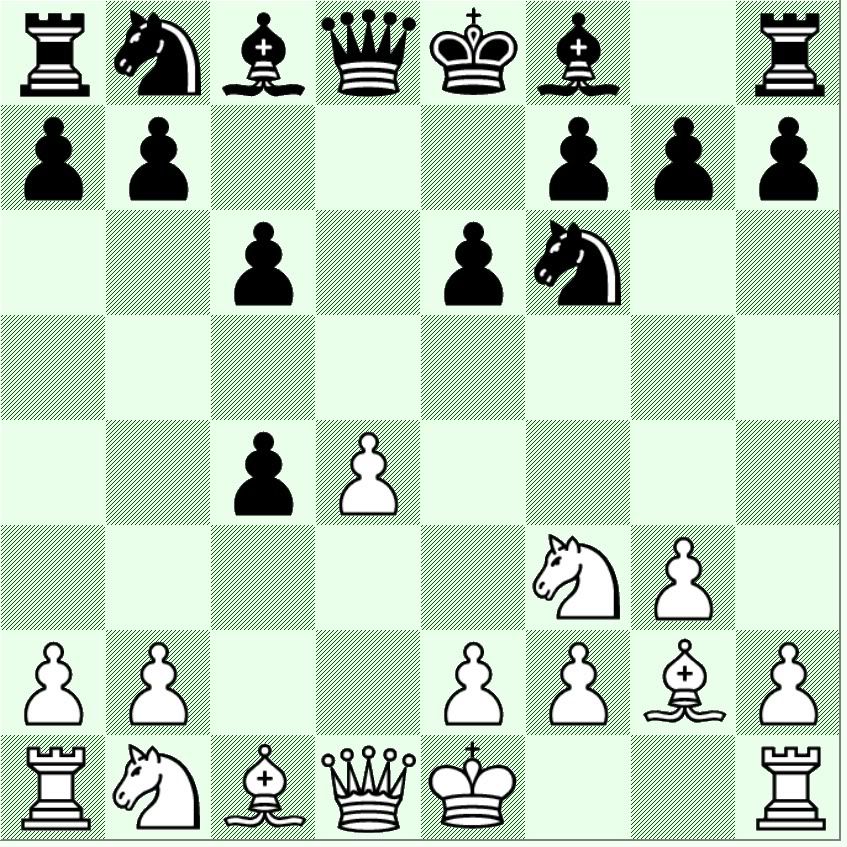
Beginning at move five, my opponent's play was mysterious. We had reached a fairly normal position that can arise when White opts for the Catalan.

Black to move
I have had this position at least 283 times previously in online play, usually, but not always with White. In these games, both White and Black have performed within three points of their average rating with 138 White wins, 116 Black wins, and 29 draws. I have played 5...cxd4 and 5...Nc6, the two most popular moves.

5...g6?!

Only on Lichess, where the games database is huge, do I find any prior games with this move.

6.cxd5 exd5 7.O-O Bg7 8.dxc5

Black to move
8...Bf8? 9.b4

9. Nc3 was better. The one Lichess game with 8...Bf8 continued 9.Be3. It was a bullet game.

9...a5 10.Bd2?

10.Qa4+ Bd7 11.b5 Bxc5 and White is much better.

10...axb4 11.Bxb4 Nc6 12.Bc3

Black to move
12...Be7

White's poor play has restored Black to equality, but now White again has an advantage.

12...Bxc5 was the obvious move.

13.Nd4?!

13.Qc1 sets up a tactic to defend the pawn. To wit, 13...Bxc5 14.Bxf6 Qxf6 15.Nc3 Be6 16.Nxd5+

13...Bxc5 14.Nxc6

And after 14...bxc6, the game is interesting and roughly equal.

14...Qd6??

White to move
15.Nd4 Bxd4 16.Bxd4 Ra4 17.Qxa4+ and Black resigned.

I had thought that 14...Qd6 was a mouse slip, or maybe a premove, but the 5.5 seconds Black used rules out premove. It was a strange move in a strange game. 16...Ra4, then, looks like Black trying to lose.

My next game was against a player in the high 1600s and featured some strange maneuvers also, but not such that dramatically altered the evaluation. Here, though, I thought I had trapped White's queen.

Black to move
24...Rf6

24...Rxf5, which I considered briefly is the engine's choice.

25.Nxd6?

White should have played 25.Qxd6 Rxd6 26.Bxf4 and White will have a rook, bishop, and pawn for the queen.

I went on to win this game, too, although my opponent proved resourceful without a queen.

Far more satisfying than this morning's games was one that I played yesterday. At move 11, I had the opportunity to win a pawn, but spend a few seconds making sure that I was not missing a zwischenzug. 

Black to move
11...Ncxd4 12.Nbxd4

12.Nfxd4 Nxd4 13.Bd3 might be better.

12...Nxd4 13.Nxd4 Qxd4 14.Bxb4 Qxb4 and I nursed the extra pawn into the endgame, eventually winning.


18 August 2020

What would you play?

 I spent a fair amount of time on this position this afternoon. The time control was 30 + 10, and this was my longest think.

White to move

The computer prefers 18.b6, which I seriously considered. But, eliminating Black's a-pawn seemed useful.

19 October 2014

Opportunity

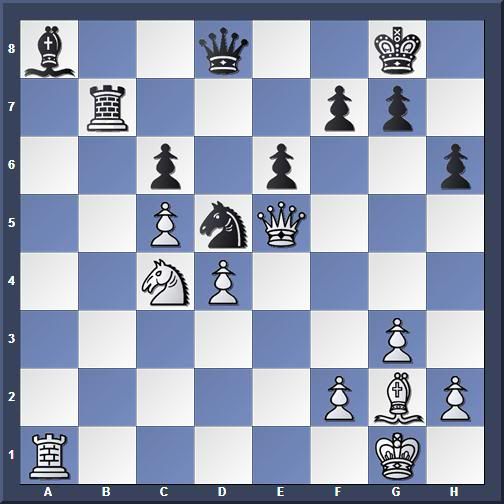
When a tactical opportunity presents itself, seize it. Perhaps Black thought that he won a pawn with 33...Nxf2. This position arose in Miroshnichenko -- Rychagov, Sochi 2005. I found the game while exploring options for Black in the Catalan after 6.Qc2 dxc4 7.Nbd2, which scores very well for White.

White to move

21 January 2014

Giri -- Aronian, Tata Steel 2014

Defending Against the Catalan

Levon Aronian leads the Tata Steel Grandmaster tournament in Wijk aan Zee by a full point over Sergey Karjakin and Anish Giri. Giri can catch him with a win today. I have been following Aronian's games throughout this event and blogging them while they are in progress.

If Aronian were playing Vladimir Kramnik, I would be uncertain who I favored as a fan. Otherwise, I choose Aronian. I hope that one of these two becomes Magnus Carlsen's first challenger for the World Championship title and that he beat the young Norwegian. I know that is a long shot, but Aronian's play in this event so far has been impressive. Or, at least his results have been impressive. In the postgame interviews, he credits luck.

Giri has not yet fallen behind on the clock, which may be a first for Aronian's opponents in this year's Tata Steel tournament.

Giri,Anish (2734) -- Aronian,Levon (2812) [E05]
Tata Steel Wijk aan Zee (8), 21.01.2014

1.d4 Nf6 2.c4 e6 3.Nf3 d5 4.g3 Be7 5.Bg2 0–0 6.0–0 dxc4 7.Qc2 a6

White to move
8.a4

I usually play 8.Qxc4, but Giri's move is almost as popular. Aronian played 8.a4 against Karjakin in blitz last month. In the same event, Le Quang played 8.Qxc4 against Aronian. Black won both of those games.

8...Bd7 9.Qxc4 Bc6 10.Bf4 Bd6

Both players have taken a less-well trod path on move ten. Now there are a mere few dozen reference games in the database.

White to move

11.Bg5 Nbd7 12.Nc3 h6 13.Bxf6 Nxf6 14.a5 Qe7 15.Nd2

This move appears to be a novelty.

Black to move

15...Bd5 16.Bxd5 exd5 17.Nxd5 Nxd5 18.Qxd5 Qxe2 19.Ne4 Rab8 20.Rfe1 Qxb2

White to move

This position seems to be a sort that could lend itself to a draw if that is what White is seeking. The rooks harass the queen which slides back and forth along the second rank.

21.Rab1 Qc3 22.Rec1 Qe2 23.Re1

Giri spent fifteen minutes on this move. He intends to apply some pressure.

23...Qc2 24.Nxd6 cxd6 25.Rb6 Rbe8 26.Rf1

Black to move

26...Qe4 27.Qxb7 Qxb7 28.Rxb7 Re4 29.Rd1 Rc8

Perhaps Black is the one who is applying pressure. My initial, superficial assessment is cliche-bound: "rook endings are drawn." However, such endings are not simple and always require concrete analysis.

30.Rb6 Rc2

Aronian gets a pig.

White to move

31.Rd3

Aronian appears to be thinking for a long time. He remains ahead on the clock, but both players have roughly an hour for less than ten moves. The clock is not a significant factor today.

I played out a line in my database record that starts with 31...d5 and had the idea of winning the d-pawn. In my line, White gained a passed a-pawn, but it fell with an exchange of rooks on a7. There is plenty to calculate in this ending. My line was quick and superficial.

31...g5

I was not looking at this move. I do see that Rxd6 can be met with Re6, so the vulnerability Aronian has just created on h6 may not be so important.

32.h3

A lot of moves were made while I drove my wife to work. Most of them were easy to predict. Although I did not anticipate 31...g5, once it was played, I more or less thought that I understood Aronian's plan.

32...h5 Rf3 g4 34.hxg4 hxg4 35.Rxf4 Rxf4 36.gxf4 Ra2 37.Rxa6 Kg7 38.Kg2 Kg6

White to move

39.Rxd6+ Kf5 40.a6 Kxf4 41.Rf6+ Kg5 42.Rb6 Kf4 43.d5

Here, I arrived back home, got the garbage cans set out and started following the game again.

43...Ke5

Seemed the obvious move to me.

44.d6 Ke6 45.Kg3 f5

White to move

I think that Aronian is looking for a draw, but his position is not without threats if Giri becomes careless.

46.d7+ Kxd7

Both players have over an hour on their clocks.

47.Rf6 Ke7 48.Rh6 Kf7 1/2-1/2

Just as I am wondering whether there is anything more than elementary rook ending technique here, the players agreed to a draw. Aronian maintains his one point lead over Giri. He has White against Karjakin on Thursday. I will follow the game until it is time to leave for work.

This game was the only draw today and Karjakin was one of the winners. Aronian's lead has been cut to 1/2 point.

26 June 2012

The Good, the Bad, the Ugly

The secret [to creating theoretical novelties] is to look for bad moves.... I mean those moves that are obviously so bad that no one ever takes the time to prove their awfulness.
Andrew Soltis, Karl Marx Play Chess

Yesterday, I played a move in the opening that I am not likely to repeat. On the other hand, I could explore it further and make it part of my repertoire.

1.d4 d5 2.c4 e6 3.Nf3 Nf6 4.g3 Be7 5.Bg2 O-O 6.O-O c6 7.Qc2 Nbd7 8.a3?!N


In truth, this move has been played before. ChessBase Online database has eight games that have reached this position. In two of these eight, both players were over 2000. In one game, White was over 2400 (Vladimir Okhotnik), but his opponent was 1733.

What is wrong with this move?

It abandons efforts to develop the initiative. It presents Black with no difficulties.

Franco Valencia (2176) -- Mercado (2066), Pereira 2011 continued:

8...b6 9.Rd1 Ba6 10.Nbd2 Rc8 11.b4 dxc4 12.Nxc4 c5 13.dxc5 bxc5 14.Nce5 cxb4 15.Nc6 b3 16.Nxe7+ Qxe7 17.Qxb3 Bxe2 18.Re1 Nc5

Black has the initiative, an extra pawn, and better piece coordination. Black went on to win.

Baldwin del Castillo (2045) -- Baigorri Navarro (2178), Collado Villalba 2008 continued:

8...b6 9.cxd5 cxd5 10.Bf4 Ba6 11.b4 Rc8 12.Qb2 b5 13.Nbd2 Nb6 14.Rfc1 Na4 15.Qb3 Bb7

White went on to win.

Stripes (1933) -- Moroney (2075), Spokane 2012 continued:

8...a5 9.Nbd2 b5

Here we reach the game's actual novelty.

Okhotnik (2447) -- Fournel (1733), Fouesnant 2009 continued:

9...Re8 10.e4 dxe4 11.Nxe4 Nxe4 12.Qxe4 Nf6 13.Qc2 Qd6

Black's queen rook never came into play, White directed event in the center, and his pieces penetrated the king's defenses.*

My game continued:

10.c5 Qc7 (we agreed after the game that 10...Bb7 is better) 11.Nb3 Bb7 12.Bf4 Qd8 13.Nc1 Re8 14.Nd3 Nf8


White's pieces seem well-placed, but if Black has any weaknesses, they are difficult to detect. We both struggled to find a plan. My opponent struggled harder and burned a lot of time off the clock. After some exchanges many moves later, Black was slightly better, and I opted to sacrifice a pawn to keep more of my pieces on the board during his time scramble. I was then two pawns down and objectively lost. Then, my opponent, with perhaps one minute left on the clock, missed an X-ray/discovery tactic and I won a bishop. I won back the pawns, plus another one.

I won, but my opening reveals some need for improvement. Parts of the game are not worth showing to the world.


*In the game score from ChessBase, Okhotnik's last move 31.Rxg5 is a howler that loses his queen. But, if he played 31.Rf5+ he was executing a forced checkmate in five. I suspect the latter is the actual move.

13 September 2011

Review: Chess Viewer (Everyman)

Publisher Everyman Chess has been producing good quality chess books long enough that I have accumulated many of their titles on my shelves. Some of my favorites include Garry Kasparov, My Great Predecessors, 5 vols.; John Watson, Play the French, 3d ed.; and Vladimir Kramnik, and Iakov Damsky, Kramnik: My Life and Games. But, Everyman Chess also published what may have been the worst edited book that I've ever purchased from a major publisher, a book that shows evidence of immense need for simple copy editing and that seems as though it received none. Susan Polgar, with Paul Truong, Breaking Through: How the Polgar Sisters Changed the Game of Chess stands as an embarrassment to Everyman Chess. Aside from printing, binding, and distribution, they utterly failed as a publisher.

With this track record, I had some trepidation before purchasing an ebook version of Nigel Davies, Play the Catalan ($19.99) for viewing within the iPad Chess Viewer ($1.99). The three samples provided with the app revealed that viewing games and commentary was functional, although complex variations are not particularly well supported by the Chess Viewer app. It is easier to navigate complex variations in Chess Base, the viewer of choice for Everyman Chess ebooks.

Play the Catalan is less expensive in paperback ($18.96 at Amazon), but weighs more than the iPad, which also contains many hundreds of other books (and currently sixteen chess programs). The advantages of purchasing it in this format include the convenience of the iPad itself, and that acquiring it does not require finding more space on already overcrowded book cases.

Everyman's website lists 125 ebooks, but only 30 appear in the store accessible via Chess Viewer. All these books concern openings, while their list of ebooks available for viewing in Chess Base includes a handful that are not opening manuals, including Jose Capablanca, Chess Fundamentals (algebraic edition).

It seems as though they rushed Chess Viewer through the process without considering the features that might be of interest to readers. Even so, it is a good beginning.

The Introduction in Play the Catalan includes two complete games: Kasparov - Korchnoi 1983, 7th match game, and a game not available in the Chess Base online database, Davies - Brown, 2009. This position stems from the latter.

White to move


Here Davies found a simple winning combination.

04 August 2009

Encyclopedia of Chess Openings

What does E04 mean?
Overheard at the chess club
Chess is a game of nearly infinite complexity, yet endings with six or fewer pieces have been solved and the openings have been analyzed in considerable depth at least since Friar Ruy Lopez (c. 1540-1580). In 1966, Chess Informant began publication twice yearly, later increased to thrice. Each issue of Informant contains the best games from recent tournaments, especially those of theoretical significance; many are annotated by the players. In 1974, Volume C of the Encyclopedia of Chess Openings became the first volume published in what would become the standard five-volume reference work on opening theory.

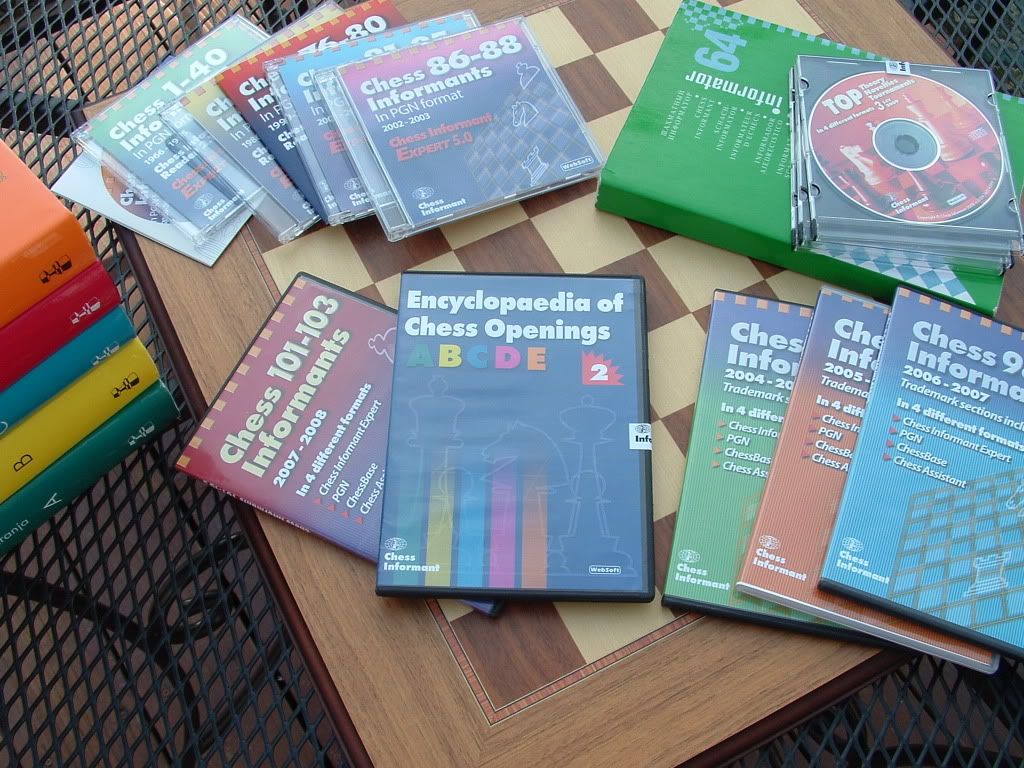
Yesterday, the postman brought the second edition of the Encyclopedia on CD. It was part of my prize for placing fifth in Chess Informant's Best of the Best 1000 Reader's Contest.* Along with this electronic version of ECO came several CDs that complete my collection of Chess Informants, except for the most recent volume. With a few mouse clicks, I can check the published theory on a position in the Encyclopedia and in recent grandmaster practice.

Consider a position that is not uncommon for me: 1.d4 Nf6 2.c4 e6 3.Nf3 d5 4.g3 dxc4 5.Bg2 e6

Five moves present themselves as candidates:

6.a4
6.O-O
6.Ne5
6.Qc2
6.Nc3

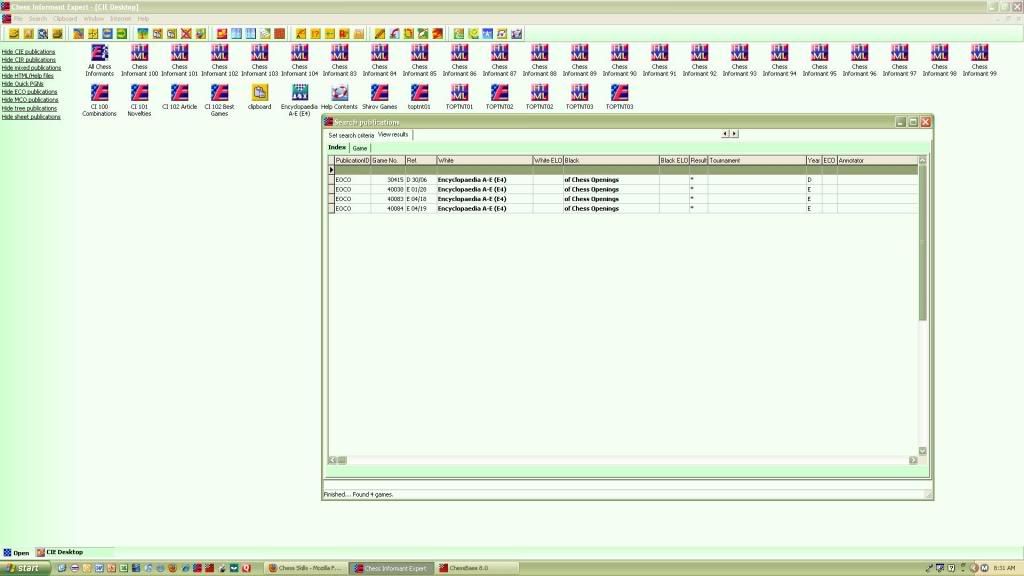
I'm pretty certain that I've played all five. Through my ChessBase database program I can search my Big Database--an old version of this CB product that I keep up-to-date through weekly downloads of The Week in Chess--or ChessBase online. My resident database contains 289 games with this position; ChessBase online has quite a few more with 423.

With this mass of data, how does one find the relevant ones--those worthy of study? I have a select database and electronic opening book of games since 2000 played by masters. Searching it produces a mere 83 games, a far more manageable quantity. But, suppose some of the essential theory concerning this position derives from games played before 2000. I'm back to wading through many hundreds of games.

6.Ne5 takes us from E04 to D15, and possibly D17 or D11. One of the lines given in ECO continues with 6...e6, identified as a novelty when Murey played it against Benjamin in 1986, and published as an annotation to Stohl - Ehlvest, Tallinn 1986 42/471. 6.Ne5 ceases to appears in Informant after 1999, although it has made several appearances since then in high level games. Perhaps at the top levels that line lacks promise for White, even though it is quite playable at my level.

When I faced 6.Ne5 from the Black side, I lost on time in a bishop versus knight endgame where I had a slight edge. When I played it as White, I blundered away a rook in the late middlegame.

6.Qc2 is rare, and not the choice of the strongest players. My only foray with it led to victory in a three minute game on Playchess last August.

6.Nc3 is popular, but according to my CB Opening book has an inauspicious record for White. My score over five games is abysmal--20%.

My database of online games reveals that I played 6.a4 most often a few years ago, and 6.O-O most often in recent years. In both cases, I have scored well above average: 64% (eleven games) and 71% (nineteen games), respectively.

Informant 103/326 is the game Pashikian-Meier, Martuni 2008, which strangely is not found in the ChessBase databases. Martuni 2008 was the Lake Sevan International Chess Tournament pitting some of the strongest young Armenian players against players invited from elsewhere. Arman Pashikian won this game and the tournament. Georg Meier lost two games as Black from this position at this tournament, and fragments from both games were published in Informant. In both games, White opted for 6.a4. Ivanchuk also opted for 6.a4 in his first match game against Aderito at Khanty-Mansiysk (Informant 101/383).

My favored choice in recent years, 6.O-O was Peter Svidler's choice against Vallejo-Pons in the 2007 Monaco Rapid event. A portion of this game was published as Informant 102/(361).

With ChessBase I can find more games; with electronic versions of the Encyclopedia of Chess Openings and Informants, I can find the most significant games annotated by leading theorists.


*The contest winner was Russ Brown whose recently released CD, The Fugitive Peace, I am happy to recommend. Some reviews of the album note that his music starts good, and gets better the more you listen. That's certainly the kind of quality I would expect from a fellow reader of Chess Informant! I bought the album last week, listened to it three times through that day, and have it playing again now.

ECO Code is a trademark of Chess Informant

28 January 2009

Aronian, Carlsen Win! Aronian Alone in First

Corus Chess 2009, Wijk aan Zee

Co-leader Levon Aronian showed Michael Adams, and the world, how rook endgames can be won. This victory put him alone in first place going into the last rest day because the other leaders drew or lost. Sergei Karjakin drew Loek van Wely. Co-leader Leinier Dominguez lost to Magnus Carlsen, ending the young player's winless streak. In 2008 Carlsen and Aronian shared first with eight points each. That finale remains one of several possibilities with three rounds remaining.

Standings after Ten Rounds
1. Aronian 6.5
2. Karjakin 6
3. Carlsen, Dominguez, Radjabov, Movsesian 5.5
7. van Wely, Smeets 5
9. Ivanchuk, Kamsky, Adams, Wang 4.5
13. Stellwagen 4
14.Morozevich 3.5

I'm studying the endgame in Aronian - Adams, and expect to post again this evening.

22 September 2008

Kingscrusher

Kingscrusher is the screen name of Tryfon Gavriel. He is the webmaster for ChessWorld, arguably the best online correspondence chess site (also called turn-based chess). Kingcrusher also has posted over 250 instructive chess videos to YouTube. There are many ways to access these videos, including Kingscrusher's Blog. Here's another one:

14 January 2008

Kramnik's New Repertoire

Vladimir Kramnik has not played the Catalan at Wijk aan Zee yet. Is he changing his opening repertoire in preparation for his match against Anand?


Technorati Profile

30 November 2007

What was I thinking?

. . . and why did I get away with it?

Stripes,J (1627) - Copeland,C (1555) [E07]
Turkey Quads Spokane (3), 15.11.2007
[Stripes]

 1.Nf3 Nf6 2.g3 d5 3.c4
The Reti 3...e6 4.d4 no longer the Reti 4...c6 5.Bg2 Nbd7 6.0-0 Be7


7.Nc3

7.Qc2 is the correct move, as is known by everyone that plays the Catalan

7...0-0 8.Bf4 seemed like a reasonable move, and it is certainly thematic in the Queen's Gambit, but I have almost always regretted this move--this game is no exception.

8...dxc4 9.e4
Staunton and Steinitz would be proud of me for getting this nifty pawn center--but Chris will not let it stand long

 
9...Qb6 the novelty of our game, and not a particularly good one. But why? What is wrong with a move that attacks the pawn nearly always laced with poison?

10.Qe2 c5 11.Qxc4

11.d5 occupied most of the time I spent thinking about my move, and may have been a better choice.

11...cxd4 12.Nxd4

12...e5?
giving White the advantage that should have been his birthright.

12...Qxb2 was possible.

13.Nf5 Re8? two inaccuracies by Black, and White now has a good game

13...exf4 14.Nxe7+ Kh8 15.gxf4 Qxb2 seemed better for Black to me, but my engine disagrees;
13...Bc5 is the move Hiarcs prefers.

14.Nxe7+ Rxe7 15.Be3 Qe6 

15...Qxb2 was still possible, and would make White fight for the win.

16.Nd5

16.Qxe6 seems simple enough.

16...Kh8??

16...Re8

17.Rac1 b6 18.Rfd1 Nxd5?

it is not easy to play a position such as Black has created for himself


18...Bb7

19.exd5 Qd6 20.Qxc8+ Re8

20...Rxc8 is suicidal 21.Rxc8+ Re8 22.Rxe8+ Nf8 forget about the queen as she is helpless against two rooks and two bishops.

21.Qc7 Qxc7 22.Rxc7 I like pigs! 22...Nf6 23.d6 e4 24.d7 Red8 25.Bg5 Rxd7 26.Rdxd7 Nxd7 27.Rxd7 f6 28.Bxe4 1-0

This badly played pseudo-Catalan gave me a much needed but undeserved win.