17 March 2008

Discovery

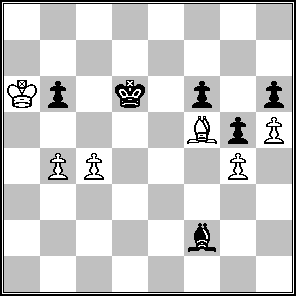
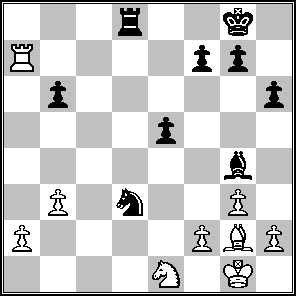
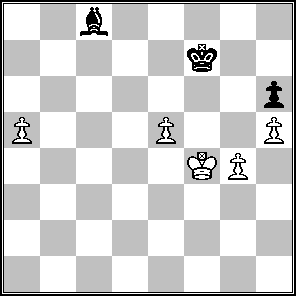
Opposite colored bishops is a draw, right. Most often it should be. The position below from an internet blitz game is drawn with correct play. However, correct play does not always reveal itself when both players are scrambling with less than fifteen seconds remaining on the clock.


Photobucket - Video and Image Hosting


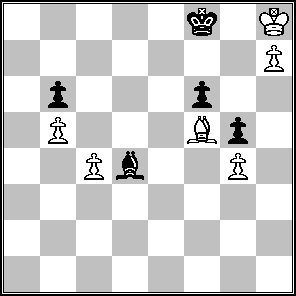
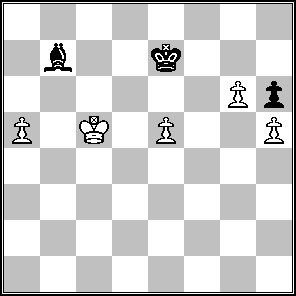
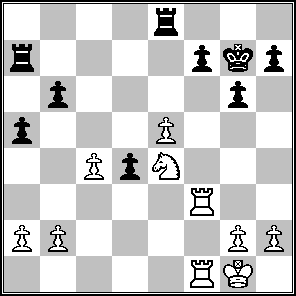
White perceived an opportunity when Black allowed the h-pawn to fall, causing something perverse to occur. Twelve moves later ...

Black to move. Mate in six.


Photobucket - Video and Image Hosting


16 March 2008

Practical Technique

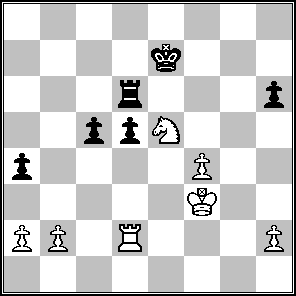
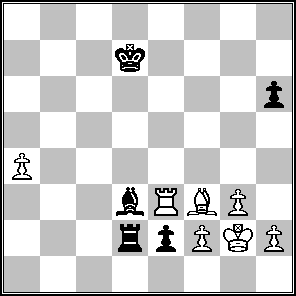
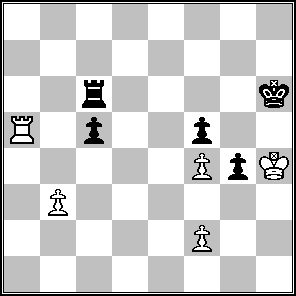
While playing from position 302 in Fred Reinfeld's 1001 Sacrifices and Combinations (see "Power of Pawns"), I reached this position with White to move.


Photobucket - Video and Image Hosting

Here I conjured the notion to sacrifice my material advantage in hopes of eliminating any possible counterplay. 1.Nc4! Hiarcs took the knight, the rooks were exchanged, and then I played a2-a3, although Ke4 might have been better.

1...dxc4 2.Rxd6 Kxd6 3.a3

As a result of my sacrifice, I reached a materially equal, but easily won king and pawn endgame. The rest was simple.

From the diagram position, the computer seeks to improve the position of the White pieces while maintaining a material advantage. We might say that moves like Ke3 or f5 (the moves favored by Hiarcs and Fritz) are objectively best. However, the practical decision to eliminate counterplay seems more sensible for human players.

12 March 2008

Reciprocal Thinking

Of the tactics books on my shelf, among the most challenging is Paata Gaprindashvili, Imagination in Chess (2004). The problems are difficult, designed to be set on a board and studied at length, rather than flipping through the diagrams at breakfast or lunch as is my habit. In the second chapter, Gaprindashvili advocates correcting an idea that seems not to work after analysis. We will often find that altering the move order or inserting an additional move into the plan transforms a failed idea into a successful one.

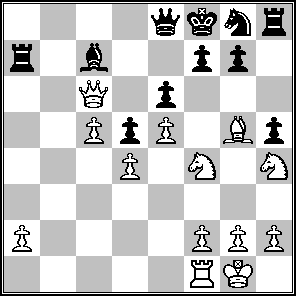
This position from Geller - Karpov, Moscow 1976 came up in Kaber's Exercises this morning. It is White's move.

Photobucket - Video and Image Hosting

My initial idea was to play one of the knights to g6 with a check and fork. But, White's advantage seems minuscule after 1.Nhg6+ fxg6 2.Nxe6+ [Nxg6+ loses to Qxg6; the in-between Qxe8+ fails as well because after Kxe8, Ng6 is not check and the rook can move] Kf7 3.Qxe8+ Kxe8 4.Nf4.

Another move inserted in the sequence at the right moment leads to clear advantage for White. What is the solution?


I've previously mentioned the training set called Kaber's Exercises in "Good Luck." More information concerning this training resource is available there.


03 March 2008

Power of Pawns

Here's the gig: I'm using Fred Reinfeld's 1001 Sacrifices and Combinations for tactics training. However, I'm not solving the problems as presented in the book and checking Reinfeld's answers to see how many I get right. Rather, I set up a problem in Hiarcs or Fritz and play it against the engine until one of us gives up. In theory, this exercise should present many opportunities for the engine to resign. In practice, my capacity to lose or draw a winning position humbles me.

In the position below, it is White's move. The tactic that Reinfeld had in mind is simple enough.

Photobucket - Video and Image Hosting


1.Nxe3 and black loses quickly with 1...Rxe3. 2.Ra8+ Kh7 3.Be4+ winning the rook. That's all Reinfeld wants the pupil to find. But, Hiarcs does not play 1...Rxe3. Rather, 1...Be2 gives White a decision regarding placement of the knight. Care is needed because snatching the pawn on e5 leads to Rd1+ and Bh3 with checkmate to follow.

After quite a few moves more, I lost my way and Black gained the edge. During post game analysis Hiarcs pointed out a variation I had overlooked, leading to the next diagram with Back to move. I set up this position and started again.


Photobucket - Video and Image Hosting


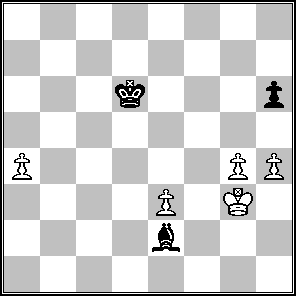
Hiarcs played 19...Kd6. How can White proceed now?

I thought to activate my king, so played 20.g4 Bc4 21.h4 Ra2 22.Kg3 Ra3 an unpleasant pin 23.Bxe2 Rxe3+ 24.fxe3 Bxe2 reaching the next diagram.


Photobucket - Video and Image Hosting

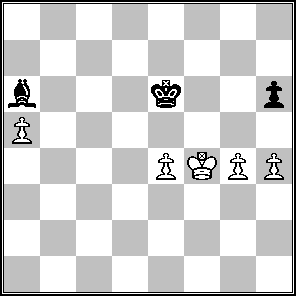
Hiarcs gives White an advantage of 2/3 a pawn in this endgame. The bishop has a lot of work to do stopping all White's pawns, but my immediate sense was that the cleric was up to the task. To my surprise, I managed to win this position!

25.Kf4 Ke6 26.e4 Bc4 27.a5 Ba6

Photobucket - Video and Image Hosting


28.h5! Kf7 29.Ke5?! a wasted maneuver looking for the next step in the plan
29... Bb7 30.Kf4 Ba6 31.e5 Bc8

Photobucket - Video and Image Hosting


32.g5! Kg7

if 32...hxg5, 33.Kxg5 Ba6 34.h6 Bd3 35.Kf4 and the Black king must defend e8, while the bishop cannot stop both flank pawns.

33.g6 Kf8 34.Ke4 Ke7 35.Kd5 Bb7+ 36.Kc5 Hiarcs resigns 1-0

Photobucket - Video and Image Hosting

The bishop will fall stopping the a-pawn, and the Black king cannot take the e-pawn without letting the g-pawn promote. The White king has plenty of time to get back in action after capturing the bishop on a8.

25 February 2008

"Good Luck"

Chess players must respect the sport and their opponents, so the game begins with a handshake or other culturally sanctioned greeting. Commonly players say, "play well" or "good luck". I teach children to say good luck because they can mean it with no harm to themselves. Chess is a game of skill with nothing hidden. Outside of such chance elements in the selection of opponents and color assignment in Swiss tournaments, or of color assignment in single round-robin events, the game rests wholly upon the skills of the players.

The lack of chance contributes in large measure to the appeal of chess. One cannot blame the cards, the dice, or the referees.

True?


Historic Luck

Consider a historic game between William Davies Evans and Alexander MacDonnell in London in 1826. The game opened with a variation on Captain Evans' signature opening.

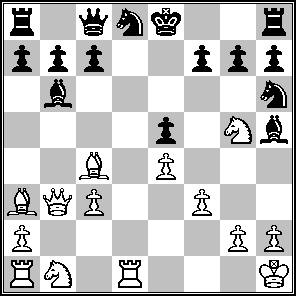
1.e4 e5 2.Nf3 Nc6 3.Bc4 Bc5 4.0–0 d6 5.b4 Bxb4 6.c3 Ba5 7.d4 Bg4 8.Qb3 Qd7 9.Ng5 Nd8 10.dxe5 dxe5 11.Ba3 Nh6 12.f3 Bb6+ 13.Kh1 Bh5 14.Rd1 Qc8

Photobucket - Video and Image Hosting


From this position, White has a clear win: 15.Qb5+ Nc6 16.Bd5 Qd7 17.Bxc6 bxc6 18.Qxe5+ Kd8 19.Rxd7+ and black might as well resign, as Fritz did when I played it from the diagram position.

Captain Evans did not play 15.Qb5+. Rather, he won the game in more dramatic fashion.

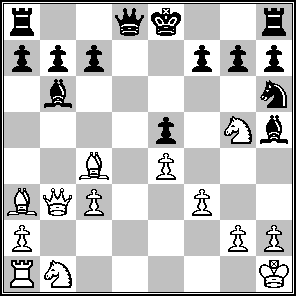
15.Rxd8+ Qxd8

Photobucket - Video and Image Hosting


Here we have the position as I encountered it in my tactics training last week. It is one of the problems available in the database I call Kaber's Exercises because I created it from files available at Claude Kaber's Chess Stuff page. The exercises are an excellent training regimen for use within ChessBase, if only I would use them regularly. Many of Kaber's exercises have entertaining questions, such as "play like Captain Evans" in the present case.

I found the correct move, which was the one Evans played.

16.Nxf7!

MacDonnell answered with 16...Qh4, threatening checkmate. Kaber put this position in as a training position with the tease, "play better than Captain Evans." Evans finished off MacDonnell with 17.Qb5+ c6 18.Qxe5+ Kd7 19.Qe6+ Kc7 20.Bd6#. Kaber offers the quicker checkmate 17.Bb5+ c6 18.Qe6+ Qe7 19.Qxe7#.

Kaber also offers as a variation, 16...Qf6 17.Nxh8+/=. Kaber's analysis is wrong. After 17...O-O-O! black has a substantial advantage. The knight on h8 is trapped and its capture will produce material equality. White's king is more vulnerable than Black's, and his queenside knight blocks in the rook, while several moves are needed to free the horse.

Evans' dramatic victory offers tactical fireworks that prevailed due to inadequate defense. Evans benefited from luck: MacDonnell did not play to his full capabilities.


Recent Luck

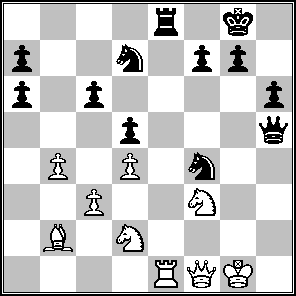
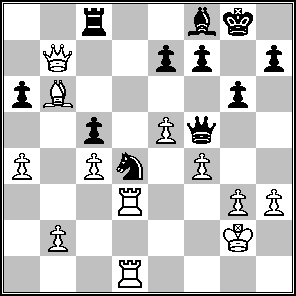
In the final round of our Club championship last week, I was playing on the top board attempting to upset the likely winner. My miserable play resulted in this position with Black on move:

Photobucket - Video and Image Hosting


I'm clearly losing, so in desperation I played 29...Rb8. This clever decoy is an illusion. I get some checks, but they are not enough.

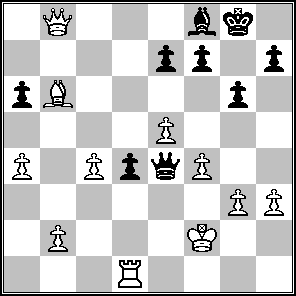
Play continued 30.Qxb8 Qe4+ 31.Kg1 Nf3+ 32.Kf2 Nd4 33.Rxd4 cxd4

Photobucket - Video and Image Hosting


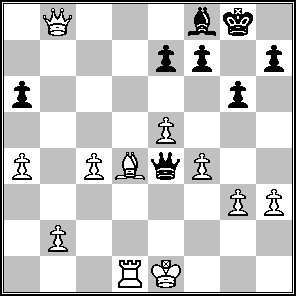
34.Rxd4+- would end my little fantasy, but my opponent played 34.Bxd4 instead. The game went on 34...Qc2+ 35.Ke1 Qe4+

Photobucket - Video and Image Hosting

My opponent didn't like the looks of 36.Kf1 Qf3+ 37.Bf2 Qxd1+ 38.Kg2, or he didn't see all of the sequence. But with two pawns to the good, White should win this. Instead, my opponent played 36.Kd2?

The game concluded with a forced repetition 36...Qxd4+ 37.Kc1 Qxc4+ 38.Kb1 Qe4+ 39.Kc1 Qc4+ 40.Kd2 Qd4+ 41.Ke2 Qe4+ ½-½

With this draw, my opponent still managed to secure the Club championship, but his taste of victory is bittersweet and he gave up a few rating points. My tactical bluff worked because my opponent did not play to his ability.


A Puzzle

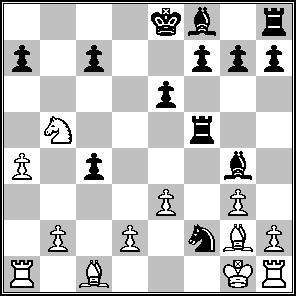
Saturday morning in the first round of the annual Dave Collyer Memorial tournament, I faced an unrated player. He was unfamiliar with the Réti opening, played some odd moves, and the resulting melee went badly for me. I eventually won the game and went on to have an excellent tournament, but I was lucky that my opponent overlooked something when he played 19...Bc5? from this position.


Photobucket - Video and Image Hosting


What did he miss?

24 February 2008

Queen's Value

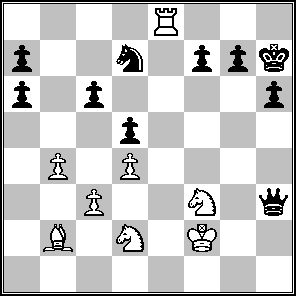
Imbalances are the heart of chess strategy, but how many pieces are equal to an active queen? I came to the position below replaying a game from the playchess server against Hiarcs 10. Black to move.


Photobucket - Video and Image Hosting


Here I played 24. ... Qg4+ and Hiarcs evaluated Kf2 as at least a half a pawn better than moving to the h-file. So, 25.Kf2 Nh3+ 26.Qxh3 Qxh3 27.Rxe8+ Kh7.


Photobucket - Video and Image Hosting


For White's queen, Black has given up a rook and knight. Earlier in the game, Black had given up a bishop for three pawns, then White sacrificed a pawn.

According to the most widely used version of point count chess, White has three minor pieces (9), rook (5), and three pawns (3) for 17. Black has a queen (9), knight (3), and seven pawns (7) for 19. But, arithmetic tells us little. How can a queen play against so many pieces? How many of Black's pawns will fall in the process?

15 February 2008

Kings and Pawns

In a Club Championship game this evening I had White in the following position. I played 31.Rxf7+

Did I err?

What alternative plan should White consider?


Photobucket - Video and Image Hosting


12 February 2008