19 July 2019

A Positional Crush

My play in over the board events the past few years has been limited, even though I seem to play online most days. After recovering from a couple of poor results that sent my rating racing towards its floor, I climbed back into the middle of A class. That terrible result--the 2016 Collyer Memorial--included three consecutive losses after winning an easy game in round one. This summer, I lost three straight again. I lost the last round of the Inland Empire Open, then my first two games in the Spokane Contender's--an event that takes place over the course of two months to determine the challenger for the City Championship.

Last night I won a game, stopping the string of losses.

My opponent was a high school student who has been having good results at the Spokane Chess Club. This game was our first. I knew from a conversation at the Inland Empire Open in May about Tactics Trainer on Chess.com that he does a lot of tactics and is pretty good. I intended to be careful, avoiding unnecessary complications.

Stripes,James (1881) -- Sauder,Samuel W M (1758) [C02]
Spokane Contenders Spokane, 18.07.2019

1.d4

In this game, my opponent ran his clock down to 21 minutes, spending lots of time each move, while I used about 31 minutes for the entire game. Of course, I used his time well. Rather than deep tactical calculation, I mainly proceeded on the base of relatively simple and straight-forward positional ideas with a little tactics at the moment of attack.

1...Nc6 2.Nf3 e6 3.e4 d5

I don't usually have to work this hard this early in the game.

4.e5

Both player's knights seem somewhat misplaced for the French Advance, but it strikes me as a principled way to meet my opponent's odd move order.

Black to move

How should Black continue? During the game, of course, I want to show that Black's plans are all wrong. After the game, my focus shifts. I play the French, so improvements for Black must be found.

4...Bd7?!

Black sets up a tactic if White is foolish (something I've been on the Black side of countless times).

4...Nge7 has fared better for Black than other options. 5.c3 Nf5 6.Bd3 Nh4 7.0-0 Nxf3+ 8.Qxf3 and Black won in 61 moves. Simonian,H (2405)--Shaposhnikov,E (2545), playchess.com INT 2007.

4...f6 must be played sooner or later. 5.Bd3 There are four games in 2016 PowerBook--all White wins, but Black gets some play in several of them. I believe this option offered better prospects for my opponent than the course he chose in the game.

5.Bd3

5.Bb5? Nxe5 and Black has the upper hand.

5...Qe7 6.a3

I'm thinking of Dirty Harry's line, "go ahead and make my day." Castle queenside and see what happens.

6...0-0-0? 7.b4±

At this point in the game, I've used seven minutes to Sam's fifteen. I'm starting to feel comfortable that I have a long-term plan. Push the queenside pawns, set up a battery on the a6-f1 diagonal, and prepare to bring the other rook to the queenside. The a1 rook is perfectly developed. Where to put my queenside minor pieces and the optimal move order remain open questions.

7...Re8

Sam prepares a retreat for the knight.

7...f6 8.b5 Na5 9.Bd2 Nc4 10.a4 Nb2 11.Qc1 Nxd3+ 12.cxd3 is good for White, but probably better than accepting near immobility of Black's forces.

8.Nc3

I had notions of playing Na4-c5, but the discovery gave me pause.

8...f6 9.b5 Nd8

White to move

10.0-0

10.Na4 b6 and I've lost some tempi, but perhaps a4-a5 will be useful after repositioning the knight. ;
10.a4 was probably fine, but I could see that my opponent had ideas of opening the e-file. I didn't see a way for him to do so, but got my king off it anyway before proceeding with my attack.

10...g5 11.a4!?

11.exf6 I planned to play this move, originally. 11...Nxf6 12.a4 (12.Bxg5 was my intent, but it does offer Black more play than he got in the game. 12...Rg8)

11...g4

Black's pawn helps shield White against any possible counterattacks.

12.exf6 Nxf6 13.Ne5

A happy knight!

Black to move.

13...Rg8 14.a5 Qg7

14...Qb4

(15.Bd2 was my intent 15...Qxd4 was something I overlooked, but maybe I would have looked more carefully if Black had opted to try this line. 16.Nxd7)

15.Ne2! Now Bd2 is a threat 15...Qe7 16.c4

15.b6

15.Qe2 was the main alternative. I wasn't certain the best move order here, but thought that White was clearly winning in either case. Sam had used nearly an hour to my fifteen minutes.

15...cxb6

15...a6 16.Qe2 (16.bxc7 Nf7 17.Qe2 Nxe5 18.dxe5 Ne4 19.Nxe4 dxe4 20.Bxa6) 16...cxb6 17.axb6;
15...c5 16.bxa7

16.axb6 a6 17.Qe2

I've known for a long time that I would be sacrificing a piece on a6, but when is less clear.

17...Bc6 18.Nb5!

I was happy with this move.

18.Bxa6 bxa6 19.Rxa6 Bb7 20.Bf4! was not something I examined. (20.Ra7 was in my calculations, but I played it a little safer. 20...Bd6 21.Nb5 Bxe5 22.Qxe5 seems fine for White, too.) 20...Bxa6 21.Qxa6+ Qb7 22.Qa4 Qxb6 23.Rb1 Qc7 24.Qa8+.

Black to move
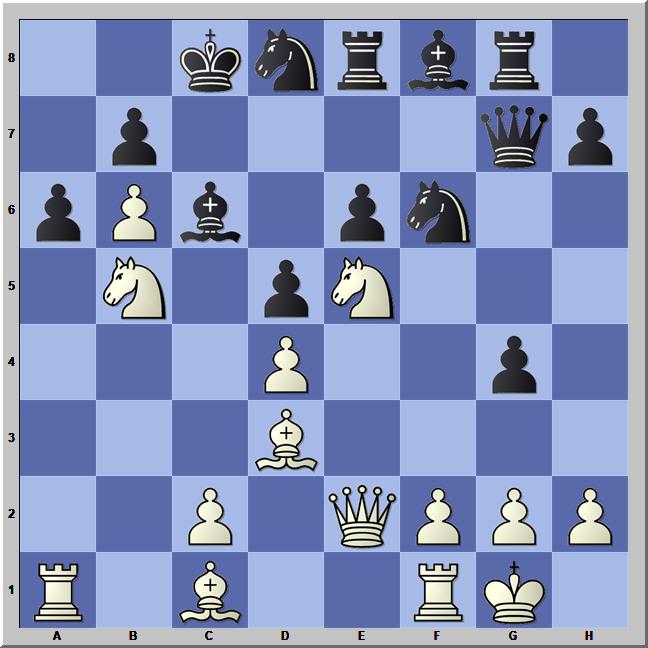
18...Bxb5

Forced.

18...Kb8 19.Bf4 (19.Na7 Bd6 20.Naxc6+ Nxc6 21.Nxc6+ bxc6 22.Bxa6) 19...Nh5 20.Nxc6+ Kc8 21.Nba7+ Kd7 22.Ne5+ Ke7 23.Nc8+ Kf6 24.Qe3+-.

18...axb5 19.Ra8#.

19.Bxb5 Re7?

19...Bd6 20.Ba3 Bxe5 21.Qxe5 Nh5 22.Qd6 Qe7 23.Bxe8 Qxd6 24.Bxd6 Rxe8 White is winning, but Black can play on a bit.

20.Ba3

20.Bxa6 is the right time, according to the engine. I thought it was fine, but Black does have some seventh rank defenders. Besides, my dark-squared bishop is in the way of my plans. 20...bxa6 21.Rxa6 Rb7 22.Ra8+ Rb8 23.Qa6+ Qb7 24.Ra7 Bd6 (24...Qxa6 25.Rc7#) 25.Rxb7 Rxb7 26.c4.

20...Rf7

White to move

21.Bxf8

21.Nxf7 did not seem the right course. This knight assists in maintaining checkmate threats.

21...Rfxf8 22.c4!?

Not Clint Eastwood, but some 1960s Western with a line, "roll 'em, keep those doggies rollin'" or something like that pops into my head.

And so I turned to Google.

My memory of the lyrics is a little off, and it seems that a young Clint Eastwood was in the television series Rawhide, the theme song of which sits vaguely in my memory with incorrect lyrics.

22.Bxa6 bxa6 23.Rxa6 was still possible, but until I see a clear checkmate and as long as my bishop is immune ...

22...Kb8 23.Bxa6

Now is the time, there is no more work for the bishop. Soon a rook battery on the a-file will end things (or I will will find something else.

23...bxa6 24.Rxa6 Qb7

White to move

25.c5

Defends the rook and puts my pawns to use as insurance against Black organizing a defense.

25.Rfa1 Rg7 26.Qa2 the engine sees a mate in seven, but I was not looking that deep.

25...Nc6

25...Kc8 26.Rfa1

26.Nxc6+ Qxc6 27.Qe5+ Kc8 28.Ra8+

Black to move

28...Kd7

28...Qxa8 29.Qc7#;
28...Kb7 29.Ra7+ Kc8 30.Rc7+

29.Ra7+ Kd8 30.Qb8+ Qc8 31.Qd6+ 1-0

31...Nd7 32.c6 was my idea.


14 July 2019

Gifford -- Ter Haar 1873

This game came to my attention during a search for examples of smother mate. In early July, I put together a worksheet for my students that featured smother checkmate threats, some of which could be prevented. Some of the source games offered additional interest.

The game was played in the first ever Dutch Championship, which was won after tiebreaks by Henry William Birkmyre Gifford. Little is known today about Gifford, although ChessBase has 39 of his games in their database. Even less is known about his opponent whose only games in the database are from this event.

Gifford,HWB -- Ter Haar,TC [B01]
DCA Congress 1st The Hague (1), 1873

1.e4 e5 2.Nf3 Nc6 3.d4 d5

Rare move

More common is 3...exd4 4.Nxd4 then several branches.

4.exd5 Qxd5 5.c4 Qe4+ 6.Be3

6.Be2 seems sensible to me.

6...exd4

The pinned bishop is attacked.

White to move

7.Bd3??-+

This game is the only one with this move. 7.Nxd4 was necessary.

7...Qe7 8.Nxd4 Nxd4 9.0-0 Ne6 10.Nc3

Black to move

Does White have compensation for the  knight? His pieces are better placed and Black's king is in the center, but it is not so easy to mount an attack. Still, one gets the sense from the game as it subsequently developed that Gifford foresaw this position and estimated the loss of the knight to be a worthwhile sacrifice to bring it about.

10...c6 11.Re1 Bd7 12.Bf4 Nf6 13.Bg3 g6 14.f4 Bg7

White to move

15.Kh1

Gifford surely saw 15.f5 Qc5+ 16.Kh1 gxf5.

15...Nh5 16.Ne4 Nxg3+ 17.Nxg3 0-0-0

The g-file will open.

White to move

18.f5 gxf5 19.Nxf5 Qf6 20.Nd6+ Kb8 21.Rf1 Nf4

21...Qe7 22.Nxf7

22.c5 Qg5 23.Qd2

Black to move

The pinned knight is attacked.

23...Qd5?

23...Qxg2+ 24.Qxg2 Nxg2 25.Kxg2 Rdf8;
23...Ne6 24.Qb4 Bc8

24.Qxf4

Black is fine even yet.

24...Qxd3??+-

24...Ka8? 25.Qb4 Rb8 26.Be4 Qh5;
24...Be5 25.Qe3 Bd4 26.Qf3

White to move

This position was on my worksheet.

25.Ne8+ Ka8

Black can delay checkmate two moves longer with 25...Be5 26.Qxe5+ Qd6 27.Qxd6+ Ka8 28.Nc7+ Kb8 29.Na6+ Ka8 30.Qb8+ Rxb8 31.Nc7#.

26.Nc7+ Kb8 27.Na6+ Ka8 28.Qb8+ Rxb8 29.Nc7# 1-0

03 July 2019

The Immobile Rook

As I plod through games that are referenced in the Encyclopedia of Chess Openings, sometimes a game will catch my eye. This morning it was Franzoni,G.--Dreev,A., Luzern 1993, published in Chess Informant 59/325. Dreev provided the annotations.

Black to move
After 23.Bf3

23...dxe3

My first impulse is to guard against the capture of the knight that forks king and rook. Dreev, however, found that his pawns and queen were quite strong enough for the attack. Meanwhile his pawn chain, immobile rook, and bishop could neutralize White's threats.

I should file this position away as an example of intermezzo.

24.Bxc6+ Kf8

White to move

25.Re2

Dreev offers two alternatives for this rook: 25.Rff1 and 25.Rf3. He carries out the second to move 31 when Black is forcing the queens off the board when ahead by a rook.

25...c3 26.Bxa8 cxb2 27.Rb1 Bxe2

White to move

28.f5 Qd2–+ 29.h3 exf5 30.e6 Bb5

One wonders how many moves back Dreev discovered this important resource. White's threats are not insignificant even though Dreev renders them impotent.

31.e7+ Kg8 32.Bf3 Qxc2 33.Bd5 Qxb1+ 34.Kh2

Black to move


34...f4

White's checkmate threat had to be stopped.

35.Qe5

Another checkmate threat.

35....Be8

Stopped.

36.Be4 Qe1 37.Bxg6 Qg3+ 38.Kg1 0–1

I'm always curious about the circumstances when the player who lost gets in the last move. White still has threats, but they are easily parried.


02 July 2019

Helping Benko

In round 22 of the 1962 Candidates tournament, Pal Benko with the Black pieces had a crushing attack against Bobby Fischer. However, he failed to find the knockout blow and then blundered in time pressure. Black can force checkmate from all of the positions below, which might have occurred had Benko played slightly differently. Perhaps, also, Fisher needed to err to reach these positions.

Warm Up (mate in three)

Black to move

Black to move


Slightly Challenging (mate in five)

Black to move


Challenge (mate in seven and nine)

Black to move

Black to move

01 July 2019

Chess Camp

I have my annual chess camp for youth next week. As in years past, the students each receive a camp workbook (see "The Camp Workbook"). When I started creating these workbooks, I would print them on school photocopiers at no cost to me, and then bind them at Staples or FedEx Office (formerly Kinkos) with cardstock covers (costing me about $4.50 each). Publishing them via Amazon, my printing costs are less than binding was in the past, and the students get a professionally bound book.

Two years ago, I created Five Days to Better Chess: Essential Tools for my camp. It is a good quality book that stands own its own as a resource for teachers and developing chess players up to B Class (under 1800). This year, I have finally added a long-planned glossary of tactics to a collection of 150 exercises that I have used since 2006. These exercises with glossary was published last week as Checkmates and Tactics. This book will be this year's workbook, supplemented with a some additional materials.

Every chess camp consists of endgame study the first day or two and some sort of endgame tournament, depending on the strength of the players enrolled. One of my top fifth graders is in the camp, as are several students whom I do not yet know. It is likely that some will be just starting to learn chess.

There is always a camp tournament consisting of one game per day for the five days. The day's camp routine consists of short lectures on positions, concepts, and short games. These lectures are broken up by cooperative and competitive problem solving exercises. The workbook fills idle time as some finish their tournament games earlier than others. Some time is set aside for workbook focus. Any errors that I discover in the book before camp begins (correctable for those buying the book later) become contests for the students: find the misspelled word.

Camp consists of five days, three hours per day. As the week goes on, the presentations are tailored to the needs of the students and we discuss middle games and openings.

Everything the students do, including behaving well, earns camp points. At the end of the week, prizes are awarded based on these points.

29 June 2019

Tactical Ideas: Updated List

Seven years ago, I posted "Tactical Motifs: A List," which contains several lists of varied length from text and internet sources. It had been my intent to develop a "glossary of tactics" to be published along with exercises that I had been using for several years with my students. Over the past three months, I have been poking away at creating this glossary, which also includes a small set of checkmate patterns, as part of a new self-published book. The impetus to finish it was my desire for a workbook that I could give the students in my chess camp next month.

For the book, Checkmate and Tactics (2019), I found an example of every tactic listed. For the checkmate patterns, I mostly used smaller partial diagrams, but a few are illustrated from games.

An example:

Trapped piece:
A piece that is vulnerable to capture because it has no way to retreat out of danger is trapped. Aggressive play grabbing material often leads to getting one’s own piece trapped, as in Spassky,B.–Fischer,R., Reykjavik 1972, the first game of their World Championship Match.

White to move

Fischer had grabbed a pawn with 29…Bxh2. Spassky’s 30.g3 trapped the bishop. Black gained two pawns for the bishop, but it was not enough. Black went on to win the game.

The list in Checkmates and Tactics, sans the checkmate patterns.

Battery
Breakthrough
Clearance
Decoy
Deflection
Desperado
Destroying the pawn shield
Discovery
Double attack
Double check
Fork
Greek gift
Interference
Intermezzo (Zwischenzug)
Key Squares
Lucena position
Opposition
Outflanking
Pin
Philidor Position
Removing the guard
Simplification
Skewer
Square of the pawn
Stalemate
Tableau
Tempo
Trapped piece
Undefended/Underdefended piece
Understanding threats
Windmill
X-ray
Zugzwang

28 June 2019

Mate in Four

From a composition by George Koltanowski. White forces checkmate in four moves.

White to move

27 June 2019

Endgame Exercise

My apologies for inactivity this past month. My chess time has been devoted mostly towards preparing my annual chess camp workbook. Now, however, with it submitted to the publisher, I'm looking at old chess lessons from many years ago. Playing around with an endgame my opponent muffed fifteen years ago, I created this position.

White to move

What must White do?