15 October 2021

Poor Decisions

Fifteen years ago, more or less, I was analyzing a game with another member of the Spokane Chess Club. We were looking at his game, examining missed opportunities. His opponent stopped by to interrupt our discussion of what should have happened with the authoritative, "but that's not what happened", proceeding to show us anew the errors that we were striving to correct. Both players were rated about 1400. The one with whom I was analyzing subsequently climbed to the mid-1600s before falling back to a plateau near 1500. After a few more poor events he fell to his 1400 floor and then started climbing again just before COVID-19 shut down OTB play. The other player briefly peaked more than a decade ago over 1500, but is nearly always between 1370 and 1420. I remember the interruption because the actual result of a game is usually less interesting and less useful than what might have happened. I believe the interrupter holds himself back through his refusal to study the possibilities.

Last night I beat a difficult opponent and won a small cash prize for finishing second in the club championship. Notably, I was never worse through the course of a 58 move game. This was the conclusion reached when I entered the game on my iPad late last night with a weak engine running.

However, I was equal more than once after having had a clear advantage, and I once seriously considered a line that would have left me worse. This roller coaster of clear advantage followed by slight advantage and equality became clear as I analyzed the game more deeply this morning. Through the course of the game, I made a series of poor decisions. I did not correctly assess the positions that I saw an opportunity to create through tactical operations, opting instead for a seemingly safer course that, in fact, squandered the advantage.

White to move

My opponent could have played 15...d4, leading to this position. I then intended to play 16.Nxe7+ Qxe7 17.Bxd4. Much better for me would be 16.Nxd4.

Instead of 15...d4, my opponent played 15...Bb4.

White to move

I overlooked 16.Nxd5! Nxd5 17.Qxd5 Qxd5 18.Bxd5 with a substantial advantage for White.

Instead, I played 16.Bd4.

After a few moves.

White to move

I spent six minutes contemplating 21.Bxe4 dxe4 22.Ne6! (or Nc6? when the queen has options and my knight will almost certainly retreat to b4) 22...Bxe6 23.Rxd8 Raxd8 24.Qc2.

Black to move
Analysis Diagram

This position should be winning for White, although play clearly may be difficult. I mistakenly believed that 22.Nc6 was the better line and spent more time trying to find some clarity there, ultimately rejecting 21.Bxe4.

A few moves later:

White to move

I played 24.a3, and after 24...Qb6 25.Qe3 Rfe8 26.Rd3, my opponent could have equalized with 26...Rac8. I considered all too briefly--using only a minute off the clock--24.Bxe4 dxe4 25.Nxe6 fxe6 when White has the upper hand.

After 26...Nf6, instead of the equalizing opportunity, I made another hasty decision.

White to move

27.Rb3

I considered the better 27.Nxe6, which forces queens off the board, and then I can play Rc7.

After 27...Qa7, I played 28.Nxe6 (three minutes thought), but 28.Rc7 would have been better.

The queens came off and my game was starting to look as though it was headed towards a comfortable endgame for me.

White to move

31.Kf1 and I have a clear edge, but even here, 31.Rc7 is better.

My opponent struggled to get some counterplay, eventually leading to a rook ending where I had more pawns and more active rooks.


14 October 2021

Lasker's Originality

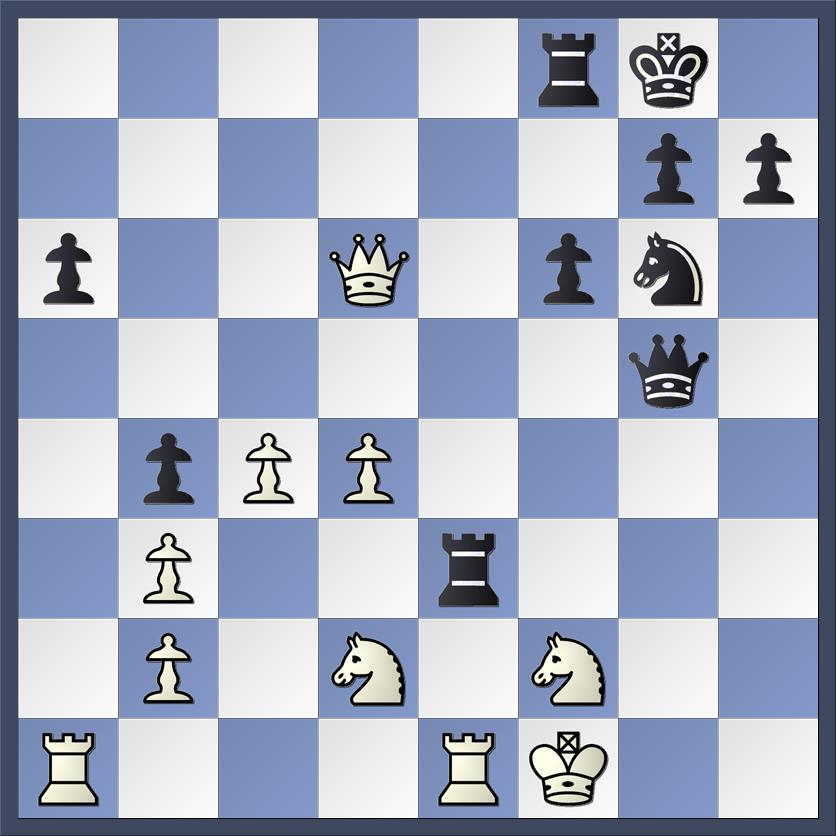
I am watching chess videos that are part of the Fritz Trainer DVD, Master Class, vol. 5: Emanuel Lasker (2015). Mihail Marin makes the argument that Emanuel Lasker was an original strategic player who sought to bring new ideas into familiar openings. In the fourth game of his World Championship match with Siegbert Tarrasch, Lasker brought his rook to the fifth rank, then transferred in to the fourth, where tactical complications ensued. Tarrasch made a few small errors, leading to this position.

Black to move

How should Black deal with the fork?

06 October 2021

Elementary

This position was presented by William Lewis in Elements of Chess (1819) for teaching chess to beginners. I have shown it to hundreds of young students, including those in their first few days with the game and others who think they have advanced beyond the beginner's stage.

White to move

Nearly all young students play the queen forward one square and work to drive Black's king towards the eighth rank. Lewis suggests that White should seek to checkmate on the side of the board that Black's king is nearest, stating that Qe2+ or Qb3+ (both have been suggested by many students when I have shown this position) "would have played ill" because it forces the king towards the center, "as far removed from the side of the board as he was at the beginning" (30).

Something that should be second nature does not even enter the imagination of many players who think they know elementary checkmates.

This position is Lewis's "fifth situation". His second is instructive, too.

White to move

The tendency of beginners and many others who think they have advanced beyond that stage is to move the king. Mate is thereby delivered on the fifth move. He points out that checkmate in four moves is "more masterly and shorter" (28). Drive the king towards your own.

26 September 2021

Patterns

This position appeared in a book, The Art of the Checkmate (2015) by Georges Renaud and Victor Kahn. It appears as well in older versions of the text, but this one is in algebraic.

White to move

From Pillsbury -- Wolf, Monte Carlo 1903.

"Here Pillsbury missed the bus."

Renaud and Kahn point out that Pillsbury played a move that was winning, but he had two other moves that win much faster. The faster win was pointed out after the game by an amateur, James C. Boyce.

18 September 2021

The Art of Defense

This position is analyzed in Modern Chess Miniatures (1960) by Leonard Barden and Wolfgang Heidenfeld. It is from Corte -- Jac. Bolbochan, Mar del Plata 1946.

Black to move

The second position and analysis can be found in Colin Crouch, Chess Secrets: Great Attackers (2009). The position is from analysis of Kasparov -- Sokolov, Vilnius 1975.

Black to move

What would you play?

15 September 2021

Memory

An exercise from Chess.com this morning was made simple because I remembered one that I composed for my book, Essential Tactics: Building a Foundation for Chess Skill (2017).

White to move


The decision to trade rooks in Exercise 1289523 hinges on whether White can seize the opposition. 

White to move

White must outflank with Kg5. All other moves draw.

Exercise 14 in Essential Tactics begins with a tactical sequence.

White to move

After forcing the exchange of bishop and rook for Black's queen, White faces an elementary queen and pawn endgame. However, those who have learned the principle of opposition poorly--thinking opposition is the end, rather than the means to an end--can fail. The White king must outflank Black's king.

White to move

In this case, the distant diagonal opposition is sufficient. Black's king is one square closer to the pawn than in this morning's exercise. This difference suggests perhaps that it was a faulty memory that helped me solve the exercise on Chess.com.

03 September 2021

Capablanca and Books

There should be no question that study of the games of José Raúl Capablanca will benefit any chess player.

Had I made a New Year's Resolution to study the games and works of Capablanca in 2021, it would be my satisfaction to report excellent progress. But I have lost that particular self-improvement habit. Nonetheless, the pursuit of knowledge is central to all that I do. 

My long-lasting advocacy of Chess Fundamentals (1921) as a terrific resource for beginning players was given as a boost as Netflix's Queen's Gambit (2020) brought a surge in the number of beginners seeking advice. I created "Advice for Beginners" so that I could avoid typing the same thing day-after-day, and so my answer could be more detailed. 

Writing that article motivated me to reread Chess Fundamentals, a task made easier by purchasing both the algebraic edition in paperback and an ebook version in ChessBase format. Rapidly, my collection of books by and about Capablanca began to grow from two books that I have had several years to fifteen (at the moment of this writing).


Capablanca, José R. Chess Fundamentals. New York: Harcourt, Brace and Company, 1934.
I have only a vague recollection of buying this book sometime in the 1990s. Much clearer is my horror when I found a position in the text that I had been shown at the Spokane Chess Club, and proven myself ignorant as to the solution (see "Capablanca's Sources").
Capablanca, José. Chess Fundamentals. London: Everyman Chess Classics, 1994.
Anyone lacking a copy of Chess Fundamentals should order this book forthwith. Be careful that you are getting this copy (a reprint) or a used copy of the original Cadogan Chess version from 1994. See my footnote to "Advice for Beginners" for more detail.
Capablanca, José. Chess Fundamentals, rev. and updated by Nick de Firmian. New York: Random House, 2006.
Aside from acknowledging that I bought a used copy last spring, I have nothing to add to Edward Winter, "Capablanca Book Destroyed", Chess History Center, updated 6 August 2020.
Capablanca, José R. A Primer of Chess, rpt. San Diego: Harcourt, Inc, 1977 (1935).
Capablanca considered A Primer of Chess as a companion to Chess Fundamentals. There is some overlap, especially in the section on elementary checkmates and basic pawn endings. This book, however, begins with the basic rules of the game, omitted from the earlier book. Some of the discussion on openings is a bit more detailed than in Chess Fundamentals, and the tactics portion is less oriented towards forced checkmates. I concur with the author's assessment.
Capablanca, José Raoul. Last Lectures: The Chess Legacy of José Raoul Capablanca. New York: Simon and Shuster, 1966.
This book offers a print version of lectures that Capablanca delivered over the radio shortly before his death. It could be seen as the third in his trilogy for beginners. The themes are in the spirit of the two earlier books, but the examples differ.
Capablanca, José Raúl. World's Championship Matches, 1921 and 1927. New York: Dover, 1977.
This book is a republication of Capablanca's limited edition book on the match that was published by American Chess Bulletin in 1921. It also republishes a 1928 book on the match with Alekhine with annotations by Fred D. Yates and William Winter.
Capablanca, José Raúl. Capablanca x3: My Chess Career, A Primer of Chess, Chess Fundamentals. London: Everyman Chess Classics, 2017.
This book presents in facsimile the text of My Chess Career (1920), along with algebraic versions of Capablanca's other two books. The pagination of each volume is retained. With the others listed above, this gives me three print copies of Chess Fundamentals, two of which are identical.
Chernev, Irving. Capablanca's Best Chess Endings. New York: Dover, 1978.
This is one of prolific author Irving Chernev's most highly regarded books. He offers sixty complete games arranged chronologically, selected based on the endings. The index, "Principal themes in the endings" (287), has been useful to me while looking for instructive lessons for my students. I bought this book after losing the Spokane City Championship in 2012. My opponent beat me in a nice endgame in one of the games and credited study of this book for having prepared him.
Del Rosario, Frisco. Capablanca: A Primer of Checkmate. Newton Highlands, MA: Mongoose Press, 2010.
Frisco del Rosario took the structure of the classic Renaud and Kahn, The Art of the Checkmate and developed a similar text using Capablanca's games. Naturally, it is less comprehensive than Renaud and Kahn, as Capablanca did not have the opportunity to employ the full range of patterns. Even so, it is a terrific instructional book.
Gilchrist, J., and D. Hooper. Weltgeschichte des Scachs, no. 14: Jose Raoul Capablanca. Hamburg: Verlag Dr. E. Wildhagen, 1963.
This book contains all of Capablanca's match and tournament games with a diagram every five moves. There is not much need for such texts in these days of databases and websites, but it served a purpose when it was published.
Golombek, Harry. Capablanca's 100 Best Games of Chess. London: B.C.M. Classic Reprints, 1989.
This book offers reasonably insightful annotations for the pre-computer age. I examine the annotations to the first game in some detail in "Is Less More?"
Hooper, David, and Dale Brandreth. The Unknown Capablanca. New York: R.H.M. Press, 1975.
This book gathers games from exhibitions and lesser matches. It serves well as a companion to Gilchrist and Hooper, above, when you need to study Capablanca's games without computers and the internet.
Linder, Isaak, and Vladimir Linder. José Raúl Capablanca: 3rd World Chess Champion, trans. Boris Belitsky. Milford, CT: Russell Enterprises, 2010.
Although I read this book in two afternoons after it arrived, I cannot recommend it enthusiastically. The authors are a bit sloppy with factual matters, even claiming to find a forced checkmate that Capablanca missed because they have incorrect notation. Lasker played 41...Qd7, but they have 41...Qd2 (82). Even so, it is readable. For a quick overview of Capablanca's life and chess achievements, it is a place to begin.
Reinfeld, Fred. The Immortal Games of Capablanca. New York: Dover, 1990.
Which is preferable, the annotations of Harry Golombek or those of Fred Reinfeld? This book contains 112 games.
Sánchez, Miguel A. José Raúl Capablanca: A Chess Biography. Jefferson, NC: McFarland & Company, 2015.
This book is the definitive biography of Capablanca, expanding on a Spanish edition published decades earlier, Capablanca, Leyenda y Realidad (1978). Miguel Sánchez's scholarship is first-rate and the book is well-written.
Winter, Edward. Capablanca: A Compendium of Games, Notes, Articles, Correspondence, Illustrations and Other Rare Archival Materials on the Chess Genius José Raúl Capablanca, 1888-1942. Jefferson, NC: McFarland & Company, 1989.
As the long title indicated, this book assembles primary materials relating to Capablanca's work and life. These are presented with Edward Winter's exemplary attention to detail and often wit.
There are other books about Capablanca, but these are the ones I have on my shelves.

08 August 2021

Losing the Thread

In Spokane Chess Club's Ajeeb Quads, I was matched with Michael Cambareri, our city champion, in the first round. He played the Bird and I found myself in a position where my pieces were poorly coordinated. Move by move, I improved the coordination but remained in an unpleasant position. Then, an opportunity presented itself to sacrifice a piece for the attack. The game became fun to play, but my position was still clearly worse until Michael made a small error.

Cambareri,Michael (2040) -- Stripes,James (1835) [A02]
Ajeeb Quads Spokane (1), 05.08.2021

White to move
27.Qxc6?=

I anticipated this move and saw the reply.

27.Qf3+/-

27...Rxe3 28.Qxd6

28.Rxe3 Qg5+ 29.Ng4 Qxg4+ 30.Kf1 Bf4-/+

28...Qg5+

28...Rxe1+ 29.Rxe1 Qg5+ 30.Kf1 Qxd2=

29.Kf1
 
Black to move
29...Rg3??

29...Rxe1+ was the only move leading to equality. Michael suggested this move during our brief postgame analysis. 30.Rxe1

(30.Kxe1?? Qg1+ 31.Ke2 [31.Nf1 is the position that I somehow misevaluated 31...Re8+] 31...Qxa1-+)

30...Qxd2=

30.Nde4+- Rg1+ 31.Ke2 Qh5+ 32.Kd2 1-0

I played on to move 46, although my position was hopeless. Michael was short of time and I still had threats.