29 April 2012

Training Log

This past week, I have been battling my old nemesis: blitz addiction. A major part of what drives the addiction is easy to understand. I lose. I must play again when I lose a game that I feel I should have won because I outplayed my opponent, but failed to watch the time, or because I was outplayed by an opponent who lacks rudimentary skills, or a host of other reasons. When I wake up at four in the morning after eight hours of sleep because I woke up at four the previous morning and went to bed early, I lie in bed with my iPad and play three minutes games with the Internet Chess Club iPad app. At that hour, it takes me four games before I can see the screen. My rating plummets, and so I must play on to restore my own dignity. This illness cuts into tactics training, but is not always a complete waste.

This game was played early yesterday morning in the 3 0 pool. I was a bit too cavalier concerning the loss of my queenside pawns in the opening, but managed to create some pressure in the center.


Stripes -- ICC Player [D11]
ICC 3 0 Internet Chess Club, 28.04.2012

1.d4 c6 2.c4 d5 3.Nf3 Nf6 4.g3 a6 5.Bg2 dxc4 6.0–0 b5 7.a4 Bb7 8.b3 cxb3 9.Qxb3 Nbd7

White to move

10.Bf4

A silly move.

10...Nd5

The correct response.

11.Bd2 e6 12.e4 N5b6 13.a5 Nc4 14.Bc3 Nf6 15.Re1 Be7 16.Nbd2 Nxd2 17.Nxd2 0–0 18.Rad1 c5 19.d5

Black to move

Black has two connected passed pawns. These shall become a thorn in my side, but the puss that develops around the wound will strengthen me for attacking elsewhere.

19...c4 20.Qb2 exd5 21.e5

Now, three passers are coming at me. Yet, somehow I was less worried than when I had four pawns coming down the middle when Elston sacrificed two knights to get his pawns moving in the opening round of the 2005 Collyer Memorial in Spokane. I missed an opportunity in that game, and then survived with a draw because we were using my old analog clock and Elston ran out of time eight moves before checkmating me.

21...Ne8 22.Qa1 b4 23.Bd4 c3 24.Nf3 Nc7 25.Bb6 Qd7 26.Nd4 Ne6 27.Nf5 Bc5 28.Bxc5 Nxc5 29.Nd4 Ne6 30.Nf5 d4

White to move

I have the opportunity to dispatch one of the pesky pawns.

31.Bxb7 Qxb7 32.Nxd4 Nxd4 33.Rxd4 Rad8 34.Rde4 Rd2 35.Qa4 Rb8 36.e6 fxe6 37.Rxe6

Black to move

37...Rdd8??

Despite his or her clear advantage, my opponent panics. 37...Rf8 applies pressure to a White position already in dire straits.

38.Qb3??

38.Rb6 keeps some chances for equality.

38... Kh8 39.Re7??

White's idea of playing Qf7 is easily refuted by 39...Qf3

39... h6??

And, now, finally, White gets to have some fun in this blunderfest. The errors in this game should reveal why blitz does not strengthen one's game. When many hours of online blitz cut into useful activity, such as tactics training, then ambitions to achieve new levels of chess performance in serious play are deferred.

White to move

40.Rxb7 Rxb7 41.Kg2 Rc8 42.Rc1 Rb5 43.Qe6 Rcb8 44.Qxa6 b3?

Black makes White's game easier with this move.

White to move

45.Rxc3 b2 46.Rc8+

It seems that I spent quite a bit of time working out the variations before playing this move. I did not want to deal with a Black queen again. This "long think" was probably ten seconds.

46...Kh7 47.Rxb8 Rxb8 48.Qd3+ Kg8 49.Qb1 Black forfeits on time 1–0

Despite an excessive amount of time playing blitz this past week, I did find time for 14 Shredder puzzles on the iPad.


1622 puzzles: 12690/16220 points 78%
last 10 puzzles: 63/100 63%

Nothing impressive there. However, I also continued to work the problems at Chess Tempo. Not only did I complete 138 standard rated problems, but also worked through 6 problems in a new set that I created to address an area of weakness (getting five correct).


Problems Done: 1077 (Correct: 613 Failed: 464)
Percentage correct: 56.92%

I do plan to visit Lev Alburt's Chess Training Pocket Book II this week. My wife and I are spending a couple of days at a beautiful resort where she has a professional conference. Although I will attend a few of the conference social activities, I have ample time in the hotel for a bit of tactics training unless I decide to spend the time fishing. And there are some nice small lakes near here as well as the mammoth one a few feet from the patio where I am typing this post. Balancing chess training with fishing, exercise, and a bit of wine tasting is essential to my long-term progress.

I do have my endgame flash cards with me, and am scheduled to do a bit of driving for one conference excursion, so will keep the cards handy should there be some idle moments.

26 April 2012

Glossary of Tactics: Pins

In chess, a pin is an attack of two targets along a rank, file, or diagonal such that moving one attacked piece renders the other vulnerable to capture. When a piece is pinned against the king, it is an absolute pin: the pinned piece cannot legally move. In a relative pin, the pinned piece may legally move, but often with dire consequences.

In this position from a blindfold exhibition by Miguel Najdorf, Black's knight on c6 cannot legally move.

White to move
Najdorf played 10.d5, a technique known as piling on: attack a pinned piece with another piece, and sometimes the defense will crumble. The game continued 10...a6 11.Bxc6+ Bxc6 12.dxc6 and Najdorf has won two pieces for one.

In contrast, Black's relative pin of the knight against the queen in this famous game played in Paris in 1851 is ineffective. The knight is able to move, winning a pawn.

White to move
White played 5.Nxe5. After 5...dxe5 6.Qxg4, we see that White gained a pawn, while exchanging knight for bishop. A pin by a bishop was transformed into a discovered attack against that bishop. However, in the actual game, Black preserved his bishop by capturing White's queen. Alas, the cost was the Black monarch.

5...Bxd1 6.Bxf7+ Ke7 7.Nd5#.

Bishops, rooks, and queens are the only chess pieces capable of pinning one piece to another. Likewise, these three pieces are capable of a skewer, a sort of pin in reverse, and are essential pieces in the construction of threats of discovered attacks.

A pin may also be executed against a piece and a critical square. In the position below from Anderssen -- Staunton, London 1851, Black's pawn on h6 is pinned, although it has no way to move off the h-file at the moment. Staunton just played 21...h6 to avoid checkmate.

White to move
3r1rk1/b4pp1/p3p1np/1pp1P2Q/5PP1/3BB2R/qPP4P/5R1K w - - 0 22
22.g5!

Anderssen offers the pawn an opportunity to vacate the h-file, and piles on pressure along the same. If Black plays 22...hxg5, then White wins instantly: 23.Qh7#. Anderssen's exemplary attack employed pins and other tactics to break down Black's defenses. Staunton proved resourceful in defense, but errors made earlier in the game were decisive and his position proved indefensible.

22...Rxd3 23.cxd3 Qd5+ 24.Rff3 Ne7 25.gxh6 g6 26.h7+ Kh8 27.Qg5 Nf5 28.Qf6+ Ng7

White to move

The knight is pinned, and if White can simply pile on with the dark-squared bishop, the game will be over.

29.f5! Qb3 30.Bh6 Qd1+ 31.Kg2 Qe2+ 32.Rf2 Qg4+ 33.Rg3 Qxg3+ 34.hxg3 Rg8 35.hxg8Q+ Kxg8 36.Qxg7# 1–0

So, we see that pins were useful to the winner of the first International Chess Tournament.


25 April 2012

Glossary of Tactics: Forks

In chess, a fork is when one piece attacks two targets in different directions. A fork may occur along a rank, file, or diagonal. In such cases, the forking piece will stand between the two targets.*

The knight fork is often the first tactic that beginners use to gain an upper hand on their competition.

Black to move

In the position above, White's knight is attacking Black's queen and Black's rook, a typical knight fork. However, because the knight is unprotected, this fork is not particularly effective. If the knight were secure from capture by the Black king, it would capture one of the two attacked pieces.

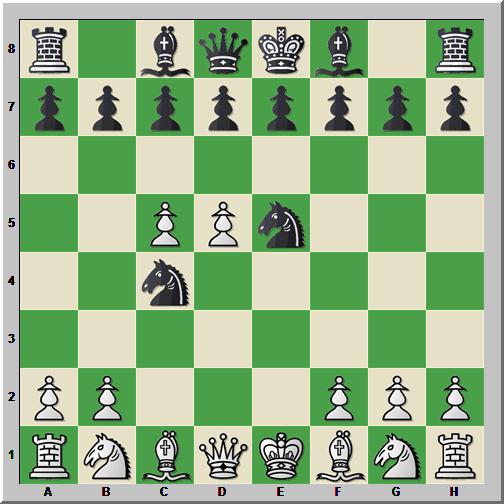
The position above comes from the Fried Liver Attack after the moves 1.e4 e5 2.Nf3 Nc6 3.Bc4 Nf6 4.Ng5 d5 5.exd5 Nxd5 6.Nxf7.

After the usual 6...Kxf7 7.Qf3+, we have a queen fork. The queen attacks both king and the knight on d5. The knight is protected by Black's queen, but is also attacked by White's light-squared bishop. There are two attackers, but only one defender.

Black to move

In order to avoid the loss of material due to the queen fork, Black's king must move towards the center. 7.Ke6. So it is in the Fried Liver Attack. White employs a sequence of forks and other tactics to apply pressure, to provoke and then to exploit a vulnerable king. White sacrifices a knight to initiate these actions.

In most examples of forks in chess books, one piece attacks two pieces. But a fork may include critical targets that are not pieces. For example, in the solution to Problem 44255 on Chess Tempo, a knight forks king, queen, and a critical square.

White to move

White's key move is a queen sacrifice. 1.Qxh6. After 1...Nxh6, the pawn on f6 is undefended. 2.Nxf6 is the winning fork. Although the queen and king are both forked, that is inconsequential. What matters is that the knight controls g8 and h7, forking king and square. After 2...Kh8, White wins with an exchange sacrifice. 3.Rg8+ Nxg8 4.Rxg8#.

Every chess piece is able to fork, even the king. Normally, a bishop and a knight will win against a lone king. But, if the defending king is able to capture either, the position is a draw by insufficient material.

Black to move

Black draws with 1...Kd4. The king attacks both bishop and knight, winning one and leaving White with insufficient material to deliver checkmate.


*Tactics such as pins and skewers attack two targets along a line, a diagonal, file, or rank. Both targets will be in the same direction from the attacking piece.

24 April 2012

Tactical Motifs: A List

What are the tactical ideas that chess writers and teachers use to classify practice positions? Where can the aspiring chess player find a definitive list? In this post, I compile several lists for comparison purposes.

Jonathan Tisdall, Improve Your Chess Now (1997) offers two useful appendices: "Mating Patterns" and "Common Tactical Themes." His words describing "Double Attack/Check" echo a statement that  recall from Yuri Averbakh, Chess Tactics for Advanced Players (1992).
Double Attack is the essence of any successful operation. It would be more accurate to say Multiple Attack, since there is often a presence of, or a need for, more. I imagine the wording has arisen because a double is the limit on checking. Almost all the other themes have some element of multiple attack contained in them.
Tisdall, Improve Your Chess Now, 204.
In his largely successful effort to advance middlegame theory, Averbakh highlights the centrality of the double attack.
If we regard the term "double attack" in a broader sense than has been done up to now by theoreticians, namely not merely as a two-pronged attack, but as a combination of attacks and threats, we notice that the double attack in one form or another in the basis of most intricate tactical operations.
Averbakh, Chess Tactics for Advanced Players, 6.
Averbakh's brilliant discussion of how the elementary checkmate of a lone king through the coordinated actions of a queen and king illustrates the double attack in practice is sufficient reason for paying the price to acquire a copy of this classic text. Averbakh's clear discussion of contacts also informs, it seems to me, the thought-provoking efforts of Momir Radovic to challenge the way chess is ordinarily taught to beginners, and to offer a system grounded in sound pedagogy.

It is almost possible to extract a list from Averbakh's text through examination of subheadings. However, most of his terms are better described as meta-motifs, efforts to make a theoretical contribution in the understanding of types of contacts. It is not Averbakh's central purpose to develop a practical list of motifs. Here's a sample of his headings.

Fork
Discovered check
Double check
Two-fold attack on a defended piece
Two-fold attack on two targets
Two-fold attack in conjunction with a pin
Mutual two-fold attack
Double attack
Zugzwang
Exchange
Sacrifice
Decoy attack
Two-fold double attack

Tisdall offers an abbreviated theoretical discussion in the process of defining the terms in his list.

Double attack/check
Discovered attack/check
Pinning
Skewer
Deflection
Decoying
Interference
Destruction
Clearance
Blocking
Brinkmate
X-Ray
Overloading
Zwischenzug
Pawn promotion
Pursuit (Perpetual)
Stalemate
Demolition of Pawn structure
Trapped pieces

The index to Lev Alburt and Al Lawrence, Chess Training Pocket Book II (2008) offers another list. Some of the motifs are better described as positional, rather than tactical.

Battery
Blockade
Blocking
Decoy
Deflection
Desperado
Discovered attack
Discovered check
Double attack
Double check
In-between move
Interference
Line clearance
Loose piece
Overloading
Pawn promotion
Perpetual check
Pin
Removing the defender
Skewer
Stalemate
X-ray
Zugzwang

The training website Chess Tempo uses a tagging system whereby users identify the motifs in problems, or can vote motifs others have identified up or down. The CT list currently has 34 tactical motif tags.

Advanced Pawn
Attraction
Avoiding Perpetual
Avoiding Stalemate
Back Rank Mate
Blocking
Capturing Defender
Clearance
Coercion
Counting
Defensive Move
Desperado
Discovered Attack
Distraction
Double Check
Exposed King
Fork/Double Attack
Hanging Piece
Interference
Overloading
Mate Threat
Pin
Quiet Move
Sacrifice
Simplification
Skewer
Smother
Trapped Piece
Unpinning
Unsound Sacrifice
Weak Back Rank
X-Ray Attack
Zugzwang
Zwischenzug

I have previously compiled a practical list in the creation of workbooks for my chess summer camps. The list is far from complete, but highlights those that I easily find in historic games from which I extract training positions for youth players to solve.

Pin
Skewer
Fork
Discovery
Double check
Removal of the guard
Deflection
Decoy
Clearance
Interference
Trapped Piece
Zugzwang


Edit 24 June 2014:
This year's camp workbook added zwischenzug, as well as discovered check as a separate entry.

22 April 2012

Training Log

Peaks and Valleys Show Upward Trend
My training lacked balance this past week as I focused almost exclusively on Chess Tempo tactics. In "Hanging Pieces" I highlighted a new element in my training that Chess Tempo facilitates: intensive practice in particular tactical motifs. CT permits me to track my performance by motif, identify areas of weakness, and design exercises for transforming weaknesses into strengths.

Over the course of the week, I solved 231 problems in 442 attempts.

Chess Tempo Totals

Problems Done: 939 (Correct: 541 Failed: 398)
Percentage correct: 57.61%

Over the course of the week, I attempted a small number (39) of the problems on the Shredder iPad app.

Shredder Totals

1608 puzzles: 12593/16080 points 78%
last 10 puzzles: 89/100 89%

I attempted nearly 500 tactics problems for the week, correctly solving more than 250.

18 April 2012

Lesson of the Week

End of Season

This week is the last one until October for most of my school chess clubs. The 2012 Washington State Elementary Chess Championship will be held on Saturday. Washington's elementary championship is the largest state championship in the United States. I might have been organizing this year's event as I did in 2009 (see "Advice for Organizers"), but the Spokane bid lost to the Tri-Cities bid put together by the organizers of the 2003 and 2006 event. Yesterday, I told the organizer of this year's event that I was relieved when he won the bid. My week is less stressful than it might have been.

Yesterday afternoon, I took a group of young children through a batch of games from Irving Chernev, The 1000 Best Short Games of Chess (see "My First Chess Book"). In most cases, the position in the diagram comes just before the last move of the game.

These are not particularly difficult. They are instructive, as each game featured a fatal error by one player that the other player exploited. It is likely that there will be similar knockouts on Saturday. My hope is that the players in my clubs will be on the winning end.


Meek -- Amateur [C36]
New Orleans, 1855

1.e4 e5 2.f4 exf4 3.Nf3 d5 4.Nc3 dxe4 5.Nxe4 Bg4 6.Qe2 Bxf3

White to move

Muhlock -- Kostics [C50]
Cologne, 1912

1.e4 e5 2.Nf3 Nc6 3.Bc4 Nd4 4.Nxe5 Qg5 5.Nxf7 Qxg2 6.Rf1 Qxe4+ 7.Be2

Black to move

Imbusch -- Goring [C27]Munich, 1899

1.e4 e5 2.Bc4 Nf6 3.Nc3 Nxe4 4.Bxf7+ Kxf7 5.Nxe4 Nc6 6.Qf3+ Kg8

White to move

Kraus -- Costin [A43]
Correspondence, 1914

1.d4 c5 2.dxc5 Qa5+ 3.Nc3 Qxc5 4.e4 e5 5.Nf3 d6 6.Nd5 Ne7

White to move

Amateur -- Goetz [C33]
Strassburg, 1880

1.e4 e5 2.f4 exf4 3.b3 Qh4+ 4.g3 fxg3 5.h3 g2+ 6.Ke2 Qxe4+ 7.Kf2

Black to move

Borochow -- Fine [B02]
Pasadena, 1932

1.e4 Nf6 2.e5 Nd5 3.c4 Nb6 4.d4 Nc6 5.d5 Nxe5 6.c5 Nbc4

White to move


17 April 2012

Hanging Pieces

Deliberate practice includes activities that have been specially designed to improve the current level of performance.
K. A. Ericsson, R. Th. Krampe, and C.  Tesch-Römer, "The Role of Deliberate Practice in the Acquisition of Expert Performance," 368. 
[D]eliberate practice requires that one identify certain sharply defined elements of performance that need to be improved, and then work intently on them.
Geoff Colvin, Talent is Overrated, 68.*
Having spent more than a decade coaching elementary school age beginning chess players, I have observed the pattern that pieces are frequently left undefended. These pieces are ripe for plucking. Those who learn to spot the fruit of error enjoy a bountiful harvest. Observing the strengths and weaknesses of beginning players is one thing, but learning that tactics involving hanging pieces was my own weakness was quite another.

Chess Tempo's "Rated Tactical Motif Performance" lists the tactical motifs identified by users of that site for each problem. For each motif, information is given concerning the number of problems that I have attempted, the number correct, a percentage, and a rating performance. After 637 problem attempts, hanging pieces appeared as as one of my worst percentages, and my lowest performance rating: 37/72 problems, 51.39% correct, performance >200 below current target.

In order to improve through practice, exercises must address those areas where I fail. Failure, thus, becomes not a cause for anger, but data to diagnose. Through the problem search on Chess Tempo, I found those problems that involve hanging pieces, limiting the search to those above a target rating (higher than my current performance). I then set my training to solve only problems from this set. Chess Tempo creates a new rating based only on solving problems in this user created set. The rating offers one index for tracking improvement over the new few days and week. Because I set a minimum rating, the problems were difficult. In my first session with this set, I solved 4/16 for 25%. My performance was 4.8 over the initial target.

That was yesterday. Today, before solving another set, I reviewed my errors. Chess Tempo offers Silver and Gold members access to the source game, which is already in my reference database in ChessBase 11. Yesterday, I opted for a one-month trial of Gold membership ($4). So far, it seems money well-spent.


De la Riva Aguado,Oscar (2515) - Hassan,Abdul (2296) [C14]
Bled ol (Men) Bled (12.1), 07.11.2002

1.e4 e6 2.d4 d5 3.Nc3 Nf6 4.Bg5 Be7 5.e5 Nfd7 6.Bxe7 Qxe7 7.f4 a6 8.Nf3 c5 9.dxc5 Nxc5 10.Bd3 Nc6 11.0–0 Bd7 12.Qd2 f5 13.exf6 Qxf6 14.Rae1 0–0 15.Ne5 Nxe5 16.Rxe5 Rac8 17.g3 Be8 18.Rfe1 Bf7 19.Bf1 Nd7 20.R5e3 Nc5 21.Bg2 Rfe8 22.R3e2 Nd7 23.Nd1

White's last move is interesting. In this game, it precedes Black's decisive error.

Black to move

23...Bh5?? 24.Rxe6 Rxe6 25.Rxe6 Rxc2

And now we have the position that appears as Problem 48544 on Chess Tempo.

White to move

26.Bxd5

I played 26.Rxf6, the third most common wrong move. My move actually loses by force, as I have now hung both my rook and my knight.

26...Bf7 27.Re8+ Nf8 28.Bxf7+ 1–0

The Chess Tempo problem carries the combination another two moves.


*Geoff Colvin. Talent is Overrated: What Really Separates World-Class Performers from Everybody Else. New York: Portfolio, 2008.

K. Anders Ericsson, Ralf Th. Krampe, and Clemens  Tesch-Römer. "The Role of Deliberate Practice in the Acquisition of Expert Performance." Psychological Review, 100, no. 3 (1993): 363-406.

16 April 2012

Dealing with Frustration

In "Getting Angry" I mentioned the effort to transform anger into a productive resource. That post was intended to end on a positive note as I achieved the day's objective that had been set after initial unsuccessful efforts with Chess Tempo tactics training. Instead, the day ended not with the tactics rating goal met, but seventy points below (some twenty-five Elo lower than I had begun the day). Initial frustration gave way to despair as I realized that my skill is far below my self-assessment.

Sunday morning's tactics session began much as Saturday's: I missed five of the first ten problems. As a result my tactics rating went from -52.2 (relative to Saturday's goal) to -52.3.* I went back through the problems that I had missed, including a few from Saturday. Then, I created a new database in ChessBase 11: Chess Tempo Fails. When I fail a problem, I do not immediately move on to the next, but save the position into this database. After missing five of the first ten, my results improved. After thirty problems, I had missed ten total. My rating improved to -23.7.

I felt robbed on my forty-second problem. I found the first two moves easily, and then had an elementary checkmate in three. Fail! It was checkmate in two. Rating drops to -18.9. The Chess Tempo Fails database now contains fifteen positions for review later.

Black to move

I played 3...Bg2+, seeing 4.Kg1 Bf3+ 5.Kf1 Qg2#

The correct answer was 3...Qh3+ 4.Ke2 Qd3#. It is an elegant checkmate.

After fifty problems, my rating has risen to -9.3. I remain short of Saturday's goal, but cannot deem the day a failure. The vertical gray bar on the graph to the right marks the beginning of Sunday's set of fifty problems.


*I am too embarrassed to mention my actual Chess Tempo rating not only because the number is far below my USCF rating, but because the percentile score places me well below a level that I judge to be in the class of skilled chess players. Of course, only serious chess enthusiasts use Chess Tempo with any consistency, and it is not inconceivable that the overall pool may reflect a subset of the upper percentiles of other rating pools. It is not reasonable to comparing ratings on one site to those on another, nor to official ratings achieved through tournament play.