27 February 2024

Ways of Reading

After finishing the process of going through every game in Irving Chernev, The 1000 Best Short Games of Chess (1955), I was motivated to tackle another classic. Now, I am following the same process with P. H. Clarke, 100 Soviet Chess Miniatures (1963). I downloaded the PGN file from Bill Wall’s Chess Page and opened it in tChess Pro on my iPad. During my morning coffee a day or two per week, I go through a game on the iPad, sometimes several times, then I go through the game while reading Clark’s annotations. Sometimes, I then find the game on chessgames.com and drop a note there.

Clarke’s book had some competition for my attention. Bobby Fischer, My 60 Memorable Games (1969) also beckoned. Wall has a PGN for that book as well. It, too, resides on my iPad. But as I was going through Fischer — Sherwin 1957, I had a strong impulse to set a chess board on the table for the purpose of studying Fischer’s annotations in a manner that is more difficult with tChess Pro.

Working through My 60 Memorable Games will be more work, but I also think it is worth doing. Perhaps I will do a quick orientation to each game in tChess Pro, then switch to a chessboard on the table and the book for further study.

26 February 2024

Study Material

What might I gain from some focused study of the works of Aron Nimzowitsch? I’ve had My System and Chess Praxis in the old English descriptive versions since the 1990s and have dipped into them often enough to have a grasp of his central concepts. Of course, prophylaxis, blockade, pawn chains, the isolated queen pawn, and other ideas that he articulated before anyone else are found in many books today. One cannot read chess books and fail to encounter the work of Nimzowitsch.

John Watson, Secrets of Modern Chess Strategy has been in my possession close to twenty years and I’ve read chunks. In fact, it was much on my mind during yesterday’s round four game, as was Neil McDonald, Break the Rules! Both Watson and McDonald present a Caro-Kann line in which White begins the game with eight pawn moves. Concrete calculation trumps general principles, Watson notes. In my game yesterday, prior to 17…Qb6, I had made 11 pawn moves and 5 knight moves. Also, I had trapped my opponent’s bishop.
Last summer, I purchased both the original edition of Raymond Keene, Aron Nimzowitsch: A Reappraisal and the somewhat newer algebraic edition. I’ve read only the first chapter. Yesterday, at the chess tournament, the new translation of Nimzowitsch’s classics was added to my book collection thanks to the generosity of IM John Donaldson attending and playing in our local tournament. He has been doing so for a quarter century and has made a habit of bringing books that he sells at bargain prices.
Perhaps the new book will end up on the shelf gathering dust. Perhaps I will make some time to study it. 

12 February 2024

Failed Twice

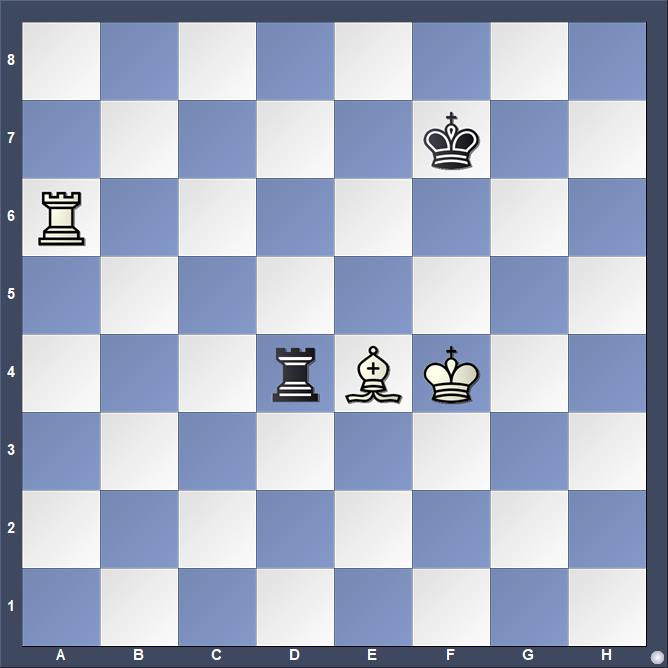
On Friday morning, I spent about ten minutes struggling with this chess problem, then gave up and looked at the answer in the back of the book. Friday's failure was a repeat of the same process with the same problem several months ago.

White to move and win
It was composed by Oldrich Duras and published in Deutsche Schachzeitung (October 1908), 310. The solution was published in January.

I encountered the position in Sergey Ivashchenko, The Manual of Chess Combinations, vol. 2 (2002). Reuben Fine presents it without a diagram in Basic Chess Endings (1941), 121.

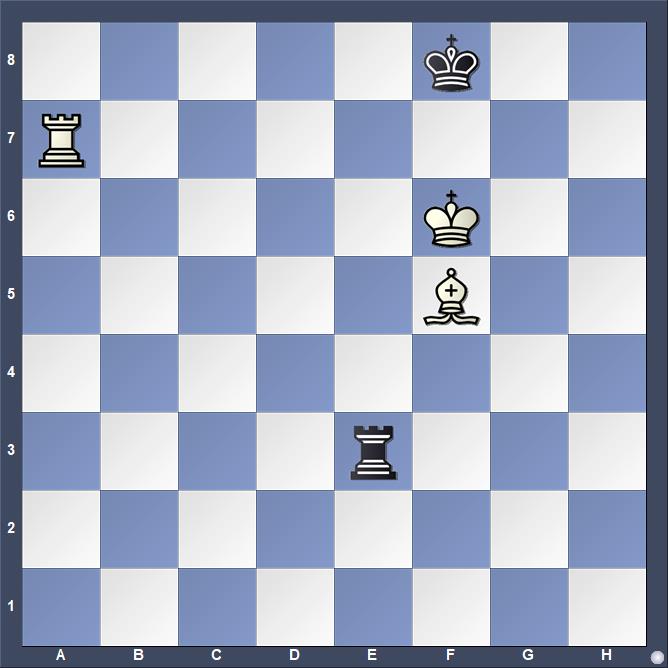
While attempting to solve the puzzle, I had a faint recollection of some of the key ideas from a study by Alexey Troitzky that I had spent some time with last summer after getting a copy of Yuri Averbakh, Bishop Endings (1977). Troitzky's study also appears sans diagram in Fine, Basic Chess Endings.

White to move
I could recall the bishop maneuvers in the Troitzky study, but forgot the importance of the king's position.

In the Troitzky study, White wins with 1.Be6 Ke7 2.h6 Kf6 3.Bf5! 

I remembered this idea.

3...Kf7 4.Bh7

And this paradoxical move.

Black to move
4...Kf6 5.Kf4

This necessary move is not possible in the Duras study. The solution in Deutsche Schachzeitung (January 1909) reaches a similar position after one of the moves that fails, 1.Bc5, and the line was part of what I examined before I gave up.

Most of my effort, however, was spent trying to make 1.Bd6 work. That move was also the first one that FM Jim Maki tried when I showed him Duras's study during a youth chess tournament on Saturday. Black's drawing idea of the king taking refuge on and adjacent to the promotion square is one I learned the hard way in a tournament game a quarter century ago (see "A Memorable Lesson").

If Bd6 and Bc5 both fail, how can White win? I know now. Maybe I will remember the next time that I see this study by Duras.


01 February 2024

Maczuski -- Kolisch 1863

On Tuesday, I showed a short game to my young students that is the source for exercise 19 in Checkmates and Tactics (2019), a book that presents 150 exercises that I developed in 2006 for scholastic chess players. While doing so, my ignorance grated. I knew nothing about the players, although the name of the losing player was familiar enough that I thought I should know more.

While printing the game score before club, it surprised me that only two games played by Ladislav Maczuski appeared in ChessBase Mega (online was no different). This paltry selection was surprising particularly because the game data indicated it was part of a four game match between the players. ChessBase has 151 games played by Ignatz Kolisch, plus two consultation games. Maczuski's performance in the game against a strong master suggests that he should be better known. Kolisch was "one of the world's leading players from 1859 to 1867", according to David Hooper and Kenneth Whyld, The Oxford Companion to Chess (205).

It is not surprising that chessgames.com has more information than almost any where else that I searched. Edward Winter's Chess Notes is also useful. Note 2335 has an 1876 game played by Maczuski as part of a blindfold simul that does not appear in databases. Note 11728 recommends Fabrizio Zavatarelli, Ignaz Kolisch The Life and Chess Career (2015) for "a detailed discussion". Chessgames.com led me to the first publication of the game and a second the next month. ChessBase referenced David Levy and Kevin O'Connell, The Oxford Encyclopedia of Chess Games, Vol. 1 1485-1866 (1981), which also references Schachzeitung (1864). Levy and O'Connell get the date wrong, an error carried forward in ChessBase.

I know more than I did on Tuesday and know how to learn a bit more should I manage to acquire a copy of Zavatarelli's book.

Here is the game.

Maczuski,Ladislav -- Kolisch,Ignaz [C45]
Match Kolisch--Maczuski +2-2=0 Paris (1), 03.1863

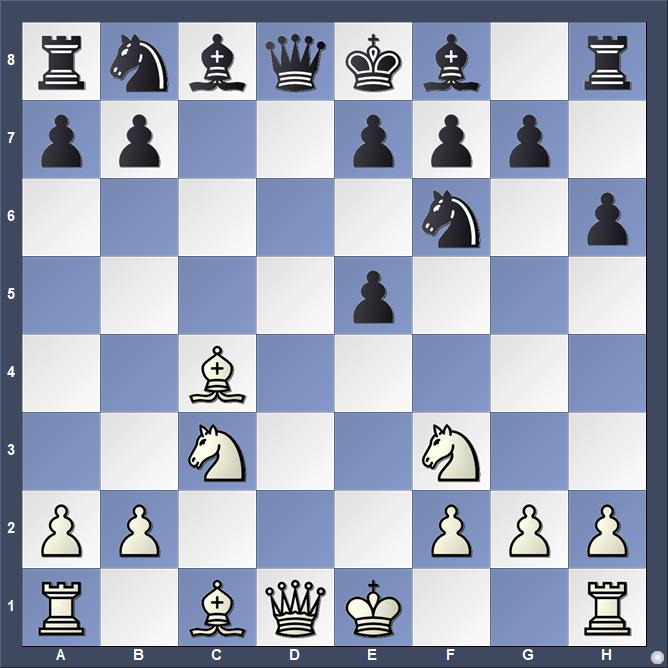
1.e4 e5 2.Nf3 Nc6 3.d4 exd4 4.Nxd4 Qh4

The fifth most popular reply wins a pawn, but often a great cost

5.Nc3

5.Nb5 is an alternative 5...Bb4+ 6.N1c3 Ba5 7.Be2 a6 (7...Qxe4? 8.Nxc7+ Kd8 9.Nxa8 Qxg2 10.Bf3+-) 

5...Bb4 6.Qd3!?

6.Be2 and 6.Ndb5 are more frequently played

Black to move

6...Nf6 7.Nxc6

Also possible: 7.Nf5 Qxe4+ 8.Qxe4+ Nxe4 9.Nxg7+ Kf8 (9...Kd8) 10.Nh5 (10.Bh6 Nxc3 11.Nf5+ Ke8 12.a3 Ba5 13.b4 Bb6) 10...Nxc3 11.Bh6+ Ke7 12.Bg7 Ne4+ 13.c3 with equal chances.

7...dxc6 8.Bd2 Bxc3 9.Bxc3 Nxe4

9...0-0 seems prudent, but White does not yet have full compensation for the pawn with the line played.

10.Qd4

Black to move
10...Qe7

10...Bf5 has also been played here 11.Qe5+ Qe7 12.Qxe7+ Kxe7 13.Bxg7 Rhg8 14.Bd4 (14.Bh6 may be better) 14...Rad8 15.c3 c5 16.Be3 b6  and Black won in 60 moves Trabert,B (2285)--Tomescu,V (2436) Montecatini Terme 1999.

11.0-0-0 Qg5+??

A terrible blunder.

11...Nxc3 12.Qxg7 Nxa2+ 13.Kb1 Rf8 with a slight edge for Black, who went on to win in 65 moves Rizovic,S--Minic,M Vrnjacka Banja 2006.

White to move
This position could make a good exercise.

12.f4! Qxf4+

Black could also play 12...Qe7, but the game is lost in any case.

13.Bd2 Qg4

13...Qh4 14.Re1 0-0 15.Rxe4+-
13...Qf6 also prevents checkmate.

White to move
This position appears in my Checkmates and Tactics book. My students have been solving it, or failing to solve it nearly twenty years.

14.Qd8+ Kxd8 15.Bg5+

The game as it appears in La Nouvelle Régence (image above) would seem to indicate that the last move was not played.

15...Ke8 16.Rd8# 1-0


17 January 2024

Not so Easy

Yesterday, I posted a position on Facebook from a game played online. In that position, my opponent blundered and lost. But, had my opponent played differently, I would have lost. The position generated a fair amount of discussion. I am particularly grateful to three commentators--Lukas Bratcher, Chris Kalina, and Misha de Rue. All three regularly comment.

We begin eighteen moves prior to the posted diagram in order to show several missed opportunities by both contestants as they played too fast with too little analysis. I was White.

White to move
Black has captured my rook on c5. I correctly assessed that my passed c-pawn could win, but missed some of the details.

33.dxc5??

It was necessary to first divert Black's king away from my e-pawn.

33.g4+ Kg5 34.dxc5+-
33.Bd3+ Kg5 34.dxc5+-

33...Kxe5-/+

Now, Black has an edge.

34.b4 g5 35.Bf3 f6 36.Bh5 h6 37.Be8 f5?

37...d4+ 38.Kd2-/+

38.Bc6

38.c6 d4+ 39.Kd2 Kd5 40.Ke2-/= Black is slightly better, but it is unclear how to make progress due to the c-pawn threatening to advance.

38...Bc8 39.Be8 f4+

39...d4+-/+

40.gxf4+ gxf4+ 41.Kf3= d4

White to move

42.Bg6??

I may have been overconfident, thinking I was better. Or, I may have believed that my bishop was needed for defense.

42.c6=

42...Bb7+ Black has the edge, but there was a stronger move.

42...Bd7-+

43.Kf2 f3 44.Bh5

Black to move

44...Kf4

44...d3 is the only move that clearly maintains Black's advantage 45.Ke3 f2 46.Kxf2 Kd4-+

45.Be8 Ke4??

45...d3=

46.Bg6+??

46.c6+-

46...Kf4= 47.Bd3??

47.Be8=

47...h5

Black missed another opportunity to put White away.

47...Be4 48.Bxe4 Kxe4 49.c6 d3 50.c7 d2 51.c8Q d1Q oh boy! White hopes to draw with perpetual checks, but Black's king can hide among the forest of pawns on the queenside.

48.Bg6 h4 49.h3

49.Be8 (only move) holds out some hope of equality, but Black remains better.

49...Ke5-+

49...Bc8-+

50.Be8 d3 51.c6

The position I posted on Facebook

Black to move

51...Bxc6??

The losing move, also suggested by a Facebook member. If Black considered the consequences of this move, he may have thought to saddle me with an unpromotable h-pawn (wrong bishop does not control h8). 

51...Ba8-/+ Black retains an edge.
51...Bc8! and Black will win. 52.Kxf3 (52.Bd7 d2 "Black wins the race." Chris Kalina)

Black to move
Analysis diagram after 51...Bc8 52.Kxf3
52...Bxh3

(Misha de Rue pointed out other ways for Black to win from this position: 52...Kd4 53.Kf2 Kc3 54.Bh5 Kc2 [or 54...d2; or 54...Bxh3] )

53.Bd7 was suggested with the belief that Black blundered in taking the h-pawn. 53...d2 54.Ke2 Be6!

White to move
Analysis diagram after 54...Be6!

I think this move solves the problems perceived in the analysis that saw 52...Bxh3 as an error.

51...d2 was also suggested, but 52.cxb7 d1Q 53.b8Q+ with an extra bishop and an exposed Black king, White should win easily. 53...Ke6 54.Qb6+ Ke7 (54...Qd6 55.Qxd6+ Kxd6 56.Kxf3+-) 55.Qe3+ Kf8 56.Bg6+-.

52.Bxc6+-

Black to move

52...Kd4 53.Bxf3 Kc3 54.Ke3 Kb2 55.Kxd3 Kxa3 56.Kc3

Here my opponent thought for a full minute. I suspect it is now dawning upon him that the game is lost.

56...a5 57.bxa5 b4+ 58.Kd2 b3 59.a6

White won by resignation 1-0

Both my opponent and I have some things that we can learn from how we played this ending.

12 December 2023

Learning from Books

Frequently, I repeat stories of how chess skill first became something possessed in small measure and hoped to develop further. At the heart of the story are several books for which the authors and titles have been forgotten and one that I can identify. That one is Irving Chernev, The 1000 Best Short Games of Chess (1955). Playing through some of the games in this book in 1975 transformed my play. The book came back into my possession in 2012, now usually serving as a source of lessons for young students.

Over the past year (since September 2022), I have been working through this book deliberately and systematically, going through every game. Some games hold my interest a few minutes. Others sustain it an hour or more. Most days, I go through two or three games, often posting a position from one of the games on this blog’s Facebook page. I expect to go through the last ten games this week.

Last Tuesday, I posted a position from a blitz game that I won in seven moves. The winning idea was identical to that in Gibaud — Lazard, Paris 1924, the first game in Chernev’s classic. It was the second time I had employed this idea in online play.

Black to move

Two weeks ago, Mattison — Nimzowitsch, Carlsbad 1929 (game 933 in Chernev) made such an impression on me that I pulled from my bookcase a book purchased last summer and started to read it. I bought Raymond Keene, Aron Nimzowitsch: A Reappraisal (1974) because it had been often recommended by IM John Donaldson, among others, and had not yet appeared on my shelf. In fact, I bought two copies: the original and Batsford’s algebraic edition (1999). 

Saturday morning, I played one game online before heading to a youth chess tournament for which I served as the tournament director. While the children played, I showed my game to FM Jim Maki, who runs the analysis table at our youth events. Keene’s book guided some of the decisions I made during the game.

White to move
In the endless battle between bishops and knights, this position struck me as one that favored knights. Also, I was cognizant of Keene’s words.
…superlative demonstration of good knight against bad bishop, … The bishops, locked behind the pawns, are never given a chance. (7)
And thirty pages later, these foci in Nimzowitsch’s play are made more explicit, Keene making the point that he had a clear preference for the knight over the bishop.
Ideally the rounded chess master should not harbour an idiosyncratic affection for one or other of the two minor pieces. However, Nimzowitsch did, and it is quite obvious from his games that he had a penchant for closed positions where he could exploit to the utmost the blockading potential of the knight.
Keene then presents a fantasy position that Nimzowitsch presents in Die Blockade, which “gives away his preference for the knight” (37).

Of course, there are other reasons learned from other books that might have led me to exchange bishop for knight. Many chess writers have emphasized the concept of time, for instance. I particularly recall studying this idea in Lasker’s Manual of Chess and Dan Heisman, Elements of Positional Evaluation. But, Keene’s work on Nimzowitsch was actively in my thoughts while playing.

Later in this same game, as I retreated a knight to maintain control of the central square it occupied, I recalled words of R. N. Cole, Dynamic Chess in reference to the play of William Steinitz. But these words were on my mind because Keene quotes them in discussion of the influences on Nimzowitsch. 

White to move
31.Nef3, which I played, is consistent with these ideas Keene credits to Steinitz and Nimzowitsch. Nonetheless, the engine on chessdotcom prefers that I would have transferred my rook to the b-file, and now sees an opportunity for Black to bring the nearly worthless light-squared bishop back into a position where it has some value.

I was concerned that allowing Bxe5 would place a potentially vulnerable pawn on a strong point best utilized and controlled by my knights.


10 November 2023

The Week's Lessons

My own failures often become lessons for my students. Tuesday morning I had a winning position in what should have been a drawn ending, misplayed it, and managed to win on the clock after my opponent recovered from his error. I had briefly studied rook and bishop vs. rook ten years ago after watching Levon Aronian and Fabiano Caruana play out a drawn ending for 37 moves in the Tata Steel tournament in Wijk aan Zee (see "Tata Steel Chess, Final Round" and "Rook and Bishop versus Rook").

I had this position from which I created a problem for my opponent.

White to move
70.Ke5 Rd2 71.Ra7+

Driving the king to the back rank is White's only chance to create a winning advantage.

71...Kf8

Black finds the only square for the king.

72.Bf5

Black to move
72...Re2+??

Black must play 72...Ke8

73.Kf6 Re3

White to move
Several of my students saw this position and were given a chance to win from the White side. I failed to find the winning plan and my students mostly played it the way I did with the same result. Then, I showed them how I and they could have played.

74.Rf7+

This move does not spoil the win, but nor is it the correct idea.

White wins quickly with 74.Rh7 Kg8 75.Rh1

Black to move
Analysis diagram
Black is in zugzwang.

a) 75...Rf3 76.Rd1 renews the mate threat and Black can delay longest by exchanging rook for bishop.
b) 75...Re2 allows Be6+ and exchanging rook for bishop is the only move to prevent immediate checkmate.

74...Ke8

74...Kg8 is no better.

Now, White forces a return to a position with a second opportunity to play it correctly.

75.Rh7

75.Ra7 is slower. 75.Rc7 is best, as it threatens checkmate.

75...Kd8

Black plays the most stubborn defense.

White to move
76.Rh8+??

Of course I knew, or should have known that driving the king off the back rank returns the game to a technical draw. I spent 13 seconds on this error.

76.Rd7+ was best, driving the king back towards mine. 76...Ke8 (76...Kc8 allows a discovery that picks up a rook) 77.Rc7 Kf8 and White can win with 78.Rh7 as above.

Lessons are tailored to the student's skill level.

Other advanced students were presented with a sequence of tactical positions to solve from classic games that every chess player should know. Working from a series of books that present 300 critical positions (Rashid Ziyatdinov, GM-RAM: Essential Grandmaster Knowledge [2000], and a trilogy by Thomas Engqvist, 300 Most Important Chess Positions [2018], 300 Most Important Tactical Chess Positions [2020], and 300 Most Important Chess Exercises [2022]), I am assembling study positions for my students. The link to a Lichess study is public.

Beginning students worked on checkmates in one and saw two short games: my worst OTB tournament loss and a recent online win with the same idea.

White to move
8.Bxf7+ deflects the king from defense of the queen (also see "Attraction").


03 November 2023

Attack the King

The importance of Irving Chernev, The 1000 Best Short Games of Chess (1955) to me personal development as a chess player was articulated in “My First Chess Book”. But, I read very little of the book when I had that library copy nearly fifty years ago. In the past few years, the book has served as a source for student lessons on many occasions. Finally, however, in September 2022, I resolved to play through every game in the book. Progress is slow, deliberate, attentive.

There are many fine games with creative attacking ideas, and there are many games where an unfortunate blunder led to immediate collapse. As I work through this book, many positions make it to Chess Skills’ Facebook page, and from there to other chess pages on Facebook.
This morning’s games included number 853, Taubenhaus — NN, Paris 1909, which concluded with an instructive forced checkmate in five moves.

White to move
Yesterday, I posted a mate in eight from Jambert — Tibi, Aleppo 1946. Game 848 in the book.

White to move
In both cases, Black’s defense was inadequate prior to the mating sequence. Tibi, in fact, had the advantage when White’s knight came to e7 with check. Moving the king was the fatal error.
Chernev’s book is worthy of study by chess players looking to improve their game, and it is good fun for those with no ambitions. It is a rich source of tactics and checkmate exercises for players at many levels.