30 August 2012

Elementary Tactics: Discovery

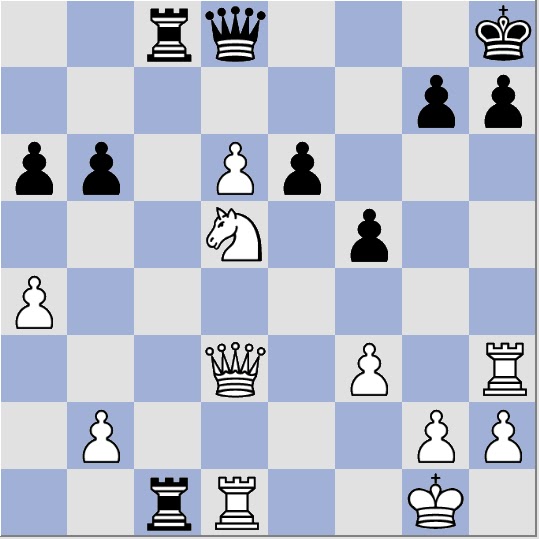
In Gligoric -- Averbakh, 1966, Black did not play 32...Qxd6. Why not?

Black to move

2rq3k/6pp/pp1Pp3/3N1p2/P7/3Q1P1R/1P4PP/2rR2K1 b - -


28 August 2012

Benefits of Chess

Benefits of Chess

Chess is a great game. It has been played longer and in more places than any other comparable game. In addition to its cultural value, chess play and study offers many benefits that go beyond chess.

Academics
Chess improves mental skills of observation, pattern recognition, memory, analysis, logic, and critical thinking. It stimulates the development of creativity, concentration, and persistence. Studies have demonstrated clear improvement in math and reading skills for students receiving a few hours of chess instruction per week.

Emotional Growth
Chess competition encourages growth in the personal qualities of patience, self-control, coping with frustration, self-confidence, and selfesteem.

Social Skills
Playing chess develops sportsmanship, responsibility, and respect for others.

Global Dimension
Chess is played on every continent. Its history spans more than a millennium. It probably originated in China or India; it became popular in Europe during the Renaissance. Chess notation and evaluation symbols permit chess players of all languages to communicate games and analysis.

21 August 2012

Svetozar Gligoric, 1923-2012

Grandmaster Svetozar Gligoric passed away 14 August 2012. He was among the top players in the 1950s and '60s. Gligoric was a top chess commentator, an innovative openings theorist, a fierce competitor, and a true gentleman. He avoided psychological ploys against perceived weaknesses in his opponents, preferring as he put it, to "play against pieces."

When I started reading chess books in the mid-1970s, Gligoric was a regular at top GM tournaments, and an excellent chess writer.

14 August 2012

Tactics and Strategy

How do we distinguish tactics from strategy? Strategy refers to grand objectives, while tactics are the means to achieve these. Archaeologist Richard Fox offers an explanation that may interest chess players.
For standing armies, battle is undertaken in accordance with codified tactical prescriptions. On the battlefield, tactics dictate the maneuvers of soldiers in quest of strategic goals, and they standardize individual actions for the common good. Tactics among standing armies, then, are the codified manners in which strategy is carried out.
Richard Allan Fox, Jr., Archaeology, History, and Custer's Last Battle (1993), 10.

Knight forks, occupation of key squares, batteries, discovery, and other tactical motifs are comparable to the U.S. Cavalry's 1874 prescriptions to deploy companies in a particular manner.

13 August 2012

Training Log: Travel

For the first time since February, I attempted fewer than fifty tactics problems over the past week. During the week, there were two or three solving sessions consisting of perhaps thirty problems--I'm uncertain as to the precise number. The last of these sessions was Saturday morning while eating breakfast in a hotel in Butte, Montana. My wife, my youngest son, and I pulled out of the driveway at 7:00 am Sunday morning, and we pulled back in very near 5:00 pm Saturday evening.

During the week, I drove slightly more than 1600 miles (2575 kilometers). We visited museums with admission fees in Wallace, Idaho; Cody, Wyoming; just outside Powell, Wyoming; Butte, Montana; just outside Crow Agency, Montana (my son and I); and Garryowen, Montana (my son waited outside, and my wife was at her conference in Billings). We saw Mammoth Hot Springs, a herd of bison, Old Faithful, and the Fishing Bridge in Yellowstone National Park. My son and I toured the Little Bighorn Battlefield. We visited the World Museum of Mining in Butte, as well as a small mining museum in Idaho's Silver Valley. We walked through the downtown area of Wallace, Idaho where every building is on the National Register of Historic Places.

We visited three National Forest ranger stations that had historical exhibits. We stopped at dozens of roadside historical markers. Although I left my fishing gear at home, I bought a hat and two river maps at three different fly shops along our journey. We drank wine with picnic lunches along the road in two states, and we consumed beer in a brewery. We ate bull testicles in a bar in Wyoming (my son is 21). In Cody, we spent an hour in the Buffalo Bill Historical Center's collection of some 15,000 guns, and then in the afternoon, my son and I spent some time discussion particular weapons with the curator of the gun collection. We glanced briefly at the exhibit of another 12,000 guns downstairs in the museum. We spent ninety minutes or so in the Plains Indian section of the museum, and then another couple of hours in other exhibits after lunch downtown.

We watched short historical films about silver mining in Idaho, Japanese-American Relocation during World War II, Mandan and Hidatsa earth lodges, the Custer battle. At the Heart Mountain Interpretive Center between Cody and Powell, we walked a trail that presented us with a sense of the size of the WW II concentration camp, and then visited the museum where there is a reconstruction of one of the guard towers and some excellent exhibits.

We photographed the Anaconda Smelter Stack and a large slag pile that remains uncovered alongside Montana State Highway 1.

We drove through the middle of an oil field after accidentally taking the longer road from Powell, Wyoming to Billings, Montana. After more than five hours at the Little Bighorn Battlefield, my son and I drove through the middle of the Crow Indian Reservation to visit Fort Smith, Montana but failed to locate the historical marker for the Hayfield Fight (1 August 1867) that is on private land (we did not trespass).

It was a busy week that left little room for chess. It was an excellent week for a historian of the American West.

05 August 2012

Training Log

My focus the past two weeks has been drifting away from chess. Although the U.S. Open began yesterday only a few hours from my home, I am traveling in the other direction. When I teach a six week history course, as I am doing beginning 14 August, my attention shifts almost wholly to it for a few weeks before it begins. Nevertheless, I keep up on daily chess: tactics training, correspondence games, occasional rapid and blitz games online.

After an eight hour session working on my history course on Friday morning, I played ten 3 0 games on Chess.com. Losing five of the first six games was frustrating, but then I finished with four consecutive wins. The past few weeks, I have played very little 3 0 chess, using most of my online playing time for 15 0 games.  Reducing junk is important to chess improvement.

As for tactics training, I solved a handful of problems in the Shredder iPad app, the Tactic Trainer app, and attempted 113 problems through four sessions on Chess Tempo. My two posts the past week, "Failing at Tactics" and "Tracking Failures," detail some of the challenges through which I struggled. My last session on Wednesday was ten problems with an 80% correct rate.

The graph shows steady progress upward through the end of July until I scored a mere 41% correct through 80 problems on Monday. I regained over half of the rating reduction through a mere ten problems. My average recent time per problem went up from ~75 seconds to 98.

I waffle a bit over how low I should aim to keep my average time per problem. Is speed important in training, or do I gain more from seeking a high degree of accuracy?

Stats for Standard Tactics
Problems Done: 2481 (Correct: 1316 Failed: 1165)
Percentage correct: 53.04%
Average recent per problem time spent 98 seconds

I spent a bit of time going through game three from the Spokane City Championship, but have not yet completed my annotations for posting.

31 July 2012

Tracking Failures

As a follow-up to yesterday's "Failing at Tactics," I moved more slowly through today's training session on Chess Tempo. With each failed problem, I wrote an explanation of the cause of my error.

1. With fresh coffee in the cup, although still groggy-eyed due to working until nearly 10:00 pm, I opened the first problem, CT 78563. Immediately, I saw the checkmate threat, and then within a few seconds saw that White had prevented my threats from going anywhere. Then, I thought to remove the queen's defender. Through simple miscalculation, I failed to see that after my capture of the knight and the exchange of queens, I would be hitting two pieces. My 1...Bg4 was the fourth most popular wrong move, and wholly ineffective.

Cause: gross miscalculation

2. After solving one problem correctly, I missed CT 47952. Laurent's urging (see comments to yesterday's post) that one must ask "what can my opponent do?" led me to reject the first move that I examined. I saw the discovered attack against queen after capture of the bishop that only appears to be en prise. As it happens, that would have been the correct move. A knight fork of king and queen refutes the discovery.

Cause: missing fork

3. My fourth problem, CT 57540, was my third failure. This time, however, I failed on the second move rather than the first. I found and executed the correct idea, but executed it badly. After the forcing check by the rook, I parried the checkmate threat with a discovery on the threatening rook. But, I moved my knight to a square where it was vulnerable to capture.

White to move

Instead of gaining a clear and decisive advantage, I put myself in a rook and pawn ending with the advantage of one pawn.

Cause: hasty failure to calculate alternative moves

4. Although I correctly solved CT 57744 and CT 48156, I made moves that were "not the computer's first choice." In 57744, I missed seeing the full mobility of my queen, finding a win of material but not the checkmate. In 48156, my second move was to check with the bishop rather than the queen. Again, I was winning material but not finding checkmate.

Cause: shallow calculation

So far today, 4/7 correct, but errors in five of seven problems. Yesterday, I had a terrible run of 31 problems in which only six were solved correctly, but then finished the day with seven correct. Starting today with 4/7 correct suggests that slowing down between problems might lead to greater success. Instead of frantic solving one problem after another, a few moments to reflect on my thinking processes after each problem might be the prescription for yesterday's malady.

5. In CT 49766, I chased illusions.* When my initial move was rejected as "not the computer's top choice," I attempted to drive the Black queen to a square where it no longer threatened my bishop. That my own queen was en prise failed to lead me to calculate variations.

White to move

It is interesting that the eye instantly catches the check on f7, and almost as instantly rejects it due to the knight on d8. Yet, in this idea is the kernel of the double attack that wins.

Cause: gross miscalculation, inflexibility

6. CT 91892 put me under 50% for the day so far.

White to move

Winning the exchange is easy, but it is important to look for more. I correctly identified White's threats along the a3-f8 diagonal, but failed to use the b-file. Instead, I sought to bring both queen and rook to the d-file.

Cause: shallow calculation

I managed to finish the day's ten problems at 50% because CT 59114 offered the resource that I missed in CT 47952. Perhaps slowly working through problems, writing down the cause of each failure, is a practice more akin to deliberate practice than trying to solve as many problems as possible in the allotted time. More likely, there is good reason to do both sorts of solving sessions.


*There was a break in my Chess Tempo session in which I took care of some morning business. During this break, I worked four problems on the Shredder iPad app. The problems in this app often call for simpler resolution than problems at the level where I'm working on CT. Could an easy problem set lead to failure when moving to harder problems? I am reminded of something that Valeri Beim wrote in Paul Morphy: A Modern Perspective (see "Beware of Weak Opponents").

30 July 2012

Failing at Tactics

Pattern recognition in attack proves insufficient when one's own king is vulnerable. Two weeks ago, I observed my own failure to check the security of my king as the cause of failing a tactics problem. I failed Chess Tempo problem 63593 this morning for the same reason.

White to move

The first move was easy, but I played the wrong second move because I missed 2...Rxb2+ and 3...Qd2+ with checkmate to follow. My own checkmate threat was parried by a more immediate threat against my own king.

On the previous problem (CT 43197), I observed the vulnerability of my own king, but missed a simple defense of the critical d1 square and made an empty threat that I knew offered no advantage by swinging my rook to e1.

White to move

Both problems seem simple in retrospect. Why did I fail? How do I find the patterns in my errors and create exercises to address them?