21 February 2022

A Memorable Lesson

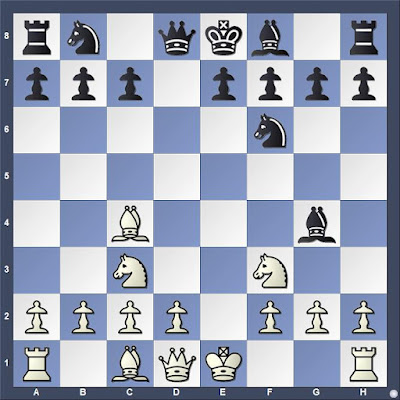
What are the plans for both sides?

White to move

Whenever an occurrence of a bishop on the wrong color squares in a pawn ending occurs, I recall a game I played in 1996. It was the first round of my second USCF rated tournament and I nearly beat one of the strongest players in my local chess club.* In the end, I had four pawns to two and opposite colored bishops. I was looking at this game anew a few weeks ago because I wanted to use it in the first of a series of lessons for some of the chess classes I'm teaching this month. These classes are organized by other people who supply me with students. They create a different theme each month, but I am at liberty to develop the theme as I see fit.

The February theme mentioned pawn structure and "lesser pieces", which I opted to make bishop and knights. I began with some elementary positions, such as one finds in Dvoretsky's Endgame Manual (2003).

Black to move

During the first session, I invited students to think through the plans for White from positions that arose in my 1996 game with Gary Younker. I make the point that I pursued a faulty plan because whatever the state of my understanding of the elementary position above, I failed to understand it well enough to deter me from futile efforts to promote my a-pawn.

From the diagram at the top of the post play continued:

55.Kg3 Bc6

After explaining to one group what White's plans should have been and demonstrating what seemed a plausible win, I tried against Stockfish. Here the silicon beast demonstrated that Black's resources were adequate after 55...Kd7

56.Kf4 Kb7?

White to move
57.g3?

Today, I would play 57.Kg5 with nary a thought. But, in 1996 I was obsessed with promoting my a-pawn.

57...b4 58.Ke5 Kc7 59.Ke6

59.Kf6 seems better.

59...b3 60.h4 b2 61.Bxb2 d4?

Gary was pleased with this move. After the game, he taught me some important lessons, criticizing my early c4-c5 in the opening because it "released the tension" and explaining that he sacked this pawn to create the fortress that ensued.

White to move

62.Bxd4??

Remarkably, I still had a winning position until this error. About half of my students who have seen this position have suggested 62.exd4, which creates a more useful passed pawn.

62...Bxf3=

The game went on another 14 moves with an exchange of my e-pawn for Black's f-pawn and my futile and even silly efforts to trap Black's king on a8.

I finally replied to a draw offer from many moves earlier with assent after 76...Bg4.

White to move
The Game's Final Position


*Although I began playing chess with some seriousness in the 1970s, played some high school matches and at the Spokane Chess Club, and entered a couple of USCF correspondence events, I did not have a USCF OTB rating until I returned to active play in the mid-1990s following completion of graduate school.

18 February 2022

Move Order

The exercises at the end of each chapter in Victor Henkin, 1000 Checkmate Combinations (2011)* are not sequenced in order of difficulty. Rather, as the author explains in the introduction:
Easy examples deliberately alternate with more complicated ones. The "lottery" principle of the lucky ticket makes the solving of exercises more like the process of searching for a combination in a tournament game. (9)
Preceding two that were solved easily in only a few seconds were one that I failed with the wrong move order, missing a key subtlety, and then one that I made more complicated than it was.

The first was Vladimirov -- Kharitonov 1977 from the Soviet Young Masters.

White to move

I started with the bishop check, failing to consider that capturing the bishop is not obligatory.

Then one of Henkin's own games against Mudrov, 1956. I could not find this game in a database. In fact, Viktor Khenkin's games in the Chessbase database are limited to ten games from a single event.

White to move

This first move that I considered is correct, but I talked myself out of it as I examined Black's choices and defensive resources against one mate threat, completely missing the other mate threat.


*See "Two Old Books (and one new)", which also has a note on the variability of the spelling of Henkin/Khenkin.

13 February 2022

Two Old Books (and one new)

Koltanowski, George, and Milton Finkelstein. Checkmate! The Patterns of the Winning Mating Attacks and How to Achieve Them. New York: Doubleday and Co., 1978.
Tal, Mikhail, and Victor Khenkin. Tal’s Winning Chess Combinations: The Secrets of Winning Chess Combinations Described and Explained by the Russian Grandmaster Mikhail Tal, trans. Hanon W. Russell. New York: Simon and Schuster, 1979.


Checkmate! (1978) and Tal’s Winning Chess Combinations (1979) are remarkably similar in approach. Each takes an individual piece and offers game conclusions where that piece delivers the check that is mate. Then, individual chapters concern certain groups of pieces: both texts have chapters on two rooks, rook and bishop, rook and knight, two bishops, two knights, and queen and knight. Tal and Khenkin* continue this scheme with queen and bishop, queen and knight, and three pieces. In contrast, Koltanowski and Finkelstein offer chapters on certain patterns—Boden’s Mate, Epaulettes Mate, Long Diagonal Mates, Greco and Damiano Mates, and a chapter on double check. These pattern-oriented chapters are followed by chapters arranged by the piece that is sacrificed to set-up checkmate. There are additional chapters on pawn promotion, drawing resources, and how masters use checkmate threats.

There is a difference in the expectation of the target audience evident in advice about how to read the books. Koltanowski and Finkelstein repeatedly suggest that a reader should set up the position on a board and play through the moves in order to plant the patterns into memory. Tal and Khenkin, in contrast, suggest that readers study the book without a chess board to improve visualization skills, using a chess board "when you're really stymied" (14).

Legall’s Mate appears in both books. Tal and Khenkin have it in the chapter on three pieces, while Koltanowski and Finkelstein place it under queen sacrifices. These books differ on the game score of Legall — St. Brie, as well as the date. Tal’s Winning Chess Combinations has the game played in 1787 when Legall was 85 years old (351). Checkmate! states that the opening trap was first recorded about 1750, but does not explicitly state the game was played then (197-198). Koltanowski’s penchant for dubious stories makes its appearance here in the claim, “Légal was one of the first players to record his games” (197). If he recorded his games, what happened to them? Today, we cannot even be certain of the moves in the sole surviving example of Legall's play.

Checkmate!

Checkmate! was brought to my attention in response to my assertion in the Facebook group Chess Book Collectors that the best books for teaching checkmate patterns are George Renaud and Victor Kahn, The Art of the Checkmate; and Victor Henkin, 1000 Checkmate Combinations (see below). My claim provoked some interesting discussion. One commenter identified Checkmate! as a book that helped him learn these skills. Bruce Pandolfini also commented that Milton Finkelstein "was a wonderful chess teacher". On the strength of such recommendations, I found a copy and bought it.

The chapters in Checkmate! typically begin with some elementary illustrations and an impressive combination from master play. The authors describe conditions and rules for executing the checkmate in question, often producing numbered lists. For instance, the "four conditions necessary for mate with a rook":
1. The enemy king lacks escape squares.
2. A rook can attack it on a rank or a file.
3. The rook is immune from capture.
4. The rook check cannot be blocked by the interposing of a protected piece or pawn. (41)
The bulk of each chapter consists of exercises with a number of blanks on which a student can write the moves--workbook style. The introduction of each exercise typically offers clues, and in some cases the final position is shown. The book contains a bit over 550 exercises in total. Answers are in the back of the book. Here is an example from the chapter, "Boden's Mate", that is simple when you know the pattern, but has vexed many of my students over the years (151).

White to move

Often there are historical anecdotes about a player whose combination is featured. These anecdotes in Checkmate! are entertaining, but unreliable. We learn, for instance, that Akiba Rubinstein was confined to Berlin during World War I, "went bankrupt and then developed a persecution mania that broke his powers of concentration" (47). A more credible work, Akiba Rubinstein: Uncrowned King (1994) by John Donaldson and Nikolay Minev, places Rubinstein in Warsaw, limited to a playing local opponents in that city and in Lodz. Donaldson and Minev offer crosstables and games from the war period. They also note that Rubinstein married in 1917 and had a son born in 1918, both events taking place in German occupied Warsaw (254). There should be no question that Rubinstein's postwar play was inconsistent, as suggested by Koltanowski and Finkelstein, but they leave the impression that he did not play at all after the war. In fact, he won several strong tournaments in the 1920s. His performance in St. Petersburg in 1914 suggests that inconsistency cannot be wholly pinned on difficulties during the war years.

Historical errors are distracting, but do not destroy the book's pedagogical value for learning checkmate patterns. Nor do the errors in Checkmate! make the book unique. The list of errors that could be produced from thorough fact checking of Renaud and Kahn also would be lengthy (see "Pillsbury's Mate").

One of the simple illustrations of a final check by a rook in Checkmate! is identical in concept to one that I use often with my beginning students, and with which I became acquainted through Bruce Pandolfini, Pandolfini's Endgame Course (1988).

White to move

Classifying and organizing checkmate patterns is not a simple matter. In my own efforts, guided by half a dozen books and a few websites, I separated the dovetail and swallowtail checkmates from epaulette, listing all three as checkmates with the queen. Renaud and Kahn use the term Guéridon for the two bird mates and include this pattern with epaulette. Koltanowski and Kinkelstein lump them together under epaulette mate, but do not limit the pattern to a final check with the queen. This position credited to a Russian player surnamed Usachev illustrates (67-68).

Black to move

1...Bc3 2.Ke2

Black could avoid checkmate at the cost of a rook, the authors note. Stockfish shows that both rooks will disappear if Black plays the superior move 2.Kc1. After 2.Ke2, Black has a mate in two that starts with a queen sacrifice and ends with a knight check. Four White pieces occupy the king's escape squares, serving as ornament rather than protection.

Checkmate! includes a substantial number of checkmate examples. Had I acquired it when it was first published during my teen years and devoted myself to working through the book, I may have become a much stronger player.

Unfortunately, whatever the merits of the book, the authors were ill-served by their publisher. The very first diagram in the text is wrong (2). It appears that the image negative was flipped before printing--there is a dark square in the lower-right corner. Black's 4...K-K4 is an illegal move as there is a pawn on that square. The mismatch between the original position and the final position showing checkmate with a pawn alerts the attentive reader to the problem, so the error can be overcome. The publisher also exercised poor quality control over the printing process. Too much ink was allowed to flow, creating many pages where the dark squares are so dark that the Black pieces on them nearly disappear. Many pages have crystal clear diagrams, but a large percentage are dark and even blurred from inattention by the printer. These problems will be even worse in the Ishi Press reprints, which are notorious for poor print quality. 

Tal's Winning Chess Combinations

My Facebook assertion in favor of the value of Henkin, 1000 Checkmate Combinations was grounded in study of Tal and Khenkin, Tal's Winning Chess Combinations, which I have found quite good. My view also stems from superficial examination of the newer translation in Kindle format. Others have assured me that the newer edition is a better translation of The Last Check (more on that below).

Tal's Winning Chess Combinations is more challenging than Checkmate! This position from Adams -- Torre, New Orleans 1920 (given as 1921 in the text) and the winning idea is richer than most of the combinations in Koltanowski and Finkelstein (19).** 

White to move

White offered his queen for six consecutive moves in the effort to divert Black's queen from the defense of e8. The idea reappears as exercise 8 (37) from Guldin -- Bagdatev (1963), a position I remember from Lev Alburt, Chess Training Pocket Book, 2nd ed. (2000).

The initial example in each chapter of Checkmate! is usually comparable, but the rest of each chapter is less demanding. It did not take me more than ten minutes to blaze through the 13 exercises in the rook chapter, and every example was a forced checkmate. In many of the examples in Tal's Winning Chess Combinations, mate threats can be parried with significant sacrifice, still leading to a lost game.

Tal's Winning Chess Combinations also has a clearer demarcation between the instructive section and the exercises. Each chapter begins with diagrams showing the elementary pattern, and then proceeds through instructive and entertaining examples. Most chapters repeat this sequence with more checkmate patterns and game fragments. The object is showing a range of possibilities with the piece or pieces in question. As in Checkmate!, Tal's Winning Chess Combinations presents game endings where a queen did not deliver the final check in an epaulette mate.

This one is presented as Korchnoy -- Petrosyan 1965 (281).

White to move

White has a forced checkmate in four moves with a queen sacrifice on the second.

The bulk of the book is devoted to instructive examples. An idea is presented, then a few position, then a variations on the idea and more illustrations. The Adams -- Torre position above is the ninth instance of a combination exploiting a weak back rank in the chapter on the rook. This chapter begins with a simple illustration of a back rank checkmate. The instructive portion offers fifteen combinations to divert defenders from protecting the vulnerability. Diversion is combined with a second threat in some combinations. Further examples offer other tactical ideas, such as "line interference" in Reti -- Bogoljubow 1924 (22).

White to move
After 24.Bf7+ Kh8 25.Be8, Black resigned.

Tal's Winning Chess Combinations is notable for how it builds understanding of many possibilities related to a simple pattern. Applying what we know from backrank checkmates, the author notes that kings can be hemmed in by their own pieces on a file as well as rank. Even a file away from the edge of the board can become a deadly corridor. Goldenov -- Zakharian 1960 is a memorable example (34).

Black to move
1...g4 2.Kf4 Ra5 3.e5 Ra4+ 4.e4 Ra3 and White resigned.

Tal and Khenkin's chapter on the rook offers 45 instructive positions and then 17 exercises at the end of the chapter for the reader to solve. This abundance contrasts with a total of 13 exercises following four instructive examples in Koltanowski and Finkelstein. Checkmate!, however, offers 25 chapters to the 14 in the other text. The total of 271 exercises in Tal's Winning Chess Combinations are far fewer than more than 550 found in Checkmate!, but many offer greater challenge. On balance, I prefer Tal's Winning Chess Combinations, but expect to lift some examples from Checkmate! while creating worksheets for my students.

The New Book

Henkin, Victor. 1000 Checkmate Combinations, trans. Jimmy Adams and Sarah Hurst. London: Batsford Chess, [2011] 2022.


1000 Checkmate Combinations is a newer translation of the same Russian book as Tal’s Winning Chess Combinations. As such, the two books have considerable overlap. However, the differences are extensive. Both books have the same fourteen chapters, although the sequence differs. Each chapter offers a series of instructive game fragments and studies and then conclude with exercises at the end of the chapter. Tal’s Winning Chess Combinations has a total of 271 exercises, but the newer translation expands these to 456. 1000 Checkmate Combinations was published just over ten years ago, but has been out of print most of that time, although a Kindle edition was available. It was brought back into print in February 2022.

I cannot assess the quality of the translation. I lack both the resources (a copy of the Russian edition of The Last Check) and the competence (knowledge of Russian). However, I prefer the recent Batsford edition for several reasons. Tal's Winning Chess Combinations blurs the lines between Khenkin's work and Tal's contribution. 1000 Checkmate Combinations explicitly states that the book is Henkin's work. The title page reveals that Victor Henkin owns the text copyright. Batsford also asserts copyright ownership. The publisher owns all rights in the 1979 translation by Hanon Russell; there is no mention of the authors on the copyright page.

Tal’s Winning Chess Combinations begins with an Introduction: “Don’t Reinvent the Wheel”, co-authored by Tal and Khenkin (9-14). 1000 Checkmate Combinations has “Don’t Reinvent the Bicycle” by Tal (5-6) followed by “Before You Open the Book” by Henkin (7-9). The joint introduction in the earlier translation contains most of the content presented in the two introductions in the later text. In addition to clarifying authorship, the most notable differences are that Tal ended his introduction in the Batsford edition with a quote from Richard Réti, Masters of the Chessboard. This quote is absent from Russell’s translation. Russell also inserts Legall’s game into the introduction, while Adams and Hurst do not.

In Tal's introduction to the Batsford edition, we find:
There hasn't been a book like this before in our chess literature. The author has done an enormous amount of work selecting and systematizing the material. An experienced master, who in the recent past himself participated in competitions and had a reputation as a staunch tactician, he has retained a particular taste for the last check. (6)
This text is absent from Tal's Winning Chess Combinations. 1000 Checkmate Combinations is clearly the work of Henkin, lauded by Tal. Henkin's authorship is attested in Vladimir Barsky, A Modern Guide to Checkmating Patterns (2020), which is dedicated to Viktor Khenkin, whose pioneering organization in The Last Check is the model for Barsky's text.

Tal's Winning Chess Combinations presents a decisive mating combination played by Vera Menchik against George Thomas in 1932, and then imitated by David Bronstein against Paul Keres 18 years later (32-33). In both books this combination follows Capablanca -- Raubitschek 1906, to which it is comparable. 1000 Checkmate Combinations adds Tal -- Andersson 1976, where Tal's threats to bring about Menchik's combination provoked a series of exchanges that simplified into an ending with queen against knight and rook (25).

White to move
After the immediate 25.Qh6, the combination falters because Black's resources with 25...Rg8 and 26...Nf8 hold the position together. Tal first set out to remove the knight.

25.Bb6 Rc8 26.Qh6 Rg8 27.Rd4!

Henkin writes, "So Ulf Andersson gives up his queen for rook and bishop, which, however, doesn't save the game" (25).

27...Nxb6 28.Rxd5 Nxd5 29.Rf3

With Tal renewing the mating threat, Anderrson is forced to exchange rooks.

29...Rc3 30.Rxc3 Nxc3 31.Qe3 b4 32.Qa7 Rf8 33.Qc5 Rb8 34.Qd6 1-0

This long combination with checkmate threats parried, but still leading to a decisive advantage is a characteristic of Henkin's work. Both translations of his work bring this out, but the more recent text does so in greater abundance.

Detailed comparison of the first chapter of both books shows that the 45 positions in Tal and Khenkin expands to 62 in 1000 Checkmate Combinations. I count five in the older translation that are missing from the newer edition. My count of 15 in the Batsford edition that are absent from Tal's Winning Chess Combinations reveals there is something askew with my counting (15+5 > 17). But there is no doubt that the newer edition has more material. The 1979 text has three sets of basic patterns followed by examples from games and studies. The Batsford edition has four. Above, I credit Tal's Winning Chess Combinations with showing corridor mates on files as well as ranks. The idea is there, but is is made more explicit in the section found only in the newer book.
Mating situations in which the rook delivers a linear blow can also arise on the files. In these cases it is as if the board does a 90-degree turn. (20).
At the end of the chapter on rooks, the exercises have expanded from 17 to 43 in 1000 Checkmate Combinations.

Although many passages in the two books make it abundantly clear that they are derived from the same Russian text, the language employed differs. The familiar term luft is found in Russell's translation, but becomes "the little window" in the work of Adams and Hurst. Diversion becomes deflection. Line interruption becomes interference.

Some readers will object to the small size of the diagrams in 1000 Checkmate Combinations. They are indeed small at 35 mm. Only a few books have smaller diagrams, such as the training positions in Antonio Gude, Fundamental Checkmates (2016), measuring 34 mm. Other chess books typically have diagrams from 40-50 mm, and the main part of Gude's book comes in at 45 mm. Diagrams in Tal's Winning Chess Combinations are 41 mm. They are 43 mm in Checkmate!

In the Kindle edition of Henkin, the figurines in the notation are a larger font than the text. I have found this ebook difficult to read, but the print text is a delight, even with the small diagrams. At least the diagrams are very clear with appropriate shading of the dark squares and clear pieces.


Notes

*Both Khenkin and Henkin appear as the spelling of this writer's name in different places. I favor the spelling used by the book under discussion. Vladimir Barsky dedicates A Modern Guide to Checkmating Patterns (2020) to Viktor Lvovich Khenkin and offers The Last Check as the English title of the Russian work upon which both Tal's Winning Chess Combinations and 1000 Checkmate Combinations are based. Barsky's book follows the general outline of these two, but with far less instructive material. Rather the instruction is provided as exercises. While Khenkin is the spelling on the cover and title page of Tal's Winning Chess Combinations, games played by the author are presented in the text with the spelling Henkin.

**In all likelihood, this game was analysis, possibly by the alleged victim of the combination as instruction for the alleged victor. See Edward Winter, "Adams v Torre -- A Sham?" Chess Notes (updated 14 December 2021).

05 February 2022

Compounding an Error in Renaud and Kahn

The Art of the Checkmate by Georges Renaud and Victor Kahn is a terrific book. Originally written in French and published as Les Échecs by Nouvelle Académie des Jeux (New Games Academy) in 1947, it has been twice translated into English. A translation by W.J. Taylor was brought out by Simon and Schuster in 1953, and then a Dover edition of this text appeared in 1962. This edition is the one I have used for more than two decades. In 2015, a new translation by Jimmy Adams was brought out by Batsford. Adams corrects a few historical errors and some oversights in the analysis. The edition also offers a few examples that are missing from the 1953 translation.

In the light of these improvements, Exercise 24 is curious. This position from Robinson,M. -- Chatard,E., Paris 1920 is presented as Black to play and win in both editions, but the White queen is placed differently. A note in the solution in Adams' translation identifies the placement of the queen on d2 as having appeared in the game.

Black to move
1953 Edition

Black to move
2015 Edition

Stockfish 14 assures me that Black is not winning from either position. The line given in the solution offers better prospects in the version given in 1953 than in the 2015 edition. In the older version, White has a slight advantage. In the 2015 edition, White has a decisive advantage. Adams note "improving" the solution offered by Renaud and Kahn omits the critical defense that refutes Black's intent.

The Adams translation presents the solution as beginning 12...Qh5, while Taylor's translation begins every game fragment at move one. Has Adams seen the original game?

I cannot find it. ChessBase Online offers two games played by Eugene Chatard (a loss to Pillsbury in a simul) and a win against Wladimir Bienstock, who has thirteen games in the database, including a draw with Georges Renaud. Most databases have only the loss to Pillsbury. The database contains no games by an M. Robinson who would have been playing in 1920, but there is a Robinson (no given name or initial) who drew Emanuel Lasker in a simul in 1902. However, that game was played in the US.

It seems strange that so few games of Chatard have found their way into the database.

Not able to access the game, I imagine that it ended in the manner described in the solution.

1...Qh5 2.Be2

"Or else ...Qh3, followed by mate." (Both editions)

Adams adds: "This is a modified position. In the actual game the White queen was on d2 thus allowing the defense 13.Re1, to meet 13...Qh3 with 14.Bf1. Then 13...Ng4 14.Qxh4? 15.gxh4 Bh2+ 16.Kf1 and there is no mate."

My hunch is that while correcting small errors in the text, he moved the queen to e1 to take away the king's escape via f1. However, in doing so, he created a new opportunity for White:

2...Nd2+-

There is no longer a mate threat with the queen going to h3 because White simply snatches the bishop on f3, and absent this threat, there is no reason for the weakening h2-h4 move that leads to Blackburne's checkmate.

For the most part, Adams' editorial comments add a useful layer to the instructive value of this fine text, but changing Exercise 24 took an oversight and compounded it in the name of correction.


03 February 2022

Useless Delays

As I was racing through simple checkmate exercises near the beginning of John Nunn, 1001 Deadly Checkmates (2011), one created slight difficulty.

White to move
I found 1.Qa8+ Kd7 2.Nc5# almost instantly, but Black can interpose with 1...Rb8, making the exercise checkmate in three. I spent a long time trying to find something that was not there because all of the exercises in the first section are mate in one or two. Finally, I peeked at the solution to see what I overlooked.

I was warned in the introduction:
[R]eaders should be aware that in some cases the defender can delay mate by "spite checks" (giving away pieces with check) or by interposing pieces that can just be taken. In most cases I don't mention such pointless delaying tactics. (7)
Cyrus Lakdawala takes a different approach in Tactical Training (2021). This position is presented as a mate in six.

White to move

The game finished with 24.Qxh7+ Kxh7 25.Rd4 and Black resigned. Black can delay the inevitable checkmate with a knight interposition on e4, a queen sacrifice on h3, and a rook sacrifice on c4. These useless delays change nothing, but they are listed in Lakdawala's solution. He also uses the game's move numbers rather than beginning with 1, as Nunn does in 1001 Deadly Checkmates.

In "The Spite Check" (2020) on ChessBase.com, Karsten Müller presents a "spite check" as provoking an error.

White to move
After 62...Ne3+
As Müller notes, only 63.Kh5 wins. White played 63.Kf3 and went on to lose. Here, however, the "spite check" does not delay an otherwise unstoppable checkmate, but the advance of a pawn that is otherwise certain to promote. By reacting incorrectly to the check, White allowed Black's knight to reposition to a square where it can move to stop the pawn. Meanwhile, Black's passed c-pawn remains a threat.

Müller's use of the term "spite check" suggests that delaying tactics might have a secondary purpose in some instances.
 
I posted this position from my reading on Facebook yesterday.

White to move

White has a forced checkmate in six, but many who saw it thought they found a checkmate in three. If you found the first move and the reason the sacrifice works, does it matter how many delaying moves Black can throw in the way?


02 February 2022

Elementary Checkmates 1

Beginning chess players like to give check. Check is a forcing move, so this tendency can be beneficial. However, when working towards checkmate with few pieces remaining on the board, check is nearly always an error. Battling a lone king is a matter of restriction--anticipate the route of escape and cut it off. Corral the king, always giving him fewer and fewer squares. But do not reduce it to one without a check because that is stalemate.

This six exercises should be simple, but they have proven torturously difficult for young beginners who cannot curb the tendency to always check. In every case, the correct first move is not check. I created these in 2015 for several groups of young chess players. They were used again this week for my after school chess club.

Find the move for White that leads to checkmate in the fewest moves.

You may practice these on an interactive board on Lichess ("Elementary Checkmates 1"). Master these exercises.

1.

2.

3.

4.

5.

6.

Some notes on the positions. 

1. This is a variation of the first checkmate I learned when I was a beginner. It is a simpler version of a basis exercise that appears in many books, such diagram 24 in Jose Capablanca, A Primer of Chess (1935), where Black's king is on e5 and White forces mate in six.

2. This position is nearly identical to one in Bruce Pandolfini, Pandolfini's Endgame Course (1988), a book that I recommend highly to beginning chess players who intend to develop their skills. See Endgame 9 in that text.

3. This position is derived from a sub-optimal solution to number four. It is the conclusion to a mate in five from a position where White can mate in four. 

4. White mates in four. Position is from William Lewis, Elements of Chess (1819), as is number 6. Both were presented in October in "Elementary". I use these two often in my teaching because I think the lessons learned while mastering them are of great value.

5. The idea here is identical to the exercise derived from Pandolfini, but the position is identical to one in Lewis, Elements.

6. White forces checkmate in five moves. Only once does Black have a choice of squares.

26 January 2022

The Bad Pin

A pin is a restrictive contact that either prevents a piece from moving because doing so would violate the rules of the game (absolute pin), or that discourages moving the piece because the consequences could be dire (relative pin). Pins can be potent weapons in the chess struggle (see "A Lesson in Pins").

Relative pins are double edged. They can backfire, presenting the player facing the pin with an opportunity. Many of my students the past two weeks have seen this position from a game I played 16 January on Lichess.

White to move
After 5...Bg4??
How should White deal with the pin on the knight? Once you understand certain patterns, the correct answer is instantaneous. 

Evidently I am not the only player who has had this exact position. The position just before I played 8.Qxf7# has been examined in the ChessBase cloud more than 1500 times. Certainly some of the games that could have led to the moves in my game continued 6.Ne5 Bxd1 7.Bxf7#. It seems likely that a few players of the Black pieces also would have found 6...Be6 (the best choice after White exploits the bad pin).

Years ago, perhaps 1999, I bought and began reading Georges Renaud and Victor Kahn, The Art of the Checkmate, trans. W. J. Taylor (1953). I wrote about this book and how it first came to my attention in "Checkmate Patterns) (2015) and again in "Learning Checkmate (Or Teaching It)" (2021). I am rereading it, now in a new translation that has algebraic notation.

The Art of the Checkmate is my first recommendation when players are looking to learn checkmate patterns. Renaud and Kahn do far more than present basic patterns and then offer exercises. They offer detailed discussion of the variability of the basic pattern and how to bring it about. They use mostly full games. The chapter, "Legal's Pseudo-Sacrifice" (11-21) offers 17 complete games arranged by what they refer to as the "four aspects" of Legal's mate. They explain:
First and foremost we ask you not to learn it by heart but to grasp the precise mechanism, to understand that the bishop on g4 in "hanging", that is to say exposed to capture if the knight moves to threaten mate. But this mechanism appears in many positions as a latent threat and the opponent, if he pins your king's knight, is obliged to take this into account.
The Art of the Checkmate, trans. Jimmy Adams (2015)
I missed my chance to show the knowledge I should have acquired from the book in this blitz game played in 1999 on the Internet Chess Club.

White to move
Cleary, 9.Nxe5 is the correct move. I played 9.Nbd2, still managed to get a clear advantage, worked it into a decisive advantage, and lost on time in the endgame.

In 2000, I showed further incomprehension by maneuvering my way into the losing side of one of the combinational motifs enabled by "the bad pin".

White to move
My opponent understood the ideas and seized a clear advantage.

7.Bxf7+ Kxf7 8.Ng5+ Ke8 9.Qxg4

White has a decisive advantage and went on to win.

Genesis of the Instruction

It might be a stretch to claim that Renaud and Kahn invented the genre of checkmate pattern books. The manuscripts of Gioachino Greco, and many books grounded in these manuscripts offer more in the way of elementary checkmates than any sort of positional insight. But, when it comes to naming and classifying checkmate patterns, I know of nothing earlier than The Art of the Checkmate.

In the annotations to Kermer de Légall's famous game in the Jimmy Adams translation, Renaud and Kahn credit Emanuel Lasker with articulating a general principle of open games: "it is not always advisable to pin the opponent's king's knight before he has castled" (the 1953 translation makes no reference to Lasker). They are referring to lectures Lasker presented in London in 1895 and which were later published in outline as Common Sense in Chess (1917). I presented "Lasker's Rules" to my students and on Chess Skills in 2013, and then discussed Erik Kislik's (Applying Logic in Chess [2018]) critique in "Knights Before Bishops" (2018). It is notable that Renaud and Kahn qualify Lasker's rules in a manner that anticipates Kislik's critique. 

Lasker, Common Sense in Chess presents two short games at the beginning of the chapter. It is not clear that they derived from actual play as all the instances of his two miniatures that I find in the database are relatively recent (late-twentieth century to the present). This position arose in the second.

Black to move
6...Nxe4 7.Bxd8 Bxf2+ 8.Ke2 Bg4#

Renaud and Kahn begin with Legall's well-known game. However, the version they offer differs from that found in George Walker, A Selection of Games at Chess (1835). Edward Winter inquired in 2008 about the earliest known publication of Legall's game (Chess Notes 5720, 18 August 2008). Dominique Thimognier has been researching Legall and published some of the results in French at Heritage des Echecs Francais.

The variation presented in Walker is unsound. White blunders with 5.Nxe5. Yet, the Walker variation is the one found in ChessBase Mega 2020. Chessgames.com has the variation presented in Renaud and Kahn, but with White's rook on a1 absent.

Although there is plenty to doubt about the original game, the endless variations of the ideas have appeared in a great many games. Renaud and Kahn explicate the possibilities well.

Practice

I created an interactive lesson on Lichess.org with some instructive games and 20 exercises. The Study is called "The Bad Pin". I may add to it as I find time. Take a look. Let me know what you think.


14 January 2022

A Lesson in Pins

In my after school chess club at Saint George's School yesterday, I presented the game below to the students to highlight some basic principles for using pins effectively.

The player with the White pieces was William Lewis (1787-1870), a prolific chess author best remembered as one of those who hid inside the infamous fake chess playing machine called "The Turk".* Lewis was a student of Jacob Henry Sarratt, England's best player. I am drawn to Lewis because his Gioachino Greco on the Game of Chess (1819) offers more of Greco's model games than can be found in databases (see "Gioachino Greco on the Game of Chess"). Some of the positions in his other instructional books also are a regular part of my teaching.

Lewis,William -- Keen,Eric [C56]
London Casual Games London, 1817

1.e4 e5 2.Nf3 Nc6 3.Bc4 Bc5 4.c3 d6

4...Nf6 is the most popular move today, but 4...d6 is solid.

5.0-0 Nf6 6.d4

6.d3 seems better.

6...exd4 7.cxd4 Bb6 8.h3

Black to move
8...Nxe4

8...0-0 has led to better results for Black in current master play.

9.Re1

The first pin. We use the term pin when two pieces are attacked along a file, diagonal, or rank such that the one in front cannot move (absolute pin) or by moving exposes a piece of greater value to capture (relative pin).

9...d5?

A mistake.

9...0-0 is best 10.Rxe4 d5 restores the material balance 11.Bxd5 Qxd5 and White has a slight advantage.

10.Bxd5

10.Bg5 is also strong

10...Qxd5 11.Nc3

Piling on the pinned knight wins back the material and maintains substantial pressure on Black's position.

11...Qd8

White to move
12.Rxe4+!+-

12.Nxe4 0-0 leaves White with only a slight advantage (12...Nxd4?? 13.Bg5! [13.Nf6+ Kf8 14.Re8+ Qxe8 15.Nxe8 Kxe8 16.Nxd4] 13...Nxf3+ 14.Qxf3 Qd4 15.Nd6+).

12...Ne7

Moving another piece into a pin makes Black's troubles worse.

12...Kf8 and Black cannot castle. This move is Black's best choice. In either case, White already has a technical win.

13.Qe2

Here, castling would lose the knight.

13...Be6 14.Bg5

Pinning the knight again

14...Qd6 15.Bxe7

Black to move
15...Kxe7

Now the bishop is pinned.

15...Qxe7 16.d5 0-0-0 17.dxe6+-

16.d5 Rhd8 17.Ng5

Piling on. The manner with which Lewis increases the pressure on Black's pinned pieces is instructive. 17.dxe6 is just as good.

17...c6 18.Nxe6

Threatens discovered check

18...fxe6


18...Rd7 19.Nc7+ Kd8 20.Nxa8

19.Rxe6+

Fork

Black to move
19...Qxe6

19...Kf8 20.Rxd6 Rxd6 21.Re1

20.Qxe6+ Kf8 21.d6 Re8 22.Qf5+

22.Qc4 is stronger. Whites material superiority and less vulnerable king makes the advantage overwhelming in any case.

22...Kg8 23.Ne4

White has a checkmate idea that Black does not find a way to stop.

Black to move
23...Rf8

23...h6 offers more stubborn, albeit helpless defense.

24.Qe6+ Kh8

White to move
25.Ng5

25.d7 is simple, but Lewis wants to execute a picturesque checkmate.

25...Bxf2+

Black strikes back to win a pawn and check the king, but there is no follow up as Black's lacks sufficient force for a counterattack.

26.Kh2 Rae8 

Moves into the checkmate that Lewis hoped for in bringing up his knight.

White to move
27.Nf7+ Kg8

27...Rxf7 28.Qxe8+ Rf8 29.Qxf8#

 28.Nh6+ Kh8 29.Qg8+ Rxg8 30.Nf7# 1-0

*See Tom Standage, The Turk: The Life and Times of the Famous Eighteenth-Century Chess-Playing Machine (2002).