Showing posts with label Adams (Michael). Show all posts

14 May 2025

Tough Choices

Reading is central to my life. Last night, I finished John Steinbeck, Tortilla Flat (1935) and placed an order for In Dubious Battle (1936). I am working through all of Steinbeck's books in order of publication. Herman Melville, The Confidence-Man: His Masquerade (1857), which I started appropriately on 1 April, is slower going.

I also read chess books and usually more than one at a time. I bought the first edition of Dvoretsky's Endgame Manual (2003) within a year of its first publication and later acquired the second edition on my Kindle app, a second copy of the first edition in Chessbase format, and the fifth edition. Dvoretsky's book has served as an indispensable endgame resource and frequently the first of my many endgame books that I open when I want to understand something. As I wrote in late-April, the chapter on rook endings is part of my regular work at present (see "Working through Dvoretsky").

After racing through 300 Most Important Chess Positions (2018) in 74 days from December to March, the sequel, 300 Most Important Tactical Chess Positions (2020) has on a table in the living room, on my desk, or in a chess bag as I am beginning a slower process of working through it.

Some newer books are offering me tough choices or distractions from focus.

Think Like a Super-GM (2022) by Michael Adams and Philip Hurtado joined my chess book collection on 1 May. I took it with me on a trip that weekend (see "Think Like a Super-GM"). When I returned home, I set up the second position on the dining room table, looked at it some with neither a note pad nor discipline and focus. I had to remove it from the table in preparation for hosting a family get together on Mother's Day.

I remain a subscriber and occasional reader of Chess Informant, which now serves class players as well as it served masters in the days before ready access to recent games that came with the internet. I referenced an opening article from CI 162 in "When preparation meets opportunity", showing a game where I beat a player gambling with the Budapest.

At Spring Break Chess Camp, Jim Maki was using a lot of challenging checkmate problems with the young players. In a conversation about sources for such exercises after one of the sessions, I immediately remembered Anthology of Chess Problems, 2nd ed. (2021), a reissue of the anthology published in the 1990s by Milan Velimirovic and Marjan Kovacevic. I took it to camp the next day to show Maki, and brought it again to the youth tournament that Saturday when Maki and I were working the analysis table. It was with me during chess lessons with young players the following week. The mate in twos that begin the book are challenging enough to keep me busy far longer than I am likely to invest in the effort.

Two days ago, another book arrived that I bought not only because the topic is interesting, but also because I really liked the cover art by Kallia Kleisarchaki.

Cyrus Lakdawala takes on the task of ranking chess players past and present in The Greatest (2025). No one will agree with his rankings, of course, because the topic remains more interesting so long as chess enthusiasts enjoy arguing with any and every list ever constructed.

Naturally, I immediately found fault with his chronology that begins with Philidor. Giulio Cesare Polerio's innovations and Gioachino Greco's improvements on those innovations remain underappreciated in chess history. Nonetheless, I find no fault either with his top four, nor with the sequence he offers. I also find his defense of the arrangement logical and compelling. Numbers five and six were the focus of Chess Skills for two months in 2021. 

After his "Classical Era Top Tier List", Lakdawala lists twenty criteria that informed his list. The Greatest will be earning more of my attention in the coming days and weeks and I work through at least some of the 80 games that Lakdawala selected to develop the theme of chess greatness.

From time to time, I am still also working through P.H. Clarke, 100 Soviet Chess Miniatures (1963). It might be how I take my coffee in the morning if not for always playing at least two words games with my wife on our iPads--Scrabble and Words with Friends.

03 May 2025

Think Like a Super-GM

I watched an excessively long video on YouTube concerning the best puzzle books. Nonetheless, the long discussion was often interesting. Most of the books highlighted are useful for masters, but less likely to benefit lower rated players. But there were some, such as the Polgar brick, that also earned accolades.

One of the top choices has proven difficult for strong players, but has improved their game. It reminded me of Jeremy Silman, The Amateur’s Mind because the thoughts of players at different levels were recorded, presented, and evaluated.

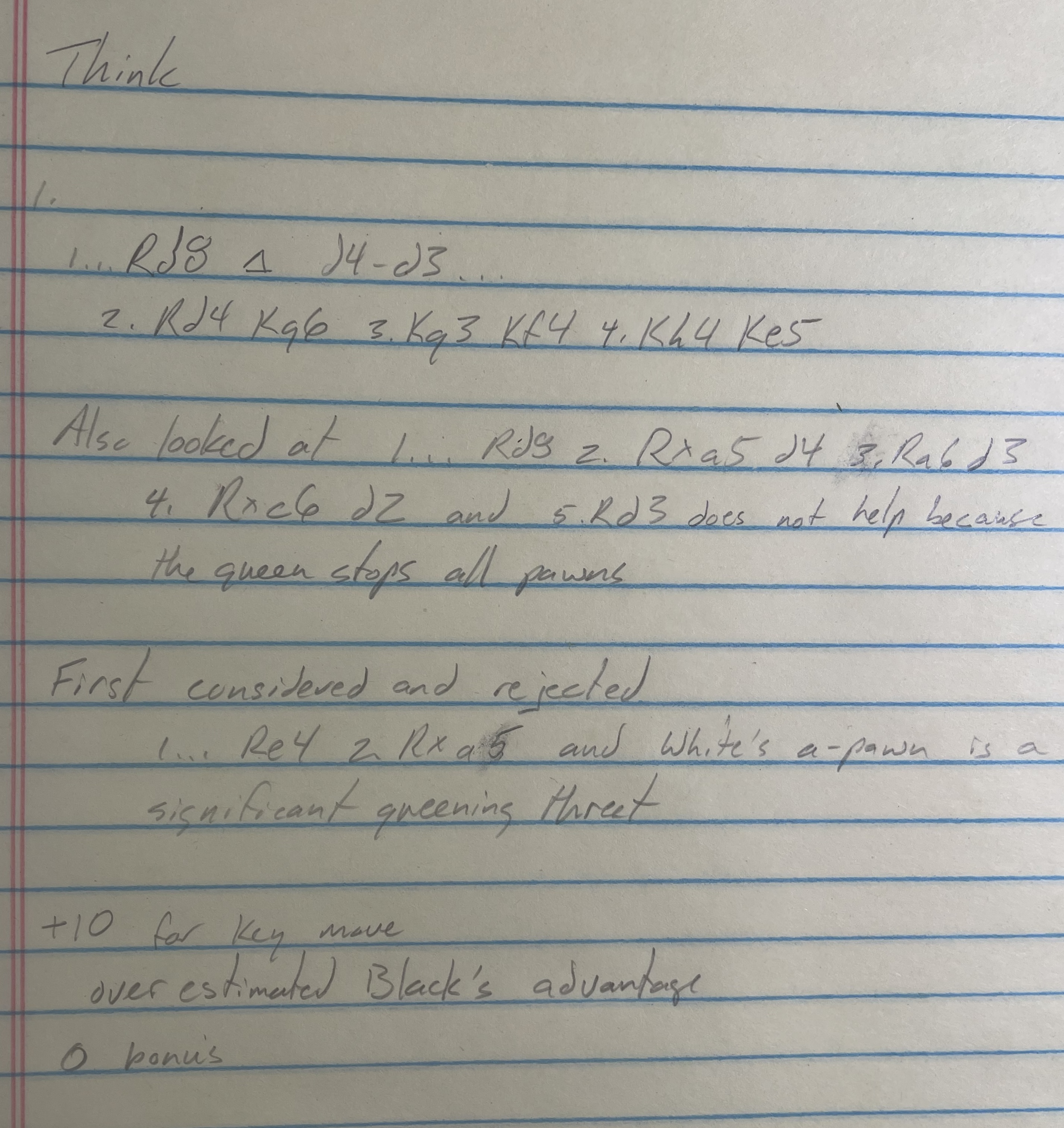
That book is Michael Adams, and Philip Hurtado, Think Like a Super-GM (2022). I ordered it Thursday morning, it arrived Thursday evening, and I took it with me on a weekend trip to Montana. I did the first exercise while eating breakfast.


I found the key move, but my analysis needs to go deeper to reach a correct evaluation.


16 January 2016

Tata Steel Chess 2016, Round One

Last night, in preparation for today's opening round of the Tata Steel Chess Tournament, I reviewed previous encounters for each of the pairs of contestants. Although the overall strength of this year's event is down from prior years, there will be some interesting match-ups. In the Tata Steel Masters, there are three players from China and only two from Russia. The future is thus well represented.

Hou -- Karjakin

I found one game in the database between these two players, and it was a game that I remember watching live three years ago. It was played during the Tata Steel Chess tournament. Hou Yifan played the French Defense and chose an obscure line of the Steinitz variation designed to immediately swap off her bad bishop. Against a player of Sergey Karjakin's caliber, this strategy was fatal. Too much time was spent in the exchange. Karjakin built up his attack and forced the Black king to remain in the middle of the board. That was enough for a lasting advantage.

Today's game was drawn after both players reached the time control. Each had two rooks and four pawns remaining.

So -- Giri

Anish Giri had White in his first meeting with Wesley So in the Corus C-Group of the 2009 Wijk aan Zee tournament. That game was agreed drawn after it was reduced to a pawn ending. Both players were elevated to the B-Group the following year. Giri won with the Petroff. Later in 2010, Giri beat So again in Biel. Their next two encounters were draws, one in the 2014 Tata Steel Masters. In last year's Tata Steel Masters, Giri won a marathon battle of 111 moves. So then scored a win against Giri in the Vugar Gashimov Memorial in April. They played six more games against one another in 2015, with So winning one of the blitz games and the others all drawn.

So won a symmetrical English that left Black's minor pieces inferior to White's.

Ding -- Adams

The only prior encounter between these two players in my database was at the 2013 Alekhine Memorial. Ding Liren played 4.f3 against Michael Adams' Nimzo-Indian Defense. Most of the pieces came off in a tactical melee, and the players agreed to a draw in a balanced endgame.

Ding Liren won an ending that featured a knight, rook, and pawns on each side. Eventually, Adams lost his knight with a stalemate trap that Ding easily saw through.

Navara -- Carlsen

According to my database, David Navara has an even score against Magnus Carlsen, but all but one of these games were played before Carlsen ascended to the top of the rating list. Navara was over 2700, and ranked above Carlsen when he beat the future World Champion with a Grunfeld Defense at Wijk aan Zee 2007. The previous year, they drew their game in the B-Group. Carlsen's win against Navara came in 2008 at the Dresden Olympiad. Two other games, most recently in 2012, ended as draws.

David Navara gave a nice interview with Yasser Seirawan where he described how he avoided the sort of strategic complications that would have favored the World Champion. In the end, Carlsen forced a draw by repetition.

Caruana -- Eljanov

All of the games between these two players have been decisive with Pavel Eljanov leading 3-2. Two games were played in the World Blitz Championship in 2010. Caruana won with White, but lost in three moves from the Black side. There must have been an illegal move or some other irregularity. The only clue that I could find in ten minutes of searching was Mark Crowther's comment (The Week in Chess, theweekinchess.com, 18 November 2010) that some games were incomplete. Perhaps the game score is incomplete due to problems with the DGT boards. Fabiano Caruana's sole classic time control win against Eljanov came against the Berlin Defense in 2011. Later that year, Eljanov opted for the Caro-Kann and won. Will Eljanov opt to test Caruana in the Berlin once again?

Caruana told Seirawan that he was worse early on in this Queen's Gambit, but his attack began to gain ground after a coupld of time wasting moves by Eljanov. The score between these two players is now even.

Wei -- Tomashevsky

If Wei Yi and Evgeny Tomashevsky have played one another prior to today, the game is not in my database. Nor do any games from the usual online database appear via a Google search.

This 23 move draw was the shortest game of the round.

Mamedyarov -- Van Wely

These two have seventeen prior encounters at my fingertips. Shakhryar Mamedyarov leads Loek Van Wely 7-7-3 (W-D-L). Two of these games were played at Wijk aan Zee.

If you showed this position to any Grandmaster and mentioned that Black has a win, he or she would find it in under two minutes. Alas, there is no such voice of assistance in a tournament game and Loek van Wely missed his chance. The game was drawn after a long ending where White was unable to convert a small advantage.

Black to move