Showing posts with label tournament directors. Show all posts

01 August 2020

Playing Online (Pros and Cons)

The first time that I played chess via the internet was 1989 when my younger brother let me play in his place some regularly scheduled telnet games with a friend of his in another city. Both my brother and his friend were programmers. The Internet Chess Club (ICC) came into existence a few years later. I recall my brother claiming that he helped with some of the programming.

When ICC started charging a membership fee, Free Internet Chess Server (FICS) was created to maintain a free playing environment. After that one evening in 1989, the next time I played online was a now defunct site called Net-Chess in 1998. I joined ICC in 1999 and started playing regularly--maybe almost every day. I also started watching live broadcasts of Grandmaster events.

ICC, FICS, Net-Chess, and Playchess (where I started in 2003) are servers that require software on your computer and send small amounts of data over the internet. Website hosted chess, to my knowledge, began with Yahoo! It was terrible. Chess.com, which came online in 2007 and added live chess after a few months, began to change the quality of website chess. The distinctions summarized in Edward Collins' Yahoo! Chess vs. The Chess Servers are no longer valid.

LiChess, Chess.com, Chess24, and others now have hundreds of thousands of games every day. They also host Grandmaster events and other tournaments, as well as organizing their own. ICC and Playchess also seem to be doing well. It has been several months since I have played on FICS, and many years since I enjoyed the experience. The lag there is terrible, and I lack confidence that they effectively root out cheats.

Last night I played in the World Open Game 7 Championship on ICC. It is organized by the Continental Chess Association. The time control was 7+2. I was very low in the pairing chart in the open section. In seven rounds, I managed one win and two draws. I beat the only opponent who was lower rated (according to USCF standard OTB rating, which was used for pairings). I had chances in several of the games that I lost.

I threw away a clear win from this position, although my opponent had done the same earlier in the game. It ended as a draw one move before we had lone kings.

Black to move

In the next game, I again threw away a clear advantage. This time, I went on to lose.

White to move

My previous post here highlights how these types of errors are often the product of haste.

Next weekend, I am playing in the World Open. The time control is 60 + 10, longer than any time control I have experienced in live online play (I have played hundreds of online correspondence games). This morning, I tried two games at 30 + 10. Both opponents were relatively weak and I won easily. Even so, I was happy that in 46 moves, I made no blunders (according to the website's Stockfish 11), and only three inaccuracies. Two of these inaccuracies were opening choices that I might make again. The other missed a vulnerability that could have been attacked.

One of our strongest local players offers a summary of the pros and cons of online play at his chess tutoring site: Casey Chess Tutoring. I also recommend him as a teacher if you are looking for some instruction.

Rather than creating my own list of the pros and cons, or repeating his, I want to address one point: cheating.

How common is cheating online?

A high percentage of my online correspondence opponents have been banned from the website where we played because of cheating; perhaps 8-10%. In live play, cheating is less frequent, percentage-wise. Nonetheless, like many others, I am usually suspicious when I get outplayed. I often report my opponents, and often check the engine analysis before or after such reporting. Most players are clean. Nonetheless, it happens. During last night's preliminary remarks by an organizer, he stated that they go over every game before an event is rated, and that they usually (he may have said, "always") find cases of cheating.

I was on the organizing committee for the Washington State Elementary Chess Tournament, which went online this year. We had detailed procedures for rooting out cheats, and we had some ethical breaches that we needed to address. We also had nearly 1200 participants! The number of suspicious players was in the dozens, and most were determined to be clean. More than 99% of the participants never faced a suspicious opponent.

A few weeks ago, I ran into a suspicious player in an online tournament. That player's computer match rate in the event was 97%. To be fair, however, all of these games were relatively short. I submitted a cheating report. Later, I learned that my opponent is an underrated and very young youth player. The cheating accusation was likely quickly dismissed by the website. The player is clean. The third time we played, I won.

Cheating also occurs OTB. Is is less common? We need to consider the percentages. The number of games that are played online is astronomically large and the number of cheats relatively small (even if it happens every single day). I do not know whether anyone has compiled clear data on the question. Hence we are left with impressions and anecdotes.

My anecdote is this: I have lost to cheats online. I also have won against them. I have played more than 150,000 live games online. More than 150,000 of these games have been 100% clean. The risk of facing a cheat is much lower than the fears associated with it.

Do not let fear of online cheating stand in the way of playing chess during a time of social isolation. Do consider playing in tournaments, even tournaments that have entry fees and cash prizes. In my experience, the quality of play in online tournaments is worth it.

15 February 2016

Swiss Tournament Tie-Breaks

It is relatively easy to split a sum of money equitably between two or more recipients. However, cutting a trophy into halves or thirds only makes a mess. Consequently, chess tournaments use tie-breaks to determine the relative standings of chess players who finish with the same scores.

The Swiss System method for running chess tournaments accommodates a large number of competitors. It was first used in Zurich, Switzerland in 1895, where it was developed by Julius Müller, a founding member of the Swiss Chess Federation (see Edward Winter, Chess Notes 4118, 20 January 2006). Random pairings were used among winners and losers when first used, but the system has developed more sophistication since its first use.

Swiss System tournaments are non-elimination. The basic rules* are simple:

1) No one plays the same opponent twice.
2) In each round, players are paired as nearly as possible against others with the same score.
3) Each player should have approximately the same number of Blacks and Whites.

At the end of an event with a number of players that does not exceed 2 to the power of the number of rounds, there will be no more than one perfect score. It often happens, however, that there is no perfect score. Instead, a group is clustered at the top with one-half or one point below perfect. In such case, who wins first place? Tie-breaks are used to make this determination. Tie-breaks also sort players below first place for additional prizes.

Tie-breaks attempt to determine the first among equals by measuring the quality of each player's opponents. There are several methods for making this determination. Usually more than one is used by tournament directors. Below I describe tie-break methods and display how each sorts the participants in one particular tournament. As will be seen, different methods lead to different results.

In this event, three players shared first place, Lucas, Ernest, and Henry. Each of these three won four games and lost one. Each one's only loss was to another of the three. Lucas beat Ernest, the top rated player, but lost to Henry. Henry lost to Ernest.

Henry might prefer Cumulative, as that puts him on top. Lucas comes out on top with Average Opposition. Ernest prevails via Opposition Performance, Opposition Cumulative, and Solkoff.

U.S. Chess Federation rules prefer a system that employs Modified Median, Solkoff, Cumulative, and Opposition Cumulative in that order. In Washington State scholastic events, the standard tie-break system employed is Solkoff, Cumulative, and Opposition Cumulative.

Average Opposition

Average opposition employs the mean of the opponent's pre-tournament ratings. This system will tend to favor the higher rated player, but that did not occur in our sample tournament.

Standings. Average Opposition

#NameRtngRd 1Rd 2Rd 3Rd 4Rd 5TotTBrk[A]
1Lucas Beauchamp1418W12W5W2L3W44.01128
2Ernest Thayer1643W11W4L1W6W34.01123
3Henry Bird1448W14W10W8W1L24.01076
4Flannery O'Connor1069W7L2W11W8L13.01016
5David Duncanunr.W9L1L6W14W103.0950.5
6Gilbert Chesterton889L10W15W5L2W73.0888
7Robert Zimmerman419L4B---W13W9L63.0761
8Joanne Rowling809W15W13L3L4W143.0732.5
9Shaun Alexander934L5W12W10L7W153.0645.5
10Charles B. Brownunr.W6L3L9W11L52.01022.5
11Robert Frost793L2W14L4L10W122.0931
12E Dickinson432L1L9B---W13L112.0824.5
13Carl Sandburgunr.H---L8L7L12B---1.5553
14Rodney Serling588L3L11W15L5L81.0900.5
15Stephane Mallarmeunr.L8L6L14B---L91.0805

Average Opposition Performance

Rather than using pre-tournament ratings, opposition performance employs performance ratings. Performance rating is determined by opponent's rating + 400 for a win, opponent's rating - 400 for a loss, and opponent's rating for a draw.

Standings. Opposition Performance

#NameRtngRd 1Rd 2Rd 3Rd 4Rd 5TotTBrk[P]
1Ernest Thayer1643W11W4L2W5W34.01194
2Lucas Beauchamp1418W12W6W1L3W44.01182
3Henry Bird1448W14W10W7W2L14.01101
4Flannery O'Connor1069W9L1W11W7L23.01116.5
5Gilbert Chesterton889L10W15W6L1W93.0941
6David Duncanunr.W8L2L5W14W103.0934
7Joanne Rowling809W15W13L3L4W143.0766.5
8Shaun Alexander934L6W12W10L9W153.0744.5
9Robert Zimmerman419L4B---W13W8L53.0737
10Charles B. Brownunr.W5L3L8W11L62.01014
11Robert Frost793L1W14L4L10W122.0976.5
12E Dickinson432L2L8B---W13L112.0807
13Carl Sandburgunr.H---L7L9L12B---1.5743
14Rodney Serling588L3L11W15L6L71.0944
15Stephane Mallarmeunr.L7L5L14B---L81.0783

Cumulative

Cumulative sums the scores round by round. A player losing in early rounds will face weaker opponents than one winning in early rounds.

Standings. Cumulative

#NameRtngRd 1Rd 2Rd 3Rd 4Rd 5TotTBrk[C]
1Henry Bird1448W14W10W5W2L34.014
2Lucas Beauchamp1418W12W9W3L1W44.013
3Ernest Thayer1643W11W4L2W7W14.012
4Flannery O'Connor1069W8L3W11W5L23.010
5Joanne Rowling809W15W13L1L4W143.010
6Shaun Alexander934L9W12W10L8W153.08
7Gilbert Chesterton889L10W15W9L3W83.08
8Robert Zimmerman419L4B---W13W6L73.08
9David Duncanunr.W6L2L7W14W103.08
10Charles B. Brownunr.W7L1L6W11L92.07
11Robert Frost793L3W14L4L10W122.05
12E Dickinson432L2L6B---W13L112.04
13Carl Sandburgunr.H---L5L8L12B---1.52
14Rodney Serling588L1L11W15L9L51.03
15Stephane Mallarmeunr.L5L7L14B---L61.01

Opposition Cumulative

Opposition cumulative sums the cumulative scores of each player's opponents.

Standings. Opposition Cumulative

#NameRtngRd 1Rd 2Rd 3Rd 4Rd 5TotTBrk[O]
1Ernest Thayer1643W11W4L2W6W34.050
2Lucas Beauchamp1418W12W5W1L3W44.048
3Henry Bird1448W14W10W7W2L14.045
4Flannery O'Connor1069W8L1W11W7L23.048
5David Duncanunr.W9L2L6W14W103.039
6Gilbert Chesterton889L10W15W5L1W83.036
7Joanne Rowling809W15W13L3L4W143.030.5
8Robert Zimmerman419L4B---W13W9L63.028.5
9Shaun Alexander934L5W12W10L8W153.028
10Charles B. Brownunr.W6L3L9W11L52.043
11Robert Frost793L1W14L4L10W122.036
12E Dickinson432L2L9B---W13L112.028.5
13Carl Sandburgunr.H---L7L8L12B---1.522
14Rodney Serling588L3L11W15L5L71.038
15Stephane Mallarmeunr.L7L6L14B---L91.029

Head-to-Head

When two tied players have played each other, the winner of their game wins head-to-head. If they drew, however, or if more than two share the same score, head-to-head is useless. The scores below give each player 100, then subtract 1 for each loss to another player with the same score. As can be seen, it was effective for determining last place.

Standings. Head-to-Head

#NameRtngRd 1Rd 2Rd 3Rd 4Rd 5TotTBrk[H]
1Ernest Thayer1643W11W4L3W5W24.099
2Henry Bird1448W14W10W6W3L14.099
3Lucas Beauchamp1418W12W7W1L2W44.099
4Flannery O'Connor1069W9L1W11W6L33.0100
5Gilbert Chesterton889L10W15W7L1W93.0100
6Joanne Rowling809W15W13L2L4W143.099
7David Duncanunr.W8L3L5W14W103.099
8Shaun Alexander934L7W12W10L9W153.098
9Robert Zimmerman419L4B---W13W8L53.098
10Charles B. Brownunr.W5L2L8W11L72.0100
11Robert Frost793L1W14L4L10W122.099
12E Dickinson432L3L8B---W13L112.099
13Carl Sandburgunr.H---L6L9L12B---1.5100
14Rodney Serling588L2L11W15L7L61.0100
15Stephane Mallarmeunr.L6L5L14B---L81.099

Kashdan

The Kashdan system rewards aggressive play by awarding 4 points for a win, 2 points for a draw, 1 point for a loss, and 0 for an unplayed game.

Standings. Kashdan

#NameRtngRd 1Rd 2Rd 3Rd 4Rd 5TotTBrk[K]
1Ernest Thayer1643W10W4L3W6W24.017
2Henry Bird1448W14W11W7W3L14.017
3Lucas Beauchamp1418W12W8W1L2W44.017
4Flannery O'Connor1069W9L1W10W7L33.014
5Shaun Alexander934L8W12W11L9W153.014
6Gilbert Chesterton889L11W15W8L1W93.014
7Joanne Rowling809W15W13L2L4W143.014
8David Duncanunr.W5L3L6W14W113.014
9Robert Zimmerman419L4B---W13W5L63.010
10Robert Frost793L1W14L4L11W122.011
11Charles B. Brownunr.W6L2L5W10L82.011
12E Dickinson432L3L5B---W13L102.07
13Carl Sandburgunr.H---L7L9L12B---1.53
14Rodney Serling588L2L10W15L8L71.08
15Stephane Mallarmeunr.L7L6L14B---L51.04

Median

The Median system sums the final scores of each player's opponents, discarding the highest and lowest. This system is also known as the Harkness system for its inventor, Kenneth Harkness.

Standings. Median

#NameRtngRd 1Rd 2Rd 3Rd 4Rd 5TotTBrk[B]
1Ernest Thayer1643W11W4L2W6W34.010
2Lucas Beauchamp1418W12W5W1L3W44.010
3Henry Bird1448W14W10W9W2L14.09
4Flannery O'Connor1069W7L1W11W9L23.09.5
5David Duncanunr.W8L2L6W14W103.08
6Gilbert Chesterton889L10W15W5L1W73.07.5
7Robert Zimmerman419L4B---W13W8L63.07
8Shaun Alexander934L5W12W10L7W153.06
9Joanne Rowling809W15W13L3L4W143.05
10Charles B. Brownunr.W6L3L8W11L52.09
11Robert Frost793L1W14L4L10W122.06.5
12E Dickinson432L2L8B---W13L112.06
13Carl Sandburgunr.H---L9L7L12B---1.54
14Rodney Serling588L3L11W15L5L91.08
15Stephane Mallarmeunr.L9L6L14B---L81.07

Modified Median

Modified median treats players with even scores (i.e. 2.5 in a five-round event) the same as the Median. Players with plus scores discard only the lowest scoring opponent's score. Players with minus scores discard the highest scoring opponent's score.

Standings. Modified Median

#NameRtngRd 1Rd 2Rd 3Rd 4Rd 5TotTBrk[M]
1Ernest Thayer1643W11W4L2W6W34.014
2Lucas Beauchamp1418W12W5W1L3W44.014
3Henry Bird1448W14W10W9W2L14.013
4Flannery O'Connor1069W7L1W11W9L23.013.5
5David Duncanunr.W8L2L6W14W103.012
6Gilbert Chesterton889L10W15W5L1W73.011.5
7Robert Zimmerman419L4B---W13W8L63.010
8Shaun Alexander934L5W12W10L7W153.09
9Joanne Rowling809W15W13L3L4W143.09
10Charles B. Brownunr.W6L3L8W11L52.011
11Robert Frost793L1W14L4L10W122.07.5
12E Dickinson432L2L8B---W13L112.06
13Carl Sandburgunr.H---L9L7L12B---1.54
14Rodney Serling588L3L11W15L5L91.08.5
15Stephane Mallarmeunr.L9L6L14B---L81.07

Solkoff

The Solkoff tie-break method sums the final scores of the opponents. No scores are discarded.

Standings. Solkoff

#NameRtngRd 1Rd 2Rd 3Rd 4Rd 5TotTBrk[S]
1Ernest Thayer1643W11W4L2W6W34.016
2Lucas Beauchamp1418W12W5W1L3W44.015.5
3Henry Bird1448W14W10W9W2L14.014
4Flannery O'Connor1069W7L1W11W9L23.015.5
5David Duncanunr.W8L2L6W14W103.013
6Gilbert Chesterton889L10W15W5L1W73.012
7Robert Zimmerman419L4B---W13W8L63.010
8Shaun Alexander934L5W12W10L7W153.09.5
9Joanne Rowling809W15W13L3L4W143.09.5
10Charles B. Brownunr.W6L3L8W11L52.015
11Robert Frost793L1W14L4L10W122.011.5
12E Dickinson432L2L8B---W13L112.010
13Carl Sandburgunr.H---L9L7L12B---1.57
14Rodney Serling588L3L11W15L5L91.012.5
15Stephane Mallarmeunr.L9L6L14B---L81.010


*The United States Chess Federation Official Rules of Chess, 6th ed (2014) list these three as priorities 1, 2, and 4, respectively. Number 3 is upper half versus lower half. The USCF rules also list a 5th priority: alternating colors.

06 November 2011

Teaching the Rules of Chess


A Beginner's Confusion

At a youth tournament yesterday, I was called in by a judge to deal with a case where one player insisted that he had checkmated his opponent. The checkmated player did not understand that he was in checkmate. I had taught him to play when I taught the game in his first or second grade classroom. As a second grader, he was part of an in-school chess club that I run. Now in third grade, he is part of an after-school club. I continue to teach the basic rules in these clubs. Some of these children do not play chess at home.

The diagram below shows the essentials of the position. There were perhaps another dozen pieces on the board, more white than black.

Black to move

I asked him to show me where his king could legally move. The youth's argument was thus: if I move to f7 and he leaves his queen there, I can capture the queen on the next move. Can the queen capture your king, I asked. "No, you're not allowed to capture the king," he replied. But, I told him, you're not allowed to move your king where it may be captured. Is there any square where your king can move that it cannot be captured? We went a few rounds with this conversation before he acknowledged that he was indeed in checkmate.


Teaching the Rules

How does one explain the king's movement, check, and checkmate to young children? Do many chess teachers say that a player cannot capture the king? I've heard chess coaches tell children, "you cannot capture the king, you must checkmate him." I have expressed the basic rules in terms of a paradox: the object is to capture the king, but the king cannot be captured.

FIDE Rule 1.2 supports this notion:
Leaving one’s own king under attack, exposing one’s own king to attack and also "capturing" the opponent’s king are not allowed. The opponent whose king has been checkmated has lost the game.
FIDE Handbook, http://www.fide.com/fide/handbook
How does this prohibition against capturing the opponent's king function? If it is possible to capture the king, what must be done? If the king is in checkmate, the game is over. But, what do we do if the players failed to notice the check? What may be done if the player moved into check?

FIDE Rules, Article 7 addresses irregularities, including illegal moves.
If during a game it is found that an illegal move, including failing to meet the requirements of the promotion of a pawn or capturing the opponent’s king, has been completed, the position immediately before the irregularity shall be reinstated. (7.4.a)

After the action taken under Article 7.4.a, for the first two illegal moves by a player the arbiter shall give two minutes extra time to his opponent in each instance; for a third illegal move by the same player, the arbiter shall declare the game lost by this player. (7.4.b)
The position prior to the illegal move must be restored, and the game recommence by a legal move. In classrooms, I teach the children to politely request that their opponent recognize the check, take back the illegal move, and make a move that does not leave the king in check.

Sometimes the children learn these rules incompletely.

08 November 2009

Director's Woes

Yesterday, I ran a small scholastic chess tournament--the fourth annual Black Knights' Joust--with seventy-nine players in three sections (K-3, 4-6, 7-12).

As I was starting to pair the first round, a message popped up in SwissSys 8 telling me that I was running an unregistered copy. I had purchased version eight last May. The license covers one copy on my desktop computer, and one on my notebook. I received the codes from Thad Suits, developer of the software. This message at the start of the tournament revealed my oversight: I had installed SwissSys 8 on both computers, but only entered the codes in my desktop. I ran several test tournaments to familiarize myself with the changes in version 8, including several nifty new features, but failed to run these tests on the machine I use during events.

I've run more than a dozen scholastic tournaments with 70-142 players, one large state championship with over one thousand participants, and I've helped at many others. I've learned from some of the best in my state--Jon Licht, Elliott Neff, Rick Jorgensen. Even so, I always make errors. Most errors are small, insignificant, and easily concealed. I might have hid yesterday's error because I resolved it quickly. But, I answered the phone at a critical moment.


Cascading Errors

A few years ago, I plugged my computer into the wall, turned it on, and then left the TD room to set up tables, chess sets, other aspects of the venue. When I returned to my computer, it was off. The outlet was switch controlled, and dead. On battery power, my notebook was set to shut off after a certain period of idleness. That event had ninety players preregistered, and enough late entries to bring the total to one hundred forty-two. I transferred my computer to a live outlet (per my wife's command), got my assistant TD (who runs most of the area's adult tournaments) to enter the late registrants, and after some delay we were ready to pair round one. Already, we were running late when the pairings were sent to the printer.

The computer failed to find the default printer. The usual printer was connected, but ordinarily was part of a home network, and so the computer was looking for the printer in all the wrong places. It took a few minutes to cancel the print job, and switch to the printer as configured at the tournament site. However, a spooling process continued to run until--panic behind--we deciphered the problem and shut it off (thanks to Dr. John, who has more experience with SwissSys than the rest of us--he and my tremendously experienced "assistant TD" ran the pairings at last year's state tournament). Printing was slow through three rounds, and the tournament ran further behind.

We managed to finish about the time that would be normal if elementary age children used all of their available thirty minutes per game. However, kids play too fast. These scholastic events tend to run ahead of schedule, so "on-time" is considered late. My tournament announcements list start times that once seemed realistic:
Schedule: First round begins at 10:00 a.m. Check in 8:30 to 9:30. Late arrivals will forfeit first round. Rounds 2-5 at 11:15, 12:30, 2:00, 3:30, or ASAP
Winterfest Scholastic Tournament Announcement 2004
ASAP is the key. In Spokane, the children usually finish play before 3:00 pm.

We ran close to the published schedule near the end of the day, and trophies were distributed near 5:00pm. Parents were frustrated. Since that event, I've asked for 100% preregistration (and get 90-98%). I always test my printer on Friday night. I do not repeat the same errors from prior events.

Yesterday, the K-6 awards ceremony ended close to 3:00 pm. The high school/middle school players finished play just before 4:00 pm, and after clean-up I was in my vehicle ready to head home at 4:40 pm.


Courting Disaster

I find new errors to commit with each new event, and seem to be growing more inventive in how I can sabotage myself. Friday evening, my spouse and I ran through the checklist. She no longer attends these events, as she did for my first few. She did help significantly with the state tournament last spring, and complied a list of lessons learned. Our Friday night checklist did not include: "Is the pairing software registered?" It should have.

When the message of doom appeared on my screen yesterday morning, I felt a sense of terror that may have lasted fifteen seconds or three minutes. Of course, I had options: pair by hand (not in a scholastic tournament of this size if that can be avoided), recreate the tournament set-up in an older version of SwissSys (five to ten minutes delay), get the codes before round three.

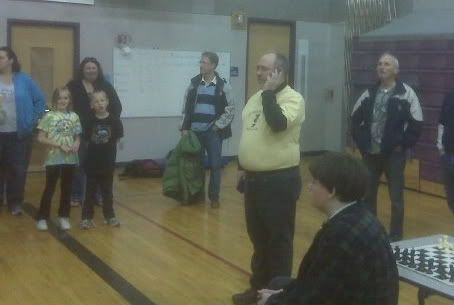
I called my wife. I told her where to find the email from Thad Suits and the information in it that I would need. She set to work, so I knew two things: I would have the codes in time, and I would be buying flowers on the way home. At 10:11 am, players were seated for round one. I was beginning the meeting for players and parents only a few minutes later than normal, and my phone rang. It was my wife, so I answered.

Don Lester captured the moment and posted the photo to Facebook.


As I talked on the phone in front of more than one hundred players, parents, and coaches, my wife told me she had sent a text message with the necessary codes.

Please add mobile phone to the list of essential tournament director's equipment.

27 April 2009

Advice for Organizers

While I was the event coordinator for the 2009 Washington State Elementary Chess Championship, my beloved served as the event's treasurer and volunteer coordinator. When the time for the event arrived, she joined the hospitality coordinators at the check-in and information tables. These tables might be dubbed problem central. There were and will always be problems large and small in a large event. These problems must be solved, often by people who must think on their feet after inadequate sleep.

From most reports, the event ran smoothly. But, when over 1000 participants compete, problems must be expected. My wife compiled a list of tidbits of advice based on her observations and experiences. Event organizers should have or be prepared for:

puke at pairings postings (in a large public facility, you cannot just grab a paper towel)
lost children--hold them by the hand until you find mom or dad
lost parents
medical attention--a child playing outside became injured, his parent withdrew him from the tournament and took him to the hospital for stitches. He returned from the hospital and wanted back in the tournament to play round five.
indoor soccer
walkie-talkies--check-in table, tournament director, head judge, medical, clean-up, hospitality staff all need to be able to contact each other easily

scrapes, scratches, headaches
award snafus--300 trophies, someone might get the wrong one, or none when one was expected
angry teams--"NO PROTESTS ON THE PLAYING FLOOR"
angry parents
drunk parents--2000+ adults, there will be one
shelter--tournament director, head judge, event organizer

empower decision makers for specific aspects of the event to spend money--when late registrations for Friday Bughouse crowd the facility and a microphone is needed from the hotel, someone other than the event coordinator must decide that we can spend $85 more; when the judges hospitality room needs more potato chips, the hospitality coordinator must know that she has the authority to order them, that the added cost is okay

outsource registration, check-in, and web management--I spent too much time on these tasks. The positive benefit was that I had personal contact with many parents and coaches. There are alternatives to our system that have been tried and tested. Our webmaster created a nice site, and both he and I made many small modifications along the way. We might have hired someone else to maintain the site, and post periodic announcements.

lost and found
validate and understand hurt feelings and anger--I am convinced that a team that was hurt twice--once by an error in the program, and once by an error in pairings--did feel listened to and validated even though I could not fully repair the errors. That's just the biggest one, there were many other complaints.
complaint process--there should be a clear process for formal complaints; there should be a clear appeals process. The current WSECC Policy has much to say about team membership and team competition, but it does not address team pairing restrictions with clear rules.

K-1 escorts--having assured that parents are not in the playing room, where they would interfere with the competition, we cannot just set a five or six year old loose in the building to find her Dad. The parents need a waiting area; the event staff must assure that children get connected with their parents as they finish each round. We had a pediatrician step up as safety director and supervise this process on-site.

you will not collect all money due
double check everything
stolen items
receipt book for commemorative board purchases
gifts--lunches, boards, t-shirts
color code playing room by section
create "do not cross" line on the boundary between playing room and waiting area; post security--some of the high school students working as floor judges stepped up to this task and did a great job.

Have a physician on the volunteer staff willing to attend to injuries
Have enough space--we had 102,000 square feet, and the success of the event was largely due to an exceptional facility, and well planned traffic flow. Pairing were posted in three locations, and in a manner designed to channel players and parents efficiently. Standings were posted in the team room, NOT in the playing room.

Thank people often--competitors, parents, coaches, and volunteer staff all gave of themselves. They deserve praise and thanks. Make certain they get it.