Showing posts with label Scotch Gambit. Show all posts

06 August 2019

Reiner -- Steinitz

William Steinitz moved to Vienna from his hometown of Prague in 1858, and in 1859 placed third in the city's chess championship. Databases contain three of his games against Reiner from 1860. This game cropped up in a search for examples of Arabian checkmate. White could have delayed checkmate, but he was effectively lost quite early in the game. It is a good example of a risky gambit going horribly wrong.


Reiner -- Steinitz,William [C44]
Vienna, 1860

1.e4 e5 2.Nf3 Nc6 3.d4 exd4 4.Bc4 Bc5 5.0-0

5.Ng5 Nh6 6.Nxf7 Nxf7 7.Bxf7+ Kxf7 8.Qh5+ g6 9.Qxc5 d6 10.Qb5 Re8 Black won in 21 moves Meek,A -- Morphy,P, Mobile 1855. See Meek--Morphy

5.c3 is the main line, but even here Black scores well

5...d6 6.c3 Bg4

White to move

7.Qb3

7.Bb5 dxc3 8.Nxc3 Nge7 9.h3 Bd7 (9...Bh5) 10.Bf4 (10.a3) 10...a6 11.Bc4 Ng6 12.Bg5 Qc8 White won in 40 moves Lapshun,Y (2479) -- Berczes,D (2450), Budapest 2007.

7.Bxf7+ fails 7...Kxf7 8.Ng5+ compounds White's problems 8...Qxg5 9.Bxg5 Bxd1 10.Rxd1-+;

7.Bg5 Nge7

7...Bxf3 8.Bxf7+ Kf8 9.Bxg8

9.gxf3 seems White's best chance. 9...Nf6 10.Bc4=

9...Rxg8 10.gxf3 g5

Black is better, although one master game that reached this position was won by White.

White to move

11.Qe6

11.Nd2 seems useful. White's pieces must get into the game. 11...Ne5 12.cxd4 Bxd4 13.Nc4 Qf6 (13...Qc8? 14.Nxe5 Bxe5 15.Kg2 White won in 42 moves Kopetzky,K -- Spielmann,R, Vienna 1933) 14.Nxe5 Bxe5 and even with the reduced material, White's king is vulnerable.

11...Ne5

White's opening must be judged a failure. A pawn was sacrificed for mobilization, but Black's pieces are better mobilized.

11...Rg6 12.Qf5+ Kg7 13.Kh1 Qe7 14.Rg1 Rf8 15.Bxg5 Rxf5 16.Bxe7 Rh5 17.b4 Bb6 18.Bxd6 cxd6 Black won in 25 moves Karaklajic,N (2405) -- Barle,J (2425), Caorle 1988.

12.Qf5+ Kg7 13.Kh1

13.Bxg5 Nxf3+ 14.Qxf3 Qxg5+ 15.Kh1 Kh8 16.Nd2 Raf8-+;

13.f4 gxf4 14.Bxf4 Kh8+ 15.Kh1 Ng4-+.

13...Kh8 14.Rg1

14.cxd4 Bxd4 15.Nc3 g4-+

14...g4

White to move

15.f4

15.fxg4 Qh4 (15...Rg5 16.Qf4) 16.Bf4 Nxg4 17.Rxg4 (17.Rf1 Raf8) 17...Qxg4 18.Qxg4 Rxg4 19.Bh6 Rxe4-+;

15.Bf4 Qe7 16.Bxe5+ dxe5-+.

15...Nf3

15...Nd3!

16.Rxg4?

16.Nd2 Nxg1-+;
16.Rg2 Nh4-+

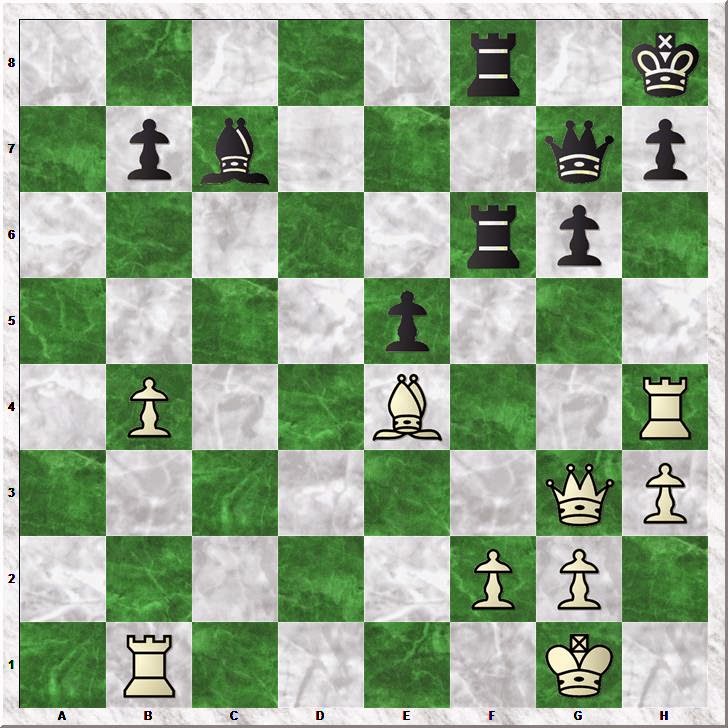
White to move

This position is one of the exercises I prepared for my students. I'm sure that it appears in many tactics sets in print and online.

16...Qh4! 17.Rg2

17.Qf6 delays the end.

17...Qxh2+ 18.Rxh2 Rg1# 0-1

18 January 2015

The Scotch Gambit

The 6.Qh5!? Line

My game of the week features a Scotch Gambit refuted by Paul Morphy (see "Meek -- Morphy 1855"). In the annotations to that game, I mentioned but did not explore 6.Qh5!? At first site, this aggressive line looks dangerous. However, with accurate play, Black gets the better game.

A handful of games in the nineteenth century revealed the main ideas and tactics.

1.e4 e5 2.Nf3 Nc6 3.d4

The Scotch Opening

3...exd4 4.Bc4

The Scotch Gambit

White sacrifices a pawn for rapid deployment.

4...Bc5

4...Nf6 is also playable.

5.Ng5 Nh6 6.Qh5!?

Black to move

Black has three reasonable replies:

a) 6...O-O

b) 6...Qf6

c) 6...Qe7

For each of these Black replies, I offer an illustrative game.

6...O-O

A. Johnston played the Scotch Gambit twice in the Second American Chess Congress, Cleveland 1871. He had an advantage for much of the game in this encounter.

Johnston,A -- Smith,Harsen Darwin [C44]
USA–02.Kongress Cleveland, 1871

1.e4 e5 2.Nf3 Nc6 3.d4 exd4 4.Bc4 Bc5 5.Ng5 Nh6 6.Qh5 0–0 7.Bxf7+

A more recent game continued 7.0–0 d6 8.h3 Ne5 9.Bb3 Qf6 10.Kh1 Kh8 11.f4 d3? and Black threw away a nice position with a series of errors. Facchetti,G (2159) -- Bisignano,G (2055)/Gorgonzola 2003. White won in 24 moves.

7...Rxf7

Obviously not 7...Nxf7 8.Qxh7#.

8.Nxf7

Black to move

8...Nxf7

Black should have played 8...Bb4+ 9.c3 Nxf7 10.cxb4 Nxb4 11.Qd1 when Black has good compensation and a pawn for the exchange.

9.Qxc5 d6

The position is similar to the main line, except that White is ahead an exchange.

10.Qc4 Qe7 11.Qe2 Nfe5 12.0–0 Be6 13.Na3 Rf8 14.f4 Bg4 15.Qb5 Ng6 16.Qxb7 Qxe4 17.Qb3+ Kh8 18.Qg3 Bf5 19.Qf3 Qe8 20.Bd2 Be4 21.Qg3 Nce7 22.Rae1 d5 23.f5 Nxf5 24.Qxc7 Ngh4 25.Rf2 Qg6 26.Qg3 Qe8 27.Qh3 h6 28.g4 Qg6 29.Rxe4??

29.Rf4 Rc8 30.Kf2

29...dxe4 30.Kh1 e3 31.Rxf5 Nxf5 32.gxf5 Qc6+ 33.Kg1 exd2 34.Qd3 Rxf5 35.Qxd2 Qg6+ 0–1

6...Qf6

The last ten moves of Max Lange's thrashing of Hermann Pollmacher offer a study in piece coordination.

Lange,Max -- Pollmacher,Hermann [C44]
Leipzig, 24.09.1856

1.e4 e5 2.Nf3 Nc6 3.d4 exd4 4.Bc4 Bc5 5.Ng5 Nh6 6.Qh5 Qf6 7.f4

White has other options, but this aggressive move is in the spirit of his play so far.

Black to move

7...d6

A pawn sacrifice appears to be Black's best option here. 7...d5! 8.Bxd5 Bg4 9.Bxf7+ is White's only move (9.Qh4 leads to a worse position quickly. 9...Nb4 10.Bb3 d3 and Black is running over the top of White's position.) 9...Qxf7 10.Nxf7 Bxh5 11.Nxh8 Nb4 12.Na3 (12.h3 Nxc2+) 12...0–0–0 with an initiative for Black.

8.h3 0–0 9.0–0 Be6? 10.Bd3 Qg6 11.Qxg6 hxg6 12.f5 gxf5 13.exf5 Bd5 14.f6

Black to move

14...gxf6??

14...Nb4

15.Rxf6

Even more convincing is 15.Nh7!

15...Kg7 16.Rxh6 Kxh6 17.Ne6+! Kh5 18.Nf4+ Kh4

18...Kh6 offers small hope 19.Nxd5+ Kg7 20.Nxc7 Rac8±.

19.Nxd5+- f5 20.Bf4 Ne5 21.Nd2 c6 22.g3+ Kxh3 23.Bf1+ Kg4 24.Kg2 Kh5

24...cxd5 25.Be2+ Nf3 26.Bxf3#.

25.Ne7 Ng4 26.Be2 Rae8 27.Rh1# 1–0

6...Qe7

6...Qe7 is probably Black's best choice. Adolf Anderssen was one of the first to play this move.

Von Eckstadt,Count Vitzthum -- Anderssen,Adolf [C44]
Leipzig, 1855

1.e4 e5 2.Nf3 Nc6 3.d4 exd4 4.Bc4 Bc5 5.Ng5 Nh6 6.Qh5 Qe7 7.f4

7.0–0 may be better.

7...d6 8.h3

Black to move

8...Na5

Better might have been the simple 8...Bd7 9.0–0 0–0–0 Black's lead in development gives him an edge.

9.Bd3 Nf5 10.Nxf7

10.Qxf7+ offers White better prospects of equality. 10...Qxf7 11.Nxf7 Kxf7 12.exf5.

10...g6 11.Qe2

11.Qf3? Kxf7 12.0–0 Ne3 13.Bxe3 dxe3–+.

11...Ng3 12.Qf3 Nxh1 13.Nxh8 Qh4+ 14.Kd1? 

14.Kf1 is more stubborn.

14...Nf2+–+ 15.Ke2 Nxd3 16.Qxd3

16.cxd3 Qf6 17.Nxg6 hxg6–+.

16...Be6 17.Qb5+ Nc6 18.Qxb7

Black to move

18... d3+! 19.cxd3 Nd4+ 20.Kd1 Bg4+ 21.hxg4 Qh1+ 0–1

17 January 2015

Meek -- Morphy 1855

While a student at Spring Hill College on the outskirts of Mobile, Alabama, Paul Morphy traveled the twelve miles into Mobile a couple of times. During one of these visits, he played three games with Judge Alexander Beaufort Meek, who was serving as judge of the probate court there. Morphy won. Meek and Morphy would again square off at the First American Chess Congress two years later

One of the games played in Mobile was selected by Rashid Ziyatdinov for inclusion in GM-RAM: Essential Grandmaster Knowledge and is the source for three "essential middlegame positions" therein. I am going through the 59 games in Ziyatdinov's book at the rate on one per week. The tag, "Game of the Week 2015," links to my comments on these games.


Meek,Alexander Beaufort -- Morphy,Paul  [C44]
Mobile, 01.03.1855

1.e4 e5 2.Nf3 Nc6 3.d4 exd4 4.Bc4 Bc5

Two years later, Morphy would play 4...Nf6 5.e5 d5 6.Bb5

(6.exf6 dxc4 7.fxg7 Bxg7 appears good for Black)

6...Ne4 7.Nxd4 Bd7 8.Nxc6 bxc6 9.Bd3 Bc5 10.Bxe4 Qh4 11.Qe2 dxe4 12.Be3 Bg4 13.Qc4 Bxe3 14.g3 Qd8 15.fxe3

(15.Qxc6+ Bd7 16.Qc3 Bb6-+)

15...Qd1+ 16.Kf2 Qf3+ 17.Kg1 Bh3 18.Qxc6+ Kf8 19.Qxa8+ Ke7 0–1 Lichtenhein,T -- Morphy,P, New York 1857.

5.Ng5

Black to move
GM-RAM Position 147
This position occurs in a dubious and uncommon gambit line. Why does it merit inclusion in Ziyatdinov's 120 "essential middlegame positions"?

Perhaps the answer stems from the forcing tactics. An error by Black here could lead to a rapid collapse.

5...Nh6

5...Ne5 scores poorly 6.Nxf7

(6.Bxf7+ Nxf7 7.Nxf7 Bb4+ 8.c3 dxc3 9.bxc3 Bxc3+ 10.Nxc3 Kxf7 11.Qd5+ Kf8 12.Ba3+ d6 13.e5 Qg5, Cochrane,J -- Deschapelles,A, Paris 1821. White clearly has the better game and won in 31 moves.)

6...Nxf7 7.Bxf7+ Kxf7 8.Qh5+ g6 9.Qxc5 d6 10.Qxd4, NN -- Alekhine,A, Kislovodsk 1907/EXT 2007. Black has dropped a pawn because he has an undeveloped knight instead of one on c6. Nonetheless, Alekhine won in 21 moves.

6.Nxf7

6.Bxf7+ leads to the same position 6...Nxf7 7.Nxf7 Kxf7 8.Qh5+ g6 9.Qxc5.

6.Qh5!? also merits study. There are pitfalls for Black after any inaccurate moves.

6...Nxf7 7.Bxf7+ Kxf7 8.Qh5+ g6 9.Qxc5 d6

White to move

Black's king looks exposed, but White is ill-prepared to attack. Rather, Black seizes the initiative. It is my understanding that Ziyatdinov expects the aspiring student to instantly perceive this position as one possible consequence of that in Position 147.

10.Qb5

10.Qc4+ Be6 11.Qd3 with a slight edge for Black.

10...Re8 11.Qb3+

11.0–0 seems better than Meek's move.

a) 11...a6 12.Qb3+ Kg7 13.Qd3;

b) 11...Re5 12.Qd3 Qe7 13.Nd2 Kg7 14.f4 Rh5

b1) 15.b4!? a6 (15...Qh4 16.h3) 16.Bb2 Qh4 (16...Nxb4 17.Qxd4+ Kf7 18.Qxb4+-) 17.h3.

b2) 15.Nf3 Qf6 16.Bd2 Bg4 17.c3 Bxf3 18.Rxf3 Re8 and drawn in 57 moves, Forgacs,A (2256) -- Piroska,I (2153), Dunaujvaros 2011

c) 11...Rxe4 12.Qd5+ Re6

11...d5 12.f3

12.0–0 still seems sensible.

12...Na5 13.Qd3

13.Qa3

13...dxe4 14.fxe4 Qh4+ 15.g3

15.Kf1 Rxe4 16.Qg3 Qg4 Black has the upper hand.

Black to move

15...Rxe4+

Morphy's most important inaccuracy.

15...Qxe4+! 16.Qxe4 (16.Kd2 Qg2+ 17.Kd1 Bg4+ 18.Qf3+ Bxf3#) 16...Rxe4+ 17.Kf2–+.

16.Kf2

16.Kd1 Bg4+ 17.Kd2 Qg5+ 18.Qe3 Qxe3#.

16.Be3!! Qg4 with a slight advantage for Black.

16...Qe7 17.Nd2

17.Bg5 seems better. 17...Qe5 18.Nd2 Bf5 19.Nxe4 Bxe4 Black has the upper hand.

17...Re3–+ 18.Qb5

18.Qxd4 Re2+ 19.Kg1 Bh3 20.Qd5+ Kf8 21.Nf1 Rg2+ 22.Qxg2 Bxg2 23.Kxg2–+.

18...c6 19.Qf1

19.Qxa5 is worse. 19...Re2+ 20.Kg1 (20.Kf3 Qe3#) 20...Qe3+ 21.Kf1 Qf2#.

Black to move
GM-RAM Position 148
19...Bh3 20.Qd1

20.Qxh3 Re2+ 21.Kf3 (21.Kf1 Re1+ 22.Kg2 Qe2#) 21...Qe3+ 22.Kg4 h5+ 23.Qxh5 gxh5+ (23...Qe6+ 24.Kh4 gxh5 25.Rf1+ Kg6 26.Rf6+ Qxf6+ 27.Kh3 Qf5+ 28.Kh4 Qg4#) 24.Kh4 Kg6 25.Ne4 Qxe4+ 26.Bf4 Rxh2+ 27.Rxh2 Qf5 and mate next move.

Black to move
GM-RAM Diagram 149
It may seem odd that Ziyatdinov offers two diagrams separated by a single move. However, the first is justified because the offer of a decoy sacrifice leads to a forced checkmate in nine moves. In the second, Black's victory is certain with correct play even though checkmate is not imminent.

20...Rf8 21.Nf3 Ke8 22.Bd2

22.Bxe3 Qxe3#.

22.Re1 Rfxf3+ 23.Qxf3 Rxf3+ 24.Kxf3 Qxe1–+.

22...Qe4 23.Kg1 Rexf3 24.Qxf3 Rxf3 25.Re1 Rf1+

25...Qxe1+ 26.Bxe1 Rf1#.

26.Rxf1 Qg2# 0–1

30 June 2014

Three Fighting Draws

McDonnell -- De La Bourdonnais 1834

The chess games of Alexander McDonnell (1798-1835) offer abundant instruction in tactics. McDonnell, born in Belfast, Ireland, is considered to have been the strongest chess player in Great  Britain during the early 1830s. He is most often remembered, however, for his matches with Louis-Charles Mahé de La Bourdonnais (1795-1840). McDonnell lost more than half of their 85 games played during six matches. He was thus the runner-up in the first unofficial world chess championship. He also won 27 of those games, however.

For the past several days, I have working through McDonnell's games during my morning coffee. My intention is to go through all of his available games (ChessBase has 110; chessgames.com has 105). Most of his play was at odds, as was customary in his day, so the selection of available games in databases is small. There are 35 games in addition to the match games against Bourdonnais. Two of these are short losses to Captain William Davies Evans, including what is probably the oldest recorded instance of the Evans Gambit. Most of the rest are games played during simuls.

After going through these 35 games neither as fast as Jeremy Silman claims was his habit as a young player, nor slow enough to understand every nuance, I reached the La Bourdonnais match games this morning. They appeared to play by a rule that would remain common for the next several decades: draws do not count and must be replayed. Hence, La Bourdonnais had White through the first four games. Each draw led to another game with the same colors.

Although all drawn, the first three games were battles from the first moves to the finish.

De Labourdonnais,Louis Charles Mahe -- McDonnell,Alexander [C21]
London m1 London (1), 1834

1.e4 e5 2.d4 exd4 3.Nf3 c5 4.Bc4 Nc6 5.c3 Qf6 6.0–0 d6 7.cxd4 cxd4 8.Ng5 Nh6 9.f4 Be7 10.e5 Qg6 11.exd6 Qxd6 12.Na3 0–0 13.Bd3 Bf5 14.Nc4 Qg6 15.Nf3 Bxd3 16.Nce5 Bc2 17.Nxg6 Bxd1

White to move

18.Nxe7+

18.Nxf8? loses material. 18...Bxf3. After the text, White remains down only the sacrificed pawn and retains a slight initiative.

18...Nxe7 19.Rxd1 Nhf5 20.g4 Ne3 21.Bxe3 dxe3 22.Rd7 Rfe8 23.Re1 Ng6 24.f5 Nf4 25.Rd4 Nh3+ 26.Kg2 Nf2 27.Rc4 Rad8 28.h3 h6 29.Re2 b5 30.Rd4 Rxd4 31.Nxd4 a6

La Bourdonnais's aggressive play has led to exchanges and an ending where Black retains the advantage of one pawn, albeit one that will fall.

White to move

32.Kf3 Nxh3 33.Rxe3 Ng5+ 34.Kf4 Rxe3 35.Kxe3

And now it is a knight ending with pawns on both sides. Such knight endings are often sought by players substantially stronger than their opponents because they offer better prospects of victory than rook endings.

35...g6 36.fxg6 fxg6 37.Nc6 Ne6 38.Ke4 Kf7 39.Ke5 h5 40.gxh5 gxh5

White to move

McDonnell has the advantage, but La Bourdonnais has the draw well in hand. As long as he holds, he gets another game with the White pieces.

41.Kf5 Nc7 42.b3 Ke8 43.a4 bxa4 44.bxa4 Nd5 45.Kg5 Ne7 46.Nb8 a5 47.Na6 Ng6 48.Kxh5 Nf4+ 49.Kg5 Ne6+ 50.Kf5 Kd7 51.Ke5 Nd8 ½–½

De Labourdonnais,Louis Charles Mahe -- McDonnell,Alexander [C44]
London m1 London (2), 1834

1.e4 e5 2.Nf3 Nc6 3.d4 exd4

Switching the move order of the first game has led to the Scotch Gambit, an opening occasionally employed as a surprise weapon in our day.

4.Bc4 Qf6 5.c3 d3 6.Qxd3

This time, White recovers the pawn quickly.

6...d6 7.0–0 Qg6 8.Bf4 Be7 9.Nbd2 h5 10.Rfe1 Bh3

McDonnell, too, shows some aggression.

White to move

11.Nh4 Bxh4 12.Qxh3 Bf6 13.e5 dxe5 14.Bxe5 Bxe5 15.f4 Nge7 16.fxe5

This time, it is White who has a vulnerable e-pawn that is far advanced.

16...Qg4 17.Qxg4 hxg4 18.Nb3 Ng6 19.e6 f5 20.Rad1 Nge5 21.Bd3 Rh5 22.Bc2

Black to move

22...Ke7 23.Nd4 Kf6 24.Rf1 Ne7 25.b4 Rah8 26.Ne2 Rxh2

McDonnell wins a pawn.

27.Ng3 g6 28.Bb3 Kg5 29.Rde1 Nd3 30.Re3 Nf4 31.Rf2 R2h7 32.Rd2 Nh5 33.Nxh5 Rxh5 34.Kf2 f4 35.Re5+ Nf5 36.e7 Re8 37.Rd7

Black to move

La Bourdonnais is positioned to win back a pawn, but McDonnell finds the way to another ending with a one pawn advantage.

37...Rh7 38.Rxc7 Rhxe7 39.Rcxe7 Rxe7 40.Rxe7 Nxe7

White to move

The players reach a minor piece ending where the bishop must contend with a knight that fights alongside a superior number of pawns.

41.a4 Kf5 42.a5 Ke5 43.Bd1 g3+ 44.Kf3 Nd5 45.Bc2 g5 46.b5 Nxc3 47.b6 axb6 48.axb6 Nb5 49.Kg4 Nd6 50.Bd3 Ne4 51.Be2 Kd5 52.Bf3 Ke5 53.Be2 Kf6 54.Bf3 Nf2+ 55.Kh5 g4 56.Bxg4 Ke7 57.Bc8 Kd6 58.Bxb7 Kc5 ½–½

The Frenchman survives again.

De Labourdonnais,Louis Charles Mahe -- McDonnell,Alexander [C44]
London m1 London (3), 1834

1.e4 e5 2.Nf3 Nc6 3.d4 exd4 4.Bc4 Qf6 5.0–0 d6 6.c3 d3 7.Qxd3 Qg6 8.Bf4 Be7 9.Nbd2 Nh6

McDonnell deviates from the previous game.

White to move

10.Rae1 0–0 11.Nd4 Ne5 12.Bxe5 dxe5 13.N4f3 Bd6 14.h3 Kh8

Preparing to thrust the f-pawn forward.

15.Nh4 Qh5 16.Qg3 f5 17.Nxf5 Nxf5 18.exf5 Bxf5 19.Ne4 Bxe4 20.Rxe4 Rf6 21.Rh4 Qf5 22.Qe3 Qd7

White to move

The tension builds in the match as the players keep their queens on the board longer than the first two games.

23.Bd3 g6 24.Be4

La Bourdonnais sets the stage for Aron Nimzovich to articulate the concept of blockade.

24...Raf8 25.Qg3

The g-pawn is threatened.

25...Qg7 26.b4 a5 27.a3 axb4 28.axb4 c5 29.Rb1 cxb4 30.cxb4 Bc7 31.Kh1

Black to move

31...Rb6

31...Rxf2? 32.Bxg6

32.b5 Bd8 33.Rg4 g5 34.Bf3 h5 35.Re4 g4 36.hxg4 hxg4 37.Qxg4 Rh6+ 38.Kg1 Qh7

White to move

39.g3 Rg8 40.Qc8 Bb6 41.Qc3 Rxg3+

Exploiting the pinned f-pawn, and the continuation of tactical actions aimed at the rook on b1.

42.Kf1 Bd4 43.Qc8+ Rg8 44.Qc4 Rh1+ 45.Ke2 Rxb1

Black wins the rook

46.Rxd4

White takes a bishop in exchange.

46...Rb2+

46...exd4 appears to lead to a draw by repetition due to perpetual checks by White's queen.*

47.Rd2 Rxd2+ 48.Kxd2 Rd8+ 49.Ke2 Qh6 50.Qc3 Qg7 51.Be4 Kg8 52.Qb3+ Kf8 53.Qf3+

Black to move

Again, perpetual check appears to be a resource for White.

53...Qf7 54.Bxb7 Qxf3+ 55.Kxf3 ½–½

After three games without gaining a clear advantage with White, the Frenchman will find his way to victory in game 4 (see "McDonnell Blunders").

*It is my intention to go through these games and write my own comments without reference to engine analysis. I will check my analysis after completing a pass through all games.

27 March 2013

Lesson of the Week

Who had the Black Pieces?

There are dozens of internet sites that make reference to a match between Max Lange and Wilhelm Steinitz in Vienna in 1860, although none that I have found offer any details concerning this match. There were three games, all won by Steinitz. Black's play does not reflect the level of skill that might be expected from the editor of Schachzeitung der Berliner Schachgesellschaft, a chess newsletter. The publication was founded in 1846 and became Deutsche Schachzeitung in 1872. It continued publication until 1988. Lange was the editor 1858-1864. In 1860, Max Lange published Paul Morphy: A Sketch from the Chess World, translated into English by Ernest Falkbeer. Lange was an active and knowledgeable chess player in 1860. In 1862, he won the West German Championship.

Did Lange visit Vienna in 1860 and get trounced by Steinitz? It is possible. However, it is easier to believe that Steinitz won these lopsided games against a local Vienna player with the last name of Lang (without the e). Dozens of internet sites have Lang with no first name, but also no details.

Whoever played Black had his mistakes trounced by a sacrificial attack against the king that merits attention by improving chess players. Steinitz understood that material could be given up if it led to the execution of his opponent's king.

Steinitz,William -- Lange,Max or Lang [C44]
Vienna, 1860

1.e4 e5 2.Nf3 Nc6 3.d4 exd4 4.Bc4 Qe7 5.0–0 Ne5 6.Nxe5 Qxe5 7.c3 c5 8.f4 Qf6 9.e5 Qb6 10.Kh1 Be7 11.f5 d5 12.Bxd5 Nh6 13.f6 Bf8 14.Bxh6 gxh6

Black has made several positional errors already in this game. Now the tactics begin. This position appears on the demonstration board in youth chess clubs this week. One young player won a chess pencil for suggesting the correct move (and later revealed that he suggested it because he thought it was "stupid"--the "stupid move is often the correct one in these problems").

White to move

15.Bxf7+! Kxf7

15...Kd8 was a better choice for Black, although White still has a considerable advantage after 16.cxd4 Qxb2 17.Nd2

16.Qh5+ Ke6

16...Kg8 also loses 17.Rf3 Qe6 18.Rg3+ Bg7 19.Qxh6 Kf7 20.Qxg7+ Ke8 21.Qxh8+ Kd7+-

17.Qe8+ Kd5

17...Be7 was possible, leading to 18.Qxh8 Qd8 19.Qxh7 Bf8 20.cxd4+-

18.cxd4 Be6

18...Qxb2 offers more stubborn defense 19.Qd8+ Kc6 20.d5+ Kb5 21.Nc3+ Ka6 22.Rab1 Qxc3 23.Rf3+-

White to move

19.Nc3+!! Kc4 20.d5 Rxe8

20...Kd4 or 20...Qxb2 hold off checkmate longer.

21.Rf4+ Kd3 22.Rd1+ Kc2 23.Rf2# 1–0