Showing posts with label Larsen (Bent). Show all posts

25 January 2019

Evans -- Larsen 1957

Game of the Week

After several people recommended J.H. Donner, The King: Chess Pieces (2006), I finally bought a copy. It arrived two days ago. This game is presented in one of the early essays in the book, "Fun and Seriousness" (26-28).

Evans,Larry Melvyn -- Larsen,Bent [D32]
Dallas, 1957

1.d4 d5 2.c4 e6 3.Nc3 c5

J.H. Donner notes, "Officially, the line is known to be unfavorable for Black" (27). Readers of Seigbert Tarrasch, on the other hand, know that in his opinion this move must be played sooner or later, and playing it without loss of tempo has its merits.

4.e3

4.cxd5

4...Nf6 5.Nf3 Nc6

Symmetry, it seems to me, should favor the first player.

6.cxd5

6.a3 has become the main line.

6...exd5

White to move


I have had this position at least 27 times in online play. Black scored over 60% in my games. I had White in 13 of these 27 and my record from both sides is +1.

7.Bb5 a6

This move has not been played by any of my opponents, nor by me.

7...Bd6 is slightly more popular. It seems sensible to prepare castling before the center opens further. I have faced this move once. I won that game after a long struggle.

8.Bxc6+

8.Be2 The handful of games with this move have favored Black.

8...bxc6 9.0–0 Bd6

9...c4 and Black won in 35 moves in Howard,G. -- Whitfield,K., Hamilton 1924.

10.dxc5 Bxc5

White to move

This position has been reached more than fifty times since this game.

11.e4

"It seems White is taking the initiative" (Donner 27). Three other moves are more popular. Trying to open the center before Black castles seems sensible.

11.b3;
11.Qc2;
11.Qa4

11...0–0 12.Bg5

12.e5 does not seem to offer White much 12...Nd7.

12...Be7 13.Nd4

Striking at an obvious target that is easily defended. Does this move provoke a concession as Black defends the pawn?

13.Qa4;
13.exd5 cxd5 Black has two isolated pawns 14.Nd4 (14.Qd3) 14...Qd6 15.Qd2 Ne4 and White went on to win after a long struggle (60 moves) in Barlocco,C (2144) -- Wohl,A (2362) Arco 2008.

13...Qd6 14.e5

14.Nf5 Bxf5 15.exf5

14...Qxe5 15.Nxc6 Qxg5 16.Nxe7+ Kh8 17.Nxc8 Raxc8

White to move

Donner, who was preparing to face Larsen over the board when he wrote this article states, "Black has easily parried all white threats, obtaining comfortable play. That is when Larsen is at his most dangerous" (28). Perhaps the point of White's move 13 was to eliminate the clergy.

18.Qd3 Rfd8

"If Evans thought even for a moment that Larsen would defend the a6 pawn, he didn't know whom he was up against" (Donner 28). It seems to me that now Black is seizing the initiative.

19.Qxa6

Donner gives this move !??. Does this annotation mean an interesting blunder?

19...d4 20.Ne2 Rc2

"Note that Black is no longer in danger of being mated on the back rank" (Donner 28).

21.Rad1 Qe5 22.Ng3

One alternative, 22.Nxd4, is the sort of move weak chess engines make when they are programmed to see three plies deep, as it appears that White is provoking a back-rank weakness. 22...Rxd4 23.Qa8+ Ng8 24.Rxd4 Qxd4. It's also the kind of move I might make in blitz.

Black to move
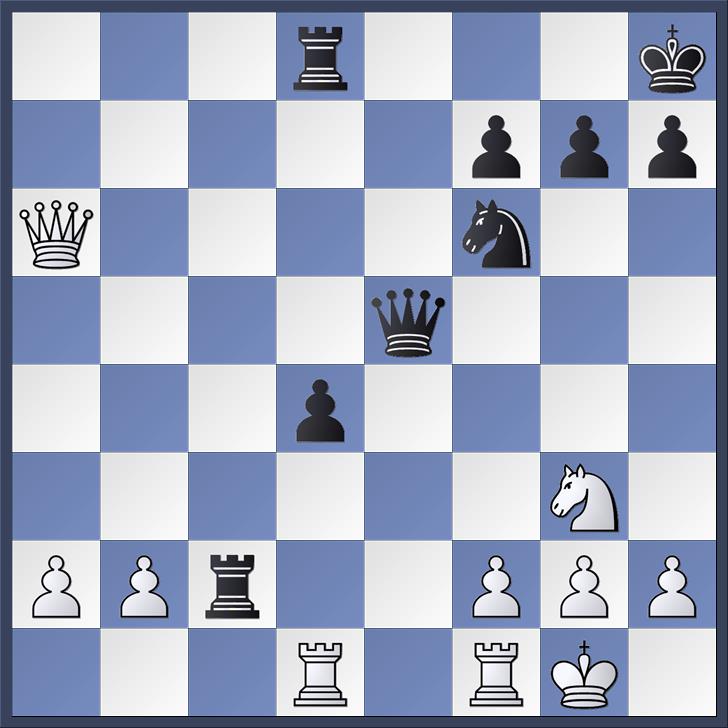
22...h5

Donner gives this move an explanation mark. The computer sees snatching the b-pawn as the only way for Black to maintain a slight edge.

23.Rfe1 Qd5 24.Re2

Quite possibly the decisive error.

24.Qd3 Rxb2

24...d3 25.Re3

A mistake, according to Donner.

25.Red2 Rxd2 26.Rxd2 h4 27.Nf1 Ne4 Black still has the upper hand. That's why I see the critical error as one move earlier than Donner's assessment.

Black to move

This position makes for a good tactics exercise.

25...Rxf2

Donner offers a double exclam and, "A most unexpected combination, with the point appearing soon" (28).

26.Ne4

26.Kxf2 Ng4+

26...Nxe4

The computer likes 26...Ng4. Perhaps Donner might have noted the role of luck in chess, because here Larsen lets it slip away, if only Evans, who has been under enormous pressure could have found the  correct response.

White to move

This position, also, could serve in a battery of tactics exercises. White might yet resist Black's attack.

27.Rexd3

Now, Larsen can finish.

27.Rdxd3 Qg5 28.Rxd8+ Qxd8 29.Rxe4 Rxb2 and this position should develop into a draw.

27...Rf1+

Another double exclam from Donner, and possibly a third tactics exercise.

28.Rxf1

28.Kxf1 Qf5+ 29.Rf3 (29.Kg1 Qc5+ 30.Rd4 Rxd4 31.Qa8+ Rd8+ with smother mate to follow) 29...Rxd1+ 30.Ke2 Nc3+ 31.Rxc3 Qf1+.

28...Qc5+

Evans resigned.

29.Kh1 Nf2+ 30.Rxf2 (30.Kg1 Nh3+ 31.Kh1 Qg1+ 32.Rxg1 Nf2#) 30...Qc1+ 31.Rd1 Rxd1+ 32.Rf1 Rxf1+ 33.Qxf1 Qxf1#

0–1

20 December 2014

An Unplayed Brilliancy

This was a betrayal of myself.
Mikhail Tal
There is a line of the Alekhine Defense in which the Black king strolls towards the center after White's knight sacrifice. The line resembles the Fried Liver Attack, but is more often played by Grandmasters.

In one game, Bent Larsen defended the Black side well and won a nice miniature against Mikahil Tal. In another game, Tal worked out the variations all the way to checkmate before sacrificing the knight. The Black king was driven to a1 where it was checkmated with White's few remaining pieces.

These games are fantasy variations that stem from a war of nerves in which Larsen scored an important victory against the master of attack, but still lost the Candidate's Match against the former World Champion. Tal spent fifty minutes contemplating the knight sacrifice, trusted his opponent's preparation, and opted for a safer route. He ended up in a worse position, but managed to salvage a draw in the endgame.

My interest in this line was provoked by Yasser Seirawan's excellent recent lecture at the Chess Club of Saint Louis, "A History of Chess Openings". Near the end of the lecture, Seirawan indicates that he may have mixed up the moves of Tal -- Larsen, but goes on to make some astute comments concerning opening preparation. He had spent several days been looking at "the conservative and the super sharp lines" of this opening. Tal's trapped queen and another quieter game he showed first illustrate the possible varieties. Seirawan predicts that the Alekhine Defense, like the early queen exchange in the Berlin Defense, could become a new hot trend in Grandmaster play.

Here is the game that Seirawan remembered.

Tal,Mikhail -- Larsen,Bent [B04]
Candidates Semi-Final Bled (4), 1965

1.e4 Nf6 2.e5 Nd5 3.d4 d6 4.Nf3 dxe5 5.Nxe5 Nd7

Larsen offered Tal an opportunity to drive his king to the center with a knight sacrifice.

6.Nxf7 Kxf7 7.Qh5+ Ke6 8.c4 N5f6 9.d5+ Kd6 10.Qf7 Ne5 11.Bf4 c5

White to move

12.Nc3

12.b4 is the main line in my edition of Encyclopedia of Chess Openings.

12...a6 13.0–0–0

See the next game for 13.Rd1

13...g5 14.Bg3 Bh6 15.Re1

Seirawan does not offer 15.d6, which has been played in similar positions (after 13...g6 and no 14.Bg3).

15...g4+ 16.Kb1 Bf5+ 17.Ka1 Rf8 18.Bxe5+ Kd7

White to move

Unable to rescue his queen, it is time for White to resign.

0–1

In Attack with Mikhail Tal, trans. Ken Neat (1994), Tal explains his thinking after Larsen's shocking 5...Nd7.
My intuition insistently kept telling me that the sacrifice had to be correct, but I decided to calculate everything "as far as mate", spent some 50 minutes, but then in one of the innumerable variations I found something resembling a defense, and ... rejected the sacrifice. This was a betrayal of myself, I saved the game only by a miracle after the adjournment.

Here is the variation that Tal presents in the opening section of his book.

Tal,Mikhail -- Larsen,Bent [B04]
Candidates Semi-Final Bled (4), 1965

1.e4 Nf6 2.e5 Nd5 3.d4 d6 4.Nf3 dxe5 5.Nxe5 Nd7 6.Nxf7 Kxf7 7.Qh5+ Ke6 8.c4 N5f6 9.d5+ Kd6 10.Qf7 Ne5 11.Bf4 c5 12.Nc3 a6 13.Rd1 g6 14.Bxe5+ Kxe5 15.d6 g5 16.Rd2 Bf5 17.Re2+

Black to move

17...Kd4 18.Re4+ Bxe4 19.Qe6

Black to move

Perhaps the defense that he found in his calculations was 19...Qd7, covering h3 or 19...Qb6, covering b3.

White's threat, according to Tal is 20.Ne2+ Kd3 21.Qh3+ Kc2 22.Qb3+ Kb1 23.Nc3+ Ka1 24.Bd3 Bxd3 25.Kd2+ Bb1 26.Rxb1# 0–1

Here is the game that was actually played.

Tal,Mikhail -- Larsen,Bent [B04]
Candidates Semi-Final Bled (4), 1965

1.e4 Nf6 2.e5 Nd5 3.d4 d6 4.Nf3 dxe5 5.Nxe5 Nd7 6.Bc4

Black to move

6...e6 7.Qg4 h5 8.Qe2 Nxe5 9.dxe5 Bd7 10.0–0 Bc6 11.Rd1 Qe7 12.Nc3 Nxc3 13.bxc3 g6 14.a4 a6 15.Rb1 Qc5 16.Be3 Qxe5 17.f4 Qf5 18.Bd3 Qg4 19.Qf2 Be7 20.Bd4 0–0 21.Be2 Qf5 22.Bd3 Qg4 23.Be2 Qh4 24.g3 Qh3 25.Bf3 Rad8 26.Bxc6 bxc6 27.Be5 Qf5 28.Qe2 Bd6 29.Rd3 Bxe5 30.fxe5 Rxd3 31.cxd3 Rd8 32.Rd1 c5 33.c4 Qg4
White to move

34.Qxg4 hxg4 35.Kf2 Rb8 36.Rd2 Kg7 37.Ke3 g5 38.d4 Rb3+ 39.Kf2 cxd4 40.Rxd4 Kg6 41.Rxg4 Rb2+ 42.Kg1 Kf5 43.Rd4 Kxe5 44.Rd7 f5

White to move

Black must be better here with an active king and a pawn majority on the kingside.

45.Rxc7 Ke4 46.Rd7 Rc2 47.Rd6 e5 48.h4 gxh4 49.gxh4 Rxc4 50.h5 Kf3 51.Rd3+ Kg4 52.h6 Rc7 53.Rd6 e4 54.Kf2 a5 55.Rg6+ Kh5 56.Ra6 f4 57.Re6 Rc2+ 58.Ke1 Rc1+ 59.Kd2 Rh1 60.Rxe4 Kg4 61.Re6 Kg3 62.Rf6 f3 63.Ke3 Re1+ 64.Kd3 Re7 65.Rg6+ Kf4 66.Rf6+ Kg3 67.Rg6+ Kf4 68.Rf6+ Kg4 69.Kd4 Kg3 70.Rg6+ Kh3 71.Rg7

Black to move

71...Rxg7 72.hxg7 f2 73.g8Q f1Q 74.Qe6+ Kh4 75.Kc5 Qb1 76.Qc4+ Kg3 77.Qc3+ Kf2 ½–½

All three games are instructive. This is as true of the game played as of the two unplayed fantasies.