Showing posts with label Gaprindashvili. Show all posts

15 March 2025

Tactics Training

These days, it seems that I spend more time doing puzzles online (chessdotcom mostly, but also Lichess and Chess Tempo) than working with positions in books. Still, for serious improvement in tactical vision and calculation, books are superior.

After racing through Thomas Engqvist, 300 Most Important Chess Positions (2018) in less than three months, I’m more highly motivated to keep 300 Most Important Tactical Chess Positions (2020) near the center of my chess activities through the rest of 2025. Four of the first five positions in the book have forcing continuations that run deep enough that I anticipate some challenge working through the book. Difficulty makes the enterprise worthwhile.

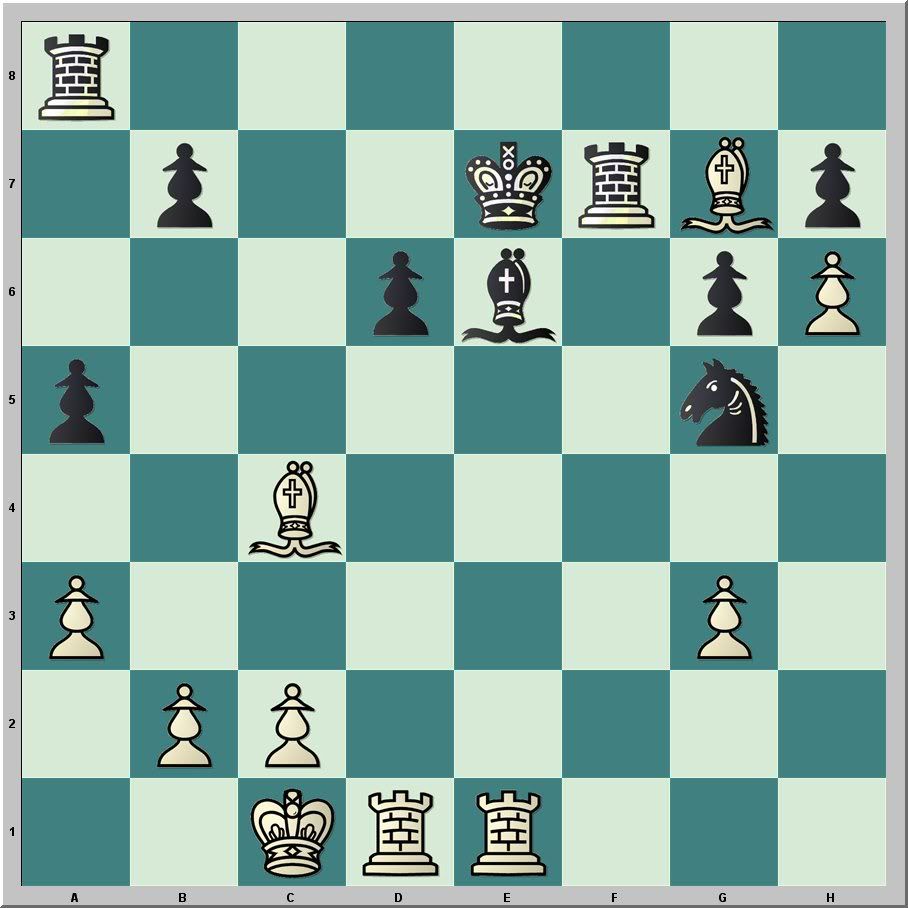
Today’s position arose in Mason,J.—Winawer,S., Vienna 1882. Engqvist’s analysis is instructive. At least three problems for players at different levels can be extracted from Mason’s combination.

Engqvist's position is before Mason's 40.Rxg5 (see photograph). If Black refuses the rook sacrifice, 40...Qf8 41.Rg6 controls the sixth rank. Then, 41...Rxf5

White to move
42.Qxf5! Qxf5 43.Rg7+ Nd7 44.Rxd7+ Kc8 45.Rxb8+ (only move) 45...Kxb8 46.Rb7+ and whichever way Black's king steps, Black's queen is coming off the board and White has a winning endgame.

After the line played in the game (40.Rxg5 hxg5 41.Qh7+ Nd7 42.Bxd7 Qg8--this position appeared as a exercise on chessgames.com in 2003--43.Rb7+ Kxb7), there is a more basic exercise position.

White to move
The discovery (44.Bc8+) is Engqvist's theme for this exercise, and the interference is an important aspect of why it works. Posters on chessgames.com and Engqvist valorize Mason's technique bringing home the full point for the resulting ending of queen and bishop vs. two rooks.

The Superiority of Books


For beginning students, the sequencing in such books as Sergey Ivashchenko, Manual of Chess Combinations (1997) and Susan Polgar, A World Champion’s Guide to Chess (2015) will lead to much more rapid growth in tactics skill than random positions online. Of course, with certain membership levels, chessdotcom and Chess Tempo allow training with particular themes and rating levels, so these can be tweaked with appropriate guidance.

For players who know basic patterns, but need work on strengthening calculation skills and assessing resulting positions after a combination, such books as Mark Dvoretsky, Secrets of Chess Tactics (1992), Paata Gaprindashvili, Imagination in Chess (2004), and Cyrus Lakdawala, Tactical Training (2021) offer abundant exercises.

Yakov Nieshtadt, Improve Your Chess Tactics (2012) is highly regarded for its organizational scheme and definitions, while Yuri Averbakh, Chess Tactics for Advanced Players (1992) articulates a notion of contacts that should be more common in chess literature.

23 September 2019

Do Something Useful

While looking at an exercise in Imagination in Chess (2004) with one of my students, a part of the solution given stuck in my memory and then entered my consciousness while playing a rook ending a week later. The exercise was an endgame position from Polovodin -- Ivanov,A., Leningrad 1988. Paata Gaprindashvili commented, "Polovodin makes a useful move, while his opponent is denied such a possibility" (179).

Stripes,James (1851) -- Internet Opponent (1880)
Live Chess Chess.com, 20.09.2019

White to move

23.f4?!

This move exposes my king--probably not a good decision

23.Rc8 Rbd7 24.Rxd8+ Rxd8 25.Rc6 h6 26.Rxa6 Rd5

23...Rbd7 24.b4 g6

24...Rd1+ 25.Rxd1 (25.Kg2 R8d2+ 26.Kh3 Rxc1 27.Rxc1 Kf8) 25...Rxd1+ 26.Kf2 g5

25.R1c2 Rd4

25...Rd1+ 26.Kf2 R8d2+ 27.Kf3

26.a3 Rd3 27.R5c3

The game seems headed for a draw, but there are some things that can be tried.

Black to move

27...h5 28.Kg2 Kg7 29.Kf2 R8d7 30.Ke2

The king is a fighting piece. At this point, I felt that I could at least do something that offered my opponent problems or opportunities to go astray.

30...R3d4 31.h4

Black to move

31...Ra7?

And he went astray.

31...Re4+ 32.Re3 Red4 (32...Rdd4?? 33.Rxe4 Rxe4+ 34.Kd3 Re1 35.Kd4) 33.Rc6 Rd2+ 34.Kf3 Ra7

32.Ke3?

But I failed to capitalize on the error.

I could have played 32.Rc7 Rd7 33.Rxd7 Rxd7 34.Rc6 Ra7 35.Kd3

32...Rdd7 33.Rd3 Rxd3+ 34.Kxd3 a5 35.bxa5 Rxa5 36.Rc3 Ra4 37.Rb3

Black to move

37...Ra5?

Another error.

37...Kf8;
37...f6

38.Kc3?

Again, failing to capitalize. This move presents Black with a problem, but one that can be solved.

38.Kd4+-

38...f6?

38...Ra4 was the only move.

39.Kb4+-

Black to move

The fork is decisive.

39...Ra4+

39...Ra8 40.exf6+ Kxf6 41.Kxb5

40.Kxb5 Re4 41.exf6+ Kxf6 42.a4

It does not appear that Black has any way to stop this pawn. My game has become much simpler.

42...e5 43.fxe5+ Rxe5+ 44.Kc6 Kf5?

Black hastens the end by allowing a pin that forces rooks off the board.

White to move

45.Rb5 Rxb5 46.axb5 Kg4 47.b6 Kxg3 48.b7 Kxh4 49.b8Q

49.Kd5

49...g5 50.Qh2+

50.Kd5

50...Kg4 51.Kd5

51.Qe2+ Kh4 52.Kd5

51...h4 52.Ke4 Kh5 53.Kf5 g4 54.Qe2

54.Qb8 is a faster mate by one move.

1-0

Sometimes, it is helpful to simply keep playing chess in an equal position.

12 February 2017

Patterns and Calculation

If we fail to make an idea work, we need to stop and ascertain the cause of the failure (i.e. answer the question 'why?'), and then attempt to correct our design.
Paata Gaprindashvili, Imagination in Chess (2004), 40.
A chess problem that cropped up in tactics training yesterday immediately reminded me of a game I had seen working through the compositions of Gioachino Greco, but the solution in Greco fails. Noting the failure, I considered why it failed and calculated the remedy. The whole process required about 23 seconds.

This elementary exercise serves to supplement my posts, "Patterns and Calculation" (23 December 2016), "Patterns: Some Evidence" (11 January 2017), and to highlight my endorsement of Paata Gaprindashvili, Imagination in Chess (see "Imagination in Chess").

White to move

The position arose in a correspondence game on Chess.com and was presented to me through the tactic trainer there. That game was a Ponziani in which Black blundered early.

Greco's game arose via a King's Gambit. I present it as it appears in Francis Beale, Royall Game of Chesse Play (1656).

Gambett LIII (Greco) [C37]
1656

1.e4 e5 2.f4 exf4 3.Nf3 g5 4.Bc4 h6 5.h4 f6 6.Ne5 fxe5 7.Qh5+ Ke7 8.Qf7+ Kd6 

White to move

9.Qd5+ Ke7 10.Qxe5# 1–0

The checkmate pattern in both games is the same, except that there is an alternative checkmate in the tactics problem if Black moves the king after White's initial move. The key difference, however, is that Black's knight guards e5 in the tactics problem. Hence, applying Gaprindashvili's advice, White must first lure this knight to e5, then execute the winning queen maneuver.

Instant recognition of patterns can be trained and aids in the development of chess strength. The same pattern often occurs in seemingly dissimilar games. Recognizing the pattern offers a plan, but calculation remains a necessary component to verify that the pattern has application.

01 February 2017

Imagination in Chess

A Book Review

Paata Gaprindashvili, Imagination in Chess: How to Think Creatively and Avoid Foolish Mistakes (2004) has been on my shelf for more than a decade. I have read and reread it, and have often found myself repeating its advice to my students.

Gaprindashvili writes, "If we fail to make an idea work, we need to stop and ascertain the cause of the failure (i.e. answer the question 'why?'), and then attempt to correct our design" (40). This sentence, which I have paraphrased to my students on numerous occasions, forms the heart of what the author calls "reciprocal thinking," the title of the second chapter. Imagination in Chess is devoted to "the evaluation and development of the brain's reflective activity" (5).

The book contains a minimum of prose. The only chess books on my shelves with less text are those published in the language-less format of Chess Informant. Even so, the prose is focused and well integrated with the 756 exercises. Gaprindashvili urges his readers to read the first section of instruction, solve a few problems, read the next section, and so on. After passing through the book in this manner, the reader should go back through the book again, and again. With enough time spent repeatedly passing through Imagination in Chess, the thinking process will become second nature. Hopefully, "regular solving of the exercises will improve the cogitative action of the brain and raise your standard of play" (5).

The book contains seven chapters of decreasing length. The instructive portion is well illustrated with flow charts (see image below).


The thinking process advocated appears to be a refinement of Alexander Kotov's well-known "tree of analysis" in Think Like a Grandmaster (1971). It is refined in both its simplicity and flexibility. Gaprindashvili's first step is to study the position. "[I]dentify all of the tactical and strategic peculiarities" of the position (7). This process will reveal certain ideas from which will flow candidate moves. A student employing Kotov's process will then examine each candidate move in turn, analyze each candidate move for the opponent for each of these candidates, and so on. In Gaprindashvili's system, if calculation of the variations following from the first candidate move leads to a positive verdict, you play it. Kotov would hesitate until all candidates had been examined.

The chess positions comprise the bulk of the book. Although varying considerably in difficulty, these are generally quite challenging even to very strong players. They are also fresh. Most of the positions are not found in other books. Even readers who choose to ignore Gaprindashvili's system of progressive thinking, reciprocal thinking, mental agility, and imagination will benefit from study of the positions.

There have been criticisms of this book by those who take the time to check solutions via computer. For example, Sam Copeland explained in a comment to his "25 Books Guaranteed to Improve Your Chess" on Chess.com (12 January 2015) why he excluded this book. The book had been mentioned in a comment by Matty D. Perrine, who asserted it was the "best tactic book" he had gone through. Copeland said that he wanted to like Imagination in Chess, but found some of the solutions frustrating. He offers two examples from the first ten in the book. The diagram below is the book's sixth position.

White to move

Copeland may be correct that his solution is stronger than the one given in the book (my computer favors his at a depth of 34 ply), but the solution given was the one played in the game. The move played also reinforces the thinking process outlined in the first chapter.

Gaprindashvili's solution is historically accurate, but perhaps not the strongest move. The play after Copeland's move seems a little more straightforward. Some readers might prefer that alternate solutions to those played should be given in the book, especially when they are as strong or stronger.

While Copeland's criticism has some merit, I would recommend this book to my readers except for one small problem. the book is out of print. Consequently, new copies, when they can be found, are quite expensive. Amazon lists several third party sellers with the book for $118 plus shipping. Used copies start at $55. When I bought the book, it sold for $22.95.

25 October 2012

Should be Easy

This position is from the Anthology of Chess Combinations in the instructional section. I am using the electronic edition and the Chess Informant Solver's Kit. One encounters it with the knowledge that Black plays to reach a win. There's not much that Black can do, as most of his piece are immobile. Attacking the king--the only vulnerability--is the clear plan. Nonetheless, I struggled to find the correct move.

Black to move


I could see the idea that creates a checkmate threat. It does not work. How do I change the dynamics of the position so that Black's defensive resource is no longer available? Had I asked this question, which Paata Gaprindashvili suggests in Imagination in Chess (2004), the solution would have been immediately evident. Gaprindashvili uses the term "reciprocal thinking" for correcting an idea that does not work via altering the order of moves, or choosing an intermediate move.

Flexibility is another term that seems appropriate here. Despite a limited number of pieces, Black has more than one way to attack the king. Flexible thinking discloses the correct sequence. The term flexibility describes the resources on the chess board, and it describes the necessary mental processes for utilizing those resources.

22 July 2012

Back to the Mines: Training Log

Assessing Weaknesses

My play in the City Championship match with John Julian revealed a weakness in my openings. In each game, I played either a dubious or a risky move early on. Each time, I found myself in a difficult position and then felt that I played well. The third game might be an exception insofar as post-game computer analysis suggest that my position may have been better than it seemed to me while playing.

For many years, I have been one who cautions others against obsession with studying opening theory at the expense of tactics and endgame training.* However, now that I am a solid A Class player with ambitions to climb into Expert Class, opening preparation needs to occupy a far larger share of my preparation. Thity-five years ago, I studied openings and played through master games, but did not work tactics problems, nor spend any significant time on endgames. My opponents rarely played book lines beyond the third or fourth move, but I was able to win often enough to feed my illusions that opening preparation gave me an edge.

When I returned to chess after some ten years away, I immediately started into opening study. I quickly established a C Class USCF Rating. Only when tactics training and endgame work became part of my regimen did I rise out of C Class and begin the climb to my current level. Even so, I have continued to work on openings, albeit mostly through database use during correspondence games. That practical opening study focuses on specific lines before me. It differs substantially from developing in-depth understanding of particular opening systems. Nevertheless, through years of play and limited study, I have become proficient at a modest level in certain openings.

It is time to do more.

Developing a strong opening repertoire for specific systems, however, creates a problem for the blogger who publicizes his ongoing training efforts. Too much information shared makes it easier for my opponents to prepare a surprise that I must confront over the board with the clock running. I prefer that my opening preparation be revealed only in the course of play.


Training Regimen

Much of the past week was invested in analysis of my three games with John Julian. Game one was completed Monday and posted Tuesday morning. Game two took longer, but posted Saturday morning. Expect to see game three sometime this next week.

In "New Year's Resolutions" and "Training Log: Mid-Year Report," I outlined three key training activities for 2012. In "Training Log" (25 March), I added a fourth element. Consistent efforts to solve more than fifty problems per week have been successful. Some weeks I have solved many more. The process of moving from relatively easy problems to harder ones has been less consistent, but not wholly unsuccessful. My endgame work needs improvement, as does work adding whole games to memory.

1. Tactics

The Shredder iPad app has been getting less use since starting to use the Tactic Trainer app. Nevertheless, I intend to complete the second cycle of its one thousand problems by early fall. At that point, I will reset the statistics and begin anew. Presently I have a 78% success rate after 1712 puzzles. On the third cycle, I will aim for 85%.

The past couple of weeks, I have split my tactics training time between Tactic Trainer and Chess Tempo. Active use of Lev Alburt, Chess Training Pocket Book II and Paata Gaprindashvili, Imagination in Chess remain unrealized goals.

2. Endings

One of the advantages of creating flash cards for important endgame positions is that they are portable. This past week, I have had my pawn endings flash cards with me more often. While enjoying the summer evening with some fine Bridge Press Cellars Rosé on the deck, I flipped through the cards studying them.

In game three, John and I played a nice endgame with bishop versus knight. His additional pawn helped him prevail. He told me after the game that he had been studying this type of endgame a few months ago because he is working through Irving Chernev, Capablanca's Best Chess Endings (1978). As it happens, Dill Books was set up to sell chess materials at the Spokane Falls Open, and had everything on discount. I accepted John's advice and bought a copy of Chernev's text.

3. Openings

Studying openings and memorizing games goes hand in hand. After spending some time learning Carlsen -- Wang Hao 2011, I started using Carlsen's set-up against the Caro-Kann in blitz play. As I work more seriously to develop my opening repertoire, selecting key games in that repertoire to commit to memory seems worthwhile.

I have a shelf full of opening monographs, print and electronic versions of the Encyclopedia of Chess Openings (ECO), an old copy of Modern Chess Openings, a handful of New in Chess Yearbooks, ChessBase 11, and other opening resources. This past week, I have been reviewing some of my games over the past year and identifying sections of ECO to study.


*Once this week I was browsing the chess books listed by an online bookseller. Some 90% of these books were opening monographs. Most of these books are of limited value to most players, yet they buy them in droves. When they wonder why they do not improve, I say because they are wasting their time studying the wrong things. On the other hand, opening books remain scarce that do a good job of explaining general principles for several opening systems (Reuben Fine, The Ideas Behind the Chess Openings) or for specific openings (Everyman Chess "Starting Out" series).

01 July 2012

Training Log

Mid-Year Report

Six months ago on January 1, I posted my "New Years Resolutions" for chess:
1. Solve a minimum of 50 tactics problems per week.
2. Spend thirty minutes once per week solving problems in Lev Alburt, Chess Training Pocket Book II and Paata Gaprindashvili, Imagination in Chess.
3. Complete my Pawn Endgame flash card project.
I began posting weekly logs of my training progress in mid-March.

My work on tactics puzzles has become routine and varied. Although I have faltered on the Alburt (minimal time) and Gaprindashvili (none) texts, I have been solving some difficult problems. My resolutions did not list all of the resources that have become regular tools, and some of these tools offer challenging problems.

Fulfillment of my resolutions is a mixture of success and failure. Gaprindashvili's problems challenge me in a way that is sometimes intimidating. I have failed to pull the book off the shelf in 2012. Alburt's problems have seemed harder than I remember finding those in the first Chess Training Pocket Book. My initial statement that Shredder iPad app problems and Alburt's problem would be warm-up for the problems in Imagination in Chess has not been fulfilled. Nor am I as far along on my Pawn Endgame project as I had hoped.

Although not among my resolutions, I have been doing some work on the opening. Indeed, that has been the bulk of my study time this past week.

The relationship between resolution one and resolution two is built into the structure of Chess Tempo training, as well as Chess.com Tactics Trainer. I have been using Chess.com's trainer sporadically for four years, completing nearly 5000 problems with a 45% pass rate. My total solving time, according to the site, is 33.7 hours. For the past three months, I have logged 38.7 hours with Chess Tempo, solving a bit over 2200 problems, including unrated problems selected to address weaknesses. Chess Tempo is vastly more powerful and flexible than similar alternatives. I attempted 111 problems on CT this past week.

Problems Done: 2139 (Correct: 1146 Failed: 993)
Percentage correct: 53.58%
Average recent per problem time spent 75 seconds
FIDE Estimated Rating based on standard tactics: 1747

Chess Tempo is quite clear that the FIDE Estimated Rating "should not be taken too seriously." It is nearly 200 points below my current USCF rating. The estimate based on Blitz solving mode is regarded by most users as more trustworthy, but I have done too few problems in that mode. For the present, I am satisfied with Standard mode. My efforts are aimed at increasing my rating to a level that I do not find embarrassing, while keeping the average time under 90 seconds.

This past week, I began using a new iPad app called Tactic Trainer that also appears to increase the difficulty of the problems with success. A friend* suggested that I try Tactic Trainer (link is to review posted 3 July) because he has been using it extensively the past few months and likes the results. Alas, I do not know how many problems that I have solved using this app. Nor does it offer correct answers when the problem is wrong.

The screenshot to the right shows the last problem that I failed. It would seem that I could press the "Analyze" tab at the top of the diagram, but doing so causes the program to crash.

Chess Tempo has been providing the bulk of my tactics training since April, but I have continued to use Shredder's iPad app, Chess-wise Pro (an iPad app), Chess Informant, and other resources. I have less than 300 problems to go with Shredder to have completed the 1000 problems twice. When I reach that milestone, I will reset the tracking. The third time through the set, I intend to aim for 85% of the possible points (a combination of speed and accuracy).

In addition to training this past week, I played two difficult games in the Spokane City Championship Contenders tournament, and I hope to play the last two this week. Michael Cambareri and I are currently in the lead with 3-0 each. Michael won the event last year. I did not play last year, but tied for first in the event two years ago with the current City Champion. He had better tie-breaks and became the challenger (his other draw was against a stronger player). I annotated my two games this past week, posting the opening portion of my win against Spokane's highest rated player, and posting the whole of my win against Nikolay Bulakh.


*Kevin Baker, whom I coached when he was in high school, recently won the u/1800 section of the National Open in Las Vegas.

01 January 2012

2012 New Year's Resolutions

It is that time of year: time to make promises to oneself in a fit of motivation for self-improvement. And so, I have some concrete promises designed to lift me over 1900 USCF, and if Caissa has a warm heart, to lift me into the Expert class. In truth, I am unlikely to play the number and strength of events in 2012 that would make Expert a realistic goal, but that is the horizon in view.


The Resolutions

1. Solve a minimum of 50 tactics problems per week.

That should not be difficult, as most days I solve ten of those in the Shredder iPad app. In addition, from time to time I spend enough time with Chess.com's Tactics Trainer to rack up some numbers. Hence, the challenge in number 2.

2. Spend thirty minutes once per week solving problems in Lev Alburt, Chess Training Pocket Book II and Paata Gaprindashvili, Imagination in Chess.

The goal here will be to work through the whole of Chess Training Pocket Book II in 2012, as I did the original Chess Training Pocket Book several years ago. Over the course of the year, problems in the Shredder app and in Alburt's books become the warm-up for more challenging exercises. Over the course of the year, regular work with Imagination in Chess should become the norm. The easy success of quantities of basic tactics should give way to success in solving complex exercises.

3. Complete my Pawn Endgame flash card project.

Two years ago, I created cards that contain all the blue diagrams of the first chapter in Mark Dvoretsky, Dvoretsky's Endgame Manual. I review these cards regularly--they contain no answers--with the intention of being able to know in an instant when looking at each how the position should be played. See the last paragraph of "GM-RAM: Essential Knowledge."

These three resolutions are not too onerous. They demand no new behaviors, but rather greater consistency and purpose in productive activities. Doing these may mean there is less time for one-minute chess. That shift is vital to improving my over the board performance.

13 December 2011

Improving Tactics: Training Resources

For most players, improvement in chess skill will be slow to non-existent if their only chess activity is playing. Tactics training, on the other hand, leads to rapid chess improvement. Resources for tactics training include books, magazines, databases and other software, websites, and more.

At the present time, in any given week, I use the Tactics Trainer at Chess.com (more than 32 hours since joining the site), the problems in the Shredder iPad app, my pawn endgame flash cards, or one of several books.

Ten years ago, I spent 15-30 minutes nearly every morning for several months working through problems in Laszlo Polgar, Chess Training in 5334 Positions (1994), which is pictured at the bottom of a stack in the image. Polgar's book, which may have been assembled by his daughter Susan, consists mostly of checkmate problems. This collection draws from an extensive library of composed problems, and a smaller collection of positions from actual play. The effectiveness of the training stems from repetition of patterns. Problems 1-306 are checkmate in one; 307-3718 are mate in two; 3719-4462 are mate in three. I completed a bit more than the first 1500 problems.

The book also contains 600 miniature games, a bit more than 100 simple endgames, and more than 100 combinations from the Polgar sisters' games. Occasionally, this book shows up on sale tables for $10, which strikes me as an opportunity calling for action.


Art of the Checkmate

While Polgar's Chess teaches checkmate patterns through compositions and miniatures, Georges Renaud and Victor Kahn, The Art of the Checkmate (1953) employs real games. The organization of this classic text, and the quality of instruction it offers, are vastly superior to Murray Chandler, How to Beat Your Dad at Chess (1998). However, Chandler's book uses algebraic notation, while Renaud and Kahn is available only in descriptive. Other books with guides to basic checkmate patterns include Fred Reinfeld, How to Force Checkmate (1947); V. Vukovic, The Art of Attack in Chess (1965); and Jonathan Tisdall, Improve Your Chess Now (1997). My effort to extend the work naming, classifying, and organizing basic patterns by the authors of several of these texts resulted in a self-published pamphlet that I use in teaching, "Checklist of Checkmates: With Exercises" (2007). My pamphlet (pictured above) identifies 34 basic patterns sorted into six groups to aid learning, and offers 139 problems all from actual play. My study of The Art of the Checkmate, and the other books, followed by extensive database research to find examples in play, has done wonders for the development of my skill.


Basic Tactical Motifs

My library contains several terrific workbooks designed especially for youth who are beginning to intermediate players. These workbooks vary in method and content, but all stress basic tactical motifs--discovery, pins, skewers, removing the guard, etc.--through repetition. John A. Bain, Chess Tactics For Students (1993) uses fill-in-blank worksheets with clear diagrams. Chapter one offers 30 problems involving pins. Subsequent chapters are "Back Rank Combinations," "Knight Forks," "Other Forks/Double Attacks," and ten more chapters. After completing this workbook, young players might advance to Al Woolum, The Chess Tactics Workbook, 4th edition (2000); Todd Bardwick, Chess Workbook for Children (2006); or Dean Ippolito, Chess Tactics for Scholastic Players (2006). Each of these other three offer problems more challenging than Bain's, but also include very simple problems in the beginning. Those sensitive to patronizing language towards women and girls may find the prose in Bardwick's text distracting, but it offers good quality instruction otherwise.

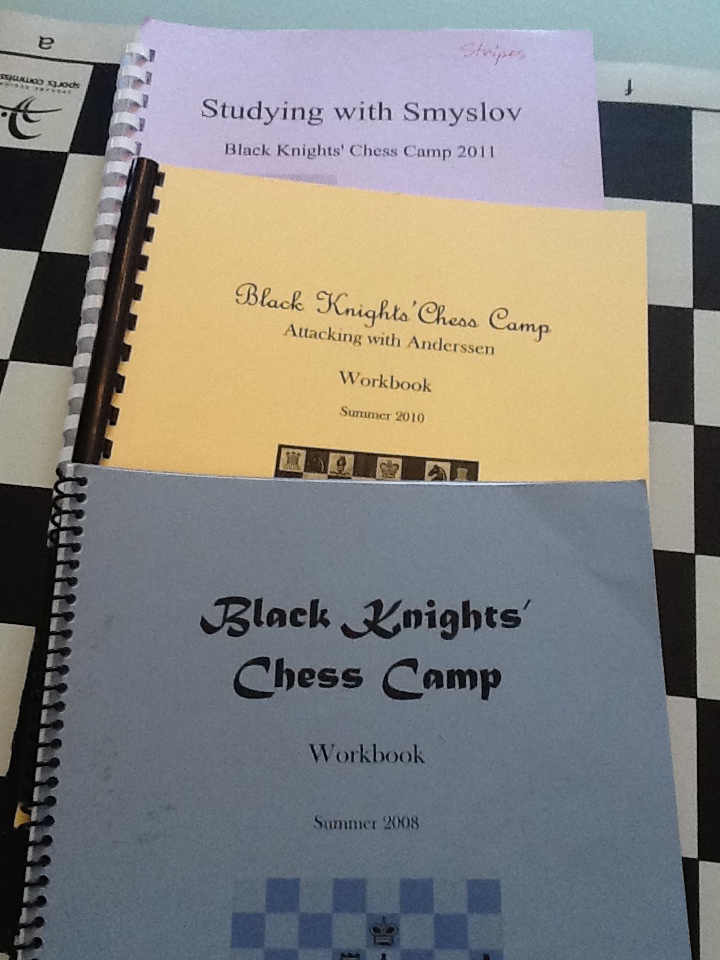
For my annual chess camp, I create workbooks with problems that teach and reinforce tactical motifs. In 2008 and 2009, I used the same workbook. In 2009, I sought tactical problems and strategic lessons exclusively from the games of Adolf Anderssen. See "Learning from Errors: Adolf Anderssen" for a sample strategic lesson from this workbook. In 2011, my tactical problems all came from the games of Vasily Smyslov, and emphasized advanced endgames a bit more. For several years I have been contemplating doing more with Gioachino Greco, but doubt there is enough there for all of what I usually put into a workbook.

While my chess students and their parents gain access to an abundance of free and inexpensive resources that I churn out as teaching materials, the research process improves my skills, too. When I am not solving problems, I am looking for problems to put in front of beginning players. Sometimes, these are more challenging than expected, as last week's lesson on pins proved to have been.


Tactics for Advanced Players

Prior to the explosion of youth chess, a standard beginning text was Fred Reinfeld, 1001 Winning Chess Sacrifices and Combinations (1955). It is organized by theme with dozens of problems in each chapter. Generations of masters have started with this book. Reinfeld wrote a few other 1001 texts, but this one seems most widely available. In "Where the Rubber Meet the Road," I detailed my training method with this text and a chess playing engine. Beyond finding Reinfeld's idea, I labor to convert the advantage gained through the tactic. I have not employed this training method in 2011, but expect to return  to such training for part of 2012.

Lev Alburt, Chess Training Pocket Book (1997) contains 300 positions, four to a page. The solutions are on the facing page, making self-discipline a necessary feature of using the text for training. These well-chosen 300 positions, most from practical play, include common tactical motifs, positional concepts, and endgame fundamentals. Over the course of several years, I went through the entire book both randomly and in sequence at least twice, and have also used the book as a reference when compiling lessons for others. This book spent several years on my bedside table. The book indexes the problems by themes and by players. Alburt, Chess Training Pocket Book II (2008) offers 320 new positions in the same format. This book will be a central component of my training in the near future. With such collections, I think it is best to go through all the problems, and then several months or a year later, go through them again.

Most club players should be able to solve the problems in Alburt's books in no more than a few minutes each, and errors will be easily corrected. A few times through these books should leave the student with a core knowledge of important positions. For more challenging tactical exercises, I turn to John Nunn's Chess Puzzle Book (1999) and Paata Gaprindashvili, Imagination in Chess: How to Think Creatively and Avoid Foolish Mistakes (2004). Both of these texts offer fresh positions. That is, the positions in these texts will not be found in Reinfeld. Some of those in Alburt's texts are in Reinfeld, as well as in dozens of other training texts. Alburt's books lay the foundation that helped me reach USCF Class A, and to secure my position there. As I struggle to move up to Expert Class, and possibly master, Nunn's and Gaprindashvili's texts offer resources of value. Imagination in Chess also offers suggestions for effective thought processes. Gaprindashvili's logical process may be considered an improvement over the famed analysis tree in Alexander Kotov's Think Like a Grandmaster (1971). Readers may differ in their assessments of these modes of systematic thinking.

Two other challenging texts offer exceptional insight into the nature of chess tactics, and plenty of training material. These are not collections of problems so much as treatises on the the middlegame. Yuri Averbakh, Chess Tactics for Advanced Players (1992) seeks to build a theoretical base for comprehension of chess tactics. Mark Dvoretsky, Secrets of Chess Tactics (1992) takes a more practical approach, but also contains much of theoretical value. The positions analyzed in both texts can be quite challenging, even for masters.


17 August 2009

Reinforcing Error

Unlike Michael de la Maza (Rapid Chess Improvement [2002]), who quit chess, and his minions, my chess improvement stems from a varied approach. My tactics training encompasses periodic commitment to playing from the key position to the computer's resignation (see "Where the Rubber Meets the Road") interspersed with working a website's system, such as Chess Tactics Server or the Tactics Trainer at Chess.com (see "Milestones"). I also use training exercises that Fritz or Hiarcs creates during its automatic analysis of games, or that users can create with the assistance of this software. Claude Kaber's training exercises are exemplary for illustrating the potential of this feature (see "Good Luck").

The exercises created automatically by Fritz, however, should be greeted with skepticism. The engines like drama.


Fritz Training Flaws

When I ran my game from last Thursday through full analysis by Hiarcs 12 (this engine uses the Fritz 11 interface), it created two training problems. The second is from this position awaiting my move 27.

White to move


During the game I looked at this position, found the dramatic 27.Rxe6+, and executed it. In my interior monologue I was telling myself that I was winning a piece through brilliant forcing play. Indeed, I was implementing that sage advice uttered by chess teachers everywhere, such as Peter Kurzdorfer, The Tao of Chess (2004).
The key to checking multimove combinations is to concentrate on the forcing moves: checks, captures, promotions, and the immediate threats to check, capture, and promote. By cutting it down to these forcing moves, you now have some manageable numbers to work with. The moves you look at are the ones that will likely affect the outcome of the game.
Kurtzdorfer, 108
Immediately after executing my "brilliant move," I found the antidote. My opponent had a defense that refutes my idea. Instead of winning a piece as I had thought, I would have a bishop and two pawns for a rook. My internal monologue became hypercritical, telling myself how I will never advance in chess if I keep making hasty moves that I have not fully calculated.

The rook check fails, and had I examined why it failed, I could have quickly found the much superior 27.Bd5. A fundamental element in tactical training and calculation is the process that Paata Gaprindashvili calls "reciprocal thinking" in his challenging Imagination in Chess: How to Think Creatively and Avoid Foolish Mistakes (2004).
After noticing an idea and briefly familiarizing ourselves with it, we proceed to its detailed examination. What do we do if we find that it doesn't work? ... If we fail to make an idea work, we need to stop and ascertain the cause of failure (i.e. answer the question "why?"), and then attempt to correct our design.
Gaprindashvili, 40
Without detailed examination, the failure goes unnoticed.

I was lucky. Under the pressure of my forcing move, my opponent cracked and offered the game losing blunder on move 28. It's no wonder that Hiarcs likes forcing moves. Carbon-based lifeforms capitulate to such deceptions with regularity. But the engine knows better, so why did it create this training exercise?


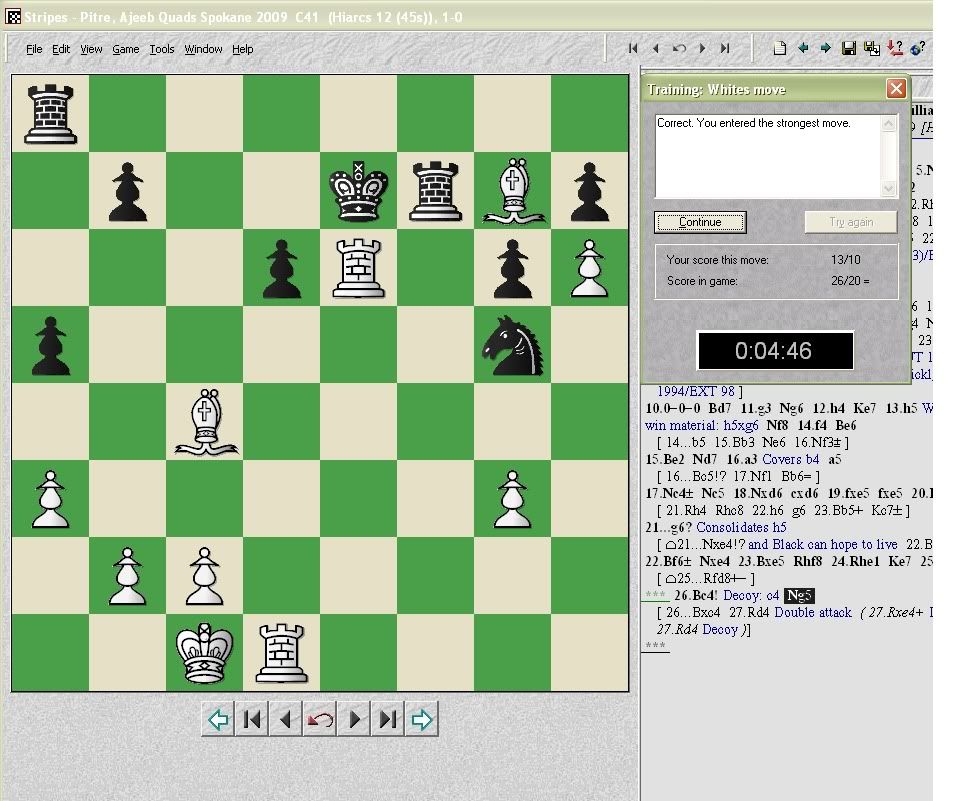
After executing the same move that I played in the game, I read, "Correct! You entered the strongest move." But this feedback is wrong. My move is not among the half-dozen best choices. Although forcing, and although successful in this case, it might have cost me the game.

According to the quantitative assessment of Hiarcs 12 from the problem position, White's advantage is greater than two pawns. 27.Bd5 is assessed at +2.29 with a depth of 16, and is slightly inferior to +2.39 for Re3. After executing the move from the game, the assessment drops to +0.85. When I annotated this game in the wee hours of Friday morning (see "Last Night"), I gave my move a single ?; I might have given it two, calling it an egregious blunder.

Tactics training with these automatically generated exercises, if they have not been checked for accuracy, will cultivate one's vision for forcing moves. Rather than improving the necessary abilities for calculation, however, such problems may reinforce error.