Showing posts with label Washington State. Show all posts

30 September 2024

Knight Award

As noted in “Pawn Award”, I created my awards based youth chess curriculum twenty years ago. It provides structure to lessons in after school clubs and with individual students. It assures that those who stick with the program acquire certain skills that provide a foundation for lifelong chess improvement.

Many students skip the Pawn Award because they have been playing and even competing before I start working with them. For some of them, the Knight Award is earned in the first or second session. For others, some work is necessary.


1. Previously earned Pawn, or achieve a NWSRS rating over 500.

In Washington state, unlike many parts of the United States, casual players are not required to join the US Chess Federation* in order to compete in tournaments. More than likely, this difference partly accounts for the level of youth chess activity activity in our state—our annual state elementary is among the largest chess events in the US and certainly represents the highest per capita activity level in the 50 states.

Our rating system is the Northwest Scholastic Rating System. It employs the same formula as the US Chess Federation, but is free to organizers and participants. A student who has a NWSRS rating above 500 has scored enough tournament wins that familiarity with basic rules can be assumed. Even so, some of these students may yet have some confusion with rules for castling and en passant.

2. Demonstrate understanding of checkmate of lone king with heavy pieces:

* queen and rook,
* queen and king, and
* rook and king (each from two random positions selected by the coach).

Checkmate ends a game of chess. Everyone knows this and yet not every chess player begins by learning basic checkmate skills thoroughly.

When testing understanding of checkmate with queen and rook, I generally look for understanding of the first two endings in Bruce Pandolfini, Pandolfini’s Endgame Course (1988). Most students have learned the “rolling barrier” by the time I test them. This elementary checkmate is also called the ladder mate. It was the first checkmate that I learned nearly sixty years ago.

However, Pandolfini’s first mate, the “queen and rook roll”, is not one beginners have generally mastered in my experience, although it should be learned first. Learning it assures the student can coordinate two heavy pieces well both to control the opponent’s king and to assure that both are safe from capture.

Pandolfini presents this position with White to move.

Black is threatening to capture White’s rook. Students who need work on this elementary mate will often withdraw the rook to a safer square. Others will lose the rook, which still allows them to complete a different checkmate test (see below).

The correct move, however, is to bring the queen up where it checks the king and protects the rook from capture. Doing so leaves Black’s king with a single legal move. A post in 2011 explains the technique with some useful diagrams (see “Lesson of the Week: Elementary Checkmates”).

Checkmate with queen and rook should be understood so well that exhaustion and time pressure will not interfere with success. When Ryan Ackerman** was Mead High School’s top player, he and I practiced performing this at the Spokane Chess Club one Thursday with only ten seconds on the clock. We consistently played ten perfect moves in six seconds. Our starting position was a version of the “hardest position” (the longest distance to mate with such material).

White to move

Performing this checkmate in the optimal ten moves requires understanding of how to coordinate both pieces well and requires some calculation. If a student can do it in fifteen moves, they pass the test. If they move the queen systematically until the defending king is cornered with only two squares, and then bring up the king, it will require more than fifteen moves, but I still award a pass.

I encourage all students to learn optimal technique. Here’s my play against Stockfish this morning These moves and some variations can be viewed at my Lichess study, "Simply Perfect". Note that Black’s king was never put in check until checkmate. Control by restriction is a vital skill, and one that young chess players do not easily learn.
My post, “Teaching Elementary Checkmates” has some instructive positions for learning this technique. Some of these positions are from a book published in 1822 that I find more useful than more recent books: William Lewis, Elements of the Game of Chess. The author was England’s strongest player for a few years at the time and is most remembered as one of those who hid inside the famous chess playing “machine” sometimes called “the Turk”.

Checkmate with a rook and king against a lone king takes sixteen moves with perfect play from the hardest position. If the student demonstrates technique sufficient to accomplish the task in 25-30 moves, I consider it a passing performance. The second game in "Simply Perfect" on Lichess shows one example of perfect play.

3. Demonstrate understanding of “fox in the chicken coop” pawn promotion technique.

The tactical advantages of an outside passed pawn in the endgame is one of the aspects of fundamental endgame knowledge upon which it is possible to build advanced skills. Jeremy Silman calls a winning technique with such material the “fox in the chicken coop” in Silman’s Complete Endgame Course (2007). One of the early posts a few months after I started Chess Skills (this blog) in 2007 shows a position from which I played a somewhat forcing ten move sequence to reach such a pawn ending in a tournament game. Calculating that deeply occurs rarely (see "Kings and Pawns"). Moves 31-34, I exchanges two rooks and a knight for two rooks and a pawn. Moves 35-39, both kings raced to capture the opponent's weakest pawn. At that point, I had the move in this position.

White to move
40.b3 struck me as the simplest way to assure that my queenside pawn majority would assure the creation of a passed pawn.

A few moves later, we reached another critical position that was easy to play because of understanding the core idea of how to use an outside passed pawn.

White to move
The only winning move is 47.c5, leading to exchanging two queenside pawns for Black's remaining pawn on that side of the board. The point (as I understood at move 31) was to lure Black's king far from the action on the kingside, where my king mowed down Black's last two pawns. My opponent resigned one move before checkmate on move 65.

In testing this skill, the student will be presented with a made-up position or perhaps one from a game that requires demonstration of understanding how a pawn majority on one wing of the board leads to certain victory with a dominating king on the other wing. For instance, this position, which arose while playing the position from my game against the computer instead of my human opponent.

White to move

4. Complete “Knight Award: checkmates and tactics” worksheet.

The Checkmates and Tactics worksheets consist of a series of exercises of increasing difficulty: Pawn Award, 6 mates in one; Knight Award, 8 checkmate puzzles with mate in 2-5 moves, and 4 exercises where material gain is forced; Bishop Award, 24 exercises, half leading to checkmate; Rook Award, 48 exercises, less than half lead to checkmate; and Queen Award, 60 exercises. These have been published with solutions as Checkmates and Tactics (2019). The book version also has a useful glossary of tactics. Naturally, I prefer that students working the awards do not look at the answers in the book while completing the worksheets.

5. Demonstrates ability to read chess notation.

Chess notation is the language of chess. Today, the system known as algebraic has become standard all over the world. When I was young, the US, England, and other English speaking countries used English descriptive. For the Knight Award, I present the student with a game score and have them show me the game.

Here is an example:

1. e4 e5 2. Nf3 Nc6 3. Nc3 Nf6 4. Bc4 Nxe4 5. Nxe4 d5 6. Bxd5 Qxd5 7. d3 Bg4 8. O-O Nd4 9. Be3 Nxf3+ 10. gxf3 Bh3 11. Re1 Be7 12. f4 O-O-O 13. Qf3 Be6 14. f5 Bd7 15. c4 Qxd3 16. b3 Bc6 17. Red1 Qxe4 18. Rxd8+ Rxd8 19. Qxe4 Bxe4 20. Rc1 Bxf5 21. Kg2 f6 22. f4 exf4 23. Bxf4 Bd6 24. Be3 Be4+ 25. Kf1 Bxh2 26. Bc5 f5 27. Be7 Rd2 28. a4 f4 29. Bg5 f3 30. Bxd2 Bg3 31. Be3 h5 32. Rd1 h4 33. Rd4 Bf5 34. Bg5 Bh3+ 35. Kg1 f2+ 36. Kh1 f1=R# {Eric Rosen won by checkmate} 0-1

The game comes from IM Eric Rosen's speedrun.

My YouTube video, Reading Chess Notation, explains what students need to learn (and also features a game that will help with the mate in five in the Checkmates and Tactics exercises).


*Nonetheless, we are pushing strong players to join the USCF so that Washington state will be well-represented when the USCF Grade Level Nationals come to Spokane in December 2025.
**Ryan is now a professional chess coach. He won the Spokane City Championship in 2022 and again in 2023.

13 June 2020

Largest Online State Chess Championship


WA State Elementary 2020 is the Largest Online State Championship Ever
By WSECC Organizers | June 4, 2020

Seattle, WA – The 2020 Washington State Elementary Chess Championships is the largest online state chess championship in US history, featuring a whopping 1170 players! At a time when most local and national events were cancelled due to COVID-19, members of the Pacific Northwest chess community collaborated with ChessKid.com on Saturday May 2 to host the Washington State Elementary Chess Championships online. Chief organizer Jacob Mayer orchestrated the day’s festivities, which included a live stream, raffle contest, virtual Zoom help desk, real-time tournament standings, and an online chess store featuring local vendors. The Facebook live stream, hosted by Randy Kaech, contributed to the event’s prestige with a star-studded cast of special guest speakers including Seattle Seahawk K.J. Wright, former World Champion GM Susan Polgar, WA State Attorney General Bob Ferguson, and local chess stars IM Bryce Tiglon and WFM Alexandra Botez. Despite some first round hiccups caused by a server crash, over 1,000 players completed the marathon 7-hour, 7-round extravaganza.

Hosting an event of this magnitude online presented several logistical challenges and was only possible thanks to the tremendous efforts of the WSECC Organizers, the ChessKid Team, and the local chess families. All games were played from home over the internet using custom accounts created by ChessKid’s team to incorporate the players’ local NWSRS (Northwest Scholastic Rating System) ratings to ensure proper Swiss pairings. Due to high traffic volume on the ChessKid website, many players experienced connectivity problems and subsequently reported them post-event via a feedback form. A joint effort between the ChessKid team and the WSECC Fair Play Review Team resulted in impartial adjudication of all games in question and players’ scores in affected games were adjusted accordingly for points fairly earned.

To ensure honest play and fair games, each player signed a Fair Play Agreement before the start of the tournament in which they promised to play their own moves without outside assistance. A systematic three-pronged approach consisting of ChessKid analysis, engine analysis, and human analysis was used to check all suspicious games for fair play violations. Only the players found by all three methods to have violated the Fair Play Agreement were forfeited from the tournament. For the most part, the fair play rules were followed, as less than 1% of total players were found to have violated fair play.

After 3,721 games and 254,340 moves in 7+ hours of play, only the most courageous chess warriors survived the marathon experience! Special congratulations to the following State Champions: Kindergarten – Ted Wang, 1st Grade – Sharvesh Arul, 2nd Grade – Shrey Talathi, 3rd Grade – Keshav Beegala, 4th Grade – Derek Heath & Erin Bian, 5th Grade – Derin Goktepe & Jack Miller, 6th Grade – Owen Xuan, Kai Marcelais & Christos Boulis, 7-8th Grade – Sonia Devaraju & Brandon Peng, I Love Chess Too – Anne-Marie Velea.

Congratulations to all who have contributed to this record-breaking event!

About Washington State Elementary Chess Championships

The Washington State Elementary Chess Championships (WSECC) is largest annual scholastic chess event in the Pacific Northwest. Starting with only a few hundred players in the early 1990s, the tournament now attracts as many as 1,500 scholastic chess players from throughout WA State each year. WSECC rotates between the western, southern, and eastern regions of the state on a 3-year cycle. Since 2020, the event is run by the WSECC Organizing Committee, a group of experienced chess leaders and organizers from throughout WA State. This committee, appointed by the nonprofit Chess Enrichment Association, is tasked with running the highest possible quality event each year. The committee’s goal is to provide the opportunity for local scholastic chess players from all backgrounds to compete in a fun, large-scale festival of chess. For more information, please visit: https://wsecc.org/.

About Chess Enrichment Association

Chess Enrichment Association (CEA) is a 501(c) (3) nonprofit corporation based in Lynden, WA. Its purpose is to support and host chess tournaments, camps, programs, and other events that promote chess for children, primarily focusing on elementary scholastic chess programs. CEA was founded in 2004 by Elliott Neff and now oversees the organization of WSECC starting from 2020.

Contact
To learn more about this record-breaking event, please see the link to the website in the sidebar.

Note: I am sharing this with the permission of others on the WSECC organizing committee. I am a member of the committee. NM Josh Sinanan took the lead composing the article, but the rest of the committee offered feedback

13 June 2012

Play as Yasser

It is exciting to see Yasser Seirawan returning to active competitive chess. He is from my home state, although living in the Netherlands these days. On the USCF rating list for active players in Washington state, he remains No. 1, where he has been many years.* With him playing again, and with me looking for players to profile for my chess camp next week, I've been looking over some Seirawan's games old and new.

This position comes from the US Open 1975. Seirawan was fourteen years old and had been playing chess roughly two years. It was published as Chess Informant 20/45.

White to move

Seirawan played 35.Re5! Annotators Robert Byrne and Edmar Mednis gave the position after his move as decisive advantage for White. The rook move is perhaps not so difficult to find, as Black must lose the queen to prevent checkmate. Rather, the previous 34.Bf4! demonstrates Seirawan's understanding of the tactics in the position. From these tactical shots, he achieved a clear positional advantage.

Later in the game, he gave up his queen for the Black bishop in order to promote the c-pawn to another queen.


*I have found myself as high as No. 69, but at the time of this writing stand at 71. The change was not due to my rating changing, but that of others.

09 October 2009

Many are Stronger

US Chess Federation Washington State Rankings


8512758357
2012-05-31
DANIEL R COPELAND
1835
2009-08-01
8612829747
2010-05-31
DAVID MARX
1832
2009-07-01
8712694020
2010-10-31
HALUK BEYENAL
1829
2008-11-01
8811188303
2099-12-31
MARVIN Y HAYAMI
1828
2009-07-01
8912417220
2099-12-31
RANDY A WALTHER
1828
2009-07-01
9012524238
2010-02-28
PETER J O'GORMAN
1827
2009-10-01
9112705642
2011-05-31
EDDIE CHENG-HO CHANG
1824
2009-04-01
9212970386
2009-12-31
SAMIR SEN
1824
2009-10-01
9312677638
2010-09-30
JAMES D STRIPES
1824
2009-09-01
9420012139
2010-05-31
HILLEL SHIRMAN
1819
2009-08-01
9513099265
2011-02-28
CASEY XING
1818
2009-10-01
9612852335
2010-12-31
DAVID INGLIS
1816
2009-10-01
9711062563
2010-05-31
RONALD B KIRSCH
1814
2009-03-01
9812707145
2012-04-30
MICHAEL EDWARD CAMBARERI
1807
2009-08-01
9911495699
2011-05-31
VERNON L VANPOUCKE
1803
2009-05-01
10012837312
2009-11-30
KRISHNAN V WARRIER
1801
2009-09-01
10110137071
2099-12-31
RICHARD LI BANNER
1800
2009-10-01
10213293145
2011-11-30
FRANK QU
1791
2009-10-01
10312958635
2009-10-31
YUN TENG
1790
2009-09-01
10412581979
2009-11-30
BRIAN KAISER
1784
2009-04-01
10513388598
2010-04-30
NILES DESMARAIS
1775
2009-04-01
10610508606
2009-12-31
BRUCE W GREGG
1768
2009-02-01
10713631615
2010-03-31
ROLAND FENG
1767
2009-10-01
10812810674
2012-02-29
LARRY HUBBELL
1764
2009-09-01
10913432771
2010-04-30
RYAN SCOTT ACKERMAN
1764
2009-10-01

27 May 2009

Class A!

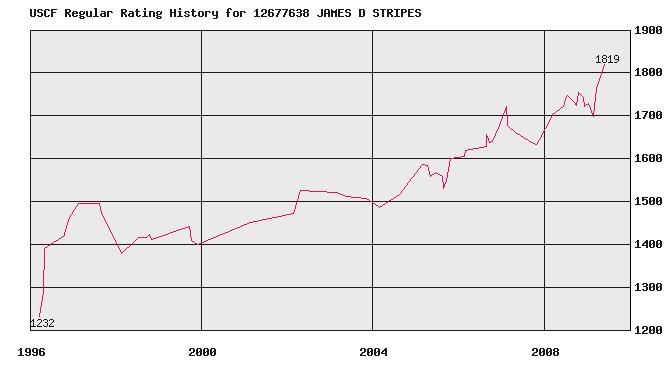
My goal was to reach a rating above 1800 by spring 2010. Now I need a new goal. Staying there is one idea. Reaching for 1900 is another.


I finished the Washington Open without a loss. I won two games, one against a class B player and one against a class A. I drew two class A players, and two class B.

My current rating is now 1819.

27 April 2009

Advice for Organizers

While I was the event coordinator for the 2009 Washington State Elementary Chess Championship, my beloved served as the event's treasurer and volunteer coordinator. When the time for the event arrived, she joined the hospitality coordinators at the check-in and information tables. These tables might be dubbed problem central. There were and will always be problems large and small in a large event. These problems must be solved, often by people who must think on their feet after inadequate sleep.

From most reports, the event ran smoothly. But, when over 1000 participants compete, problems must be expected. My wife compiled a list of tidbits of advice based on her observations and experiences. Event organizers should have or be prepared for:

puke at pairings postings (in a large public facility, you cannot just grab a paper towel)
lost children--hold them by the hand until you find mom or dad
lost parents
medical attention--a child playing outside became injured, his parent withdrew him from the tournament and took him to the hospital for stitches. He returned from the hospital and wanted back in the tournament to play round five.
indoor soccer
walkie-talkies--check-in table, tournament director, head judge, medical, clean-up, hospitality staff all need to be able to contact each other easily

scrapes, scratches, headaches
award snafus--300 trophies, someone might get the wrong one, or none when one was expected
angry teams--"NO PROTESTS ON THE PLAYING FLOOR"
angry parents
drunk parents--2000+ adults, there will be one
shelter--tournament director, head judge, event organizer

empower decision makers for specific aspects of the event to spend money--when late registrations for Friday Bughouse crowd the facility and a microphone is needed from the hotel, someone other than the event coordinator must decide that we can spend $85 more; when the judges hospitality room needs more potato chips, the hospitality coordinator must know that she has the authority to order them, that the added cost is okay

outsource registration, check-in, and web management--I spent too much time on these tasks. The positive benefit was that I had personal contact with many parents and coaches. There are alternatives to our system that have been tried and tested. Our webmaster created a nice site, and both he and I made many small modifications along the way. We might have hired someone else to maintain the site, and post periodic announcements.

lost and found
validate and understand hurt feelings and anger--I am convinced that a team that was hurt twice--once by an error in the program, and once by an error in pairings--did feel listened to and validated even though I could not fully repair the errors. That's just the biggest one, there were many other complaints.
complaint process--there should be a clear process for formal complaints; there should be a clear appeals process. The current WSECC Policy has much to say about team membership and team competition, but it does not address team pairing restrictions with clear rules.

K-1 escorts--having assured that parents are not in the playing room, where they would interfere with the competition, we cannot just set a five or six year old loose in the building to find her Dad. The parents need a waiting area; the event staff must assure that children get connected with their parents as they finish each round. We had a pediatrician step up as safety director and supervise this process on-site.

you will not collect all money due
double check everything
stolen items
receipt book for commemorative board purchases
gifts--lunches, boards, t-shirts
color code playing room by section
create "do not cross" line on the boundary between playing room and waiting area; post security--some of the high school students working as floor judges stepped up to this task and did a great job.

Have a physician on the volunteer staff willing to attend to injuries
Have enough space--we had 102,000 square feet, and the success of the event was largely due to an exceptional facility, and well planned traffic flow. Pairing were posted in three locations, and in a manner designed to channel players and parents efficiently. Standings were posted in the team room, NOT in the playing room.

Thank people often--competitors, parents, coaches, and volunteer staff all gave of themselves. They deserve praise and thanks. Make certain they get it.

20 April 2009

Numbers

What is involved in organizing a large state youth tournament? In winter 2006-2007 I met with Chris Frye at the Spokane Regional Sports Commission to begin work submitting a bid to host the 2009 Washington State Elementary Chess Championship. The Sports Commission helped line up a venue, secured rate quotes from area hotels, and offered advice on getting started. With their help, I put together a bid proposal that was then approved at the annual coaches meeting during the 2007 WSECC in Vancouver, Washington.

After the bid was approved, the SRSC paid the Spokane Convention Center a security deposit. The local organizing committee started meeting regularly in May 2007. In early summer 2008 these meetings became monthly. This spring, we've met every three weeks, and the meetings have run two hours or longer.

The tournament will be held this weekend. The past five weeks, I have worked full time on the event.

These numbers tell part of the story.

45,000 approximate budget in dollars
300+ hours I've spent putting this together
2000+ emails I've answered
200+ phone calls I've made
4 flights I've made into Sea-Tac Airport for event promotion
5 rental cars I've driven for same purpose
1098 shipping weight in pounds of chess equipment purchased for the event
120 C batteries purchased for chess clocks
10728.28 cost in dollars of trophies
200 volunteer t-shirts printed
250+ approximate number of chess sets to be donated to area schools
0 minutes spent on this enterprise that I regret!

03 February 2009

Washington State Elementary Chess Championship

Spokane Chess 2009

As luck would have it, I worked my way into a mammoth volunteer project. The seeds of the project were sown when a Spokane bid for the 2005 state elementary tournament lost by one vote. During the same meeting, the level of state organization took a jump in the creation of the WSECC Policy Board and detailed policies governing the state tournament.

In the wake of that meeting, I suggested to those responsible for the failed bid that we should bring the event to Spokane in 2009.

Two important related aspects of the expanded policies were that the site would follow a pattern of regional rotation among three vastly different areas of the state, and that bids from the hosting region must be presented two years out. Formerly, the next's year's tournament date, location, and organizers were selected at the event. That is, the 2005 event host was selected at the 2004 coaches meeting. Organizers had as little as eleven months to put together all aspects of the event.

This scholastic tournament has been growing rapidly in recent years. What once took place in a high school gym, now requires a larger facility. When I first attended in 2001, there were two sections, K-3 and 4-6. In 2003, there were seven sections--each grade level was a separate section. In 2007, two side events were added: Friday night Bughouse and I Love Chess 2. In 2008, a few adults participated in I Love Chess 2.


Two years out is a minimal time to start the process of reserving a facility that can accommodate 1200-1500 players and an even larger number of support personnel--parents, coaches, siblings. The bids for 2006 and 2007 were accepted at the 2005 coaches meeting in Lynden, Washington. The 2008 bid was accepted at the 2006 tournament. At that meeting I was elected as one of two eastern Washington representatives on the Policy Board. My term expired at the 2008 tournament.

In January 2007, I started working with the Spokane Regional Sports Commission and the Spokane Chess Club's Gary Younker Foundation to put together a bid for the 2009 Washington State Elementary Chess Championship. A key aspect of creating a bid was finding a venue that was available on a Saturday in late March to late April on a weekend that did not correspond with the dates of Nationals, Easter, and Passover. At the 2007 tournament in Vancouver, the coaches accepted the Spokane bid. The following week, I met with a sales representative at the Spokane Convention Center to get the rental contract drawn up.

In May 2007, the local organizing committee held its first formal meeting to begin planning the details. This committee was assembled through personal contacts and verbal commitments during the process of writing the bid, but the real work began after the bid was approved. I drafted and presented a preliminary budget at this meeting.

Through all of 2007, I might have put in twenty hours of labor preparing the bid and assembling a group of core volunteers. In March 2008, regular work began. Some weeks, I put in as little as a hour--talking with key personnel, making phone calls, reviewing priorities. In May 2008, the local organizing committee began meeting monthly, although we skipped one month in the summer. In October 2008, we secured a corporate sponsor. A second, Chess.com, came forward in December 2008 (and we still need more).

Yesterday, we officially opened registration. I am much relieved to have finally reached this critical stage of a long process. Now, I am putting in 10-20 hours per work each week. The Director of the Chess Enrichment Association, last year's organizer / host / tournament director, has told me that I can expect much longer days in April.

See our website at Spokane Chess 2009.