Showing posts with label Hou Yifan. Show all posts

29 January 2016

Mamedyarov -- Caruana, Tata Steel 2016

Can Fabiano Caruana catch Carlsen?

With three rounds to play, Fabiano Caruana stands one-half point behind Magnus Carlsen in the Tata Steel Chess Tournament in Wijk aan Zee. In today's games, Carlsen has White against Hou Yifan. She opted for a Petroff Defense, which often functions well as a drawing weapon. Caruana has the Black pieces against Shakhriyar Mamedyarov and played the Sicilian Defense. Mamedyarov opted for the Alapin variation.

When I awoke this morning, the games had been going for nearly two hours. My morning begins with making coffee, feeding dogs, and creating the beginning of this blog post. Once I am caught up with the action in the Netherlands, I will attempt to follow the games live and record my observations here through frequent updates.

Mamedyarov,Shakhriyar (2747) -- Caruana,Fabiano (2787) [B22]
78th Tata Steel GpA Wijk aan Zee (11), 29.01.2016

1.e4 c5 2.c3 Nf6 3.e5 Nd5 4.Nf3 e6 5.d4 cxd4 6.cxd4 d6

White to move

7.Bd3

The fourth most popular move with just over 300 games in my database. Mamedyarov asks Caruana, "just how deep is your preparation in this line that is new to both of us?"

7.Bc4 leads in popularity.

7...dxe5

A few dozen reference games. Only one with a player above 2600.

8.dxe5 Nb4

Sam Shankland has played this move.

9.Be4 Qxd1+ 10.Kxd1 Nd7

Reference Game:
Fruebing,Thomas (2187) -- Shankland,Samuel L (2539) [B22]
Dresden ZMD op 20th Dresden (1), 06.08.2011
10...N8a6 11.a3 Nc5 12.Nc3 Nxe4 13.Nxe4 Nd5 14.Nd4 Bd7 15.Bg5 h6 16.Bh4 Rc8 17.Rc1 Rxc1+ 18.Kxc1 Nf4 19.Bg3 Nd3+ 20.Kc2 Nc5 21.Nc3 Be7 22.b4 Na4 23.Ne4 0–0 24.Rc1 Nb6 25.Nc5 Bxc5 26.bxc5 Rc8 27.Kb3 Nd5 28.Kb2 Bc6 29.Kb3 Kf8 30.a4 a6 31.h4 Ke7 32.Bh2 h5 33.g3 Kd7 34.Bg1 Kc7 35.f4 Ne7 36.Rc3 Rd8 37.Bf2 Be4 38.Rc1 Nc6 39.Kc3 Rd5 40.Nxc6 Rd3+ 41.Kc4 Kxc6 42.Rb1 Ra3 43.Rb6+ Kc7 44.Rd6 Rxa4+ 45.Kb3 Ra1 46.Bd4 Rb1+ 47.Bb2 Bd5+ 48.Kc2 Be4+ 49.Kb3 a5 50.Ka2 a4 51.Rd4 Re1 52.Bc3 Re2+ 53.Rd2 Bd5+ 54.Kb2 Re3 55.f5 a3+ 56.Kc2 Be4+ 57.Kb3 a2 0–1

White to move

There are still four games in my database with this position.

11.Bd2N a5 12.a3 Nc5 13.axb4 Nxe4

Black has created a minor piece imbalance.

14.Be1 b6 15.Nc3 Nxc3+ 16.Bxc3

White could undouble his pawns, but that would give Black a passed pawn and White's c-pawn would be backwards. The doubled b-pawns have strength.

16...a4 17.Nd2 Bb7 18.f3 Bd5 19.Kc1

Black to move

19...b5 20.b3 a3

Caruana has a passed pawn, but any hopes it cherishes of promotion are in the distant future.

21.Kb1 Be7 22.Ka2

The king blockades the passer, freeing White's rook for action.

22...O-O 23.Rac1

Black to move

Caruana has a achieved a middlegame with dynamic prospects to create winning chances.

I was looking at 23...Ra4 to pile on the b4 pawn, but 24...Bxb4 25.Bxb4 Rxb4 drops the a-pawn. Bad ideas are the curse of the class player. On the other hand, keeping the a-pawn on the board ties down one of Black's rooks. What else can he do?

23...Rfc8 24.Nb1 Bg5

Attack the rook. That's what Black can do.

25.Bd2 Rxc1!

Mamedyarov was ahead a few minutes on the clock until the amount of time that he spent on this position. While he thought, I looked at some tactical threats that Black might have in mind. Once I concluded that they did not work, they were played rapidly on the board.

26.Rxc1

Black to move

26...Bxb3+

That's the move I was looking at!

27.Kxb3 a2 28.Na3

When I found this move, I concluded that Black's combination failed. Somehow I overlooked that White's bishop on d2 was now undefended and that losing the a-pawn did not eliminate all of Black's winning chances. There are other vulnerable pawns in White's position. On the other hand, Black must watch his back rank.

28...Bxd2 29.Ra1 Bf4 30.h3 Bxe5 31.Rxa2 Rb8

White to move

32.Rc2

Nxb5 is threatened.

32...Bd6

Black can block a check, so the pawn is safe for now. With most of White's pawns on light squares, the bishop has few targets. But the crucial pawn is on a dark square. The pawns for both players on the kingside are mobile. In this position, the bishop is still a better piece that the knight.

Black is one pawn ahead.

33.Rc6 Be7 34.Rc7 Bf8

34...Bd6 might lead to a repetition, but one repetition gets closer to the time control.

35.Ra7 g6

Black's king gets some air.

36.Ra5

Black to move

Black cannot keep the b-pawn.

36...Rd8

But, an active rook is essential in this endgame and White has other pawns that can be threatened. Will Black be forced to give up the bishop to stop White's b-pawn?

Hou and Carlsen are still playing, but the commentators think that it is headed to a draw.

37.Rxb5 Rd2 38.Rb8

Black to move

38...Kg7

This move may have been necessary. If 38...Rxg2 39.Rxf8 Kxf8 40.b5 and White's pawn will promote.

39.Nc4 Rxg2 40.b5 Rg1 41.Rxf8! Kxf8 42.b6

Black to move

Uh-oh. Caruana is in trouble. How will he stop that pawn? Caruana will be fighting for a draw. Meanwhile, Carlsen continues to force Hou to play chess. That game is not drawn yet.

The commentators are convinced that Black must play 42...Rd1. It seems to me that 42...Rg5 might be worth considering. In any case, Caruana is using a lot of time to think. His tournament hangs in the balance. If he cannot draw this game, Carlsen will be out of reach.

After a little more than 30 minutes:

42...Rg5

White's king and knight will work together to try and prevent the rook's exchange for the pawn.

43.Kb4 Rg1

Now Mamedyarov is thinking. Watching the live video feed, I see Wei Yi stop by to look at the game, Then Carlsen came by. This game is drawing some interest. It is a significant game for the final standings, and it is also an interesting ending.

44.Nd2

White keeps the rook off b1. Now what can Black do?

44...Rd1 45.b7 Rxd2 46.b8Q+

Black to move

White must win this ending. Or, can Black construct a fortress?

46...Kg7 47.Qe5+ Kg8 48.Qb8+ Kg7 49.Qe5+ Kg8 50.Qb8+ 1/2-1/2

I am surprised at this draw. But perhaps Black could have created a fortress with his king on g7 and the rook shuffling among d5, f5, and h5. On the other hand, in such a position White would checkmate with king on e7 and queen on f8. The fortress might not be possible.

Carlsen won his game. Caruana falls a full point behind the leader.

17 January 2016

Tata Steel Chess 2016, Round Two

When was the last time that two Americans shared the lead with a Chinese player in Wijk aan Zee? After the first round, they do.


Disappointing Chess Fans

Loek Van Wely and Sergey Karjakin had four draws at Wijk aan Zee before Karjakin's win in 2012. Karjakin then won again in 2013 and 2014. Their overall record together stands at two wins for Van Wely, the latest in 2005, seven wins for Karjakin, and six draws. After Van Wely missed a clear win against Shakhryar Mamedyarov yesterday, he will be hard-pressed to end Karjakin's streak of wins since 2012.

Van Wely played a Dragon and reached an interesting position analyzed in some depth by Yasser Seirawan and Lawrence Trent.

Karjakin,Sergey -- Van Wely,Loek [B76]
Tata Steel Chess Wijk aan Zee, 17.01.2016

1.e4 c5 2.Nf3 Nc6 3.Nc3 g6 4.d4 cxd4 5.Nxd4 Bg7 6.Be3 Nf6 7.Bc4 0–0 8.Bb3 d6 9.f3 Bd7 10.h4 h5 11.Qd2 Qa5 12.0–0–0 Rfc8 13.Kb1 Ne5 14.Bg5 Kf8 15.f4 Neg4 16.Rhe1 Rc5 17.f5 gxf5 18.Nxf5 Bxf5 19.exf5

Black to move

19...Re8 

In their analysis, Trant and Seirawan concluded that 19...Re8 was Black's only non-losing move, and then learned from their researchers that it had been played before.

20.Nd5N

20.Bf4 was played in the reference game that I was able to locate. 20...Rxf5 21.Rxe7 Rxe7 22.Bxd6 Rfe5 23.Qf4 Kg8 24.Bxe7 Rxe7 0–1 Guempges,P (2076) -- Wisskirchen,A (2266) Germany 2004.

Apparently Karjakin offered a draw with the move's novelty. ½–½

Fighting Draws

Mamedyarov leads Evgeny Tomashevsky 3-5-1 (W-D-L) in their encounters. However, Tomashevsky's win in February 2015 was their most recent battle at classical time control. That win came in the fourth round of the FIDE Grand Prix in Tbilisi, an event that Tomashevsky won. In August 2015, Tomashevsky won the Russian Championship, which pushed him to his peak rating of 2758.

Among amateurs, there would still be some play in the position where Tomashevsky and Mamedyarov agreed to a draw, but I sense that the position is completely equal for Grandmasters. Black has a bishop pair and rook against White's bishop, knight and rook. Black also has an extra pawn, although two pawns are threatened.

In August 2014, Wei Yi lost to Pavel Eljanov in their only game prior to today. After a battle, the players reached a queen and minor piece ending with fourteen pawns still on the board. Maybe White's knight is a little better than Black's bishop according to the theory that knights work well with bishops. On the other hand, White's queen must guard the first rank or Black's queen and bishop will create checkmate threats. After a repetition of moves, the game was drawn.

White to move

Assuming that my database is complete, Magnus Carlsen leads Fabiano Caruana 16-10-7. In 2014, Caruana's astounding success, especially at the Sinquefield Cup where he beat Carlsen, created expectations that he was on the verge of challenging Carlsen's reign at the top of the rating charts. His results since then have not been as strong, although he defeated Carlsen again in 2015. It was Carlsen's second loss in the first two rounds of Norway Chess in Stavanger (see video). The two played seven games in 2015 with Carlsen winning three, Caruana winning one, and three draws.

Their game today was an intense battle.

Carlsen,Magnus -- Caruana,Fabiano [A00]
Tata Steel Chess Wijk aan Zee, 17.01.2016

1.g3 g6 2.Bg2 Bg7 3.e4 e5 4.Ne2 c5 5.d3 Nc6 6.Be3 d6 7.Qd2 Nd4 

7...Nge7 has been reached in at least four games with three White wins.

8.c3 Nxe2 9.Qxe2 Ne7 10.h4 h6 11.h5 g5 12.f4 exf4 13.gxf4 gxf4 14.Bxf4 Nc6 15.Na3 Be5 16.Be3 Be6 17.Nc4 Bg3+ 18.Kd2 Qd7 19.d4 cxd4 20.cxd4

Black to move

20...Ne5

Seirawan and Trent thought this move was forced. Caruana, in his postgame interview with Seirawan thought so as well.

21.Nxe5 dxe5 22.d5 Bg4 23.Bf3 Bxf3 24.Qxf3 Qb5 25.Rac1 Qxb2+ 26.Kd1 Bf4 27.Bxf4 exf4 28.Qxf4 Rg8 29.Rf1 Qd4+ 30.Ke1 Qb4+ 31.Kd1 Qd4+ 32.Ke1 Qb4+ ½–½

Navara's Activity Level
David Navara has two draws and four losses against Michael Adams. He played well yesterday against Carlsen. It seems that Navara's level of activity has increased in the past year or two. He also is currently at his peak rating. Perhaps he will score his first victory against Adams.

He did not win. The game was a battle that ended when the players reached a knight and pawn ending after 31 moves.

Ding Liren and Anish Giri tied for second in last year's Tata Steel Chess tournament, along with Maxime Vachier-Lagrave. Giri won their individual encounter with an instructive endgame of knight and bishop against rook with three pawns each. Ding had won their first encounter in 2012 and the two have had three draws, two of them at the Bilbao tournament in 2015.

Ding is the highest rated Chinese player ever and the second to break into the FIDE top ten.

After Black's 33rd move, the knights are coming off the board and the resulting queen ending with five pawns each should be objectively drawn. The players agreed to a draw vefore exchanging knights.

Hou Yifan surpassed Judit Polgar as the top rated woman in 2015. Polgar had been the top rated woman for 26 years. Her five prior encounters with Wesley So have all ended in draws, typically fifty moves or more. Their shortest draw was in Dortmund last year and lasted forty moves.

At the time that I needed to turn my attention to the Seattle Seahawks and their effort to return to a third Super Bowl appearance in three years, this game was at its 49th move. So seemed to have the upper hand earlier, but now Hou seems better.

At the end of the first quarter, the Seahawks were already in a hole and I saw that after five more moves, Hou -- So ended with a draw.


16 January 2016

Tata Steel Chess 2016, Round One

Last night, in preparation for today's opening round of the Tata Steel Chess Tournament, I reviewed previous encounters for each of the pairs of contestants. Although the overall strength of this year's event is down from prior years, there will be some interesting match-ups. In the Tata Steel Masters, there are three players from China and only two from Russia. The future is thus well represented.

Hou -- Karjakin

I found one game in the database between these two players, and it was a game that I remember watching live three years ago. It was played during the Tata Steel Chess tournament. Hou Yifan played the French Defense and chose an obscure line of the Steinitz variation designed to immediately swap off her bad bishop. Against a player of Sergey Karjakin's caliber, this strategy was fatal. Too much time was spent in the exchange. Karjakin built up his attack and forced the Black king to remain in the middle of the board. That was enough for a lasting advantage.

Today's game was drawn after both players reached the time control. Each had two rooks and four pawns remaining.

So -- Giri

Anish Giri had White in his first meeting with Wesley So in the Corus C-Group of the 2009 Wijk aan Zee tournament. That game was agreed drawn after it was reduced to a pawn ending. Both players were elevated to the B-Group the following year. Giri won with the Petroff. Later in 2010, Giri beat So again in Biel. Their next two encounters were draws, one in the 2014 Tata Steel Masters. In last year's Tata Steel Masters, Giri won a marathon battle of 111 moves. So then scored a win against Giri in the Vugar Gashimov Memorial in April. They played six more games against one another in 2015, with So winning one of the blitz games and the others all drawn.

So won a symmetrical English that left Black's minor pieces inferior to White's.

Ding -- Adams

The only prior encounter between these two players in my database was at the 2013 Alekhine Memorial. Ding Liren played 4.f3 against Michael Adams' Nimzo-Indian Defense. Most of the pieces came off in a tactical melee, and the players agreed to a draw in a balanced endgame.

Ding Liren won an ending that featured a knight, rook, and pawns on each side. Eventually, Adams lost his knight with a stalemate trap that Ding easily saw through.

Navara -- Carlsen

According to my database, David Navara has an even score against Magnus Carlsen, but all but one of these games were played before Carlsen ascended to the top of the rating list. Navara was over 2700, and ranked above Carlsen when he beat the future World Champion with a Grunfeld Defense at Wijk aan Zee 2007. The previous year, they drew their game in the B-Group. Carlsen's win against Navara came in 2008 at the Dresden Olympiad. Two other games, most recently in 2012, ended as draws.

David Navara gave a nice interview with Yasser Seirawan where he described how he avoided the sort of strategic complications that would have favored the World Champion. In the end, Carlsen forced a draw by repetition.

Caruana -- Eljanov

All of the games between these two players have been decisive with Pavel Eljanov leading 3-2. Two games were played in the World Blitz Championship in 2010. Caruana won with White, but lost in three moves from the Black side. There must have been an illegal move or some other irregularity. The only clue that I could find in ten minutes of searching was Mark Crowther's comment (The Week in Chess, theweekinchess.com, 18 November 2010) that some games were incomplete. Perhaps the game score is incomplete due to problems with the DGT boards. Fabiano Caruana's sole classic time control win against Eljanov came against the Berlin Defense in 2011. Later that year, Eljanov opted for the Caro-Kann and won. Will Eljanov opt to test Caruana in the Berlin once again?

Caruana told Seirawan that he was worse early on in this Queen's Gambit, but his attack began to gain ground after a coupld of time wasting moves by Eljanov. The score between these two players is now even.

Wei -- Tomashevsky

If Wei Yi and Evgeny Tomashevsky have played one another prior to today, the game is not in my database. Nor do any games from the usual online database appear via a Google search.

This 23 move draw was the shortest game of the round.

Mamedyarov -- Van Wely

These two have seventeen prior encounters at my fingertips. Shakhryar Mamedyarov leads Loek Van Wely 7-7-3 (W-D-L). Two of these games were played at Wijk aan Zee.

If you showed this position to any Grandmaster and mentioned that Black has a win, he or she would find it in under two minutes. Alas, there is no such voice of assistance in a tournament game and Loek van Wely missed his chance. The game was drawn after a long ending where White was unable to convert a small advantage.

Black to move


23 February 2014

Losing my Virginity with the Ponziani

In the second round of the Collyer Memorial tournament yesterday, I played the Ponziani for the first time in a standard game. My prior experience with the opening had been limited to a few games of online blitz the previous three days, one game against a beginner in a chess class that I teach, and another against the winner of Spokane Chess Club's winter championship in Friday's blitz tournament. In that game, I had a nice position but then hung my queen.

I have looked over a few Grandmaster games in the past few days. My interest in the opening was stimulated a year ago when Magnus Carlsen played it against Pentala Harikrishna in the 2013 Tata Steel tournament, and then had the Black side in his game against Hou Yifan. The latter was mentioned on this blog while it was taking place. More recently, I have been looking through the games of Rezső Charousek and spent some time this week looking at a miniature that he lost to Geza Marozcy. Here is that game with a few comments.

Geza Maroczy -- Rudolf Rezso Charousek [C44]
Match Budapest (2), 19.04.1895

1.e4 e5 2.Nf3 Nc6 3.c3 d5 4.Qa4 f6 5.Bb5 Nge7 6.exd5 Qxd5 7.d4 exd4

7...Bd7
7...Bg4

8.cxd4 Bd7 9.Nc3 Qf5 10.0–0 Nc8??

10...0–0–0 11.Be3 a6 12.Be2 g5 13.Qd1 Nd5 14.Nxd5 Qxd5 15.b3 g4 16.Bc4 Qh5 17.Nd2 Bd6 18.g3 f5 19.f4 b5 20.Bd5 Rhe8 21.Re1 Bb4 22.Rc1 Ne7 23.Bh1 Qf7 24.a3 Ba5 25.b4 Bb6 26.Qc2 Nd5 27.Qb3 Be6 28.Bxd5 Bxd5 29.Qc3 Bb7 30.Qb3 Qd7 31.Nf1 Bxd4 32.Red1 Bxe3+ 33.Nxe3 Qe7 34.Nd5 Bxd5 35.Rxd5 Rxd5 36.Qc2 Qe3+ 37.Kh1 Qe4+ 38.Qxe4 Rxe4 39.Rc2 Red4 0–1 Kelling,F -- Gyles,A, Auckland 1914

11.d5 Nb6 12.dxc6 Nxa4 13.cxd7+ Kd8 14.Bxa4 c6 15.Rd1 Bc5 16.Be3 Bb6 17.Rd6 Kc7 18.Rad1 Rad8 19.Bxb6+ 1–0

For the past few days, I have been contemplating deploying the Ponziani in a tournament game. Self-doubt has been a deterrent. Having been pleased with my play in round one, I decided to play it.

Stripes,James (1899) -- Lombardi,George (1429) [C44]
Collyer Memorial Spokane (2), 22.02.2014

1.e4 e5 2.Nf3

I briefly considered 2.f4, which would have been Charousek's move.

2...Nc6 3.c3

I also considered the Spanish and the Italian, both of which I have played in many games over the years.

3...Nf6

Black has several choices, but this move is most popular.

4.d4 Nxe4

I had looked at games with this move, but forget the main lines. I was now completely on my own tactical and positional understanding without any database memory. To be forced to create something new early, and to force one's opponent to do the same is a principal appeal of the Ponziani.

5.d5

I found the main line.

Black to move

5...Nxf2!?

I was busy taking photos of the players for the Spokane Chess Club when my opponent made this astounding move. Returning to my own board, I was certain the move was an error. Nonetheless, my king did become exposed and I had several alternate lines to consider.

6.Kxf2 Bc5+ 7.Be3 Bxe3+ 8.Kxe3

Black to move

My king's position reminds me of a conversation I had the previous evening concerning the Steinitz Gambit, where Steinitz himself marched his king forward to e3 in some King's Gambit games. The prompt was the second game that John Donaldson showed during his lecture. In that game, White's king stepped up to d2 to connect the rooks, then moved to the third rank. Eventually, it took up position on f2 where it helped keep Black's rogue queen trapped.

8...e4 9.dxc6

I spent six minutes on this move (compared to four for the whole game prior). Most of that time was spent contemplating my next move.

9...exf3 10.Qxf3

The materialistic 10.cxd7+ struck me as being a bit too helpful to Black's mobilization. With a vulnerable king, that seemed a foolish course. A computer can work out the tactics and may favor the material gain. I may check this game with an engine after posting these annotations.

10...0–0 11.Bd3 dxc6

White to move

12.Rd1?!

This set-up of a cheap tactic invites trouble. I seemed to be daring my opponent to find a way to skewer my queen to get at the rook. Perhaps Re1 puts the rook on a better square. I also contemplated Nd2.

12...Re8+

Somehow I overlooked this zwischenzug to set up the skewer.

13.Kf2 Qh4+ 14.Kg1 Bg4 15.Qf4

A strong chess player would have found this pin before playing 12.Rd1, and then assessed the consequences of Black's choices.

Black to move 

15...Re1+

15...g5! looked dangerous to me. 16.Bxh7+ Kxh7 17.Qxf7+ Kh8 and I would seriously consider bailing out of this game with a draw.

My opponent chose a forcing line that kept me from burning much clock time contemplating alternatives. It appeared there were none.

16.Rxe1 Qxe1+ 17.Qf1 Qe3+ 18.Kh1 Re8 19.Na3 Be2

My opponent used ten minutes deciding upon this move, and I had already decided to force the queens off the board with the bishops. The clock showed 1:32 remaining for me and 1:06 for my opponent. Our time control was 1:55 for the game plus a five second delay.

White to move

20.Qxe2 Qxe2 21.Bxe2 Rxe2 22.Rb1?

22.Nc4 must be better.

22...b5 23.Kg1 f5

White to move

24.Rd1

My seven minutes on this move was my longest think of the game. I should have spent a few of these minutes on move 22.
24...Kf7

The critical line that I examined was 24...Rxb2 25.Rd8+ Kf7 26.Rd7+ Kf3

The king could consider e8 and e6, too, as I'm not interested in the kingside pawns just yet.

27.Rxc7 Rxa2 28.Rxa7 with the idea of 29.Nxb5 if the rook remains on the a-file.

A version of this line is still possible after 24...Kf7, but is more likely advantageous for White, or so I thought during the game.

25.Rd7+ Re7

My opponent makes my job easier. At this point, my opponent from the previous round stopped by and looked at the game. He smiled because in our postgame analysis, we had played out a variation where I had a knight against a superior number of pawns. He, too, had sacrificed a knight for two pawns and an attack.

26.Rxe7+ Kxe7 27.Nc2

Black to move

27...g5?

Black needed to address the threatened fork with 27...c5 or 27...Kd6.

28.Nd4 Kf6 29.Nxc6 a6 30.Kf2?

The immediate 30.Nb4 was decisive.

30...h5 31.Nb4

Black to move

Another fork is coming.

31...a5 32.Nd5+ 1–0

I am pleased with the result.

Five players finished day one with 3.0 and with my third round bye, I am one of three with 2.5. This morning, I have a stronger opponent.

22 January 2013

Tata Steel Chess 2013, Round 9

Two King's Pawn Openings: Ponziani and Berlin

When my alarm went off at 5:30 am Pacific Standard Time, the players in Wijk aan Zee had been sitting at their boards for an hour. Rising from bed, I started the coffee and turned on some electronics. I must find a game to follow for the next two hours before I leave for work.

Karjakin -- Harikrishna immediately caught my eye because Sergey Karjakin is on the White side of one of his specialty openings: the Berlin Wall.

Wang -- Caruana is following an uncommon line in the Slav. Peter Leko is battling Viswanathan Anand's Najdorf. Hou Yifan's aggressive Ponziani against Magnus Carlsen also looks interesting. Sokolov -- Van Wely is a Rubinstein variation of the Nimzo-Indian. Levon Aronian is on the Black side of a Symmetrical English against Erwin L'Ami. Nakamura -- Giri are playing an offbeat Sicilian.

There are fourteen more games in the B and C Groups of the 75th Tata Steel Chess tournament in Wijk aan Zee.

Today, my efforts will be directed towards keeping track of two games as they develop. My resources include the tournament website, the Playchess server, and, of course, ChessBase 11. It is likely the games will continue beyond the time when I must leave for work. At work, in a chess classroom, it will be possible to follow these games, but not possible to blog my observations.

Karjakin,Sergey (2780) - Harikrishna,Pentala (2698) [C67]
75th Tata Steel Chess Group A Wijk aan Zee (9), 22.01.2013

1.e4 e5 2.Nf3 Nc6 3.Bb5 Nf6 4.0–0 Nxe4 5.d4 Nd6 6.Bxc6 dxc6 7.dxe5 Nf5 8.Qxd8+ Kxd8

White to move

The most common move here is 9.Nc3. Nonetheless, Karjakin has previously played 9.h3, the fourth most common move (131 in ChessBase Online database).

9.h3

Reference games:

Karjakin,Sergey (2747) - Pashikian,Arman (2639) [C67]
Khanty Mansiysk ol (Men) 39th Khanty Mansiysk (9.4), 30.09.2010

1.e4 e5 2.Nf3 Nc6 3.Bb5 Nf6 4.0–0 Nxe4 5.d4 Nd6 6.Bxc6 dxc6 7.dxe5 Nf5 8.Qxd8+ Kxd8 9.h3 Ke8 10.Nc3 h5 11.Ne2 Be7 12.Bg5 Be6 13.Nf4 Bd5 14.Nxd5 cxd5 15.Rad1 c6 16.Rd3 h4 17.Re1 Rh5 18.Bf4 g6 19.a4 Rd8 20.Red1 Ng7 21.Be3 Ne6 22.a5 a6 23.c3 ½–½

Karjakin,Sergey (2775) - Aronian,Levon (2815) [C67]
Beijing Sportaccord blitz Beijing (13), 17.12.2012

1.e4 e5 2.Nf3 Nc6 3.Bb5 Nf6 4.0–0 Nxe4 5.d4 Nd6 6.Bxc6 dxc6 7.dxe5 Nf5 8.Qxd8+ Kxd8 9.h3 Ke8 10.Nc3 h5 11.Bf4 Be7 12.Rad1 Nh4 13.Nd4 Nf5 14.Nce2 g5 15.Bh2 Rh6 16.Rfe1 a6 17.Nxf5 Bxf5 18.Nd4 Be6 19.Nxe6 Rxe6 20.g4 hxg4 21.hxg4 c5 22.c3 c4 23.Kg2 b5 24.Kf3 Rb8 25.Bg3 Rh6 26.Ke4 b4 27.Rd4 bxc3 28.bxc3 Rb2 29.Rxc4 c5 30.Ra4 Kd7 31.Rd1+ Kc8 32.Ke3 Rc2 33.Kd3 Rb2 34.Rd2 Rxd2+ 35.Kxd2 Rb6 36.Kc2 Kd7 37.Re4 Ke6 38.Re1 Rb5 39.a4 Ra5 40.Re4 Kd5 41.f3 c4 42.Rd4+ Kc5 43.Bf2 Kc6 44.Rxc4+ Kd5 45.Re4 Ke6 46.Kb3 Rxe5 47.Bd4 Rxe4 48.fxe4 Kd6 49.c4 Kc6 50.e5 Bd8 51.Kc3 Kd7 52.Kb4 Kc6 53.Kc3 Kd7 54.Kd3 Ke6 55.Ke4 Bc7 56.c5 Bb8 57.c6 Bc7 58.Bc3 Bb6 59.Bd2 Bd8 60.Be3 Bc7 61.Bxg5 Bxe5 62.Bf4 Bc3 63.c7 Kd7 64.Kf5 Bd4 65.Be5 1–0

9...Bd7

Harikrishna is not new to this opening. 9...Bd7 is part of his repertoire.

Reference games:

Sutovsky,Emil (2687) - Harikrishna,Penteala (2685) [C67]
Istanbul ol (Men) 40th Istanbul (6.2), 03.09.2012

1.e4 e5 2.Nf3 Nc6 3.Bb5 Nf6 4.0–0 Nxe4 5.d4 Nd6 6.Bxc6 dxc6 7.dxe5 Nf5 8.Qxd8+ Kxd8 9.h3 Bd7 10.Rd1 Kc8 11.a4 a5 12.g4 Ne7 13.Ra3 Nd5 14.Rad3 Be7 15.c4 Nb6 16.b3 h5 17.Bg5 f6 18.e6 Bxe6 19.Re1 fxg5 20.Rxe6 Bf6 21.Nbd2 hxg4 22.hxg4 Nd7 23.Ne4 b6 24.Kg2 Rb8 25.Nd4 Kb7 26.Nxc6 Rbe8 27.Rxe8 Rxe8 28.Nxf6 Nxf6 29.Nd8+ Kc8 30.Nf7 Nxg4 31.Nxg5 Re5 32.Nh3 ½–½

Sutovsky,Emil (2700) - Harikrishna,Penteala (2669) [C67]
WchT 8th Ningbo (4), 20.07.2011

1.e4 e5 2.Nf3 Nc6 3.Bb5 Nf6 4.0–0 Nxe4 5.d4 Nd6 6.Bxc6 dxc6 7.dxe5 Nf5 8.Qxd8+ Kxd8 9.h3 Bd7 10.Rd1 Kc8 11.g4 Ne7 12.Ng5 Be8 13.f4 b6 14.Nc3 c5 15.Kf2 h6 16.Nf3 g6 17.Be3 Bc6 18.a4 Kb7 19.a5 Re8 20.Nd2 Nd5 21.Nxd5 Bxd5 22.Nf3 Be6 23.Rd3 Be7 24.Rad1 h5 25.Kg3 hxg4 26.hxg4 Rh7 27.R3d2 Kc6 28.axb6 cxb6 29.Rh2 Rxh2 30.Nxh2 a5 31.Rf1 Rg8 32.Ra1 Ra8 33.Rf1 Bc4 34.Re1 Rh8 35.Nf3 Be6 36.Rd1 a4 37.Ng5 Bxg5 38.fxg5 Ra8 39.Rd6+ Kb5 40.Bc1 Rh8 41.Rd1 Kc4 42.Be3 Ra8 43.Rd3 Re8 44.Rd6 Kb5 45.Rd1 Ra8 46.Bc1 a3 47.bxa3 Ra4 48.c3 Kc4 49.Rd6 Kxc3 50.Rxb6 Kc2 51.Be3 Rxa3 52.Kf2 c4 53.Rb4 Rb3 54.Ra4 c3 55.Ke2 Rb2 56.Rf4 Kb3+ 57.Kd3 Rb1 58.Rf3 c2 59.Kd4 Rd1+ 0–1

10.Nc3 b6 11.g4 Ne7 12.Ng5 Ke8 13.f4 f6 14.exf6 gxf6 15.Nge4 Kf7 16.f5 h5 17.g5 Nxf5 18.Nxf6 Be6

White to move

19.Ne2

Karjakin will be showing us how to battle for the advantage against his pet defense.

Meanwhile, I cannot resist Magnus Carlsen's game. We know before it begins that he will be giving lessons to Hou Yifan today, and we want to gain from that lesson, too. She plays with courage.

Yifan,Hou (2603) - Carlsen,Magnus (2861) [C44]
75th Tata Steel Chess Group A Wijk aan Zee, 22.01.2013

1.e4 e5 2.Nf3 Nc6 3.c3 Nf6 4.d4 exd4 5.e5 Nd5

White to move
6.Bc4

6.cxd4 is by far the most common move.

6...Nb6 7.Bb3 d5 8.cxd4 Bg4 9.Be3 f6N

9...Bb4+ 10.Nc3 f6 11.h3 Bh5 12.g4 Bg6 13.0–0 Qd7 14.Bf4 Bxc3 15.bxc3 0–0–0 16.exf6 gxf6 17.Nh4 Bf7 18.Bg3 h5 19.f3 Nc4 20.Qd3 Ne7 21.Rae1 Rdg8 22.Bc2 Nd6 23.Ba4 Qd8 24.Qe3 Nef5 25.Nxf5 Nxf5 26.Qf4 Nxg3 27.Qxg3 f5 28.Bc2 Bg6 29.Re6 f4 30.Qg2 Bxc2 31.Qxc2 hxg4 32.fxg4 Rxh3 33.Qf5 Rg3+ 34.Kf2 Kb8 35.Rfe1 R3xg4 36.Re8 Rg2+ 37.Kf3 Rxe8 38.Rxe8 Qxe8 39.Kxg2 Barrenechea Bahamonde,G (2261)-Maiorov,N (2574) 0-1 Paleochora 2012

10.0–0 Qd7 11.h3 Bh5 12.e6 Qd6 13.Nc3 0–0–0 14.a4 a5 15.Nb5 Qxe6 16.Bf4 Rd7 17.Re1 Qf7 18.Rc1 Bb4 19.Re3 g5 20.Bh2

Update 7:30 am PST; 16:30 CET

Returning to Karjakin -- Harikrishna

19...Bg7 20.Ne4 Rhf8 21.N4g3 Kg8 22.Nxh5 Bc4 23.Nxg7 Kxg7 24.Rf2 Rae8 25.Nf4 Re1+ 26.Kh2 Bd5 27.Nxd5 cxd5 28.b3 Kg6 29.Bb2 Rxa1 30.Bxa1 Kxg5 31.Be5 c6 32.Rg2+

Black to move

32...Kh6

Some folks find the Berlin Wall boring. I disagree. It is part of a search for truth, arguing that White cannot be certain of gaining the advantage with 1.e4. Truth is never boring. While draws are indeed frequent in the Berlin Wall, today's game reveals, at the least, that there is room for new ideas and much play in this much despised opening.

Here we have an endgame of knight vs. bishop with an asymmetrical pawn structure and one rook each. It is not easy to find a plan for either player that leads to an advantage, but nor is the game a dead draw.

Update 7:40 am PST

Returning to Hou -- Carlsen

No one would call this game boring, but is Hou's play sound?

20...Nc4 21.Bxc4 dxc4 22.Qc2 Bxf3 23.Rxf3 Nxd4 24.Nxd4 Rxd4 25.Be5 Rd2

White to move

26.Qf5+ Qd7 27.Qxf6 Re8 28.Bg3 Rd4 29.Rf1

Does Hou Yifan have compensation for the pawn that she sacrificed?

29...g4 30.hxg4 Rxg4 31.Rf4 h5 32.Rxg4 hxg4 33.Rc1 c3 34.bxc3 Bc5 35.Qg5 b6

White to move
36.c4

Update 11:30 am PST; 20:30 CET

I brought my notebook computer to work this morning. One consequence of this decision is that I will be lugging it around from classroom to classroom in an elementary school this afternoon. I also have my chess bag (files, iPad, pieces for the demo board), a demo board, and a bag containing thirteen chess sets plus extra pieces. The notebook is a hassle to add to this mix, but leaving it in the car when it is eleven below (12 degrees Fahrenheit to my fellow Americans) is not an option.

The other consequence, and the reason I brought it, is that I am able to use my lunch break to update this post.

By the time I got to work, turned on the classroom computer, logged in and opened the Tata Steel Chess website, Karjakin and Harikrishna agreed to a draw.

33.Re2 Kg6 34.c3 Re8 35.Kg1 Re7 36.Kf2 Rf7 37.Ke1 Rh7 38.Bb8

Black to move

38...Kf6 39.Kd2 Rxh3 40.Bxa7 ½–½

A split point might be a frequent result in the Berlin Wall variation of the Spanish, but this game should reveal that both players face opportunities to go wrong.

Returning to Hou -- Carlsen

Hou Yifan's fighting spirit deserves our admiration. Slugging it out with the highest rated (best?) player in history, she does not flinch, but exchanges blow for blow. As I told my chess class this morning, this young woman could take on the top fifty players in my city all at once and win every game without any sweat.

36...Re4 37.Qg6 Re2 38.Kf1 Qd2 39.Qxg4+ Kb8 40.Qxe2 Qxc1+ 41.Qe1 Qxc4+ 42.Qe2 Qxa4 43.Be5 Bd4 44.Bxd4 Qxd4 45.g4 Qd5 46.Qe8+ Kb7 47.Qa4 b5 48.Qxa5 Qd1+ 49.Qe1

Black to move

49...Qxg4

Of course Magnus must snatch the pawn, as other moves draw.

50.Qe5 Qc4+ 51.Kg2
>
51.Ke1 looked better to my eyes, but remember that I would lose to Hou in a simul if I were offered such a magnificent opportunity. Of course, I would try not to lose, and maybe seek winning chances. But, it is important to be realistic: to a 2603 player, A Class players are hors d'oeuvres.

51...Qc6+ 52.Kf1 b4 53.f4 b3 54.f5 Ka6 55.Qa1+ Kb6 56.Qh8 Qc1+ 57.Kg2 Qc2+ 58.Kh1 b2

White to move

Computers know that this position is a clear win for Black, and likely Magnus Carlsen does as well. Even so, one cannot fault Hou Yifan for playing on. The Black king must find refuge from the checks. If that refuge is on b1, the White f-pawn gets another step towards promotion.

59.Qb8+ Ka5 60.Qa7+ Kb4 61.Qb7+ Ka3 62.Qf3+ Qb3 63.Qa8+ Qa4 64.Qf3+ Ka2 65.Qd5+ Ka1 66.Qe5 c5 0–1

Magnus Carlsen now has a full point lead ahead of Viswanathan Anand, and 1.5 ahead of Aronian and Nakamura, who have yet to play each other. Both also still face Harikrishna, who is 1/2 point behind them.

After these games finished, my second chess class of the morning was pulled into an engame in the C Group.

GM Robin Swinkels defeated IM Mark Van Der Werf, but was the position objectively won? My quick glance without detailed calculation suggested that White could hang on if his king did not get out maneuvered.

White to move

Does Black have a decisive advantage?

17 January 2013

Anand -- Carlsen, Tata Steel 2013

Carlsen Opts for Russian Defense

Anand,Viswanathan (2772) - Carlsen,Magnus (2861) [C42]
Tata Steel Wijk aan Zee, 17.01.2013

1.e4 e5 2.Nf3 Nf6

Sorting the database by the rating of the Black player reveals that Vladimir Kramnik is the highest rated player who has played the Russian Defense, or Petroff. That changed today. It may be a very long time before another player rated higher that 2861 plays 2...Nf6.

3.Nxe5 d6 4.Nf3 Nxe4 5.d4 Be7 6.Bd3 Nf6 7.0–0 0–0 8.h3 Re8 9.Nc3 Nbd7

They have deviated from the main line, but in the Russian Defense, the so-called main line has been subject to revision quite a bit lately. Of the nearly three dozen games that have reached this position, only two were played before 2000.

White to move

10.Re1

10.Ne2 d5 11.Ng3 Nf8 12.c3 Bd6 13.Nf5 Bxf5 14.Bxf5 c6 15.Bg5 h6 16.Bh4 Ng6 17.Bxg6 fxg6 18.Qb3 Qc7 19.Bxf6 gxf6 20.Rfe1 Kg7 21.Rad1 b5 22.a4 a6 23.axb5 axb5 24.Qc2 Qd7 25.b3 Rxe1+ 26.Rxe1 Re8 27.Ra1 Qe6 28.Kf1 b4 29.Rc1 bxc3 30.Qxc3 Rc8 31.Qd3 ½–½ Karjakin,S (2785) -- Bu Xiangzhi (2670), Istanbul 2012

10...Nf8 11.d5 c6N

Possibly the game's novelty. A prior game was won in 100 moves by White after 11...N6d7 12.Ne4 Ng6 13.Nd4 Nf6 1–0 Horvath,A (2473) -- Kovacs,G (2498) Hungary 2012

12.Bf4 Bd7

The players transposed in a game between lesser masters that continued 12...cxd5 and Black won in 39 moves 0–1 De Dovitiis,A (2347) -- Gibson,T (2252) Villa Martelli 2008

13.Bc4 Ng6 14.Bg3 Rc8 15.dxc6 Bxc6 16.Bb3 d5

White to move

So, we have an isolated queen pawn.

I hope for a hard-fought game that I expect will end in a draw. Of course, I am rooting for the old guy, Anand, but do not expect Magnus to collapse tactically the way Aronian did on Tuesday.

17.Qd3 Qb6

Update 5:42 am PST

18.Nxd5 Bxd5 19.Bxd5 Nxd5 20.Qxd5

The isolated queen pawn is gone, but does Anand get two isolated pawns on the queenside?

Black to move

Update 5:57 am PST

White's b-pawn looks safe, at least for the moment.

Update 6:15 am PST

20...Qxb2

Carlsen disagrees with my assessment.

21.Rab1

Anand considered the position for five minutes and then played the move that we expected.

21...Qxc2 22.Rxb7 Red8

A few moves were played rapidly. Now the clocks seem backwards on the website again. Anand is about fifteen minutes ahead on time, but the live feed displays the reverse.

Update 6:30 am PST

I have been awake since a bit before 5:00. I checked the games on my iPad before getting up. I rose from the warmth of the covers at 5:00, but did not start my coffee till after 6:00. Now, I am drinking that first sip as the player fire off rapid moves.

23.Qb3 Qxb3 24.axb3 1/2-1/2

I was planning to type something calling for predictions concerning who would offer the draw (as I'm fairly certain that I could hold either side against Rybka). But, I glanced over at my iPad and noticed that the players were analyzing the game.


Moving on Other Games

Update 6:40 am PST

There are other interesting games to watch. Houdini 2.0 that is running on the website thinks that Hou -- Nakamura is dead even, but the players do not know that.

Pentala Harikrishna is playing aggressively against Loek van Wely's Hedgehog.

Update 6:45 am PST

It appears that Aronian can win some material against Ivan Sokolov, but it is complicated. Sokolov gives up two queens in the sequence (because a pawn captures Aronian's queen and promotes) But White's bishop is en prise and retreating it gives Black a rook for a bishop.

Update 7:05 am PST

Sokolov gave up the bishop to keep his rook a stick two connected passed pawns into Aronian's face. We need to follow this game now. Time will be a factor. Twenty moves need to be played in a few minutes. Sokolov has less than fifteen minutes on the clock.


Sokolov,Ivan (2663) - Aronian,Levon (2802) [D91]
Tata Steel Wijk aan Zee (5), 17.01.2013

1.d4 Nf6 2.c4 g6 3.Nc3 d5 4.Bg5 Bg7 5.Nf3 Ne4 6.Bf4 Nxc3 7.bxc3 dxc4 8.Qa4+ Nd7 9.e4 c5 10.Bxc4 0–0 11.0–0 Nb6 12.Qb3 Nxc4 13.Qxc4 b6 14.d5 e6 15.h3 a5 16.Bg5 f6 17.dxe6 Ba6

White to move

I was looking at 18.e7+ Bxc4 19.exd8Q Rfxd8 20.Be3 Bxf1 21.Kxf1

18.Qd5 Qxd5 19.exd5 fxg5 20.Rfd1 Bxc3 21.Rac1 Be2 22.Nxg5 Bxd1 23.Rxc3 Rf5 24.Ne4 Kg7 0–1

On to Hou -- Nakamura, where the American appears to have good winning chances.


Hou,Yifan (2603) - Nakamura,Hikaru (2769) [B77]
Tata Steel Wijk aan Zee (5), 17.01.2013

1.e4 c5 2.Nf3 Nc6 3.Nc3 g6 4.d4 cxd4 5.Nxd4 Bg7 6.Be3 Nf6 7.Bc4 0–0 8.Bb3 a6 9.f3 d6 10.Qd2 Na5 11.Bh6 Bxh6 12.Qxh6 e5 13.Nde2 b5 14.Qd2 b4 15.Na4 Nxb3 16.axb3 a5 17.0–0–0 Ra6 18.h4 Be6

Houdini 2.0 considered this position dead even. Stockfish is less certain. Note to self: get Houdini 3.0.

White to move

19.h5 Qe7 20.g4 Nd7 21.f4 Bxg4 22.f5 gxf5 23.exf5 Kh8 24.Qd3 Rc6 25.Rd2 Nf6 26.Ng3 e4 27.Qe3 Qe5 28.Rf1 Bf3 29.Ne2 Ng4 30.Qd4 Rfc8

White to move

31.c4

It appears that Hou is short on time (under five minutes).

31...Bxe2 32.Qxe5+ Nxe5 33.Rxe2 d5 34.Kb1 dxc4 35.Rxe4 f6

White to move

36.bxc4 Rxc4

Is Nakamura letting another win slip from his grasp? Are computers wrong?

37.Re2 Rh4 38.Nb6 Rd8 39.Rc2

It is 7:47 am PST, which makes it 16:47 in the Netherlands. Play has been going for more than three hours.

39...b3 40.Rc3

Yifan makes the time control.

40...Rb4 41.Rc8 Rxc8 42.Nxc8 Kg7

I like Nakamura's position.

White to move

43.Rg1+ Rg4 44.Re1 Rg2 45.Nd6 Kh6 46.Rd1 a4 47.Kc1 Rc2+ 48.Kb1 Nc4 0-1

Time to watch the en passant videos as the players leave the playing room.

14 January 2013

Monday Morning Chess

It is Monday afternoon and the third day of the Tata Steel Grandmaster chess tournament in Wijk aan Zee. This event is one that I often try to follow live. When the games begin, it is 4:30 am in my time zone. Following them from the beginning requires willingness to forego sleep. This morning, I slept in until nearly 6:30 am.

Looking through the games to select the one to follow, I found some interest in the Spanish Opening struggle in the game Anand -- Caruana. Sokolov appeared to be missing from the board after Giri's 13...Bf6. His position did not seem bad, but he was quite despondent after failing to win yesterday, so his absence raises concerns. Carlsen's attack on van Wely's King's Indian Defense also caught my eye. Here, also, the game clocks suggested a played absence. Loek van Wely appears to have less than twenty minutes remaining, while Magnus Carlsen has nearly ninety.


While I was typing, van Wely resigned. A few more moves were played after my screenshot. Carlsen's king appears to rule the queenside, while the Dutch player's king had no prospects on the other side of the board.

Will I find a single game to follow to its conclusion?

There looks to be an interesting endgame brewing in Leko -- Nakamura.

Leko,Peter (2735) -- Nakamura,Hikaru (2769)
Tata Steel, Wijk aan Zee 2013

1.e4 e5 2.Nf3 Nc6 3.Bb5 a6 4.Ba4 Nf6 5.0–0 b5 6.Bb3 Bc5 7.c3 d6 8.a4 Rb8 9.d4 Bb6 10.Na3 0–0 11.axb5 axb5 12.Nxb5 Bg4 13.Bc2 exd4 14.Nbxd4 Nxd4 15.cxd4 Re8 16.Re1 Bxf3 17.gxf3 Nh5 18.f4 Qh4 19.Ra3 Nxf4 20.Rg3 Qf6 21.Qf3 Nd5 22.Ba4 Qxf3 23.Rxf3 Re7 24.Bd2 Nf6 25.e5 dxe5 26.dxe5 Nd7 27.Bc3 Nc5 28.Bc2 Rd7 29.Bf5

Black to move

As I was creating the diagram, the players agreed to a draw.

Their postgame analysis is interesting. I like that each player is looking harder for the resources of his opponent. (Video added at 1:00 pm PST)


In the Grandmaster B Group, Sergey Tiviakov has employed an offbeat line against Jan Timman's Caro-Kann. At least the line appears offbeat to me. When I first took an interest in this tournament, Jan Timman was one of the young players battling with more experienced players. Now, he is the one with decades of experience.

Tiviakov,Sergey (2655) -- Timman,Jan (2566)
Tata Steel, Wijk aan Zee 2013

1.e4 c6 2.d3 d5 3.Nd2 e5 4.Ngf3 Bd6 5.d4 exd4 6.exd5 Qe7+ 7.Qe2 cxd5 8.Qxe7+ Nxe7 9.Nxd4 Nbc6 10.N2f3 Nxd4 11.Nxd4 Nf5 12.Bb5+ Ke7 13.Ne2 Rd8 14.Bg5+ f6 15.Bd2 Bc5 16.Bd3 Kf7 17.0–0 g5 18.Rad1 Be6 19.Nc1 Bb6 20.Rfe1 Nd6 21.Nb3 Bg4 22.Rb1 Bf5 23.Bxf5 Nxf5 24.Ba5 Bxa5 25.Nxa5 Rac8 26.Rbc1 b6 27.Nb3 d4 28.Red1 h5 29.Rd3 Rd6 30.Kf1 g4 31.h3 ½–½

And that game, too, ended while I entered the moves in my database.

A quick glance at opening data reveals that 2.d4 is not the only move that one can play against the Caro-Kann. That may be the choice in more than 146,000 games, but 2.d3 has been played more than 6000 times. Tiviakov has been playing it since the early 1990s, but even Vladimir Kramnik has trotted it out. Perhaps it is worth exploring so that it might be employed against some unwary A Class player in one of my tournaments.

28 March 2012

Missing Tactics

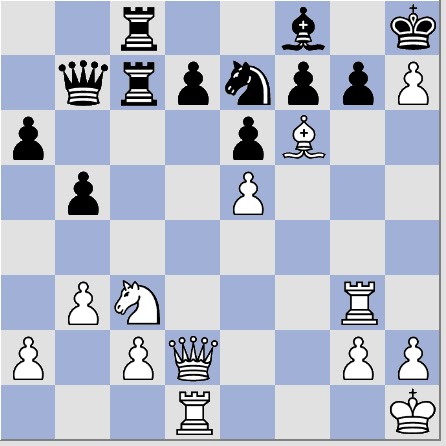
Hou Yifan is the Women's World Champion in chess, and the number two junior player (behind Anish Giri). In August 2011, she participated in the Chess World Cup, a qualifier for the Candidates stage of the 2013 World Chess Championship. She lost in the first round to Sergei Movsesian. Things might have been different. In her game with White (she and Movsesian played two games), she missed a winning tactic. The critical position was presented in the Combinations section of Chess Informant 112. I was frustrated to miss the tactic during my morning training, but at least I'm in good company!

White to move

Can you do better than the Women's World Champion?


Chess Informant Expert Software

Viewing Chess Informants is best within their proprietary software. Chess Informant Expert presents the positions much as they appear in the print edition.

Screenshot of CI 112 Combinations
Clicking on a diagram opens the position for solving. Feedback is limited to whether the answer is correct or wrong. A button (the green check mark) at the bottom of the screen reveals the full problem annotation. The hand makes the next move of the combination. The board can be flipped as well.

Solving Screen in Chess Informant Expert