Showing posts with label Queen's Indian Defense. Show all posts

05 July 2017

Blundering into Victory

On Monday, David Griffin and I met at the Spokane Valley Library to play our game in the Spokane Contenders. This six player round robin began in early May and must be completed by early August. The winner faces Michael Cambareri in the City Championship. Our game was Griffin's fifth and my first. I stated to those who asked that I would play all of my games in July.

This game was the second time that I faced Griffin's Nimzo-Larsen Attack. In the first, I opted for an attempt at tactical refutation, came out of the opening slightly worse, but then was able to gain the advantage when Griffin missed a knockout blow. I opted for a positional response this time and secured a clear space advantage from the opening. As I was playing for checkmate, I made a few errors that let my opponent crawl back into the game. He missed his chances, though, and I had a slight edge in the endgame.

Then, I blundered throwing away the game. This blunder, however, proved to be the game winning move.

Griffin,David (1523) -- Stripes,James (1841) [A06]
Spokane Contenders Spokane, 03.07.2017

1.Nf3 c5 2.b3 Nf6 3.Bb2 d5 4.e3 g6 5.Be2 Nc6 6.0–0 Qc7N

I was pleased to reach nearly the same position I had against Michael Cambareri when I beat him in seventeen moves, but with colors reversed. I contemplated whether lack of deployment of the bishop to g7 was of any account.

6...Bg7 7.Ne5 (7.d4 cxd4 8.exd4 0–0 9.c4 dxc4 10.bxc4 Ne4 and drawn in 51 moves Rethy,P [2389] -- Szabo,L [2537], Budapest 1940) 7...Nxe5 8.Bxe5 0–0 9.Qc1 Ne8 10.Bxg7 Nxg7 11.f4 Qd6 and drawn in 36 moves Trompowsky,O (2366) -- Cruz,W (2307), Rio de Janeiro 1940.

7.d3

Griffin spent twenty minutes on this move.

7.c4 d4 8.exd4 cxd4 9.Nxd4 Qe5 would have pleased me.

7...Bg7 8.Nbd2 0–0 9.h3 b5

White often plays b4 against the QID. Indeed, A row of pawns on d4, c4, and b4 occurred in several of the games I went through preparing for my Club Championship battle with Michael.

10.Nh2

I was impressed that all of White's pawns are capable of moving to the fourth rank. While it appears that I am gaining space with my pawns on the queenside, I could easily find myself in possession of a fragile center.

Black to move

10...e5

10...Bb7 11.f4 and White will post a minor piece on e5.

11.f4 d4 12.fxe5 Qxe5

12...Nxe5 would be a gross error 13.exd4 cxd4 14.Bxd4±.

13.e4

Black has more space, leading to greater mobility and flexibility. And yet, it is not entirely clear how to proceed. I would like to exploit some apparent weaknesses around the White king, but the defensive forces seem adequate. Before my queen can profitably occupy the weakened g3 square, White must commit a knight or bishop to f3.

13.exd4 Nxd4 14.Nhf3 Qe3+ 15.Kh1 Bb7 16.Bxd4 (16.Nxd4 Qxh3+ 17.Kg1 Qxg2#) 16...cxd4.

13...Be6

I didn't like 13...Qg3 14.Rf3.

13...a6 was a move that I considered, but regarded as slow. Still, it increases the mobility of my rook on a8, which could then lift to the seventh rank. It also transfers the onus of making important strategic and tactical decisions to my opponent.

14.Ng4 Nxg4

14...Bxg4 15.Bxg4 Bh6.

15.Bxg4

Black to move

15...f5

This forcing sequence left me with a weak f-pawn, but also opened the g-file for my heavy pieces. I considered 15...Qg3 16.Rf3 Bxg4 17.Rxg3 Bxd1 18.Rxd1 when it was not clear to me that I had gained anything from the material exchanges. I needed to win this game, so eschewed simplification that did not lead to clear advantage.

15...Bh6!? 16.Bxe6 Be3+ 17.Kh1 Qxe6.

16.exf5 gxf5 17.Bf3 Rac8 18.Re1 Qd6

What has become of my advantage? My forces are in retreat. And yet, I was confident that retreat was merely redeployment and that White's forces lacked coordination.

19.Nf1

19.Bxc6 seems worthy of consideration in view of the principle that a player lacking space should exchange pieces.  19...Rxc6 But, this rook will soon come to g6 and the pressure on g2 may be too much for White.

19...Ne5 20.Nh2

20.Bc1 f4 (20...Nxf3+ 21.Qxf3 Bd5 22.Bf4 Qc6 23.Qf2) 21.Nd2.

20...Rf6

20...Nxf3+ 21.Nxf3 Bd5
20...Bh6 with plans to play Be3+.

21.Bc1 Rg6

White to move

22.Kh1?!

22.Bh5! Bd5 (22...Rf6 23.Bf4+-) 23.Bxg6 Qxg6 24.Re2 Nf3+ 25.Nxf3 Bxf3 26.Bf4 and the game favors White. Black can win back the exchange, but has a weaker pawn structure.

22...Nxf3 23.Nxf3 Bd5 24.Bd2

Black to move

24...Rg3!

24...Qg3 25.Rg1 (25.Re2 Bxf3–+) 25...Re8.

25.Rf1 only move Re8

I underestimated 25...Qg6 26.Rf2 Bxf3 27.Rxf3 Rxg2 28.Qe1.

26.Be1 Rg6 27.Nh4 Re3! 28.Rf3 only move

28.Nxg6 Rxh3+ 29.Kg1 Qh2+ 30.Kf2 Qxg2#.

Black to move

28...Bxf3

28...Rge6 29.Bf2 Bxf3 30.Nxf3 Re2 was a better means of keeping control of the game.

29.Nxf3 Qd5?!

I wanted to maintain the pin on g2 with its attendant checkmate threats. I considered 29...Rge6 which would have been more logical. There is no realistic chance to find checkmate, but domination of the open file keeps White's pieces in a passive role.

30.Bf2 Re7

Again, my forces are in retreat.

31.Qf1 Bh6! 32.Re1 Be3 33.Nh4 Rge6

At this point in the game, I sensed that I had let my advantage slip away. However, Stockfish insists that my advantage is as strong as it had been at any point prior. Nonetheless, it would slip away soon.

33...Rh6 34.Nf3 (34.Bxe3 Rxe3 35.Rxe3 dxe3 36.Nxf5 Rxh3+ 37.Kg1 and what will I do about Ne7+? ) 34...f4.

34.Bxe3

Black to move

34...dxe3?

34...Rxe3 was best

a) 35.Nxf5 Rxe1 (35...Rxh3+?? 36.Kg1 Rxe1 37.Qxe1 Qxf5 38.gxh3=) 36.Nxe7+ Rxe7–+.

b) 35.Nf3 Rxe1 36.Nxe1 Qe5–+.

c) 35.Rxe3 dxe3 (35...Rxe3 I had examined 36.Nxf5 Rxh3+ 37.Kg1 Re3 38.Nxe3 dxe3=) 36.Nxf5 Re6–+.

35.Qxf5 Re5

35...Qxf5 36.Nxf5 Rf7 37.g4 e2 was not to my liking.

36.Qg4+ Kh8 37.Qc8+ Re8 38.Qg4 Rg8

38...Qd4! Black maintains a clear advantage in all lines.

39.Qf4

39.Qe2 Rf8.

39...Reg5

39...e2

40.Qf6+ R5g7 41.Rxe3

Black to move
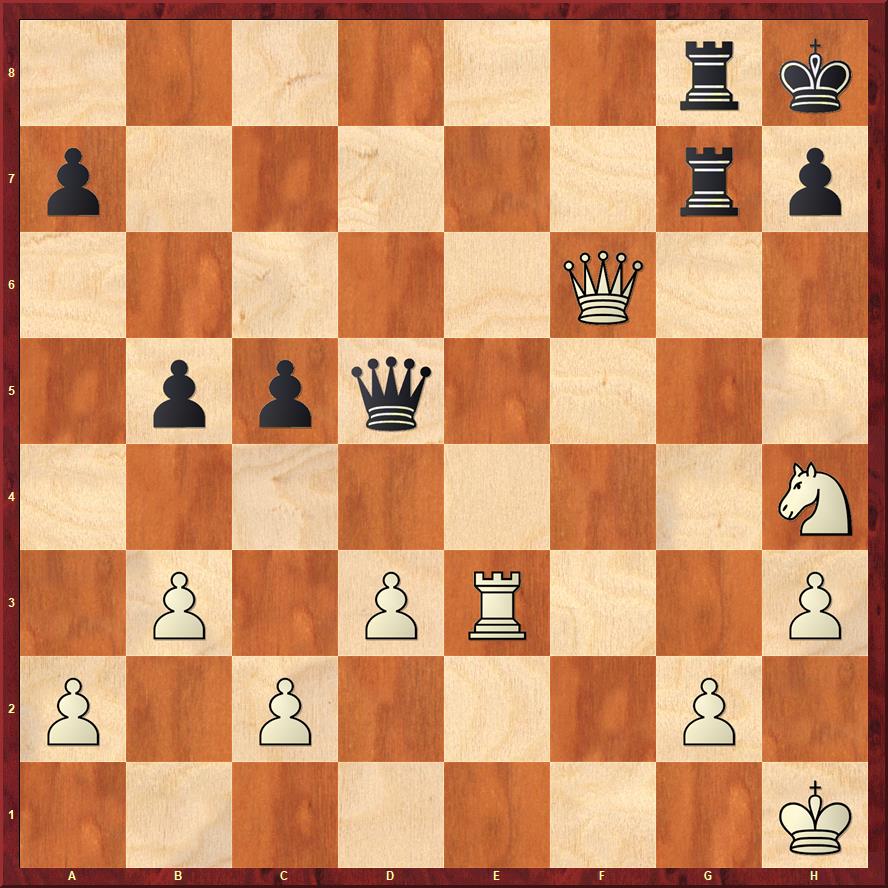
It has become clear that not only have I squandered an advantage, but am in danger of losing.

41...Qd4?

I regretted not playing this move three moves earlier and now felt that it was forced, completely missing White's refutation.

41...a5 42.Re5 Qf7 43.Qxf7 Rxf7 44.Rxc5±
41...Qf7= with equal chances for both sides.

42.Qxd4

42.Re5±

42...cxd4 43.Re4

43.Re2 is probably equal.

43...Rc7

I still have hope of advantage with a pawn exchange because my rook also restrains the enemy king, while my own king might join the fight.

44.Rxd4 Rxc2 45.a4 bxa4 46.Rxa4

Black to move

46...Ra8

46...Rg7 was the correct way to defend the pawn, keeping pressure on g2.

47.d4 Rb2 48.b4 Kg8 49.Nf5 Kf7 50.g4 Kf6

50...Kf8 would have been a beautiful prophylactic move.

51.h4

Black to move

51...Rc8??

Right idea, wrong square.

51...Re8 52.Ra6+ Re6 53.Ra1 a6 and Black is pressing with the advantage.

52.Rxa7??

With both his rook and my pawn still in his hand, David saw the ensuing checkmate and resigned here. Having touched my pawn, he could no longer retract his move.

52.Ra6+ Kf7 53.Nd6++-.

0–1


25 March 2017

A QID Miniature

The Queen's Indian Defense fascinates me. Due to my preparations for facing it from the White side, I have started employing it more often when I have the Black pieces. Last week, I played it in the first round of the Spokane Chess Club's Game 61, and was never at a disadvantage in the game (see "Playing Tired"). Thursday morning, I employed it against a National Master in a three minute online blitz game and was never really worse. Then, with ten seconds left, my opponent dropped a rook in a rook and pawn ending that should have been drawn and I obtained another master scalp.

Thursday night, I faced Michael Cambareri in the final round of our Game 61. Michael is our City Champion and won several grade restricted national championships when he was in elementary school in the first decade of this century.

Stripes,James (1853) -- Cambareri,Michael (1977) [E17]
Game 61 Gonzaga University (4), 23.03.2017

1.d4 Nf6 2.Nf3 b6 3.g3 Bb7 4.Bg2 e6 5.c4 Be7 6.Nc3 0–0 7.Qc2 c5 8.d5 exd5

Michael and I have had this position earlier this year. It was one that I was well prepared for and expected to reach again.

9.Ng5

9.cxd5 White's third most popular move has White's best scoring percentage, but I had resolved before the game began to try 9.Ng5. I played 9.cxd5 in our Club Winter Championship in February. See "Home Preparation".

9.Nh4 is also popular, and has scored better than 9.Ng5.

9...g6

9...h6 is Black's most popular reply, but after 10.h4 White has scored 100% in the handful of master games reaching this position. I would have been happy to play that position, which the chess engines say is equal.

10.cxd5 Na6

White to move 

I expected 10...d6, and indeed thought it was necessary. If so, then my failure to find the refutation highlights a focus area for further opening preparation.

11.e4

I looked at something along the lines of 11.0–0 Nb4 12.Qd1 Nfxd5 13.Nxf7 Rxf7 14.Nxd5 Nxd5 15.Bxd5 Bxd5 16.Qxd5. However, because I failed to anticipate Black's next move, I was in less of a hurry to castle. The ensuing tactics might serve as an argument in favor of 9.Nh4.

11...Nxd5! 12.Nxf7

12.Nxh7 did not seem as good 12...Ndb4 13.Qd1 Kxh7 and White is down a piece.

12.Nxd5 is plausible 12...Bxg5 13.Bxg5 Qxg5 14.f4 was the end of my analysis during the game. Had I carried it further, perhaps I would have been less concerned about the one pawn deficit. 14...Qd8 15.e5 Bxd5 16.Bxd5 Nb4 17.Qd2. In this position, perhaps White has compensation for the pawn.

12...Rxf7 13.exd5?!

13.Nxd5 was better 13...Nb4 14.Nxb4 cxb4 15.0–0 with equal chances for both sides.

13...Nb4 14.Qd1 Ba6

White to move

15.Be4?

I considered 15.Bf1, but my move seemed more active because I underestimated Black's next move.

15...Bf6-+ 16.a3

16.f3

16...Bxc3+ 17.bxc3 Qf6 18.f3 Qxc3+ 19.Bd2

19.Kf2 Qxa1 20.axb4 cxb4 21.Qd2

19...Nd3+ 20.Bxd3

20.Kf1 Nb2+

20...Qxd3

White to move

21.Kf2 Rxf3+ 0–1

I have had enough suffering and resigned. Obviously 22.Qxf3 is no good. 22...Qxd2+ 23.Kg1 Rf8.

Michael thought that I might play on with 22.Kg2, but Black has all the fun. For instance 22...Raf8 23.Bf4 R3xf4.

13 February 2017

Decisive Advantage?

When do you resign? Losing an exchange should not be sufficient cause for resignation. But, what if you are down an exchange and your opponent is rated 300 Elo higher? What if you are down an exchange and your position is passive?

Going through the games in Branko Tadic and Goran Arsovic, Encyclopedia of Chess Miniatures (2015), I came across a game where it seemed that Black might have resigned a little early. It did seem as though White's play from the position at the end of the game was relatively straightforward and that Black was consigned to passive defense. Even so, most players would play on in such a position.

I searched for the game online and found that 2700chess.com has it. That site offered me the option of playing against the computer from the final position. Of course, I could easily set up the game on my computer and play Stockfish 7, but it was coffee time. While drinking my coffee, I like to sit in the living room with my dogs and use my iPad. The strongest chess engine setting that seemed available to me on the website was 2200--good enough that it will exploit tactical blunders or force a draw if the opportunity arises.

Komarov,Dimitri (2541) -- Bogdanov,Emil (2249) [E12]
FRA-chT N1 Drancy (3), 06.02.2005

1.d4 Nf6 2.Nf3 e6 3.c4 b6 4.a3 Bb7 5.Nc3 Be7 6.d5 0–0 7.g3 d6 8.Bg2 Re8 9.0–0 Bf8 10.b4 c6 11.Nd4 cxd5 12.cxd5 Nxd5 13.Nxd5 Bxd5 14.Nxe6 fxe6 15.Bxd5 Nd7 16.Bxa8 Qxa8 17.Bb2 Be7 18.Rc1 1-0

Black to move

After playing against the computer, my coffee was finished. I went to my computer, entered the moves into a database, and ran quick analysis with Stockfish 7 at full strength to observe what I or the weakened engine on 2700chess.com might have missed.

Stripes,J -- Stockfish (2200 strength)
2700chess.com

18...b5 19.Qb3 Bf6 20.Rc7

Stockfish seems to prefer that I play Rc7 before Qb3. 19.Qd3 was also an option. All of these moves offer white an advantage of 2.5+, a little more than the material difference.

20...Ne5 21.Bxe5

I did not want this knight plugging the c-file.

21...Bxe5 22.Qe3 Qd5 23.Qxa7 Bb2

White to move

One improvement Stockfish 7 noted up to this point was that I might have played Rfc1 on any of several moves. Now, Black prevents bringing the second rook to the open file.

24.Qb7

Is it beneficial to exchange queens when ahead a rook for a bishop, and with more active rooks? I thought so here.

24...Qe5 25.Re7

At first, Stockfish prefers 25.e3, but as it examines the position longer, it likes my move almost as much as its first choice.

25...Rxe7 26.Qxe7

Threatening checkmate in one.

26...h6

26...h5 might be a little better.

27.Rb1

This move drops the computer's assessment of White's advantage from near 5.0 to 3.5. Even so, it seems that I have improved White's advantage from the end of Komarov -- Bogdanov.

Stockfish likes 27.Qe8+ Kh7 28.a4.

I did not look at this variation during the game. The central Black pawns had been my focus when considering why Bogdanov resigned.

27...Qxe2 28.Qxd6 Kh7

White to move

29.Rxb2!?

The point of my move 27. Giving back the exchange to enter a queen ending with only a one pawn advantage would normally seem the way to convert a win into a draw.

29...Qxb2 30.Qd3+ Kh8 31.h4?!

I had originally planned 31.Qxb5 Qb1+ 32.Kg2 Qe4+ but was not prepared to play 33.f3 Qc2+ 34.Kh3. This unplayed line is Stockfish 7's preference.

31...Qe5

White to move

My advantage has diminished to 1.27, but my confidence is now rooted in the observation that Black's queen can defend both e6 and b5 from relatively few squares.

32.Kg2 Kg8 33.Qf3 g6

Stockfish 7 sees this move as half a pawn worse than 33...g5. Was 33...g6 Black's critical error? It seems to me that I now have a third pawn for my queen to attack. How can Black defend everything?

34.Qb7 Qe2 35.Qb8+ Kg7 36.Qc7+ Kh8

White to move

37.Qd8+

37.Qf7 seems faster.

37...Kg7 38.Qe7+ Kg8 39.Qf6

Black to move

39...h5

39...Qe4+ at first seems to refute my plan to convert a queen ending 40.Kh2

a) 40...Qf5 41.Qxf5 exf5 42.Kg2 should be a simple win for White
b) 40...Qc2 41.Qxe6+ Kg7 42.Kg2 increases White's advantage to two pawns and weaknesses remain in the Black position.

40.Qxg6+ Kh8 41.Qf6+ Kh7 42.Qf3 Qe5 43.Qe3 Qd6

43...Qd5+ 44.f3 Qa2+ 45.Kh3 Qa1 complicates my task.

44.Qe4+

Black to move

44...Kh6

44...Kg7 45.Qb7+ Kf6 46.Qxb5 and now three pawns to the good for White.

45.Qf4+ Qxf4 46.gxf4

Black to move

The rest is simple.

46...Kh7 47.Kf3 Kg6 48.Ke4 Kf6 49.f3+-

Checkmate was delivered on move 69.


10 February 2017

Home Preparation

The Queen's Indian Defense vexes me. I have struggled enough against it that I've found myself playing the Black side recently in blitz. Memories of a particularly frustrating game in 2010 are always present when I face the QID. In a rapid event at the Spokane Chess Club, I had White against Michael Cambareri. At the time, my only win against him had been a blitz game several years earlier when he was in third grade. But, he had taken some time off chess and was just coming back. In a bunch of casual games one night at the club, I won as many as I lost. I thought that I had a chance.

I played well that night, but could only manage a draw. A draw was still a good result for me against Michael, but my ambitions called for more. Three months later, we played another tournament game with the same first seven moves. I tried a different eighth move and lost, just as I had lost previously in 2007.

After last week's games, I thought there was a good chance that I would be playing Michael this week in the Spokane Chess Club Winter Championship. I started reviewing our games in the French Defense, thinking that I would have Black. On Monday, I received the email that told me that I had White against Michael. I started some work on the Queen's Indian Defense. Over the course of the next three days, I probably looked at four dozen grandmaster games.

I did not expect that Sergey Karjakin's 2007 miniature against Falko Bindrich would be helpful, but was aware of the possibility. My study convinced me that the most likely scenario was that we would reach a position out of the opening where I would not feel hopelessly lost in terms of ideas concerning how to proceed. With some luck, I might get a little ahead on the clock thanks to my preparation. In a game 90 + five second delay, being ahead on the clock can help.

Karjakin's miniature is astounding and should certainly be studied by players of the Queen's Indian Defense.

Karjakin,Sergey (2686) -- Bindrich,Falko (2469) [E17]
EU-ch 8th Dresden (10), 13.04.2007

1.Nf3 Nf6 2.c4 b6 3.g3 Bb7 4.Bg2 e6 5.d4 Be7 6.Nc3 0–0 7.Qc2 c5 8.d5 exd5 9.cxd5 Nxd5 10.Qe4!

Black to move

10...Nb4 11.Qxb7 N8c6 12.Bf4 g5 13.0–0–0 gxf4 14.a3 1–0

When the diagram position appeared on my board last night, I realized that I could not remember all of this game. I realized that I had entered a tactical battle where my queen could very well become trapped.

We both had used about five minutes to reach this position. Now my opponent spent eight minutes. I also used his thinking time trying to recall, and to calculate for myself. If my queen becomes trapped, I lose.

Stripes,James (1791) -- Cambareri,Michael (1993) [E17]
SCC Club Championship (4), 09.02.2017

1.d4 Nf6 2.Nf3

My move order reserves the possibility of going into the London System (see "Fiddling with the London System").

2...b6 3.c4 e6 4.g3 Bb7 5.Bg2 Be7

White to move

6.Nc3

Castling is White's most popular move by far. When I complained to my friend John Julian some years ago about my frustration with Michael's set-up in the Queen's Indian Defense, his advice was, "don't let him set it up." My choice of White's second most popular move was the first step in hindering his tableau.

6...0–0 7.Qc2 

Delaying castling in this manner runs the risk that my king might get stuck in the center, or that I would need to expend the time to castle by hand. But, preventing Ne4 and f5 by Black was my intent.

7...c5 

Black also plays 7...d5 or 7...Na6 here. There are other obscure possibilities that do not seem as good. With either of these two moves, I would be in for a long struggle, but felt that I had looked at enough games that I might play well enough for a draw.

8.d5 exd5 9.cxd5 Nxd5?! 

Annotations on Karjakin's miniature recommend 9...Bxd5.

10.Qe4!

Michael admitted after the game that he did not anticipate this move. See diagram in Karjakin game above.

10.Ng5 was played in Tomovic -- Pirc, Zagreb 1949.

10...Nb4

10...f5 11.Qc4 b5 12.Qxb5 Nb6 13.Be3 Na6 14.0–0  was drawn in 52 moves in Lagno,K (2557) --Dzagnidze,N (2535), Tbilisi 2012

11.Qxb7 N8c6 12.Bf4 Nc2+

12...g5 13.0–0–0 gxf4 14.a3 1–0 Karjakin,S (2686) -- Bindrich,F (2469)/Dresden 2007 (presented above).

13.Kd2 Nxa1 14.Rxa1 

Black to move

14...Rc8N

14...Bf6 15.Rd1 Bxc3+ 16.bxc3 Qf6 17.Bh3 and White won in 33 moves in  Gajewski,G (2515) --Hernandez Carmenates,H (2524), Calvia 2006.

At this point in the game, I could not recall whether we were still following the Karjakin game or not. I had to do the tactical and positional calculation on my own. However, the knowledge that I was winning in the objective sense after 10.Qe4 gave me confidence. I labored to combine confidence with a clear head and find strong moves.

15.Nd5!

"This move killed me." M. Cambareri during postgame analysis.

15... d6 16.Rd1 Bf6 17.Bh3 1–0

At this point in the game, I had used sixteen minutes, while Michael had used 34. He thought for another 34 minutes, then tipped his king.

While he was thinking, I walked to stay calm, frequently returning to the board trying to anticipate his move and my response. I thought that 17...Na5 was the most testing.


14 November 2014

Anand -- Carlsen, Game 5

In order to blog the World Championship match, I need to set the alarm to arise early. I was awake a few minutes after today's game began and looked at the game on my iPad from the comfort of bed. An hour later, I looked at the game again and concluded that Viswanathan Anand was not getting much with the White pieces.

When the alarm went off, I made coffee and fed the dogs. By the time I settled into my chair to check on the game, it was over and Magnus Carlsen and Anand were sitting at the board discussing the game. The press conference started a few minutes later.

Reporters are proving adept at asking questions the players will not answer.

Magnus, are you still looking for a response to 1.d4?
Maybe.

Vishy, are you playing at your best?
During a match is not the time for such analysis.

Magnus, after 22.Qf3, did you feel as if you were playing against yourself?
No, but of course it is more pleasant to play White in such a position.

Anand,Viswanathan (2792) -- Carlsen,Magnus (2863) [E16]
WCC Sochi (5), 14.11.2014

1.d4 Nf6 2.c4 e6 3.Nf3 b6 4.g3 Bb4+ 5.Bd2

5.Nbd2 is also playable, but Anand's move is vastly more popular.

5...Be7 6.Nc3 Bb7 7.Bg2

Black to move
After Anand's 7.Bg3

I have had White in this position twice in online games. I misplayed both games, winning on time in a dead lost position and forcing a draw by repetition after squandering a material advantage in the other.

7...c6

Carlsen chooses an uncommon move

8.e4 d5 9.exd5

9.cxd5 has also been played.

9...cxd5 10.Ne5 0–0 11.0–0 Nc6 12.cxd5 Nxe5 13.d6!?N

13.dxe5 Nxd5 14.Nxd5 Bxd5 15.Bc3 Bxg2 16.Qxd8 Rfxd8 17.Kxg2 Rd5 18.Rfd1 Rad8 19.Rxd5 Rxd5 20.f4 f5 21.Rc1 Kf7 22.Be1 ½–½ Komljenovic,D (2465) -- Palac,M (2561) Sibenik 2010

Black to move
After Anand's 13.d6

13...Nc6 14.dxe7 Qxe7

Anand has created an imbalance of bishop versus knight.

15.Bg5 h6 16.d5 Na5 17.Bxf6 Qxf6

The minor piece imbalance has been eliminated. Anand is, however, maintaining the initiative.

18.dxe6 Qxe6 19.Re1 Qf6 20.Nd5 Bxd5 21.Bxd5

Again, there is a minor piece imbalance.

21...Rad8 22.Qf3

Here the game becomes interesting. During the press conference, the players went through a couple of interesting variations that they considered during the game.

Black to move
After Anand's 22.Qf3

22...Qxb2 23.Rad1 Qf6 24.Qxf6 gxf6 25.Re7

Black to move
After Anand's 25.Re7

25...Kg7

25...Nc6 reveals potential dangers in this position 26.Rc7 Ne5 (26...Rd6 27.Rxc6; 26...Nb4 27.Bxf7+ Kg7 28.Be8+) 27.Rxa7.

26.Rxa7 Nc6 27.Rb7

27.Rc7 Ne5 28.f4 Rd7 29.Rb7.

27...Nb4 28.Bb3 Rxd1+ 29.Bxd1 Nxa2 30.Rxb6 Nc3 31.Bf3 f5 

White to move
After Carlsen's 31...f5
32.Kg2 Rd8 33.Rc6 Ne4 34.Bxe4 fxe4 35.Rc4 f5 36.g4 Rd2 37.gxf5 e3

White to move
After Carlsen's 37...e3

38.Re4 Rxf2+ 39.Kg3 Rxf5 ½–½

The match score is 2.5-2.5

Carlsen gets White in the next two games.

23 January 2014

Aronian -- Karjakin, Tata Steel 2014

Battling Karjakin's Queen's Indian

In the 2014 Tata Steel Grandmaster tournament in Wijk aan Zee, Netherlands, Levon Aronian leads after eight rounds with 6.0. Sergey Karjakin is one-half point behind in second. Their battle today is critical to the final standings. Aronian has White.

Aronian,Levon (2812) -- Karjakin,Sergey (2759) [E15]
Tata Steel Wijk aan Zee (9), 23.01.2014

1.d4 Nf6 2.c4 e6 3.Nf3 b6 4.g3 Ba6 5.b3 Bb4+ 6.Bd2 Be7 7.Nc3 0–0 8.Bg2 c6 9.e4 d5 10.exd5 cxd5 11.Ne5

Black to move

11...Bb7 

Reference Game: 11...Nfd7 12.0–0 Nxe5 13.dxe5 Nd7 14.Re1 dxc4 15.Bxa8 Qxa8 16.Bh6 Rd8 17.Qg4 Bf8 18.Rad1 Nc5 19.bxc4 Bb7 20.Rxd8 Qxd8 21.Rd1 Qc7 22.Bf4 Qc6 23.f3 Nd7 24.Ne4 Qa4 25.Rxd7 Bxe4 26.Rd8 Bg6 27.Bg5 Qa3 28.Qd4 h6 29.Qd6 Kh7 30.Qxf8 1–0 Aronian,L (2816) -- Karjakin,S (2778) Sao Paulo 2012

12.0–0 Nc6 13.Bf4 Na5 14.Rc1 Ba3 15.Rb1 Bb4

White to move

16.Ne2

Reference Game: 16.Na4 Ne4 17.a3 Be7 18.cxd5 exd5 19.b4 Nc6 20.Rc1 Rc8 21.Bh3 f5 22.f3 Nd6 23.Qd3 Nxe5 24.dxe5 Rxc1 25.Bxc1 Nc4 26.f4 b5 27.Nc3 Qb6+ 28.Rf2 d4 29.Ne2 Rd8 30.Qxf5 d3 31.Qe6+ Kf8 32.Qf5+ Ke8 33.Qxh7 d2 34.Bxd2 Rxd2 35.e6 Rd1+ 36.Bf1 Qxe6 37.Qh5+ Kf8 38.Nc3 Qc6 0–1 Aronian,L (2813) -- Karjakin,S (2767) Sandnes 2013

16...Nc6 17.Bg5 Be7 18.Nf4 Qd6 19.Bxf6 Bxf6 20.cxd5 exd5

White to move

21.Bxd5 Bxe5 22.dxe5 Qxe5 23.Re1 Qf6 24.Nh5 Qh6 25.Qg4 Qg6 26.Qh3 Rad8

White to move

There are some tactics here. I considered two moves, favoring the one played by Aronian.

27.Nf4

Be4 was the alternative.

27...Qf6

Of course. White can threaten checkmate with 28,Be4, but after 28...g6, White no longer seems to have an attack. How will Aronian increase the pressure?

28.Be4

I was hoping there was something better. But, I did not find it.

28...g6

Maybe if I understood why Karjakin spent more than nine minutes for this move, I would be a decent chess player, too.

29.Nd5 Qg7

Forcing a minor piece exchange is the first candidate move that comes to mind: 30.Ne7+ Nxe7 31.Bxb7. Aronian has an hour to half an hour for Karjakin. Will the clock be a factor over the next eleven moves?

30.Rbc1

This move shows why I follow Aronian's games. While I am looking at a simple tactic that creates an imbalance, but that also reduces the material on the board, he improves his weakest piece. Aronian finds ways to build pressure. Karjakin has faced this pressure before, of course. He became the youngest Grandmaster in history a dozen years ago, and his record stands today.

Among the building threats is an exchange of rook for two minor pieces.

30...Kh8

Most of the tactics that I was considering rely on a check at e7. Karjakin took that away.

White to move

31.Nxb6

Aronian shows there is still a discovery on c6 without the check.

31...axb6 32.Bxc6 Bxc6 33.Rxc6 Rd2 34.Qh4

I sometimes miss these quiet moves.

34...Rxa2

White to move


I was contemplating 35.Rxb6, but did not like 35...Qb2 with a battery on the second rank.

35.Qb4

Revealing the purpose, or one of them, behind the quiet move. Now, Qb2 loses instantly. Aronian should win the b-pawn. He will then have a passed pawn against which Karjakin must defend. Meanwhile, Karjakin will not be able to develop threats against f2.

35...h5 36.Qxb6

The pawn falls. With twenty minutes to go for four moves, Karjakin should easily reach the time control. However, his position is now clearly worse even though the advantage for White is not yet decisive.

36...Ra1 37.Rcc1

Can Aronian get a rook behind his passed pawn and keep it there? Perhaps his plan is to post his queen on c5 in order to usher the pawn to b6.

One possible line: 37...Rxc1 38.Rxc1 Qb2 39.Qe3 with threats of Qc6+ and Qh6+ may be bad for Black. We may see. Qh6+ does not look dangerous, but an exchange of queens on c3 should give White a winning advantage.

37...Rxc1 38.Rxc1 Qb2

My line has been played part-way, and now I notice that 39.Qe3 is not necessary to defend the pawn because Qc5 hits the rook.

White to move

39.Rd1!

So often when I am looking at one move and Aronian plays something else, I instantly realize that his idea offers more flexibility. I go for the obvious direct threat; he builds pressure. He is number two in the world; I am an A Class club player.

39...Kh7 40.Qb5

I was looking at 40.Qb7.

40...Kg7

Both players have made the first time control. I must leave for work soon. Chances are good that this post will be finished many hours after the game ends.

41.Qd3 Rb8 42.Rb1

Black to move

I marvel at how Aronian managed to get his rook behind his passed pawn.

42...Qe5 43.Qd2 h4

How will Aronian address the threat of h4-h3?

44.Qb2

I think the queens are coming off. White's extra pawn should prove decisive. How far will they play it out? On the other hand, 44...Kf6 may give Black a sufficiently active king to hold the position a pawn down.

Karjakin thought for eighteen minutes and chose the line that I thought was best.

44...Qxb2 45.Rxb2 Rb4 46.Kf1

Black to move

I expect Aronian to win this game, but that may simply reveal how little that I understand rook endings.

46...Kf6 47.Ke2 Kf5

I'm off to work and will update this post this evening long after the game has ended.

Shortly after I arrived at work, I was able to check on this game and see that Aronian had won. I went over the whole game with a couple of my chess students.

48.Kd3 g5 49.Kc3 Rb7 50.b4 Kg4 51.b5 Kh3 52.gxh4 gxh4 53.f4 Kg4

White to move

54.b6 f5 55.Kd4 Kxf4 56.Rb3 h3 57.Kd5 Kg4 58.Kc6 Rb8 59.Rg3+ Kh4 60.b7 f4 61.Rg7 1-0

Black to move

It took me a couple of minutes at lunch to see that, indeed, Black is utterly and hopelessly lost and that I could finish it against a computer or Anand or Carlsen. The ending was probably elementary for Aronian, but most of the rest of us can learn from his technique.

Leinier Dominguez, one of three players 1 1/2 points behind Aronian has White against him on Saturday. Dominguez is the strongest Cuban player since Jose R. Capablanca.