Showing posts with label world champions. Show all posts

30 June 2014

Three Fighting Draws

McDonnell -- De La Bourdonnais 1834

The chess games of Alexander McDonnell (1798-1835) offer abundant instruction in tactics. McDonnell, born in Belfast, Ireland, is considered to have been the strongest chess player in Great  Britain during the early 1830s. He is most often remembered, however, for his matches with Louis-Charles Mahé de La Bourdonnais (1795-1840). McDonnell lost more than half of their 85 games played during six matches. He was thus the runner-up in the first unofficial world chess championship. He also won 27 of those games, however.

For the past several days, I have working through McDonnell's games during my morning coffee. My intention is to go through all of his available games (ChessBase has 110; chessgames.com has 105). Most of his play was at odds, as was customary in his day, so the selection of available games in databases is small. There are 35 games in addition to the match games against Bourdonnais. Two of these are short losses to Captain William Davies Evans, including what is probably the oldest recorded instance of the Evans Gambit. Most of the rest are games played during simuls.

After going through these 35 games neither as fast as Jeremy Silman claims was his habit as a young player, nor slow enough to understand every nuance, I reached the La Bourdonnais match games this morning. They appeared to play by a rule that would remain common for the next several decades: draws do not count and must be replayed. Hence, La Bourdonnais had White through the first four games. Each draw led to another game with the same colors.

Although all drawn, the first three games were battles from the first moves to the finish.

De Labourdonnais,Louis Charles Mahe -- McDonnell,Alexander [C21]
London m1 London (1), 1834

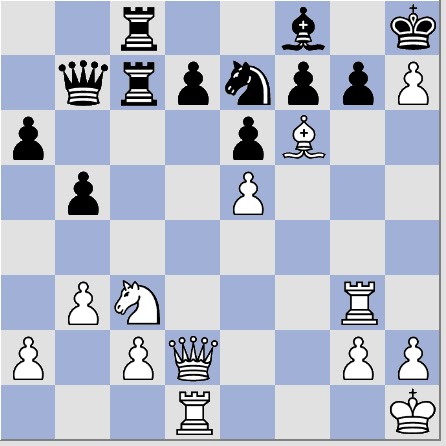
1.e4 e5 2.d4 exd4 3.Nf3 c5 4.Bc4 Nc6 5.c3 Qf6 6.0–0 d6 7.cxd4 cxd4 8.Ng5 Nh6 9.f4 Be7 10.e5 Qg6 11.exd6 Qxd6 12.Na3 0–0 13.Bd3 Bf5 14.Nc4 Qg6 15.Nf3 Bxd3 16.Nce5 Bc2 17.Nxg6 Bxd1

White to move

18.Nxe7+

18.Nxf8? loses material. 18...Bxf3. After the text, White remains down only the sacrificed pawn and retains a slight initiative.

18...Nxe7 19.Rxd1 Nhf5 20.g4 Ne3 21.Bxe3 dxe3 22.Rd7 Rfe8 23.Re1 Ng6 24.f5 Nf4 25.Rd4 Nh3+ 26.Kg2 Nf2 27.Rc4 Rad8 28.h3 h6 29.Re2 b5 30.Rd4 Rxd4 31.Nxd4 a6

La Bourdonnais's aggressive play has led to exchanges and an ending where Black retains the advantage of one pawn, albeit one that will fall.

White to move

32.Kf3 Nxh3 33.Rxe3 Ng5+ 34.Kf4 Rxe3 35.Kxe3

And now it is a knight ending with pawns on both sides. Such knight endings are often sought by players substantially stronger than their opponents because they offer better prospects of victory than rook endings.

35...g6 36.fxg6 fxg6 37.Nc6 Ne6 38.Ke4 Kf7 39.Ke5 h5 40.gxh5 gxh5

White to move

McDonnell has the advantage, but La Bourdonnais has the draw well in hand. As long as he holds, he gets another game with the White pieces.

41.Kf5 Nc7 42.b3 Ke8 43.a4 bxa4 44.bxa4 Nd5 45.Kg5 Ne7 46.Nb8 a5 47.Na6 Ng6 48.Kxh5 Nf4+ 49.Kg5 Ne6+ 50.Kf5 Kd7 51.Ke5 Nd8 ½–½

De Labourdonnais,Louis Charles Mahe -- McDonnell,Alexander [C44]
London m1 London (2), 1834

1.e4 e5 2.Nf3 Nc6 3.d4 exd4

Switching the move order of the first game has led to the Scotch Gambit, an opening occasionally employed as a surprise weapon in our day.

4.Bc4 Qf6 5.c3 d3 6.Qxd3

This time, White recovers the pawn quickly.

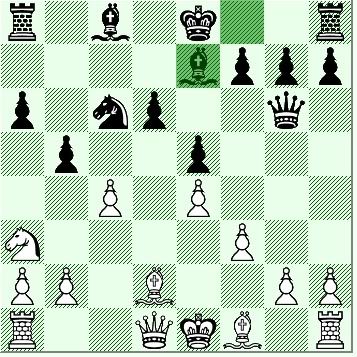
6...d6 7.0–0 Qg6 8.Bf4 Be7 9.Nbd2 h5 10.Rfe1 Bh3

McDonnell, too, shows some aggression.

White to move

11.Nh4 Bxh4 12.Qxh3 Bf6 13.e5 dxe5 14.Bxe5 Bxe5 15.f4 Nge7 16.fxe5

This time, it is White who has a vulnerable e-pawn that is far advanced.

16...Qg4 17.Qxg4 hxg4 18.Nb3 Ng6 19.e6 f5 20.Rad1 Nge5 21.Bd3 Rh5 22.Bc2

Black to move

22...Ke7 23.Nd4 Kf6 24.Rf1 Ne7 25.b4 Rah8 26.Ne2 Rxh2

McDonnell wins a pawn.

27.Ng3 g6 28.Bb3 Kg5 29.Rde1 Nd3 30.Re3 Nf4 31.Rf2 R2h7 32.Rd2 Nh5 33.Nxh5 Rxh5 34.Kf2 f4 35.Re5+ Nf5 36.e7 Re8 37.Rd7

Black to move

La Bourdonnais is positioned to win back a pawn, but McDonnell finds the way to another ending with a one pawn advantage.

37...Rh7 38.Rxc7 Rhxe7 39.Rcxe7 Rxe7 40.Rxe7 Nxe7

White to move

The players reach a minor piece ending where the bishop must contend with a knight that fights alongside a superior number of pawns.

41.a4 Kf5 42.a5 Ke5 43.Bd1 g3+ 44.Kf3 Nd5 45.Bc2 g5 46.b5 Nxc3 47.b6 axb6 48.axb6 Nb5 49.Kg4 Nd6 50.Bd3 Ne4 51.Be2 Kd5 52.Bf3 Ke5 53.Be2 Kf6 54.Bf3 Nf2+ 55.Kh5 g4 56.Bxg4 Ke7 57.Bc8 Kd6 58.Bxb7 Kc5 ½–½

The Frenchman survives again.

De Labourdonnais,Louis Charles Mahe -- McDonnell,Alexander [C44]
London m1 London (3), 1834

1.e4 e5 2.Nf3 Nc6 3.d4 exd4 4.Bc4 Qf6 5.0–0 d6 6.c3 d3 7.Qxd3 Qg6 8.Bf4 Be7 9.Nbd2 Nh6

McDonnell deviates from the previous game.

White to move

10.Rae1 0–0 11.Nd4 Ne5 12.Bxe5 dxe5 13.N4f3 Bd6 14.h3 Kh8

Preparing to thrust the f-pawn forward.

15.Nh4 Qh5 16.Qg3 f5 17.Nxf5 Nxf5 18.exf5 Bxf5 19.Ne4 Bxe4 20.Rxe4 Rf6 21.Rh4 Qf5 22.Qe3 Qd7

White to move

The tension builds in the match as the players keep their queens on the board longer than the first two games.

23.Bd3 g6 24.Be4

La Bourdonnais sets the stage for Aron Nimzovich to articulate the concept of blockade.

24...Raf8 25.Qg3

The g-pawn is threatened.

25...Qg7 26.b4 a5 27.a3 axb4 28.axb4 c5 29.Rb1 cxb4 30.cxb4 Bc7 31.Kh1

Black to move
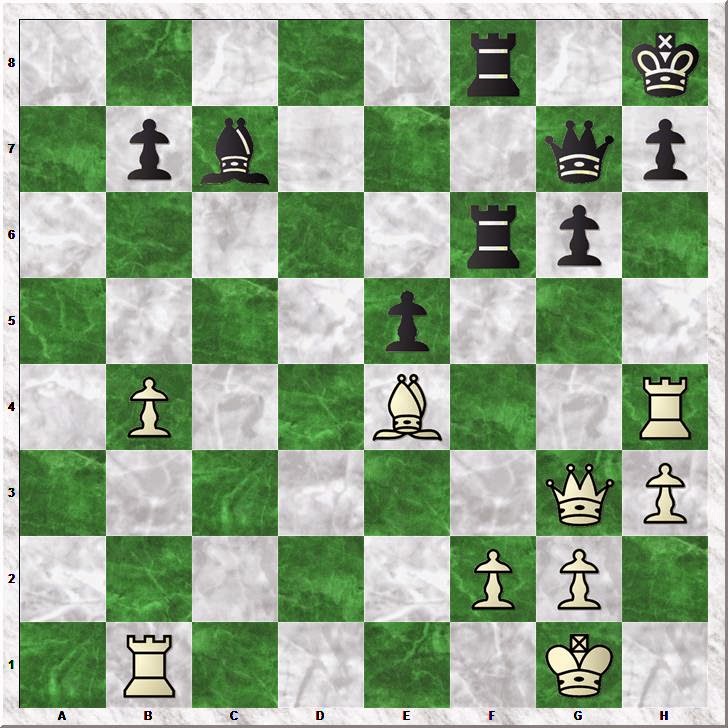
31...Rb6

31...Rxf2? 32.Bxg6

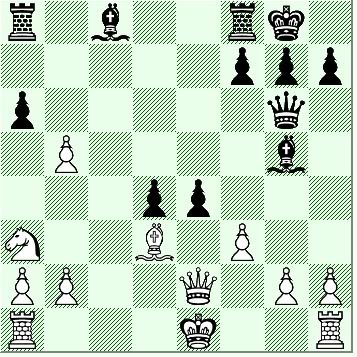
32.b5 Bd8 33.Rg4 g5 34.Bf3 h5 35.Re4 g4 36.hxg4 hxg4 37.Qxg4 Rh6+ 38.Kg1 Qh7

White to move

39.g3 Rg8 40.Qc8 Bb6 41.Qc3 Rxg3+

Exploiting the pinned f-pawn, and the continuation of tactical actions aimed at the rook on b1.

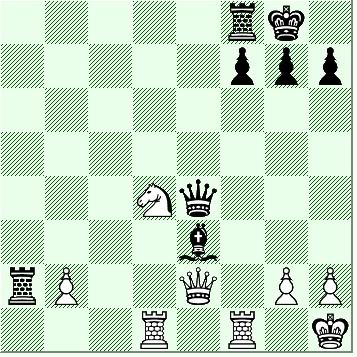
42.Kf1 Bd4 43.Qc8+ Rg8 44.Qc4 Rh1+ 45.Ke2 Rxb1

Black wins the rook

46.Rxd4

White takes a bishop in exchange.

46...Rb2+

46...exd4 appears to lead to a draw by repetition due to perpetual checks by White's queen.*

47.Rd2 Rxd2+ 48.Kxd2 Rd8+ 49.Ke2 Qh6 50.Qc3 Qg7 51.Be4 Kg8 52.Qb3+ Kf8 53.Qf3+

Black to move

Again, perpetual check appears to be a resource for White.

53...Qf7 54.Bxb7 Qxf3+ 55.Kxf3 ½–½

After three games without gaining a clear advantage with White, the Frenchman will find his way to victory in game 4 (see "McDonnell Blunders").

*It is my intention to go through these games and write my own comments without reference to engine analysis. I will check my analysis after completing a pass through all games.

11 April 2012

Lessons from Boris Gelfand

To my mind rating is overrated.
Boris Gelfand*

Nearly everyone believes that Vishy Anand will defeat Boris Galfand in the upcoming World Chess Championship Match, 10-31 May 2012 in Moscow, Russia. Boris Gelfand, the challenger, is not only older than the defending champion, but he is not even in the top ten on the FIDE rating list.

A quick search of Big Database 2011 turns up seventy games between these two players (Gelfand mentioned in an interview that they have played more than 100, including blitz). When Gelfand has had White, he leads 5-4 with 27 draws (only counting the 70 in my database). When Gelfand has had Black, Anand leads 13-1 with 20 draws. Gelfand's last win with White was in 1993, while his only win with Black was more recent in 2008. Such a record does not bode well for the challenger. Still, Bobby Fischer had never won against Boris Spassky when their World Championship battle began.

In their first few encounters, Gelfand drew with Black and won with White. Their second game was in an Interzonal.


Gelfand,Boris (2680) - Anand,Viswanathan (2610) [B38]
Manila Interzonal Manila (3), 1990

1.Nf3 c5 2.c4 Nc6 3.d4 cxd4 4.Nxd4 g6 5.e4 Bg7 6.Be3 Nf6 7.Nc3 0–0 8.Be2 d6 9.0–0 Bd7 10.Qd2 Nxd4 11.Bxd4 Bc6 12.f3 a5 13.b3 Nd7 14.Be3 Nc5 15.Rab1 Qb6 16.Rfc1 Qb4 17.Rc2 Rfc8 18.Qc1 Qb6 19.a3 Qd8 20.Qd2 e6 21.Bf1 Be5 22.b4 axb4 23.axb4 Na4 24.Ne2 Qh4 25.g3 Qe7 26.Nd4 Be8 27.Rbc1 Nb6

White to move

An elementary tactical shot wins a pawn.

28.Nxe6 Qxe6 29.Bxb6 Ra3 30.f4 Bg7 31.Qd5 Bc6 32.Qxe6 fxe6 33.Bg2 e5 34.Rd2 exf4 35.gxf4 Bc3 36.Rxd6 Bxb4 37.c5 Rf8 38.e5 Bxg2 39.Kxg2 Rxf4

White to move

Anand wins back the pawn, but Gelfand's e-pawn becomings menacing.

40.e6 Re4 41.Rd8+ Kg7 42.Rd7+ Kh6 43.e7 Re2+ 44.Kf1 Raa2

Anand generates threats.

White to move

45.Bc7 Ba3 46.Re1 Rf2+ 47.Kg1 Bxc5 48.Kh1

Black to move

Anand is in a quandary.

48...Bxe7 49.Rdxe7 Rf5 50.Bb6 Rf6 51.Be3+ g5 52.Rg1 Rf4 53.Bxf4 1–0


Gelfand's second win came in an endgame with dancing knights.


Gelfand,Boris (2700) - Anand,Viswanathan (2635) [E32]
Munich SKA Munich (10), 15.05.1991

1.d4 Nf6 2.c4 e6 3.Nc3 Bb4 4.Qc2 0–0 5.a3 Bxc3+ 6.Qxc3 b6 7.Bg5 Bb7 8.e3 h6 9.Bh4 d6 10.f3 Nbd7 11.0–0–0 d5 12.c5 Bc6 13.cxb6 cxb6 14.Kb1 Rc8 15.Rc1 Bb7 16.Qe1 Rxc1+ 17.Qxc1 Qa8 18.Bd3 a5 19.Qf1 e5 20.Ne2 e4 21.Bb5 Bc6 22.Nc3 exf3 23.gxf3 Re8 24.Qd3 Bxb5 25.Nxb5 Qc6 26.Re1 Nf8 27.Bg3 Ng6 28.Nd6 Re6 29.Rc1 Qd7 30.Nf5 Rc6 31.Rg1 Re6 32.Rc1 Rc6 33.Rg1 Re6 34.Be5 Nxe5 35.dxe5 Rxe5 36.Nxg7 Rg5 37.Rxg5 hxg5 38.Nf5 Qe6 39.Nd4 Qe5 40.Qf5 Qxf5+ 41.Nxf5 Kf8

White to move

42.Kc2 Nd7 43.Kc3 Ne5

White to move

44.f4 gxf4 45.exf4 Ng6 46.Kd4 Nxf4 47.h4 f6 48.Ne3 b5 49.Nxd5 Ne6+ 50.Ke4 Nc5+

White to move

51.Kd4 Ne6+ 52.Ke3 Nc5 53.Nxf6 Na4 54.Nd7+ Kg7 55.b3 Nc3 56.Kd3 Nd1 57.Kd4 Kg6 58.Ne5+ Kh5
White to move

59.Nc6 1–0

The final position is the sort of position that I like to play against the computer. For instance, what happens after 59...a4?


*"The Homecoming: Boris Gelfand is Back, Part I" ChessBase News (2011).

28 March 2012

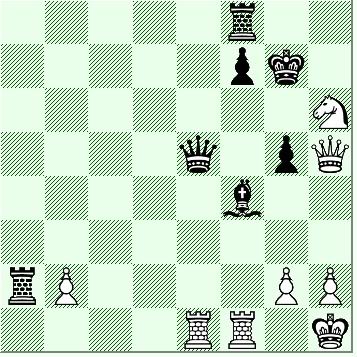
Missing Tactics

Hou Yifan is the Women's World Champion in chess, and the number two junior player (behind Anish Giri). In August 2011, she participated in the Chess World Cup, a qualifier for the Candidates stage of the 2013 World Chess Championship. She lost in the first round to Sergei Movsesian. Things might have been different. In her game with White (she and Movsesian played two games), she missed a winning tactic. The critical position was presented in the Combinations section of Chess Informant 112. I was frustrated to miss the tactic during my morning training, but at least I'm in good company!

White to move

Can you do better than the Women's World Champion?


Chess Informant Expert Software

Viewing Chess Informants is best within their proprietary software. Chess Informant Expert presents the positions much as they appear in the print edition.

Screenshot of CI 112 Combinations
Clicking on a diagram opens the position for solving. Feedback is limited to whether the answer is correct or wrong. A button (the green check mark) at the bottom of the screen reveals the full problem annotation. The hand makes the next move of the combination. The board can be flipped as well.

Solving Screen in Chess Informant Expert

28 March 2010

Vasily Vasilievich Smyslov, 1921-2010

In the art of chess there are no unalterable laws governing the struggle, which are appropriate to every position, otherwise chess would lose its attractiveness and eternal character.
Vasily Smyslov
Grandmaster Vasily Vasilievich Smyslov died Saturday. He was World Chess Champion 1957-1958. For several years after the end of World War II he was considered the second strongest player in the world behind Mikhail Botvinnik. Garry Kasparov states, he "was the strongest player in the world in the mid-1950s" (Kasparov, My Great Predecessors, vol. II, 263); in his three championship matches against Botvinnik, he scored +1. He placed second behind Botvinnik in the 1948 World Chess Championship tournament to choose a successor to Alexander Alekhine.

Smyslov was among the first group of players awarded the Grandmaster title by FIDE in 1950. He won the 1953 Candidates Tournament in Zurich, two points ahead of David Bronstein, Paul Keres, and Sammy Reshevsky. The next year he scored 12-12 (7 wins each) against Botvinnik in the World Championship match, so Botvinnik retained the title. In 1957 he defeated Botvinnik 12.5-9.5 (Smyslov won 6, lost 3) becoming World Champion. Botvinnik regained the title the following year with a score of 12.5-10.5 (Botvinnik won 7, lost 5).

Although his reign as world champion was brief, he continued to qualify for the Candidates' matches into his sixth decade. In 1983 at the age of 62 he lost the Candidates Final to Garry Kasparov, who went on to wrest the World Championship from Anatoly Karpov through two epic matches.

Smyslov became a professional chess player after he failed in his audition as an opera singer at the renowned Bolschoi Theatre. He often sang at international chess tournaments, accompanied by Mark Taimanov on piano, earning accolades for his voice from his fellow competitors. Fifty years after his audition at the Bolschoi Theatre, he performed there in celebration of Anatoly Karpov's birthday.


Search for Truth

Smyslov's chess style was worthy of emulation. Kasparov quotes Smyslov's own expression of his philosophy:
I am a staunch supporter of classical clarity of thought. The content of a game should be a search for truth, and victory a demonstration of its rightness. No imagination, however rich, no technique, however masterly, no penetration into the psychology of the opponent, however deep, can make a chess game a work of art, if these qualities do not lead to the main goal -- the search for truth.
Smyslov, as quoted in My Great Predecessors, 283
In the introduction to the English edition of Smyslov, My Best Games of Chess, 1935-1957, Peter Romanovsky emphasizes his skepticism towards dogma. Romanovsky draws attention to Smyslov's comments on the power of the bishop pair. The following position was reached in the game Euwe-Smyslov from the World Championship tournament.

Black to move


Smyslov played 19...Bxb2. He wrote in My Best Games of Chess (1958):
Outwardly simple, but in actual fact a major decision. Euwe undoubtedly considered this reply, but hoped with the help of his two Bishops to win back the pawn on b3 and obtain the better ending. So great is the conviction nowadays in the advantage of the two Bishops! Here it is interesting to recall that M.I. Tchigorin readily carried on the struggle with two Knights and obtained repeated successes. In the art of chess there are no unalterable laws governing the struggle, which are appropriate to every position, otherwise chess would lose its attractiveness and eternal character.
Smyslov, My Best Games of Chess, 78
Romanovsky observes Smyslov's penchant for unusual moves, but notes:
In the course of his daring denial of the routine and commonplace Smyslov does not in the least depart from classical principles and testaments; quite the reverse, he creates a deepening understanding of these principles, widens their effect and opens new avenues for their development.
Romanovsky, "Vassily Vassilievitch Smyslov," Introduction to My Best Games of Chess, xviii
In his fidelity to classical principles combined with resistance to dogma, Smyslov conscientiously followed the ideas of Tchigorin under whom his father, Vassily Osipovitch Smyslov, had studied. The Russian Chess School of Tchigorin trained the first Soviet masters, and they produced the innovations in training and theory that would dominate chess in the latter half of the twentieth century. Indeed, the upcoming World Championship Match between the challenger Veselin Topalov and the current champion Viswanathan Anand is the first WCC match since World War II that does not feature at least one protagonist that gained his early training in the Soviet School. As the Soviet School was gaining dominance, Smyslov was one of its leading proponents.

27 March 2010

Viswanathan Anand

Inasmuch as World Champion Viswanathan Anand defends his title in one month, it behooved me to install and begin examining the contents of a CD that has been on my shelf for the past few months: "The Best of Chess Informant, Viswanathan Anand." Anand's first annotations in Chess Informant appeared in 38/202. His win with White against Deen Hergott was played in the 1984 Olympiad in Thessaloniki. In the forward to the CD, Anand describes the circumstances of this early publication.
My mother travelled in [sic] me to Thessaloniki in 1984. This was the first time I was to play in the Indian team. When we saw that I would share the hall with other great legends, my mother was extremely proud that I was to play there. I casually mentioned to her that I would never even dream that my games could be published in the Informant. She chased Milutin and persevered until he agreed to have a game of that Indian boy who played fast. If I am not mistaken they carried a game of mine from Thessaloniki. The first game I did for them was with Deen Hergott.
Starting through this game immediately reminded me of a short draw I played on the Internet Chess Club in 1999. The opening moves:

1.e4 c5 2.Nf3 Nc6 3.d4 cxd4 4.Nxd4 e5 (the Kalashnikov, which I played with some frequency in the late 1990s) 5.Nb5 d6 6.N1c3 a6 7.Na3 b5 8.Nd5 Nf6 9.Bg5 Qa5+ 10.Bd2 Qd8

My online opponent opted to repeat the position with 11.Bg5, and we drew after my move 13. Anand was less accommodating towards Hergott.

11.Nxf6 Qxf6 12.c4 Qg6 13.f3 Be7


14.cxb5 Nd4 the novelty. 14...Bh4+ appears in Chess Informant 22/408

15.Be3 O-O 16.Bxd4 exd4 17.Qd2 d5 18.Bd3 Bg5

Anand's annotations note the importance of playing 17...d5 before this move. 17...Bg5 leads to 18.Qxd4 with a strong advantage for White.

19.Qe2 dxe4


Anand's annotations reveal enthusiasm for Chess Informant's system of symbols. If 20.Qxe4 Qxe4 21.Bxe4 Rb8 and Black has compensation for the pawn due to the bishop pair.

20.Bxe4 Bf5 21.O-O

Anand gives explanation marks to Black's move and his own here. On the other hand, the variation beginning with 21.Bxa8 leads to a decisive advantage for Black as his bishops control msot of White's first rank from e3 and d3.

21...Be3+ 22.Kh1 Bxe4 23.fxe4 Qxe4 24.Rad1 axb5 25.Nxb5 Rxa2 26.Nxd4


The critical position. Here, according to Anand, 26...Ra4 leads to equality, but the move played is an error.

26...Qe5? 27.Nf5 Bf4 28.Qg4 g5 (box) 29.Rde1 h5 30.Nh6+ Kg7 31.Qxh5


31...Qxb2?

The final error. 31...Qf6 offers more stubborn defense.

32.Nf5+ Kg8 33.Qg4 Qd2 34.Rd1 Qb4 35.Rd4 Qb8 36.h3 Kh7 37.Rdxf4 gxf4 38.Qg7#

29 October 2008

Anand-Kramnik: Game 11

Will Anand win today? He deserves the title, but not if he cannot find the resources to draw with White. However, as they say, attepting to draw with White is a good way to lose a game. Anand must play actively to get what he needs and finally exorcise those demons that place footnotes next to his World Chess Championship title indicating that he did no earn it through a match. He might today. We''ll know soon.

Anand,V-Kramnik,V
World Chess Championship, Bonn 2008

1.e4!!

Anand returns to his own style, and what is going on?

1...c5 2.Nf3 d6 3.d4 cxd4 4.Nxd4 Nf6 5.Nc3 a6

Kramnik started his career with the Sicilian Defense, and he's playing it again. Anand plays both sides of the Sicilian in tournament after tournament, year after year.

6.Bg5 e6 7.f4 Qc7

7:07am PDT; 3:07pm in Bonn

8.bxf6 gxf6 9.f5

Fifty-eight games dating back to 1960. I choose to highlight one by a couple of less known players because I have faced the White player in OTB play:

Pitre,H - Hoeffler,D [B96]
Seattle op Seattle (3), 1994
1.e4 c5 2.Nf3 d6 3.d4 cxd4 4.Nxd4 Nf6 5.Nc3 a6 6.Bg5 e6 7.f4 Qc7 8.Bxf6 gxf6 9.f5 Nc6 10.Bc4 Qb6 11.Nde2 Ne5 12.Bb3 Bh6 13.Qd4 Qxd4 14.Nxd4 Ke7 15.Na4 Nc6 16.c3 Nxd4 17.cxd4 b5 18.Nb6 Rb8 19.Nxc8+ Rbxc8 20.Kf2 Rc7 21.Rhd1 Rhc8 22.Rab1 Rc1 23.Ke2 Rxb1 24.Rxb1 Rc1 25.Rxc1 Bxc1 26.a4 bxa4 27.Bxa4 Bxb2 28.d5 exd5 29.exd5 Kf8 30.Kd3 Kg7 31.Kc4 Kh6 32.Kb4 Kg5 33.Bd7 Kf4 34.Ka5 Ke5 35.Be6 Kf4 36.Kxa6 Ke3 37.Bxf7 Kf2 38.g4 Kf3 39.Bh5 Ke4 40.Bf7 h5 41.Bxh5 Kxd5 42.h4 Ke4 43.Kb6 d5 44.Kb5 Bd4 45.Bf7 Bf2 46.g5 fxg5 ½–½

9...Qc5

They are slowing down. Now we're down to nineteen games in the ChessBase online database. Across these games, White and Black have an even score, and there is a low drawing percentage. The data is thin, but my intuition tells me that both players are playing to win today.

7:21am PDT


Anand has used twenty minutes and is using more.

10.Qd3 Nc6

11.Nb3 is usual. Anand is thinking about it almost certainly. 11.O-O-O has been played, as has 11.Nxc6.

11.Nb3 Qe5

It looks as though the game is within Kramnik's preparation.

7:38am PDT

12.O-O-O

Three games in database, including one from the 1991 Russian Correspondence championship.

Zelinskis,J - Kopylov,I [B96]
URS-ch19 corr Russia, 1991
1.e4 c5 2.Nf3 d6 3.d4 cxd4 4.Nxd4 Nf6 5.Nc3 a6 6.Bg5 e6 7.f4 Qc7 8.Bxf6 gxf6 9.f5 Qc5 10.Qd3 Nc6 11.Nb3 Qe5 12.0–0–0 Bd7 13.Kb1 Be7 14.Na4 Nb4 15.Qd2 Bxa4 16.Qxb4 Bc6 17.fxe6 fxe6 18.Nd4 d5 19.Qb3 Bc5 20.exd5 Bxd5 21.Bc4 Bxd4 22.Bxd5 Qxd5 23.Qxd5 exd5 24.Rxd4 0–0–0 25.Rf1 Rhe8 26.Rd2 Kc7 27.Rdf2 Rd6 28.Kc1 Ree6 29.Kd2 Kd7 30.Rf5 Ke8 31.Rh5 Rd7 32.Re1 1–0

Is Kramnik forced to think here, or is he bluffing?


12...exf5 has not been played prior to this game, so far as I have found. Will Kramnik's fourth novelty in eleven games give him his much needed second victory?

13.Qe3

8:15am PDT

Hi-ho, hi-ho, it's off to work I go. I'm off to train some youth chess players without the aid of silicon and software, and most of all, my internet connection. When I'm able to check in again, this game almost certainly will be history.

If Kramnik pulls off a win, I'll be here for the blow by blow tomorrow. If not, I'll be forced to become content with blogging about things with less immediacy. Thank you to all that have joined me in this enterprise the past two weeks. Let's not be strangers.

Kramnik is ahead on the clock and has an interesting pawn formation.

11:37am PDT Update

Lunch is served at the Classic Cafe in Deer Park, Washington where the coffee is great and the service excellent. Moreover, they have a wireless connection available. The game in Bonn is over, and appears to have been an interesting but relatively short draw.

13...Bg7 14.Rd5 Qe7 15.Qg3 Rg8 16.Qf4 fxe4 17.Nxe4 f5 18.Nxd6+ Kf8


19.Nxc8 Rxc8

As pieces come off the board, Kramnik's chances vanish. Or, do they improve?

20.Kb1 Qe1+ 21.Nc1 Ne7 22.Qd2 Qxd2 23.Rxd2 Bh6 24.Rf2 Be3 ½–½


There's a bit more that White might play for in this position than for Black, as White has fewer weaknesses. Both players have their pieces in the game, and their coordination might improve, but when White is seeking a draw, there's precious little hope for Black to subvert his plan.

Excellent match for World Chess Champion Viswanathan Anand! Vladimir Kramnik showed signs of making a comeback in the past few days, but it was too little, too late. It appears that Anand's excellent preparation prior to the match gave him an early and decisive edge.

It was a WCC match that was good for the players, organizers, fans, and, in short, good for chess.

27 October 2008

Kramnik-Anand: Game 10

This could be the end. I have nothing against Viswanathan Anand. Indeed I've long enjoyed his chess. But I am a partisan in favor of Vladimir Kramnik. He must win today to keep the World Chess Championship match going. I'm looking forward to an exciting game.

I recall buying Kramnik: My Life and Games (2000) before he became the World Chess Champion, but the publication date renders that improbable. Chances are that my memory is playing tricks on me and that I became a fan of Kramnik because of his performance against a former idol, Garry Kasparov. In any case, when I bought that book, the Sveshnikov and Kalashnikov variations of the Sicialian Defense were a central component of my repertoire. There are many exciting examples of so-called high risk Sicilians in Kramnik's early career.

Then, following his lead I added the Russian Defense (AKA Petroff) and Berlin Defense in the Spanish to my efforts. As I was struggling to break away from the C-class plateau, Kramnik's play offered a model for extracting wins from seemingly even positions, as well as stubbornly defending slightly inferior positions.

6:56am PDT; 2:56pm in Bonn

The game clock on Playchess is counting down to two hours.

Kramnik,V-Anand,V
World Chess Championship, Bonn 2008

1.d4 Nf6 2.c4 e6 3.Nc3 Bb4 4.Nf3 c5 5.g3 cxd4 6.Nxd4 O-O 7.Bg2 d5 8.cxd5 Nxd5 9.Qb3 Qa5 10.Bd2 Nc6 11.Nxc6 bxc6 12.O-O Bxc3 13.bxc3 Ba6 14.Rfd1 Qc5 15.e4 Bc4 16.Qa4 Nb6 17.Qb4 Qh5


At least thirteen games have reached this position, including:

Kasparov,G (2851) - Anand,V (2769) [E20]
Corus Wijk aan Zee (7), 15.01.2000
1.d4 Nf6 2.c4 e6 3.Nc3 Bb4 4.Nf3 c5 5.g3 cxd4 6.Nxd4 0–0 7.Bg2 d5 8.cxd5 Nxd5 9.Qb3 Nc6 10.Nxc6 bxc6 11.0–0 Qa5 12.Bd2 Bxc3 13.bxc3 Ba6 14.Rfd1 Qc5 15.e4 Bc4 16.Qa4 Nb6 17.Qb4 Qh5 18.Be3 Be2 19.Rd2 Rab8 20.Bxb6 axb6 21.Qd6 Bf3 22.Qxc6 Bxg2 23.Kxg2 Qe5 24.Qc4 Rfc8 25.Qd4 Qa5 26.Rb1 h6 27.Rb4 Qc5 28.Rd3 Qc7 29.a4 Rd8 30.Qe3 Rxd3 31.Qxd3 Rc8 32.Qb1 Qxc3 33.Rxb6 Rc4 34.Rb8+ Kh7 35.Rb7 f6 36.Re7 Rb4 37.Qa2 Qc4 38.Qxc4 Rxc4 39.a5 Ra4 40.Rxe6 Rxa5 41.Rd6 Ra4 42.Kf3 Ra3+ 43.Ke2 h5 44.Rd3 Ra2+ 45.Ke3 Kg6 46.h3 Ra4 47.f4 Rb4 48.Ra3 Rc4 49.g4 hxg4 50.hxg4 Rb4 51.Ra6 Kf7 52.Ra7+ Kg6 53.f5+ Kh6 54.g5+ fxg5 55.e5 g4 56.e6 Kg5 ½–½

18.Re1

Kramnik finds his third novelty of the match. Anand goes into a think.

7:32am PDT

18...c5 19.Qa5 Rfc8 20.Be3 Be2

Anand has used approximately forty minutes.

7:57am PDT; 3:57pm in Bonn

21.Bf4


Kramnik has used approximately twenty-three minutes.

21...e5

Kramnik is thirty minutes ahead on the clock.

8:21am PDT

Opening Nomenclature

This game is a Nimzo-Indian Defense, but which variation? 4.g3 is given as the Steiner Variation (for Lajos Steiner, Hungarian champion in the 1930s) in David Hooper and Kenneth Whyld, The Oxford Companion to Chess (1992) and at Chess Archaeology. In the comments section of this blog, the Romanishin Variation has been mentioned. Barry Spiro has written Romanishin Variation ( 4 g3 ) of the Nimzo-Indian Defense (1981), which might have some bearing on this game with a slightly different move order.

22.Be3

Kramnik spent over ten minutes on that move. He does not appear to have an appreciable advantage, but there are imbalances in the position: bishop pair vs. bishop and knight, and one of the players might lose his isolated pawn. 22.Bxe5 might have led to 22...Nc4 23.Qa6 Qxe5 24.Rxe2 Qxc3 when Hiarcs 12 starts to like Kramnik's position, but my eye says that c-pawn could become a problem.

Susan Polgar is optimistic, at least from the point of view of Kramnik's partisans:

I just glanced at the evaluation of Fritz. It gives the position as equal. I disagree. I think White is slightly better and Anand has an uncomfortable position with White's Bishop pair pointing at his Rooks and his pieces are not very coordinated. In addition, it is not so simple for Black to come up with a sound strategic plan here.
22...Bg4 23.Qa6

Dennis Monokrousses called the move, as did Susan Polgar. It stands to reason that Anand was not surprised.

23...f6 24.a4

Hope Springs Forth

9:18am PDT; 5:18pm in Bonn

Hiarcs 12 now gives an evaluation of +0.60!

24...Qf7

The intent of 23...f6. Anand's queen need to be in the fight. Nc4 is again a possibility.

25.Bf1 and Hiarcs 12's evaluation goes up.


25...Be6

My engine preferred 25...Kh8. Now it likes 26.Reb1 +1.10.

26.Rab1

How does a player know which rook to move? I've often selected the wrong one. Did Kramnik?

9:39am PDT; 5:39pm in Bonn

Playchess clocks showKramnik just under an hour, and Anand just over twenty minutes. Anand must move every ninety seconds to get to the endgame--Kramnik's strength. Although, as Yasser Seiriwan pointed out when I brought this point up on Friday, Anand has been outplaying Kramnik in the endgame so far in Bonn.

26...c4 Anand used something close to four minutes.

27.a5 Na4 was played while I was discussing it in a comment (where I incorrectly wrote 27.a4).

28.Rb7 Qe8 29.Qd6

Anand is in trouble!! Go Kramnik, Go!!

Almost Three Hours into the Game

9:53am PDT; 5:53pm in Bonn

Hiarcs 12 has +1.75.

1-0

Anand leads 6-4, and they will play on Wednesday. Unfortunately I will not be able to follow that game live.

26 October 2008

Anand-Kramnik: Game 9

In Europe, the clocks changed back to Standard Time on the normal date this weekend, while the United States switched to a later change a few years ago. Because I forgot, this difference robbed me of a needed hour of sleep, and may have frustrated some of my readers, who, like me, were wondering why the game had not yet begun.

7:00am PDT; 3:00pm in Bonn

The game should start now.

Anand, V-Kramnik, V
World Chess Championship, Bonn 2008

1.d4 d5 2.c4 e6

It has begun.

7:03am PDT

I am following the game on the Playchess server on my Gateway notebook computer--an old and slow P-III, while performing the seemingly endless labor of restoring files after a system restore on my HP Pavilion desktop. It is made much easier due to first backing up everything possible on an external hard drive, but still the process is maddening, and will cost me in productivity for a week or more.

3.Nf3 Nf6 4.Nc3 c6 5.Bg5 h6 6.Bh4 dxc4 7.e4 g5 8.Bg3 b5 9.Be2 Bb7 10.Qc2 Nbd7 11.Rd1

7:16am PDT; 3:16pm in Bonn

11...Bb4

Nine games in ChessBase online database. The highest level game of these nine is:

Van Wely,L (2643) - Dao Thien Hai (2555) [D43]
Istanbul ol (Men) Istanbul (3), 28.10.2000
1.d4 d5 2.c4 c6 3.Nc3 e6 4.Nf3 Nf6 5.Bg5 h6 6.Bh4 dxc4 7.e4 g5 8.Bg3 b5 9.Be2 Bb4 10.Qc2 Bb7 11.Rd1 Nbd7 12.Ne5 Rg8 13.0–0 Qe7 14.a4 a6 15.Nxd7 Nxd7 16.d5 Nf6 17.d6 Qd7 18.f4 Bxc3 19.bxc3 c5 20.fxg5 Bxe4 21.Qd2 Nd5 22.Bh5 Bg6 23.Bf3 Bd3 24.Bxd5 exd5 25.Rde1+ Kd8 26.Re7 1–0

12.Ne5

Now 7:25am PDT

12...Qe7

Kramnik delivers the novelty!


13.O-O Nxe5 14.Bxe5 O-O 15.Bxf6 Qxf6 16.f4 Qg7

8:29am PDT

17.e5

They tell me chess players are patient, but that's because they haven't been in the room with me when my computer is set up with the defaults instead of the way I want them. Add Kramnik's abysmal performance in this match to my computer problems and I'm "fit to be tied," as they say.

Kramnik appears to be twenty minutes ahead on the clock.

8:50am PDT; 4:50pm in Bonn

As a consequence of computer problems on my main box, I'm not running Hiarcs 12 today. The problems that led to my desktop problems began with one of those notorious Microsoft script errors, and were compounded by human errors--mine.

Kramnik has been thinking awhile. Fritz 9 (running on a 1.2 GhZ P-III) likes Black's position, but many of those commenting on Playchess are far less optimistic.

9:00am PDT

17...c5 just played

18.Nxb5 cxd4 19.Qxc4 a5

Good News!

Hiarcs 12 now running on my box! That's good news, but even more so is that it likes Kramnik's position, giving -0.62.


20.Kh1

Anand played this move while I was away from the board. The clocks on Playchess show Anand under thirty minutes for the next twenty moves, and Kramnik just over fifty remaining. Kramnik uncorked the novelty, is quite a bit ahead on time, and has a better position. Is this a dream? Has my perspective become distorted beyond all relationship to reality due to computer woes? Certainly my struggles with software should not skew my perspective towards a rosy view of life, but that's how I'm seeing this game at the moment.

9:49am PDT; 5:49pm in Bonn

Hiarcs 12 now showing -1.04; Fritz 9 has -0.70

20...Rac8 21.Qxd4 gxf4 22.Bf3 Ba6 23.a4

It appears that Anand has improved his position. The position seems unclear with each move changing the evaluation of engines towards even, then back towards an advantage for Black. Anand's moves seem to be coming fast. The Playchess game clocks have both players under twenty-seven minutes.

23...Rc5 24.Qxf4 Rxe5 25.b3

10:17am PDT; 6:17pm in Bonn


25...Bxb5 26.axb5 Rxb5 27.Be4 Bc3 28.Bc2 Be5 29.Qf2 Bb8 30.Qf3 Rc5 31.Bd3

10:30am PDT; 6:30pm in Bonn


31...Rc3

Hiarcs 12 has -0.97

32.g3 Kh8

Hiarcs 12 has -1.20

10:35am PDT

Hiarcs 12 has -0.96

10:36am PDT

33.Qb7 f5

Hiarcs 12 has -0.65

10:40am PDT

34...Qe5


35.Qb7

Did Anand miss something?

35...Qc7 36.Qxc7 Bxc7 37.Bc4

Did Kramnik miss something?

10:50am PDT

37...Re8 38.Rd7 a4
White can probably hold with 39.Ra1 but he has to find it.
Susan Polgar
39.Rxc7 axb3 40.Rf2 Rb8

Both players gain an hour on their clocks, having made the time control.

11:01am PDT; 7:01pm in Bonn


Playchess pundits are declaring the game a dead draw, but Susan Polgar thinks Black has winning chances.

But, in her update to include Anand's move 41, she states that White holds the position.

41...h5

11:34am PDT

42.Kg2 h4 43.Rc6 hxg3

Hiarcs 12 has =0.00

44.hxg3 Rg8 45.Rxe6 Rxc4 ½–½

Viswanathan Anand leads 6-3. One more draw secures the World Chess Championship title to the current champion. The man reputed to be the best tournament player, but less strong in matches, has so far dominated this match against Vladimir Kramnik.

In Bonn, it is 8:00pm; in the American west, it is high noon.

25 October 2008

World Chess Championship Comebacks

In the World Chess Championship taking place in Bonn, Germany right now, Viswanathan Anand is one win or two draws from match victory. If Kramnik manages four consecutive wins in all the remaining scheduled standard time games, on the other hand, he will regain the champion’s title. If Kramnik wins three and draws one, the players will play rapid games as tiebreaks. Kramnik’s chances look bleak. It even appears unlikely at this point that there will be a twelfth game.

In the past, there have been several astounding comebacks in World Chess Championship matches.

Steinitz – Zukertort 1886

In the first “official” WCC match, Wilhelm Steinitz won the first game. Then Johannes Zukertort won four in a row. After five games, Steinitz was down by three. Steinitz won the next two games, followed by a draw. In game nine, Steinitz tied the match. By game twelve of the match the first official World Chess Champion had a two game lead. Steinitz won 12½ - 7½.

Through several subsequent matches, Steinitz was not down by more than one game until his 1896 match with Emanuel Lasker. Lasker won the first four games, and was ahead 9-2 (four draws) before Steinitz won game twelve. Lasker won the match 12½ - 4½.

Euwe – Alekhine 1935

Alexander Alekhine failed to defend his world title against Max Euwe. But in this thirty game match, Euwe came back from a brief three game deficit to tie the match. Then Euwe pulled ahead. Alekhine won the first game; Euwe won game two. Then Alekhine won two, followed by two draws, and another Alekhine win. After seven games, Euwe was down 5-2. However, as the players had agreed to play a long match, Euwe had plenty of time to recover. The next three games were decisive—Euwe won, then Alekhine, then Euwe.

After twenty-four games, the score was 12-12 with ten draws and seven wins each. Euwe won games twenty-five and twenty-six, and then Alekhine won one. The event finished with three draws, although Euwe had a superior position in the final game. Euwe won 15½ - 14½ .


White just played Rf1-g1 and the players agreed to a draw.

In the rematch two years later, Euwe had a one game lead after five games and a three game deficit after ten. Alekhine regained his title 15½ - 9½ . He then held the title until his death in 1946. There were no WCC matches during the Second World War.

Fischer – Spassky 1972

In Reykjavik, Bobby Fischer lost the first game, and then forfeited game two due to his unresolved complaints about noise and lighting. From this two loss deficit, Fischer stormed back, winning games three, five, six, eight, and ten. Spassky could not recover from his three game deficit. Fischer won 12½ - 8½.

Among the demands Fischer put forth as conditions for World Chess Championships was his insistence that a match should continue until one player had won six games. FIDE could not accede to this demand, which is a nightmare for organizers.

Kasparov – Karpov 1984

After winning the title by default, Anatoli Karpov won more tournaments than any previous world champion. He also twice successfully defended his title against Victor Korchnoi, 1978 and 1981. In 1984 a match was arranged with the young new challenger, Garry Kasparov, and with the conditions Fischer had sought. Draws would not count in the result. To gain or retain the WCC title, a player had to win six games.

The first decisive game was the third of the match. Karpov won that game, then won six, seven, and nine. The next seventeen games were drawn, but then Karpov achieved his fifth win. Kasparov began a comeback with a win in game thirty-two. A string of fourteen more draws was capped by two successive Kasparov wins. With Karpov leading 5-3 and forty draws, the match was suspended. It had been running from September 1984 to February 1985.

A new match began in September 1985. In this resumption, the old system of best of twenty-four games was in place. Kasparov won the first game, lost games four and five, and then won game eleven. He won this match 13 – 11.

Perhaps this pair of matches should be regarded as the greatest comeback in World Chess Championship history. After seventy-two games, each player had eight wins and fifty-six draws.

In 1986, Kasparov was never behind in the match against Karpov. However, in 1987, each player won four games, Karpov winning first in game two. Kasparov retained the title due to the 12-12 tie. In 1990 Kasparov won the fifth WCC match between these two men 12½ - 11½.

Kasparov surrendered his WCC title to Vladimir Kramnik in a match scheduled for sixteen games in 2000. Kramnik won games two and ten; the rest were draws. After fifteen games, he achieved the 8½ needed for victory. Kramnik won 8½ to 6½.

Leko – Kramnik 2004

In Kramnik’s first title defense, the players agreed to play best of fourteen games with the reigning champion getting draw odds. Kramnik won the first game, but Peter Leko won games five and eight. Going into game fourteen, Kramnik needed a win with Black to tie the match and retain the title. He succeeded.

Topalov – Kramnik 2006

In Kramnik’s next title defense, he was considered the challenger by FIDE. This match was to unify the title that had split in 1993 when Kasparov organized a WCC title defense outside the auspices of FIDE. Kramnik won the first two games, then the psychological war began. Restrictions on use of the loo led to Kramnik forfeiting game five. Topalov won games eight and nine. Depending on one’s interpretation of Kramnik’s appeal, he was either one game down or even with Topalov when game ten began. Kramnik won this game. After two more draws, the twelve game match concluded without result. Lack of clarity regarding the identity of challenger and champion precluded any possibility of the champion having draw odds, so the players began a four game rapid match. Kramnik won two and lost one. Depending on how the split is viewed, Kramnik either retained the title or became the World Chess Champion by a score of 8½ - 7 ½. The open dispute regarding game five was rendered moot.

Three times, new World Chess Champions have been crowned after having been down three games in a match—Steinitz, Euwe, and Kasparov. In none of these has the future champion been down three games with four remaining.

24 October 2008

Kramnik-Anand: Game 8

FoidosChess Friday

As last Friday, I bought a ticket to watch today's game via FoidosChess. The game should begin in fifteen minutes, so I'm watching Tea Lancheva interview Stephan Andreae, one of the tournament organizers. He is director of the venue, the Art and Exhibition Hall of the Federal Republic of Germany in Bonn. He describes himself as "a very bad chess player," but he sees the art in chess and is proud to host the event in an art museum.

Kramnik,V-Anand,V
World Chess Championship, Bonn 2008

1.d4 Nf6 2.c4 e6

My clock says they started a minute early!

3.Nf3 d5 4.Nc3 dxc4 5.e4 Bb4 6.Bg5 c5 7.Bxc4 cxd4 8.Nxd4 Qa5 9.Bb5+ Bd7 10.Bxf6 Bxb5!


Yasser Seiriwan calls this move "off the beaten track." It appears to be the novelty. I found twenty-eight games with 10.Bxf6 in the ChessBase database, but none with Anand's move.

11.Ndxb5 gxf6

6:19am PDT in Spokane; 3:19pm in Bonn

12.O-O Nc6


FoidosChess allows the viewer to look at either player full screen, or the board, or many of several other camera angles.

13.a3

6:35am PDT

13...Bxc3

Thirt-four minutes consumed by Kramnik; five by Vishy.

14.Nxc3

Anand is thinking

6:46am PDT

Another FoidosChess viewer has provoked Grandmaster Seiriwan to consider 14...O-O in his analysis.

6:49am PDT

14...Rg8 again!

But, here Anand has no light-squared bishop helping the rook bear down on Kramnik's monarch.

15.f4

We are one hour into the game.


7:11am PDT

I just took a moment to check the US Chess Federation's Member Services page to see whether the Spokane Chess Club's Fall Championship had been rated yet, as it concluded last night. It has. I was the third seed and finished in a six-way tie for third. However, I drew the second seed. My rating went up to a new personal high--over 1750 for the first time.

15...Rd1 16.Qe1

Kramnik played his move instantly.

7:13am PDT; 4:13pm in Bonn

Both clocks show 1:13 remaining. Viswanathan Anand is thinking.

16...Qb6 17.Rf2

Kramnik is three minutes ahead on the clocks.

17...Rd3

Had to take a short drive. What did I miss?

18.Qe2 Qd4 19.Re1 a6

Hiracs 12 believes that White is slowly improving his position, which is good news for Kramnik fans.

On October 1, this blog had fifty hits. Since this game began today, I've had fifty hits per hour. It's still small time, but tremendous growth!


20.Kh1

Grandmaster Yasser Seiriwan presents excellent commentary, and engages in conversation with his listeners, who type their comments. When he started discussing the endgame that might result in this game, I sent him a comment that he read on the air:
An ending against Kramnik is almost never equal. The man is a god of the endgame.
Yasser pointed out that Anand outplayed Kramnik in the endgame yesterday. He also added that he thinks Anatoli Karpov is a one of the greatest endgame players in all types of endgames. In rook endgames, Seiriwan likes Vasily Smyslov and Victor Korchnoi.

8:22am PDT; 5:22pm in Bonn

20...Kf8

Hiarcs 12 likes 21.Na2 with the idea of Na2-c1 trapping the rook. It then gives 21...Qb6 22.f5

21.Ref1 Rg6 22.g3

8:44am PDT

Game clocks show
Kramnik 00:31 Anand 00:38

22...Kg7 23.Rd1!? Rxd1 24.Nxd1


24...Kh8

The game has been going for three hours.

25.Nc3 Rg8 26.Kg2 Rd8 27.Qh5

Kramnik 00:23 Anand 00:25

27...Kg7 28.Qg4+ Kh8 29.Qh5 Kg7

A repetition to get closer to the time control?

30.Qg4+ Kh8 31.Qh4 Kg7 32.e5 f5


33.Qf6+ Kg8 34.Qg5+ Kh8 35.Qf6+ Kg8

Kramnik came up with a brilliant combination to add an hour to his clock.

36.Re2 Qc4 37.Qg5+ Rh8 38.Qf6+ Kg8 39.Qg5+ Kh8 ½–½

Yasser Seiriwan is still looking at variations. The players are sitting at the board talking about the game.

9:38am PDT; 6:38pm in Bonn

9:41am PDT

The players just signed their scoresheets and left the board. Yasser is getting requests to ask in the press conference.

Anand leads 5½-2½

10:03am PDT

The press conference is over. Kramnik was happy to have the advantage for a change, but Anand found the position defensible.

23 October 2008

Anand-Kramnik: Game 7

Kramnik has a huge deficit to overcome in very few games.

Twenty-five minutes into the game and the players appear to be following one game from four years ago.

Banusz,T (2389) - Erdos,V (2454) [D19]
Budapest FS10 GM Budapest (6), 02.10.2004
1.Nf3 d5 2.d4 Nf6 3.c4 c6 4.Nc3 dxc4 5.a4 Bf5 6.e3 e6 7.Bxc4 Bb4 8.0–0 Nbd7 9.Qe2 Bg6 10.e4 0–0 11.Bd3 Bh5 12.e5 Nd5 13.Nxd5 cxd5 14.Qe3 Re8 15.Ne1 Bg6 16.Bxg6 hxg6 17.Nd3 Be7 18.Bd2 Rc8 19.Rfc1 Nb8 20.Rxc8 Qxc8 21.Rc1 Qd7 22.b3 b6 23.Bb4 Bxb4 24.Nxb4 a5 25.Na2 Rc8 26.Rc3 Nc6 ½–½

Anand, V-Kramnik, V
World Chess Championship, Bonn 2008

1.d4 d5 2.c4 c6 3.Nf3 Nf6 4.Nc3 dxc4 5.a4 Bf5 6.e3 e6 7.Bxc4 Bb4 8.O-O Nbd7 9.Qe2 Bg6 10.e4 O-O 11.Bd3 Bh5 12.e5 Nd5 13.Nxd5 cxd5 14.Qe3 Re8 15.Ne1 Bg6 16.Bxg6 hxg6 17.Nd3 Qxb6

Kramnik played the novelty!


18.Nxb4 Qxb4 19.b3

I apologize to readers that visited my blog looking for something that was not yet there. I got a late start this morning because I failed to reset the alarm for 5:30am. Even so I was logged into Playchess and following the game by 6:10am, but there were things to do getting ready to begin this "live blogging" enterprise.

I'm tired after my binge last night. I spent three hours playing 3 0 blitz, and losing far more than I ought. I think I dropped my internet blitz rating by 150.

19...Rac8

Time to take stock in this game.

Anand has a bishop against Kramnik's knight. Both players have weaknesses in their pawn structure. Kramnik has the doubled g-pawns, while Anand has two backwards pawns. For the moment Kramnik controls the open file, but Anand appears able to contest it.

These sort of endgames that appear to offer so little are Kramnik's stock in trade, but Anand is no slouch. It may be too early to predict a draw, but there's not a lot for Kramnik to play for here in the opinion of this patzer (remember that I'm a USCF B class player--better than 85% of the world's chess players, and weaker than most that are following this match closely).

Anand needs four draws to win the match. He has little reason to turn down opportunities to try for a win in positions that warrant such efforts, but also little reason to try to complicate a routine position (is any position in chess ever routine?).

6:54am PDT; 3:54pm in Bonn update

20.Ba3 was just played

My Hiarcs 12 sees the position as very nearly even.

7:02am PDT

20...Qc3 21.Rac1 Qxe3

Someone asks, "What is Vishy thinking about? Isn't 22.fxe3 forced?"

Well, there is Rxc8, but it probably drops a pawn. 22.Rxc8 Rxc8 23.fxe3 Rc3 forking the backwards b- and e-pawns.

7:09am PDT

Susan Polgar's blog has 22.fxe3 already played while I'm awaiting moves from the Playchess robot, who might have taken a nap.

7:14am PDT

22.fxe3 f6 23.Bd6

Perhaps we're in for a game today!


7:19am PDT

I restored my Firefox session after a crash that appears to have been caused by new advertising enhanced features at Photobucket, my image hosting service. Sometimes it seems that free stuff costs more than it's worth.

23...g5 24.h3 Kf7 25.Kf2

7:41am PDT; 4:41pm in Bonn

Kramnik appears to be in a deep think. Will he try for a win in a position that offers minimal prospects of advantage?

7:44am PDT

25...Kg6 26.Ke2


Hiracs 12 wants to move the king back to f7.

8:11am PDT update

26...fxe5 27.dxe6 b6 28.b4 Rc4

Kramnik will be able to double his rooks.

8:17am PDT

... or not

29.Rxc4 dxc4

Kramnik has a supported passed pawn.

Actually, it's not supported yet, but it can be. It also will be blockaded by the White king.

8:19am PDT

Hiracs 12 thinks that White is slowly improving his position. Kramnik, get out while you can.

30.Rc1 Rc8 31.g4


White has a more active king.

On the queenside, Kramnik is a pawn ahead, but a piece down.

8:33am PDT

31...a5!

8:38am PDT

Anand played 32.b5, and Kramnik instantly replied with 32...c3

I imagine that Kramnik has found the draw in a game that was starting to turn against him.

When Engines are Wrong

Hiarcs 12 gives +1.52 +- for the line 33.Kd3 Nc5+ 34.Bxc5 Rxc5 35.Rxc3 Rxc3+ 36.Kxc3 Kf7. However, the engine is too optimistic. Both kings are almost completely locked out of the other side, and the Black king is better positioned for the only available point of penetration along the h- and g-files. After some exchanges there, the kings keep each other at bay. There is no other way through. The engine cannot assess the pawn structure well enough, it seems.

8:54am PDT; 5:54pm in Bonn

33.Rc2 Kf7 34.Kd3

Something Awry with the Robot

The Playchess server give the conclusion of the game as 34...Nc5+ 35.Bxc5 Rxc5 36.Rxc3 Rxc3 37.Ke4 ½–½

9:02am PDT

Playchess has corrected the game score: draw after Black's move 36.

34...Nc5+ 35.Bxc5 Rxc5 36.Rxc3 Rxc3 ½–½

Anand leads 5-2.