Showing posts with label Encyclopedia of Chess Miniatures. Show all posts

22 March 2021

The Tarrasch Trap

I mentioned the "Tarrasch Trap" in annotations to Capablanca -- Lasker, game 3 in the World Championship match in Havana, March-April 1921. This possibility was noted by American Chess Bulletin as something that Lasker had to avoid in that game. There are, in fact, two Tarrasch Traps in the Spanish opening. The one that is our concern here is sometimes called the Dresden Trap because Siegbert Tarrasch played it against Georg Marco there in a tournament in summer 1892.

In Tarrasch's annotations to this game in Dreihundert Schachpartien (1896), he noted, "it is an exact copy of the analysis given by me in the February edition of the Schachzeitung" (248).* The referenced analysis was in the form of an annotation on the second game of the 1891 World Championship match between Isidor Gunsberg and Wilhelm Steinitz. This was published as "Partieen aus dem Wettkampf Gunsberg-Steinitz", Deutsches Schachzeitung 46, no. 2 (February 1891), 41-56.


Gunsberg,Isidor -- Steinitz,William [C60]
World Championship, New York (2), 11.12.1890
[Tarrasch]

1.e4 e5 2.Nf3 Nc6 3.Bb5 d6

The Spanish game is, theoretically at least, difficult to defend, because in most variants White has the advantage that his king's bishop is better than Black's. Steinitz currently considers the present defense to be the best; However, it gives the player a rather cramped and pressed game, which is why I prefer the usual move Nf6.

4.c3

A stronger attack is 4.d2-d4; if Black takes the pawn, attractive play develops after Nd4: with Nc3, O-O and Bb2!, which gives White an excellent game (cf. the game Tarrasch - Blackburne, Schachzeitung, November 1890). It is best to omit the exchange on c6 completely in order not to remove the tension, but can also (exceptionally) take advantage of the king's bishop, because in this type of game the knights will prove to be very strong--occasionally one gets to f5 and from there already threatens the position of the Black king, which is also threatened by the open line of the queen's bishop.

But if Black avoids the pawn swap in the fourth move, then, according to Steinitz, the following swap itself leads to a position that is advantageous for White: 4...Bd7 5.Nc3 Nf6 6.0-0 Be7 7.Bxc6.

This variant can be made even more compelling 7.Re1! 0-0 8.Bxc6 Bxc6 9.dxe5 dxe5 10.Qxd8 Raxd8 11.Nxe5 Bxe4 12.Nxe4 Nxe4 13.Nd3 f5 14.f3 Bc5+ 15.Nxc5! Nxc5 16.Bg5 and White wins the exchange through the threat Be7.

Also through 16...Rd5 nothing is to be changed because of 17.Be7 -- with the idea 18.c4. Tarrasch offers detailed analysis after 15.Kf1 instead of 15.Nxc5: 15...Bb6 16.fxe4 (16.Nf4 Nd2+) 16...fxe4+ 17.Nf4 g5 18.Rxe4 gxf4 19.Ke2 (19.Bxf4 Rd2; 19.Rxf4 Rd1+ 20.Ke2 Rxf4 21.Kxd1 Rf2 and Black is better) 19...Rfe8 20.Rxe8+ Rxe8+ 21.Kf3 Re1 22. -- threatening Be3.

The rest of Gunsberg -- Steinitz is not our present interest. Nor are Tarrasch's annotations to the rest of this game, which are detailed.

7...Bxc6 8.dxe5 dxe5 9.Qxd8+ Rxd8 10.Nxe5 Bxe4 11.Nxe4 Nxe4 12.Re1] 4...Bd7 5.0-0 Nge7 6.d4 Ng6 7.d5 Nb8 8.Bxd7+ Nxd7 9.Na3 Be7 10.Nc2 Nc5 11.Qe2 Qd7 12.b4 Na4 13.Bd2 0-0 14.c4 f5 15.exf5 Qxf5 16.Rac1 Rae8 17.Nfe1 Bg5 18.g3 Nc3 19.Bxc3 Bxc1 20.Ng2 Qf3 21.Qxf3 Rxf3 22.Nge3 Bxe3 23.Nxe3 Ref8 24.Kg2 c6 25.Bb2 cxd5 26.Nxd5 Rd3 27.Bc1 b5 28.Ne3 bxc4 29.Nxc4 Rd4 30.Ne3 Rxb4 31.Rd1 Rb1 32.Ba3 Rxd1 33.Nxd1 Rd8 34.f3 d5 35.Nc3 d4 36.Ne4 Rb8 37.h4 h5 38.Kf2 Rb1 39.Bd6 Rb2+ 0-1

We now look more closely at the annotations in Deutsches Schachzeitung through Tarrasch -- Marco, Dresden 1892, a game played eighteen months after the analysis was published. This game followed the main line of Tarrasch's 1891 annotations, and he later reproduced the variations mentioned in 1891 in Dreihundert Schachpartien.

Tarrasch,Siegbert -- Marco,Georg [C66]
DSB Kongress-07 Meisterturnier Dresden (7.3), 22.07.1892
[Tarrasch]

Annotations are from Dreihundert Schachpartien, except two references to Chess Informant's Encyclopedia of Chess Miniatures.

1.e4 e5 2.Nf3 Nc6 3.Bb5 d6 4.d4 Bd7 5.Nc3 Be7 6.0-0 Nf6 7.Re1

Black to move

7...0-0

After this move Black is lost. Better is 7...exd4 but it is not good enough to equalize. Annotations of this game in Encyclopedia of Chess Miniatures (2015) continues: 8.Nxd4 0-0 9.Nxc6 bxc6 10.Bf1with a slight advantage for White.

8.Bxc6 Bxc6

8...bxc6 Black loses a pawn.

9.dxe5 dxe5 10.Qxd8 Raxd8

10...Rfxd8 11.Nxe5 Bxe4 12.Nxe4 Nxe4 13.Nd3 f5 14.f3 Bc5+ 15.Kf1 White would have a plus (see below at annotations to move 15). Encyclopedia of Chess Miniatures offers this line as concluding with a decisive advantage for White.

11.Nxe5 Bxe4 12.Nxe4 Nxe4

White to move

13.Nd3 f5 14.f3 Bc5+

White to move

15.Nxc5

15.Kf1 would yield no advantage because of 15...Bb6 16.fxe4 (Or 16.Nf4 Nd2+) 16...fxe4+ 17.Nf4 g5 18.Rxe4 gxf4

Analysis diagram

19.Ke2 (19.Bxf4 Rd2; 19.Rxf4 Rd1+ 20.Ke2 Rxf4 21.Kxd1 Rf2) 19...Rfe8 20.Rxe8+ Rxe8+.

15...Nxc5

White to move

16.Bg5 Rd5 17.Be7

 Not 17.c4 at once because of 17...Rd7 18.Be7 Nd3

1-0 Black resigned here as on 17...Re8 (or 17...Rf7) White wins the exchange by 18.c4. This game is an important contribution to the refutation of Steinitz's 3...d6. It is an exact copy of the analysis given by me in the February edition of the Schachzeitung.

As noted in Friday's post, other books offer annotations of this game. There was also a lively discussion several years ago at chessgames.com.

*Siegbert Tarrasch, Three Hundred Chess Games (Dreihundert Schachpartien), trans. Sol Schwarz (1999).

21 November 2019

Crushing Attack

In my coaching this week, I've been drawing on Encyclopedia of Chess Miniatures (2015),  by Branko Tadić and Goran Arsović. For example, one student who works with me individually chose the Queen's Gambit, and we quickly went through six games that began 1.d4 d5 2.c4 c6. This afternoon at an after-school chess club, the students chose the starting moves 1.c4 Nf6 2.Nf3 e6. It took me a few minutes to find a game with these moves, and they were played in a different sequence. The winning combination proved to be quite instructive.

Stefanova,Antoaneta (2546) -- Dzagnidze,Nana (2550) [A13]
Doha FIDE GP (Women) 6th Doha (7), 01.03.2011

1.Nf3 Nf6 2.c4 e6 3.g3 d5 4.b3 d4

White to move

Here I asked the students for suggestions. We continued looking for moves that White should consider.

5.e3 Nc6 6.Bg2 e5 7.0-0 Bg4 8.h3

A young chess player suggested this plan.

8...Bh5 9.g4 Bg6 10.exd4 e4 11.Nh4 Qxd4 12.Nc3 0-0-0

White to move

13.Nxg6

I suggested that pressure along the h-file might become a problem.

13...hxg6 14.g5 Nh5 15.Rb1

Black to move

15...Kb8

We looked at the possibility of playing 15...Nf4 here. The fork, 16.Qg4+, does not win a knight, but the pin gives White a tempo.

16.Bb2 Nf4 17.Nd5

Black to move

This position is given a diagram in the Encyclopedia. I told the students that I liked White's position, and they spent a fair amount of time trying to imagine the brilliant move that Black played. No one found it.

17...Rxd5 18.Bxd4 Rxg5 0-1

We spent ten minutes trying to stop checkmate. Nothing helped. Sacrificing the queen seems to delay, but not prevent the king's capitulation.

16 February 2017

The Whole Board

This position has occurred in at least 21 games, including Ree,H -- Piket,J, Breda 2001, which appears in Encyclopedia of Chess Miniatures (2015).

White to move

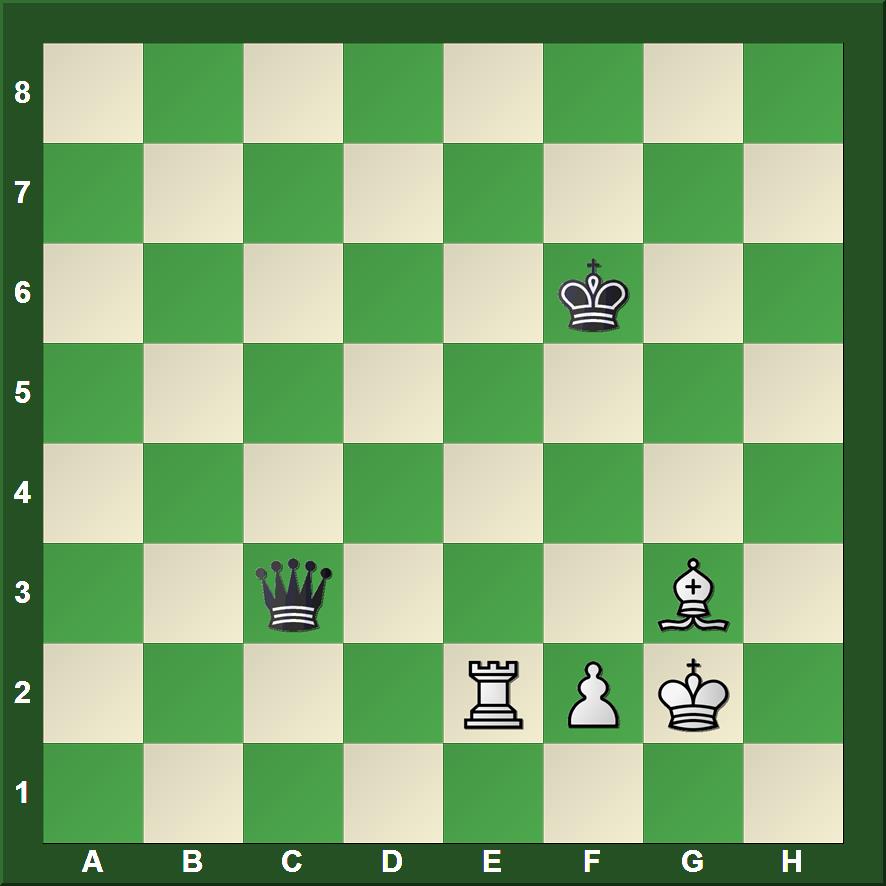
The best move, which has been played in 19 of those 21 games, is quite elegant.

15 February 2017

Basic Tactics: Pins and Forks

Yesterday, my beginning chess club saw an obscure miniature and then completed the worksheet Beginning Tactics 3.

Beginning Tactics 3

Find the correct move for White in each diagram. Draw an arrow showing the correct move.


These positions all employ pins and forks--some use pins, some forks (the links offer definitions and examples of these tactical themes). Pins and forks are also evident in the miniature that I showed the students on the demonstration board.

Soultanbeieff,V -- Dybina [E14]
Liege, 1950

1.d4 Nf6 2.c4 e6 3.Nf3 b6 4.e3 Bb7 5.Bd3 Be4 6.Nc3 Bb4

In the battle for the e4 square, Black pins White's knight.

7.Qc2 Bxd3 8.Qxd3 d5 9.cxd5 Nxd5 10.0–0

Castling eliminates the pin.

10...Nxc3 11.bxc3 Be7 

White won the battle for e4 and now controls the center.

12.Ne5 0–0 13.f4 c5 14.f5 exf5 15.Qxf5 Qd5?? 

Black should have played 15...Bf6 and fought on in a slightly worse position. Now, White wins material by force.

White to move

16.Ng6!

This discovered attack against the queen also threatens the bishop at e7. If Black captures the knight, he loses his queen (16...hxg6 17.Qxd5 Na6). If he captures the queen, then the knight captures the bishop with check, forking queen and king (16...Qxf5 17.Nxe7+ Kh8 18.Nxf5).

16...Qb7 

Black tries to escape the unfavorable exchanges.

17.Qd5 

Again, White seeks to exchange queens and gain the bishop (17...Qxd5 18.Nxe7+ Kh8 19.Nxd5).

17...Nc6 18.Qxc6 1–0

After 18...Qxc6, White's knight forks still pick up additional material. 19.Nxe7+ Kh8 20.Nxc6. Seeing this, Black opted to resign.

I found this game in Encyclopedia of Chess Miniatures (2015), but not in the other usual sources. Some information is available about Victor Soultanbeieff, the player of the White pieces. The Oxford Companion to Chess (1996) has a short entry on a variation of the Slav Defense that bears his name, and Wikipedia has an entry on him. I could find no information about his opponent, who was probably a local player who was below master strength.

Tomorrow, barring another weather incident. my advanced students will get last week's planned lesson (see "Inspired by Morphy"). Last week, we had a snow day.

13 February 2017

Decisive Advantage?

When do you resign? Losing an exchange should not be sufficient cause for resignation. But, what if you are down an exchange and your opponent is rated 300 Elo higher? What if you are down an exchange and your position is passive?

Going through the games in Branko Tadic and Goran Arsovic, Encyclopedia of Chess Miniatures (2015), I came across a game where it seemed that Black might have resigned a little early. It did seem as though White's play from the position at the end of the game was relatively straightforward and that Black was consigned to passive defense. Even so, most players would play on in such a position.

I searched for the game online and found that 2700chess.com has it. That site offered me the option of playing against the computer from the final position. Of course, I could easily set up the game on my computer and play Stockfish 7, but it was coffee time. While drinking my coffee, I like to sit in the living room with my dogs and use my iPad. The strongest chess engine setting that seemed available to me on the website was 2200--good enough that it will exploit tactical blunders or force a draw if the opportunity arises.

Komarov,Dimitri (2541) -- Bogdanov,Emil (2249) [E12]
FRA-chT N1 Drancy (3), 06.02.2005

1.d4 Nf6 2.Nf3 e6 3.c4 b6 4.a3 Bb7 5.Nc3 Be7 6.d5 0–0 7.g3 d6 8.Bg2 Re8 9.0–0 Bf8 10.b4 c6 11.Nd4 cxd5 12.cxd5 Nxd5 13.Nxd5 Bxd5 14.Nxe6 fxe6 15.Bxd5 Nd7 16.Bxa8 Qxa8 17.Bb2 Be7 18.Rc1 1-0

Black to move

After playing against the computer, my coffee was finished. I went to my computer, entered the moves into a database, and ran quick analysis with Stockfish 7 at full strength to observe what I or the weakened engine on 2700chess.com might have missed.

Stripes,J -- Stockfish (2200 strength)
2700chess.com

18...b5 19.Qb3 Bf6 20.Rc7

Stockfish seems to prefer that I play Rc7 before Qb3. 19.Qd3 was also an option. All of these moves offer white an advantage of 2.5+, a little more than the material difference.

20...Ne5 21.Bxe5

I did not want this knight plugging the c-file.

21...Bxe5 22.Qe3 Qd5 23.Qxa7 Bb2

White to move

One improvement Stockfish 7 noted up to this point was that I might have played Rfc1 on any of several moves. Now, Black prevents bringing the second rook to the open file.

24.Qb7

Is it beneficial to exchange queens when ahead a rook for a bishop, and with more active rooks? I thought so here.

24...Qe5 25.Re7

At first, Stockfish prefers 25.e3, but as it examines the position longer, it likes my move almost as much as its first choice.

25...Rxe7 26.Qxe7

Threatening checkmate in one.

26...h6

26...h5 might be a little better.

27.Rb1

This move drops the computer's assessment of White's advantage from near 5.0 to 3.5. Even so, it seems that I have improved White's advantage from the end of Komarov -- Bogdanov.

Stockfish likes 27.Qe8+ Kh7 28.a4.

I did not look at this variation during the game. The central Black pawns had been my focus when considering why Bogdanov resigned.

27...Qxe2 28.Qxd6 Kh7

White to move

29.Rxb2!?

The point of my move 27. Giving back the exchange to enter a queen ending with only a one pawn advantage would normally seem the way to convert a win into a draw.

29...Qxb2 30.Qd3+ Kh8 31.h4?!

I had originally planned 31.Qxb5 Qb1+ 32.Kg2 Qe4+ but was not prepared to play 33.f3 Qc2+ 34.Kh3. This unplayed line is Stockfish 7's preference.

31...Qe5

White to move

My advantage has diminished to 1.27, but my confidence is now rooted in the observation that Black's queen can defend both e6 and b5 from relatively few squares.

32.Kg2 Kg8 33.Qf3 g6

Stockfish 7 sees this move as half a pawn worse than 33...g5. Was 33...g6 Black's critical error? It seems to me that I now have a third pawn for my queen to attack. How can Black defend everything?

34.Qb7 Qe2 35.Qb8+ Kg7 36.Qc7+ Kh8

White to move

37.Qd8+

37.Qf7 seems faster.

37...Kg7 38.Qe7+ Kg8 39.Qf6

Black to move

39...h5

39...Qe4+ at first seems to refute my plan to convert a queen ending 40.Kh2

a) 40...Qf5 41.Qxf5 exf5 42.Kg2 should be a simple win for White
b) 40...Qc2 41.Qxe6+ Kg7 42.Kg2 increases White's advantage to two pawns and weaknesses remain in the Black position.

40.Qxg6+ Kh8 41.Qf6+ Kh7 42.Qf3 Qe5 43.Qe3 Qd6

43...Qd5+ 44.f3 Qa2+ 45.Kh3 Qa1 complicates my task.

44.Qe4+

Black to move

44...Kh6

44...Kg7 45.Qb7+ Kf6 46.Qxb5 and now three pawns to the good for White.

45.Qf4+ Qxf4 46.gxf4

Black to move

The rest is simple.

46...Kh7 47.Kf3 Kg6 48.Ke4 Kf6 49.f3+-

Checkmate was delivered on move 69.


10 February 2017

Home Preparation

The Queen's Indian Defense vexes me. I have struggled enough against it that I've found myself playing the Black side recently in blitz. Memories of a particularly frustrating game in 2010 are always present when I face the QID. In a rapid event at the Spokane Chess Club, I had White against Michael Cambareri. At the time, my only win against him had been a blitz game several years earlier when he was in third grade. But, he had taken some time off chess and was just coming back. In a bunch of casual games one night at the club, I won as many as I lost. I thought that I had a chance.

I played well that night, but could only manage a draw. A draw was still a good result for me against Michael, but my ambitions called for more. Three months later, we played another tournament game with the same first seven moves. I tried a different eighth move and lost, just as I had lost previously in 2007.

After last week's games, I thought there was a good chance that I would be playing Michael this week in the Spokane Chess Club Winter Championship. I started reviewing our games in the French Defense, thinking that I would have Black. On Monday, I received the email that told me that I had White against Michael. I started some work on the Queen's Indian Defense. Over the course of the next three days, I probably looked at four dozen grandmaster games.

I did not expect that Sergey Karjakin's 2007 miniature against Falko Bindrich would be helpful, but was aware of the possibility. My study convinced me that the most likely scenario was that we would reach a position out of the opening where I would not feel hopelessly lost in terms of ideas concerning how to proceed. With some luck, I might get a little ahead on the clock thanks to my preparation. In a game 90 + five second delay, being ahead on the clock can help.

Karjakin's miniature is astounding and should certainly be studied by players of the Queen's Indian Defense.

Karjakin,Sergey (2686) -- Bindrich,Falko (2469) [E17]
EU-ch 8th Dresden (10), 13.04.2007

1.Nf3 Nf6 2.c4 b6 3.g3 Bb7 4.Bg2 e6 5.d4 Be7 6.Nc3 0–0 7.Qc2 c5 8.d5 exd5 9.cxd5 Nxd5 10.Qe4!

Black to move

10...Nb4 11.Qxb7 N8c6 12.Bf4 g5 13.0–0–0 gxf4 14.a3 1–0

When the diagram position appeared on my board last night, I realized that I could not remember all of this game. I realized that I had entered a tactical battle where my queen could very well become trapped.

We both had used about five minutes to reach this position. Now my opponent spent eight minutes. I also used his thinking time trying to recall, and to calculate for myself. If my queen becomes trapped, I lose.

Stripes,James (1791) -- Cambareri,Michael (1993) [E17]
SCC Club Championship (4), 09.02.2017

1.d4 Nf6 2.Nf3

My move order reserves the possibility of going into the London System (see "Fiddling with the London System").

2...b6 3.c4 e6 4.g3 Bb7 5.Bg2 Be7

White to move

6.Nc3

Castling is White's most popular move by far. When I complained to my friend John Julian some years ago about my frustration with Michael's set-up in the Queen's Indian Defense, his advice was, "don't let him set it up." My choice of White's second most popular move was the first step in hindering his tableau.

6...0–0 7.Qc2 

Delaying castling in this manner runs the risk that my king might get stuck in the center, or that I would need to expend the time to castle by hand. But, preventing Ne4 and f5 by Black was my intent.

7...c5 

Black also plays 7...d5 or 7...Na6 here. There are other obscure possibilities that do not seem as good. With either of these two moves, I would be in for a long struggle, but felt that I had looked at enough games that I might play well enough for a draw.

8.d5 exd5 9.cxd5 Nxd5?! 

Annotations on Karjakin's miniature recommend 9...Bxd5.

10.Qe4!

Michael admitted after the game that he did not anticipate this move. See diagram in Karjakin game above.

10.Ng5 was played in Tomovic -- Pirc, Zagreb 1949.

10...Nb4

10...f5 11.Qc4 b5 12.Qxb5 Nb6 13.Be3 Na6 14.0–0  was drawn in 52 moves in Lagno,K (2557) --Dzagnidze,N (2535), Tbilisi 2012

11.Qxb7 N8c6 12.Bf4 Nc2+

12...g5 13.0–0–0 gxf4 14.a3 1–0 Karjakin,S (2686) -- Bindrich,F (2469)/Dresden 2007 (presented above).

13.Kd2 Nxa1 14.Rxa1 

Black to move

14...Rc8N

14...Bf6 15.Rd1 Bxc3+ 16.bxc3 Qf6 17.Bh3 and White won in 33 moves in  Gajewski,G (2515) --Hernandez Carmenates,H (2524), Calvia 2006.

At this point in the game, I could not recall whether we were still following the Karjakin game or not. I had to do the tactical and positional calculation on my own. However, the knowledge that I was winning in the objective sense after 10.Qe4 gave me confidence. I labored to combine confidence with a clear head and find strong moves.

15.Nd5!

"This move killed me." M. Cambareri during postgame analysis.

15... d6 16.Rd1 Bf6 17.Bh3 1–0

At this point in the game, I had used sixteen minutes, while Michael had used 34. He thought for another 34 minutes, then tipped his king.

While he was thinking, I walked to stay calm, frequently returning to the board trying to anticipate his move and my response. I thought that 17...Na5 was the most testing.


06 October 2016

Lesson of the Week

A new scholastic chess season has begun. The first tournament for Spokane's youth will be held October 22. My chess clubs started this week. For my beginning students, we looked at three instructive miniatures from the Encyclopedia of Chess Miniatures (2014). My advanced students saw a game from 1936.

The opening played in this game is popular in scholastic chess.

Spielmann,Rudolf -- Eliskases,Erich [C59]
Match Semmering AUT (7), 1936

1.e4 e5 2.Nf3 Nc6 3.Bc4 Nf6 4.Ng5 d5 5.exd5 Na5 6.Bb5+ c6 7.dxc6 bxc6 8.Be2 

8.Qf3 has been recommended by a local chess teacher and appears in many games.

8...h6 9.Nf3 e4 10.Ne5 Qc7 11.d4 exd3 12.Nxd3 Bd6

White to move

13.Na3 

This game was the only one in the database with this move. The most popular response was played by none other than Garry Kasparov.

13.b3 0–0 14.Bb2 Re8 15.h3 Ne4 16.0–0 Qe7 17.Nc3 Nxc3 18.Bxc3 Qxe2 19.Bxa5 Bf5 20.Re1 Qxd1 21.Raxd1 Rxe1+ 22.Rxe1 Rb8 23.g4 Bg6 24.Kf1 h5 25.Re3 Rb5 26.Bd2 f6 27.f4 Rd5 28.Ke2 hxg4 29.hxg4 f5 30.c4 Rd4 31.Bc3 Re4 32.Rxe4 fxe4 33.Ne5 Bxe5 34.Bxe5 Be8 35.Ke3 Kf7 36.Kxe4 g6 37.Kd4 Ke7 38.Kc5 Kd7 39.Bb8 Kc8 40.Bxa7 Kb7 41.Bb6 Bd7 42.g5 Bf5 43.b4 Bc2 44.a4 1–0 Kasparov,G (2805) -- Timman,J (2620)/Moscow 1994.

13...Ba6 14.g3 0–0 15.0–0 Rad8 16.Be3 Nd5 17.Bc5 Bxc5 18.Nxc5 Nc3 19.Nxa6 Qe5 20.Qe1 Nxe2+ 21.Kh1 Rfe8 22.Rd1

22.f3

22...Qh5 23.h4 Qg4 24.Kh2 Nxg3 25.fxg3

Black to move

25...Re2+

25...Rxe1 26.Rxd8+ Kh7 27.Rxe1+-

26.Rf2 Rxf2+ 27.Qxf2 Qxd1 0–1

21 August 2016

An Ivanov Miniature

One of the ways that I am enjoying Tadic and Arsovic, Encyclopedia of Chess Miniatures (2015) is working through the games in which Black played the French Defense. The French is my primary response to 1.e4, so it behooves me to be well aware of the pitfalls. Last week, a miniature won by Alexander Ivanov in 2002 caught my eye.* His opponent was Jarod J. Bryan, who had been Maine State Champion in 1988 and 1998, and has won that title five more times since his quick loss to Ivanov at the 2002 Bradley Open.

In this miniature, Ivanov applied strong pressure after some slight inaccuracies by Bryan. Black's position collapsed quickly. The game is notable in the Encyclopedia for the presence of two diagrams. Most games have one.

Ivanov,Alexander (2645) -- Bryan,Jarod J (2218) [C00]
Windsor Bradley op 7th Windsor Locks (3), 20.07.2002

1.e4 c5 2.Nf3 e6 3.g3 Nf6 4.Qe2 d5 5.d3 Be7 6.Bg2 Nc6 7.0–0 0–0 8.e5 Nd7 9.c4

Black to move

Already, Black's position seems difficult. ChessBase database indicates that White scores over 70% in most lines.

9...dxc4

Tadic and Arsovic offer as better 9...d4 10.h4 b6 11.Bf4, but even here the statistics favor White by a significant margin.

The relatively untested 9...b5 offers hope for Black if statistics have merit. 10.cxb5 Na5.

10.dxc4 Qc7 11.Bf4 a6 12.Rd1

Black to move

12...Nb6?!

12...Rd8 13.Nc3 Nf8 is worth filing away for possible exploration later. The line appears untested, at least in the sort of games that work their way into the database.

13.Nc3

As I played through this game in the North Spokane Library repeatedly, I kept looking at this knight. First, it seems a little tardy to enter the action, and thus easy to overlook. Second, once it enters the battle, Black seems busted.

13...Rd8 14.Ne4 Nd4?

14...h6 is offered as an improvement in the Encyclopedia. Stockfish prefers 14...Bf8, which strikes me as sensible given the tactics centered on f6.

15.Nxd4 Rxd4

White to move

The Encyclopedia has this diagram.

16.Nf6+!+- Bxf6

16...gxf6 17.Rxd4 cxd4 18.Qg4+ Kf8 19.exf6+-.

17.exf6 Rxf4

17...Qd8 was the last chance to suffer longer.

The second diagram in the Encyclopedia appears here.

18.Qe5

18.Qe5 Qxe5 (18...Qd7 19.Rxd7 Nxd7 20.Qxf4+-) 19.Rd8#.

1–0


*Alexander Ivanov should not be confused with Boris Ivanov, who was banned from competition by the Bulgarian Chess Federation due to suspicions of cheating. Alexander Ivanov lives in Boston, Massachusetts and shared the 1995 U.S. Championship. He was awarded the Grand Master title in 1991.

05 August 2016

Corte -- Bolbochán 1946

Reviewing Informant Annotations

The miniature Corte -- Bolbochán, Mar del Plata 1946 is the first game in Leonard Barden and Wolfgang Heidenfeld, Modern Chess Miniatures (1960). It also appears as game 404 in Irving Chernev, The 1000 Best Short Games of Chess (1955) and as game 1060 in Encyclopedia of Chess Miniatures (2015). The Encyclopedia, published by Chess Informant, is by Branko Tadic and Goran Arsovic.

Despite its appearance in these three well-known books, the game is absent from the ChessBase database. The event in which the game took place is also unclear. See "Giuoco Fortissimo" for more about the history of this game. It was written before I had copies of Modern Chess Miniatures and Encyclopedia of Chess Miniatures.

The game is the earliest that I can find with 10.Ba3, which had been suggested by James Macrae Aitken in a 1937 article in British Chess Magazine.* Hence, the move 10.Ba3 is sometimes called the Aitken variation. Chernev notes that Aitken had suggested this move (193). Barden and Heidenfeld offer that Corte -- Bolbochán is part of the reason 10.Ba3 is considered stronger than 10.Qb3, which had been known since before Greco (see "Materialism").

Of the three books on my shelves that offer annotations to this game, Encyclopedia of Chess Miniatures (ECM) shines both for its economy and for its focus on the game's critical points.

Corte, Cesar -- Bolbochan, Jacobo [C54]
Mar Del Plata, 1946

1.e4 e5 2.Nf3 Nc6 3.Bc4 Bc5 4.c3 Nf6 5.d4 exd4 6.cxd4 Bb4+ 7.Nc3 Nxe4 8.0–0 Nxc3

It is well-known today that 8...Bxc3 is better. ECM offers the critical line, 9.d5 Bf6 10.Re1 O-O 11.Rxe4 Ne7 12.d6. This line was played as early as Salwe -- Rubinstein, Vienna 1908, which Black won rather quickly.

9.bxc3 Bxc3?!

9...d5 is an improvement. ECM gives 10.cxb4 dxc4 11.Re1+ Ne7. At least 39 games have been played from this point. The earliest in the ChessBase database is Piotrowski -- Moller, Hannover 1902. Max Euwe, The Development of Chess Style (1966) credits Moller with the introduction of the move 9.d5, but after 8...Bxc3 (4).

10.Ba3 d5 11.Bb5 Bxa1 12.Re1+ Be6 13.Qa4 Rb8?

The alternative given in ECM was played in Schlesinger -- Roeberg, Hessenliga 1994 and led to a draw in 37 moves. 13...Qd7 14.Ne5 Nxe5 15.Bxd7 Nxd7 16.Rxa1 Kd8 with a slight advantage for White.

It is not so easy to give up one's queen, but it is preferable to losing the king. Even so, giving up a queen for a rook, minor piece, and pawn is "a balance of material that is usually sufficient," according to Ernesto Inarkiev in his Informant 128 article about Sergey Karjakin at the Candidates (18).

14.Ne5+- Qc8 15.Bxc6+ bxc6 16.Qxc6+ Kd8 17.Nxf7+ Bxf7 18.Be7# 1–0

Chernev offers only the reference to Aitken, "to give his king elbow room" after Black's move 14, and the conclusion of the game as a comment after 16...Resigns (192-193). Barden and Heidenfeld offer the alternative to Black's move 13 now found in ECM, carrying the line to move 18, and the comment concerning 10.Ba3 referenced above.


*David Hooper and Keneth Whyld, The Oxford Companion to Chess (1996), 5.