Showing posts with label Grigoriev (Nikolai). Show all posts

26 December 2024

60 Days, 300 Positions: Day One

Thomas Engqvist, 300 Most Important Chess Positions (2018) has been in my possession about five years. I bought it early in 2019 (see “A New Book and a Morphy Game”). Often it sits on the shelf, but I read bits from time to time. I’ve studied some of the positions for my own edification, and used some with my students. This afternoon, I resolved to read the whole book in 60 days.

Failure may be expected. Life offers many opportunities that disrupt a disciplined schedule of study, as well as occasional challenges. But, perhaps, perseverance will get me through. I do not expect to blog the process every day and certainly will present only a fraction of the positions here. Readers who wish to know the contents of Engqvist’s book should buy a copy. It is not my intention to violate the author’s intellectual property.

Going through this book in 60 days is violation enough of the author’s work. He suggests five positions per week, not five per day. In my defense, I will note, however, his advice that a student needs “to integrate the positions into your conscious chess thinking as early as possible in your life” (6-7). I am 64 years old and have been reasonably serious about studying as well as playing chess since 1975.

Because of the nature of the book, I will not read it in sequence. Today, I did positions 151-155, the first five endgame positions. I use two of them routinely in my teaching. The ideas in the other three also occur while I’m working with students via other positions.

One of today’s positions intrigued me enough that I set it up to play against the computer on chessdotcom. Usually, I’ll play set-positions against Stockfish on my iPad or against one of several engines on my notebook computer with ChessBase and Fritz software installed. The website’s computer gave me the same frustration I usually find with elementary endgames on other devices: it did not make the moves that are most testing. The position is a Nikolai Grigoriev composition.

White to move

Unhappy with the computer’s move on chessdotcom, I also played this position on my iPad. That early version of Stockfish running on a weak processor started with the line Engqvist gives in the book, presumably the most testing.

1.Kg3 is White's only drawing move. Why?

If I could calculate deeply enough, I might recognize this square as the only one that assures I will be able to step onto b4 after Black plays Kxb6. White must take the opposition at that point.

1.Kh3 takes the distant diagonal opposition. Why does this effort fail? Black's shouldering manuever leaves the White king too far from the b-fil when the pawn on b6 falls. 1...Kc2 2.Kg4 Kd3 3.Kf3 Kc4 4.Ke4 White has taken the opposition with each move, but will no longer be able to maintain it when it matters.

Although Engqvist does not mention it, Kg3 begins an outflanking maneuver.

1...Kc2 is Black's critical try, as it leaves White only one drawing move. Chessdotcom's computer played 1...Kb2, giving me three three viable moves, including the option of seizing the distant opposition. Only after the subsequent 2.Kf2 Kc3 3.Ke3 Kc4, was there a single drawing move. In this case, it is an elementary outflanking maneuver. 4.Kd2.

2.Kf2 is the only move.

2...Kd3, is testing in the sense that White again has a single drawing move is offered in a variation in 300 Most Important Chess Positions.

2...Kd2 also leaves White a single drawing move.

3.Kf1 Kd3 4.Ke1 Kc4

Black to move
5.Kd2

It is clear that White's king will be able to reach b4 at the critical moment.

For the fifth time, White had only one move that draws. It would be nice if chess engine programmers could create an algorithm that has the computer choose the move that leaves the opponent a single choice to maintain the evaluation. Engines would become better training partners for this sort of endgame that way.


11 July 2022

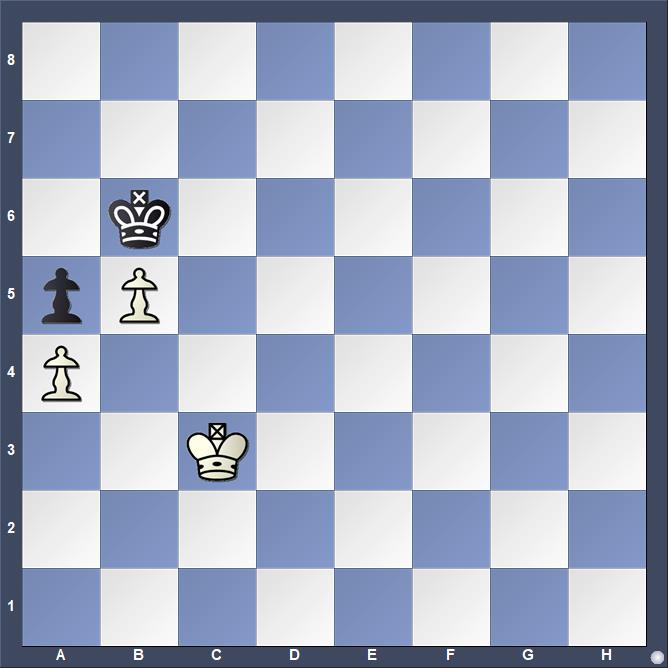
Grigoriev Study

As mentioned in "To Know a Position" yesterday, a 1921 study by Nikolai Grigoriev appears in several books, especially Dvoretsky's Endgame Manual and Alex Fishbein, King and Pawn Endings. However, I did not find the study with that date in Harold van der Heijden, Endgame Study Database VI. Rather, the position is flipped and the date given is 1924. Otherwise, it is the same position.

White to move

White must play precisely to draw.

10 July 2022

To Know a Position

Two pawns against one when the stronger side has one that is both passed and protected is generally a win. There are exceptions when the pawns are too close to the edge of the board with one of the pawns (stronger or weaker side) on its starting square. Having a pawn on a rook file also limits the stronger side's chances. The position of the kings often proves critical.

This position, ending no. 107 in Pandolfini's Endgame Course (1988), also arises while playing through examples 8 and 9 in José R. Capablanca, Chess Fundamentals (1921). Josef Kling and Bernhard Horwitz, Chess Studies, or the Endings of Games (1851) presents a study that reaches this position after the first two moves.

White to move
Sacrificing the forward pawn allows White to win Black's pawn after a few moves using opposition and outflanking maneuvers, resulting in a standard position that Bruce Pandolfini covers earlier in the book (endgames 60-62).

The diagram position is important enough in Lev Alburt's view that it appears in Chess Training Pocket Book: 300 Most Important Positions and Ideas (1997). Alburt writes that to become a strong tournament player one needs to know only 12 key pawn endings, promising that the right 12 are in the book (9). A similar position appears in Rashid Ziyatdinov, GM-RAM: Essential Grandmaster Knowledge (2000), but did not make the cut for Thomas Engqvist, 300 Most Important Chess Positions (2018).

Lest there be any doubt about the practical value of understanding how White should play, consider the ending from Polgar,I.--Ciocaltea,V., Baja 1971, which is presented in C.G. Van Perlo, Van Perlo's Endgame Tactics, new, improved and expanded edition (2014).

White to move
54.Kg3

54.Kg5 fails to make progress, Van Perlo notes.

54...Kf7 55.Kf3 Ke7 56.Ke3 Kd7 57.Ke4 Ke6

White to move
Flip the side to move, remove White's f-pawn and place a Black pawn on f6, and the position is identical to one that appeared at the Spokane Chess Club in April 2005 between two of the group's strongest players. Black pushed the unopposed pawn and the game was dead drawn, yet the game continued for many moves more because the weaker side has very little time left on the clock.

58.g5!

"Depriving the black king of some vital squares in the tempo battle" (Van Perlo 25).

58...Kd6 59.f5 Ke7 60.f6+

Now White has a passed pawn.

60...Kf7 61.Ke5 Kf8

We have reached the position at the top of this post.

62.f7

Black resigned.

We can move the initial position right or left, up or down. In most cases, the stronger side has an easy win.  Sacrifice of the forward pawn is the easiest method when the blocked pawn is on the fifth rank, but this fails when the pawn is further back.

Two key positions are analyzed in Johann Berger, Theorie und Praxis der Endspiele (1890), referencing the earlier work of George Walker, A New Treatise on Chess (1841).

No. 483
Das Spiel ist leicht zu gewinnen
It is an easy win, regardless of who has the move, Berger explains.

No. 484
Weiss gewinnt nur mit dem Zuge.
White wins only with the move.

Mark Dvoretsky, Dvoretsky's Endgame Manual, 5th ed. (2020) offers one full page of analysis with one winning and two drawing positions, plus a well-known 1921 study by Nikolai Grigoriev earlier in the chapter. Grigoriev's study, "underscore[s] that a system of corresponding squares certainly does not have to always be 'straight line', as with the opposition. Each case demands concrete analysis" (23). Alex Fishbein, King and Pawn Endings (1993) offers two positions, both of which are Grigoriev compositions. Reuben Fine, Basic Chess Endings (1941) has seven diagrams over a little more than three pages. Karsten Müller and Frank Lamprecht, Fundamental Chess Endings (2001) offer two positions from games, one winning and one drawing. Comparable positions do not appear in Jeremy Silman, Silman's Complete Endgame Course (2007), unfortunately.

Paul Keres, Practical Chess Endings (1974) offers the most thorough discussion with 11 diagrams over six pages. He begins with Berger's no. 483 (see above).

After nine moves in Keres' analysis, the following position is reached.

White to move
"White would spoil everything with 10.b6?" Keres notes (34).

10.Kd5! Kc7 11.Ke6 Kb6 12.Kd6

This outflanking idea is another standard technique.

12...Kb7 13.Kc5

Keres then turns to the most important technique for endgame book authors: shifting the position. Shift everything up on rank and White can no longer win because of the same stalemate threat noted after 10.b6? Shift one square down, and White still wins. Two squares down and it matters who has the move. White must have the move to win.

Moving the position one file to the right and one rank up, White wins, even when Black has the move.

Black to move
1...Kd6 2.Ke4 Ke6 3.Kf4 Kd6 4.Kf5 Kc7 5.Ke6 Kc8

White to move
6.c7!

The pawn must be sacrificed, as we should know from Capablanca and Pandolfini.

Continuing the shift to the right and this time down a rank, Keres sets the kings in a manner optimal for Black. After a few moves, the following position is reached.

White to move
To secure the win, White must use threats of moving to either side of the mass of pawns to perform the opposition and outflanking maneuvers.

6.Kc1!

Working out the rest is good training. Keres book is helpful, too. It was when I reached this position in my reading yesterday morning that I started playing against Stockfish from this position and then many other variations with the same arrangement of pawns across the range of possibilities.

Shift the starting position one rank down and this resource no longer exists for White.

Knowing a position well is knowing an arrangement of pieces that may be, in fact, many hundreds of possible positions. Some of these have arisen in my games in the past and can be expected to do so again. 


20 March 2022

Two Pawn Endings

A new book arrived Thursday: Sarhan Guliev, The Manual of Chess Endings (2021). This book consists of 600 endings considered foundational for development of chess skill. Normally such a book will consist of many positions that I know well. It was a bit of a surprise to find two in the first twelve that were completely fresh to me, and that offered some delight in the elementary solutions.

The first is from a game: Horvath,D. -- Horvath,C, Hungary 1988. The pawns have flipped on the h-file (both are passed).

White to move (draw)

The second is a 1933 composition by Nikolai Grigoriev (1895-1938).

White to move (win)

If you leave a solution as a comment, I will respond.