
Win with grace. Lose with dignity.During morning coffee today, I reviewed three games on Chessgames.com, then played a single blitz game. When the blitz game began, I spoke my opponent's name, DarklordCOBRA, and then said, "this could be loss number 10,000." My wife can attest that I was calm and ready to accept defeat. She does not recall my tone of voice. Lack of recall is proof. Expressions of anger and despair do not go unnoticed. Last night, for example, after she went to bed, she called from the bedroom to ask, "what's wrong?" I was in the living room playing blitz on my iPad and had dropped a piece in an otherwise equal position, uttering some profanities.
Susan Polgar

Losses torment me. They bring out such fury that it seems that I hate the world and everyone in it. I yell such obscenities at the computer screen when losing online games that even the deaf dog heads outside for safety.
It need not be this way. It is possible to "lose with dignity", as Susan Polgar advocates. As a youth chess coach, I have spent years urging children to understand, "when you lose, you learn." In truth, however, I am a little half-hearted expressing this sentiment. I know that children hurt when they lose. A cliché offers minimal comfort at such times.
I have a more serious problem with the "win, draw, or learn" saying popular among other coaches. Often, victories should be subjected to the same scrutiny as losses. One of the students whom I coach one-on-one tied for first in his tournament last Saturday, winning his first trophy. During the tournament, he brought one of his game scores to my director's table and we analyzed the victory with his opponent. She missed at least two opportunities to checkmate him with a two move sequence. Although he finished at the top and she finished near the middle, the final standings could have been much different. It is very important to learn from one's mistakes in victories, as well as from defeats.
I recently won the Spokane Chess Club's Winter Championship. It would be easy to find comfort in my success, but it is more important to find humility. I had a lost position in four out of five games (see "Perseverance"). My success stemmed from a lot of help from my opponents who failed to put me away when they had the chance. However, I kept my own chances alive by never giving up. Throughout the course of the event, I tried to remain focused on having fun, finding the best moves, and learning. I found help from the prescriptions Paul Powell puts forth in The Fighting Dragon: How to Defeat the Yugoslav Attack (2016), which I reviewed recently.
Facing an opponent whose rating was higher than I have been in the past two weeks, I resolved to learn. I aimed to find strong moves and not get caught in the rut of playing without thinking. DarklordCOBRA essayed the Advance variation against my French. I commented, "I have played this over-the-board against a titled player and done well." Nonetheless, I went for the old main line instead of what I usually play. My opponent built up an advantage through the opening and early middlegame.
DarklordCOBRA (1946) -- Ziryab (1872) [C02]
Live Chess Chess.com, 24.02.2017
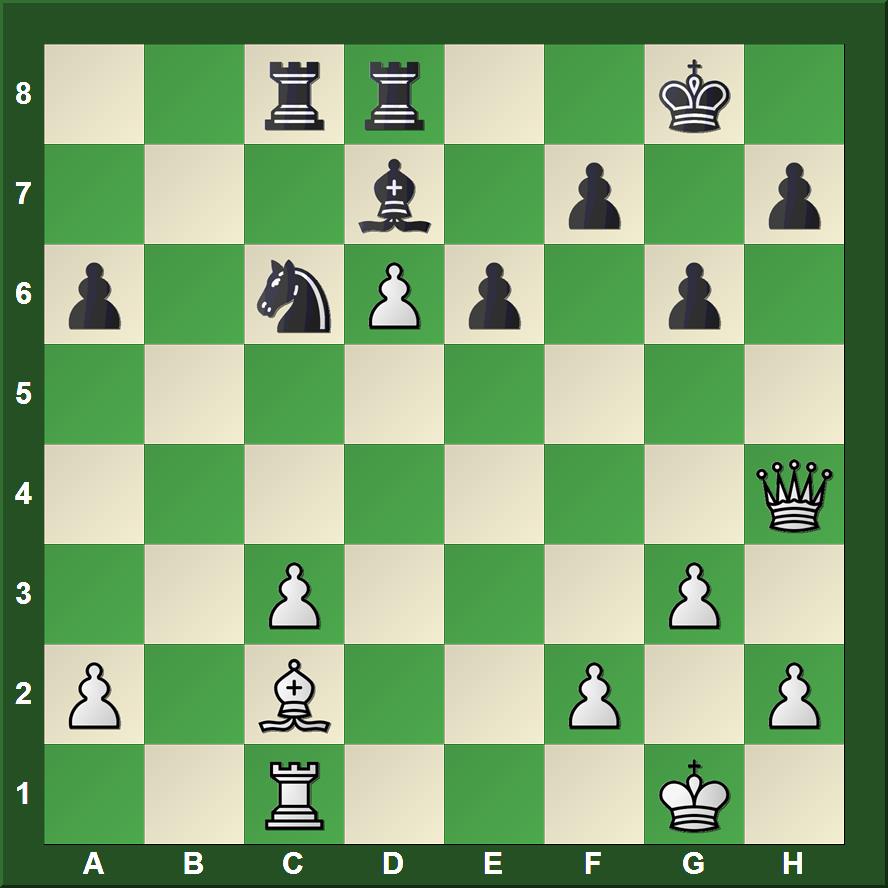
After 21.Bc3

21...Qh4
I wanted to play 21...a5, but miscounted the number of pieces that I had supporting this push. It's kind of hard to count to two during a blitz game. After the game, I looked again at this idea, thinking White would reply 22.a3. Initially, in my postgame analysis, I did not see how 22...Qb6, intending b5-b4 fails to 23.Bxg7!
My move was an effort to play b5-b4, and shows also that I was instinctively aware of some vulnerabilities on the kingside. But, my queen was kicked around a bit.
22.g3 Qh5 23.Re1 Rfd8 24.Bd1 Qc5 25.Rc1 Qf5 26.Bc2 Qh3
My queen has a nice aggressive post, but my opponent is not going to give me time to put my bishop where my knight stands in order to support Qg2#.

27.Qg5
27.Re4 should prove decisive, as my queen is running out of safe squares.
27...g6 28.Re4 b4
I am losing my queen, but at least I can get a rook and bishop for it.
29.Rh4 Qxh4 30.Qxh4 bxc3 31.bxc3
White has a decisive advantage, but also has only sixteen seconds. I have thirty.

31...Ne5 32.Qf6 Ng4 33.Qf4 f5 34.h3 Nf6 35.Bb3 Nd5
After the game, I thought I should have played 35...Kf7. Even here, Black is busted.
36.Qe5 Bc6

37.h4
With only nine seconds remaining, my opponent came up with a plan that seems to lead to checkmate.
37.Qxe6+ Kg7 38.Bxd5 Bxd5 39.Qxd5+- ends matters more quickly.
37...Nxc3 38.h5
My opponent should have found 38.Bxe6+ Kf8 39.Qf6+ Ke8 40.Qf7#
38...Bd5 39.h6 Ne2+

40.Qxe2??
40.Kh2 leaves Black with no checks, and only the possibility to delay checkmate. Black had five seconds in which to find Kh2.
40...Rxc1+
Now, for the first time in the game, Black has an advantage.
41.Bd1 Kf7 0–1
After the game, I went back through the battle looking for errors and opportunities. Mainly, I found my opponent's missed opportunities. Immediate postgame analysis of wins, losses, and draws with an aim to learning can help cultivate the correct attitude.
It need not be this way. It is possible to "lose with dignity", as Susan Polgar advocates. As a youth chess coach, I have spent years urging children to understand, "when you lose, you learn." In truth, however, I am a little half-hearted expressing this sentiment. I know that children hurt when they lose. A cliché offers minimal comfort at such times.
I have a more serious problem with the "win, draw, or learn" saying popular among other coaches. Often, victories should be subjected to the same scrutiny as losses. One of the students whom I coach one-on-one tied for first in his tournament last Saturday, winning his first trophy. During the tournament, he brought one of his game scores to my director's table and we analyzed the victory with his opponent. She missed at least two opportunities to checkmate him with a two move sequence. Although he finished at the top and she finished near the middle, the final standings could have been much different. It is very important to learn from one's mistakes in victories, as well as from defeats.
I recently won the Spokane Chess Club's Winter Championship. It would be easy to find comfort in my success, but it is more important to find humility. I had a lost position in four out of five games (see "Perseverance"). My success stemmed from a lot of help from my opponents who failed to put me away when they had the chance. However, I kept my own chances alive by never giving up. Throughout the course of the event, I tried to remain focused on having fun, finding the best moves, and learning. I found help from the prescriptions Paul Powell puts forth in The Fighting Dragon: How to Defeat the Yugoslav Attack (2016), which I reviewed recently.
I will explore new ideas and open my mind to new patterns. I will learn new patterns and become a stronger player.When I play too much blitz, the quality of my play suffers. My attitude suffers also. The problem, however, stems less from the quantity than from the mindset. It may be possible to play for many hours and still cultivate a positive attitude. It is less likely when play is aimed at getting to that next rating goal (such as the rating I had yesterday).
Failure is not measured by wins and losses; failure is continuing to play without learning.
Paul Powell, The Fighting Dragon, 18.
Facing an opponent whose rating was higher than I have been in the past two weeks, I resolved to learn. I aimed to find strong moves and not get caught in the rut of playing without thinking. DarklordCOBRA essayed the Advance variation against my French. I commented, "I have played this over-the-board against a titled player and done well." Nonetheless, I went for the old main line instead of what I usually play. My opponent built up an advantage through the opening and early middlegame.
DarklordCOBRA (1946) -- Ziryab (1872) [C02]
Live Chess Chess.com, 24.02.2017
After 21.Bc3
Black to move

21...Qh4
I wanted to play 21...a5, but miscounted the number of pieces that I had supporting this push. It's kind of hard to count to two during a blitz game. After the game, I looked again at this idea, thinking White would reply 22.a3. Initially, in my postgame analysis, I did not see how 22...Qb6, intending b5-b4 fails to 23.Bxg7!
My move was an effort to play b5-b4, and shows also that I was instinctively aware of some vulnerabilities on the kingside. But, my queen was kicked around a bit.
22.g3 Qh5 23.Re1 Rfd8 24.Bd1 Qc5 25.Rc1 Qf5 26.Bc2 Qh3
My queen has a nice aggressive post, but my opponent is not going to give me time to put my bishop where my knight stands in order to support Qg2#.
White to move

27.Qg5
27.Re4 should prove decisive, as my queen is running out of safe squares.
27...g6 28.Re4 b4
I am losing my queen, but at least I can get a rook and bishop for it.
29.Rh4 Qxh4 30.Qxh4 bxc3 31.bxc3
White has a decisive advantage, but also has only sixteen seconds. I have thirty.
Black to move
31...Ne5 32.Qf6 Ng4 33.Qf4 f5 34.h3 Nf6 35.Bb3 Nd5
After the game, I thought I should have played 35...Kf7. Even here, Black is busted.
36.Qe5 Bc6
White to move

37.h4
With only nine seconds remaining, my opponent came up with a plan that seems to lead to checkmate.
37.Qxe6+ Kg7 38.Bxd5 Bxd5 39.Qxd5+- ends matters more quickly.
37...Nxc3 38.h5
My opponent should have found 38.Bxe6+ Kf8 39.Qf6+ Ke8 40.Qf7#
38...Bd5 39.h6 Ne2+
White to move

40.Qxe2??
40.Kh2 leaves Black with no checks, and only the possibility to delay checkmate. Black had five seconds in which to find Kh2.
40...Rxc1+
Now, for the first time in the game, Black has an advantage.
41.Bd1 Kf7 0–1
After the game, I went back through the battle looking for errors and opportunities. Mainly, I found my opponent's missed opportunities. Immediate postgame analysis of wins, losses, and draws with an aim to learning can help cultivate the correct attitude.


