Showing posts with label French Defense. Show all posts

15 April 2026

Mood Swings

Yesterday afternoon, I threw away an easy draw against a player rated 400 lower. How I found myself playing for a draw is another matter. A bit later, a player rated 200 higher than me threw away an easy win.

White to move
81.Ra3+??

81.Kxe5 and Black's winning chances are gone.

81...Kd4? 

Black returns the favor.

82.Ra4+ Ke3 83.Ra3+ Rd3

Now Black is winning and had no difficulty converting what remained of the ending.

It was a painful loss.

Then, early for a chess lesson with some young students, I sat in my truck in the parking lot and played a game on my phone. The opening went poorly after I played the French Defense in an unusual manner.

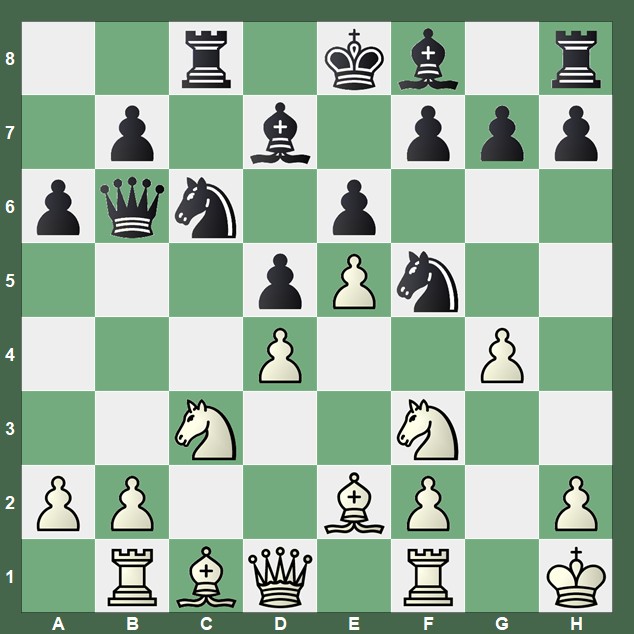
Black to move
16...Bxa2?

1...O-O was better, but I remain down a pawn.

17.Ne5

White's plans are clear.

17...O-O

17...Rc8 at least shows recognition of White's threats.

18.Rd7?? Ne5!-+

Now I am winning. The next ten minutes sitting in my truck moving chess pieces on my phone brought pleasure as I ground out a win.


15 May 2025

Some Problems in the French

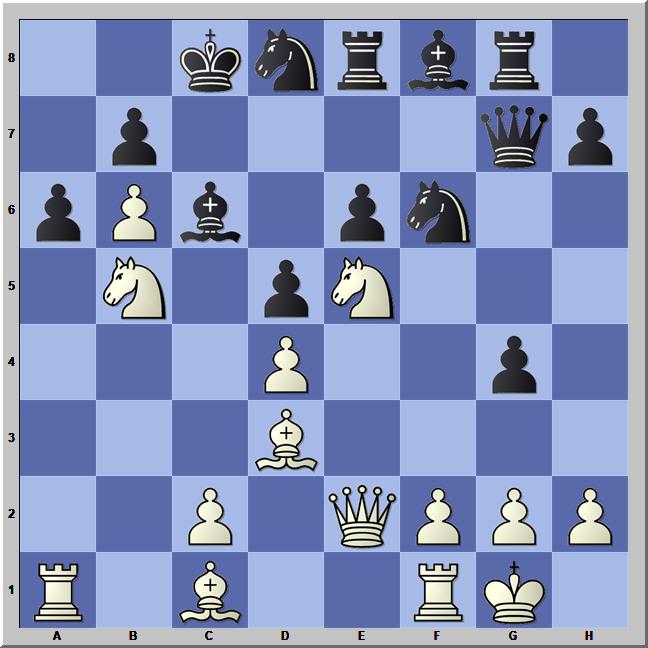
This position has arisen perhaps a dozen times in master play.

Black to move
The most recent instance of this position was in Lu,M.--Svane,F., Wijk aan Zee 2025. Svane played 10...dxc4. In ChessBase Mega 2024, Black has played this move seven times, limiting White's score to 42.9%.

10...c6 is more common and was suggested as better by Milos Perunovic in Chess Informant 163/104.

10...Bf4 appears four times in CB Mega, including in a blitz game, Topalov,V.--Nepomniachtchi,I., Zagreb 2022, which was drawn in 70 moves. In none of these games did White play 11.cxd5, which Stockfish 17 recommends.

This position appears in 35 games in ChessBase Mega 2024.

Black to move
The most popular replies have been:

a) 10...Bd7
b) 10...Qb6
c) 10...O-O

Black has not done well with Stockfish's top choice.

This position occurs with some frequency.

Black to move
Black has two ways to capture the pawn on c5, or the capture can be postponed. What are the merits of each of the main options?

a) 9...Bxc5
b) 9...Nxc5
c) 9...Qa5

Bonus Positions


What would you play?

Black to move
From Gukesh,D.--Harikrishna,P., Wijk aan Zee 2025, CI 163/105

Black to move
From Tabatabaei,M.--Mamedyarov,S., Deutschland 2025, CI 163/108


12 March 2025

Fingerslip

Playing chess on the iPad, I will drop a piece one square short of its intended destination from time to time. Often this fingerslip is fatal to the game. Likewise, playing on the computer, mouseslips are a constant danger. One day, I had five mouseslips in five games. When I flipped the rodent over for examination, I discovered that a dog hair had lodged itself where it partially covered the optical reader. Removing the dog hair improved my play.

In Nottingham 1936 (1936), Alexander Alekhine claimed his 4.Bd2 in the first round against Salo Flohr was a "lapsus manus", a slip of the hand (17). He says that his intent was to play 4.e5 and 5.f4, as he had against Aron Nimzowitsch six years earlier. David Hooper and Kenneth Whyld doubt Alekhine's explanation, pointing to the move having been played against him in 1910 (Oxford Companion to Chess, 2nd ed. [1996], 136)It is from Alekhine's remark, apparently, that the Fingerslip variation gets its name:

1.e4 e6 2.d4 d5 3.Nc3 Bb4 4.Bd2!?

This variation was brought to my attention by two games in P.H. Clarke, 100 Soviet Chess Miniatures (1963), both games won by White with rapid assaults on an uncastled king.

Black to move
According to ChessBase Mega 2024, this move appears in just over 2% of French Winawer games.

The usual continuation leads to messy tactics and a material advantage for Black.

4...dxe4 5.Qg4 Qxd4

5...Nf6 is safer, according to Clarke, and is more commonly played according to the database. 5...Qxd4 was played in both Soviet miniatures in the text. Both games continued:

6.O-O-O f5 7.Bg5

Black to move
Here they diverge.

Kunin,V.--Ochsengoit, Moscow 1958 continued:

7...Qe5 8.Rd8+ Kf7 9.Nf3

ChessBase Mega does not have the game, but it can be found on chessgames.com. Clarke notes that the game was published in Shakhmaty v SSSR (2 Nov. 1959).

Black to move
9...Qa5

Clarke writes, "Black has failed--and who can blame him?" (54).

Clarke offers 9...exf3 10.Qxb4 and then analyzes three possibilities, none of which include 10...Nf6, which Stockfish finds equal. The game ended quickly after Black's ninth move.

10.Bb5 Nc6 11.Ne5+ and Black resigned.

Black struggled longer in the second game, also absent from ChessBase Mega but on chessgames.com: Serebriany -- Ivanov, Magnitogorsk 1959. Mato Jelic also offers the game on his YouTube channel, but incorrectly states that it was played in the Soviet Championship. Perhaps it was a regional qualifier for the championship. Clarke indicates that is was the championship of Magnitogorsk, a city east of the Southern Ural Mountains.

Black continued:

7...Qxf2

White to move
8.Qh3 Bd6

Clarke states that this move is an error, but offers no alternative.

9.Bb5+ Bd7

Clarke offers some analysis of variations after 9...Nc6.

"Now Black gets a nasty shock" (Clarke, 96).

10.Nxe4

Black to move
10...Bf4+?

Clarke notes correctly that this is a fatal error. He recommends, 10...Qb6, when it is not clear that White can win after 11.Bxd7 Nxd7 12.Nxd6+ cxd6 13.Nf3. However, White has 11.Nxd6+ cxd6 12.Be2 and there are still possibilities of making the Black king uncomfortable.

11.Kb1+- Qe3 12.Nf3 Qb6 13.Bxf4 Bb5

White to move
14.Bxc7!

Eliminates a defender.

14...Qxc7 15.Nd6+ Kf8 16.Nxb5 Qe7 17.Rhe1

All of White's pieces are in play while Black's knights and rooks remain on their starting squares.

17...Nc6 18.Nbd4 Nd8


White to move
19.Nxf5! Qc5 20.Ne5 Nf6 21.Nd6 Kg8 22.Nxb7 1-0


17 February 2025

Breaking Routine

For those keeping track, my five positions per day in Thomas Engqvist, 300 Most Important Chess Positions (2018) faltered. I continue to work through this book, but some days do two or three positions. This morning, I spent some time on number 246, a terrific ending played by Akiva Rubinstein against Emanuel Lasker in 1909. Had I remained on track with five per day, I would have been at position 266.

I have faltered in that routine, but also deliberately broke my routine in a rapid game this morning with good results, although my play could have been improved.

Internet Opponent -- Stripes,J. [B21]
Live Chess Chess.com, 17.02.2025

1.e4 e6 2.f4 c5 3.Nf3 Nc6 4.d3

Black to move
My database shows that I've been on the Black side of this position no less than 98 times in online play.

4...d6

4...d5 is the main move and my norm, but I've also played 4...g6, Nge7, a6, and d6. I last played my move in this game on the Internet Chess Club in 2002.

5.c3 b5?!N

5...Nf6=
5...g6 6.a4=
5...Be7 6.Be2=

6.a3

6.d4+/=

6...Bb7= 7.Be2 Nge7?!

The knight's prospects from this square are limited and the dark-squared bishop is denied its natural square.

8.Qc2

8.Be3 g6 9.0-0 Bg7 10.h4

8...g6 9.b4?! cxb4 10.axb4 Bg7

White to move

11.Ra2?

11.d4 a6=

One gets the sense that neither player grasps the needs of the position.

11...0-0

11...Rc8 12.Qb3 Qb6 and Black has an advantage.

12.Be3 a6

12...d5 13.e5 d4! (13...Nf5 also leads to advantage for Black) 14.Nxd4 Nxd4 15.Bxd4 Bxg2 Black is better.

13.Nbd2 Rc8

14.-- △Nxb4 Black is getting pressure on White's position.

14.Rb2

Black to move

14...Nb8

14...f5! 15.e5 15.Qb3 d5 16.e5 d4 17.Nxd4 Nxd4 18.Bxd4 Bxg2 19.Bf3 Bxh1-/+

15.d4 Nd7 16.Bd3 Nb6

16...f5! was still the correct idea.

17.Qc1 Na4

17...Rc7 can be played at once.

18.Rc2 Rc7 19.0-0 Qa8 20.Re1

20.Qa3

20...Rfc8-/+

White to move

Black's pieces are well coordinated. Although completely different, the position sparked a memory of a correspondence game that I played in the 1990s (see "Playing by the Book"). In that game, I had pressure along the long diagonal a1-h8 and along the b-file and broke through to victory with penetration on the b-file.

21.Nb1?

21.Bf2 Rxc3 22.Rxc3 Rxc3 23.Qb1 Rc7 Black maintains an advantage, but there is still a game to be played.

21...Bxe4-+ 22.Ng5?

22.Bxe4 Qxe4 23.Bf2 Qd3 24.Rd1 Qf5

22...Bxd3 0-1

06 December 2024

Poor Development

Konstantin Sakaev and Konstantin Landa, The Complete Manual of Positional Chess: Opening and Middlegame (2016) begins with development. They state, "everyone is aware of the rule [rapid development], but when it comes to practical play, one often sees players struck by 'amnesia'" (18). The first three examples show Mikhail Tal exploiting this amnesia when it afflicts normally strong players.

Wolfgang Uhlmann, the victim in the first example, annotated the game for Chess Informant 12. Tal's annotations appear in Life and Games of Mikhail Tal (1997). Prior to the game, Tal prepared a surprise for Uhlmann: his fifth move, which had appeared in some previous games and had been recommended by Alekhine.

1.e4 e6 2.d4 d5 3.Nd2 c5 4.Ngf3 Nc6 5.Bb5

The surprise! Uhlmann gives the move !? and the same annotation to his reply, which Tal reports that took more than twenty minutes off Uhlmann's clock (437).

Black to move
5...dxe5

Sakaev and Landa assert that this move is dubious.

6.Nxe4 Bd7 7.Bg5!

Tal, Uhlmann, and the authors of The Complete Manual of Positional Chess all agree on the excellence of this move, developing with tempo.

Other examples of amnesia recently came up in my reading and play. Leonid Stein fell to a beautiful attack by the relatively unknown Leonid Remeyuk in the 1959 Ukranian Championship. The game is annotated in P.H. Clarke, 100 Soviet Chess Miniatures (1963).

White to move
White played 10.Bxb5+ and Stein resigned nine moves later.

Clarke writes, "White is so indignant at the sight of the text move, which disdains the principle he himself has been so careful to keep, that he there and then determines to punish the offender" (78).

Another example was selected yesterday by my advanced students in an after school chess club. They started by looking for Adolf Anderssen's final assault in his first game against Howard Staunton at the 1851 London tournament.

White to move
Staunton's problems began early.

1.e4 c5 2.d4 cxd4 3.Nf3 e6 4.Nxd4 Bc5

4...a6 or a knight move is normal today.

5.Nc3 a6

5...Qb6 would at least apply some pressure on the knight.

6.Be3 Ba7 7.Bd3

White's lead in development should be abundantly clear. I tried to tell the students that Staunton had taken a journey through time on the T.A.R.D.I.S., met Ilya Kan, and learned some of Kan's ideas in the Sicilian Defense, but did not absorb the lessons well. They did not believe my story, finding time travel unlikely.

Black to move
In a rapid game this morning, I was presented with the opportunity to apply the lessons from these games.

White to move
15.Nxd5 Nxd5 16.Bg3?

And I blew it immediately. 16.Nxe6 rips open the center and defends the attacked bishop. Black's best response would have been 16...Nxf4, when White has several winning lines.

16...g5?? 17.Bh5

Again, Nxe6 is best, but this time my move is good enough to secure a decisive advantage.

17...Bg7 18.Nxe6! Qf6

White to move
I did not always find the best move with such a smorgasbord of winning choices, but I punished Black for poor development nonetheless. 


05 June 2023

Ten Books to Achieve 1800+

Having seen many lists of top ten chess books recommended for players at different levels, I thought it time to reflect on how books contributed to my rise from C Class to A Class. My first non-provisional rating was 1425 when I was in my mid-30s. I played chess competitively many years earlier, but no events were rated. In the late-1970s, I had a USCF correspondence rating. But when I returned to active play after graduate school, the USCF had lost the records of my postal chess.

I rejoined the Spokane Chess Club in late 1995 and played in my first rated OTB event in March 1996. In October, I played my sixth event and no longer had a provisional rating. By the end of the year, my rating had risen to 1495, but would not rise above that point until 2002. I remained in C Class until fall 2006. While on this plateau, I was gaining both knowledge and skills, but rating progress was slow. Too much online blitz may have held me back.

My journey from wholly ignorant beginner in the late-1960s, to competitive high school player in the late-1970s, to active C Class club member in the mid-1990s involved a lot of book study. Further progress from C Class in my 30s to high A Class in my early 50s included many books, active play, private lessons, chess videos, and I also started coaching elementary students in 2000.

It is no easy matter to choose ten books. By the time I reached A Class, I owned close to 300 chess books and there are very few I had not spent some time reading. At the same time, there are also very few that I read wholly. Some books, or my manner of reading them, may have held me back (just as hundreds of three minute blitz games every month may not have helped me).

The Ten
In November 1996, I played in the Washington Class in Federal Way. There was a book seller set up in one of the rooms near the playing hall. I spent a bit of time there talking with David Weinstock, owner of ChessMate. In our discussions, he recommended a book to me. I was skeptical. The title sounded more basic than my own self-assessment of my needs. Nonetheless, when I found the book at Auntie’s Bookstore when I was back in Spokane, I bought it and started to read it. It was transformative.

Consider my list of ten, pictured above and described below, as a provisional suggestion rooted in experience. What worked for me may or may not work for you. Read all recommendations with skepticism, but also with openness to trying something that might help. There are no magic books guaranteed to improve your chess, but only a few will fail to teach you something of value.

1) Georges Renaud, and Victor Kahn, The Art of the Checkmate (1953) was the book David suggested, and is my first recommendation. Having spent many hours in the 1970s learning the basic checkmates with heavy pieces and even two bishops, and having delivered many fine checkmates in many games, it was hard to believe there was much I could learn from such a book. Reading it, however, exposed me to new checkmate patterns, including some that I had seen, but not absorbed, from a book I studied in 1975: Irving Chernev, The 1000 Best Short Games of Chess (1955). Renaud and Kahn not only taught me new patterns, but they gave me a framework for thinking about checkmate and checkmate threats.

As David Weinstock had, I began to recommend The Art of the Checkmate to any and all who would listen, and also to many who ignore what I say. I still do. This book helped me, and it can help you. But there are other books that could substitute, and might be even better. Victor Henkin, 1000 Checkmate Combinations (2011) takes a slightly different approach. It also teaches an abundance of vital checkmate patterns and greatly exceeds Renaud and Kahn in the amount of study material. Antonio Gude, Fundamental Checkmates (2016) is another option. It is comprehensive and to an extent combines the approaches of Henkin with that of Renaud and Kahn. One can find dozens of other books on checkmate patterns, but these three stand above the others. Get one of them, or even all three.
Vital
2) For a year or longer, Lev Alburt, Chess Training Pocket Book: 300 Most Important Positions and Ideas, 2nd ed. (2000) was my bedside reading. I read it cover-to-cover twice. Alburt’s book was the only tactics book I finished prior to early 2023 when I finished all 1320 exercises in Sergey Ivashchenko, The Manual of Chess Combinations (1999). It is not an ordinary tactics book for practicing basic ideas, but rather, a small set of carefully chosen positions with tactical and positional concepts. It also has a small number of vital endgame positions.

Many grandiose claims have been made by different authors about the legendary 300 positions, but there should be no doubt that careful and deliberate study of a small number of carefully selected positions will take your game up a notch. Alburt’s book helped me. A few years after completing it, I began study of another book focused on 300 carefully selected positions: Rashid Ziyatdinev, GM-RAM: Essential Grandmaster Knowledge (2000). More recently, Thomas Engqvist has gained my attention, now with a trilogy of books containing 300 in the title.
An Idea Worth Considering

3) Quantity matters, too, when it comes to tactics training. A classic that has lifted the skills of generations of chess players has also been part of my training. Fred Reinfeld, 1001 Winning Chess Sacrifices and Combinations (1955) deserves a place in every chess player’s library. In 2008, I spent quite a bit of time playing these positions against the computer. Often I could find the tactic, achieve a clearly superior position, and yet still fail to defeat HIARCS (see "Where the Rubber Meets the Road"). Reinfeld organizes the chapters by themes—forks, pins, double attacks, and so on. I set my database containing these positions to open randomly so I did not know which theme to look for. But I also use the book, either solving from the diagrams or sometimes setting up the positions on a board.

Endgames have been vital to my success. In 2007-2008, I invested a lot of time teaching some elementary rook endings to my top student, the strongest third grader in my city. That summer, in the Spokane City Championship, I played two rook endings against FM David Sprenkle, drawing one game.

Currently, I’m on a collector’s quest to have 64 endgame texts in my personal library. The quest stems from my enjoyment studying positions with few pieces, my conviction that endgame knowledge is vital for all skill levels, and my involvement in an online community of book lovers, Chess Book Collectors on Facebook. During my rise from the 1500s in 2002 to high-1900s in 2012, much time was invested in endgame study.

4) The endgame book that did the most for me was Mark Dvoretsky, Dvoretsky’s Endgame Manual (2003). As one of ten books to recommend to class players, Dvoretsky is a controversial choice. Many players find it too difficult for anyone below master. Poppycock! Chess books are not novels. One does not read every word. Read the part that makes sense and push through a bit that stretches and challenges you. I have read the long chapter on pawn endings in Dvoretsky’s Endgame Manual several times and have flash cards containing the 48 blue diagrams that I use for review, study, and teaching (see "Pawn Endings Flash Cards"). I’ve struggled through perhaps half of the chapter on rook endings and made flash cards for the first 24 blue diagrams. Other chapters I have dipped into from time-to-time.

During the years spent studying Dvoretsky’s Endgame Manual, other books have also supplemented my work. These include, Bruce Pandolfini, Pandolfini’s Endgame Course (1988); Jeremy Silman, Silman’s Complete Endgame Course (2007); Karsten Müller and Frank Lamprecht, Fundamental Chess Endings (2001); and several others. My top recommendation for those looking to begin endgame study is Yury Averbakh, Chess Endings: Essential Knowledge (1993). There are many choices. Choose that one that you like, but do not neglect the endgame. Make endgame study a priority if you want to play better chess.
Splurge
5) Jacob Aagard, Excelling at Technical Chess (2004) also concerns the endgame. However, it is distinct from the endgame manuals listed above. The core of the book focuses on “seven technical tools”—schematic thinking, weaknesses, domination, do not hurry, passed pawns, how to arrange your pawns, and freaky aspects. Aagaard develops each of these ideas with compelling prose and detailed game analysis. As he states in the beginning, this book follows an approach that has made Mikhail Shereshevsky, Endgame Strategy so highly regarded. The technical tools are worthy of detailed attention, and I hope to find time to explore them in more detail. I blazed through this book is a couple of days, reading all the prose and glancing superficially at the game analysis. However, this superficial reading was enough to transform my game. My endgame play became more resilient. Formerly, I would often offer or accept a draw in seemingly equal positions. After reading the book, I play out most positions to the end, often lone kings. If there is any reason to play on—an imbalance, a weakness of any sort in my opponent’s position, even a better king position—a draw is anathema unless it secures a tournament victory.

Annotated games have always been a regular part of my chess study. In my youth, I spent many hours playing through games from three GM tournaments that resulted in books that I purchased: San Antonio, 1972; Leningrad, 1973 (the 42nd Soviet Championship); and Wijk aan Zee, 1975. In addition, I bought and still have two books by David Levy that were collections of games by specific players: Karpov’s Collected Games: All 530 Available Encounters, 1961-1974 (1975); and Gligoric’s Best Games, 1945-1970 (1972). All these books influenced my play as a teenager as I sought to imitate the play of the world’s elite.

6) In my 40s, I had many more chess books to choose from and studied annotated games from many of them. One source of such games that I returned to frequently is Garry Kasparov, My Great Predecessors, 5 vols. (2003-2006). Kasparov culls some of the best insights from many years of chess literature and presents many of the most important games of every world champion before him, as well as many contenders for that title who fell short. Chess history offers a reliable foundation for the development of chess skill. Although Kasparov does a poor job of documenting his sources (see my Patriots and Peoples blog for examples of sourcing problems in the writing of US history), the series remains an important practical overview of chess history.

7) Paul Morphy’s games are particularly useful to chess players who want to play well. Perhaps one day I will be able to report that I have played through every one of his available games. So far, I have been through at least one-third of them, some of them many times. His eighteen tournament games have been imposed by me on some two dozen students, who have been through all of them. I’ve shown the Opera game to students at least one hundred times and of course know it fully. For insights into Morphy’s play, few books are in league with Valeri Beim, Paul Morphy: A Modern Perspective (2005). This book has enriched my study.

8) Chess Informant was long the indispensable source for current master games from before I took up the game in the 1960s into the twenty-first century. Now, of course, these games are readily available from many sources. In 1996, as I was coming back to chess with some seriousness of purpose, I was curious about Informant, which I had seen only in the USCF sales catalog. At the Washington Class, however, David Weinstock had some on the table. He allowed me to look at them and we talked about how they were organized. A month or so later, I included Informant 64 in an order of books from USCF sales. It aided my correspondence play in a concrete way (see "Playing by the Book"). More importantly, learning the Informant system of codes changed my thought processes during play. There are so many things that one contemplates during a chess game while looking for the right moves or the correct plan. Sometimes these thoughts are noise that interferes with clear focus on what matters. To an extent, the limited analytical possibilities in the Informant codes distills chess down to things that really matter in the quest for advantage.

As I grew as a player, Chess Informant was a useful tool. Today’s Informants are changing with the information explosion and are oriented more towards the needs of class players than they were in the past. Give them a try.
A Growing Collection
Of course, I did not rise from C Class to strong A Class without studying the works of Jeremy Silman. His endgame book is already listed above, although it was less useful to me than Dvoretsky. In fact, the day I bought it, I read everything through the section on B Class, finding very little that I did not know. Silman’s endgame book has done more for my teaching than for my own progress as a player. That’s plenty! His writing is compelling and many of his metaphors and personal anecdotes are unforgettable.

I bought and read (partly, of course) How to Reassess Your Chess, 3rd. ed. (1993); The Reassess Your Chess Workbook: How to Master Chess Imbalances (2001); The Amateur’s Mind: Turning Chess Misconceptions into Chess Mastery, 2nd ed. (1999); and The Complete Book of Strategy: Grandmaster Techniques from A to Z (1998). When it finally came out, I added How to Reassess Your Chess: Chess Mastery through Chess Imbalances, 4th ed. (2010), but my rating had risen above 1800 before then.

9) Of these books, Reassess Your Chess and the companion workbook were most useful in helping centralize imbalances in my thinking. When I need to win a tournament game, seeking imbalances from the very first move often proves vital.

The Complete Book of Strategy did nothing for my game and very little for my teaching. Its usefulness has been so slight that I struggle to show proper supportive enthusiasm when a young student has shown me that they just acquired it. I must remind myself that there is a difference between this book’s presence in a chess library of more than 400 volumes that includes several dictionaries and encyclopedias, and a chess library for which this book is the first book acquired. It is a good book, even though it does not meet my needs.

What about the Opening?

In high school, I spent many hours studying lines in I. A. Horowitz, Chess Openings: Theory and Practice (1964). In the 1990s, Walter Korn, and Nick DeFirmian, eds. Modern Chess Openings, 13th ed. (1990) took its place. Even more time was spent on opening monographs, including several on two related variations of the Sicilian Defense that feature an early e5 push by Black. There is some evidence this study hurt my game, or at least retarded my improvement. I tried to memorize lines and often faltered when my opponents deviated from the lines that I knew.
Use at Your Own Risk

In 2003, I began to switch from the Sicilian to the French as my primary defense against 1.e4. The French Defense is not superior to the Sicilian. It might even be a worse choice, but for me it marked a shift in how I approached opening study. Rather than grinding through lines in a book, I sought understanding of the principles, of basic concepts, such as one finds articulated clearly in José Capablanca, Chess Fundamentals (1921), of the ideas behind the moves. Unquestionably, I learned many lines, but when my opponents deviated from these, I was prepared. My play improved.

Detailed opening study and learning concrete lines has aided my preparation for specific opponents in several cases. At a crucial moment while still a B Class player, I won the Spokane Contender’s tournament, earning a shot at the title of Spokane City Champion. Expectations of victory were nearly non-existent. No one expected a B Class player rated in the 1730s to prevail over FM David Sprenkle, rated in the 2250s, down considerably from his peak. As preparation, I spent close to 40 hours on two semi-obscure variations: the Raphael variation against the Dutch Defense for when I had the White pieces, and a seemingly risky Nh6 idea for Black in the French Advance. It took Sprenkle 72 moves to compel my resignation in the French, and I drew my second game with White. It was a very good day.

Most of the time in tournament play, however, such extensive opening preparation is more of a crap shoot. Unless an opponent walks into your pet line, where is the benefit? Tactics win and lose games. Endgames keep chances alive as players grow weary or hungry.

10) Hence, my tenth recommended book is one that I’ve read very little, but that exemplifies how I have come to believe opening study should be pursued. Reuben Fine, The Ideas Behind the Chess Openings (1943) is out of date in terms of the line presented, as should be expected. But, players of the French Defense well-know that White’s pawn on d4 is always a target. The Sicilian Defense is always grounded in creating pawn imbalances and active piece play in the quest for equality and even winning chances.

Other Books

Many other books helped me in my successful quest to reach A Class, and remain there for fourteen years so far, as well as my quest to rise into Expert Class, falling just short and less a goal in my 60s than it was in my mid-50s. Learning drives me. My knowledge continues to grow even as my performance in competition is less consistent.


22 September 2022

A Trap in the Winawer

This morning I looked through a couple of games in Irving Chernev, The 1000 Best Short Games of Chess (1955). One of these was Booth--Fazekas, London 1940. The somewhat unusual manner of trapping Black's queen was fresh in my memory two hours later when I had the opportunity in a similar position. Naturally, I was curious whether this sort of trap appears often. It is not terribly common, but with so many games recorded daily in online play, it happens often enough. My annotations give a sense of the frequency.

Booth -- Fazekas [C18]
London, 1940

1.e4 e6 2.d4 d5 3.Nc3 Bb4 4.e5 c5 5.a3 Bxc3+ 6.bxc3 Qc7 7.Nf3 Nc6

Third most popular move.
7...Ne7 is most common.

8.Bd3

Black to move

8...cxd4

This capture does not get played by masters, but there are 23 games between lesser players in ChessBase Mega 2020. Also, there are 123 games in Lichess database, including several players of Black rated over 2300.

8...c4 9.Be2 seems appropos.

9.cxd4 Nxd4??

Loses the knight. ChessBase Mega has 18 games with this error; Lichess has 67.

10.Nxd4 Qc3+

White to move
Black has forked knight and rook and White can only defend one of them.

11.Qd2

Naturally, there are a number of games where White played Bd2, opting to give up the knight.

11...Qxa1? 12.c3!

The rook was poison. Five games in ChessBase Mega 2020 go this far. The highest rated Black player is 2153. Four games on Lichess--all players over 2000 on that site. Black appears to have resigned here as the queen is trapped. A game on Lichess continued 12...Qxc1+ 13.Qxc1 and then Black gave up.

1-0

In my game, my opponent did not blunder the knight. I still trapped the queen, but with less advantage. Alas, I moved the knight to the wrong square and let the queen back out.

Stripes -- Internet Opponent [C17]
Live Chess Chess.com, 22.09.2022

1.e4 e6 2.d4 d5 3.Nc3 Bb4 4.e5 c5 5.Nf3

5.a3 was Booth -- Fazekas.

5...a6

A rare move: 145 games on Lichess; 16 in ChessBase Mega 2020

6.a3 cxd4

6...Bxc3+ 7.bxc3

7.Nxd4 Bxc3+ 8.bxc3 Qc7

22 games between Lichess (20) and ChessBase (2) have reached this position.

9.Bd3

This move was a novelty in the position, but played in recognition of the trap.

9...Qxc3+

White to move
The position differs in particular ways from the London miniature. Compare the two diagrams.

10.Qd2!=

Booth's Qd2 gave a clear advantage

10...Qxa1??

10...Qxd2+ 11.Bxd2=

11.c3!

The queen is trapped.

11...Nc6 12.Nc2??

Lets the queen escape.

12.Nb3+-
Black to move
12...Qa2-+

I could have resigned here, but it was a rapid game and I was able to make some threats. My opponent needed several moves to get the queen back with its compatriots. In the end, facing a desperate check, my opponent moved the king to the wrong square handing me a mate in three. I did not fail a second time in this game.

03 July 2022

Solve This!

The position below arose in Stean,M.--Mestal,A.J., Canterbury 1973.

Black to move
Michael Stean analyzes this game in Simple Chess (1978), where he gives great credit to his opponent's play.

The tag, "Solve This", links to posts on Chess Skills where the move played is not part of the post. They are offered to encourage engagement.

19 July 2019

A Positional Crush

My play in over the board events the past few years has been limited, even though I seem to play online most days. After recovering from a couple of poor results that sent my rating racing towards its floor, I climbed back into the middle of A class. That terrible result--the 2016 Collyer Memorial--included three consecutive losses after winning an easy game in round one. This summer, I lost three straight again. I lost the last round of the Inland Empire Open, then my first two games in the Spokane Contender's--an event that takes place over the course of two months to determine the challenger for the City Championship.

Last night I won a game, stopping the string of losses.

My opponent was a high school student who has been having good results at the Spokane Chess Club. This game was our first. I knew from a conversation at the Inland Empire Open in May about Tactics Trainer on Chess.com that he does a lot of tactics and is pretty good. I intended to be careful, avoiding unnecessary complications.

Stripes,James (1881) -- Sauder,Samuel W M (1758) [C02]
Spokane Contenders Spokane, 18.07.2019

1.d4

In this game, my opponent ran his clock down to 21 minutes, spending lots of time each move, while I used about 31 minutes for the entire game. Of course, I used his time well. Rather than deep tactical calculation, I mainly proceeded on the base of relatively simple and straight-forward positional ideas with a little tactics at the moment of attack.

1...Nc6 2.Nf3 e6 3.e4 d5

I don't usually have to work this hard this early in the game.

4.e5

Both player's knights seem somewhat misplaced for the French Advance, but it strikes me as a principled way to meet my opponent's odd move order.

Black to move

How should Black continue? During the game, of course, I want to show that Black's plans are all wrong. After the game, my focus shifts. I play the French, so improvements for Black must be found.

4...Bd7?!

Black sets up a tactic if White is foolish (something I've been on the Black side of countless times).

4...Nge7 has fared better for Black than other options. 5.c3 Nf5 6.Bd3 Nh4 7.0-0 Nxf3+ 8.Qxf3 and Black won in 61 moves. Simonian,H (2405)--Shaposhnikov,E (2545), playchess.com INT 2007.

4...f6 must be played sooner or later. 5.Bd3 There are four games in 2016 PowerBook--all White wins, but Black gets some play in several of them. I believe this option offered better prospects for my opponent than the course he chose in the game.

5.Bd3

5.Bb5? Nxe5 and Black has the upper hand.

5...Qe7 6.a3

I'm thinking of Dirty Harry's line, "go ahead and make my day." Castle queenside and see what happens.

6...0-0-0? 7.b4±

At this point in the game, I've used seven minutes to Sam's fifteen. I'm starting to feel comfortable that I have a long-term plan. Push the queenside pawns, set up a battery on the a6-f1 diagonal, and prepare to bring the other rook to the queenside. The a1 rook is perfectly developed. Where to put my queenside minor pieces and the optimal move order remain open questions.

7...Re8

Sam prepares a retreat for the knight.

7...f6 8.b5 Na5 9.Bd2 Nc4 10.a4 Nb2 11.Qc1 Nxd3+ 12.cxd3 is good for White, but probably better than accepting near immobility of Black's forces.

8.Nc3

I had notions of playing Na4-c5, but the discovery gave me pause.

8...f6 9.b5 Nd8

White to move

10.0-0

10.Na4 b6 and I've lost some tempi, but perhaps a4-a5 will be useful after repositioning the knight. ;
10.a4 was probably fine, but I could see that my opponent had ideas of opening the e-file. I didn't see a way for him to do so, but got my king off it anyway before proceeding with my attack.

10...g5 11.a4!?

11.exf6 I planned to play this move, originally. 11...Nxf6 12.a4 (12.Bxg5 was my intent, but it does offer Black more play than he got in the game. 12...Rg8)

11...g4

Black's pawn helps shield White against any possible counterattacks.

12.exf6 Nxf6 13.Ne5

A happy knight!

Black to move.

13...Rg8 14.a5 Qg7

14...Qb4

(15.Bd2 was my intent 15...Qxd4 was something I overlooked, but maybe I would have looked more carefully if Black had opted to try this line. 16.Nxd7)

15.Ne2! Now Bd2 is a threat 15...Qe7 16.c4

15.b6

15.Qe2 was the main alternative. I wasn't certain the best move order here, but thought that White was clearly winning in either case. Sam had used nearly an hour to my fifteen minutes.

15...cxb6

15...a6 16.Qe2 (16.bxc7 Nf7 17.Qe2 Nxe5 18.dxe5 Ne4 19.Nxe4 dxe4 20.Bxa6) 16...cxb6 17.axb6;
15...c5 16.bxa7

16.axb6 a6 17.Qe2

I've known for a long time that I would be sacrificing a piece on a6, but when is less clear.

17...Bc6 18.Nb5!

I was happy with this move.

18.Bxa6 bxa6 19.Rxa6 Bb7 20.Bf4! was not something I examined. (20.Ra7 was in my calculations, but I played it a little safer. 20...Bd6 21.Nb5 Bxe5 22.Qxe5 seems fine for White, too.) 20...Bxa6 21.Qxa6+ Qb7 22.Qa4 Qxb6 23.Rb1 Qc7 24.Qa8+.

Black to move

18...Bxb5

Forced.

18...Kb8 19.Bf4 (19.Na7 Bd6 20.Naxc6+ Nxc6 21.Nxc6+ bxc6 22.Bxa6) 19...Nh5 20.Nxc6+ Kc8 21.Nba7+ Kd7 22.Ne5+ Ke7 23.Nc8+ Kf6 24.Qe3+-.

18...axb5 19.Ra8#.

19.Bxb5 Re7?

19...Bd6 20.Ba3 Bxe5 21.Qxe5 Nh5 22.Qd6 Qe7 23.Bxe8 Qxd6 24.Bxd6 Rxe8 White is winning, but Black can play on a bit.

20.Ba3

20.Bxa6 is the right time, according to the engine. I thought it was fine, but Black does have some seventh rank defenders. Besides, my dark-squared bishop is in the way of my plans. 20...bxa6 21.Rxa6 Rb7 22.Ra8+ Rb8 23.Qa6+ Qb7 24.Ra7 Bd6 (24...Qxa6 25.Rc7#) 25.Rxb7 Rxb7 26.c4.

20...Rf7

White to move

21.Bxf8

21.Nxf7 did not seem the right course. This knight assists in maintaining checkmate threats.

21...Rfxf8 22.c4!?

Not Clint Eastwood, but some 1960s Western with a line, "roll 'em, keep those doggies rollin'" or something like that pops into my head.

And so I turned to Google.

My memory of the lyrics is a little off, and it seems that a young Clint Eastwood was in the television series Rawhide, the theme song of which sits vaguely in my memory with incorrect lyrics.

22.Bxa6 bxa6 23.Rxa6 was still possible, but until I see a clear checkmate and as long as my bishop is immune ...

22...Kb8 23.Bxa6

Now is the time, there is no more work for the bishop. Soon a rook battery on the a-file will end things (or I will will find something else.

23...bxa6 24.Rxa6 Qb7

White to move

25.c5

Defends the rook and puts my pawns to use as insurance against Black organizing a defense.

25.Rfa1 Rg7 26.Qa2 the engine sees a mate in seven, but I was not looking that deep.

25...Nc6

25...Kc8 26.Rfa1

26.Nxc6+ Qxc6 27.Qe5+ Kc8 28.Ra8+

Black to move

28...Kd7

28...Qxa8 29.Qc7#;
28...Kb7 29.Ra7+ Kc8 30.Rc7+

29.Ra7+ Kd8 30.Qb8+ Qc8 31.Qd6+ 1-0

31...Nd7 32.c6 was my idea.


02 July 2019

Helping Benko

In round 22 of the 1962 Candidates tournament, Pal Benko with the Black pieces had a crushing attack against Bobby Fischer. However, he failed to find the knockout blow and then blundered in time pressure. Black can force checkmate from all of the positions below, which might have occurred had Benko played slightly differently. Perhaps, also, Fisher needed to err to reach these positions.

Warm Up (mate in three)

Black to move

Black to move


Slightly Challenging (mate in five)

Black to move


Challenge (mate in seven and nine)

Black to move

Black to move

12 April 2019

More on the Exchange French

Yesterday, I posed some questions concerning the position after the moves 1.e4 e6 2.d4 d5 3.exd5 exd5 4.c4. I generalized about the relative absence of games in the Exchange French in Chess Informant. However, White has options other than 4.c4. Indeed, this move is the third most popular at top levels, after 4.Nf3 and 4.Bd3. Informants 1-138 have 158 games with the ECO code C01 and 80 of these open 1.e4 e6 2.d4 d5 3.exd5 exd5. Black has tried other third moves and there are other move orders leading to Exchange-type positions, such as 1.e4 e6 2.d4 d5 3.Nc3 Nf6 4.exd5 that also reside within C01.

The mainline Exchange French begins after 1.e4 e6 2.d4 d5 3.exd5 exd5. I have had this position more than 2700 times, and not always as Black. This position appears in 80 games* that have been published in Informant.

White to move

PowerBook 2016 gives the following data (it may be time to update to PowerBook 2019).


My experience is that 4.c4 is the most dangerous, but all White moves are below White's average score across the database as a whole. If a chess player is looking for opportunities for creative play in an approximately equal position, there are several possibilities.

4.Nf3 is the most popular, and so deserves attention. In the 832 games of mine on Chess.com that have reached this position, Black has won more than White and there is a higher than average draw percentage. Usually I have been Black, but I have played both sides.

4...Nf6 is the most popular Black reply, but 4...Nc6 cuts more deeply into White's winning percentage. I've been on the Black side three times in April 2019 with two wins and a draw.

Internet Opponent (1965) -- Stripes,J. (1956) [C01]
Live Chess Chess.com, 10.04.2019

1.e4 e6 2.d4 d5 3.exd5 exd5

White has many options, including 4.Bd3, 4.c4, 4.Bf4, 4.Nc3, 4.Qf3, and the move played in the game. A few other rare moves have been played.

4.Nf3 Nc6

4...Nf6 is more popular, as is Bd6.

5.Bd3 Bd6 6.0–0

6.c3 is the mainline.

6...Nge7 7.a4 an unusual move that may have originated with this game. 7...Bf5

White to move

Black's pieces are all on squares that they know well. Often, I will play Qd7 and O-O-O, which may have been anticipated by White. This plan works best when White helps my kingside storm get moving with Bg5. With opposite-side castling, the speed of one's pawns can be decisive.

8.Na3

White preserves the option of pushing the c-pawn

8...a6 9.Re1 Qd7 10.Ne5

Black to move

Practically forces my reply.

10...Bxe5 11.dxe5

Black already has a slight advantage. White's pawn on e5 could become vulnerable, bit also interferes with White's efforts to attack.

11...0–0 12.f4 Nb4?

12...Rad8;
12...Nd4

13.Bxf5 Nxf5

13...Qxf5

14.c3

14.g4 White's phalanx of pawns will give Black trouble.

14...Nc6

Both sides have chances. The minor piece and pawn structure imbalances render this a game that should not end in a dull draw.

15.Nc2 d4 16.g4?

Two moves too late. Now, this move is an error.

Black to move

16...Nh4 17.cxd4 Qd5

A beautiful queen outpost!

18.Re2 Nf3+?

White's resignation was the final error. The position is equal.

Black should have played 18...Nxd4 19.Nxd4 Nf3+ with a slight edge.

0–1

The French Exchange leads to open positions with opportunities for piece play. Although it has a drawish reputation, the positions do not lack complexity and opportunities for both players to err. It deserves our attention.


*This number is inflated, as sometimes a single game will appear twice in the same issue--once in the games section and also in one of the articles. Such is the case with the most recent game through Informant 138, for example. Safarli,E.--Huzman,A., Porto Carras 2018 Informant 138/114 appears in the games section and also with verbal annotations in an article on the European Club Cup.