Showing posts with label time management. Show all posts

17 December 2025

Tested

Sometimes you must test your opponent's ability to demonstrate what should be elementary skills, especially when time is running short. In the penultimate round of a local tournament a few years ago, the top two players--both experts--were running short of time. The one defending sacked his rook to test his opponent's ability to deliver checkmate with knight and bishop. The gamble worked and they drew. My online opponents often test my ability to deliver checkmate with a queen and king against a lone king in under 15 seconds. I usually pass this test.

This morning, my opponent tested my ability to force checkmate with two bishops in under a minute. I had 59 seconds left when my last pawn was captured and 51 when I finished eliminating his pawns. When checkmate was delivered, 29 seconds remained on my clock. I made 24 moves in 22 seconds to finish the game.

After 69 moves and just over 18 minutes of play in the game 10, we had the following position. My opponent had 53 seconds left to 60 for me.

White to move
70.Nd6 Bxd6

Stockfish would pushed the pawn.

71.Kxd4 Bc5+ 72.Kc4 Bf7+ 73.Kc3 Ka5

I hasten to eliminate White's pawns so that I can begin the mating sequence.

74.Kd3 Kxa4 75.b6 Bxb6 76.Ke4

Black to move
76...Kb4

76...Kb5 leads to mate one move faster.

77.Ke5 Bc4 78.Ke4 Bc5

78...Kc3 is faster

79.Ke5 Kc3 80.Ke4

Black to move
80...Bd4

I teach students to place a protected bishop next to the king because it is easy to see and forces the defending king closer to the edge. 

However, 80...Bd6 leads to checkmate two moves faster, and if White does not move towards the edge, 81.Ke3, then 81...Bd3 is the same sort of move.

81.Kf3 Kd3 82.Kf4 Bd5

Again, there is a move that leads to checkmate two moves faster, 82...Be6

83.Kf5 Ke3 84.Kg4 Be4 85.Kg5 Be5

Time remaining: 0:35 -- 0:42

86.Kg4 Bf4

The recurring pattern that forces the king to the edge.

87.Kh5 Bf5

87...Kf3 is easy to find and two moves faster.

88.Kh4

The rest of my play was perfect and used 12 seconds.

Black to move
88...Kf2 89.Kh5 Kf3 90.Kh4

Those learning how to finish this checkmate should observe the simple way that my bishops drive the king to the corner.

90...Bg6 91.Kh3 Bg5 92.Kh2 Kf2

My king must end up here.

93.Kh3 Bf5+ 94.Kh2 Bf4+ 95.Kh1 Be4#

As is happens, one of my students is finishing the Bishop Award and has this checkmate and two pawn endings remaining.


10 February 2025

Exhilarating

Blitz chess can reinforce bad habits. It can induce stress. It can produce horrendous play and terrible disappointment. It can be addictive.

Last night, I felt a moment of positive exhilaration when I had a forced mate in three, I won on time with 0.1 seconds left. It was a thrilling moment!

It was a three minute game with no increment. At move 32, White was under one minute remaining. At move 40, Black was under one minute. After move 50, White had 11.4 seconds and Black had 21. The position was equal

51.Kf3 Kf5 52.Ke3? g5?

52...d2 and Black is better.

53.fxg5 Kxg5 54.Rg1+ Kf5 55.Rf1+ Ke5

After 55 moves, White is down to 9 seconds, while Black has 11.8. The position remains equal.

56.Rd1 Ke6 57.Rxd3 Rxd3 58.Kxd3

The exchange restores the material balance, but also makes the game easier, especially for Black.

58...Kd5

Seizing the opposition.

59.Ke3

59.Kd2 Kc4 60.Kc2 d5 was possible and also equal.

It seems that the clock will decide the result.

59...Kc4 60.Kd2 d5

60...Kb3 61.Kd3 and Black almost certainly will err with so little time. 61...Ka3 would be the only move.

61.Kc2 d4

Time for both players is precariously short. White has been moving slightly faster than Black.
62.cxd4 Kxd4 63.Kb3

We have reached a simple pawn ending that should be drawn, although only Black can win on time after White loses the last pawn.

63...Kd3 64.Ka3 Kc3 65.Ka2 Kxb4
66.Kb1??

A game losing blunder, but only if Black does not run out of time. If Black's clock expires, the game is drawn.

66...Kb3 67.Ka1 b4 68.Kb1 Ka3!

Lots of endgame practice and study and I instantly knew that my king had to go to the a-file to preserve the winning advantage. Nonetheless. 0.9 seconds came off the clock.
69.Ka1 b3 70.Kb1 b2 71.Kc2 Ka2 72.Kd3 b1=Q+ 73.Kc4
73...Qf5!

The shortest distance to mate. Again, I found this move instantly because I've been in this position against the computer many times, but it still took 0.9 seconds off the clock.

White had 2.8 seconds to Black's 1.5.

74.Kd4 Kb3 75.Ke3 Kc3

White's last 1.9 seconds expired while Black had 0.1 remaining. The game could have been drawn. What a feeling to play the last 25 moves in 21 seconds!


26 July 2020

Slow Down

Over the past twenty years, I have played at least 100,000 games, most at three minutes with no increment (3 + 0). Adding games at five minutes, or with an increment, and adding bullet, which includes a great many 2 + 1 (more time than three minute when the game exceeds sixty moves), pushes the number over 150,000.

These crude minimums belie the point that I do not know the total number of online blitz games I've played. I have played online blitz regularly since 1998, often dozens of games in a day. I play a few games most days. My personal database currently holds 103,382 games. It excludes most bullet games, although I make an exception for 2 +1. It also has many games at longer time controls, including many hundreds of correspondence games. I have not been able to save every game, and have also lost tens of thousands through database errors.

When I started saving my games in a database, I was using Chessmaster 7000. About 2001, I began learning the free versions of ChessBase and Chess Assistant, both limited to database not exceeding 15,000 games. I recall that CB was more restricted than CA. In 2003, I bought CB 8 and attempted to gather all of my online games into one database.

What has been the impact of this massive amount of online blitz on the quality of my play?

The database contains a near endless supply of instructive positions that arise from sloppy play. Exactly the sort of play that my students see in their games.

It has certainly given me ample practice with pattern recognition, and may have developed my intuitive feel for many types of positions. It has given me immense experience in playing my favored openings, such that it is very difficult for an opponent to surprise me with something that I have not seen before.

Performing elementary checkmates with minimal time on the clock is gratifying, and helps me reinforce the skill in my teaching. But, it is also humbling that I have stalemated my opponent with queen and king against king more than once.

The most important detrimental impact has been that unsound risky play has been rewarded in such a way that it has become second nature. Making the effort to switch to 3 + 2, or even the 5 + 2 that I am currently playing in USCF online blitz rated tournaments has been rough. It is much more difficult to win lost positions on the clock when there is an increment. In my OTB games, I have bouts of impatience where blitz thinking interferes with careful calculation.

Last week, I had White and this position.

White to move

Confidently assuming that I had a strategic advantage, I was blind to tactics. I had plenty of time, but did not use it.

22.Bg2?? Rxd2 and I resigned.

The Morning Membership tournaments are short and fun, and they are at a time that is good for me both in terms of schedule and capabilities. Unlike the stereotypical late-night chess player, I am a morning person. These events last about an hour, are played at 5 + 2 on Chess.com, and draw 30-40 players. They begin at 8:00 am in my west coast time zone, which is late morning on the east coast.

In my first event on July 8, I was the third highest rated player, tied with two others with perfect scores, and won the first place trophy on tiebreaks. The free membership extensions that are awarded after the event are based on a random drawing, not performance. I played three more this week. The blunder presented above was my first loss. I scored 2/4 on Monday, lost my last round game on Wednesday, and on Friday, when I was the top rated player, gave up a draw in the second round.

My online blitz rating is going down. Nonetheless, I have signed up for the next sixteen--every one through the end of August. Learning to pace myself in slower blitz may be good for my game.

In "The Soul of Philidor", I presented a position where I was happy with my choice because it reflected the application of recent study. Strategically, it was a nice game and I was happy with my performance. Postgame analysis, however, quickly revealed to me that I missed several opportunities. Using the engine to check my postgame analysis revealed more missed opportunities. As I learn to slow down, perhaps I will increase my alertness to tactical chances. Intuitive play has its place, but some calculation is necessary for improving my game.

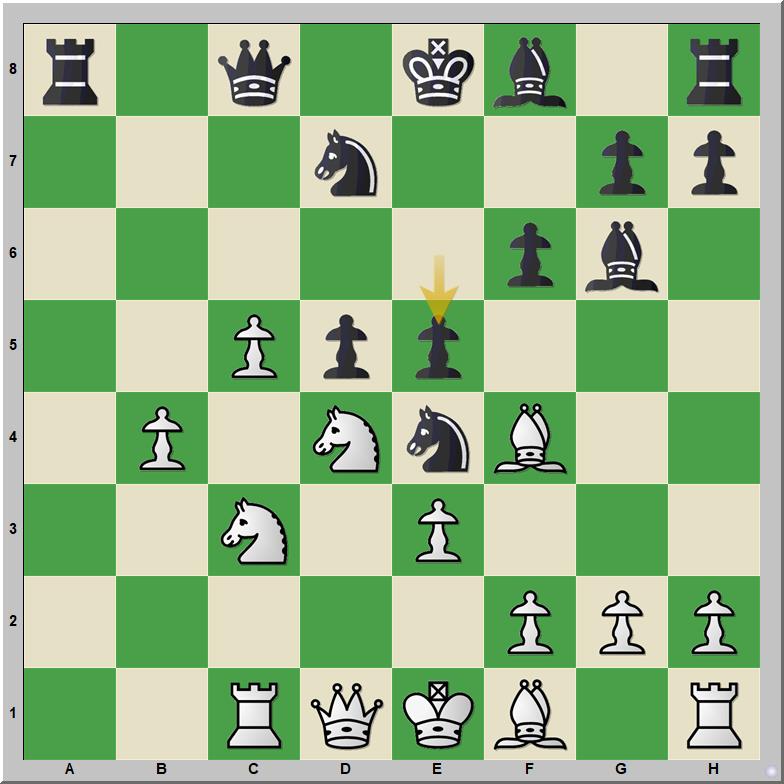
In each of these five positions, I had a better move than the one I played. Although I dominated most of the game and managed to win, I did concede the advantage and was even worse through part of the game.

White to move

I played 10.a3??

A couple of weeks ago, I was examining the tactics in a Grandmaster game that involved the type of position that occurs after the superior 10.b5!

White to move

15.Nd4?? walked into a fork, although that was not fatal and my pawns proved to be compensation for the knight. But 15.Nxe4 or 15.Bb5 were both better choices

White to move

16.Bg3?? turned out okay in the game, although Black now has a clear advantage. After 16.Nxd5 exf4 17.f3, White has a decisive advantage.

White to move

22.b5 Na4 23.Ra3 Nc2 leads to the next position, and I again have an advantage. However, 22.Re3 wins a piece. I also could have played 21.Re3, but 21.Bf3 was good enough to regain the advantage.

White to move

24.Rxa8! was a move that I considered, but without adequate calculation. Black is busted.

I played the seemingly safer 24.Qb3. A few moves later, my opponent returned the sacrificed piece which left me a clear pawn ahead. My bishops also controlled the squares my passed b-pawn needed.
I can play better.

25 May 2009

Pressure

I managed to avoid loss in yesterday's Washington Open games. After two days and four games, one player in my section has four points. I'm one of four with three. If someone beats the leader, anyone of the rest of us has a shot to share first.

I'm in the Premier section, which is limited to players under 2000. Those under 2000 that are playing in the Open are getting slaughtered as should be expected with several masters in the group and quite a bit of money on the line. The total prize fund for all sections is $8000. First prize in the Open is $1000.

I'm less interested in the $400 top prize in my section, although money is always nice, than in reaching my goal of crossing the line into class A. If the tournament ended now, I should be about 1790 or a tad higher. I'm currently 1764. My results have been:

1668 draw
1744 win
1786 draw
1839 win

The games get tougher today. I must focus on round five, thinking about neither money, round six, nor the rating. I must put all my energy into finding good moves, one at a time.

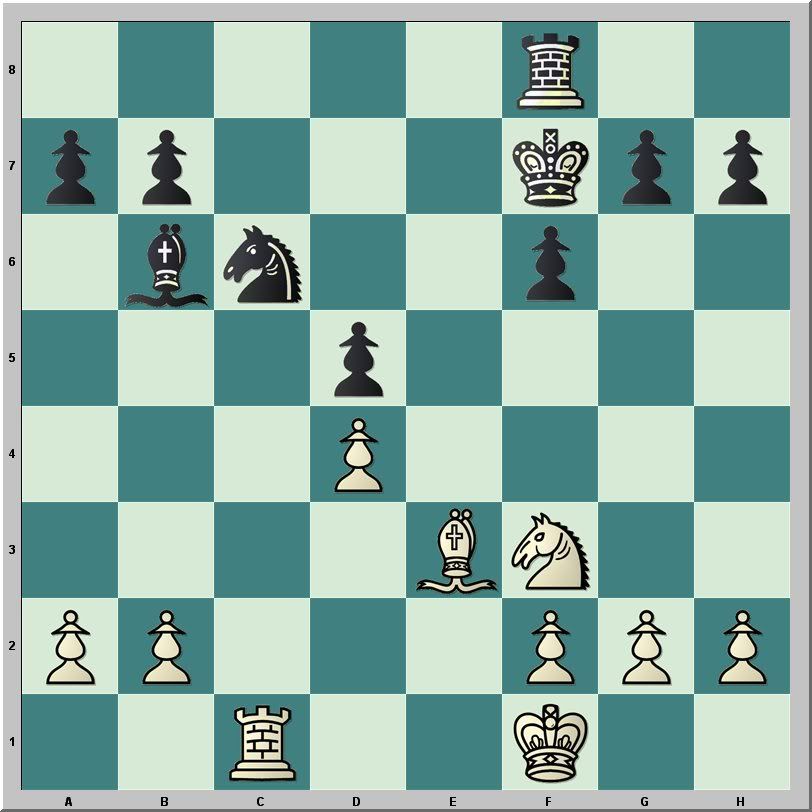
In yesterday's games, I reached easy equality in a French with most of the pieces coming off the board fast. We reached this position after my 19...Kf7.


I offered a draw, and my opponent thought for seven minutes before accepting. We used twenty-nine minutes between us.

Round four started six and a half hours later, which gave me plenty of time to talk with Tim Tobiason of Toby Chess, the vendor. I hung out in the skittles room, watched other games, and attended the Washington Chess Federation Board meeting. I haven't yet told my wife that I was elected member-at-large to the board. I might get in trouble for that.

In round four, I had White against Michael Hosford. I had lost to him in a long and difficult game in 2006. He played the King's Indian Attack against my French and eventually found a tactic that won material. I played out a lost position during his time trouble until it became clear that he could finish all necessary moves within the time delay.

When I saw him at the Washington State Elementary Chess Championship--he served as a section chief during one round,--I told him that I was looking forward to another crack at him in the Washington Open. As we were sitting down, he said, "you got your wish." But, the wish was for a win, not just to play him. He's a strong, resourceful player and a scholastic coach with Chess4Life. His focus during play is exemplary.

I lost my way in a Catalan. In the effort to mount an attack, I sacrificed a pawn. Then, I overlooked a simple tactic that lost another. Still, I had my plan: get my queen "up in his grille," as Robert Pearson put it in comments to yesterday's post. I burned a lot of time in the early going, becoming as much as thirty minutes behind. He used the time advantage to reach a superior position, but we were both responding to the need to move faster.

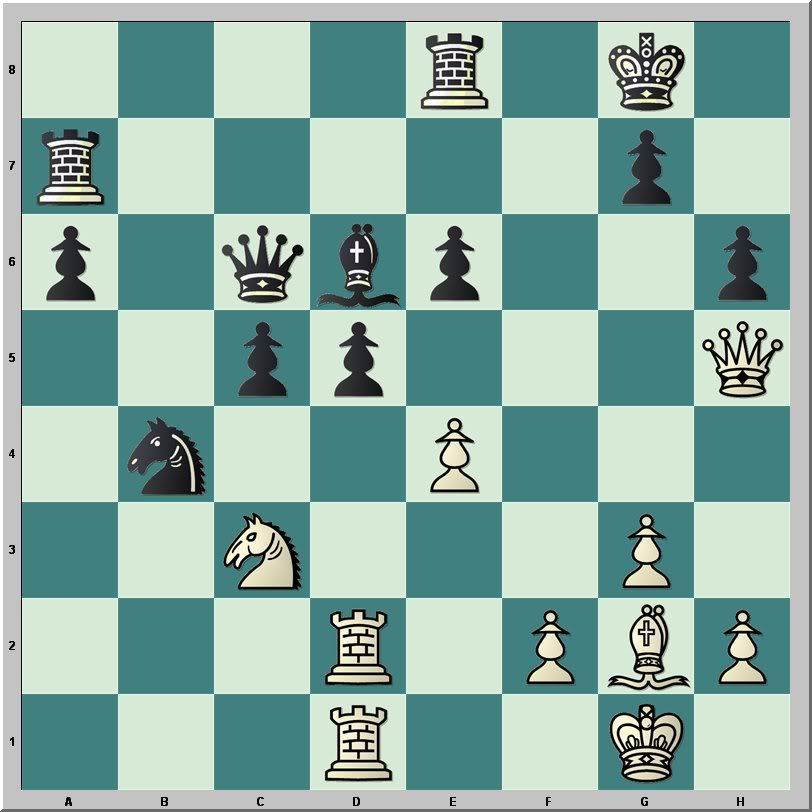
We reached this position with Black to move after 29.e4. I had twenty-three minutes left to get to move 40. He had seventeen.


What should he play?


Open Section

When I left at 10:45pm last night, Internation Master John Donaldson was pressing a one pawn advantage against FIDE Master Nick Raptis on board one in the Open section. They had opposite colored bishops, and a rook each. Donaldson's position had more dynamism than my round one game with the same pieces, but more pawns. Even so, it was hard to see a clear plan for the IM and I wanted some sleep.

Round five begins at 9:00am this morning.