Showing posts with label Keres Attack. Show all posts

12 August 2009

Keres Attack with 6...e5 7.Bb5

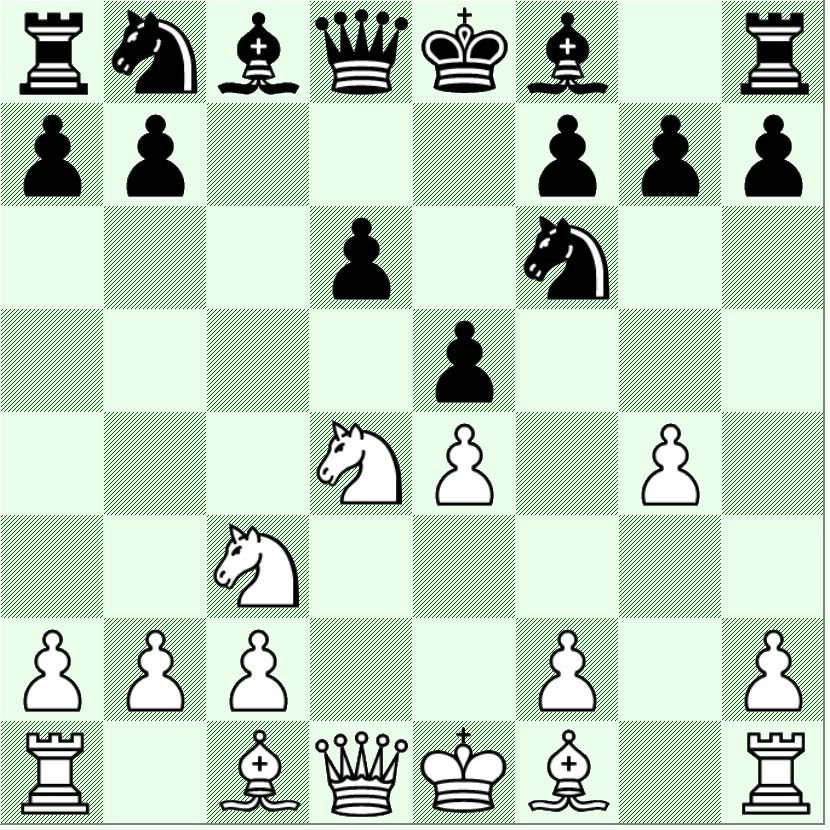
The Keres Attack is an aggressive weapon for White against the Scheveningen variation of the Sicilian Defense. It begins 1.e4 c5 2.Nf3 d6 3.d4 cxd4 4.Nxd4 Nf6 5.Nc3 e6 6.g4. I noted last week in "Intimidation" that Black has four "book" responses. Readers recommended looking at 6...e5 even though it is less popular at the highest levels, so I have been looking at a few games along the resulting lines.

6...e5 7.Bb5

For 7.Nf5, see Keres Attack with 6...e5

Detours through the next several moves seem rare.

7...Bd7 8.Bxd7 Qxd7 9.Nf5 h5
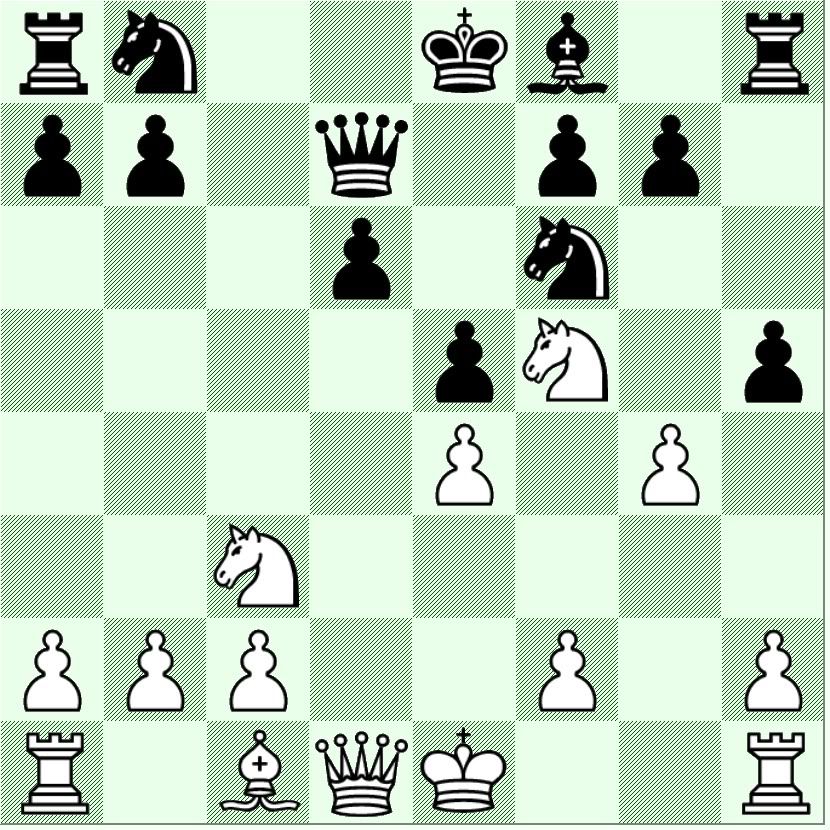


Now, White has some choices.

10.f3 appears to have been introduced by Ferdinand Pop in a correspondence game in 1964, and it has scored over 60%. Popp won his game, which I reproduce here.

Popp,F - Schnieders,H [B81]
Correspondence, Germany 1964

1.e4 c5 2.Nf3 e6 3.d4 cxd4 4.Nxd4 Nf6 5.Nc3 d6 6.g4 e5 7.Bb5+ Bd7 8.Bxd7+ Qxd7 9.Nf5 h5 10.f3 hxg4 11.fxg4 g6 12.Ne3 Bh6 13.Qf3 Bg5 14.h4 Rxh4 15.Nf5 Bxc1 16.Rxh4 gxf5 17.Rh8+ Ke7 18.Rxc1 fxg4 19.Qg3 1–0

However, among master level players since 2000, 10.f3 has appeared only twice, both in games among juniors, and both were wins for Black. Rather, Alexei Iljushin won both games. Rather than abandoning the line, it behooves the scholar to understand Iljushin's ideas and comprehend where his opponents erred.

Shinkevich,V (2440) - Iljushin,A (2515) [B81]
Russian Junior Championship, Ufa 2000

1.e4 c5 2.Nf3 e6 3.d4 cxd4 4.Nxd4 Nf6 5.Nc3 d6 6.g4 e5 7.Bb5+ Bd7 8.Bxd7+ Qxd7 9.Nf5 h5 10.f3 hxg4 11.fxg4 Rh3 12.Qe2 Qc6 13.Ng3 Nbd7 14.Bg5 d5 15.Bxf6 d4 16.Nd5 Nxf6 17.Nxf6+ gxf6 18.0–0 Rc8 19.Kg2 Rh8 20.c3 Bh6 21.cxd4 exd4 22.Nf5 Be3 23.Nxe3 Qxe4+ 24.Rf3 Kf8 25.Kg1 dxe3 26.Rxe3 Qg6 27.Rd1 Kg7 28.h3 Rc2 29.Qd3 Rxb2 30.Qxg6+ Kxg6 31.Rf3 Rc8 32.Rdf1 Rc6 33.R1f2 Rxf2 34.Rxf2 Ra6 35.Kg2 Ra3 36.Rb2 b6 37.Kh2 f5 38.gxf5+ Kxf5 39.Kg2 Kg5 40.Kh2 f5 41.Kg2 f4 42.Rf2 b5 43.Kh2 b4 44.Rg2+ Kh5 45.Rb2 a5 46.Rf2 Kg5 47.Rg2+ Kf5 48.h4 Rg3 49.Rc2 Kg4 50.Rc5 Ra3 51.h5 Rxa2+ 52.Kg1 b3 0–1

Mastrovasilis,D (2386) - Iljushin,A (2509) [B81]
European Junior Championship, Aviles 2000

1.e4 c5 2.Nf3 e6 3.d4 cxd4 4.Nxd4 Nf6 5.Nc3 d6 6.g4 e5 7.Bb5+ Bd7 8.Bxd7+ Qxd7 9.Nf5 h5 10.f3 hxg4 11.fxg4 Rh3 12.Bg5 Rxc3 13.bxc3 Nxe4 14.Be3 d5 15.0–0 Nc6 16.c4 d4 17.Qf3 Nc5 18.Bd2 e4 19.Rae1 Qe6 20.Qg2 0–0–0 21.c3 d3 22.Ng3 Ne5 23.Nxe4 Nxc4 24.Ng5 Qb6 25.Kh1 f6 26.Ne4 Qc6 27.Rf2 Re8 28.Ng3 Rxe1+ 29.Bxe1 Qe6 30.Bd2 Nxd2 31.Rxd2 Qe1+ 32.Nf1 Ne4 33.Qf3 Nxd2 34.Qf5+ Kc7 35.Qa5+ Kc6 36.Qa4+ Kc7 37.Qa5+ Kc8 38.Qf5+ Kb8 39.Qf4+ Ka8 0–1

07 August 2009

Keres Attack with 6...e5

So far at least two readers have advocated studying 6...e5 for Black in the Keres Attack against the Scheveningen Sicilian. My opening book of master games since 2001 (MT IV) indicates that this move is the least popular (44 games of 629) of the four principal continuations. Even so, Linuxguy_on_FICS claims it is the most principled reply, so it's worth a look.


After 1.e4 c5 2.Nf3 d6 3.d4 cxd4 4.Nxd4 Nf6 5.Nc3 e6 6.g4 e5 we have the starting position.


Two moves appear in the Encyclopedia of Chess Openings:

7.Nf5
7.Bb5

My opening book MT IV indicates that Bb5 is twice as popular as Nf5, but that Nf5 scores much better. The main line in ECO from Nf5 ends with a substantial edge for White. 7.Bb5 breaks into three lines in ECO--two end as unclear, one ends with a substantial advantage for White.

7.Nf5

ECO gives only 7...h5 in reply to 7.Nf5, but two other moves played in high level games in 2008 complicate my preparations to play the White side.

7...g6 was played against Bobby Fischer in 1964 in a simul, and Fischer lost. It was played a few more times until Sequera Paolini-Alvarez, San Felipe 2008, which Black won.

7...Nc6, a standard Sicilian move, appears to have been introduced into practice in the Bundesliga: Gharamian-Nisipeanu, Trier 2008. That game ended in a short draw. However, a reasonable appearing novelty in a more recent game went badly for White. Perhaps these games deserve closer attention before moving on to 7.Bb5.


Adla,D (2508) - Meier,G (2641) [B81]
TOP 16 Poule Haute Le Port Marly FRA (10), 30.05.2009

1.e4 c5 2.Nf3 e6 3.d4 cxd4 4.Nxd4 Nf6 5.Nc3 d6 6.g4 e5 7.Nf5 Nc6 8.Bc4N

8.Bg5 h6 9.Bxf6 Qxf6 10.Qd2 g6 11.Ne3 h5 12.gxh5 Rxh5 13.Nb5 Qd8 14.0–0–0 Rh4 15.Bc4 a6 16.Nxd6+ Qxd6 17.Qxd6 Bxd6 18.Rxd6 Ke7 19.Rd2 Rxe4 20.Nd5+ Kf8 21.Nb6 Rb8 22.Bd5 Rb4 Gharamian,T-Nisipeanu,L, Trier 2008 ½–½

8...Be6 9.Bb3 h5 10.Bxe6 fxe6 11.Ne3 hxg4 12.Nxg4 Nd4 13.Nxf6+ Qxf6 14.Be3 Nf3+ 15.Ke2 a6 16.Qf1 Be7 17.Qg2 Rf8 18.Nb1 d5 19.exd5 exd5 20.Nd2 e4 21.c3 a5 22.Kd1 a4 23.Nxf3 Qxf3+ 24.Qxf3 Rxf3 25.Kc2 Kd7 26.h4 Rh8 27.Rag1 Bf6 28.Rg2 Ke6 29.Kd2 Rxh4 30.Rxh4 Bxh4 31.Rxg7 Bxf2 32.Bxf2 Rxf2+ 33.Kc1 b5 0–1

06 August 2009

Intimidation

At the suggestion of a friend, I signed up for another thematic tournament. This one features the Keres Attack, ECO B81.

After 1.e4 c5 2.Nf3 d6 3.d4 cxd4 4.Nxd4 Nf6 5.Nc3 e6 6.g4 we have the starting position.


A quick glance at the Encyclopedia of Chess Openings is sufficient to intimidate most players unwilling to spend many hundreds of hours learning theory. ECO has no less than fifty-five lines. Chess Informant has published 608 theoretically significant games through its first 103 issues--three in the first issue and four in 103. In Predojevic-Movsesian, Sarajevo 2008 (Informant 103/151), 15...Nad5 was the novelty.

Black's responses from the diagram:

6...e5 lines 1-4
6...a6 lines 5-27
6...Nc6 lines 28-36
6...h6 lines 37-55

Where should I begin?