Showing posts with label ratings. Show all posts

15 July 2026

Groping in the Dark

At what level of play can someone be considered good at chess?

During his lecture at the Spokane Chess Club last on the eve of the Inland Classic, IM John Donaldson was discussing Bobby Fischer's remarkable rise after 1955. Donaldson has written several excellent books on Fischer, most recently Inside the Mind of Bobby Fischer: Revisiting His Writings and Annotations (2025). Fischer's rating in 1955 was mid-1700s. Donaldson mentioned some recent analysis of games from Fischer's first rated event that led to that rating and quipped, "he was not very good". 

In contrast to this critical historical assessment of the early career on one of the greatest chess players ever are innumerable threads in social media asking, for example, whether 1100 is a good rating. Most comments in such threads--this one has more than 350--note that 1100 is well above the average on the site. Similarly, a player near the bottom of the standings in the tournament that we played in this past weekend with a USCF rating in the 900s is at the 59th percentile. That player scored a 500+ point upset in the first round, then lost the rest of his games. These players are offered comfort in the knowledge that they are better than half of all rated players, and substantially better than the majority of casual chess enthusiasts who never enter competition.

My rating just above 1860 puts me at the 94th percentile. I told Donaldson on Sunday morning that his comment about Fischer was helping me come to terms with the fact that I'm not very good and never will be. John did not say much about this remark, but we had several conversations throughout the weekend, including him soliciting my insights into finding historic chess games online and a brief discussion of the writing of John Steinbeck, whose published books I am working my way through.

My perspective is grounded in comments I made last spring about the defects in the play of A-class players (see "Two Donner Quotes") and my sense in round two on Saturday that I was unable to comprehend and correctly assess the positions through much of the game. I believed that I was slightly worse early on, but had provoked some pawn structure weaknesses that were exploitable in the ending. When my B-class opponent blundered, I immediately recognized that my winning chances had become very good. In the brief post-game discussion, he immediately mentioned that terrible move that turned a roughly equal position into one where he was clearly worse.

From the point of view of the elementary students whom I coach, and that of the average USCF player, those of us in A-class are strong. Compared to masters and above, we are quite weak. Maybe we have some knowledge, but we also fall prey to bad habits, misevaluate positions through appalling ignorance, and fail to calculate with any precision.

Stripes,James (1865) -- Lopez,Francisco (1614) [A49]
Inland Classic Spokane Valley (2), 21.02.2026

1.d4 Nf6 2.Nf3 d6 3.g3 g6 4.Bg2 Bg7 5.Nbd2

Black to move

This move does not seem to me particularly strong, but I've been playing it in similar positions online the past few months. My idea is to maintain the flexibility to play e4 or c4, depending on how my opponent responds. Of course, blocking the mobility of the dark-squared bishop should be seen as a loss of tempi. 

I had the Black side of this position in round four, when my opponent played 5.c4 instead of my 5.Nbd2. That game continued 5...0-0 6.0-0 Nbd7 7.Nc3 c5 I was already feeling a bit lost in terms of my understanding of how Black should proceed here. 8...e5 is more common and scores much better.

5...Nc6 6.c3 0-0 7.0-0 e5 8.dxe5 Nxe5

8...dxe5 9.e4 a5 10.Qc2 Be6 11.Rd1 Qc8 0-1 Stavrianakis,I (2316) -- Stojanovic,D (2488) Belgrade Trophy 26th 2012

9.Nxe5 dxe5 10.Qb3 c6 11.Rd1 Qc7

White to move

Black's pieces are more mobile.

12.a4

12.Ne4 Nxe4 13.Bxe4 Be6 14.Qb4 Rfd8 15.Be3 Rxd1+ 16.Rxd1 Bf8 17.Qa4 a6 18.Qc2 Rd8 19.Rxd8 Qxd8 20.b4 f5 21.Bg2 Qd7 22.a4 ½-½ Lupinski,I -- Remenyi,B Wch U18 Girls 5th Guarapuava 1991 

12...Be6 13.Qc2 Bf5

Black should play 13...a5, neutralizing White's effort to create a weak point.

14.e4 Bg4 15.f3?!

Black to move

15...Be6=

15...Qb6+ 16.Kf1= (16.Kh1 Be6 17.a5 Qf2 18.Rf1 Qe2 19.Qd1 Qxd1 20.Rxd1 Rad8with a slight edge for Black)

16.Nf1

16.a5

16...h6

16...a5

17.a5 Rfd8 18.Be3

White to move

By this point, I was beginning to formulate a plan. When I played 12.a4, the intent was to provoke a weakness on the queenside. Now, the nature of that weakness is coming to light. Even so, this weakness offered me no advantage until my opponent's tactical error.

18...Kh7

18...b6 19.axb6 axb6=

19.Rxd8! Qxd8 20.Qf2 a6

I was optimistic that swapping the heavy pieces would leave Black with a vulnerable b-pawn that my king could threaten. However, if Black's king defends the pawn, it is not clear that I could make progress elsewhere.

20...b6 21.axb6 axb6 22.Rxa8 Qxa8 23.Bxb6 and White is slightly better; 
20...Bf8 21.Nd2=

21.Qe2?!

This move was rooted in shallow calculation and failure to understand the most important elements of the position

21.Nd2 would have been better with the idea of controlling c4.

21...Qe7 22.Bb6 Nd7|

Somehow I overlooked this move.

White to move

23.Be3 Rd8 24.Rd1 Nf8

I was happy for the opportunity to exchange the heavy pieces and continue with a minor piece struggle, thinking that I had some chances to exploit the hole on b6.

25.Rxd8 Qxd8 26.Bb6 Qd6

26...Qb8 27.b4=

27.Qd2 Qe7 28.Qd8

Forcing a minor piece ending (or is the resulting position still a middlegame?

28...Bf6 29.Qxe7

29.Qb8! Bg7 (29...Nd7 30.Qxb7) 30.b4 White may have a slight edge 30...Qd7 31.Bc5 Qc8 32.Qxc8 Bxc8 33.Kf2

29...Bxe7=

White to move

30.Ne3 Nd7 31.Ba7

31.Bc7 f6 32.b4 c5 33.Nd5 Bf8 34.Bf1

31...Bc5

31...Nc5 32.Nd1 Na4 33.Kf1

32.Bxc5 Nxc5 33.Bf1 f6

I expected 33...Nb3 when I tried to work out a line that could give me an advantage.

34...Bc8?!

34...Kg7; 
34...Bxc4 35.Nxc4=]

35.Kf2 White is playing for an advantage, but does not have much chance of winning.

35.b4 Ne6 36.Bxe6 Bxe6

35...Kg7 36.Ke2

36.b4 Na4 37.Nd1

36...Kf8 37.b4 Ne6 38.Ng4

38.Bxe6 might be best 38...Bxe6

38...Kg7 39.Kd3

39.Nf2!

39...Ng5 40.Ke3= 

Black to move
40...Nf7??

40...Bxg4 41.fxg4 Nf7 42.Bxf7 Kxf7 43.Kd3 Ke6 44.Kc4 Kd6 45.h4 h5 46.g5

Black to move
Analysis diagram

46...f5 (46...fxg5?? 47.hxg5 Kd7 48.Kc5 Kc7 49.c4 Kd7 50.Kb6 Kc8 51.b5 axb5 52.cxb5 cxb5 53.Kxb5 Kc7 54.Kc5+-) 47.Kd3 Ke6=

41.Bxf7+- h5

41...Kxf7 42.Nxh6+ Ke6 43.Ng4+-

42.Nxf6

42.Nxe5 fxe5 43.Be8! Bh3 44.f4+-; 
42.Bxg6 hxg4 43.Bh5 gxf3 44.Kxf3+-

42...Kxf7

42...Kxf6 43.Be8 (43.Bb3 was my intended move, but Be8 is better)

43.Nh7 Kg7 44.Ng5 Bd7 45.Kd3 Kf6 46.h4 Ke7 47.Kc4 Kd6 48.f4 exf4 49.gxf4 Bg4 50.Nf7+ Ke7 51.Ne5 Bh3 52.Nxg6+ Kd6 53.Kd4 Bc8 54.f5 Kc7 55.Kc5 Bd7 56.Nf4 Be8 57.e5 1-0

Once I had a clear advantage, I played as if I understood the game. But, my memory of this game lingers as several hours of confusion.

10 June 2014

Rating Inflation

It has become common in the chess world to assert that ratings today are inflated relative to historic ratings. As more and more players surpass Robert J. Fisher's peak rating of 2785, chess enthusiasts lament the inflation that creates the illusion that those players are stronger than Fischer. It cannot be true. Bobby Fisher is the best who ever moved a pawn.

Computer Scientist Ken Regan studies individual positions through computer analysis and compiles databases of hundreds of thousands of such positions. Through examining a player's moves over a batch of positions, he creates an Intrinsic Performance Rating (IPR). He develops methodology to catch cheaters. His analysis is also useful for estimating the Elo rating of players in the past.
What he found was that rating inflation does not exist. Between 1976 and 2009, there has been no significant change in IPR for players at all FIDE ratings ... the IPR for players rated between 2585 and 2615 has remained relatively constant over time. Today's thousands of grandmasters and dozens of players rated over 2700 indicate a legitimate proliferation of skill.
Howard Goldowsky, "How to Catch a Chess Cheater: Ken Regan Finds Moves Out of Mind," Chess Life (June 2014), 30.
Such is one of the many gems in the cover story of this months Chess Life, the magazine of the United States Chess Federation (USCF). I heartily recommend the article.

11 July 2012

Becoming a Candidate Master

Alex Dunne's How to Become a Candidate Master, 2nd ed. (Davenport, IA: Thinker's Press, 1986) is dated and contains slight flaws. Both of these weaknesses are easy to overlook in this novel text that has the advantage of aiming precisely at players at my present skill (rating) level. The term Candidate Master has been used in different times and places with slightly different meanings. For Dunne, the term refers to US Chess Federation ratings 2000-2199.

Since the publication of this text nearly two decades age, the USCF has implemented a title system. They "award permanent titles based on sustained performances at particular rating levels" (USCF Ratings Committee, "The USCF Title System," October 2011). It is possible to become a Candidate Master in the sense Dunne used the term, but not achieve the USCF norm-based title. For instance, due to my infrequent events and relatively rapid rise through recent events, my rating is strong A Class, but my title is 2nd Category (B Class level). My aim is to achieve both Expert Class (Dunne's meaning) and the USCF Candidate Master title. Thus, even though an Expert rating is not out of reach this weekend, the title remains at least one year away. There is plenty of time for thorough study of Dunne's text.

In his brief Introduction, Dunne explains the concept of the book. It consists of fifty games, most of which are between Candidate Masters (2000-2199) and Category I players (1800-1999). A few pit the CM against weaker players, or against masters. The book is dated because it contains only "recent" games from tournament play. Recent, then, was 1982. These games are ancient now. Even so, the approach remains fresh. With today's databases, it is a simple matter to update the games using the same criteria.

While going through the first game in Dunne's text yesterday, I found another game with a similar opening. In this more recent game, the Category I player did not miss an opportunity that had been missed by the Category I player in Dunne's game 1 (see Black's moves 9-14 in the game score below). Even so, the CM prevailed. Looking through the game in ChessBase 11, I quickly identified the key tactical error, Black's 27th move.


Vesely,Libor (2084) - Tretina,Zdenek (1893) [B88]
Ostrava SME op Ostrava (2), 01.05.2005

1.e4 c5 2.Nf3 d6 3.d4 cxd4 4.Nxd4 Nf6 5.Nc3 a6 6.Bc4 e6 7.Bb3 Qc7 8.0–0 Nc6 9.f4 Nxd4 10.Qxd4 d5 11.Kh1 Bc5 12.Qd3 dxe4 13.Nxe4 Nxe4 14.Qxe4 Bd7 15.f5 Bc6 16.Qg4 0–0–0 17.fxe6 fxe6 18.Bxe6+ Kb8 19.b4 Rd4 20.Qh3 Bxb4 21.Rb1 Bd6 22.Be3 Rb4 23.Rxb4 Bxb4 24.Qg4 Bc3 25.Qf5 Bb4 26.Qg4 Bc3 27.Qc4

Black to move

27...Bb5??

Swinging the undeveloped rook to a central file would have maintained equality. Black opted for a skewer. Did he miss the deflection, or did he reason that he could give up the queen for gain of rook and bishop?

28.Ba7+ Kxa7 29.Qxc7 Bxf1 30.Bd5 Rb8 31.Qxc3 Rd8 32.Qd4+ Ka8 33.c4 Kb8 34.Qc5 Rd7 35.Qf8+ Ka7 36.Qxf1 1–0

The text focuses upon how CMs beat A Class players. Through such study, the Class A player may identify and correct his or her own weaknesses, while honing the ability to exploit these weaknesses in others. The game above reinforces my recognition, revealed in post-game analysis with Tim Moroney  (who has the USCF CM title), that Experts analyze positions deeper than I have been doing.

Dunne asks the reader to begin thinking of him- or herself as a Candidate Master, and hence to examine the book's games from that side of the board. The most apparent flaw in the book's structure is the failure of each chapter to indicate at the outset which side that is. For that information, the reader must turn to the Table of Contents. It's a minor flaw that is easy to work around.

I am not yet in a position to comment on the quality of the analysis offered by Dunne in the text. First, I have fifty games to go through. I also must reach my goal. Then, and only then, will I be able to assess the usefulness of this book in helping me along that quest.

10 June 2012

Training Log

The Funk

Losing puts me into a funk. Sometimes it's not the loss, but an unreasonable concern with meaningless online ratings. Make no mistake, ratings are useful for measuring personal progress over time, and for finding appropriately difficult opponents. But ratings are too easily compared.

My USCF rating of 1933 is solid. I spent years struggling to rise above 1800, and then celebrated the achievement. Now, if I suffered a losing streak and dropped below 1900, it would put me into a funk.

Compare my USCF OTB rating to an online correspondence rating of 2275. The higher rating is deemed inflated by some, but it strokes my ego. At another site my rating is 1840, and it hovers near 1700 at yet another. These are correspondence ratings, and at my most active sites they are near 2000.

Online blitz is another matter. My blitz rating at FICS, where I have not played for several years, is slightly over 1600, and my peak rating there was mid-1700s. On Chess.com, my blitz rating is a tad over 1800, and has been over 1950. On ICC, it is near 1600, but based on a mere handful of games. Most of my play on ICC is in the 3 0 pool and the 1 0 pool. Those pools are brutal, and the ratings are embarrassing. Yesterday, I drew a Women's International Master (or lost on time in a clearly superior position)--I cannot recall, exactly, except that I was not outplayed. Her rating was near 1500, and it is a good day when my rating climbs above that. I have yet to crack 1600 in the 3 0 pool. Even so, I am mid-1900s in the 5 0 pool, albeit based on fewer than one dozen games.

I know well that ratings are relative. Indeed, I'm constantly preaching this point when the subject arises in online chess forums. Even so, some ratings put me into a funk. My response to losing or even drawing a player whose rating seems too low to me is to play more, but increasingly my play is foul: I'm playing the rating instead of the player. My play gets worse, and I play more. As the quality deteriorates, the quantity grows to gargantuan proportions and my mood worsens.

Much of my work is done from home. This convenience creates a flexible schedule that permits chess study. But, it also renders possible a wholly dysfunctional waste of days--hundreds and even thousands of online blitz and bullet with nothing to show for the time except a foul mood, a funk.


The Training

All this lamenting of my weakness for binges on nonstop garbage chess is to say that my training regimen lacked a sense of purpose this past week. No effort was expended solving the challenging and well-selected chess positions in Chess Training Pocket Book II, nor in Imagination in Chess (see "New Year's Resolutions"). No effort was put forth on my efforts to master fundamental pawn endgames. There were, however, three sessions (two quite short, and one long) working standard tactics on Chess Tempo for a total of 83 problems. As noted in "Counting Pieces," I had a pleasant reminder of the benefits of such training on Friday.

Chess Tempo total:

Problems Done: 1894 (Correct: 1025 Failed: 869)
Percentage correct: 54.12%
Average recent per problem time spent 79 seconds

27 February 2012

Breaking Through 1900!

New Peak Rating
No more waffling will be permitted. I aim to become a USCF Expert. I had set the modest goal of pushing through the next rating level, 1900, and wrote my New Year's Resolutions to achieve that aim. My first tournament of 2012 was an astounding, and wholly unexpected success! I wanted to score 3.5 or better, believing that would propel me over 1900. I won all my games, took my usual third round bye, and finished in second place in the 20th Dave Collyer Memorial. My new rating is 1933! My head is reeling from the thin air.

Ironically, my winning strategy in two games was playing for a draw. I can neither pursue this strategy with plans for success, nor recommend it. Even so, there is something worthwhile in the efforts to become difficult to beat. In "Rating Estimation," one of the most popular posts on this blog, I mentioned increasing my drawing ratio as part of the path to improvement.
To get to A class, I've needed to learn tactics and endgames, and expanded my opening repertoire. But, more important, I've needed to reduce the obvious blunders made in haste, and I've needed to become far more consistent against lower rated players. I've also increased my drawing ratio.
"Rating Estimation"
I certainly made errors in my four games this past weekend, but these errors were far less severe than some that had been common. My game against Michael Cambareri in round four is a case in point. Just a bit over a year ago, I played a memorable game against Michael. I was talking with others on the nearby boards about this game before round one began. Michael often plays the opening extremely fast, and I became caught up in matching his speed one Thursday night. In the 2010 Turkey Quads, I instinctively pushed my c-pawn without the necessary preparation.

Cambareri, M (1884) -- Stripes, J (1841)
Turkey Quads, Spokane 2010

1.e4 e6 2.d4 d5 3.Nc3 Nf6 4.Bg5 Be7 5.e5 Nd7 6.Bxe7 Qxe7 7.f4 c5?? 8.Nb5 1-0

It was possible to play on and make my opponent prove his ability to convert the advantage gained from winning the exchange. I opted to go home and watch television with my wife. In previous games, Michael had demonstrated to my satisfaction his ability to convert such an advantage. Spending an hour or two suffering from slow strangulation did not strike me as the way that I wanted to spend the evening.

Black to move
Black must play 7...a6. When I played this move yesterday, Michael laughed. He, too, had clear memories of our previous game in the Classical French. This time, after a long think, Michael played an unusual move. It may have been an error. I was able to temporarily win a pawn, and might have taken two. I had a solid position with no clear weaknesses, but for a time was defending passively due to some positional errors. The opportunities that my opponent missed were far less obvious than his opportunity after my egregious tactical blunder in the Turkey Quads. In the end, under time pressure, he turned down my draw offer and then promptly walked into a mating net.

26 February 2012

Goals

I remain in pursuit of the next rating floor. Currently my USCF floor is 1600. When my brain deteriorates due to age and ill health, I will always remain at or above 1600 rating. A win today in two efforts could propel me up to a floor of 1700.

31 May 2009

Rating Estimation

It seems that a lot of chess players new to or unacquainted with tournament chess want to know their rating. Others who have played online, but not OTB (over the board) frequently ask how one rating compares to another. There are several ways to estimate one's rating, but all should be treated with skepticism.

The series of ten problems at Chess Maniac might be better than most. I tried it a few days ago and scored 1830, which is reasonably close to my recently gained USCF rating of 1819. Less reliable are the Chessmaster personalities. Vlad, for example, allegedly plays at 1846, but the software does not adjust for processor speed. Few human A class players commit the egregious positional errors in the opening that are Vlad's trademark, nor are they as adept at tactical calculation. When I entered B class, I played a sequence of training games against Vlad, finding him surprisingly easy to outplay positionally.


Rating History

In the early 1990s, I was coming back into chess after more than a decade away. I had played in some team matches in high school, at least one club event at the Spokane Chess Club, and had joined the US Chess Federation and played postal chess. All these activities ended by the time I had been in college one year. Among my circle of acquaintances, the second best player could beat me occasionally. I did not renew my USCF membership and I stopped playing postal.

I bought my first personal computer in 1989, learned that Chessmaster 2100 was available, and that it allegedly played at a master level. Even though I was too busy with graduate school for play--aside from a fanatical obsession with golf during the summer,--I started learning a bit about computer chess. Finding the right level for playing against the box pulled me into efforts to estimate my own level of skill.

Through CM 2100, 3000, 4500, and 5000, I used several features of the program to approximate my skill level, which also increased slightly as I played against successive versions. I also spent some time in the library reading Chess Life, especially Bruce Pandolfini's "Solitaire Chess." In "Solitaire Chess," students guess the moves of a master level game and earn scores for right answers and some alternatives. The total score at the end of each game corresponds to an approximate rating.

When I returned to the Spokane Chess Club in fall 1995, I told the club's contact person that I thought I might be an A Class player. But, at my first club meeting, I played a series of pick-up games against an E class player with an approximately even score. In March 1996, I entered my first USCF rated tournament, scored 2.0 of 5.0, and earned a provisional rating of 1232.


Competitive Edge

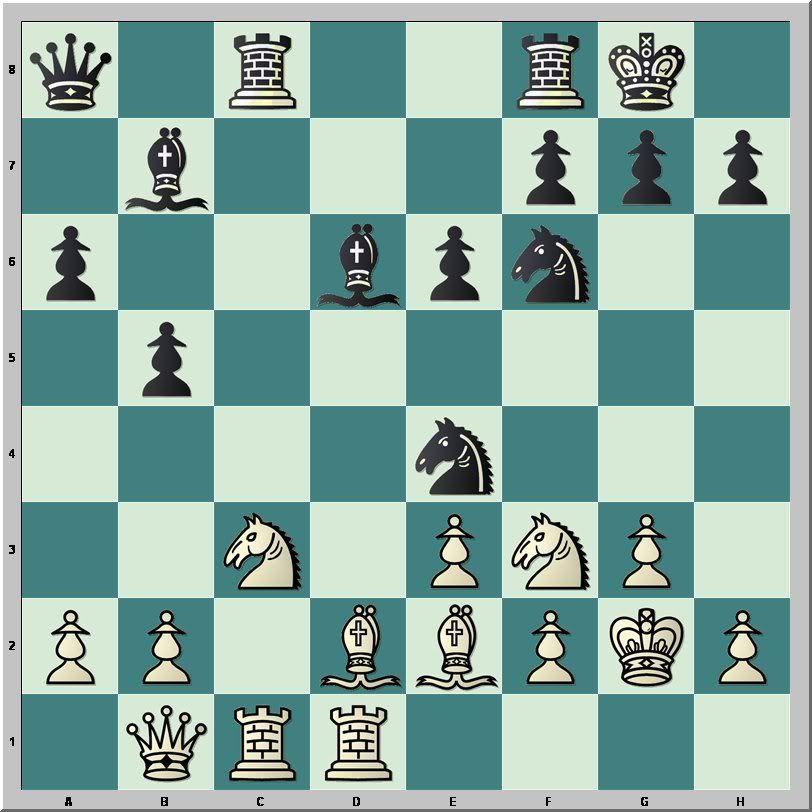
My first published non-provisional rating nine months later was 1425. My estimate based on various exercises turned out to be high by 400 points. But, my initial published rating very nearly could have been much higher. In the 1996 Washington Class Championships, I had Black and move on board one in round four in the position below. A win in this game would have guaranteed me a tie for first, and likely would have given me an initial non-provisional rating over 1500.


I spent quite a bit of time assessing the consequences of 19...b4 with the idea of driving the white queen completely out of play on a1. I played a better move, 19...Ng5, but not the best move. However, as my opponent improved his position move after move, and his queen became active, I lost my way.

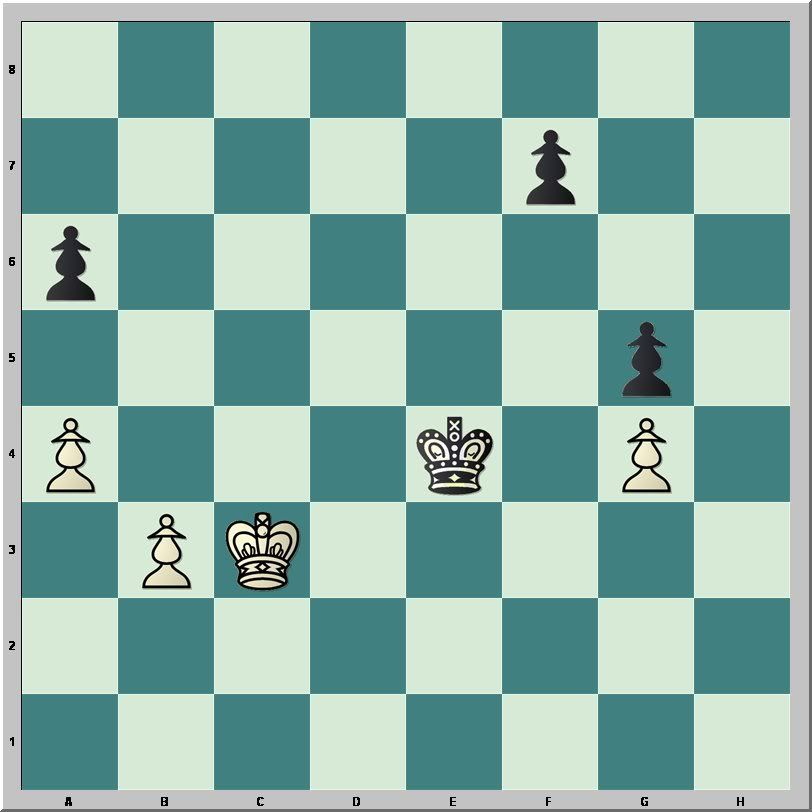
The win slipped away, and I found myself in a drawn king and pawn endgame.

Black to move


Inexplicably, I played 45...Kf4?? After this loss, I also lost round five and ended the event sharing places 8-15.

I returned from the event and told a close friend that I no longer had the competitive edge that had been my norm in high school cross country. My loss demonstrated that chess skill development included emotional preparation and mental focus if I was to have the success I sought. My friend played chess casually, but well understood competition. He has been a state champion in cross country, and had run for two college teams, including a leading Pac-10 school. Last fall, the high school team he coaches became the first team west of the Mississippi to win the national championship.

My rating bounced around in the 1400s for the next five and one-half years, finally jumping above 1500 in February 2002. It dipped back into the 1400s for most of 2004, and in 2005 started a steady climb up to 1601. Once I reached B class, I did not drop below, and after my performance last weekend, reached A class. To get to A class, I've needed to learn tactics and endgames, and expanded my opening repertoire. But, more important, I've needed to reduce the obvious blunders made in haste, and I've needed to become far more consistent against lower rated players. I've also increased my drawing ratio.

In the USCF rating system, a rating of 1800 creates a floor of 1600. If I never win again, I will never drop below B class. But, I still have ambitions. My current established rating remains a crude underestimate of my capabilities.