Showing posts with label Mayet. Show all posts

11 March 2021

Sourcing a Classic Game

Ten years ago I was studying a game that appears in Rashid Ziyatdinov, GM-RAM: Essential Grandmaster Knowledge (2000) and posted "Understanding Mayet's Thinking". Four years later, I found some discrepancies concerning its provenance while studying this game again. Ziyatdinov lists the game as Berlin 1851. In a video made in 2017, Kingscrusher has the game as Berlin 1859. In 2014, I checked David Levy and Kevin O'Connell, Oxford Encyclopedia of Chess Games, vol 1 1485-1866 (1981). Levy and O'Connell's book is an impressive work of scholarship. In the days before databases, it offered a greater selection of historic games than any other single book. The authors also source every game.

Unfortunately, checking Levy and O'Connell's source for Mayet -- Anderssen's miniature complicated matters. They have the game as Berlin 1859, but their source, Leopold Hoffer, and Johannes Zukertort, eds. The Chess-Monthly (1882) has London 1851, played "during the London International Chess Tournament" (212). I noted this contradiction in a comment on chessgames.com. The Chess-Monthly (March 1882) presents a game played in Jackson, Mississippi, which they reproduce from the St. Louis Globe-Democrat, and appends Mayet -- Anderssen as a note to that game (211-212).

The Chess-Monthly

The Chess-Monthly omits a piece of information that can be found in the Globe-Democrat's account of the game: it was played at odds of rook plus move. Chess Archaeology's Jack O'Keefe Project has digital images of most of the chess columns from the St Louis Globe-Democrat. This image is from 15 January 1882, and was the source for the game that appeared in The Chess-Monthly.


The game:

Hunter,Rev. Dr. -- Galbreath,John A.
Jackson, Miss. c.1882
[Mackenzie, George H.]

Remove the rook from a8.

1.e4 e5 2.Bc4 Nf6 3.d3 b5 4.Bb3 a5 5.a3 Bc5 6.Nf3 Nc6 7.c4 bxc4 8.Bxc4 d6 9.0-0 Bg4 10.h3 h5 11.hxg4

With this capture White's troubles begin.

11...hxg4 12.Nh2 g3 13.Ng4 Nd4

The commencement of a highly ingenious combination, which the Reverend Doctor may be pardoned for having failed to see through.

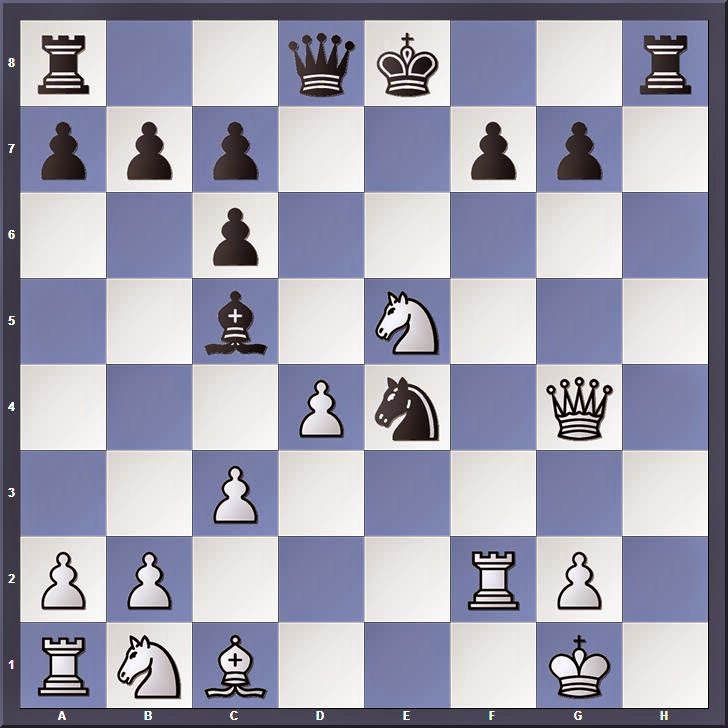
14.Be3 Nxg4

White to move

Up until this point, White had a winning position, but here he blundered.

15.Qxg4?? Ne2+

The termination is exceedingly piquant and interesting.

16.Qxe2 Rh1+ 17.Kxh1 Qh4+ and mates next move 0-1

On Monday this week, I won a miniature using the fishing pole trap, and that brought me back to The Chess-Monthly, Mayet -- Anderssen, and for the first time this interesting game in the Globe-Democrat. That led to a renewed search for the provenance of Mayet -- Anderssen. In turns out, the original publication of the game had been identified at chessgames.com two years ago. The game was published in Schachzeitung in February 1851, a Berlin magazine for which Adolf Anderssen served as one of the editors. Staunton's London 1851 tournament began in late April. Once again, Chess Archaeology had a link to Schachzeitung at GoogleBooks, actually two links--one at the Bavaria State Library and one at the Austrian National Library.


The game:

Mayet,C. -- Anderssen,A. [C64]
Berlin, 1851

1.e4 e5 2.Nf3 Nc6 3.Bb5 Bc5 4.c3 Nf6 5.Bxc6

As I noted ten years ago, this move is inconsistent with 4.c3.

5...dxc6 6.0-0 Bg4 7.h3 h5

Putting a fishing pole out to see if Mayet might bite.

8.hxg4 hxg4 9.Nxe5

Black to move

9...g3

9...Nxe4 and Black is winning. The lines are instructive, and at the end of the best sequence for both, I am able to beat Stockfish on my iPad with Black's second best move (engine assessed), but not with the best.

10.d4 Nxe4

White to move

11.Qg4

Hoffer and Zukertort offer two alternatives:

11.Nf3 gxf2+ 12.Rxf2 Rh1+ 13.Kxh1 Nxf2+ 14.Kg1 Nxd1; 

11.fxg3 Nxg3 12.Re1 Rh1+ 13.Kf2 Qh4 14.Rxh1 Nxh1+ 15.Kg1 Bd6 16.Be3 (16.Nf3 Qf2+ 17.Kxh1 0-0-0) 

11...Bxd4

The greatest representation of dash and brilliancy is not satisfied with the gain of a hostile Queen by 11...gxf2+, etc. (Hoffer and Zukertort)

12.Qxe4

12.Be3 gxf2+ 13.Bxf2 (13.Rxf2 Bxe3) 13...Bxf2+ 14.Rxf2 Rh1+; 
12.Nd3 Rh4 13.Bg5 Rxg4 14.Bxd8 Bxf2+ 15.Nxf2 gxf2+ 16.Rxf2 Nxf2 (Hoffer and Zukertort)

12...Bxf2+ 0-1

In Schachzeitung (Berlin, February 1851), the sole annotation follows this move: "Schwarz kunigt ein erzwungenes Matt in funf Zugan an" (Black announces a forced mate in five moves).

This morning I copied eight games from the February 1851 issue of Schachzeitung into a database. All of them are in ChessBase Mega 2020. However, the versions in CB extend the games to checkmate where that did not occur in Schachzeitung, and in one case the players' colors are reversed.

In a different Mayet -- Anderssen battle, Anderssen let a win slip away from this position.

Black to move

What would you play? Probably the move suggested in the notes to the game.


13 October 2016

Fried Liver Attack

In the second week of after school chess club, my beginning group doubled in size and includes several who have never played chess. While emphasizing how the pieces move and other first things, I showed the group Gibaud -- Lazard 1924, then offered assistance as the students paired off and played.

The advanced group saw this game, but not with all of the annotations presented here.

Von der Lasa,Tassilo -- Mayet,Carl [C57]
Berlin Berlin, 1839

1.e4 e5 2.Nf3 Nc6 3.Bc4 Nf6 4.Ng5

White's aggressive move immediately presents Black with some problems.

4.d3 is the main line and scores best.

4...d5

4...Bc5 is the other principal way of meeting White's threats. 5.Nxf7 Bxf2+ 6.Kf1 and White should be better 6...Qe7 7.Nxh8; 4...b5 5.Bxf7+ Ke7 6.Bb3.

4...h6 5.Nxf7 Qe7 6.Nxh8 was played in De Wit -- Soylu 1999.

5.exd5 Nxd5

Accepting the Fried Liver gives White strong practical chances. Black is okay, and probably better, but it is much easier for Black to err. Moreover, errors are often fatal.

5...Na5 is a recommended alternative, as we saw last week.

White to move

6.Nxf7

6.d4 is an alternative, leading to:

a) 6...Bb4+ 7.c3 Be7 8.h4 Bxg5 9.Bxg5 Qd7 10.dxe5 Nb6 and was drawn in 47 moves Stoltz,G (2487) -- Karaklajic,N (2436), Belgrade 1952.

b) 6...exd4 7.0–0 Be6

7...Be7 was played against Paul Morphy when he was playing blindfold 8.Nxf7 Kxf7 9.Qf3+ Ke6 10.Nc3 dxc3 11.Re1+ Ne5 12.Bf4 Bd6 13.Bxe5 Bxe5 14.Rxe5+ Kxe5 15.Re1+ Kd4 16.Bxd5 Rf8 17.Qd3+ Kc5 18.b4+ Kxb4 19.Qd4+ 1–0 Morphy,P -- Amateur,New Orleans 1858.

8.Re1 Qd7 9.Nxf7 Kxf7 10.Qf3+ Kg8 11.Rxe6 is the line recommended by Tartakower and Du Mont, 500 Master Games of Chess (1952). Last week's game also came from this book.

6...Kxf7 7.Qf3+ Ke6

Beginners sometimes play 7...Ke8 8.Bxd5 Qf6 9.Bxc6+ bxc6 10.Qxf6 gxf6 11.d3 and White has a clear advantage with both material and positional superiority.

8.Nc3

Black to move

8...Nce7

8...Ncb4 is Black's principal alternative, and one that I prefer as Black.

White's main responses are:

a) 9.Qe4 c6 10.a3 Na6

Alternately, Black can return the material in hopes of finding a secure home for the king 10...Nxc2+ 11.Qxc2 Kf7.

11.d4 Nac7 12.Bf4 Kf7 13.Bxe5 Be7 14.0–0–0 with a clear lead in development for White.

b) 9.Bb3 c6 10.a3 Na6 and Black is surviving for now.

c) 9. a3 Nxc2+ 10.Kd1 Nxa1 11.Nxd5 Kd6 12.d4 Be6

In a correspondence game ten years ago, I played 12...b5 13.Ne7!? and I spent several hours finding Bg4.

The knight is untouchable:


13...Bxe7 14.Qd5#
13...Kxe7 14.Qf7+ Kd6 15.Qd5+ Ke7 16.Qxe5+ Be6 17.Qxe6#
13...Qxe7 14.Qd5#

13.Re1 b5 14.Nb4 bxc4 15.Qc6+ Ke7 16.Bg5+ Kf7 17.Bxd8 Rxd8 18.Qxc7+ Rd7 19.Qxe5 Rd6 20.d5 Bd7 21.Qf4+ Kg8 22.Qxc4 a5 23.Nd3 a4 24.Nc5 h5 25.Nxd7 Rxd7 26.d6+ Kh7 27.Re6 g6 28.Rxg6 1–0 Shirov,A (2709) -- Sulskis,S (2544), Tromso 2014.

9.d4 b5 10.Nxb5 

Black to move

10...c6

Students were asked to find White's refutations of 10...Ng6.

11.Bxd5+ Qxd5 12.Nxc7+

11.Nc3 Qb6

11...Bb7 is met by 12.Ne4.

12.dxe5 Bb7 13.Ne4 Qb4+?

13...Kd7 may be Black's best chance.

14.Bd2 Qxc4

White to move

This position offers a good example of materialism vs. piece activity and coordination. White has sacrificed two minor pieces, netting three pawns, but has a decisive attack.

15.Qg4+! Kxe5 

15...Kf7 16.Nd6+ Kg8 17.Qe6#
15...Nf5 16.Ng5+ Kd7 17.Qxc4+-.

16.f4+ Kd4 

16...Kxe4 17.Qe6+ Kd4 18.Be3+ Nxe3 19.Qe5#.

17.c3+ 

17.0–0–0 wins as quickly.

17...Nxc3 18.Bxc3+

Black to move

18...Kxe4

18...Qxc3+ 19.bxc3+ Kc4 20.Qe2+ Kd5 21.0–0–0+ Ke6 22.Ng5+ Kf5 23.Qe6+ Kxf4 24.Nh3#.

19.f5+

Von der Lasa missed a quicker checkmate:19.0–0–0 Qd3 20.f5+ Kd5 21.Rxd3+ Kc5 22.Qb4#.

19...Kd5 20.0–0–0+ Kc5 21.b4+ Kb5 

21...Kb6 22.Qxc4

22.a4+ 1–0

White regains far more material than he sacrificed to create an attack against the king.

28 February 2016

Don't Be Clever

"You can have all the knowledge in the world and still play crappy chess."
Cam Leslie
I had this position and a clear plan

White to move

The plan had been to swap knights when my opponent moved his to e4, and then play Rf1. Maybe I have enough play to seek an advantage in the endgame. When the moment arrived, however, I started looking deeply at the strategic implications of a tactical plan: he takes my rook, I take his rook with check, then my queen goes to g4.

23.Ng4?? Rh1+ 0-1

After the game, I showed my blunder to Cam Leslie, and showed him the variation to Mayet -- Anderssen (1851?) that I show young chess players regularly (see "Sacrificial Attack").

I am more or less assured that my rating will go down when the 24th Collyer Memorial Chess Tournament is rated. My opponent in round two was rated roughly 200 below me. But, at least I'm having fun and gaining more positions that I can show students.

06 December 2014

Sacrificial Attack

In keeping with the theme of the name of the tournament, today's Solstice Sacrifice youth chess tournament has a problem solving contest concerning a sacrificial attack. In this case, all six positions are theoretical positions that might have occurred, but did not, in Mayet -- Anderssen, 1851.

Black has a winning sequence from each position.

1.

2.

3.

4.

5.

6.

05 December 2014

Analyzing Variations

Lesson of the Week

My chess students range from beginners struggling to remember how all the pieces move to several of the top local scholastic competitors. In a club for beginners this week, I worked with most of the students individually on checkmate with queen and king against a lone king (see "Teaching Elementary Checkmates").

My other students--both those receiving individual lessons and those in groups--were presented with a variety of positions that might have occurred in actual games. A few were also shown a portion of a game from the 1969 World Championship between challenger Boris Spassky and Tigran Petrosian.

Many students saw two positions that might have resulted in the first match game between Louis Charles de la Bourdonnais and Alexander McDonnell (see "Three Fighting Draws" for the whole game).

Black to move
After 46.Nxe7
Could White have preserved the draw after 46.Nxe7 instead of the move he played in the game?

This variation might have led to the following position.

White to move

Can White prevent Black's pawn from becoming a queen?

Several students were shown the entire game Mayet -- Anderssen, London 1851.*

1.e4 e5 2.Nf3 Nc6 3.Bb5 Bc4 4.c3 Nf6 5.Bxc6 dxc6 6.O-O Bg4 7.h3 h5 8.hxg4 hxg4 9.Nxe5 g3 10.d4 Nxe4 11.Qg4 Bxd4 12.Qxe4 Bxf2+

The game may have ended here, or been played one move longer, or even all the way until checkmate.

White to move
After 12...Bxf2+

Those who were shown this game went through it repeatedly, looking for improvements. First, efforts were made to find where White's position became hopelessly lost and to suggest alternatives. Then, efforts were also made to find improvements for Black.

One group and several individuals were shown the final portion of Spassky -- Petrosian 1969.

Spassky,Boris V -- Petrosian,Tigran V [D41]
World Championship 27th Moscow (5), 23.04.1969

1.c4 Nf6 2.Nc3 e6 3.Nf3 d5 4.d4 c5 5.cxd5 Nxd5 6.e4 Nxc3 7.bxc3 cxd4 8.cxd4 Bb4+ 9.Bd2 Bxd2+ 10.Qxd2 0–0 11.Bc4 Nc6 12.0–0 b6 13.Rad1 Bb7 14.Rfe1 Rc8 15.d5 exd5 16.Bxd5 Na5 17.Qf4 Qc7 18.Qf5 Bxd5 19.exd5 Qc2

White to move

The most important element in this position is White's passed d-pawn. In Chess.com's Chess Mentor, this position is presented with guidelines for handling such pawn. I communicated these ideas to the students.

1) control the square in front of the pawn
2) trade off minor pieces
3) keep the queens on the board to prevent the defending king's activity
4) keep at least one rook

The player defending against such a pawn, of course, hopes to trade queens, blockade the pawn with a minor piece, and activate the king. The Chess Mentor lesson focuses on White's side of things in this struggle and does not elucidate the defensive ideas.

20.Qf4 Qxa2 21.d6 Rcd8 22.d7 Qc4 23.Qf5 h6 24.Rc1 Qa6 25.Rc7 b5 26.Nd4 Qb6 27.Rc8

The Chess Mentor lesson ends here.

27...Nb7 28.Nc6 Nd6 29.Nxd8 Nxf5 30.Nc6 1–0


*The Oxford Encyclopedia of Chess Games (1981) presents this game as Berlin 1859 with the source as The Chess Monthly (1882). In that publication, however, it is stated that the game was played during the International Chess Tournament, London 1851. Mayet and Anderssen did not play each other in that tournament, but all of the participants played many non-tournament games with one another during the course of the event.

12 April 2010

Understanding Mayet's Thinking

One of several games between Adolph Anderssen, probably the best player after Morphy quit, and Carl Mayet provides the first middlegame position in Rashid Ziyatdinov's GM-RAM: Essential Grandmaster Knowledge (2000). This position is not that one, but stems from earlier in the game. This position precedes the critical point when Anderssen launched his mating combination.

White to move


Mayet played 5.Bxc6. His move has not become common. Indeed, in the eight other instances I found, five are from youth events. I believe Mayet's move is a positional error. Perhaps he thought removing the knight prepared 6.d4, but the immediate 5.d4 is possible with the idea of meeting 5...exd4 with 6.e5!

What principles explain the assessment that 5.Bxc6 is a positional error? I'm tempted to claim that bishops are superior to knights, but it is too early in the opening to rest on this principle, which becomes dogma in such assertions. In the Spanish Opening, White's light-squared bishop often becomes a critical attacking piece. Even so, White gives it up in the exchange variation, but c2-c3, which Mayet played the previous move, makes less sense in such lines.

I think the move is an error, but I'm not confident in my explanation why.