Showing posts with label chess news. Show all posts

13 June 2020

Largest Online State Chess Championship


WA State Elementary 2020 is the Largest Online State Championship Ever
By WSECC Organizers | June 4, 2020

Seattle, WA – The 2020 Washington State Elementary Chess Championships is the largest online state chess championship in US history, featuring a whopping 1170 players! At a time when most local and national events were cancelled due to COVID-19, members of the Pacific Northwest chess community collaborated with ChessKid.com on Saturday May 2 to host the Washington State Elementary Chess Championships online. Chief organizer Jacob Mayer orchestrated the day’s festivities, which included a live stream, raffle contest, virtual Zoom help desk, real-time tournament standings, and an online chess store featuring local vendors. The Facebook live stream, hosted by Randy Kaech, contributed to the event’s prestige with a star-studded cast of special guest speakers including Seattle Seahawk K.J. Wright, former World Champion GM Susan Polgar, WA State Attorney General Bob Ferguson, and local chess stars IM Bryce Tiglon and WFM Alexandra Botez. Despite some first round hiccups caused by a server crash, over 1,000 players completed the marathon 7-hour, 7-round extravaganza.

Hosting an event of this magnitude online presented several logistical challenges and was only possible thanks to the tremendous efforts of the WSECC Organizers, the ChessKid Team, and the local chess families. All games were played from home over the internet using custom accounts created by ChessKid’s team to incorporate the players’ local NWSRS (Northwest Scholastic Rating System) ratings to ensure proper Swiss pairings. Due to high traffic volume on the ChessKid website, many players experienced connectivity problems and subsequently reported them post-event via a feedback form. A joint effort between the ChessKid team and the WSECC Fair Play Review Team resulted in impartial adjudication of all games in question and players’ scores in affected games were adjusted accordingly for points fairly earned.

To ensure honest play and fair games, each player signed a Fair Play Agreement before the start of the tournament in which they promised to play their own moves without outside assistance. A systematic three-pronged approach consisting of ChessKid analysis, engine analysis, and human analysis was used to check all suspicious games for fair play violations. Only the players found by all three methods to have violated the Fair Play Agreement were forfeited from the tournament. For the most part, the fair play rules were followed, as less than 1% of total players were found to have violated fair play.

After 3,721 games and 254,340 moves in 7+ hours of play, only the most courageous chess warriors survived the marathon experience! Special congratulations to the following State Champions: Kindergarten – Ted Wang, 1st Grade – Sharvesh Arul, 2nd Grade – Shrey Talathi, 3rd Grade – Keshav Beegala, 4th Grade – Derek Heath & Erin Bian, 5th Grade – Derin Goktepe & Jack Miller, 6th Grade – Owen Xuan, Kai Marcelais & Christos Boulis, 7-8th Grade – Sonia Devaraju & Brandon Peng, I Love Chess Too – Anne-Marie Velea.

Congratulations to all who have contributed to this record-breaking event!

About Washington State Elementary Chess Championships

The Washington State Elementary Chess Championships (WSECC) is largest annual scholastic chess event in the Pacific Northwest. Starting with only a few hundred players in the early 1990s, the tournament now attracts as many as 1,500 scholastic chess players from throughout WA State each year. WSECC rotates between the western, southern, and eastern regions of the state on a 3-year cycle. Since 2020, the event is run by the WSECC Organizing Committee, a group of experienced chess leaders and organizers from throughout WA State. This committee, appointed by the nonprofit Chess Enrichment Association, is tasked with running the highest possible quality event each year. The committee’s goal is to provide the opportunity for local scholastic chess players from all backgrounds to compete in a fun, large-scale festival of chess. For more information, please visit: https://wsecc.org/.

About Chess Enrichment Association

Chess Enrichment Association (CEA) is a 501(c) (3) nonprofit corporation based in Lynden, WA. Its purpose is to support and host chess tournaments, camps, programs, and other events that promote chess for children, primarily focusing on elementary scholastic chess programs. CEA was founded in 2004 by Elliott Neff and now oversees the organization of WSECC starting from 2020.

Contact
To learn more about this record-breaking event, please see the link to the website in the sidebar.

Note: I am sharing this with the permission of others on the WSECC organizing committee. I am a member of the committee. NM Josh Sinanan took the lead composing the article, but the rest of the committee offered feedback

01 April 2017

Fool's Mate

Today is the 160th anniversary of the publication of Herman Melville's last novel, The Confidence Man (1857). It was both published and set on this day. Showing more detailed comprehension of the future than Nostradamus, in Confidence Man Melville offers an allegory of the administration of the 45th President of the United States.

Today is also the day when the news stories on ChessBase News must be considered suspect, as one or more are almost certainly fake. Discerning the real from the fake will not be easy.

Today is also the date of a youth chess tournament called Fool's Mate. I am the tournament director, so I will have a busy day.

Fool's Mate is the name for a checkmate, and a checkmate pattern, that has a long history. The infamous checkmate in which a foolish White player might capitulate after Black's second move has been known as Fool's Mate at least since the reign of King Charles I of England (1600-1649), or shortly thereafter. Francis Beale, The Royal Game of Chesse-Play (1656), which is dedicated to the late king, lists the moves.

Image from The Royal Game of Chesse-Play (1656)

The pattern can be seen in this well-known failure by White in Bird's Opening. I placed Black at the bottom, spurning a centuries old tradition for chess diagrams.

Black to move

In a 2015 Blitz game, I missed an opportunity from this position, thrusting 5...g4 instead. After my opponent's 6.hxg4. I awoke.

Black to move

The reader will decide for him- or herself whether this position from Perekrestov,V. -- Inozemtsev,A., Yuzhny 2010 should be classified with the others.

Black to move

18 August 2013

Chess World Cup 2013

Terrific chess is on display at the FIDE World Cup, taking place in Tromsø, Norway. Play began Sunday, 11 August 2013 and continues until September 3. At stake are two slots in the Candidates Tournament, scheduled for March 2014. The winner of the Candidates will become the challenger in a World Championship match.

Interview with Mikhail Markov
I have been following the games on the official website where there is exceptional commentary by GM Susan Polgar and IM Lawrence Trent. Polgar and Trent offer their own analysis without reference to engine evaluations. Their analysis emphasizes aspects of the battles that are instructive to average players: main ideas in the openings, common tactical motifs, checkmate threats, and basic principles in the endgames. As games finish, they often interview some of the players. They answer some questions that viewers Tweet to #chessworldcup.

The event is a 128 player knockout. Each pair plays a mini-match of two standard games of 40 moves in 90 minutes, 30 minutes for the rest of the game, and 30 second increment beginning at move one. If tied after these two, they play two rapid games of 25 minutes, plus increment of 10 seconds per move. If still tied, two accelerated games at 10 minutes with 10 second increment; then two blitz games at 5 minutes with 3 second increment. Finally, if still tied, an Armageddon game where White gets 5 minutes, and Back 4, with 3 second increment beginning at move 61. Black has draw odds in the final game.

In the first round, two matches went as far as the Armageddon game. Tomashevsky -- Ramirez was won by Tomashevsky; Melkumyan -- Granda Zuniga was won by Granda Zuniga, who won with Black. There were many notable upsets through the course of the first three days, and in a few cases the higher rated player did not advance to the second round. More upsets ensued in the second round, where there was a single Armageddon game. In that game, former FIDE World Champion Ruslan Ponomariov fell to Daniil Dubov after eight draws between the two players.

The initial group of 128 players included most of the world's top players matched with a truly global list of competitors. Only one player is untitled, Mikhail Markov (2304). Markov qualified by placing second in the FIDE Zonal tournament in his hometown, Osh, Kyrgyzstan. During an interview after his loss to Levon Aronian (2813) in the first game, he expressed his sense that he was privileged to play in such an event and to be able to play a match with Aronian. He lost 2-0. Women's World Champion, Anna Ushenina (2500) stung Peter Svidler (2746) in their second game, but then fell in the rapid games, losing both. She will be defending her title against former Women's World Champion Hou Yifan (2609) next month. Hou took Alexei Shirov to the tie-breaks before being knocked of of the World Cup.

Selection criteria for players is evident from a document on the FIDE website: four semi-finalists from the 2011 FIDE World Cup, the Women's World Champion, the Junior World Champions of the past two years, 18 players based on average rating on the FIDE rating list (March 2012 to January 2013), 46 players from the European Championships 2012 and 2013, 20 players from the Americas, 20 players from Asia/Oceania, six players from Africa, six nominees of the FIDE President, and four nominees of the local organizing committee.

After the first two rounds, when the field had been narrowed to 32 players, most of those remaining are rated over 2700. A few strong players have been eliminated. More were eliminated in round three, including the top seed, Aronian. He lost with White against Evgeny Tomashevsky (2706). After needing to go to the Armageddon round against Alejandro Ramirez (2588) in the first round, Tomashevsky dispatched Wesley So (2710) 1 1/2-1/2 in round 2. Then, he won with Black in the first game with Aronian. Needing only a draw with White, he sacrificed a pawn to create disharmony among Aronian's forces. Then, he sacrificed a knight to lay bare the Black king.

White to move

Tomashevsky played 19.Nxh7!

The last game of round 3.2 lasted 154 moves, with Alexander Grischuk (2785) finally reaching a Lucena position against Quang Liem Le (2702).

A few sub-2700 players are going home. India's Baskaran Adhiban (2567) was defeated by Hikaru Nakamura 2-0 after Abhiban made it to round three with upset victories over Evgeny Alekseev (2710) and Alexandr Fier (2595). Alexander Moiseenko (2699) lost 1 1/2 - 1/2 to Boris Gelfand. Norwegian Jon Ludvig Hammer (2605) fell 1 1/2 - 1/2 to Gata Kamsky after Magnus Carlsen's former schoolmate knocked out Sergei Movsesian (2699) and David Navara (2715) in rounds one and two.

The current youngest Grandmaster, fourteen year old Wei Yi (2551) held Shakhriyar Mamedyarov (2775) to two draws in the classic games, and will be struggling with his formidable opponent during tomorrow's tie-breaks. Wei defeated Ian Nepomniachtchi (2723) and Alexei Shirov (2696) enroute to round three. Daniil Dubov (2624) will be playing tie-breaks with Anton Korobov (2720). Others going to tie-breaks: Alexsey Dreev (2668) has two draws with Dmitry Andreikin (2716), Yuriy Kryvoruchko (2678) has two draws against Vassily Ivanchuk (2731), and Julio Granda Zuniga (2664) exchanged wins with Anish Giri (2737).

Tomorrow's tie-breaks promise more exciting chess. Perhaps another match or two will remain tied through the rapid, accelerated, and blitz. Perhaps a few of the under-2700 players will advance to round four: Chess's Sweet Sixteen!

20 January 2013

Tata Steel Chess 2013, Round 8

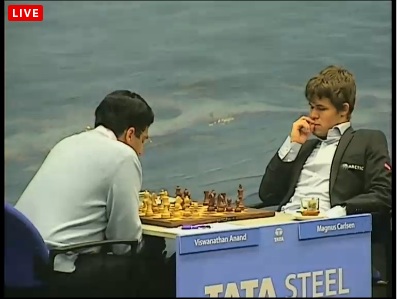
After seven rounds of the thirteen round Tata Steel Chess tournament, the current world champion shares the lead with the highest rated player ever. Viswanathan Anand and Magnus Carlsen lead with 5/7. Two players follow with 4.5/7--Hikaru Nakamura and Sergey Karjakin. Levon Aronian and Pentala Harikrishna are a full point behind the leaders. Things would be different if Aronian had closed the deal yesterday in his game with Karjakin, but "it is what it is," as Nakamura seems to say in every interview.

I usually follow this tournament live. Some years, I have logged in to the Playchess server and had eight game boards open at once trying to watch all the games in the A group and at least one game in B or C. I remember watching the games of a thirteen year old International Master as he won the C Group in 2004. Magnus Carlsen earned his first Grandmaster norm in that event, and beat second place Sipke Ernst in dramatic fashion. His next two norms came quickly and he was awarded the GM title in April.

This year, I decided to follow one game each day, but follow it closely. As the players contemplate their moves, I look over their shoulders, as it were, trying to anticipate their play. Today, I cannot decide which game to watch.

While writing the beginning of this post, my live feed failed on my iPad. Now, I cannot bring up the games via iPad nor via notebook computer. The iPad shows a message "too many connections." But there are other means, so I logged into the Playchess server to discover that Levon Aronian won his game against Hou Yifan.

Aronian,Levon (2802) - Hou,Yifan (2603) [A18]
75th Tata Steel Chess Group A Wijk aan Zee (8), 20.01.2013

1.c4 Nf6 2.Nc3 e6 3.e4 d5 4.e5 d4 5.exf6 dxc3 6.bxc3 Qxf6 7.Nf3 e5 8.Bd3 Bg4 9.Be4 Nd7 10.Bxb7 Rb8 11.Bd5 c6 12.Be4 Nc5 13.Qe2 Nxe4 14.Qxe4 Bxf3 15.Qxf3 Qxf3 16.gxf3 Bd6 17.Kd1 Kd7 18.Kc2 f5 19.d3 Rhf8 20.Rg1 g6 21.Bh6 Rf7 22.Rad1 Ke6 23.Bc1 Rb6 24.f4

Black to move
This position caught my eye as I was in bed, checking on the games with my iPad.

24...Ra6 25.fxe5 Rxa2+ 26.Kb1 Rxf2 27.exd6 Rb7+ 28.Ka1 Kxd6 29.Rd2 Rf3 30.Re1 Rd7 31.Kb1 g5 32.Kc2 f4 33.Ba3+ Kc7 34.d4 g4 35.d5 cxd5 36.cxd5 h5 37.Be7 g3 38.Re5 Re3 39.d6+ Kc6 40.Rxh5 1–0

I do not know what to make of the opening of this strange game.

Back at the Playchess server, I flit through the games that are ongoing, looking for something of interest.

Update 7:31 am PST; 16:31 CET

Carlsen provoked some pawn moves on the queenside, then shifted action to the kingside. Meanwhile, I am again able to follow the games on the website! It is much easier to put up my diagrams when I can follow the game on one device, and input the moves to another.

Still, there's something to be said for the software and live stream available from Playchess.


Aronian prepared today's endgame some time back.


Update 8:27 am PST

This tournament is exhausting. It starts early in the morning (for spectators on the west coast of North America). There are twenty-one good games nearly every day, and the weather outside is frightful. It has been much easier this year to concentrate on a single game each day. Sometimes the game ends just as I am getting settled, and other days the play continues beyond the time that I am able to devote to watching.

Today Magnus Carlsen is making Sergey Karjakin play chess in a position the engines consider equal. But, there are pawn imbalances.

I'm watching the game on Playchess and on the Tata Steel Chess website. But, I keep going back to the Aronian -- Hou game. Aronian's novelty 10.Bxb7 seems to have rushed the game to an endgame that computers consider equal (see video above). But, as I remarked yesterday, "computers often fail" when it comes to pawn structures. So it was in Aronian's victory today, and so it might be in Carlsen -- Karjakin.

Update 8:46 am PST

Some reference games:

Up until the White's eighth move, Aronian -- Hou followed another Aronian win against a strong opponent.

Aronian,Levon (2807) - Kramnik,Vladimir (2791) [A18]
Moscow Botvinnik Memorial Moscow (6), 03.09.2011

1.c4 Nf6 2.Nc3 e6 3.e4 d5 4.e5 d4 5.exf6 dxc3 6.bxc3 Qxf6 7.Nf3 e5 8.d4 exd4 9.Bg5 Qe6+ 10.Be2 Be7 11.cxd4 Bxg5 12.Nxg5 Qf6 13.Qd2 0–0 14.0–0 Nc6 15.d5 Nd4 16.Ne4 Nxe2+ 17.Qxe2 Qg6 18.Rfe1 Bf5 19.Ng3 Bd3 20.Qe5 Bxc4 21.Nf5 Kh8 22.Ne3 Bd3 23.Qxc7 Be4 24.Qf4 Rfe8 25.f3 Bd3 26.Rad1 h5 27.Rd2 Bb5 28.Red1 Rad8 29.d6 Bc6 30.d7 Re6 31.Nc4 Qf6 32.Qxf6 gxf6 33.Na5 Kg7 34.Rd4 f5 35.Kf2 b6 36.Nxc6 Rxc6 37.Kg3 Rc2 38.Kf4 Kg6 39.Ke5 Re2+ 40.Kd6 Kf6 41.Rd5 Rxg2 42.Kc7 Rgg8 43.f4 Rgf8 44.Rg1 Ke7 45.Rd6 1–0

Aronian had played 8.Bd3, as he did today, in a game last September. Today Hou Yifan responded differently than Aronian's previous opponent.

Aronian,Levon (2816) - Naiditsch,Arkadij (2712) [A18]
Istanbul ol (Men) 40th Istanbul (9.1), 06.09.2012

1.c4 Nf6 2.Nc3 e6 3.e4 d5 4.e5 d4 5.exf6 dxc3 6.bxc3 Qxf6 7.Nf3 e5 8.Bd3 Na6 9.0–0 Bd6 10.Bc2 Bg4 11.d4 Bxf3 12.Qxf3 Qxf3 13.gxf3 exd4 14.Ba4+ Kd8 15.cxd4 c5 16.d5 Kc7 17.Re1 Nb4 18.Bd2 Nd3 19.Re3 Ne5 20.Rc1 g5 21.Ba5+ b6 22.Bc3 f6 23.Rce1 Rhg8 24.Kg2 Raf8 25.Re4 Ng6 26.Kh1 Be5 27.Bd2 Kd6 28.R4e3 Nf4 29.Bc2 Rg7 30.Re4 Re7 31.Bxf4 gxf4 32.Rg1 f5 33.Re2 Bd4 34.Rxe7 Kxe7 35.Re1+ Kd8 36.Kg2 Re8 37.Rxe8+ Kxe8 38.Bxf5 h6 39.d6 h5 40.Kf1 Be5 41.d7+ Ke7 42.Ke2 Bc7 43.Kd3 Kd6 44.Ke4 Kc6 45.h4 a6 46.Bg6 Bd8 47.Bxh5 Bxh4 48.Be8 Bd8 49.Kxf4 b5 50.Ke5 bxc4 51.Ke6 c3 52.Bg6 Kc7 53.f4 Bh4 54.f3 Bg3 55.Ke7 Bh4+ 56.Ke8 a5 57.Bc2 c4 58.f5 Bd8 59.f4 Bh4 60.Ba4 Bd8 61.Kf7 c2 62.Bxc2 Kxd7 63.f6 Bc7 64.Ba4+ Kd8 65.Kg8 1–0

In all three games, Aronian won in the endgame. That is part of the appeal of his play to me. His openings suit my tastes, he seeks the truth in the position, and he wins the endgame. Yesterday's disappointment aside, he is a player who models the play that I struggle to emulate.

Update 8:56 am PST

Houdini 2.0 favors Loek van Wely by three-quarters of a pawn against Hikaru Nakamura. I think the computer exaggerates the value of White's passed h-pawn. Nakamura's queenside pawns appear to me to be a more substantive factor. Not that Nakamura has the advantage, but he does not seem worse in my estimation. On the other hand, I am often overly optimistic about my own position when playing, and I must root for a player who has lived in Washington state. Nakamura, to his credit, views his own positions with objectivity. It will be interesting to hear what he says after the game.

Carlsen seems to be doing what he does, squeezing blood from a turnip. He might find a win today and move back into the sole lead.

Update 9:04 am PST; 18:04 CET

Houdini has +1.57 in favor of the Dutchman against the American.

Update 9:16 am PST

Houdini's evaluation has dropped to +1.39, but I am starting to believe the engine. Nakamura's position looks uncomfortable. White's e5-e6 cannot be stopped, but does it lead anywhere?

Black to move
van Wely -- Nakamura after 47.f6+
Update 9:29 am PST

47...Kh6

Somehow, this move did not look safe to my eyes.

48.e6 fxe6 49.Rxe6 Kg5

Improve your weakest piece! Nakamura's king steps into the battle.

Update 9:44 am PST

50.f7 Rf8 51.Rxc6 Rxf7 52.Rxb6 Rf1 53.Rb5+ Kh6 54.Rxa5 Rb1 55.Kf4 Rxb2 56.Ra6+ Kg7

White to move

57.Ke3 Rg2 58.Bf3 Rg3

Nakamura's position clearly is worse, but is it losing? I think that he can hold.

Update 9:51 am PST

59.a4

On the other hand, van Wely has two advantages: an extra pawn and a more active king. Still, perhaps White's king is not so active, nor Black's so passive. There are tactics in the position.

Black to move

Update 10:10 am PST

Nakamura created a theoretically drawn ending with some sharp play!

59...Kh7 60.Rc6 Bc2! 61.Rxc4 Bd1 62.Rf4 Rxf3+! 63.Rxf3 Bxa4

Update 10:13 am PST

64.Rf6 Be8 65.h6 Bg6 66.Rxg6 Kxg6 67.h7 Kxh7 1/2-1/2

Carlsen still presses on that turnip.
White to move
Carlsen -- Karjakin after 70...Kh6
While I was contemplating the transparent threat 71.Re8, Carlsen showed why he is the master with a nice double attack.

71.Bd5 Rh2+ 72.Kg3 Rh3+ 73.Kxg4 Rxd3

White to move

74.f5 Re3 75.Rxg6+ Kh7 76.Bg8+ Kh8 77.Kf4

Update 10:50 am PST; 19:50 CET

77...Rc3 78.f6 d3 79.Ke3 c4 80.Be6 Kh7 81.Bf5

Black to move

Yesterday, Karjakin dodged a bullet. He plays on hoping for another escape. Houdini is not optimistic.

81...Rc2 82.Rg2+ Kh6 83.Rxc2 dxc2 84.Bxc2 Kg5 85.Kd4 Ba3

White to move

86.Kxc4 Bb2 87.Kd5 Kf4 88.f7 Ba3 89.e6 Kg5 90.Kc6 Kf6 91.Kd7 Kg7 92.e7 1-0

Magnus Carlsen leads by 1/2 point over Anand. Aronian and Nakamura share third. Tomorrow is a rest day. There are five rounds remaining.

19 January 2013

Karjakin -- Aronian, Tata Steel 2013

Theory in the Anti-Marshall

Karjakin,Sergey (2780) - Aronian,Levon (2802) [C88]
Tata Steel Wijk aan Zee, 19.01.2013

1.e4 e5 2.Nf3 Nc6 3.Bb5 a6 4.Ba4 Nf6 5.0–0 Be7 6.Re1 b5 7.Bb3 0–0 8.a4 b4 9.d3 d6 10.Nbd2 Na5 11.Ba2 c5 12.c3 Rb8

White to move

Sergey Karjakin had this position last year and played 13.d4.

13.d4 Qc7 14.dxe5 dxe5 15.Nc4 b3 16.Nxa5 bxa2 17.Nc4 Be6 18.Qe2 Nd7 19.Rxa2 Nb6 20.Nfd2 Rfd8 21.Ra1 Nxc4 22.Nxc4 Bxc4 23.Qxc4 Qd6 24.Ra2 a5 25.Be3 h6 26.h3 Qb6 27.Kh2 Qd6 28.Rb1 Qd3 29.Qxd3 Rxd3 30.Kg1 c4 31.Re1 Bg5 32.Bc5 Rd2 33.Ba3 Bd8 34.Raa1 Bb6 35.Rf1 Rbd8 36.g4 Re2 37.Kg2 Rxe4 38.Rae1 Rxe1 39.Rxe1 f6 40.Re4 Rc8 41.f4 exf4 42.Rxf4 Kf7 1-0 Karjakin,S (2775)-Grischuk,A (2764) Moscow 2012

13.Nc4

13.Nc4 was first played in 1968, but was not repeated until 1988. After two games in the 1990s, it became slightly more common, although the totla number of games in the ChessBase Online database remains under three dozen. 13.d4 is slightly more common.

Reference game:

13...Bg4 14.Ne3 Bxf3 15.Qxf3 b3 16.Bb1 h6 17.Qd1 Rb7 18.f4 exf4 19.Ng4 d5 20.exd5 Nxd5 21.d4 Nxc3 22.bxc3 b2 23.Bxb2 Rxb2 24.Ra2 Rb6 25.Rae2 Bh4 26.Rf1 cxd4 27.cxd4 Rd6 28.Rxf4 Bg5 29.Rf3 Rxd4 30.Rd3 Rxd3 31.Bxd3 Qb6+ 32.Nf2 Rd8 33.Qb1 Be3 34.Qxb6 Bxb6 35.Bc2 Nc4 0–1 Arseniev,V-Shianovsky,V Riga 1968

13...Nc6 14.h3 h6 15.d4 cxd4 16.cxd4 exd4N

Predecessor: 16...Nxd4 17.Nxd4 exd4 18.Bf4 Be6 19.Rc1 Nd7 20.Bb1 Bg5 21.Bxg5 Qxg5 22.Bd3 Ne5 23.Bf1 Bxc4 24.Bxc4 Rfc8 25.Bxa6 Rxc1 26.Qxc1 Nf3+ 27.Kf1 Nxe1 28.Qxg5 hxg5 29.Kxe1 b3 30.Kd2 Rb4 31.Bb5 Kf8 32.Kd3 Ke7 33.Bc6 Kd8 34.a5 Kc7 35.Bd5 f6 36.Bc4 Ra4 37.Bxb3 Rxa5 38.Kxd4 Ra1 39.Bd5 Kb6 40.Be6 Rd1+ 41.Ke3 Kc5 42.g3 Re1+ 43.Kd3 Rb1 44.b3 Rb2 45.Ke3 Rc2 46.Kf3 0-1 Morozevich,A (2721)-Leko,P (2740) Monte Carlo 2006

White to move

17.Bf4 b3 18.Bxb3 Be6 19.Ba2 d3 20.Qxd3 Nb4 21.Qe2 Nxa2 22.Rxa2 Rc8 23.b3 Nxe4

White to move
24.Rc2

I am following the game as it develops thanks to the excellent Tata Steel Chess website. As this year marks the 75th anniversary of the annual tournament in Wijk aan Zee, the website has new features. Of particular interest is the extensive history of prior events now online.

24...Bf6

It is hard to say who is better in this position. Black has equalized and there are imbalances. Aronian has a pair of bishops, while Karjakin has a queenside pawn majority. Black has a passed pawn, but it is isolated and a potential weakness. We learned yesterday that Aronian is able to extract a win from a seemingly equal endgame.

Update 6:40 am PST; 15:40 in the Netherlands

Karjakin is spending a long time studying the position. The knight only appears en prise. It is defended by a fork that threatens White's queenside pawn majority.

Meanwhile, with two machines running, I am trying to keep up on Anand -- van Wely as well. Loek van Wely played the Scandinavian Opening (aka Center Counter). It is an unusual opening at this level, although I seem to encounter it nearly every day in online blitz.

Update 6:55 am PST

While I was making my coffee and some breakfast, the players traded knights. Karjakin now has an extra pawn, but it is isolated and weak.

25.Qxe4 d5 26.Qe2 dxc4 27.bxc4 Qa5

White to move

28.Be5 Bxe5

It appears that Black's bishop pair is coming off the board.

29.Qxe5 Qxa4 30.Nd4

It is 7:03 am PST

The website's game clocks show 20 minutes for White and 55 for Black. They must get to move 40 to add 50 minutes. There is an additional 30 seconds per move.

30...Bxh3

I did not see that coming! I think that Aronian is playing for the win.

White to move

Update 7:20 am PST

Loek van Wely conceded the game to Viswanathan Anand. If Peter Leko draws Magnus Carlsen, Anand will join him in the lead. A Leko victory puts Anand on top. Meanwhile, Aronian is playing the Black pieces well against Karjakin, who began this round tied for second and half a point ahead of Aronian. Aronian could get his third consecutive win after his brilliant loss to Anand's prepared novelty on Tuesday.

31.Qf4 Bd7 32.Re7

Can Aronian play 32...Bb5?

Leko -- Carlsen is in the endgame with light-squared bishops and six pawns each. Houdini 2.0 has Leko at nearly half a pawn ahead, but computers often fail to understand pawn structures. This game could go either way.

Aronian opted for

32...Rce8 33.Rxe8 Rxe8

White to move

Aronian's position would be more pleasant to play.

34.Qd6


Update 7:50 am PST; 16:50 in the Netherlands

34...Re1+ 35.Kh2 Rd1

White to move

I like the geometry of the d-file and the triangle with Aronian's queen.


It seems doubtful that Karjakin appreciates the aesthetics of the position.

Update 7:58 am PST

36.Rc3 Qa1

Karjakin seems unable to find the best defense. His position is quite difficult. Sometimes in the Spanish Opening, the torturer becomes the tortured. It may be called the Spanish Torture because of White's long-term advantage, but Black has abundant resources in the middle game and endgame.

37.Qb8+ Kh7 38.Ne2 Bg4

I suspect that Karjakin will make the time control, assess his position, and give up.

39.Qf4

Perhaps Aronian's position, although winning, is not so easy to play. The engines, in any case, regard 38...Bg4 an inaccuracy.

Black to move

Update 8:12 am PST; 17:12 in Wijk aan Zee

39...Rh1+ 40.Kg3 h5

Time is now less of a factor in the game.

41.f3?? would be embarrassing, but 41.Rc1 may be worth considering.

Hou Yifan has a nice position against Fabiano Caruana. Both players have quite a few moves to hammer out in a couple of minutes.

Update 8:32 am PST

41.Re3

Sergey spent about twenty minutes on this move. Evidently, the position is not yet clearly won for Black.

Hou -- Caruana met the time control. Each player has two rooks and four pawns.

41...Qa5

Update 8:55 am PST

Hou -- Caruana drew. Leko -- Carlsen play on.

42.Nd4 Qd8 43.Nf3 f6

White to move

I am getting the feeling that Aronian has let a win slip away. This feeling depresses me. Aronian has been displacing Kramnik as my favorite top player.

44.Qe4+ Kh6

My chess engine preferred 44...Kh8.

White gets some checkmate threats, but Black has a resource to stop the threat and remove the queens. White gets his rook behind his passed pawn, but the bishop guards the promotion square.

45.Nh4

Leko -- Carlsen has completed 82 moves. Carlsen appears to be two hours ahead on the clock.

45...Qd6+

With engine assistance, I had been looking at 45...Qb8+ 46.f4 Qb1 (guarding against the checkmate threat) 47.Rd3 Qe1+ and the queens come off.

46.f4 Rxh4 47.Kxh4 Qc5

White to move

Leko -- Carlsen drawn in 83 moves. One game left in each section.

48.Kg3 Bf5

Update 9:30 am PST

49.Qe8 Qxc4 50.Qh8+ Bh7 51.Qb8

Evaluation graph from website
Aronian missed a win today. Tuesday's brilliant win by Anand was assisted by Aronian's tactical errors. His play has been mixed lately.

51...a5 52.Kh2

I took some time to play a bingo in Scrabble, and then back to the website where the players finished.

52...Bf5 53.Qh8+ Bh7 54.Qb8 Bf5 55.Qh8+ Bh7 1/2-1/2


17 January 2013

Anand -- Carlsen, Tata Steel 2013

Carlsen Opts for Russian Defense

Anand,Viswanathan (2772) - Carlsen,Magnus (2861) [C42]
Tata Steel Wijk aan Zee, 17.01.2013

1.e4 e5 2.Nf3 Nf6

Sorting the database by the rating of the Black player reveals that Vladimir Kramnik is the highest rated player who has played the Russian Defense, or Petroff. That changed today. It may be a very long time before another player rated higher that 2861 plays 2...Nf6.

3.Nxe5 d6 4.Nf3 Nxe4 5.d4 Be7 6.Bd3 Nf6 7.0–0 0–0 8.h3 Re8 9.Nc3 Nbd7

They have deviated from the main line, but in the Russian Defense, the so-called main line has been subject to revision quite a bit lately. Of the nearly three dozen games that have reached this position, only two were played before 2000.

White to move

10.Re1

10.Ne2 d5 11.Ng3 Nf8 12.c3 Bd6 13.Nf5 Bxf5 14.Bxf5 c6 15.Bg5 h6 16.Bh4 Ng6 17.Bxg6 fxg6 18.Qb3 Qc7 19.Bxf6 gxf6 20.Rfe1 Kg7 21.Rad1 b5 22.a4 a6 23.axb5 axb5 24.Qc2 Qd7 25.b3 Rxe1+ 26.Rxe1 Re8 27.Ra1 Qe6 28.Kf1 b4 29.Rc1 bxc3 30.Qxc3 Rc8 31.Qd3 ½–½ Karjakin,S (2785) -- Bu Xiangzhi (2670), Istanbul 2012

10...Nf8 11.d5 c6N

Possibly the game's novelty. A prior game was won in 100 moves by White after 11...N6d7 12.Ne4 Ng6 13.Nd4 Nf6 1–0 Horvath,A (2473) -- Kovacs,G (2498) Hungary 2012

12.Bf4 Bd7

The players transposed in a game between lesser masters that continued 12...cxd5 and Black won in 39 moves 0–1 De Dovitiis,A (2347) -- Gibson,T (2252) Villa Martelli 2008

13.Bc4 Ng6 14.Bg3 Rc8 15.dxc6 Bxc6 16.Bb3 d5

White to move

So, we have an isolated queen pawn.

I hope for a hard-fought game that I expect will end in a draw. Of course, I am rooting for the old guy, Anand, but do not expect Magnus to collapse tactically the way Aronian did on Tuesday.

17.Qd3 Qb6

Update 5:42 am PST

18.Nxd5 Bxd5 19.Bxd5 Nxd5 20.Qxd5

The isolated queen pawn is gone, but does Anand get two isolated pawns on the queenside?

Black to move

Update 5:57 am PST

White's b-pawn looks safe, at least for the moment.

Update 6:15 am PST

20...Qxb2

Carlsen disagrees with my assessment.

21.Rab1

Anand considered the position for five minutes and then played the move that we expected.

21...Qxc2 22.Rxb7 Red8

A few moves were played rapidly. Now the clocks seem backwards on the website again. Anand is about fifteen minutes ahead on time, but the live feed displays the reverse.

Update 6:30 am PST

I have been awake since a bit before 5:00. I checked the games on my iPad before getting up. I rose from the warmth of the covers at 5:00, but did not start my coffee till after 6:00. Now, I am drinking that first sip as the player fire off rapid moves.

23.Qb3 Qxb3 24.axb3 1/2-1/2

I was planning to type something calling for predictions concerning who would offer the draw (as I'm fairly certain that I could hold either side against Rybka). But, I glanced over at my iPad and noticed that the players were analyzing the game.


Moving on Other Games

Update 6:40 am PST

There are other interesting games to watch. Houdini 2.0 that is running on the website thinks that Hou -- Nakamura is dead even, but the players do not know that.

Pentala Harikrishna is playing aggressively against Loek van Wely's Hedgehog.

Update 6:45 am PST

It appears that Aronian can win some material against Ivan Sokolov, but it is complicated. Sokolov gives up two queens in the sequence (because a pawn captures Aronian's queen and promotes) But White's bishop is en prise and retreating it gives Black a rook for a bishop.

Update 7:05 am PST

Sokolov gave up the bishop to keep his rook a stick two connected passed pawns into Aronian's face. We need to follow this game now. Time will be a factor. Twenty moves need to be played in a few minutes. Sokolov has less than fifteen minutes on the clock.


Sokolov,Ivan (2663) - Aronian,Levon (2802) [D91]
Tata Steel Wijk aan Zee (5), 17.01.2013

1.d4 Nf6 2.c4 g6 3.Nc3 d5 4.Bg5 Bg7 5.Nf3 Ne4 6.Bf4 Nxc3 7.bxc3 dxc4 8.Qa4+ Nd7 9.e4 c5 10.Bxc4 0–0 11.0–0 Nb6 12.Qb3 Nxc4 13.Qxc4 b6 14.d5 e6 15.h3 a5 16.Bg5 f6 17.dxe6 Ba6

White to move

I was looking at 18.e7+ Bxc4 19.exd8Q Rfxd8 20.Be3 Bxf1 21.Kxf1

18.Qd5 Qxd5 19.exd5 fxg5 20.Rfd1 Bxc3 21.Rac1 Be2 22.Nxg5 Bxd1 23.Rxc3 Rf5 24.Ne4 Kg7 0–1

On to Hou -- Nakamura, where the American appears to have good winning chances.


Hou,Yifan (2603) - Nakamura,Hikaru (2769) [B77]
Tata Steel Wijk aan Zee (5), 17.01.2013

1.e4 c5 2.Nf3 Nc6 3.Nc3 g6 4.d4 cxd4 5.Nxd4 Bg7 6.Be3 Nf6 7.Bc4 0–0 8.Bb3 a6 9.f3 d6 10.Qd2 Na5 11.Bh6 Bxh6 12.Qxh6 e5 13.Nde2 b5 14.Qd2 b4 15.Na4 Nxb3 16.axb3 a5 17.0–0–0 Ra6 18.h4 Be6

Houdini 2.0 considered this position dead even. Stockfish is less certain. Note to self: get Houdini 3.0.

White to move

19.h5 Qe7 20.g4 Nd7 21.f4 Bxg4 22.f5 gxf5 23.exf5 Kh8 24.Qd3 Rc6 25.Rd2 Nf6 26.Ng3 e4 27.Qe3 Qe5 28.Rf1 Bf3 29.Ne2 Ng4 30.Qd4 Rfc8

White to move

31.c4

It appears that Hou is short on time (under five minutes).

31...Bxe2 32.Qxe5+ Nxe5 33.Rxe2 d5 34.Kb1 dxc4 35.Rxe4 f6

White to move

36.bxc4 Rxc4

Is Nakamura letting another win slip from his grasp? Are computers wrong?

37.Re2 Rh4 38.Nb6 Rd8 39.Rc2

It is 7:47 am PST, which makes it 16:47 in the Netherlands. Play has been going for more than three hours.

39...b3 40.Rc3

Yifan makes the time control.

40...Rb4 41.Rc8 Rxc8 42.Nxc8 Kg7

I like Nakamura's position.

White to move

43.Rg1+ Rg4 44.Re1 Rg2 45.Nd6 Kh6 46.Rd1 a4 47.Kc1 Rc2+ 48.Kb1 Nc4 0-1

Time to watch the en passant videos as the players leave the playing room.

14 January 2013

Monday Morning Chess

It is Monday afternoon and the third day of the Tata Steel Grandmaster chess tournament in Wijk aan Zee. This event is one that I often try to follow live. When the games begin, it is 4:30 am in my time zone. Following them from the beginning requires willingness to forego sleep. This morning, I slept in until nearly 6:30 am.

Looking through the games to select the one to follow, I found some interest in the Spanish Opening struggle in the game Anand -- Caruana. Sokolov appeared to be missing from the board after Giri's 13...Bf6. His position did not seem bad, but he was quite despondent after failing to win yesterday, so his absence raises concerns. Carlsen's attack on van Wely's King's Indian Defense also caught my eye. Here, also, the game clocks suggested a played absence. Loek van Wely appears to have less than twenty minutes remaining, while Magnus Carlsen has nearly ninety.


While I was typing, van Wely resigned. A few more moves were played after my screenshot. Carlsen's king appears to rule the queenside, while the Dutch player's king had no prospects on the other side of the board.

Will I find a single game to follow to its conclusion?

There looks to be an interesting endgame brewing in Leko -- Nakamura.

Leko,Peter (2735) -- Nakamura,Hikaru (2769)
Tata Steel, Wijk aan Zee 2013

1.e4 e5 2.Nf3 Nc6 3.Bb5 a6 4.Ba4 Nf6 5.0–0 b5 6.Bb3 Bc5 7.c3 d6 8.a4 Rb8 9.d4 Bb6 10.Na3 0–0 11.axb5 axb5 12.Nxb5 Bg4 13.Bc2 exd4 14.Nbxd4 Nxd4 15.cxd4 Re8 16.Re1 Bxf3 17.gxf3 Nh5 18.f4 Qh4 19.Ra3 Nxf4 20.Rg3 Qf6 21.Qf3 Nd5 22.Ba4 Qxf3 23.Rxf3 Re7 24.Bd2 Nf6 25.e5 dxe5 26.dxe5 Nd7 27.Bc3 Nc5 28.Bc2 Rd7 29.Bf5

Black to move

As I was creating the diagram, the players agreed to a draw.

Their postgame analysis is interesting. I like that each player is looking harder for the resources of his opponent. (Video added at 1:00 pm PST)


In the Grandmaster B Group, Sergey Tiviakov has employed an offbeat line against Jan Timman's Caro-Kann. At least the line appears offbeat to me. When I first took an interest in this tournament, Jan Timman was one of the young players battling with more experienced players. Now, he is the one with decades of experience.

Tiviakov,Sergey (2655) -- Timman,Jan (2566)
Tata Steel, Wijk aan Zee 2013

1.e4 c6 2.d3 d5 3.Nd2 e5 4.Ngf3 Bd6 5.d4 exd4 6.exd5 Qe7+ 7.Qe2 cxd5 8.Qxe7+ Nxe7 9.Nxd4 Nbc6 10.N2f3 Nxd4 11.Nxd4 Nf5 12.Bb5+ Ke7 13.Ne2 Rd8 14.Bg5+ f6 15.Bd2 Bc5 16.Bd3 Kf7 17.0–0 g5 18.Rad1 Be6 19.Nc1 Bb6 20.Rfe1 Nd6 21.Nb3 Bg4 22.Rb1 Bf5 23.Bxf5 Nxf5 24.Ba5 Bxa5 25.Nxa5 Rac8 26.Rbc1 b6 27.Nb3 d4 28.Red1 h5 29.Rd3 Rd6 30.Kf1 g4 31.h3 ½–½

And that game, too, ended while I entered the moves in my database.

A quick glance at opening data reveals that 2.d4 is not the only move that one can play against the Caro-Kann. That may be the choice in more than 146,000 games, but 2.d3 has been played more than 6000 times. Tiviakov has been playing it since the early 1990s, but even Vladimir Kramnik has trotted it out. Perhaps it is worth exploring so that it might be employed against some unwary A Class player in one of my tournaments.

11 April 2012

Lessons from Boris Gelfand

To my mind rating is overrated.
Boris Gelfand*

Nearly everyone believes that Vishy Anand will defeat Boris Galfand in the upcoming World Chess Championship Match, 10-31 May 2012 in Moscow, Russia. Boris Gelfand, the challenger, is not only older than the defending champion, but he is not even in the top ten on the FIDE rating list.

A quick search of Big Database 2011 turns up seventy games between these two players (Gelfand mentioned in an interview that they have played more than 100, including blitz). When Gelfand has had White, he leads 5-4 with 27 draws (only counting the 70 in my database). When Gelfand has had Black, Anand leads 13-1 with 20 draws. Gelfand's last win with White was in 1993, while his only win with Black was more recent in 2008. Such a record does not bode well for the challenger. Still, Bobby Fischer had never won against Boris Spassky when their World Championship battle began.

In their first few encounters, Gelfand drew with Black and won with White. Their second game was in an Interzonal.


Gelfand,Boris (2680) - Anand,Viswanathan (2610) [B38]
Manila Interzonal Manila (3), 1990

1.Nf3 c5 2.c4 Nc6 3.d4 cxd4 4.Nxd4 g6 5.e4 Bg7 6.Be3 Nf6 7.Nc3 0–0 8.Be2 d6 9.0–0 Bd7 10.Qd2 Nxd4 11.Bxd4 Bc6 12.f3 a5 13.b3 Nd7 14.Be3 Nc5 15.Rab1 Qb6 16.Rfc1 Qb4 17.Rc2 Rfc8 18.Qc1 Qb6 19.a3 Qd8 20.Qd2 e6 21.Bf1 Be5 22.b4 axb4 23.axb4 Na4 24.Ne2 Qh4 25.g3 Qe7 26.Nd4 Be8 27.Rbc1 Nb6

White to move

An elementary tactical shot wins a pawn.

28.Nxe6 Qxe6 29.Bxb6 Ra3 30.f4 Bg7 31.Qd5 Bc6 32.Qxe6 fxe6 33.Bg2 e5 34.Rd2 exf4 35.gxf4 Bc3 36.Rxd6 Bxb4 37.c5 Rf8 38.e5 Bxg2 39.Kxg2 Rxf4

White to move

Anand wins back the pawn, but Gelfand's e-pawn becomings menacing.

40.e6 Re4 41.Rd8+ Kg7 42.Rd7+ Kh6 43.e7 Re2+ 44.Kf1 Raa2

Anand generates threats.

White to move

45.Bc7 Ba3 46.Re1 Rf2+ 47.Kg1 Bxc5 48.Kh1

Black to move

Anand is in a quandary.

48...Bxe7 49.Rdxe7 Rf5 50.Bb6 Rf6 51.Be3+ g5 52.Rg1 Rf4 53.Bxf4 1–0


Gelfand's second win came in an endgame with dancing knights.


Gelfand,Boris (2700) - Anand,Viswanathan (2635) [E32]
Munich SKA Munich (10), 15.05.1991

1.d4 Nf6 2.c4 e6 3.Nc3 Bb4 4.Qc2 0–0 5.a3 Bxc3+ 6.Qxc3 b6 7.Bg5 Bb7 8.e3 h6 9.Bh4 d6 10.f3 Nbd7 11.0–0–0 d5 12.c5 Bc6 13.cxb6 cxb6 14.Kb1 Rc8 15.Rc1 Bb7 16.Qe1 Rxc1+ 17.Qxc1 Qa8 18.Bd3 a5 19.Qf1 e5 20.Ne2 e4 21.Bb5 Bc6 22.Nc3 exf3 23.gxf3 Re8 24.Qd3 Bxb5 25.Nxb5 Qc6 26.Re1 Nf8 27.Bg3 Ng6 28.Nd6 Re6 29.Rc1 Qd7 30.Nf5 Rc6 31.Rg1 Re6 32.Rc1 Rc6 33.Rg1 Re6 34.Be5 Nxe5 35.dxe5 Rxe5 36.Nxg7 Rg5 37.Rxg5 hxg5 38.Nf5 Qe6 39.Nd4 Qe5 40.Qf5 Qxf5+ 41.Nxf5 Kf8

White to move

42.Kc2 Nd7 43.Kc3 Ne5

White to move

44.f4 gxf4 45.exf4 Ng6 46.Kd4 Nxf4 47.h4 f6 48.Ne3 b5 49.Nxd5 Ne6+ 50.Ke4 Nc5+

White to move

51.Kd4 Ne6+ 52.Ke3 Nc5 53.Nxf6 Na4 54.Nd7+ Kg7 55.b3 Nc3 56.Kd3 Nd1 57.Kd4 Kg6 58.Ne5+ Kh5
White to move

59.Nc6 1–0

The final position is the sort of position that I like to play against the computer. For instance, what happens after 59...a4?


*"The Homecoming: Boris Gelfand is Back, Part I" ChessBase News (2011).

25 May 2009

Pressure

I managed to avoid loss in yesterday's Washington Open games. After two days and four games, one player in my section has four points. I'm one of four with three. If someone beats the leader, anyone of the rest of us has a shot to share first.

I'm in the Premier section, which is limited to players under 2000. Those under 2000 that are playing in the Open are getting slaughtered as should be expected with several masters in the group and quite a bit of money on the line. The total prize fund for all sections is $8000. First prize in the Open is $1000.

I'm less interested in the $400 top prize in my section, although money is always nice, than in reaching my goal of crossing the line into class A. If the tournament ended now, I should be about 1790 or a tad higher. I'm currently 1764. My results have been:

1668 draw
1744 win
1786 draw
1839 win

The games get tougher today. I must focus on round five, thinking about neither money, round six, nor the rating. I must put all my energy into finding good moves, one at a time.

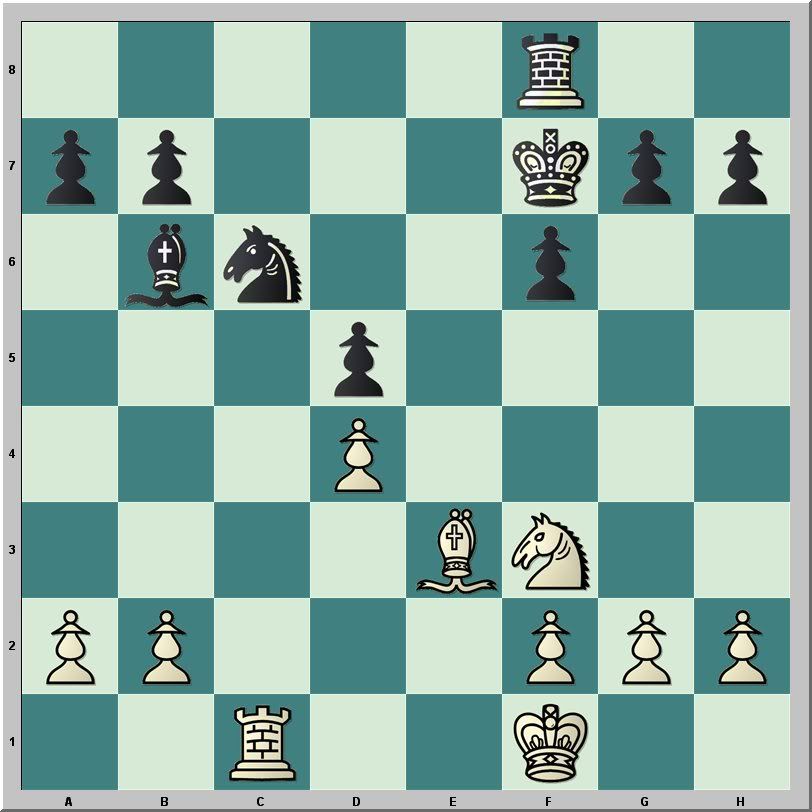
In yesterday's games, I reached easy equality in a French with most of the pieces coming off the board fast. We reached this position after my 19...Kf7.


I offered a draw, and my opponent thought for seven minutes before accepting. We used twenty-nine minutes between us.

Round four started six and a half hours later, which gave me plenty of time to talk with Tim Tobiason of Toby Chess, the vendor. I hung out in the skittles room, watched other games, and attended the Washington Chess Federation Board meeting. I haven't yet told my wife that I was elected member-at-large to the board. I might get in trouble for that.

In round four, I had White against Michael Hosford. I had lost to him in a long and difficult game in 2006. He played the King's Indian Attack against my French and eventually found a tactic that won material. I played out a lost position during his time trouble until it became clear that he could finish all necessary moves within the time delay.

When I saw him at the Washington State Elementary Chess Championship--he served as a section chief during one round,--I told him that I was looking forward to another crack at him in the Washington Open. As we were sitting down, he said, "you got your wish." But, the wish was for a win, not just to play him. He's a strong, resourceful player and a scholastic coach with Chess4Life. His focus during play is exemplary.

I lost my way in a Catalan. In the effort to mount an attack, I sacrificed a pawn. Then, I overlooked a simple tactic that lost another. Still, I had my plan: get my queen "up in his grille," as Robert Pearson put it in comments to yesterday's post. I burned a lot of time in the early going, becoming as much as thirty minutes behind. He used the time advantage to reach a superior position, but we were both responding to the need to move faster.

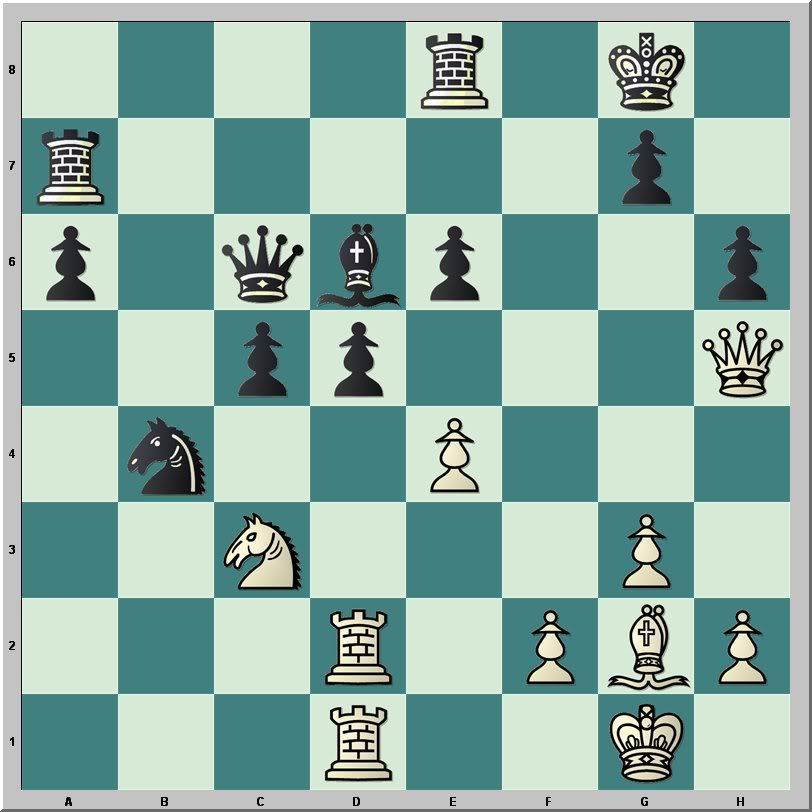
We reached this position with Black to move after 29.e4. I had twenty-three minutes left to get to move 40. He had seventeen.


What should he play?


Open Section

When I left at 10:45pm last night, Internation Master John Donaldson was pressing a one pawn advantage against FIDE Master Nick Raptis on board one in the Open section. They had opposite colored bishops, and a rook each. Donaldson's position had more dynamism than my round one game with the same pieces, but more pawns. Even so, it was hard to see a clear plan for the IM and I wanted some sleep.

Round five begins at 9:00am this morning.