Showing posts with label Chernev (Irving). Show all posts

27 February 2024

Ways of Reading

After finishing the process of going through every game in Irving Chernev, The 1000 Best Short Games of Chess (1955), I was motivated to tackle another classic. Now, I am following the same process with P. H. Clarke, 100 Soviet Chess Miniatures (1963). I downloaded the PGN file from Bill Wall’s Chess Page and opened it in tChess Pro on my iPad. During my morning coffee a day or two per week, I go through a game on the iPad, sometimes several times, then I go through the game while reading Clark’s annotations. Sometimes, I then find the game on chessgames.com and drop a note there.

Clarke’s book had some competition for my attention. Bobby Fischer, My 60 Memorable Games (1969) also beckoned. Wall has a PGN for that book as well. It, too, resides on my iPad. But as I was going through Fischer — Sherwin 1957, I had a strong impulse to set a chess board on the table for the purpose of studying Fischer’s annotations in a manner that is more difficult with tChess Pro.

Working through My 60 Memorable Games will be more work, but I also think it is worth doing. Perhaps I will do a quick orientation to each game in tChess Pro, then switch to a chessboard on the table and the book for further study.

12 December 2023

Learning from Books

Frequently, I repeat stories of how chess skill first became something possessed in small measure and hoped to develop further. At the heart of the story are several books for which the authors and titles have been forgotten and one that I can identify. That one is Irving Chernev, The 1000 Best Short Games of Chess (1955). Playing through some of the games in this book in 1975 transformed my play. The book came back into my possession in 2012, now usually serving as a source of lessons for young students.

Over the past year (since September 2022), I have been working through this book deliberately and systematically, going through every game. Some games hold my interest a few minutes. Others sustain it an hour or more. Most days, I go through two or three games, often posting a position from one of the games on this blog’s Facebook page. I expect to go through the last ten games this week.

Last Tuesday, I posted a position from a blitz game that I won in seven moves. The winning idea was identical to that in Gibaud — Lazard, Paris 1924, the first game in Chernev’s classic. It was the second time I had employed this idea in online play.

Black to move

Two weeks ago, Mattison — Nimzowitsch, Carlsbad 1929 (game 933 in Chernev) made such an impression on me that I pulled from my bookcase a book purchased last summer and started to read it. I bought Raymond Keene, Aron Nimzowitsch: A Reappraisal (1974) because it had been often recommended by IM John Donaldson, among others, and had not yet appeared on my shelf. In fact, I bought two copies: the original and Batsford’s algebraic edition (1999). 

Saturday morning, I played one game online before heading to a youth chess tournament for which I served as the tournament director. While the children played, I showed my game to FM Jim Maki, who runs the analysis table at our youth events. Keene’s book guided some of the decisions I made during the game.

White to move
In the endless battle between bishops and knights, this position struck me as one that favored knights. Also, I was cognizant of Keene’s words.
…superlative demonstration of good knight against bad bishop, … The bishops, locked behind the pawns, are never given a chance. (7)
And thirty pages later, these foci in Nimzowitsch’s play are made more explicit, Keene making the point that he had a clear preference for the knight over the bishop.
Ideally the rounded chess master should not harbour an idiosyncratic affection for one or other of the two minor pieces. However, Nimzowitsch did, and it is quite obvious from his games that he had a penchant for closed positions where he could exploit to the utmost the blockading potential of the knight.
Keene then presents a fantasy position that Nimzowitsch presents in Die Blockade, which “gives away his preference for the knight” (37).

Of course, there are other reasons learned from other books that might have led me to exchange bishop for knight. Many chess writers have emphasized the concept of time, for instance. I particularly recall studying this idea in Lasker’s Manual of Chess and Dan Heisman, Elements of Positional Evaluation. But, Keene’s work on Nimzowitsch was actively in my thoughts while playing.

Later in this same game, as I retreated a knight to maintain control of the central square it occupied, I recalled words of R. N. Cole, Dynamic Chess in reference to the play of William Steinitz. But these words were on my mind because Keene quotes them in discussion of the influences on Nimzowitsch. 

White to move
31.Nef3, which I played, is consistent with these ideas Keene credits to Steinitz and Nimzowitsch. Nonetheless, the engine on chessdotcom prefers that I would have transferred my rook to the b-file, and now sees an opportunity for Black to bring the nearly worthless light-squared bishop back into a position where it has some value.

I was concerned that allowing Bxe5 would place a potentially vulnerable pawn on a strong point best utilized and controlled by my knights.


03 November 2023

Attack the King

The importance of Irving Chernev, The 1000 Best Short Games of Chess (1955) to me personal development as a chess player was articulated in “My First Chess Book”. But, I read very little of the book when I had that library copy nearly fifty years ago. In the past few years, the book has served as a source for student lessons on many occasions. Finally, however, in September 2022, I resolved to play through every game in the book. Progress is slow, deliberate, attentive.

There are many fine games with creative attacking ideas, and there are many games where an unfortunate blunder led to immediate collapse. As I work through this book, many positions make it to Chess Skills’ Facebook page, and from there to other chess pages on Facebook.
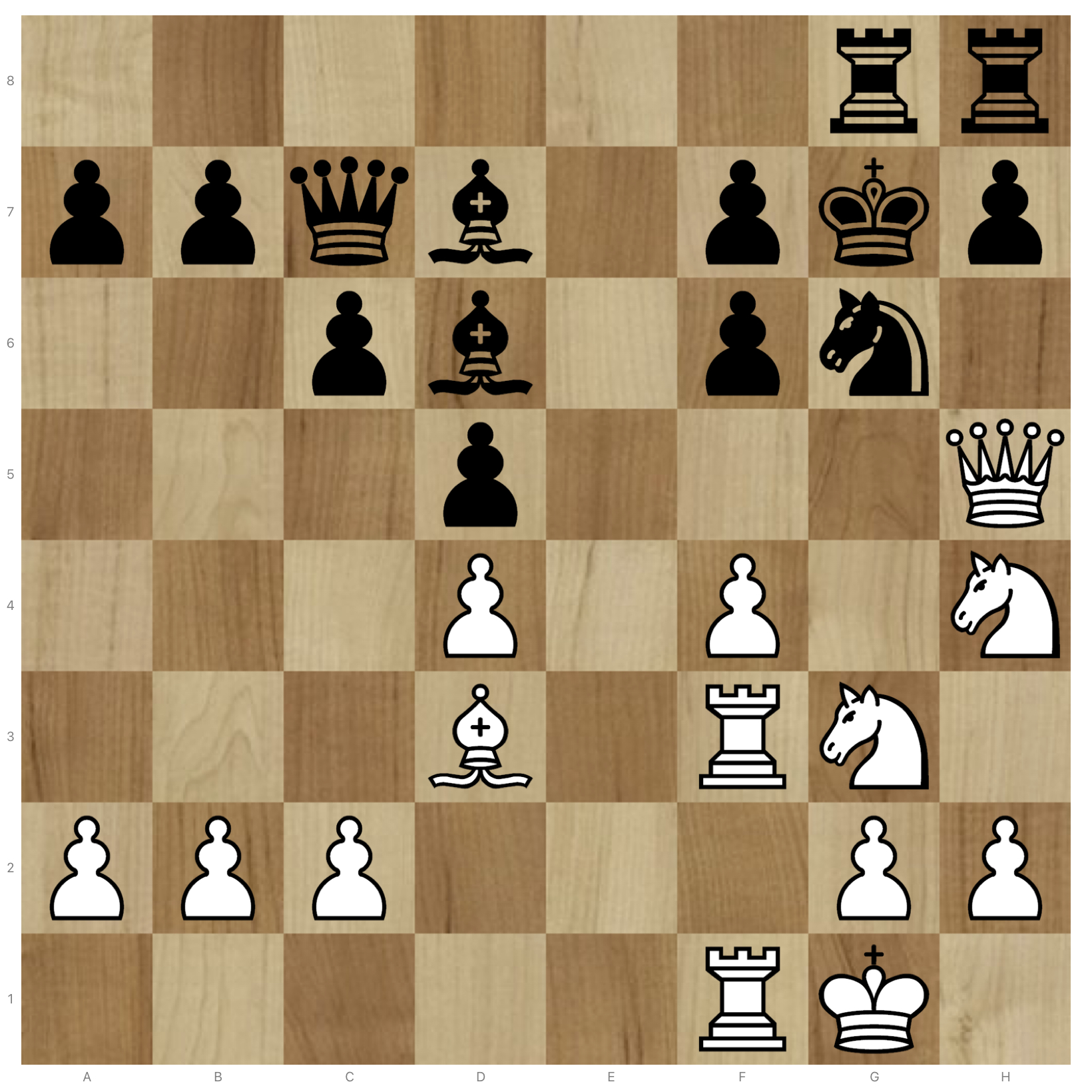
This morning’s games included number 853, Taubenhaus — NN, Paris 1909, which concluded with an instructive forced checkmate in five moves.

White to move
Yesterday, I posted a mate in eight from Jambert — Tibi, Aleppo 1946. Game 848 in the book.

White to move
In both cases, Black’s defense was inadequate prior to the mating sequence. Tibi, in fact, had the advantage when White’s knight came to e7 with check. Moving the king was the fatal error.
Chernev’s book is worthy of study by chess players looking to improve their game, and it is good fun for those with no ambitions. It is a rich source of tactics and checkmate exercises for players at many levels.


18 October 2023

Attraction

Decoys and deflections differ but share the idea of drawing an opponent’s piece where it would rather not go. Sometimes neither term fully articulates the manner in which the enemy king is drawn into a fatal trap. Two games I looked at this morning from Irving Chernev, The 1000 Best Short Games of Chess (1955) are worth remembering. Black’s king is drawn towards White’s forces until surrounded with no possibility of escape.

Since September 2022, I have been slowly working my way through this book. Some days, two or three games add flavor to my morning coffee. Other days, I read The Wall Street Journal.

About Mackenzie — Mason, Paris 1878, Chernev writes, “this queen sacrifice and the subsequent play of the minor pieces is now standard equipment for the master” (444).

White to move

Three moves prior to this position, White played 14.Raf1. I had thought until that moment that controlling the e-file with a rook was part of the planned mating net.

Prior to this game was Imbaud — Strumilo, a 1922 correspondence game. How much of White’s idea can you work out from this position?

White to move


11 January 2023

Mate in Six

Black to move

Position arose in Schulten — Kieseritzky, Paris 1844, which is game 511 in Irving Chernev, The 1000 Best Short Games of Chess (1955).

In September 2022, I started working my way through all the games in this book. This game was the first one this morning. I may go through as many as five before heading to work.

07 January 2023

Bramley -- Burgess 1946

Sometimes a particular game captures my attention. Tuesday morning I went through five games in Irving Chernev, The 1000 Best Short Games of Chess (1955). I have been working through this book since mid-September. I went through the games quickly and then returned to the first, spending considerable time examining variations that might have been played. Using the opening explorer on Lichess, I found another game with the same odd ninth move.

That afternoon, I showed the game to my after school chess club. On Wednesday, I spent more time exploring the game, annotated it, and created a worksheet for my students with positions derived from the game--mostly those that did not occur. Captions under diagrams indicate the positions on the worksheet.

I cannot find any information about the game beyond what Chernev offers--only surnames, location, and year. Another book includes the game, László Polgár, Chess: 5334 Problems, Combinations, and Games, but derived from Chernev. The game is number 500 in Chernev. Polgár includes it among 100 miniatures with sacrifices on f2/f7.

Bramley -- Burgess [C54]
Surrey, 1946

1.e4 e5 2.Nf3 Nc6 3.Bc4 Bc5 4.c3 Nf6 5.d4

5.d3 is the top choice of masters

5...exd4 6.cxd4

6.b4 Be7; 
6.e5 d5 7.Bb5

6...Bb4+ 7.Nc3

This move initiates the Greco Attack, which I have explored in several articles on Chess Skills.

7.Bd2 also preferred.

7...Nxe4 8.0-0

8.d5

8...Nxc3

8...Bxc3 9.d5 Bf6 10.Re1 Ne7 11.Rxe4 d6 Although approximately equal, Black tends to do better.

9.bxc3 Be7?!

Here we reach what struck me as a novelty when I first looked at the game. It has been been played by others, even at least once by a chess master.

White to move

Stockfish 14 on Lichess gave this move and White's response ?? in annotations to Boricsev,O. -- Sevostianov,P. 2017.

9...d5 10.Re1+ Be7 11.Bd3

10.Re1

Better is the immediate 10.d5 Nb8 (10...Na5 11.Bd3) 11.d6! (11.Re1 reaches the game) 11...cxd6 12.Bxf7+ Kxf7 13.Qd5+ Kf8

White to move
Analysis diagram

14.Re1 Na6 15.Ng5 Qe8 16.Bf4 Nc7 17.Qf5+ Kg8 18.Bxd6 Ne6 19.Nxe6 dxe6 20.Rxe6 Bxe6 21.Qxe6+ Qf7 22.Qxe7 Qxe7 23.Bxe7 Kf7 24.Bc5 Rhd8 and drawn in 63 moves. Chen,Y (2081) -- Kislik,E (2347) Budapest 2011.

14.Ng5 Bxg5 15.Bxg5 Qe8 16.Rfe1 Qf7 17.Qxd6+ Kg8 18.Re7 Nc6 and White won in 32 moves. Sizov,A -- Prikhodko,P Serpukhov 2001.

10...0-0

10...d5 11.Bd3 0-0 12.h3 Be6 13.Bf4 Qd7 14.Rb1 b6 15.Qd2 Bd6 16.Bxd6 Qxd6 17.Re2 h6 18.Rbe1 Rfe8 19.Bb5 f6 20.a4 Bf7 ½-½ Boricsev,O (2343) -- Sevostianov,P (2248) Mukachevo UKR 2017.

11.d5 Nb8

Both players have made errors, but White seems to be much better.

11...Na5 would be my inclination 12.d6! (12.Bd3) 12...cxd6 13.Bd5 Nc6 14.Ba3 Bf6 15.Qd3 (15.Rb1) 15...Ne7 16.Be4 g6 17.Bxd6+-

12.d6!

Lichess opening explorer shows that eleven other moves have been employed here, but none with the sort of results garnered by 12.d6! 12.Qe2 has been the most popular and Stockfish likes it almost as well.

12...Bf6

12...cxd6 13.Ba3 Nc6 14.Bd5 White's advantage is clear;
12...Bxd6?

White to move
Analysis: Exercise 2
13.Bg5 Qe8 14.Rxe8 Rxe8+-

White to move

13.dxc7

White could have struck now with 13.Bxf7+! Rxf7 14.dxc7 Qf8 (14...Qxc7 15.Re8+ Rf8 16.Qd5+ Kh8 17.Rxf8#) 15.cxb8Q Rxb8 16.Ba3 Be7 (16...Qxa3?

White to move
Analysis: Exercise 6
17.Re8+ Rf8 18.Qd5+ Kh8 19.Rae1+-)

17.Rxe7 Rxe7 18.Qd5+ Qf7 19.Qd6+-

13...Qxc7 14.Ba3

Again, White could have played 14.Bxf7+! Kh8 15.Bb3

14...Bxc3

Why not trade a rook for two bishops? 14...Qxc4 15.Bxf8 Kxf8?

White to move
Analysis: Exercise 1
16.Qd6+ Be7 17.Qxe7+ Kg8 18.Qe8#

15.Bxf7+!

Black to move
15...Kh8

During chess club, I was asked what if Black captures the bishop.

15...Kxf7

White to move
Analysis: Exercise 5
16.Qd5+ Kg6 17.Qg5+ Kf7 18.Qf5+ Bf6 19.Ng5+ Kg8 20.Qxh7#

Matters end more quickly if the rook nabs the bishop. 15...Rxf7 16.Re8+ Re7 17.Rxf8#

16.Bxf8 Bxe1 

16...d5 17.Ng5 Be6

White to move
Analysis: Exercise 4
18.Bxg7+ Kxg7 19.Nxe6+ Kh8 20.Nxc7+-

White to move
Exercise 3
17.Qd4

Black can delay, but not prevent checkmate. 1-0


02 October 2022

The Art of Analysis

How do you analyze a chess game?

I was thinking about this question this morning when I would have preferred to sleep another hour. Hence, I thought to open Irving Chernev, The 1000 Best Short Games of Chess (1955) to the next game and analyze it. Then, I would compare my annotations to those Chernev offers. I am working my way through this book.

While analyzing a game, I look at many possibilities that will vary depending on the game and why it has come to my attention. For miniatures, such as one finds in this classic Chernev text, I expect to find a game-losing blunder and sometimes a series of weak moves. I make an effort to identify these before seeking any assistance from the annotations of others or from engines.

Wills -- Sparks [C42]
USA, 1942
Stripes,James

1.e4 e5 2.Nf3 Nf6 3.Nxe5 Nxe4?

This move is the critical error and a common beginner's mistake. There are few chess coaches who have not shown this error and the subsequent refutation to their students. It also appears in some of the oldest chess books and manuscripts (see the section on history below).

4.Qe2 Qe7

4...Nf6?? worsens matters and should be shown to beginners 5.Nc6+ wins the queen.

5.Qxe4

Black to move

5...d6 6.d4 f6

6...dxe5 and Black is a pawn down. Surely, this should be preferred to a futile effort for equality that cannot succeed against attentive play.

7.f4 Nd7 8.Nc3 dxe5

White to move

9.Nd5!+-

The refutation of Black's idea is a good example of an intermezzo. Instead of continuing a sequence of exchanges, White attack's Black's queen.

9...Qd6 10.fxe5 fxe5 11.dxe5 Qc6

11...Nxe5 12.Bf4 Yes, Black ends up a piece down, but that piece is a knight. Alternatives leave Black down a rook or a knight.
11...Qxe5 12.Qxe5+ Nxe5 13.Nxc7+ Kd8 14.Nxa8 Black may be able to trap the knight, being down only an exchange.

12.Bb5 Qc5 13.Be3 1-0

Chernev does not highlight the critical error, but offers some analysis after the game is already lost. His headnote, however, offers a clue to Black's fatal decision: "Mimicry can be very amusing, but in chess it usually turns out to be expensive fun" (91).

Wills -- Sparks [C42]
USA, 1942
Chernev,Irving

1.e4 e5 2.Nf3 Nf6 3.Nxe5 Nxe4 4.Qe2 Qe7

The knight must not move, as the discovered check will cost Black his queen.

5.Qxe4 d6 6.d4 f6 7.f4 Nd7 8.Nc3 dxe5 9.Nd5 Qd6 10.fxe5 fxe5 11.dxe5 Qc6

11...Qxe5 12.Qxe5+ Nxe5 13.Nxc7+; or 11...Nxe5 12.Bf4 wins a piece

12.Bb5 Qc5 13.Be3 1-0

I must credit Chernev's sometimes cryptic annotations for driving me to think and analyze for myself when I first encountered this book 47 years ago.

History

Neither the players Wills and Sparks, nor this particular execution of these moves are well-known apart from Chernev's book, but the moves and ideas can be found in the texts of Pedro Damiano, Ruy Lopez. Giulio Cesare Polerio, Gioachino Greco, and others. In ChessBase Mega 2020, Greco's game is the oldest, but Chessgames.com has one attributed to Damiano.

The following game appeared in ChessBase News in Spanish and German versions on 21 May 2009. The only English versions I have found are Google Translate versions of these. The article is an interview with Mário Silva Araújo, an amateur historian who produced a biographical study of Damiano. Araújo suggests that Damiano fled Portugal to Rome because he was Jewish. In December 1496, King Manuel I of Portugal ordered the expulsion of Jews from the nation. According to Araújo, "It is the oldest known game played--and won--by a Portuguese."

Damiano [C42]
Rome 1497

1.e4 e5 2.Nf3 Nf6 3.Nxe5 Nxe4 4.Qe2 Qe7 5.Qxe4 d6 6.d4 f6 7.f4 Nd7 8.Nc3 dxe5 9.Nd5 Qd6 10.dxe5 fxe5 11.fxe5 Qc6 12.Bb5 Qc5 13.Be3 Qxe3+

The game presented on chessgames.com lists Araújo's study as its source and concludes 13...Qxb5 14.Nxc7

14.Nxe3 1-0

Early Petrov lines similar to those in these games span pages 449-452 in Peter J. Monté, The Classical Era of Modern Chess (2014), "Part II. Openings and Games of the Classical Era of Modern Chess". There the move order presented from Damiano's published text and its many reprints have 7...dxe5, but still reach a position after White's move 11 that is shared by all the games presented in this post.

Black to move
There are several continuations from this point in manuscripts from the late fifteenth century to Greco's seventeenth century work: 11...Qc6, 11...Qc5, and 11...Qg6. Monté also presents a fair number of alternatives to the main line that were explored in these manuscripts. Whoever Sparks may have been, he fell prey to one of the oldest known opening fiascos.

22 September 2022

A Trap in the Winawer

This morning I looked through a couple of games in Irving Chernev, The 1000 Best Short Games of Chess (1955). One of these was Booth--Fazekas, London 1940. The somewhat unusual manner of trapping Black's queen was fresh in my memory two hours later when I had the opportunity in a similar position. Naturally, I was curious whether this sort of trap appears often. It is not terribly common, but with so many games recorded daily in online play, it happens often enough. My annotations give a sense of the frequency.

Booth -- Fazekas [C18]
London, 1940

1.e4 e6 2.d4 d5 3.Nc3 Bb4 4.e5 c5 5.a3 Bxc3+ 6.bxc3 Qc7 7.Nf3 Nc6

Third most popular move.
7...Ne7 is most common.

8.Bd3

Black to move

8...cxd4

This capture does not get played by masters, but there are 23 games between lesser players in ChessBase Mega 2020. Also, there are 123 games in Lichess database, including several players of Black rated over 2300.

8...c4 9.Be2 seems appropos.

9.cxd4 Nxd4??

Loses the knight. ChessBase Mega has 18 games with this error; Lichess has 67.

10.Nxd4 Qc3+

White to move
Black has forked knight and rook and White can only defend one of them.

11.Qd2

Naturally, there are a number of games where White played Bd2, opting to give up the knight.

11...Qxa1? 12.c3!

The rook was poison. Five games in ChessBase Mega 2020 go this far. The highest rated Black player is 2153. Four games on Lichess--all players over 2000 on that site. Black appears to have resigned here as the queen is trapped. A game on Lichess continued 12...Qxc1+ 13.Qxc1 and then Black gave up.

1-0

In my game, my opponent did not blunder the knight. I still trapped the queen, but with less advantage. Alas, I moved the knight to the wrong square and let the queen back out.

Stripes -- Internet Opponent [C17]
Live Chess Chess.com, 22.09.2022

1.e4 e6 2.d4 d5 3.Nc3 Bb4 4.e5 c5 5.Nf3

5.a3 was Booth -- Fazekas.

5...a6

A rare move: 145 games on Lichess; 16 in ChessBase Mega 2020

6.a3 cxd4

6...Bxc3+ 7.bxc3

7.Nxd4 Bxc3+ 8.bxc3 Qc7

22 games between Lichess (20) and ChessBase (2) have reached this position.

9.Bd3

This move was a novelty in the position, but played in recognition of the trap.

9...Qxc3+

White to move
The position differs in particular ways from the London miniature. Compare the two diagrams.

10.Qd2!=

Booth's Qd2 gave a clear advantage

10...Qxa1??

10...Qxd2+ 11.Bxd2=

11.c3!

The queen is trapped.

11...Nc6 12.Nc2??

Lets the queen escape.

12.Nb3+-
Black to move
12...Qa2-+

I could have resigned here, but it was a rapid game and I was able to make some threats. My opponent needed several moves to get the queen back with its compatriots. In the end, facing a desperate check, my opponent moved the king to the wrong square handing me a mate in three. I did not fail a second time in this game.

18 September 2022

Progressing Through

After announcing in "Try, Try, Again" my resolve to play through the whole of the games section in Chess Informant 152, I have felt a sense of responsibility. Initially, I was racing through the games as Jeremy Silman appears to advocate, but I slowed down (see "Quality"). My routine has developed into one that satisfies me. I play through the games quickly, but with enough attention that I can write a few words in the margins of the print text for later review. I have also extracted key positions from a number of games that became lessons for my students.

This morning I compiled some data on my progress.
The numbers on the spreadsheet are approximate and low. They were compiled mainly through ChessBase's history feature. They do not include games that I played through on Lichess, Chess.com, or Chessgames.com. I used all of these sites, as well as FICS Database while writing my article yesterday on a Greco game that I know well (see "Following Greco").

Since 7 September, I have been through the first 80 games (there are 201) in Informant 152. With annotations that are full and partial games, that includes at least the opening phase of 113 games. In addition, I have been through 133 other games from books or database search. I have also looked at a considerable number of my own games, although the vast majority was only a specific endgame position in the game.

The principal reason I have not successfully completed the project of playing through all games in any given Informant in the past is that other projects crowd in. The past few days I have again begun a project of playing through all of the games in Irving Chernev, The 1000 Best Short Games of Chess (1955).

Last night I downloaded a PGN file of the games in Chernev's book for playing through on my iPad. I play through a game and then read what Chernev wrote. I went through 40 games in this manner last night and another 10 this morning. I expect to create this week's chess lessons for my students from Chernev's collection off miniatures.

After starting with Chernev, I spent half an hour or so going through games 76-80 in Informant 152.
I go through each game without seeing the game score or annotations. Often I am trying to predict the moves. For some games, I then go through the game again with notation visible and play through some or all of the analytical variations. After recording a thought or two in the margins of my print copy, I move on to the next game.

The game Inarkiev -- Sakaev, Russia 2022, 152/80 received my comment, "reminds me of a line by Steinitz". I'm thinking of his comment that the king can take care of himself. The game was drawn.

After 27.Kf3


17 September 2022

Following Greco

In the headnote to the game, Irving Chernev mentions four later publications, each with different players, that follow an eight-move miniature that he presents in The 1000 Best Short Games of Chess (1955).* It would seem that this particular Gioachino Greco composition frequently occurs in actual play.

The earliest extant record of this game appears in Greco's MountStephen manuscript (1623). Chernev claims that it appeared in a book published by Greco in 1619. Greco never published a book. Nonetheless, the 1619 date appears with this game in many places. Greco's work is known through slightly more than two dozen extant manuscripts, as well as a few that were once known and were copied before they disappeared. Greco's sojourn in Rome is known through four manuscripts that were produced in 1619 or very early in 1620. But, this game appears only in later MSS: MountStephen, mentioned above, and Paris (1625), as well as a few documents derived from Greco's MSS.**

The rest of Chernev's note withstands scrutiny. The note, preceding game 23, reads:
    In 1891 the Deutsches Wochenschach published a pretty game won by Deichmann. The same game appeared in the Deutsche Schachzeitung of 1917 with K.J. as the winner. Chess Review printed the score in 1935 with Pearsall the victor over X. In his book Lehrreiche Kurzpartien, Herr Benzinger gives himself credit for the win.
    These claimants and a few others will have to step aside though and make room for a fellow known as the Calabrese, Gioachino Greco.
    Away back in 1619 he published a book of his games. This is one of the brilliants which graced this early collection. (9-10)
The game score appears in descriptive notation in Chernev's text. Here I present it in algebraic.

1.e4 b6 2.d4 Bb7 3.Bd3 f5 4.exf5 Bxg2 5.Qh5+ g6 6.fxg6 Nf6 7.gxh7 Nxh5 8.Bg6#

I often present the checkmate in two to beginning students.

Three of Chernev's four references have been digitized and are readily accessible. The game appears in Deutsches Wochenschach (December 1891), 412. An extra set of moves is included that are absent from Greco's version.

The Deutsche Schachzeitung was also easily located (158-159). It shows the initials of the player of White as K.Sz.J. A note explains that the game had been played in Budapest and was copied from a Hungarian publication. In Chess Review (July 1935), Arnold Denker comments, "Very, very old, but always amusing; the Black player had ideas" (155). The player with White, Allen G. Pearsall, is sufficiently well-known that chessgames.com has six of his correspondence games and a win against Frank Marshall from a 20-game simul in San Diego. Game 31 in Chernev is another Pearsall miniature.

Josef Benzinger, Lehrreiche Kurzpartien (1938) has not been digitized and presented on the Web, so far as I have found, but a copy exists in the Cleveland Public Library.

The "few others" referenced by Chernev must number in the thousands. Several commentators on the game at chessgames.com claim they have played this miniature. 3...f5 appears 1393 times in the FICS Database. In the overwhelming majority, however, 6...Bg7 was played instead of moving into mate in two with 6...Nf6. After 6...Nf6, ten games have 7.g7+ (an error) and 19 have 7.gxh7+. That is still 19 instances of the miniature on the Free Internet Chess Server.

An astounding 22,410 games on Lichess have the nearly fatal 3...f5 and a much higher percent (~20%) of those that continue to follow Greco's line play 6...Nf6. Alas, 7.g7+ is played nearly as often as 7.gxh7+. A total of 818 games on that site conclude with Greco's 8.Bg6#.

If the Chess.com explorer allowed full archive access in that manner afforded by Lichess, surely there would be at least another thousand or so instances of this game. One of my youngest students memorized Greco's game earlier this summer, so the repetitions should continue.


*Please see "My First Chess Book" (2012) for a description of the importance of this book to my early development as a chess player.
**My source for the early records of this and other games is Peter J. Monté, The Classical Era of Modern Chess (2014), "Part II. Openings and Games of the Classical Era of Modern Chess".

16 September 2022

Outside Passed Pawn

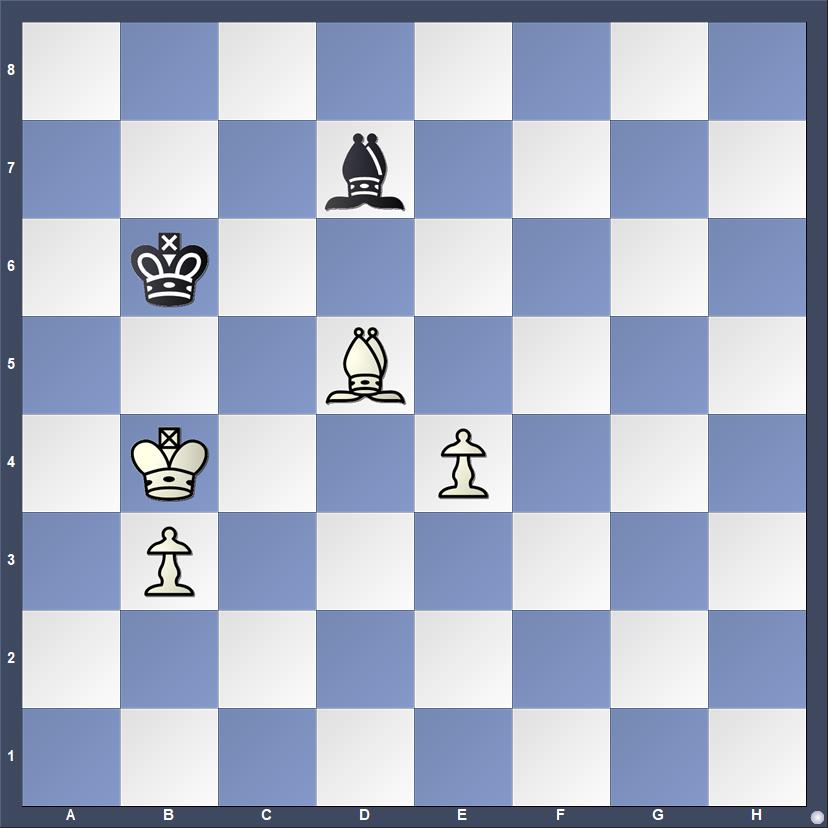
In Jeremy Silman, Silman's Complete Endgame Course (2007), he uses the term "the fox in the chicken coop" for the concept that I learned as "outside passed pawn". It is a skill that I routinely teach beginning students and require for completion of my Knight Award. The core idea that Silman explains--abandoning a passed pawn to create another--appears in the endgame book that I have had since my youth. Irving Chernev, Practical Chess Endings (1961) presents this position. Perhaps that is where I first learned the concept many years ago.

White to move
Chernev explains, "White abandons his passed pawn. Capturing it will keep Black busy on one side of the board, while White gets time to win on the other" (39). He gives the moves:

1.Kf5 Kh6 2.Ke5 Kxh5 3.Kd5 Kg6 4.Kc6 Kf6 5.Kxb6 Ke7 6.Kc7

When young players learn this simple idea, they have a requisite skill for navigating a great many pawn endings that will occur in their own games.

Chernev gives a second solution that employs a fundamentally different set of principles, but that leads to a faster checkmate. Hence, the position is less than ideal for my purposes. Even so, I had the exact position in a blitz game in July 2021 and played it according to book.

Silman's illustration is cleaner. While there are several winning moves that can be played, his solution appears to follow the top engine moves.

White to move
1.b5 Kb7 2.Ka5 Ka7 3.b6+ Kb7 4.Kb5 Kb8 5.Kc6 Kc8 6.Kd6 Kb7 7.Ke6 Kxb6 8.Kxf6 Kc7

White to move
9.Kxg5

Silman writes, "the rest is mindlessly easy" (67).

I would play 9.Ke7, which wins faster.

When teaching or testing students, I usually compose positions on the spot. But, perhaps it would be useful to have a printed sheet in my chess bag with some of the most instructive positions from books and game. Paul Keres, Practical Chess Endings (1974) offers one that is excellent. His term is "distant passed pawn" (55). As he notes, without the passed pawn that will be sacrificed (or exchanged for Black's passed pawn), White would be lost. 

White to move
1.f5 Ke5 2.f6 Kxf6 3.Kxd4 Ke6 4.Kc5 Kd7 5.Kxb5 Kc7 6.Ka6

Reviewing my own internet games stretching back to the late-twentieth century produced many positions where the basic idea of using a passed pawn to deflect the opponent's king from the main scene was required. In many cases, the correct move was not played.

I played it correctly in this position from the Internet Chess Club in 2001.

Black to move
38...b3! was the only winning move. My opponent resigned after 39.Kxb3 Kxd5 40.Kc3 Ke4 41.Kd2 Kf3

Thinking I was applying this idea, I managed to throw away the win in this game from 2001.

White to move
I played 45.h4 and succeeded in forcing Black's king to the h-file while gobbling Black's two remaining pawns with my king. However, Black's king was able to get back to the a-file in time. This position shows that calculation is necessary in pawn endings and sometimes there is more than one idea in play.

1.Kf4! is the only winning move.

If Black then goes after the a-pawn, White needs to win a queen vs. pawn ending where it is important that Black's pawn is two squares from promotion. If the Black king tries to get the the h-file, then the distant passed pawn is far enough away that White will be able to promote the a-pawn.


28 July 2022

"The student should work this out"

In Chess Fundamentals by José Raúl Capablanca, the author frequently states that a given position, "should be worked out by the student", and other comparable phrases. This assertion vexes some readers and some coaches are loath to recommend the book. If the student does not understand something, how will they come to an understanding without assistance?

In some cases, especially with simple pawn endgames in chapter 1 of Chess Fundamentals, I believe that Capablanca provides the necessary resources in the explanations that he offers. Still, I have seen others struggle. They need more help. Capablanca recommends a teacher.

When Capablanca wrote Chess Fundamentals (he was checking the proofs in England in 1920 while negotiating conditions for the World Championship Match that took place in March and April 1921--see "WCC Havana 1921" in this site's index), there were fewer resources than we have today. I believe the standard endgame book then was Johann Berger, Theorie und Praxis der Endspiele (1890), a book in the German language that was probably not readily available or accessible to the majority of Capablanca's readers.

Today, however, we have an abundance of books, websites, YouTube, ready access to engines, and even tablebases. The danger to the student stems not from lack of help, but rather too much help. Easy access to answers cause many to fail to develop self-reliance. Capablanca's call to develop the habit of working things out may offer a more certain formula for strengthening a player's skills.

I often claim that I have zero natural ability at chess, but that I have learned a modest amount from books (see "My First Chess Book"). Many years ago when I started reading chess books, I found much that was confusing. The book I remember most clearly is Irving Chernev, The 1000 Best Short Games of Chess (1955). Often it was not evident to me why a game ended. Sometimes Chernev explained the reason, but even then I had questions. I sought answers to my questions by moving the pieces on a chess board, exploring variations. Certainly, with so little skill at the time, most of my fantasy variations were rubbish. Even so, the effort developed a habit of thinking for myself about chess.

The past few days I've found myself back in the classroom, seeking understanding. I started playing some bishop endgames against the computer on chess.com. Failure in my first effort got me hooked. My time struggling through five positions against the silicon monster engages me for hours every day. At the Learn/Endgames/Minor Pieces/Bishops tab on chess.com, there are five practice positions. To see the second one, you must checkmate the computer in the first. The first is simple and takes me from 12 to 24 seconds most times. 

The second one varies in difficulty, depending on how the engine plays.

White to move
Number Two
1.Bf5

I always play this move. It might be best.

1...h5 2.f3

Now the engine has played 2...a5, 2...Ke7, and 2...Kc6 most regularly. 2...Kc6 has proven most testing but I am reliably winning most of the time. Success grants me the opportunity to see number three.

White to move
Number Three
I found the pawn sacrifice quickly and now get to my seventh move in two seconds or less. Sometimes I reach this point with considerably less than two minutes total time elapsed for checkmating the computer in the first two and playing these seven moves.

1.c5 dxc5 2.Bc4 Bg4 3.Kxe5 Ke7 4.Kd5 Kxf7 5.Kxc5 Ke7 (the computer threw me a curve with 5...Kf6 at least once) 6.Kxb4 Kd6 7.Bd5

Black to move
The computer has played at least five different moves here.

a) 7...Bf3 proved challenging the first time I saw it. That line now often continues 8.Ka5 Be2 9.b4 Bg4 10.Kb6 Bh3 11.b5 Bg4 12.Ka7 and the computer must give up the bishop for my b-pawn.

Black to move
12...Kc5 has given me trouble when I am moving too fast, which the exercise encourages by tracking total time for the series and making me play simple checkmates all the way to the end. Sometimes I underpromote to practice bishop and knight or two bishop checkmates.

13.Bc6 Bc8

Here, 14.b6?? fails, but both 14.Kb8 and 14.e5 succeed.

I have seen most of the computer's responses several times, but this morning's effort presented me with a position I did not recall seeing before. 

b) 7...Bd7 8.Ka5 Kc7 9.Kb4 Kb6

White to move
10.Kc4!

There is more than one way to get rid of Black's bishop.

10...Be8 11.Kd4 Kb5 12.e5 Kb4 13.Ke4 Kc5

White to move
14.Bg8 Bc6+ 15.Kf5 Kb4 16.Kf6 Kc3 17.Bc4 Bd7

This move is Stockfish surrendering it seems.

White to move
18.e6 Bc6 19.Kf7 

Black must give up the bishop for the e-pawn. A few moves later, I underpromoted the b-pawn to a bishop. When I was nine or ten moves from mate, I made a hasty move that stalemated the engine. Now, I must start over at number one. I've played number five half a dozen times and have some ideas how to proceed. My current problems are two: 1) the engine lures me into a pawn ending that is lost foe me, and 2) I fail two, three, and four too often.

Have you tried these exercises? How did you do?


15 February 2021

What is Reading?

Some books are to be tasted, others to be swallowed, and some few to be chewed and digested; that is, some books are to be read only in parts; others to be read, but not curiously; and some few to be read wholly, and with diligence and attention.
Francis Bacon, "Of Studies" (1625)
What do you mean when you say you've read a book? Have you read every word?

During a class my first year of graduate school, my professor stated her view that for a master's degree, a history student should know 300 books. For the doctorate, she said, one thousand books was the expectation. Her statement was a little intimidating at first, for it meant reading one academic book every two to three days. Many of these books are densely written and run 400-500 pages.

For that class, we each bought the twelve required texts, and were each assigned one for our individual presentations, and two written assignments--an annotated bibliography and a 15-20 page paper. For my bibliography and paper, I "read" perhaps a dozen more books, and several journal articles. The assignment was to place the book in question in the context of other scholarship on the same topic.* Reading a book with this purpose meant spending as much as two hours identifying the central arguments and the nature of the supporting evidence of each book. An article should take fifteen minutes. With practice, and some familiarity with the subject matter, this level of reading can be achieved in about thirty minutes for most history books.

Reading a novel is another matter. It must be read in sequence and cover-to-cover. Some books may remain unfinished--there is a long list of popular classics that I started and did not finish because I did not like them. For other novels, reading only begins the second or third time through the book. This need for a second and third reading is a characteristic of the sort of dense fiction that I prefer. All reading is rereading, as some French theorist famously suggested.**

How do you read a chess book?

For some chess books, the practice of the historian--skimming, assessing, highlighting key points--might be all you need. A few weeks ago, I reviewed three chess books for beginners that were all terrible. Each was self-published and two seemed as if they were not written by chess players. The third read like a bad machine translation of a decent book in a language other than English. Perhaps two hours were required to read the combined 300 pages of these three books. I did not skip any pages, but did pass rapidly over the surface looking for points where the author said something of merit, or got something egregiously wrong.

There are many chess books on my shelves that I read for an hour or two on the day of purchase, often with the intent to go back and peruse with more attention to detail. Most chess books offer verbal discussion of key ideas, illustrative positions with diagrams, and detailed analysis of positions, sometimes with many branches of possible variations. Reading the text often does not take long, while pondering the variations can keep you tied up for years.

The day I bought Jeremy Silman's Complete Endgame Course (2007), I spent less than two hours racing through the first third of the book, pausing only to think through a few diagrams. Most of the content through what he calls "Endgames for Class C" consists of knowledge I assimilated before I bought the book. Even so, Silman's book transformed the curriculum I was using to teach elementary age chess players. He convinced me that checkmate with knight and bishop was an inefficient use of time, while the Lucena and Philidor rook endings deserved far more attention. Prior to buying his Endgame Course, some ideas presented in How to Reasssess Your Chess, 3rd ed. (1993) had worked their way into my teaching. I cannot say that I have read either of these books, except in part. But I have frequently reread a few parts of Reassess, both 3rd and 4th editions.

I read Excelling at Technical Chess (2004) by Jacob Aagaard more slowly and more deliberately, but still not wholly. It had a profound impact on my play that was vital as I rose from B Class to A within the USCF rating system. Where I was once eager to accept a draw in a seemingly equal position, I started refusing these offers after reading Aagaard. If there is an imbalance that allows me to create problems for my opponent to solve, I insist that we should play on at least a few more moves. I also began to see that some endings, while long and potentially difficult, were not at all equal. See "Excelling at Technical Chess" for an example of the fighting spirit Aagaard helped inspire.

Prereading


When reading some chess books, especially those that present whole games well-annotated, I often follow a longer process. First I locate the next game in the text in a database. I play through the game several times without reference to the book. The first few times, I use no aids, but seek the key moments in the game. Where did the player who lost begin to go wrong?

When I am comfortable with understanding some of the key tactical and positional points, I may use an opening database to research a bit. After I have worked to acquire a thorough understanding of the game, I read the annotations in the text.

Sometimes I will continue by looking at how other books present the same game. I have used this process for dozens of books on my shelves, but Logical Chess Move by Move (1998) by Irving Chernev is the only book for which I have taken this process all the way through every game. I went through the algebraic edition a few years ago, but also have vague memories of a more superficial reading of a library copy of the original descriptive edition in the late-1970s.

This process of "chewing and digesting" a chess book is one that I advocate. Perhaps, if I find the time, I will complete other books in this manner. I started this process a bit over a year ago with Paul Keres, World Championship 1948 (2016), which is a terrific book. Alas, work and other chess books got in the way.

*I discuss this specific book and that graduate class in more detail on Patriots and Peoples, "Pandemic History".
**Roland Barthes, S/Z: An Essay, trans. Richard Miller (1974).

01 June 2020

Surprising

My students and I are going through some of the gems in Irving Chernev, The 1000 Best Short Games of Chess (1955). The finish of this game between Aron Nimzovich and a player whose identity is not preserved by Chernev proved delightful.

White to move

27 March 2019

Foresee the Threats

Black to move

What are the merits of 8...Qxd4?

The position comes from Luer -- Rattman, correspondence 1922 and published in Irving Chernev, The 1000 Best Short Games of Chess (1955).

28 December 2018

One from Chernev

More than six years ago, I wrote about the importance to me of Irving Chernev's The 1000 Best Short Games of Chess (1955) (see "My First Chess Book"). I still go through the games in this book in small batches from time to time. This one caught my eyes this morning. The entire game has been played at least three times, according to ChessBase's database.

Schuster -- Carls [B15]
Bremen, 1914

1.e4 c6 2.d4 d5 3.Nc3 dxe4 4.Nxe4 Nf6 5.Ng3

5.Nxf6+ is the main line

5...h5

White has a problem. Harry the h-pawn is coming for his knight.

White to move

6.Bg5?

6.h4
6.Bc4

6...h4

Black is winning

7.Bxf6 hxg3 8.Be5 Rxh2 9.Rxh2

Black to move

9...Qa5+

The star move!

10.c3 Qxe5+ 11.dxe5 gxh2 0–1

07 April 2017

Bogoljubov -- Alekhine, Hastings 1922

Alexander Alekhine gave up three queens to beat Efim Bogoljubow in their last round game at Hastings Six Masters in 1922. The game featured some spectacular tactics and a textbook finish with a near zugzwang position giving way to an elementary pawn ending. Many chess enthusiasts consider it one of  the greatest games ever played. I included it among my ten candidates in the list created for my Spring Break Chess Camp class on the subject of the best game ever played.

Alekhine needed a win to finish first in the tournament as he was tied with Akiva Rubinstein going into the last round. This need drove his choice of the Dutch Defense, which he characterized as risky. Many recent accounts of this game confuse this event, held September 1922, with the Hastings International Chess Congress, held December 1922 -- January 1923. Rubinstein won the latter. Alekhine did not participate. The Six Masters event was a double round robin featuring two British masters--George A. Thomas and Frederick Yates--and four of the leading masters from outside Britain--Alekhine, Rubinstein, Seigbert Tarrasch, and Efim Bogoljubow.

The round-by-round results with links to the games are posted on Chessgames.com. I looked at crosstables for this event and for the Hastings Chess Congress in John Donaldson, and Nikolay Minev, The Life and Games of Akiva Rubinstein, vol. 2: the Later Years, 2nd. ed. (2011).

A. Alekhine from Wikimedia Commons*
Alekhine considers this game against Bogoljubow, alongside his win against Richard Reti (Baden-Baden 1925), as "the most brilliant wins of [his] chess career" (Alekhine, My Best Games of Chess, 1924-1937 [1965], 13). Irving Chernev also calls this game, "the most brilliant game ever played" (The Most Instructive Games of Chess Ever Played [1965], 67). Chernev annotates this game in The Chess Companion (1968) and in Twelve Great Players and Their Best Games (1976). The former is quoted on the website Master Chess Open:
Alekhine's subtle strategy involves manoeuvres which encompass the entire chessboard as a battlefield. There are exciting plots and counterplots. There are fascinating combinations and brilliant sacrifices of Queens and Rooks. There are two remarkable promotions of Pawns and a third in the offing, before White decides to capitulate.
Chernev, The Chess Companion (as quoted at Master Chess Open).
Andrew Soltis lists this game as number four in The 100 Best Chess Games of the 20th Century, Ranked (2006).

Despite such praise, Bogoljubow -- Alekhine, Hastings 1922 is absent from Graham Burgess, John Nunn, and John Emms, The World's Greatest Chess Games (1998). Burgess does include it in Chess Highlights of the 20th Century (2000), but that book contains 270 games. The editors of The World's Greatest Chess Games carefully culled their list to one hundred. Their criteria were:
Quality and brilliance of play by both contestants.
Historical value.
Historical significance.
Burgess, Nunn, and Emms (1998), 7.
Bogoljubow's play falls short of this standard. He makes several positional errors in the opening and middle game, which Alekhine then exploits brilliantly. Even then, however, Alekhine may have eschewed the clearest path to victory in favor of artistic chess.

Annotations to this game are found in many books, websites, and YouTube videos. Most annotators start with Alekhine's own comments in My Best Games of Chess, 1908-1923 (1927) or in W.H. Watts, The Book of the Hastings International Masters' Chess Tournament 1922 (1924). A. J. Goldsby offers detailed annotations on his website and also a YouTube video. While going through this game, I studied annotations in S. Tartakower, and J. DuMont, 500 Master Games of Chess (1975); Max Euwe, From Steinitz to Fischer (1976); and Garry Kasparov, My Great Predecessors, Part 1 (2003). The game without annotations is included in Rashid Ziyatdinov, GM-RAM: Essential Grandmaster Knowledge (2000), which I mention frequently on Chess Skills. There are three middlegame positions in GM-RAM from this game.

In my annotations, I aim to highlight the critical moments of this game, rather than creating a compendium of all that has been said by others.


Bogoljubow,Efim -- Alekhine,Alexander [A90]
Hastings Six Masters, Hastings, 21 September 1922

1.d4 f5 2.c4 Nf6 3.g3 e6 4.Bg2 Bb4+ 5.Bd2 Bxd2+ 6.Nxd2

6.Qxd2 offers White much better prospects. This game well-illustrates how this capture leads to a misplaced knight and reduces White's influence in the center. As long as this knight stands on d2 it prevents White's rooks from controlling the d-file and it stands as a potential target should Bogoljubow seek exchanges in the center. Tartakower suggests 6.Qxd2 and Nc3. Kasparov concurs.

6...Nc6 7.Ngf3 0–0 8.0–0 d6 9.Qb3 Kh8

White to move

While running a youth chess tournament at the end of our Spring Break Camp, I spent my idle moments going through this game. The position in the diagram above was on my board for much of the day. I asked many of the youth players and coaches whether they agreed with Alekhine's assessment that Black already has the upper hand. The first youth to face this question suggested 10.d5 and thought White was better. Tartakower also prefers 10.d5 to the move Bogoljubow played in the game.

Black's queen knight on c6 is more active than its counterpart on d2. White's queen is temporarily more mobile than Black's, but knowing how the game continued makes it hard to evaluate the position objectively. Black's queen proved to have more influence in the game. Perhaps the White queen is somewhat misplaced on the queenside. White's rooks are connected. Many youth players suggested that White has a lead in development and cannot be worse.

Alekhine annotated this game from the perspective of having won a brilliant victory. He might not have been particularly objective in his assessment of the game up to this point. We know that Black's queen made a foray to the kingside, where it provoked weaknesses, then returned to e8 to support action in the center and on the queenside. From the standpoint of the game's whole, Black's queen proved much more flexible and effective.

After 9.Qb3, Alekhine wrote, "This manoeuvre does not prevent Black from realising his plan, but it is already difficult to suggest a satisfactory line of play for White (Alexander Alekhine's Best Games [2012], eBook, loc 2665). Presumably, it is this comment that Euwe translated into the Informant symbol for Black has the upper hand in From Steinitz to Fischer. But, it seems to me that Alekhine might be annotating by result.

Tartakower and DuMont, 500 Master Games of Chess offer several improvements to White's play over the next several moves. Most of these suggestions are repeated by Kasparov in My Great Predecessors. I think the game is still balanced at this point, but that Black has a clear edge after move 18. Kasparov quotes Alekhine's "already difficult ... for White," adding "Why?"

10.Qc3

After 10.d5, Kasparov offers two lines that the young players and I examined at the youth tournament.

10...Na5 11.Qc3 c5
10...exd5 11.cxd5 Ne7

In both cases, it does not seem that Black has an advantage. Kasparov states, "Black would have faced a thankless defence" (365).

10...e5 11.e3

Alekhine points out the vulnerability of White's knight on d2. If 11.dxe5 dxe5 12.Nxe5 Nxe5 13.Qxe5 and the knight on d2 is en prise. Tartakower, Euwe, and Kasparov all repeat this line.

11...a5

Upon seeing this move, I might agree that Black has a slight edge after White's failure to play 10.d5.

White to move

12.b3 Qe8 13.a3 Qh5

At this point, Kasparov quotes Alexander Kotov, "The start of a deep strategic plan. First of all Black creates threats on the kingside and provokes a weakening of the opponents pawns" (Kasparov, 365).

A defect of My Great Predecessors is the absence of documentation. The whole series is full of quotes from other chess writers. Parts IV and V offer bibliographies, but not the sort of documentation that is desirable for a work that is so much a digest of the work of others. The first three parts offer less.

Kotov wrote several books about Alekhine in Russian (I saw the number six somewhere). One book exists in English, put out by R.H.M. Press: Alexander Kotov, Alexander Alekhine, tran. K. P. Neat (1975). I am tempted to buy this book. There are used copies floating about, and also an Ishi Press reprint.

14.h4

Alekhine writes, "A good defensive move, which secures new squares for his f3-knight and revived the threat of 15.dxe5" (loc 2682). I do not see why 14.dxe5 was not possible. Tartakower rejects it because after 14...dxe5 15.Nxe5 drops a piece. It seems to me that White could open the center and does not need to follow-up by blundering away a knight. The h2-h4 push can be played later.

I considered 14.Rab1 to support b3-b4. The immediate 14.b3-b4 drops a pawn because after 14...e4 15.Ne1, the rook is skewered through White's a-pawn.

14...Ng4 15.Ng5 Bd7

White to move

16.f3

Alekhine sought to provoke a weakening of White's kingside, and did so. But, Bogoljubow might have been a little too cooperative. I am tempted to regard 16.f3 as a mistake. Alekhine suggested in comments to 15.Ng5 that 15.b4 was preferable. Kasparov repeats Alekhine's suggestion.

Here Alekhine offers a tactical line that is even worse for White: 16.Bxc6 Bxc6 17.f3 exd4 18.fxg4 dxc3 19.gxh5 cxd2 with a better endgame for Black.

16...Nf6 17.f4

Black threatened 17...f4, which would have pried open White's pawn shield.

e4 18.Rfd1

18.d5 was White's last chance to be slightly worse.

18...h6 19.Nh3 d5

White to move

Black clearly has the upper hand now, in my view. Where did White fail? On moves 10-18, Bogoljubow had several opportunities to open the center and possibly create a balanced struggle. He opted instead to close the kingside and close the center. As a consequence, his pieces lost their mobility and became passive. His long-term plan seemed oriented towards action on the queenside, but the game's subsequent course revealed surprising resources for Black there.

Kasparov offers another juicy quote from Kotov, which highlights the success of Alekhine's long-term strategic plan. Kasparov's note preceding the game highlights the centrality of Kotov's commentary.
The last of the wins is one of the most grandiose Alekhine canvases. It once again shows that his amazing combinations did not arise out of thin air, but were the fruit of very deep strategic preparation.
Kasparov, My Great Predecessors, 364.
20.Nf1

This position is the first of the three in GM-RAM from this game.

Ne7 21.a4

This position is the second in GM-RAM from this game.

Now, Boguljubow weakens his queenside, offering Black a nice outpost for his knight. Could he have tried to close matters there, too, and then hunkered down inside a fortress? To wit, 21.c5 Qg6 22.Qe1 Neg8 23.Kh2 Nh5 24.Ng1 Ngf6. White has no play, but how will Black break through?

21...Nc6 22.Rd2 Nb4 23.Bh1

This bishop could be useful preventing Black's knight for employing d3 as an outpost. Alas, there is no way to maneuver the bishop to such a useful square so long as the knight on f1 must guard the weak g-pawn. Perhaps White could redeploy his knights to h1 and h2 to guard g3 and g4? Surely, that would offer Black some opportunities elsewhere on the board.

Maybe 23.c5 is no worse than White's other choices. the tension between c4 and d5 only benefits Black. 23.cxd5 looks suicidal.

23...Qe8!

White to move

Now, c4-c5 is not possible due to b6. The problems with 24.cxd5 are worse than before.

24.Rg2 dxc4 25.bxc4 Bxa4

Alekhine has won a pawn. More significant than the pawn, however, is the preponderance of force for Black on the queenside as things open up. Half of White's army is sitting in the bleachers with their monarch, watching the game.

26.Nf2 Bd7 27.Nd2 b5 28.Nd1 Nd3

Alekine rejected 28...bxc4 because it would bring a White knight to e5.

29.Rxa5

White has won back the pawn, but his position is now much worse than it was a few moves ago. Now the game enters the phase where Alekhine's flashy tactical brilliance shines. Black has several ways to win, but the manner he chose elevates this game in the opinions of many chess students.

29.cxb5 and Alekhine offers 29...Bxb5 30.Rxa5 Nd5 31.Qa3 Rxa5 32.Qxa5 Qc6 with a winning attack for Black.

Black to move

29...b4! 30.Rxa8

Ziyatdinov's third position in GM-RAM from this game has now been reached.

30...bxc3!! 

This brilliant move was not necessary to win. 30...Qxa8 31.Qb3 (Alekhine's suggestion) 31...Qa1 (Kasparov's improvement over Alekhine's 31...Ba4) 32.Qb1 Ra8 and Black has a technical win.

31.Rxe8 c2 

The point of Black's last few moves.

32.Rxf8+ Kh7 33.Nf2 c1Q+ 34.Nf1 Ne1

Threatening smother checkmate.

35.Rh2 Qxc4 36.Rb8 Bb5 37.Rxb5 Qxb5

White's moves 30-37 are the computer's top choice. Alternatives lose much quicker.

White to move

38.g4 Nf3+ 39.Bxf3 exf3 40.gxf5 Qe2

White to move

What can White do? He is in zugzwang. Pawn moves delay the end.

41.d5

41.Nh1 Ng4 42.Rxe2 fxe2 and after sacrificing two queens. Black will gain one more to sacrifice.

41...Kg8 42.h5 Kh7 43.e4

Now White's remain pawn moves lose pawns.

43...Nxe4 44.Nxe4 Qxe4

White to move

45.d6 cxd6 46.f6 gxf6 47.Rd2 Qe2

Alekhine threatens checkmate in one.

48.Rxe2 fxe2 49.Kf2 exf1Q+

Alekhine's third queen sacrifice in this game.

50.Kxf1 Kg7 51.Kf2 Kf7 52.Ke3 Ke6 53.Ke4 d5+ 0–1

There is not much to criticize in Bogoljubow's moves after about move 20. But, his inaccurate play in the early game deprives this game of some of its merit. Alekhine's strategic preparation and tactical execution deserve study.


*George Grantham Bain Collection (Library of Congress) derivative work: Jesus Angel Rey, Public Domain, https://commons.wikimedia.org/w/index.php?curid=16985493.