Showing posts with label pin. Show all posts

09 January 2026

Beginner's Club: This Week

Many of the young students in my after school club have only begun playing chess when they joined the club. Others have more experience and more skill, but very few have played in tournaments and with limited success. My focus in these sessions is teaching elementary skills and cultivating enjoyment of the game. Most sessions begin with a short lesson that consists of a small number of problems on the demo board, or a short game. Sometimes, I show a simple technique and ask them to practice, such as building a shrinking box to force checkmate with heavy pieces.

This week, I pulled two checkmate exercises from the Facebook group Chess Teachers & Learners.

The first was presented as a difficult checkmate in one.

White to move
Obviously White has overwhelming force, but the stipulation is that there is a mate in one.

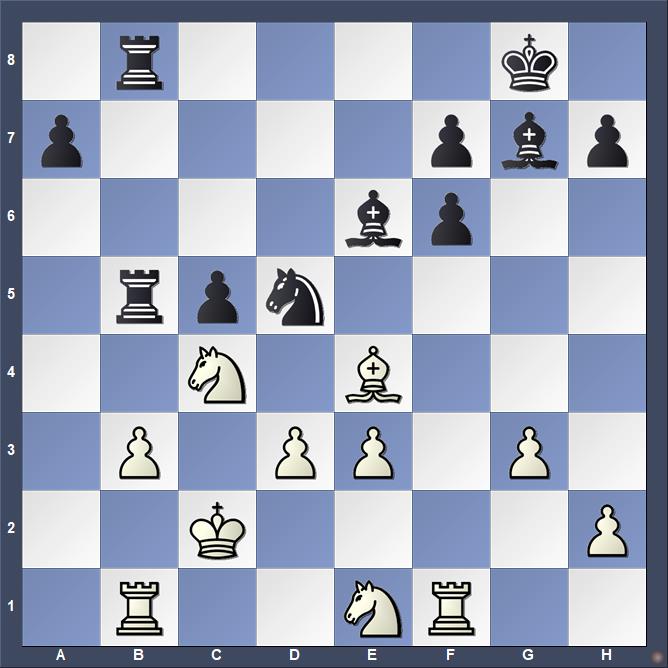
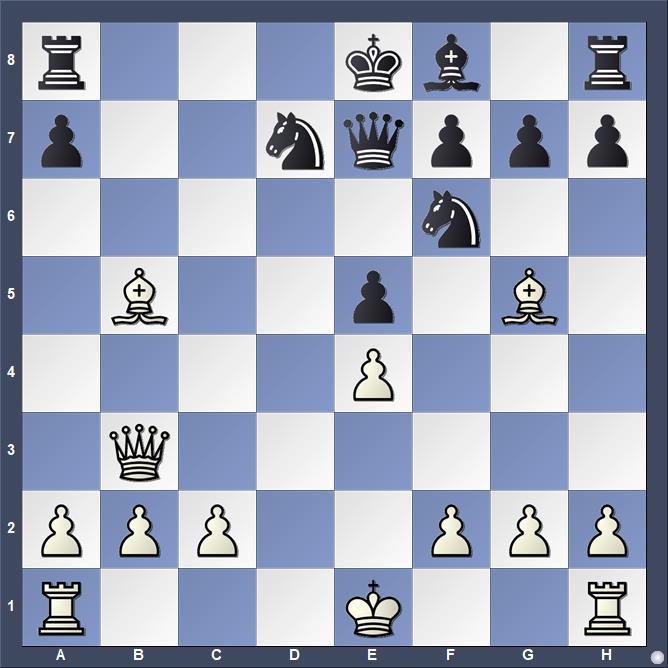
There are many possible checks, including some that would be illegal. One young student immediately suggested Bb3+, so I pointed out that the bishop was pinned by the queen. Beginners need to learn that pieces pinned to their king cannot move off the rank, file, or diagonal along which the pin occurs. Although this bishop cannot move, it still defends the h7 knight from capture. But, as we will see with the solution, the immobility of a pinned piece reduces its power.

The correct answer took me half a minute when I saw this position on Facebook because I subconsciously rejected moving the pinned queen. Then, I saw that the rook attacking the queen is also pinned.

With the young students, we looked at every possible check except the correct one and saw why it does not achieve checkmate. Then, a student saw the correct answer, 1.Qb3#.

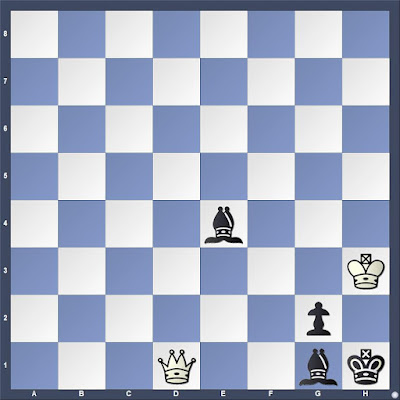
We moved on to the second problem--a mate in two.

White to move
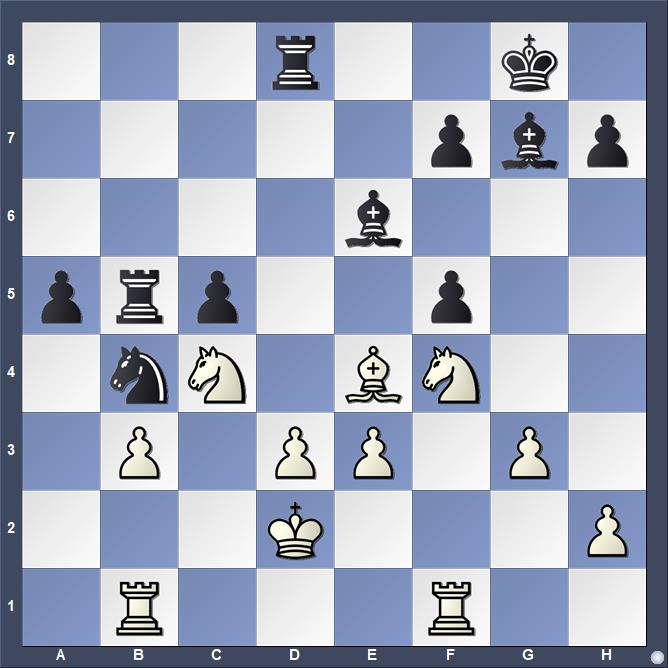
This one proved difficult. The students tried several ideas. I stressed the importance of the pin on Black's pawn by the queen to help. After we had spent fifteen minutes on the lesson without finding the answer to this problem, I had the get chess sets and play chess, leaving the position on the board.

They played for 30-40 minutes and started to seem a little restless, so I brought them back to the demo board and showed them the solution (it turns out that there is a second solution that I missed).

1.Qd4 is an elegant move that forces Black to move a rook, the capture of which delivers checkmate.

1.Rd7 is the alternate solution that I missed.

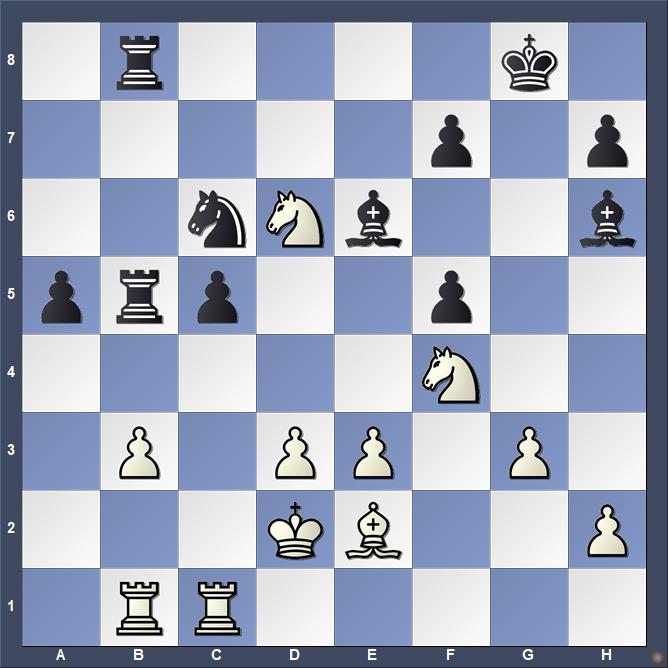
Then I set up a position from William Lewis, Elements of the Game of Chess (1822) that I use with some frequency (see "Teaching Elementary Checkmates"). It is mate in five.

White to move
Students were directed to work in teams solving this. If they found the correct solution, each member of the team would earn a chess pencil. Several came close.

After they struggled a bit with simple forcing moves that were not forcing enough, I offered some hints: find a move that leaves Black only one legal move, force the defending king to remain in the quadrant of the board in which it begins (of course, I had to explain the word quadrant).

03 December 2024

Radiology

In a rapid game online this morning, I planned an attack well before conditions on the board were ready. My opponent failed to defend appropriately and the attack succeeded.

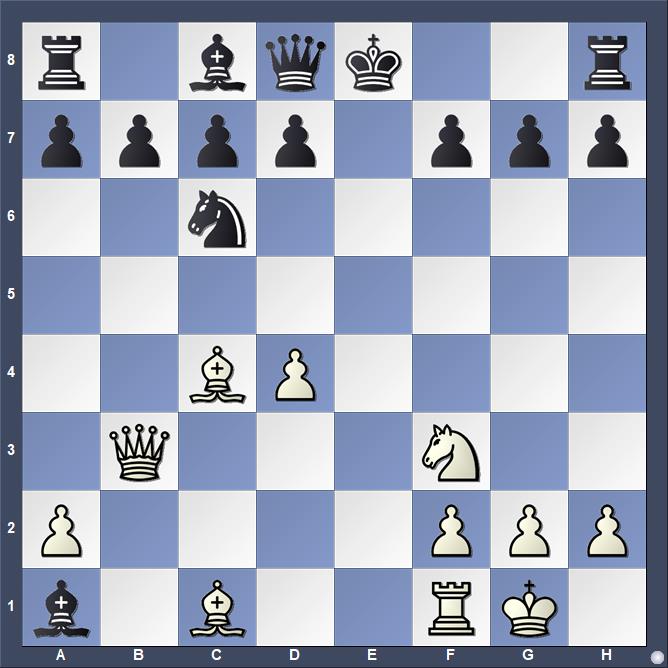
After some opening moves, we reached this position with White to move. I had White.


At this point in the game, I began to have fantasies about an attack along the f-file against a pinned knight. This attack requires a knight sacrifice on f7 to capitalize on the x-ray.

11.f4! gxf4

11...Bxe5 12.fxe5 Nd7 13.Qh5+-

12.Rxf4

12.Qf3 was better--battery 12...Rf8 13.exf4

12...Be7??

12...Rf8= anticipates White's threats and prevents them.

White to move
Now is the time!

13.Qe2

But. I thought that more preparation was necessary, planning to first double rooks on the f-file.

13.Nxf7!! Kxf7 14.Qh5+ Kg8 15.Qg6+ Kf8 16.Raf1+-

13...Bd7

13...Rf8 was still possible, neutralizing White's plans. 14.Raf1

14.Raf1

14.Nxf7 is less effective now 14...Kxf7 15.Qh5+ Kf8 16.Raf1 Be8 the point of Bd7.

14...Rg8

White to move

15.Nxf7! Kxf7

15...Qb6 16.Rxf6 Bxf6 17.Rxf6 Qxb2 18.Na4 Qb4 19.Nc5 is also winning for White.

16.Qh5+ Kf8 17.Qxh6+ Kf7

White to move

18.Be2?!

Throws away most of the advantage.
I considered 18.Bh7 Rg7 19.Qh5+ Kf8 but did not see the ideas clearly enough.

18...Rg6??

Black moves into forced checkmate.

18...Rg7 19.Bd3 (19.Qh5+ Kg8=) 19...Qh8 (19...Qg8 20.Rxf6+ Bxf6 21.Qxf6+ Ke8 22.Rf2) 20.Rxf6+ Bxf6 21.Qxf6+ Kg8 22.Ne2+-.

19.Qh7+ Rg7

19...Kf8 holds out longer 20.Qxg6 Be8 21.Qh6+ Kg8 22.Qg5+ Kf8 23.Rh4

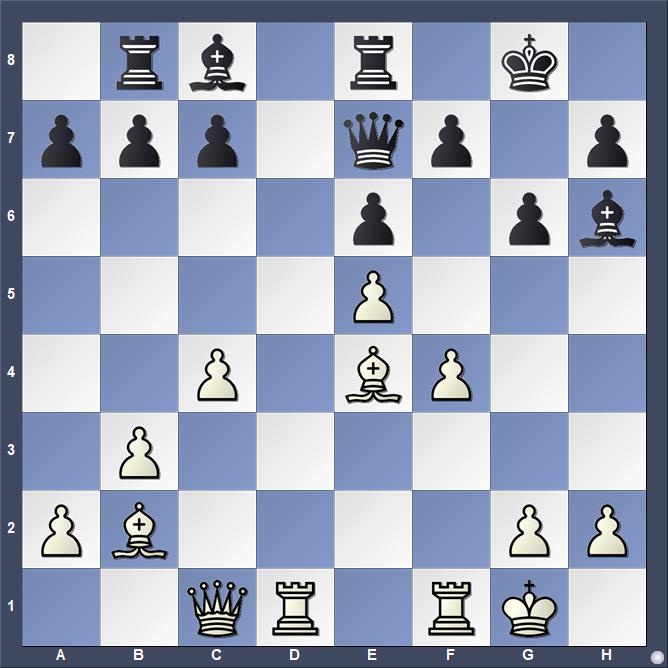
White to move
White has a mate in five, which I saw to the end.

20.Bh5+ Kf8 21.Qh8+ Rg8 22.Rxf6+ Bxf6 23.Rxf6+ Ke7

23...Qxf6 24.Qxf6#

24.Rf7+ Kd6 25.Qe5# 1-0

19 May 2024

Distraction

This morning’s tactics session was suboptimal. After solving the first one correctly, I did so poorly that I dropped my rating 98 points from 3038 to 2940. I continued to solve with increased determination, ending at 3004. The last exercise, which I solved correctly in 4:59, offers a case study in distraction. How often do we focus on one area of the board, completely oblivious to what else is happening somewhere else.

I spend most of five minutes trying to make something work on the queenside, noting the threatened knight fork if my queen strayed. I looked at the contact between the bishops. In the last few seconds after expending so much time looking at unproductive lines, I noticed Black’s fatal problem on the kingside and executed the simple mate in two.

30 April 2024

Inspired by Ruy Lopez

This morning I had a familiar position although the opening moves were not anything I recall playing before. The position was familiar because it had the same critical elements (pattern) found in a game Ruy Lopez played in 1560 and that appears in my book, Checkmates and Tactics (2019). The exercises in this book are those I've been using with scholastic chess players since 2006 as part of my award curriculum.

I had White in the 10 minute game.

1.e4 e6 2.c4 c5 3.Nf3 d5 4.exd5 exd5 5.d4 dxc4?! 6.Bxc4 Bg4?

Bad pins often backfire.

White to move
7.Bxf7+ Kxf7 8.Ne5+ creates a discovery against the bishop as well as forking king and bishop.

8...Ke8 9.Qxg4 Nf6 10.Qe6+

The game is continuing along the path shown by Lopez.

10...Qe7

White to move
11.Qc8+ Qd8 12.Qxd8

I considered 12.Qxb7, which Stockfish prefers, but reasoned that Lopez's combination was good enough to give me a clear advantage.

12...Kxd8 13.Nf7+

What we have of Lopez's game ends with this fork.

13...Ke8 14.Nxh8

My opponent made me play all the way to checkmate. Along the way, I won the other rook through another combination.

White to move
24.Rxe6

24.Rxb7+ is simpler and better.

24...Kxe6 25.Nc7+ Kf5 26.Nxa8

It's not often that I get to fork both rooks with my knights in the same game.

Lopez's game started with a King's Gambit Declined. His opponent is given in ChessBase Mega as Giovanni Leonardo da Cutri (spelling and name sequence differs from source to source).

1.e4 e5 2.f4 d6 3.Bc4 c6 4.Nf3 Bg4

The bad pin.

White to move
This position is number 21 in Checkmates and Tactics, available through Amazon both in print and Kindle versions. It is the third exercise in my Bishop Award set.

6.Bxf7+ Kxf7 7.Nxe5+ Ke8 8.Qxg4 Nf6 9.Qe6 Qe7 10.Qc8+ Qd8 11.Qxd8

Lopez's move is best, which differs from my game.

11...Kxd8 12.Nf7+


02 October 2023

Slipping Away

The round four battle with Nikolay Bulakh was my most interesting game in the 2023 Eastern Washington Open. He surprised me with 1.c4! and we both made unusual moves that had us out of book by move five. After Nikolay chose to keep his king in the middle, my confidence in the strength of my position soared. After a sequence of parried threats that had us repeating a couple of positions, Nikolay offered a draw.

Black to move
My response to the draw offer was to push a pawn.

27...a5

My silicon friend suggests that 27...Ne7, threatening f6-f5, offered prospects of an advantage. I doubt either of us would have found the engine's line: 28.h3 Bxh3 29.Bxh7+ Kf8 30.Rf2 with a slight advantage for Black.

28.Ng2

28.Bxd5 was possible 28...Bxd5 and several lines that White can choose keep the balance.

28...Nb4+

I continue with the idea  I was pursuing before the draw offer, now with the a-pawn on a5 instead of a7.

I recall glancing at 28...a4, which deserved deeper calculation.

29.Kd2 Rd8 30.Nf4 f5

White to move
31.Bf3 Bh6

By attacking both knights, I threaten to win the d-pawn, but White's defensive resources are sufficient.

32.Be2 Rdb8 

I keep shifting targets, but cannot generate any tactics that Nikolay does not parry.

33.Rfc1

"A strong move", Nikolay said during our postgame analysis during lunch. I concurred.

33...Nc6 34.Nd6

Black to move
34...Rxb3

I had been trying to win this pawn since I opted to defer taking it with my bishop on move 15. After the game, I decided that this move was the critical mistake, suggesting to Nikolay that I should have played 34...Rfb6. Stockfish agrees my suggestion is better, but not decisively so. "Am I in trouble here," Nikolay asked. Our lunch break was coming to an end as round five would be starting in about ten minutes. We analyzed a couple of lines quickly.

35.Rxc5 Bf8 is better for Black. However, 35.Nxe6 fxe6 36.Nc4 maintains equality. I don't recall whether we looked at this line.

35.Rxb3 Rxb3 36.Rxc5

Black to move
36.Ne7?

It would have been wise to play 36...Rb2+ 37.Kc3 Rb3+ when White has nothing better than letting Black repeat the position. Blocking the check on the second rank with the rook keeps Black's outside passed pawn and a knight vs. bishop ending that should be drawn. We would have played it out, of course.

37.Rxa5

Now, White has an advantage. Any chances that I thought I had slipped away. I played another 14 moves as my position grew worse and worse. Then, I resigned and we went to lunch with 50 minutes before round five would begin.

In the last round, Nikolay drew the tournament's top seed on board two, finishing in a tie for second place. I won my round five game quickly (see "Checkmate Exercises"), then enjoyed watching the battles on boards two and three.


16 November 2022

Decisive Advantage

My students this week are seeing a series of positions in which White has a decisive advantage. Before suggesting moves, or seeing those that were played, I ask them to assess the position. What features account for White's substantial advantage?

The intent is for them to grow in their understanding that a player must use all their pieces in coordination. They should notice that in each position, White's pieces are more mobile, offer concrete threats, and work together. Students are also asked to understand the difference between the pieces on the board and the pieces in the battle. This dynamic imbalance is temporary unless the player wit the advantage acts with vigor.

I spent about an hour gathering 16 positions for these lessons, but no student so far has seen more than eight. The first two are from famous games that many of the students have seen before.

The first is from Paul Morphy's Opera Game.

White to move
The second is from Gioachino Greco's best known use of the Greco Attack (see "Cultivating Error"). I have had this position myself in at least 17 games, winning 16. The one loss was a bullet game where I inexplicably put a horse on a square earmarked for an elephant.

White to move
The third position highlights the relationship between space and mobility. It comes from a game that I played on Chess.com a few days ago.

White to move
Number four was presented at "Desperation". It highlights concrete checkmate threats. Number five is a textbook endgame exercise.

White to move
The sixth proves difficult for students to assess. It comes from a cyborg game played in a match organized by the International Correspondence Chess Association (ICCF). In this game, White used his intuition and a great deal of time on moves 13-15 to acquire mobile center pawns that confer a dynamic advantage.

White to move
Thomas Engqvist's analysis of Morphy,P. -- Morphy,A., New Orleans 1849 in 300 Most Important Chess Positions (2018) guided my selection of the seventh position (14-15).

White to move


26 January 2022

The Bad Pin

A pin is a restrictive contact that either prevents a piece from moving because doing so would violate the rules of the game (absolute pin), or that discourages moving the piece because the consequences could be dire (relative pin). Pins can be potent weapons in the chess struggle (see "A Lesson in Pins").

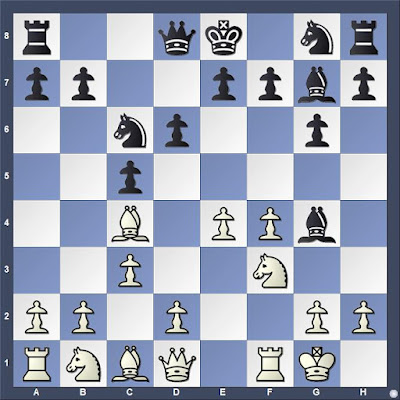
Relative pins are double edged. They can backfire, presenting the player facing the pin with an opportunity. Many of my students the past two weeks have seen this position from a game I played 16 January on Lichess.

White to move
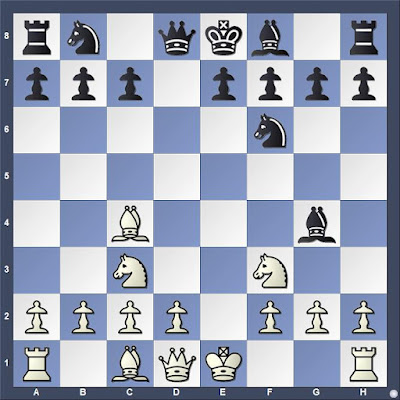
After 5...Bg4??
How should White deal with the pin on the knight? Once you understand certain patterns, the correct answer is instantaneous. 

Evidently I am not the only player who has had this exact position. The position just before I played 8.Qxf7# has been examined in the ChessBase cloud more than 1500 times. Certainly some of the games that could have led to the moves in my game continued 6.Ne5 Bxd1 7.Bxf7#. It seems likely that a few players of the Black pieces also would have found 6...Be6 (the best choice after White exploits the bad pin).

Years ago, perhaps 1999, I bought and began reading Georges Renaud and Victor Kahn, The Art of the Checkmate, trans. W. J. Taylor (1953). I wrote about this book and how it first came to my attention in "Checkmate Patterns) (2015) and again in "Learning Checkmate (Or Teaching It)" (2021). I am rereading it, now in a new translation that has algebraic notation.

The Art of the Checkmate is my first recommendation when players are looking to learn checkmate patterns. Renaud and Kahn do far more than present basic patterns and then offer exercises. They offer detailed discussion of the variability of the basic pattern and how to bring it about. They use mostly full games. The chapter, "Legal's Pseudo-Sacrifice" (11-21) offers 17 complete games arranged by what they refer to as the "four aspects" of Legal's mate. They explain:
First and foremost we ask you not to learn it by heart but to grasp the precise mechanism, to understand that the bishop on g4 in "hanging", that is to say exposed to capture if the knight moves to threaten mate. But this mechanism appears in many positions as a latent threat and the opponent, if he pins your king's knight, is obliged to take this into account.
The Art of the Checkmate, trans. Jimmy Adams (2015)
I missed my chance to show the knowledge I should have acquired from the book in this blitz game played in 1999 on the Internet Chess Club.

White to move
Cleary, 9.Nxe5 is the correct move. I played 9.Nbd2, still managed to get a clear advantage, worked it into a decisive advantage, and lost on time in the endgame.

In 2000, I showed further incomprehension by maneuvering my way into the losing side of one of the combinational motifs enabled by "the bad pin".

White to move
My opponent understood the ideas and seized a clear advantage.

7.Bxf7+ Kxf7 8.Ng5+ Ke8 9.Qxg4

White has a decisive advantage and went on to win.

Genesis of the Instruction

It might be a stretch to claim that Renaud and Kahn invented the genre of checkmate pattern books. The manuscripts of Gioachino Greco, and many books grounded in these manuscripts offer more in the way of elementary checkmates than any sort of positional insight. But, when it comes to naming and classifying checkmate patterns, I know of nothing earlier than The Art of the Checkmate.

In the annotations to Kermer de Légall's famous game in the Jimmy Adams translation, Renaud and Kahn credit Emanuel Lasker with articulating a general principle of open games: "it is not always advisable to pin the opponent's king's knight before he has castled" (the 1953 translation makes no reference to Lasker). They are referring to lectures Lasker presented in London in 1895 and which were later published in outline as Common Sense in Chess (1917). I presented "Lasker's Rules" to my students and on Chess Skills in 2013, and then discussed Erik Kislik's (Applying Logic in Chess [2018]) critique in "Knights Before Bishops" (2018). It is notable that Renaud and Kahn qualify Lasker's rules in a manner that anticipates Kislik's critique. 

Lasker, Common Sense in Chess presents two short games at the beginning of the chapter. It is not clear that they derived from actual play as all the instances of his two miniatures that I find in the database are relatively recent (late-twentieth century to the present). This position arose in the second.

Black to move
6...Nxe4 7.Bxd8 Bxf2+ 8.Ke2 Bg4#

Renaud and Kahn begin with Legall's well-known game. However, the version they offer differs from that found in George Walker, A Selection of Games at Chess (1835). Edward Winter inquired in 2008 about the earliest known publication of Legall's game (Chess Notes 5720, 18 August 2008). Dominique Thimognier has been researching Legall and published some of the results in French at Heritage des Echecs Francais.

The variation presented in Walker is unsound. White blunders with 5.Nxe5. Yet, the Walker variation is the one found in ChessBase Mega 2020. Chessgames.com has the variation presented in Renaud and Kahn, but with White's rook on a1 absent.

Although there is plenty to doubt about the original game, the endless variations of the ideas have appeared in a great many games. Renaud and Kahn explicate the possibilities well.

Practice

I created an interactive lesson on Lichess.org with some instructive games and 20 exercises. The Study is called "The Bad Pin". I may add to it as I find time. Take a look. Let me know what you think.


14 January 2022

A Lesson in Pins

In my after school chess club at Saint George's School yesterday, I presented the game below to the students to highlight some basic principles for using pins effectively.

The player with the White pieces was William Lewis (1787-1870), a prolific chess author best remembered as one of those who hid inside the infamous fake chess playing machine called "The Turk".* Lewis was a student of Jacob Henry Sarratt, England's best player. I am drawn to Lewis because his Gioachino Greco on the Game of Chess (1819) offers more of Greco's model games than can be found in databases (see "Gioachino Greco on the Game of Chess"). Some of the positions in his other instructional books also are a regular part of my teaching.

Lewis,William -- Keen,Eric [C56]
London Casual Games London, 1817

1.e4 e5 2.Nf3 Nc6 3.Bc4 Bc5 4.c3 d6

4...Nf6 is the most popular move today, but 4...d6 is solid.

5.0-0 Nf6 6.d4

6.d3 seems better.

6...exd4 7.cxd4 Bb6 8.h3

Black to move
8...Nxe4

8...0-0 has led to better results for Black in current master play.

9.Re1

The first pin. We use the term pin when two pieces are attacked along a file, diagonal, or rank such that the one in front cannot move (absolute pin) or by moving exposes a piece of greater value to capture (relative pin).

9...d5?

A mistake.

9...0-0 is best 10.Rxe4 d5 restores the material balance 11.Bxd5 Qxd5 and White has a slight advantage.

10.Bxd5

10.Bg5 is also strong

10...Qxd5 11.Nc3

Piling on the pinned knight wins back the material and maintains substantial pressure on Black's position.

11...Qd8

White to move
12.Rxe4+!+-

12.Nxe4 0-0 leaves White with only a slight advantage (12...Nxd4?? 13.Bg5! [13.Nf6+ Kf8 14.Re8+ Qxe8 15.Nxe8 Kxe8 16.Nxd4] 13...Nxf3+ 14.Qxf3 Qd4 15.Nd6+).

12...Ne7

Moving another piece into a pin makes Black's troubles worse.

12...Kf8 and Black cannot castle. This move is Black's best choice. In either case, White already has a technical win.

13.Qe2

Here, castling would lose the knight.

13...Be6 14.Bg5

Pinning the knight again

14...Qd6 15.Bxe7

Black to move
15...Kxe7

Now the bishop is pinned.

15...Qxe7 16.d5 0-0-0 17.dxe6+-

16.d5 Rhd8 17.Ng5

Piling on. The manner with which Lewis increases the pressure on Black's pinned pieces is instructive. 17.dxe6 is just as good.

17...c6 18.Nxe6

Threatens discovered check

18...fxe6


18...Rd7 19.Nc7+ Kd8 20.Nxa8

19.Rxe6+

Fork

Black to move
19...Qxe6

19...Kf8 20.Rxd6 Rxd6 21.Re1

20.Qxe6+ Kf8 21.d6 Re8 22.Qf5+

22.Qc4 is stronger. Whites material superiority and less vulnerable king makes the advantage overwhelming in any case.

22...Kg8 23.Ne4

White has a checkmate idea that Black does not find a way to stop.

Black to move
23...Rf8

23...h6 offers more stubborn, albeit helpless defense.

24.Qe6+ Kh8

White to move
25.Ng5

25.d7 is simple, but Lewis wants to execute a picturesque checkmate.

25...Bxf2+

Black strikes back to win a pawn and check the king, but there is no follow up as Black's lacks sufficient force for a counterattack.

26.Kh2 Rae8 

Moves into the checkmate that Lewis hoped for in bringing up his knight.
White to move
27.Nf7+ Kg8

27...Rxf7 28.Qxe8+ Rf8 29.Qxf8#

 28.Nh6+ Kh8 29.Qg8+ Rxg8 30.Nf7# 1-0

*See Tom Standage, The Turk: The Life and Times of the Famous Eighteenth-Century Chess-Playing Machine (2002).

17 December 2021

Seeking Understanding

Five years ago, I posted "Two Endgame Compositions", giving only the solution to the second. This week I was asked to provide the solution to the first, an 1888 composition by Johann Berger that was first published in Columbia Chess Chronicle. The past two mornings, I have been studying the solution with an aim to understand every move. Although the maneuvers appear complex, they are based on some simple ideas.

White to move
J. Berger, 1888
1.Qb8

The only winning move, according to the tablebases. It forces the light-squared bishop to move because of the checkmate threat Qh2#.

1...Bc4

Threatens Be6+, followed by Bf2+ (or Bh2+).

Other moves lose more quickly.

1...Be2 2.Qf4 (see at move 4 below)
1...Bd3 2.Qf4
1...Bb5 2.Qxb5 Ba7 3.Qd5
1...Ba6 2.Qg8 Bb7 3.Qh7 Bc8+ (3...Bf2 4.Qxb7) 4.Kg3+

2.Qe5

Prevents the check while keeping the dark-squared bishop immobile.

2.Qd6 is one move slower. This move is presented as a "cook" in Harold van der Heijden's Endgame Study Database with a line leading to underpromotion of Black's pawn. It is an instructive alternative.

2...Ba6

Threatens Bc8+

2...Bd3 3.Qg5 threatens Qxg2#. 3...Be4 4.Qh4 Bf5+ (4...Bf2 5.Qxe4) 5.Kg3+
2...Be2 3.Qxe2
2...Bb5 3.Qxb5

3.Qc7

Prevents the check while keeping alive the Qh2 threat.

3.Qe1 is one move slower according to tablebases.

3...Bd3

3...Bb5 allows 4.Qg7
(4.Qc1 Is given ! in Genrikh Moiseyevich Kasparian, 888 Miniature Studies [2010]. Pins the dark-squared bishop so a check can be met by Kg3 and then Qh6+ 4...Bf1 5.Qf4 Ba6 6.Qg4; 4.Qb7)
4...Bc6 5.Qh6 Bd7+ (5...Bf2 6.Qxc6; 5...Be3 6.Qxc6) 6.Kg3+
3...Be2 is second best 4.Qg7 Bf3 5.Qa1 Be2 6.Kg3

4.Qf4

Threatening to move to g4 where checks along the c8-h3 diagonal are blocked and Qxg2 is threatened. This move forces the light-squared bishop onto the a8-h1 diagonal.

Black to move

4...Bb5 5.Qg4

Shields the king from check and threatens Qxg2#

5...Bc6

Defends g2

6.Qd1

Pins the dark-squared bishop and prepares Kg3

6...Be4

White to move

7.Kg3

Threatens Qh5+. The complex battle between White's queen and Black's light-squared bishop has concluded. Now, White threatens checks on the h-file, which Black can delay briefly.

7...Bg6

Guards h5

8.Qc1

Threatens Qh6+

8...Bh5

Prevents the check

9.Qa1

Forces the bishop off the h-file.

Black to move

The rest is easy.

9...Be2 10.Qh8+ Bh5 11.Qxh5+ Bh2+ 12.Qxh2#

19 December 2020

Rubinstein -- Heilmann 1905

In October 2012, my wife and I loaded into the SUV our three month old puppies, and two dog crates, and headed to Eden Valley Guest Ranch. I also carried along a book that had recently arrived in the mail, Akiba Rubinstein: Uncrowned King (1994) by John Donaldson and Nikolay Minev. I wrote about this trip and the game annotated here after returning home (see "Practicing Visualization"). The Hauptturnier was a tournament for aspiring masters. Rubinstein scored 12 points in 15 games, finishing in a tie for first. He was then recognized as a master.

Rubinstein,Akiba -- Heilmann,Ernst [D40]
Hauptturnier-A Barmen (2), 1905

1.d4 d5 2.Nf3 e6 3.c4 c5 4.e3 Nf6 5.Nc3 Nc6

White to move

There are more than 9000 games with this position in Mega Database 2020, reached via several move orders.

6.a3

The main move has been known since Saint Amant played it against Staunton (see "Staunton Annotates").

6...b6

White scores over 70% after this move. Donaldson and Minev call it an error in Akiba Rubinstein: Uncrowned King (1994). Staunton criticizes his own play of this move, calling it "premature" (Chess Player's Companion, p. 342). Daniel Fiske notes this in reference to his own game in the First American Chess Congress, where it was played against him by Napoleon Marache. However, Fiske switches players, asserting that St. Amant played it against Staunton.

6...Ne4;
6...a6;
6...cxd4

7.cxd5! exd5

7...Nxd5 does not fare much better; White wins at least a pawn, according to Donaldson and Minev, citing Minev -- Morcken 1956 (Olympiad). Sherwin -- Chertkof 1957 New Jersey State Championship also offers an instructive reference game.

8.Bb5

First played by Saint Amant in the eleventh match game against Staunton

Black to move

8...Qd6

This move was a novelty at the time that worsens Black's position.

8...Bb7 was played in the two nineteenth century games referenced above. 9.Ne5 Rc8 10.Qa4 Qc7 11.Qxa7 Ra8

(Both players may have studied 11...Be7 12.Bxc6+ Bxc6 13.Qxc7 Rxc7 14.Nxc6 Rxc6 1-0 (50) De Saint Amant,P -- Staunton,H, Paris 1843)

12.Bxc6+ Qxc6 13.Qxa8+ Bxa8 14.Nxc6 Bxc6 1-0 (42) Fiske,D -- Marache,N, New York 1857. The game was published in the book of the tournament, edited by Daniel Fiske. 

8...Bd7 was recommended as an improvement by Saint Amant 9.dxc5 bxc5 10.0-0 Qa5 11.b4 Qb6 12.Ba4 cxb4 13.Nxd5 Nxd5 14.Qxd5 1-0 (46) Wallace,A -- Crane,B, Sydney 1893

9.e4!

This exciting move happens to be the engine's third choice.

9.Ne5 is Komodo's second choice. 9...Bd7 10.Nxd7 Qxd7 11.Qa4 Rc8 12.0-0 Be7 13.e4 Nxe4 14.Nxe4 dxe4 15.Rd1 a6 1-0 (35) Jovanic,O (2476) -- Grbac,B (2190), Porec 2011;

9.dxc5 bxc5 10.e4 is Komodo's top choice

9...Bd7

9...dxe4 10.d5 Nxd5 (10...exf3 11.Qxf3 Nxd5 12.Nxd5 Bb7) 11.Qxd5 Bb7 12.Qxe4+ Be7 13.Bf4 and Black resigned 1-0 Lundin,E -- Staehelin,A, Zuerich 1952

10.e5 Qe7 11.0-0

Black to move

11...Ng8

11...Ng4 12.Nxd5 Qd8 13.Bg5 Ne7

12.Nxd5 Qd8 13.Qa4

Other moves might be a little better if the engine should be heeded, but White's advantage is overwhelming in any case.

13.Re1 Be7 14.e6 fxe6 15.Nf4;
13.e6 fxe6 14.Nf4;
13.dxc5 Bxc5 14.Qa4

13...Rc8 14.Bg5 14...Nge7

White to move

There is something about this position that makes me think of Morphy's Opera Game.

15.dxc5

15.Nc3

15...bxc5 16.Rad1 a6 17.Qxa6 Nd4

17...Nb8 18.e6 Nxa6 19.exd7+ Qxd7 20.Bxd7+ Kxd7 21.Nxe7+

18.Nxd4 cxd4 19.Rxd4 1-0

Rubinstein's play was exemplary. I return to this game from time to time and marvel at how Heilmann's game fell apart so quickly.

08 July 2020

Failure to Learn

This morning I played in a USCF rated online chess event that I had learned about via email a couple of weeks ago. I finished tied for first, winning the top prize (a virtual trophy) on tiebreaks. The event cost a mere $5 and the entry fees went back to the players in the form of one-year membership extensions. These membership extensions are based on random drawing of numbers after the event concludes.

See information about these thrice-weekly tournaments at Events4Chess.com.

In the second round, my failure of imagination unnecessarily extended the length of the game, and even led to an equal position as my opponent and I exchanged blunders. Ironically, the critical move that I could have played at least four times in the course of the game had come up in a Greco game that I used with my chess students in last week's lesson.

The position from Greco.

White to move

Two positions from my game.

White to move

White to move

23 September 2019

Do Something Useful

While looking at an exercise in Imagination in Chess (2004) with one of my students, a part of the solution given stuck in my memory and then entered my consciousness while playing a rook ending a week later. The exercise was an endgame position from Polovodin -- Ivanov,A., Leningrad 1988. Paata Gaprindashvili commented, "Polovodin makes a useful move, while his opponent is denied such a possibility" (179).

Stripes,James (1851) -- Internet Opponent (1880)
Live Chess Chess.com, 20.09.2019

White to move

23.f4?!

This move exposes my king--probably not a good decision

23.Rc8 Rbd7 24.Rxd8+ Rxd8 25.Rc6 h6 26.Rxa6 Rd5

23...Rbd7 24.b4 g6

24...Rd1+ 25.Rxd1 (25.Kg2 R8d2+ 26.Kh3 Rxc1 27.Rxc1 Kf8) 25...Rxd1+ 26.Kf2 g5

25.R1c2 Rd4

25...Rd1+ 26.Kf2 R8d2+ 27.Kf3

26.a3 Rd3 27.R5c3

The game seems headed for a draw, but there are some things that can be tried.

Black to move

27...h5 28.Kg2 Kg7 29.Kf2 R8d7 30.Ke2

The king is a fighting piece. At this point, I felt that I could at least do something that offered my opponent problems or opportunities to go astray.

30...R3d4 31.h4

Black to move

31...Ra7?

And he went astray.

31...Re4+ 32.Re3 Red4 (32...Rdd4?? 33.Rxe4 Rxe4+ 34.Kd3 Re1 35.Kd4) 33.Rc6 Rd2+ 34.Kf3 Ra7

32.Ke3?

But I failed to capitalize on the error.

I could have played 32.Rc7 Rd7 33.Rxd7 Rxd7 34.Rc6 Ra7 35.Kd3

32...Rdd7 33.Rd3 Rxd3+ 34.Kxd3 a5 35.bxa5 Rxa5 36.Rc3 Ra4 37.Rb3

Black to move

37...Ra5?

Another error.

37...Kf8;
37...f6

38.Kc3?

Again, failing to capitalize. This move presents Black with a problem, but one that can be solved.

38.Kd4+-

38...f6?

38...Ra4 was the only move.

39.Kb4+-

Black to move

The fork is decisive.

39...Ra4+

39...Ra8 40.exf6+ Kxf6 41.Kxb5

40.Kxb5 Re4 41.exf6+ Kxf6 42.a4

It does not appear that Black has any way to stop this pawn. My game has become much simpler.

42...e5 43.fxe5+ Rxe5+ 44.Kc6 Kf5?

Black hastens the end by allowing a pin that forces rooks off the board.

White to move

45.Rb5 Rxb5 46.axb5 Kg4 47.b6 Kxg3 48.b7 Kxh4 49.b8Q

49.Kd5

49...g5 50.Qh2+

50.Kd5

50...Kg4 51.Kd5

51.Qe2+ Kh4 52.Kd5

51...h4 52.Ke4 Kh5 53.Kf5 g4 54.Qe2

54.Qb8 is a faster mate by one move.

1-0

Sometimes, it is helpful to simply keep playing chess in an equal position.