Showing posts with label Euwe (Max). Show all posts

03 January 2025

Interesting Exercise

This pawn structure arises after the Spanish Exchange and a similar one, but with Black’s doubled pawns on the f-file, can arise from the Caro-Kann. Opening theory states that Black cannot allow liquidation of all the pieces because the pawn ending would be lost. Max Euwe offers analysis of how to play the pawn ending in an obscure book. Thomas Engqvist presents the analysis in 300 Most Important Chess Positions (2018).

White to move
Naturally, after reading through Engqvist’s analysis, I played the game against Stockfish. My best result after several efforts has been a draw. I lost, used the takeback feature, and tried again. In repeated efforts, I’ve blundered and lost more than I have tracked, but completed two games with draws.

The win is elusive and worth pursuing for what I can learn about pawn endings.

Today is the ninth day of my 60 day quest to go through all of Engqvist’s book at the rate of five positions per day. Yesterday, I spent a fair amount of time looking at games from which positions 21-25 were or could have been derived. For instance, one position featured a novelty played by Hikaru Nakamura in 2011. Several other players have followed his lead and I played through some of those games.

Today’s position is the 16th in the section on pawn endings. I have been alternating between openings and endings. I will finish the development section tomorrow.

Edit: after multiple efforts, I dove back into the analysis in 300 Most Important Chess Positions. I have been struggling against the engine from the wrong position. Black's a-pawn should be on a6. How much difference does this make?

23 July 2023

Chess Set Inquiries

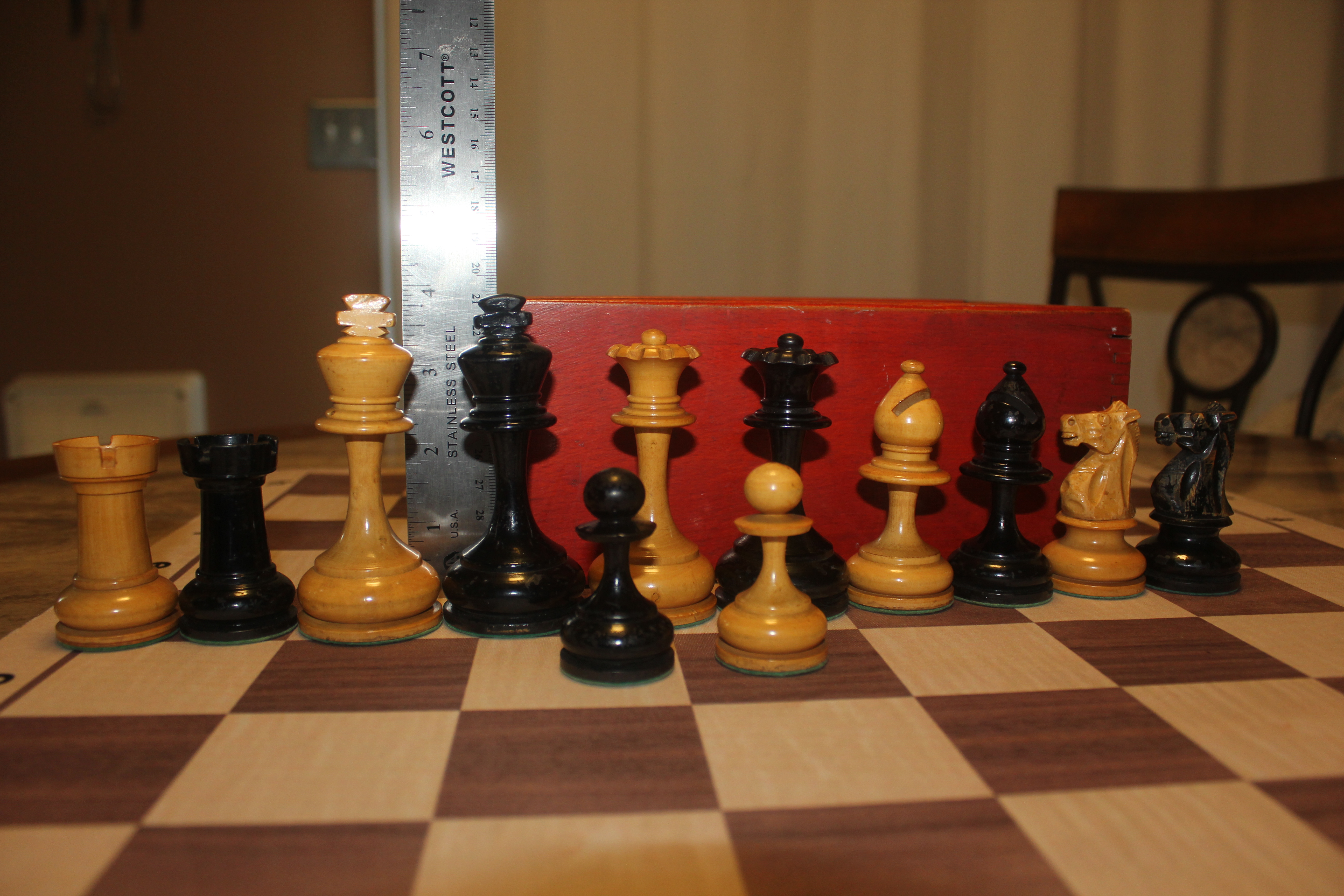
Two chess sets in my possession have raised questions. When were they made? By whom?

After several years of attending estate sales at Owen’s Auction and seeing many chess sets, I bid on one. It  differed somewhat from familiar sets, but remained within the general Staunton pattern required for tournament play. It became mine. That was 2018. I have told people it was made in the 1960s, although I had no evidence for the statement.

In mid-July this year, it was set-up on a library table as I waited for my opponent for the Spokane Contenders Tournament. I posted a photo to “Post Your Chess Sets” on chess.com. Another poster identified it as resembling sets made in the 1930s and 1940s, much older than I had imagined. He said he had a similar set and had been interested in mid-century French sets for several years. The wide bases and narrow stems of my set are uncommon, I learned.

That evening, my wife and I sat on the patio and put our phones to work as we conducted research. There were several lines of inquiry and my pursuit continued a couple of days. I conversed with the poster who had a similar set. He shared some useful links to research on chess sets. One link identified the set’s box as having been used by Lardy in the 1930s: “Chess Boxes” at The Chess Museum.

Under the tissue paper inside the box were four newspaper clippings with five chess games. These games were played September 1937 to August 1938. The games are Keres, P.—Reshevsky, S., Semmering/Baden 1937; Euwe,M—Alekhine,A., rd. 21, Amsterdam 1937; two games from the US Championship in April 1938: Fine,R.—Shainswit,G. and Simonson,A.—Suesman,W.; and MacMurray,D.—Platz,J., Cazenova, 1938, played at the NY State Chess Association Championship.

World Chess Championship 1937, Game 21

On the back side of game 21 between Max Euwe and Alexander Alekhine in the World Chess Championship was a notice of a wedding that took place. Pursuing wedding details provided a location for the newspaper itself—New York City. In the New York Times I found an announcement of the engagement that led to the wedding. That article identified the groom as a stockbroker. Also easily located in other  articles were some biographical details about the bride’s parents.

It seems reasonable to conclude that someone who owned this chess set clipped and saved these games, which all seem to me worthy of study. Likely, it was the set’s first owner. I believe the set may have been sold new in 1937 in New York City. The set had been imported from France. Of course, there is plenty of uncertainty.

There are no clues to the set’s subsequent journey after August 1938, but there should be no doubt that it has been well-used. All the pieces show signs of wear. It is most apparent on the Black knights.

Coming to terms with the age of the set, I wanted a newer old French set. My bidding on one advertised as a French Lardy set was successful and it arrived Saturday evening, 22 July.


I shared photos of the new set on “Post Your Chess Sets”, which provoked the expected discussion. One poster has a set that appears very similar and has been identified as a Chavet set, rather than Lardy.  Another agreed that it appeared to be a Chavet. Both directed me towards other threads with a great deal of detail concerning Chavet chess sets. I spent Sunday morning reading these threads.

The longest thread, “Chavet N° 8” made clear to me why others regard Walterbiensur as a trusted resource and authority concerning Chavet chess sets. He has posted images of many primary sources, is himself a collector of these sets, and his own quest to learn more is ongoing. Walter identified the set most like mine as Chavet. For now, that’s the best information that I have.

Most Chavet knights clearly differ from those in my new set, but one thread has a 1932 catalog from Chavet with a similar knight. There are a small number of others known to be Chavet sets with similar knights. The poster with a set close to mine drew attention to the relative heights of the base and the carved head. Lardy sets have a higher base, he wrote.

My inquiry has just begun.

In the meantime, the new set appears newer, sturdier, and less fragile than my 1937 set. It now resides in my tournament bag.


10 June 2022

A Study Position

How does a position reached in a game played many years ago become an important study position?

Consider a position from Euwe -- Smyslov, Moscow 1948. The game was played in the fourteenth round of the five-player world chess championship to determine the successor to Alexander Alekhine. Max Euwe finished in last place, winning only this single game.

White to move
In Paul Keres, World Chess Championship 1948 (1949), the author criticizes Euwe's move from this position, 27.Qe3. Euwe's position is so strong that this move "assures him of an easy win." But, "he misses the worthy finishing combination ... which would immediately have forced Black to resign" (332).

This position appears as number 1 in Thomas Engqvist, 300 Most Important Tactical Positions (2020). The first 27 positions in the book highlight five basic tactical ideas--"tricks" is Engqvist's term. The first three positions, the writer tells us, are "from top level chess where one highly qualified player missed a fork at a certain point. It pays to study positions where a strong player missed a tactical solution" (13).

Engqvist mentions that Keres gave the move played in the game a question mark, offers Keres' improvement, and also discusses a second alternative to the text move.

11 July 2020

On the Origin: Reading Journal

Some books are to be tasted, others to be swallowed, and some few to be chewed and digested; that is, some books are to be read only in parts; others to be read, but not curiously; and some few to be read wholly, and with diligence and attention.
Francis Bacon, "Of Studies" (1625)
Willy Hendriks, On the Origin of Good Moves (2020) arrived yesterday. I spent an hour last night and a bit more than an hour this morning leafing through the whole book, reading a few pages here and there. Then I reread the chapter on Greco. I had read the Kindle sample in June after Brian Karen asked me about this book in reference to my post on the Chess Book Collectors's Facebook page concerning Peter J. Monté, The Classical Era of Modern Chess (2014). Do look at "Monumental Scholarship: Notes Toward a Book Review" for my initial assessment of Monté's text. Hendriks' book looked interesting, so I preordered the paperback. It shipped Tuesday on the date listed by Amazon as the publication date.

Although I use almost every one of my nearly 400 chess books principally as reference works and rarely read one all the way through, On the Origin of Good Moves may join the small rank of exceptions. In order to encourage myself to keep at it, this post begins a reading journal on my progress.

Hendriks has an ambitious agenda to challenge the common notion that William Steinitz initiated the modern notions of positional play. This myth, he argues, is the work of Emanuel Lasker. He states that he wanted to write a whodunnit, but self-deprecates his writing abilities and so identifies the culprit immediately (10). Even so, Hendriks's take concerning the development of chess history is about the details more than the plot.

He also begins by noting the recapitulation theory of chess development offered by Max Euwe, Garry Kasparov, and others. I summarized this view in my 2013 workbook for students in my summer chess camp, "Dragon Chess Camp 2013: Learning from the First Chess Masters":
No one is born a chess master. Euwe suggests that an individual player's growth from beginner to master follows the pattern of chess history. First players learn to play like Greco. Then, as Philidor, they discover the importance of pawns and begin to think positionally. Individual growth moves through attacking play in the style of Adolph Anderssen and Paul Morphy to learning to accumulate small advantages in the manner of Wilhelm Steinitz. (26)
I went on from there, but this excerpt serves to illustrate that I have found Euwe's concept compelling at least pedagogically. Hendriks correctly links the recapitulation theory to Ernst Haeckel: "ontogeny recapitulates phylogeny" (9, 411). The structure of On the Origin of Good Moves--a title clearly derived from Charles Darwin, On the Origin of Species by Means of Natural Selection, or the Preservation of Favoured Races in the Struggle for Life (1859)--follows the pattern evident in Euwe, The Development of Chess Style (1968), but in a manner that interrogates with skepticism the central claims that have been advanced by many chess writers along the way.

Journal: "Footnotes to Greco"
The safest general characterization of the European philosophical tradition is that it consists of a series of footnotes to Plato.
Alfred North Whitehead (1979)
Hendriks notes that Greco has not received the same honor given to Plato that all of chess theory is a series of footnotes to his original work, although a few months ago I wrote, partly in jest, in a chess forum, "Greco is the originator; all others are imitators." I have taken the work of Greco seriously for some time, found Euwe's annotations of two Greco games useful and inspiring, have played at least three games online that almost wholly follow one of Greco's masterpieces (see "Near Perfect"), and have been convinced since at least 2013 that the best parts of Greco remain unknown to most chess players.

As I had read Hendriks' chapters on Greco several weeks ago, it should not be surprising that I scored 100% on the two quizzes from Greco's games this morning. I missed the second one, however, in June because I chose Greco's move and Hendriks was looking for the improvement. When I took that quiz in June, the game from which exercise 2 was extracted had been part of my lesson with my chess students the previous week. However, I was using a version of the game that was not in any databases, but can be found in Francis Beale's 1656 text. Chessgames.com has it now because I submitted it after researching the game score in Monté. In June, I finished a project of entering all 94 of Beale's selections from Greco into a database.

Black to move

This position appears in five games in ChessBase Mega 2020. Four are Greco's games. 10...Kd7 appears in two Greco games in the database, 10...Kd8 appears in one, and as Hendriks notes, 10...Kf8 appears in one of Greco's games in the database (19-20). The position after 10...Kf8 is Hendriks second exercise. In this one, and one in the second set, Greco's move is not the best move.

The version of the game given by Hendriks ended with checkmate in 14 moves. The version of the game in Beale, however, continues with much more stubborn defense. Monté's research reveals that the better game appears in several of the London manuscripts created in 1623 by Greco. The better version also appears in William Lewis, Gioachino Greco on the Game of Chess (1819).

All this is to say that Hendriks' historical questions differ from mine. While I can spend many hours tracking down minutiae through original sources, or secondary works that are grounded is such sources, Hendriks builds his assessment of Greco on readily available databases. What do Greco's games offer the aspiring chess player? More than he usually gets credit for, Hendriks argues.

Despite approaching work on Greco from a somewhat different perspective regarding the nature of historical research, I am encouraged by the assessment in On the Origin of Good Moves: "Greco's legacy is really impressive" (23). I agree.

There are two chapters and two quizzes on Greco in Hendriks's book. This position is number 8--the second exercise for chapter 2: "The Nimzowitsch of the 17th Century" (27-38).

Black to move

This position is from Greco's longest game, and one of the few that Hendriks thinks might represent actual play. His annotations on this game are brief but highlight the critical point: Philidor's reputation for discovering the importance of the pawns is but a footnote to Greco.


20 January 2020

Study Position

A new book arrived Saturday and I spent some time going through the first game. Paul Keres, World Chess Championship 1948 (2016 [1949]) is an old classic now available in English. It was sent to me because I solved a chess history exercise on the cover of Chess Life (December 2019).  Keres had Black against Max Euwe in the first round. He was losing, according to his annotations, until Euwe failed to find the correct plan from this position.

White to move


Stockfish does not agree with Keres' assessment of the position. What should we make of his analysis if the computer disagrees?

17 August 2019

An Exercise

This week's lessons with my chess students have focused on queenside pawn majorities. We look at a couple of games played by Mikhail Botvinnik, an endgame that Seigbert Tarrasch blew against Emanuel Lasker, and this position that I created.

White to move

We start with the pawn exercise, and I do not initially tell the student who is to move, nor our theme concerning queenside pawn majorities. If the student thinks the position is equal, I play White. If they think one side is winning, they get that side and get to move first.

Try it against a friend or your computer.

Then, Lasker -- Tarrasch, St. Petersburg 1914.

Black to move

We play it out. I take White.

Then we look at Botvinnik -- Kmoch, Leningrad 1934 and Botvinnik -- Konstantinopolsky, Sverdlovsk 1943. If enough time remains, we go over a game that I played a few years ago (see "Excelling at Technical Chess").

The lesson and much of its content was inspired by Max Euwe, Judgement and Planning in Chess (1953).


07 April 2017

Bogoljubov -- Alekhine, Hastings 1922

Alexander Alekhine gave up three queens to beat Efim Bogoljubow in their last round game at Hastings Six Masters in 1922. The game featured some spectacular tactics and a textbook finish with a near zugzwang position giving way to an elementary pawn ending. Many chess enthusiasts consider it one of  the greatest games ever played. I included it among my ten candidates in the list created for my Spring Break Chess Camp class on the subject of the best game ever played.

Alekhine needed a win to finish first in the tournament as he was tied with Akiva Rubinstein going into the last round. This need drove his choice of the Dutch Defense, which he characterized as risky. Many recent accounts of this game confuse this event, held September 1922, with the Hastings International Chess Congress, held December 1922 -- January 1923. Rubinstein won the latter. Alekhine did not participate. The Six Masters event was a double round robin featuring two British masters--George A. Thomas and Frederick Yates--and four of the leading masters from outside Britain--Alekhine, Rubinstein, Seigbert Tarrasch, and Efim Bogoljubow.

The round-by-round results with links to the games are posted on Chessgames.com. I looked at crosstables for this event and for the Hastings Chess Congress in John Donaldson, and Nikolay Minev, The Life and Games of Akiva Rubinstein, vol. 2: the Later Years, 2nd. ed. (2011).

A. Alekhine from Wikimedia Commons*
Alekhine considers this game against Bogoljubow, alongside his win against Richard Reti (Baden-Baden 1925), as "the most brilliant wins of [his] chess career" (Alekhine, My Best Games of Chess, 1924-1937 [1965], 13). Irving Chernev also calls this game, "the most brilliant game ever played" (The Most Instructive Games of Chess Ever Played [1965], 67). Chernev annotates this game in The Chess Companion (1968) and in Twelve Great Players and Their Best Games (1976). The former is quoted on the website Master Chess Open:
Alekhine's subtle strategy involves manoeuvres which encompass the entire chessboard as a battlefield. There are exciting plots and counterplots. There are fascinating combinations and brilliant sacrifices of Queens and Rooks. There are two remarkable promotions of Pawns and a third in the offing, before White decides to capitulate.
Chernev, The Chess Companion (as quoted at Master Chess Open).
Andrew Soltis lists this game as number four in The 100 Best Chess Games of the 20th Century, Ranked (2006).

Despite such praise, Bogoljubow -- Alekhine, Hastings 1922 is absent from Graham Burgess, John Nunn, and John Emms, The World's Greatest Chess Games (1998). Burgess does include it in Chess Highlights of the 20th Century (2000), but that book contains 270 games. The editors of The World's Greatest Chess Games carefully culled their list to one hundred. Their criteria were:
Quality and brilliance of play by both contestants.
Historical value.
Historical significance.
Burgess, Nunn, and Emms (1998), 7.
Bogoljubow's play falls short of this standard. He makes several positional errors in the opening and middle game, which Alekhine then exploits brilliantly. Even then, however, Alekhine may have eschewed the clearest path to victory in favor of artistic chess.

Annotations to this game are found in many books, websites, and YouTube videos. Most annotators start with Alekhine's own comments in My Best Games of Chess, 1908-1923 (1927) or in W.H. Watts, The Book of the Hastings International Masters' Chess Tournament 1922 (1924). A. J. Goldsby offers detailed annotations on his website and also a YouTube video. While going through this game, I studied annotations in S. Tartakower, and J. DuMont, 500 Master Games of Chess (1975); Max Euwe, From Steinitz to Fischer (1976); and Garry Kasparov, My Great Predecessors, Part 1 (2003). The game without annotations is included in Rashid Ziyatdinov, GM-RAM: Essential Grandmaster Knowledge (2000), which I mention frequently on Chess Skills. There are three middlegame positions in GM-RAM from this game.

In my annotations, I aim to highlight the critical moments of this game, rather than creating a compendium of all that has been said by others.


Bogoljubow,Efim -- Alekhine,Alexander [A90]
Hastings Six Masters, Hastings, 21 September 1922

1.d4 f5 2.c4 Nf6 3.g3 e6 4.Bg2 Bb4+ 5.Bd2 Bxd2+ 6.Nxd2

6.Qxd2 offers White much better prospects. This game well-illustrates how this capture leads to a misplaced knight and reduces White's influence in the center. As long as this knight stands on d2 it prevents White's rooks from controlling the d-file and it stands as a potential target should Bogoljubow seek exchanges in the center. Tartakower suggests 6.Qxd2 and Nc3. Kasparov concurs.

6...Nc6 7.Ngf3 0–0 8.0–0 d6 9.Qb3 Kh8

White to move

While running a youth chess tournament at the end of our Spring Break Camp, I spent my idle moments going through this game. The position in the diagram above was on my board for much of the day. I asked many of the youth players and coaches whether they agreed with Alekhine's assessment that Black already has the upper hand. The first youth to face this question suggested 10.d5 and thought White was better. Tartakower also prefers 10.d5 to the move Bogoljubow played in the game.

Black's queen knight on c6 is more active than its counterpart on d2. White's queen is temporarily more mobile than Black's, but knowing how the game continued makes it hard to evaluate the position objectively. Black's queen proved to have more influence in the game. Perhaps the White queen is somewhat misplaced on the queenside. White's rooks are connected. Many youth players suggested that White has a lead in development and cannot be worse.

Alekhine annotated this game from the perspective of having won a brilliant victory. He might not have been particularly objective in his assessment of the game up to this point. We know that Black's queen made a foray to the kingside, where it provoked weaknesses, then returned to e8 to support action in the center and on the queenside. From the standpoint of the game's whole, Black's queen proved much more flexible and effective.

After 9.Qb3, Alekhine wrote, "This manoeuvre does not prevent Black from realising his plan, but it is already difficult to suggest a satisfactory line of play for White (Alexander Alekhine's Best Games [2012], eBook, loc 2665). Presumably, it is this comment that Euwe translated into the Informant symbol for Black has the upper hand in From Steinitz to Fischer. But, it seems to me that Alekhine might be annotating by result.

Tartakower and DuMont, 500 Master Games of Chess offer several improvements to White's play over the next several moves. Most of these suggestions are repeated by Kasparov in My Great Predecessors. I think the game is still balanced at this point, but that Black has a clear edge after move 18. Kasparov quotes Alekhine's "already difficult ... for White," adding "Why?"

10.Qc3

After 10.d5, Kasparov offers two lines that the young players and I examined at the youth tournament.

10...Na5 11.Qc3 c5
10...exd5 11.cxd5 Ne7

In both cases, it does not seem that Black has an advantage. Kasparov states, "Black would have faced a thankless defence" (365).

10...e5 11.e3

Alekhine points out the vulnerability of White's knight on d2. If 11.dxe5 dxe5 12.Nxe5 Nxe5 13.Qxe5 and the knight on d2 is en prise. Tartakower, Euwe, and Kasparov all repeat this line.

11...a5

Upon seeing this move, I might agree that Black has a slight edge after White's failure to play 10.d5.

White to move

12.b3 Qe8 13.a3 Qh5

At this point, Kasparov quotes Alexander Kotov, "The start of a deep strategic plan. First of all Black creates threats on the kingside and provokes a weakening of the opponents pawns" (Kasparov, 365).

A defect of My Great Predecessors is the absence of documentation. The whole series is full of quotes from other chess writers. Parts IV and V offer bibliographies, but not the sort of documentation that is desirable for a work that is so much a digest of the work of others. The first three parts offer less.

Kotov wrote several books about Alekhine in Russian (I saw the number six somewhere). One book exists in English, put out by R.H.M. Press: Alexander Kotov, Alexander Alekhine, tran. K. P. Neat (1975). I am tempted to buy this book. There are used copies floating about, and also an Ishi Press reprint.

14.h4

Alekhine writes, "A good defensive move, which secures new squares for his f3-knight and revived the threat of 15.dxe5" (loc 2682). I do not see why 14.dxe5 was not possible. Tartakower rejects it because after 14...dxe5 15.Nxe5 drops a piece. It seems to me that White could open the center and does not need to follow-up by blundering away a knight. The h2-h4 push can be played later.

I considered 14.Rab1 to support b3-b4. The immediate 14.b3-b4 drops a pawn because after 14...e4 15.Ne1, the rook is skewered through White's a-pawn.

14...Ng4 15.Ng5 Bd7

White to move

16.f3

Alekhine sought to provoke a weakening of White's kingside, and did so. But, Bogoljubow might have been a little too cooperative. I am tempted to regard 16.f3 as a mistake. Alekhine suggested in comments to 15.Ng5 that 15.b4 was preferable. Kasparov repeats Alekhine's suggestion.

Here Alekhine offers a tactical line that is even worse for White: 16.Bxc6 Bxc6 17.f3 exd4 18.fxg4 dxc3 19.gxh5 cxd2 with a better endgame for Black.

16...Nf6 17.f4

Black threatened 17...f4, which would have pried open White's pawn shield.

e4 18.Rfd1

18.d5 was White's last chance to be slightly worse.

18...h6 19.Nh3 d5

White to move

Black clearly has the upper hand now, in my view. Where did White fail? On moves 10-18, Bogoljubow had several opportunities to open the center and possibly create a balanced struggle. He opted instead to close the kingside and close the center. As a consequence, his pieces lost their mobility and became passive. His long-term plan seemed oriented towards action on the queenside, but the game's subsequent course revealed surprising resources for Black there.

Kasparov offers another juicy quote from Kotov, which highlights the success of Alekhine's long-term strategic plan. Kasparov's note preceding the game highlights the centrality of Kotov's commentary.
The last of the wins is one of the most grandiose Alekhine canvases. It once again shows that his amazing combinations did not arise out of thin air, but were the fruit of very deep strategic preparation.
Kasparov, My Great Predecessors, 364.
20.Nf1

This position is the first of the three in GM-RAM from this game.

Ne7 21.a4

This position is the second in GM-RAM from this game.

Now, Boguljubow weakens his queenside, offering Black a nice outpost for his knight. Could he have tried to close matters there, too, and then hunkered down inside a fortress? To wit, 21.c5 Qg6 22.Qe1 Neg8 23.Kh2 Nh5 24.Ng1 Ngf6. White has no play, but how will Black break through?

21...Nc6 22.Rd2 Nb4 23.Bh1

This bishop could be useful preventing Black's knight for employing d3 as an outpost. Alas, there is no way to maneuver the bishop to such a useful square so long as the knight on f1 must guard the weak g-pawn. Perhaps White could redeploy his knights to h1 and h2 to guard g3 and g4? Surely, that would offer Black some opportunities elsewhere on the board.

Maybe 23.c5 is no worse than White's other choices. the tension between c4 and d5 only benefits Black. 23.cxd5 looks suicidal.

23...Qe8!

White to move

Now, c4-c5 is not possible due to b6. The problems with 24.cxd5 are worse than before.

24.Rg2 dxc4 25.bxc4 Bxa4

Alekhine has won a pawn. More significant than the pawn, however, is the preponderance of force for Black on the queenside as things open up. Half of White's army is sitting in the bleachers with their monarch, watching the game.

26.Nf2 Bd7 27.Nd2 b5 28.Nd1 Nd3

Alekine rejected 28...bxc4 because it would bring a White knight to e5.

29.Rxa5

White has won back the pawn, but his position is now much worse than it was a few moves ago. Now the game enters the phase where Alekhine's flashy tactical brilliance shines. Black has several ways to win, but the manner he chose elevates this game in the opinions of many chess students.

29.cxb5 and Alekhine offers 29...Bxb5 30.Rxa5 Nd5 31.Qa3 Rxa5 32.Qxa5 Qc6 with a winning attack for Black.

Black to move

29...b4! 30.Rxa8

Ziyatdinov's third position in GM-RAM from this game has now been reached.

30...bxc3!! 

This brilliant move was not necessary to win. 30...Qxa8 31.Qb3 (Alekhine's suggestion) 31...Qa1 (Kasparov's improvement over Alekhine's 31...Ba4) 32.Qb1 Ra8 and Black has a technical win.

31.Rxe8 c2 

The point of Black's last few moves.

32.Rxf8+ Kh7 33.Nf2 c1Q+ 34.Nf1 Ne1

Threatening smother checkmate.

35.Rh2 Qxc4 36.Rb8 Bb5 37.Rxb5 Qxb5

White's moves 30-37 are the computer's top choice. Alternatives lose much quicker.

White to move

38.g4 Nf3+ 39.Bxf3 exf3 40.gxf5 Qe2

White to move

What can White do? He is in zugzwang. Pawn moves delay the end.

41.d5

41.Nh1 Ng4 42.Rxe2 fxe2 and after sacrificing two queens. Black will gain one more to sacrifice.

41...Kg8 42.h5 Kh7 43.e4

Now White's remain pawn moves lose pawns.

43...Nxe4 44.Nxe4 Qxe4

White to move

45.d6 cxd6 46.f6 gxf6 47.Rd2 Qe2

Alekhine threatens checkmate in one.

48.Rxe2 fxe2 49.Kf2 exf1Q+

Alekhine's third queen sacrifice in this game.

50.Kxf1 Kg7 51.Kf2 Kf7 52.Ke3 Ke6 53.Ke4 d5+ 0–1

There is not much to criticize in Bogoljubow's moves after about move 20. But, his inaccurate play in the early game deprives this game of some of its merit. Alekhine's strategic preparation and tactical execution deserve study.


*George Grantham Bain Collection (Library of Congress) derivative work: Jesus Angel Rey, Public Domain, https://commons.wikimedia.org/w/index.php?curid=16985493.

17 May 2016

Materialism

Two Miniatures

Max Euwe describes the games of Gioachino Greco as "chess fairy-tales on the age-old theme of the conflict between riches and honour" (The Development of Chess Style [1966], 1). One side grabs material while the other plays for checkmate.

In early April, I played a game that might have been lifted from the pages of Greco. I knew when my opponent grabbed my rook on a1 that I would either gain the queen in exchange or win by checkmate.

Stripes, J (1876) -- Internet Opponent (1870) [C54]
Live Chess Chess.com, 05.04.2016

1.e4 e5 2.Nf3 Nc6 3.Bc4 Bc5 4.c3 Nf6 5.d4 exd4 6.cxd4 Bb4+ 7.Nc3 

This opening is known as the Greco Gambit.

7.Bd2 is considered a better way to block the check. In blitz, however, I prefer the reckless gambit approach.

7.Nbd2 Nxe4 8.d5 Nxd2 9.Bxd2 Bxd2+ 10.Qxd2 Ne7 11.d6 cxd6 12.0–0 d5 13.Bxd5 0–0 14.Rad1 Nxd5 15.Qxd5 d6 16.Qxd6 Qxd6 17.Rxd6 Be6 18.a3 Rfd8 19.Rd4 Rxd4 20.Nxd4 Rd8 21.Rd1 f6 22.f3 Kf7 23.Kf2 Rd5 24.Ke3 Re5+ 25.Kd3 Rc5 26.Re1 Bd7 27.Kd2 Rd5 28.Kc3 Rc5+ 29.Kd2 Rd5 30.Kc3 Rc5+ 31.Kd2 ½–½ Nakamura,H (2799) -- Giri,A (2776) Khanty-Mansiysk 2015

7...Nxe4 8.0–0 Nxc3

8...Bxc3 is better.

9.bxc3

Black to move

9...Bxc3 

9...d5 may be best.

10.Qb3 Bxa1?? 

Now, Black is lost.

10...d5 11.Bxd5 0–0 and White is only slightly better.

11.Bxf7+ Kf8 12.Bg5 Ne7 13.Ne5

13.Re1 d6 14.Bxe7+ Qxe7 15.Rxe7 Kxe7 16.Bg8

Black to move

13...d5

13...Bxd4 14.Bg6 d5 15.Qf3+ Bf5 16.Bxf5 Bxe5 17.Be6+ Bf6 18.Bxf6 Ke8 19.Bxg7 1–0 Greco,G-Analysis 1625.

14.Qf3 Bxd4N 

Two other games in ChessBase's database continued 14...Bf5 15.Be6 Bxd4 16.Bxf5 Ng8 (16...Bxe5 17.Be6+ Nf5 18.Bxd8) 17.Bxd8.

15.Be6+ Ke8 

15...Nf5 is more stubborn.

16.Qxf5+ Qf6 17.Bxf6 g6 18.Nxg6+ hxg6 19.Qxg6.

16.Qf7# 1–0


Then, yesterday morning, I won another quick game when my opponent grabbed a rook instead of protecting his king. This game, although completely different in opening plans and structure, is linked to Greco's via the mating attack that follows a materialistic rook grab.


Stripes,J (2083) -- Internet Opponent (2107) [A80]
Another Chess Site, 16.05.2016

1.d4 f5 2.Nc3 Nf6 3.Bg5 e6 4.e4

I have played this line in correspondence chess and over-the-board. See "Staunton Gambit".

4...fxe4 5.Nxe4 Be7 6.Bxf6 Bxf6 7.Qh5+

7.Nf3 is popular among strong players.

7...g6 8.Qh6 Qe7 9.Nxf6+ Qxf6 

White to move

10.h4?N 

10.Nf3 seems necessary.

10...Qxd4 11.Nf3 Qxb2 12.Rd1 Qxc2

12...Qb4+ 13.Rd2 Qf8 14.Qg5 White has minimal compensation for the pawns.

13.Bd3 Qc3+ 14.Rd2

Black to move

14...Qc1+?

Black wins material, but disregards the safety of his king.

14...Nc6 and Black is better.

15.Ke2

Only move, but leads to a clear advantage.

15.Rd1 Qxh6 and White can resign.

15...Qxh1??

15...Qc3 was the last chance. 16.h5±.

White to move

16.Bxg6+ 

White has a decisive advantage.

16...hxg6 

16...Kd8 17.Qg5#.

16...Ke7 17.Qg7+ Kd8 18.Qf6#.

17.Qxh8+ Kf7

17...Ke7 is best, although White has a forced checkmate in thirteen: 18.Qg7+ Ke8 19.Ne5 c5 20.Qf7+ Kd8 21.Qf8+ Kc7 22.Qxc5+ Nc6 23.Qd6+ Kd8 24.Nxd7 Qh2 25.g3 Nb8 26.Nf6+ Bd7 27.Rc2 Qxf2+ 28.Kxf2 e5 29.Qf8+ Be8 30.Qxe8#.

18.Ng5+ Ke7 19.Qg7+ Kd8 

19...Ke8 20.Qf7+ Kd8 21.Qf8#.

20.Qf8# 1–0

Sometimes it is best to play for a material advantage, but not when the king is vulnerable.

30 April 2016

Vulnerability

In The Road to Chess Mastery (1966) by Max Euwe and Walter Meiden, the authors criticize Black's 25...d5, which led to the following position.

White to move

How does White exploit the error?

23 April 2016

The Bishop Pair

This position arose in a game presented as master vs. amateur in The Road to Chess Mastery (1966) by Max Euwe and Walter Meiden.

White to move

How would you play this position as White? Why?

07 July 2015

The Spirit of Greco

Should aspiring chess players study the games of players who have been dead for more than a century? In an interview conducted while he was World Champion, Vladimir Kramnik answered in the affirmative.
I think that if a player wants to achieve much, he should live through the entire history of chess in his thoughts. I can't explain it from a purely logical standpoint, but in my opinion, you have to experience the entire history.
Vladimir Kramnik, 2004*
The interviewer probed further, asking whether it was useful to go back as far as Gioachino Greco. Kramnik did not think Greco was necessary because Greco's games are only the basics of chess, but he thought aspiring players should know the games of Philidor, Anderssen, and Morphy.

Max Euwe expressed a similar view of the importance of chess history. He asserted in The Development of Chess Style (1966) that an individual player's development and chess history follow parallel courses. The longest and most difficult is the first stage, which Euwe characterizes as "excursions with the pieces" (1). Players succeed when they take advantage of the opportunities presented by opponents, "such as winning a piece" (1). Greco embodies this first stage, he suggests.

Euwe annotates two of Greco's games. In another 300+ volumes in my library, I look in vain for annotations of Greco's games. Several books make passing reference to his collections, usually by noting that some tactical idea or opening move "has been known since Greco." Garry Kasparov, My Great Predecessors, Part I (2003) is a notable exception. On the first page of chapter 1, he presents a synopsis of Euwe's argument (without attribution) and four Greco games. In two of the games, he offers a small number of suggested improvements. But Kasparov offers no verbal annotations, no detailed analysis.

Euwe also offers one game by Andre Philidor. Philidor's games, too, are mostly absent from other books. In Philidor's case, however, many more writers mention his contribution towards understanding the centrality of pawns to chess strategy. Kasparov offers one game fragment from Philidor with annotations. His views align well with Kramnik's concerning the merits of Philidor.

Last week, however, DHL brought an exciting new book hot off the presses that offers fresh annotations of the second of the two Greco games featured in Euwe's classic. This new book is Chess Informant 124. In this volume is the tenth installment of Mihail Marin's column, "Old Wine in New Bottles."**

Marin sets out to contextualize the explosion of information that we observe in this era of computers. He challenges a common belief that this explosion is without precedent. He recalls similar claims in opening monographs of the 1970s and 1980s. Even the first systematic opening reference, Handbuch des Schachspiels (1843) describes an explosion of information in its day.

Marin does not stop at simply challenging perceptions that our age is unique due to a massive increase in the information available to us. He also traces the development of new ideas with the point of showing that they are not so new after all. Tracing the continuities between old and new offers an affirmation of the value of studying classic games.
In every game, there comes a moment when a novelty inevitably pops up, but one cannot be sure that the idea behind it has not been played before.
Mihail Marin, Informant 124, 82.
Marin's focus in Informant 124 is the Italian Opening, particularly the Giuoco Fortissimo. He begins with Nakamura -- Giri, Khanty-Mansiysk 2015.

1.e4 e5 2.Nf3 Nc6 3.Bc4 Bc5 4.c3 Nf6 5.d4 exd4 6.cxd4 Bb4+

White must either Block the check or move his king. Greco blocked with 7.Nc3 and these days 7.Bd2 is preferred. Nakamura, however, played a relatively rare move: 7.Nbd2, which sacrifices a pawn. I can find approximately one hundred instances of this move in my database.

Black to move

After 7...Nxe4, Nakamura shows that he is playing in the spirit of Greco with 8.d5, "fighting for space and an advance in development" (83).

After Nakamura -- Giri, Marin offers analysis of one of Greco's best games. Then, there is another game from Khanty-Mansiysk. Jobava -- Grischuk featured 6.e5 d5, which the author notes is reminiscent of several games played by Morphy and Anderssen. Jobava repeated his opening experiment in a later round of the same event, and Marin refers readers to the column by Sarunas Sulskis, where that game in analyzed in depth.

"Old Wine in New Bottles" continues with an instructive game when Marin lost on the Black side of the not so quiet Italian Game, and then a World Championship game where Karpov employed the quieter line with 5.d3 for the purpose of torturing Korchnoi. But this quieter line still permitted fortissimo in Bologan -- Marin, Bucharest 1990 (a friendly blitz game). Marin finishes the article with a third game of his own and then Dubois -- Steinitz, London 1862, which had been one of my study games a few months ago (see "Some Miniatures").

Marin's column offers a good mix of old and new, of famous games and those less well-known. His ongoing column builds the logical argument that Kramnik deferred in his 2004 interview.


*The interview in Russian in available at e3e5.com. There are several English translations online. Because the English is smoother, I have employed the one posted by Spektrowski on Chess.com.

**Marin's column first appeared in Informant 114 and has appeared in every issue except 121 since.

11 March 2015

Hitting the Books

Context

A distinctive element of GM-RAM: Essential Grandmaster Knowledge (2000) draws in some readers and pushes many others away. Rashid Ziyatdinov's book contains diagrams without analysis. The author explains that the book is more of an exam than an instructional book. As such, it is an open book exam that can be taken and retaken until the desired score is achieved. Co-author Peter Dyson suggests that GM-RAM, "can be thought of as both a study outline and as an evaluation tool" (9).

Fifty-nine "classic games" are the source for 120 middlegame positions. Ziyatdinov addresses the definition of "classic". Games are not classic merely because they were played a long time ago. The games in GM-RAM:
...have been analyzed in great detail by many strong players from different periods, different schools of chess, and different ages and generations. It is only after a game has withstood these many different perspectives--these "tests of time"--that it can be considered a classic. (77)
Ziyatdinov directs his readers to analysis of these games by other writers. Alternately, he writes, "a chess trainer can help teach the necessary knowledge" (13). He provides a list of references. This list offers a secondary curriculum. Most, if not all, of the the endgame positions in GM-RAM can be found in Yuri Averbakh's Comprehensive Chess Endings, which comprises the bulk of the texts listed for endgame study.

The middlegame books listed are another matter. Most of the games are from the nineteenth century, but the recommended middlegame books include the two volumes of My Best Games of Chess by Alexander Alekhine; and Bobby Fischer, My 60 Memorable Games. Also listed are Averbakh, Chess Middlegames: Essential Knowledge; Paul Keres, and Alexander Kotov, The Art of the Middle Game; and Hans Kmoch, Pawn Power in Chess. There is minimal analysis of the games of Adolf Anderssen and Paul Morphy in these books.

Practice

For the past few months, I have been systematically working through Ziyatdinov's fifty-nine games at the rate of one each week. This past week, my game has been Bird -- Morphy, London 1858 (chessgames.com link). I have not done well on my study of this game. The week has been filled with activities that interfere with personal study, and an exciting new book arrived as well, Encyclopedia of Chess Combinations, 5th ed. (2014), putting my chess study time on another course. Hence, my study of this game will carry over another week. I will press on, though, adding this week's game: Morphy's Opera Game.

I have print editions of three good books on Paul Morphy: Philip W. Sergeant, Morphy's Games of Chess (1957); Macon Shibut, Paul Morphy and the Evolution of Chess Theory (2004); and Valeri Beim, Paul Morphy: A Modern Perspective (2005). In addition, I have the Kindle edition of David Lawson, Paul Morphy: The Pride and Sorrow of Chess, new. ed. (2010) and access to older books, such as Frederick M. Edge's 1859 Paul Morphy: The Chess Champion, via GoogleBooks. Other books that contain analysis of Bird -- Morphy include Garry Kasparov, My Great Predecessors, part I (2003); and Max Euwe, The Development of Chess Style (1968).

Kasparov's book offers a good entry point to the most important historical analysis and sometimes modern computer evaluation of this analysis. It behooves me to invest the time to work through the analysis of this week's and last week's games in all of these books.

Analysis

Ziyatdinov's GM-RAM contains two essential middlegame positions from Bird -- Morphy. These are separated by a single move. The positions are before 17...Rxf2 and after 17...Rxf2 18.Bxf2. Studying Kasparov's analysis last night focused my attention much earlier in the game.

White to move
After 5...d5
Kasparov credits Johannes Zukertort with having pointed out the improvement from this position that refutes Morphy's dubious opening choice. Bird could have gained an advantage had he properly applied knowledge from the ancient work of Pedro Damiano.

Euwe does not offer a source, but notes, "Nowadays it is known that the answer to Black's chosen variation is 6.Nxe5! dxe4 7.Qh5+, White getting an irresistable attack in return for the sacrificed piece" (29).

15 April 2013

A Small Library

In an important text that is not pictured here, Max Euwe opined:
The development of a chess player runs parallel with that of chess itself; a study of the history of playing methods therefore has great practical value.
The Development of Chess Style (1968), n.p.
Euwe's notion that growth in individual chess skill follows a pattern that parallels historic development often occupies my thoughts. It forms part of my rationale for favoring nineteenth and early-twentieth century games as a principal source for the lessons I develop for young players. It keeps me going back to the classics for my own skill development.

Culled from a much larger collection of chess books, these ten books as a body emphasize the development and practice of positional chess at the beginning of what came to be called the Modern School or Steinitz School. Several of them have been among my principal study and teaching aids through the past seven months.

Paul Morphy's play precedes the Modern School, but Valeri Beim argues in Paul Morphy: A Modern Perspective (2005) that Morphy understood the principles that others would articulate, principles that would revolutionize chess. Beim's text is the first one on the left in the image. It has great value for contributing to an understanding of Morphy's positional knowledge, but it falls short as historical scholarship (see "Footnote to Morphy's Mate").

Irving Chernev's texts draw from the era of Wilhelm Steinitz and Emanuel Lasker, contain several games by Akiba Rubinstein, and also include games by the likes of Jose R. Capablanca and Alexander Alekhine, and even players who were active at the time Chernev was writing. As works of history, his texts are worse than useless: he makes up stories that cannot be verified through reference to primary texts. "My First Chess Book" was Chernev's The 1000 Best Short Games of Chess (1955), which makes frequent claims of checkmate being announced over the board before a forced sequence was played. There should be no doubt that such conversations have taken place in the annuls of chess history, but Chernev's claims are often suspect.

Nonetheless, The Most Instructive Games of Chess Ever Played (1965) and Logical Chess: Move by Move (1998 [1957]) have tremendous instructive value. Sometimes the value of his writing stems from the efforts of readers who fill in the gaps in his analysis (see "Chernev's Errors"). Chernev's assessment of the contribution of Steinitz offers a kernel of wisdom.
[I]t is from Steinitz and his queer moves that we learn so much about game-winning strategy. It is from Steinitz, whose play might have horrified La Bourdonnais and Morphy, that we discover the fundamentals of position play.
Most Instructive Games, 166
Morphy would more likely have been appreciative of Steinitz's play, but Chernev can be forgiven for adopting a view that is commonly shared by many. It was from Chernev's Most Instructive Games that I found the inspiration and analysis that led me to begin the 2012-2013 school year with lessons from the games of Akiba Rubinstein (see "Lesson of the Week" [18 September 2012]).


Lessons from Rubinstein
As the nineteenth century gave way to the twentieth, positional play became the focus of top chess players. The elements of positional understanding were first articulated by Wilhelm Steinitz, followed by Siegbert Tarrasch, and others.
James Stripes, "Positional Play: Lessons from Akiba Rubinstein"
After studying a few of Rubinstein's games in Chernev's Most Instructive Games and Logical Chess, I ordered a copy of John Donaldson and Nikolay Minev, Akiba Rubinstein: Uncrowned King (1994). This book, a chess set, and my puppies were my companions in Eden while my wife attended a retreat there. Through the next two months, as a warm fall gave way to winter, Rubinstein's games occupied the bulk of my study time.

Donaldson and Minev did extensive historical research for Akiba Rubinstein: Uncrowned King and The Life & Games of Akiva Rubinstein, Volume 2: The Later Years, 2nd edition (2011). These books resemble anthogies in the way that they present the annotations to Rubinstein's games. These annotations of many earlier works by several authors are integrated into the game scores with initials identifying sources that are listed at the end of the book. Unlike the vast majority of chess books published today, Donaldson and Minev's comments are sourced and verifiable. Although their documentation does not quite meet the rigor expected of professional historians, they set a standard that other chess books should emulate (see "Rubinstein's Rook Endings").

Having spent so much time with Uncrowned King in late 2012, I was certain to pack my copy of the book along in February for John Donaldson's annual simul on the eve of the Dave Collyer Memorial Chess Tournament. Donaldson graciously agreed to autograph the book upon my request. It was then a pleasant surprise during the tournament itself, that among the books he brought for sale (Donaldson always brings books) was the new edition of his second volume on Rubinstein. I bought the text and asked for another autograph.

In the Introduction to this second edition, the authors present a rationale for studying these old games. Referring to Rubinstein -- Salwe, Lodz 1908, which is also found as Game 20 in Logical Chess, Donaldson and Minev note its significance.
Akiva's play against the Tarrasch variation of the Queen's Gambit, in which he gives Black hanging pawns and blockades the d4- and c5-squares, is part of the technical knowledge of every master today. Knowing what happened to Salwe, modern players will take radical action rather than acquiesce to a static disadvantage. Rubinstein's games, in which the great master was often given carte blanche to implement long-term plans, are still models for students wishing to learn positional chess.
Life & Games of Akiva Rubinstein (2011), 7
Yesterday, in a blitz game, I had this game in mind as I sacrificed pawns to lock Black's light-squared bishop out of the action. My efforts nearly succeeded until, in time pressure, I missed the winning idea and then even blew a technical draw. In contrast to this game, Viswanathan Anand scored a brilliant victory over Levon Aronian in the recent Tata Steel Grandmaster Tournament by sacrificing material to release this bishop. In the En Passant interview after the game, Anand mentioned Rotlewi -- Rubinstein as the inspiration for his play. The authors of Uncrowned King call Anand's inspiration "Rubinstein's Immortal Game" (95).


Steinitz, Lasker, Tarrasch
In spite of his youth [Rubinstein] has acquired the set and sound style (suitable of his temperament) of Dr. Tarrasch. As a matter of fact he acknowledges his indebtedness to the latter, whose book of 300 games he has thoroughly studied.
C.T. Blanchard, Western Daily Mercury (29 June 1907)*
Garry Kasparov calls Rubinstein the "brightest" of the "new generation of followers of the Steinitz School" that emerged on the competitive chess scene in the early years of the twentieth century (My Great Predecessors, Part 1 [2003], 187). Kasparov's comment led me to consider the so-called Steinitz School in more detail following two months of focus on Rubinstein.

Lasker's Manual of Chess (1960 [1932]) has been in my personal library for many years. It is a remarkable text offering instruction in all phases of the chess game--opening, ending, middlegame strategy, combinations. It also offers Lasker's inimitable views of the ancient and modern history of the game. His writing sometimes seems ponderous as he struggles to elevate ideas concerning chess up to a level of life philosophy. Some of his remarks concerning the contribution of Steinitz illustrate this tendency.
Principles, though dwelling in the realm of thought, are rooted in Life. There are so many thoughts which have no roots and these are more glittering and more seductive than the sound ones. Therefore, in order to distinguish between the true and the false principles, Steinitz had to dig deep to lay bare the roots of art possessed by Morphy. ...
     The world did not listen but mocked at him. How should this insignificant-looking person have discovered anything great?
     So the world spoke and acted accordingly, but the world was entirely mistaken. The world would have benefited if it had given Steinitz a chance. He was a thinker worthy of a seat in the halls of a University.
Lasker's Manual of Chess, 187
Perhaps ten years ago, I pored through some portions of Lasker's Manual that had a lasting impact on me. In particular, I was impressed by his honesty and objectivity in annotating a loss to Harry Nelson Pillsbury. Many times while playing in tournaments, Lasker's words, "Black wants to set White a task" (247), have echoed in my head. An object in competition is to offer one's opponent problems to solve. If he or she solves them correctly, play may result in neither player gaining an advantage. In this game, Lasker criticizes his own loss of time in his manner of bringing his pieces into play through the first few moves. As a chess coach teaching choldren, I designed my first lessons concerning positional chess on the basis of Lasker's annotations.

Lasker's Common Sense in Chess (1965 [1917]) is the print version of a series of lectures that he presented in London shortly after he became World Chess Champion. The book offers a brief and useful primer in the basic principles of chess strategy. Lasker's lectures were, perhaps, one of the earliest expressions of the rule that one should deploy knights before bishops in the opening.

Lasker is sometimes undervalued in discussions concerning the development of the modern school. Although he calls himself a "player" and favored psychological play against his opponent over objective consideration of the board, when he expressed tenets of positional play, he was very much a student of Steinitz, or an ally in advocacy of Modern Chess.

Wilhelm Steinitz, The Modern Chess Instructor (1895) is an essential text for the chess historian. The Preface offers a précis of the tenets of the Modern School, as well as many practical ideas for individual chess improvement (see "Principles of Chess Training"). The bulk of the book, however, offers an opening manual that must be regarded as terribly out of date. Indeed, Steinitz sometimes opted to ignore his own recommendations in practical play (see "Steinitz Defense").

The most systematic expression of the principles of chess strategy as they were understood by those of the Modern School should find articulation, one would expect, in Seigbert Tarrasch, The Game of Chess (1987 [1935]). That, at least, was the reason I bought the text. But, I have spent far more time going through Tarrasch, Three Hundred Chess Games (1999), a translation of the now classic Dreihundert Schachpartien (1896), which reputedly served the great Rubinstein so well in his quest for chess excellence.

In these ten books are enough of value to serve well during a lifetime of study.

*As quoted in John Donaldson, and Nikolay Minev, Akiba Rubinstein: Uncrowned King (Seattle: International Chess Enterprises, 1994), 56.


25 October 2008

World Chess Championship Comebacks

In the World Chess Championship taking place in Bonn, Germany right now, Viswanathan Anand is one win or two draws from match victory. If Kramnik manages four consecutive wins in all the remaining scheduled standard time games, on the other hand, he will regain the champion’s title. If Kramnik wins three and draws one, the players will play rapid games as tiebreaks. Kramnik’s chances look bleak. It even appears unlikely at this point that there will be a twelfth game.

In the past, there have been several astounding comebacks in World Chess Championship matches.

Steinitz – Zukertort 1886

In the first “official” WCC match, Wilhelm Steinitz won the first game. Then Johannes Zukertort won four in a row. After five games, Steinitz was down by three. Steinitz won the next two games, followed by a draw. In game nine, Steinitz tied the match. By game twelve of the match the first official World Chess Champion had a two game lead. Steinitz won 12½ - 7½.

Through several subsequent matches, Steinitz was not down by more than one game until his 1896 match with Emanuel Lasker. Lasker won the first four games, and was ahead 9-2 (four draws) before Steinitz won game twelve. Lasker won the match 12½ - 4½.

Euwe – Alekhine 1935

Alexander Alekhine failed to defend his world title against Max Euwe. But in this thirty game match, Euwe came back from a brief three game deficit to tie the match. Then Euwe pulled ahead. Alekhine won the first game; Euwe won game two. Then Alekhine won two, followed by two draws, and another Alekhine win. After seven games, Euwe was down 5-2. However, as the players had agreed to play a long match, Euwe had plenty of time to recover. The next three games were decisive—Euwe won, then Alekhine, then Euwe.

After twenty-four games, the score was 12-12 with ten draws and seven wins each. Euwe won games twenty-five and twenty-six, and then Alekhine won one. The event finished with three draws, although Euwe had a superior position in the final game. Euwe won 15½ - 14½ .


White just played Rf1-g1 and the players agreed to a draw.

In the rematch two years later, Euwe had a one game lead after five games and a three game deficit after ten. Alekhine regained his title 15½ - 9½ . He then held the title until his death in 1946. There were no WCC matches during the Second World War.

Fischer – Spassky 1972

In Reykjavik, Bobby Fischer lost the first game, and then forfeited game two due to his unresolved complaints about noise and lighting. From this two loss deficit, Fischer stormed back, winning games three, five, six, eight, and ten. Spassky could not recover from his three game deficit. Fischer won 12½ - 8½.

Among the demands Fischer put forth as conditions for World Chess Championships was his insistence that a match should continue until one player had won six games. FIDE could not accede to this demand, which is a nightmare for organizers.

Kasparov – Karpov 1984

After winning the title by default, Anatoli Karpov won more tournaments than any previous world champion. He also twice successfully defended his title against Victor Korchnoi, 1978 and 1981. In 1984 a match was arranged with the young new challenger, Garry Kasparov, and with the conditions Fischer had sought. Draws would not count in the result. To gain or retain the WCC title, a player had to win six games.

The first decisive game was the third of the match. Karpov won that game, then won six, seven, and nine. The next seventeen games were drawn, but then Karpov achieved his fifth win. Kasparov began a comeback with a win in game thirty-two. A string of fourteen more draws was capped by two successive Kasparov wins. With Karpov leading 5-3 and forty draws, the match was suspended. It had been running from September 1984 to February 1985.

A new match began in September 1985. In this resumption, the old system of best of twenty-four games was in place. Kasparov won the first game, lost games four and five, and then won game eleven. He won this match 13 – 11.

Perhaps this pair of matches should be regarded as the greatest comeback in World Chess Championship history. After seventy-two games, each player had eight wins and fifty-six draws.

In 1986, Kasparov was never behind in the match against Karpov. However, in 1987, each player won four games, Karpov winning first in game two. Kasparov retained the title due to the 12-12 tie. In 1990 Kasparov won the fifth WCC match between these two men 12½ - 11½.

Kasparov surrendered his WCC title to Vladimir Kramnik in a match scheduled for sixteen games in 2000. Kramnik won games two and ten; the rest were draws. After fifteen games, he achieved the 8½ needed for victory. Kramnik won 8½ to 6½.

Leko – Kramnik 2004

In Kramnik’s first title defense, the players agreed to play best of fourteen games with the reigning champion getting draw odds. Kramnik won the first game, but Peter Leko won games five and eight. Going into game fourteen, Kramnik needed a win with Black to tie the match and retain the title. He succeeded.

Topalov – Kramnik 2006

In Kramnik’s next title defense, he was considered the challenger by FIDE. This match was to unify the title that had split in 1993 when Kasparov organized a WCC title defense outside the auspices of FIDE. Kramnik won the first two games, then the psychological war began. Restrictions on use of the loo led to Kramnik forfeiting game five. Topalov won games eight and nine. Depending on one’s interpretation of Kramnik’s appeal, he was either one game down or even with Topalov when game ten began. Kramnik won this game. After two more draws, the twelve game match concluded without result. Lack of clarity regarding the identity of challenger and champion precluded any possibility of the champion having draw odds, so the players began a four game rapid match. Kramnik won two and lost one. Depending on how the split is viewed, Kramnik either retained the title or became the World Chess Champion by a score of 8½ - 7 ½. The open dispute regarding game five was rendered moot.

Three times, new World Chess Champions have been crowned after having been down three games in a match—Steinitz, Euwe, and Kasparov. In none of these has the future champion been down three games with four remaining.