Showing posts with label fork. Show all posts

19 May 2024

Distraction

This morning’s tactics session was suboptimal. After solving the first one correctly, I did so poorly that I dropped my rating 98 points from 3038 to 2940. I continued to solve with increased determination, ending at 3004. The last exercise, which I solved correctly in 4:59, offers a case study in distraction. How often do we focus on one area of the board, completely oblivious to what else is happening somewhere else.

I spend most of five minutes trying to make something work on the queenside, noting the threatened knight fork if my queen strayed. I looked at the contact between the bishops. In the last few seconds after expending so much time looking at unproductive lines, I noticed Black’s fatal problem on the kingside and executed the simple mate in two.

30 April 2024

Inspired by Ruy Lopez

This morning I had a familiar position although the opening moves were not anything I recall playing before. The position was familiar because it had the same critical elements (pattern) found in a game Ruy Lopez played in 1560 and that appears in my book, Checkmates and Tactics (2019). The exercises in this book are those I've been using with scholastic chess players since 2006 as part of my award curriculum.

I had White in the 10 minute game.

1.e4 e6 2.c4 c5 3.Nf3 d5 4.exd5 exd5 5.d4 dxc4?! 6.Bxc4 Bg4?

Bad pins often backfire.

White to move
7.Bxf7+ Kxf7 8.Ne5+ creates a discovery against the bishop as well as forking king and bishop.

8...Ke8 9.Qxg4 Nf6 10.Qe6+

The game is continuing along the path shown by Lopez.

10...Qe7

White to move
11.Qc8+ Qd8 12.Qxd8

I considered 12.Qxb7, which Stockfish prefers, but reasoned that Lopez's combination was good enough to give me a clear advantage.

12...Kxd8 13.Nf7+

What we have of Lopez's game ends with this fork.

13...Ke8 14.Nxh8

My opponent made me play all the way to checkmate. Along the way, I won the other rook through another combination.

White to move
24.Rxe6

24.Rxb7+ is simpler and better.

24...Kxe6 25.Nc7+ Kf5 26.Nxa8

It's not often that I get to fork both rooks with my knights in the same game.

Lopez's game started with a King's Gambit Declined. His opponent is given in ChessBase Mega as Giovanni Leonardo da Cutri (spelling and name sequence differs from source to source).

1.e4 e5 2.f4 d6 3.Bc4 c6 4.Nf3 Bg4

The bad pin.

White to move
This position is number 21 in Checkmates and Tactics, available through Amazon both in print and Kindle versions. It is the third exercise in my Bishop Award set.

6.Bxf7+ Kxf7 7.Nxe5+ Ke8 8.Qxg4 Nf6 9.Qe6 Qe7 10.Qc8+ Qd8 11.Qxd8

Lopez's move is best, which differs from my game.

11...Kxd8 12.Nf7+


28 February 2024

Misses

In the Inland Classic tournament last weekend, I played reasonably well, despite giving up a 520 point upset to an underrated high school senior who has been one of the top youth players in my city since he was in elementary school. There were points where my play could be improved. The positions below highlight points when errors were made. How would you play?

1. Black to move
How should Black meet the fork threat?

Later in this same game, my round one loss, I had a clear advantage after errors on both sides. Choosing the wrong course from this position turned the game in favor of my opponent.

2. Black to move
In round two, I had a decisive advantage by move six. Nonetheless, I missed a quicker finish from the following position.

3. White to move
My round five game was a long battle and was among the last games to finish. Early in the middle game, I made a sensible move using a minute of thinking time. The position demanded more thought because another idea, which I considered briefly, was sufficiently complex that it could have offered my opponent the opportunity to go wrong.

4. White to move
Two moves later, I threw away a small advantage.

5. White to move
My error in this last diagram maintained a clear advantage, but there was a much better move.

6. White to move


15 February 2023

Flawed Combination

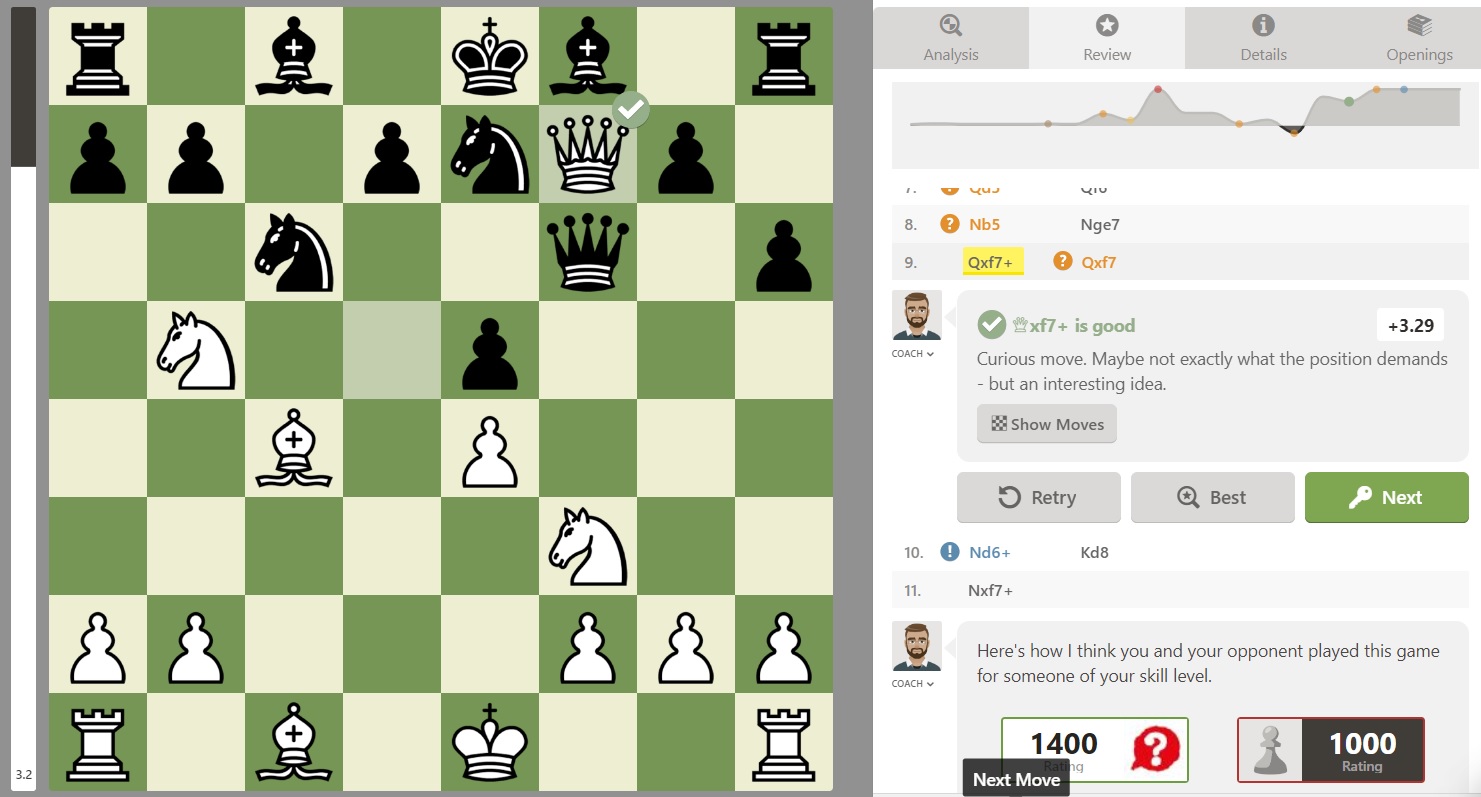
Yesterday, I played what I thought was a nice forcing sequence and my opponent resigned. After showing it to some some students and posting the position on Chess Skill's Facebook page, I looked at chessdotcom's game analysis and was surprised. "Coach" was critical.


In the following position, Black blundered to give me a clear advantage.

Black to move
8...Nge7??

Black could have played 8...Bb4+ 9.Bd2 Nge7 with a clear advantage. After the blunder, I spent a little more than half a minute working out the combination that led to my opponent's resignation. But, we both missed a resource.

9.Qxf7+!?

"Coach" opined: "Curious move. Maybe not exactly what the position demands -- but an interesting idea."

9...Qxf7?

9...Kd8 was more stubborn, shows the flaw in my idea, but still leads to a winning advantage for White.

White to move
Analysis diagram after 9...Kd8
White now should proceed with normal development, such as Be3 or O-O. Black's king remains in the middle and White's pieces are far more mobile. But, the win of the rook through a knight fork does not occur.

Going back a move, White could have played 9.Qd6!

Black to move
Analysis diagram after 9.Qd6!
After the superior 9.Qd6, the engine favors 9...Rh7 when White wins the other rook with 10.Nc7+ Kd8 11.Qxf6 gxf6 12.Nxa8.

9...Qxd6 leads to the same position as occurred in the game.

After my 9.Qxf7, Black followed the line I had analyzed with 9...Qxf7.

White to move
10.Nd6+ Kd8 11.Nxf7+ 1-0

As he is losing the rook and cannot trap the knight, Black resigned.


10 June 2022

A Study Position

How does a position reached in a game played many years ago become an important study position?

Consider a position from Euwe -- Smyslov, Moscow 1948. The game was played in the fourteenth round of the five-player world chess championship to determine the successor to Alexander Alekhine. Max Euwe finished in last place, winning only this single game.

White to move
In Paul Keres, World Chess Championship 1948 (1949), the author criticizes Euwe's move from this position, 27.Qe3. Euwe's position is so strong that this move "assures him of an easy win." But, "he misses the worthy finishing combination ... which would immediately have forced Black to resign" (332).

This position appears as number 1 in Thomas Engqvist, 300 Most Important Tactical Positions (2020). The first 27 positions in the book highlight five basic tactical ideas--"tricks" is Engqvist's term. The first three positions, the writer tells us, are "from top level chess where one highly qualified player missed a fork at a certain point. It pays to study positions where a strong player missed a tactical solution" (13).

Engqvist mentions that Keres gave the move played in the game a question mark, offers Keres' improvement, and also discusses a second alternative to the text move.

24 November 2021

Bishop takes Pawn with Check!

Two positions were presented to my elementary students at the after school chess club yesterday. The first occurred in my shortest game in a weekend Swiss. The second position did not occur in Nepomniachtchi,I. -- Carlsen,M., Halkidiki 2003. Cyrus Lakdawala explains in Nepomniachtchi: Move by Move (2021), which was just published, that Carlsen, "even as a newborn infant, wouldn't fall for 8...dxe3??" I explained to the students that Carlsen was not born knowing this tactic, but learned it, just as they can.

My short loss:

Rodriguez,Luis (2211) -- Stripes,James (1472) [B21]
Collyer Memorial Spokane (1), 21.02.1998

1.e4 c5 2.d4 cxd4 3.c3 dxc3 4.Nxc3 d6

Remembering the game incorrectly, I presented my move as 4...Nc6, which is probably a more accurate move order.

5.Bc4 a6?

A waste of time. 5...Nc6 should be played. After 5...Nc6, it is still possible to fail the way I did in the game. For instance, 6.Nf3 Nf6 7.e5 Nxe5?? 8.Nxe5 dxe5. This was the position shown to the students because I was presenting the tactic from a faulty memory.

6.Nf3 Bg4??

Utter foolishness.

7.Ne5+- dxe5

White to move
8.Bxf7+ 1-0

I resigned because I had far better things to do than watching how easily a master would checkmate me from such a horrid position.

Ian Nepomniachtchi (2447) -- Magnus Carlsen (2450) [B06]
Wch U14 Halkidiki GRE, 2003
1.e4 c5 2.c3 d5 3.exd5 Qxd5 4.d4 g6 5.Nf3 Bg7 6.Na3 cxd4 7.Bc4 Qe4+ 8.Be3

The game continued 8...Nh6

For the children, however, the error that Magnus Carlsen could see through is worth examining.

After dxe3??

White to move

9.Bxf7+ wins the queen.

9...Kxf7 allows 10.Ng5+ forking king and queen.

9...Kf8 delays the fork one move. 10.Qd8+ Kxf7.

The World Chess Championship between Champion Magnus Carlsen and Challenger Ian Nepomniatchchi begins at 16:30 Friday afternoon in Dubai. That's 3:30 am in my time zone. I may not watch the beginning of the game live, needing some sleep. But, I will check on the progress as soon as I awake.


14 October 2021

Lasker's Originality

I am watching chess videos that are part of the Fritz Trainer DVD, Master Class, vol. 5: Emanuel Lasker (2015). Mihail Marin makes the argument that Emanuel Lasker was an original strategic player who sought to bring new ideas into familiar openings. In the fourth game of his World Championship match with Siegbert Tarrasch, Lasker brought his rook to the fifth rank, then transferred in to the fourth, where tactical complications ensued. Tarrasch made a few small errors, leading to this position.

Black to move

How should Black deal with the fork?

08 July 2020

Failure to Learn

This morning I played in a USCF rated online chess event that I had learned about via email a couple of weeks ago. I finished tied for first, winning the top prize (a virtual trophy) on tiebreaks. The event cost a mere $5 and the entry fees went back to the players in the form of one-year membership extensions. These membership extensions are based on random drawing of numbers after the event concludes.

See information about these thrice-weekly tournaments at Events4Chess.com.

In the second round, my failure of imagination unnecessarily extended the length of the game, and even led to an equal position as my opponent and I exchanged blunders. Ironically, the critical move that I could have played at least four times in the course of the game had come up in a Greco game that I used with my chess students in last week's lesson.

The position from Greco.

White to move

Two positions from my game.

White to move

White to move

23 September 2019

Do Something Useful

While looking at an exercise in Imagination in Chess (2004) with one of my students, a part of the solution given stuck in my memory and then entered my consciousness while playing a rook ending a week later. The exercise was an endgame position from Polovodin -- Ivanov,A., Leningrad 1988. Paata Gaprindashvili commented, "Polovodin makes a useful move, while his opponent is denied such a possibility" (179).

Stripes,James (1851) -- Internet Opponent (1880)
Live Chess Chess.com, 20.09.2019

White to move

23.f4?!

This move exposes my king--probably not a good decision

23.Rc8 Rbd7 24.Rxd8+ Rxd8 25.Rc6 h6 26.Rxa6 Rd5

23...Rbd7 24.b4 g6

24...Rd1+ 25.Rxd1 (25.Kg2 R8d2+ 26.Kh3 Rxc1 27.Rxc1 Kf8) 25...Rxd1+ 26.Kf2 g5

25.R1c2 Rd4

25...Rd1+ 26.Kf2 R8d2+ 27.Kf3

26.a3 Rd3 27.R5c3

The game seems headed for a draw, but there are some things that can be tried.

Black to move

27...h5 28.Kg2 Kg7 29.Kf2 R8d7 30.Ke2

The king is a fighting piece. At this point, I felt that I could at least do something that offered my opponent problems or opportunities to go astray.

30...R3d4 31.h4

Black to move

31...Ra7?

And he went astray.

31...Re4+ 32.Re3 Red4 (32...Rdd4?? 33.Rxe4 Rxe4+ 34.Kd3 Re1 35.Kd4) 33.Rc6 Rd2+ 34.Kf3 Ra7

32.Ke3?

But I failed to capitalize on the error.

I could have played 32.Rc7 Rd7 33.Rxd7 Rxd7 34.Rc6 Ra7 35.Kd3

32...Rdd7 33.Rd3 Rxd3+ 34.Kxd3 a5 35.bxa5 Rxa5 36.Rc3 Ra4 37.Rb3

Black to move

37...Ra5?

Another error.

37...Kf8;
37...f6

38.Kc3?

Again, failing to capitalize. This move presents Black with a problem, but one that can be solved.

38.Kd4+-

38...f6?

38...Ra4 was the only move.

39.Kb4+-

Black to move

The fork is decisive.

39...Ra4+

39...Ra8 40.exf6+ Kxf6 41.Kxb5

40.Kxb5 Re4 41.exf6+ Kxf6 42.a4

It does not appear that Black has any way to stop this pawn. My game has become much simpler.

42...e5 43.fxe5+ Rxe5+ 44.Kc6 Kf5?

Black hastens the end by allowing a pin that forces rooks off the board.

White to move

45.Rb5 Rxb5 46.axb5 Kg4 47.b6 Kxg3 48.b7 Kxh4 49.b8Q

49.Kd5

49...g5 50.Qh2+

50.Kd5

50...Kg4 51.Kd5

51.Qe2+ Kh4 52.Kd5

51...h4 52.Ke4 Kh5 53.Kf5 g4 54.Qe2

54.Qb8 is a faster mate by one move.

1-0

Sometimes, it is helpful to simply keep playing chess in an equal position.

15 September 2019

Fidelity Chess Challenger

Several years ago, my wife's uncle gave me an old stand alone chess computer, Fidelity Chess Challenger. Last night, I searched and found an instruction manual online for Chess Challenger 7, which appears to have the correct instructions. I played a game on its top level--level 7. Based on research presented in the HIARCS chess forum, I believe the device was manufactured in 1980.


In the image above, the machine has played its move as O-O-O by indicating that it moves its king from e8 to c8. That move puts my king in check.

In my game, I played quickly while also reading a book. On its top level, Chess Challenger requires several minutes per move for most moves. I was reading in another room, would read a page or two, and then check on the machine. I recorded the moves on another device that allowed me to quickly email the completed score to myself.

Chess Challenger played a decent opening, reached a winning position in the middle game, and then revealed substantial weaknesses in endgame understanding. It demonstrated understanding of exploiting a pin, and using forks. It also set a simple stalemate trap near the end of the game.


Stripes,James -- Fidelity Chess Challenger [C68]
14.09.2019

1.e4 e5 2.Nf3 Nc6 3.Bb5 a6 4.Bxc6 dxc6 5.d4

Probably a weak move on my part. I rarely play the Spanish Opening, and the exchange variation is not my usual choice when I do.

5...Bg4

5...exd4 6.Qxd4 Qxd4 7.Nxd4 seemed okay to me.

6.dxe5 Qxd1+ 7.Kxd1

This is the position in the photograph.

7....0-0-0+ 8.Ke2

Black to move

8...Bc5

This move struck me as odd.

8...Re8 9.Bf4 f6 10.Nbd2 fxe5 11.Bg3 Nf6 12.Rhe1 Bd6 (a later game continued 12...Nh5 13.Kf1 Nxg3+ 14.hxg3 Bc5 15.Nc4 Rhf8 16.Ncxe5?? Rxe5 17.Re2 Rh5 18.Rd2 0-1 Luptak,P (2086) --nZvarik,M (2245), Slovakia 2010.) 13.Kf1 Nh5 14.Kg1 Nxg3 15.hxg3 h5 Black won in 61 moves Aleksandrova,D (2015) -- Yilmaz,G, Albena 1977.

8...f6 9.h3 (9.Nbd2 Re8 10.h3 Bh5 11.Nf1 fxe5 12.Ng3 Bg6 13.Be3 Nf6 14.Nd2 Nd7 15.Rhd1 Be7 16.f3 Rhf8 White won in 54 moves Kieninger,G (2509) -- Rellstab,L (2478), Bad Oeynhausen 1941) 9...Bxf3+ 10.gxf3 fxe5 11.Bd2 Ne7 12.f4 exf4 13.Bxf4 Ng6 14.Bg3 Re8 15.Nd2 Bd6 Black won in 46 moves Babula,M -- Dobrovolsky,L, Brno 1969.

9.Be3 Bxf3+

This move does not exist in my database.

9...Bxe3 10.Kxe3 f6 11.Nbd2 Re8 12.exf6 Nxf6 13.Rae1 Nd5+ 14.Kd4 Nf4 15.h3 Bh5 16.g3 Ne6+ 17.Kc3 Bxf3 18.Nxf3 Rhf8 19.Re3 Nc5 and Black went on to win a pawn ending after a lot of middle game manuevering in Toumaniantz,R (2162) -- Duflot,S, Le Touquet.

If there was any sort of opening tree built into the software, it could have included moves from Lasker -- Pollock 1892.

9...Be7 My database shows four games with this move 10.h3 No other game in the database has this position. 10...Bh5 11.Nbd2 f6 12.Rhd1 fxe5 13.g4 Be8 and Black won in 42 moves Lasker,E -- Pollock,W, Baltimore 1892.

10.Kxf3

10.gxf3 might not be bad.

10...Bxe3 11.Kxe3 Nh6 12.h3 Rhe8 13.f4 f6

White to move

14.exf6??

14.Nc3 fxe5 15.g3 exf4+ 16.gxf4 Nf5+ 17.Kf3 Nd4+ 18.Kg3 Nxc2 19.Rad1 Black should win the ending;

14.g4! fxe5 15.f5 White's kingside majority is more dangerous than Black's queenside. Such endings, as I understand, are a principle reason for playing the exchange variation of the Spanish.;

14.Nd2 fxe5 15.f5.

14...Nf5+

I had underestimated this move, having mainly assured myself that I would not lose the rook on a1.

15.Kf2

15.Kf3 Nd4+ 16.Kg4 Nxc2 and Black wins material.

15...Rxe4

15...Nd4? 16.Nc3 Nxc2 17.f7 (17.Rad1 Rxd1 18.Rxd1 gxf6).

16.g3

I realized by this point that I was clearly worse.

16...gxf6 17.Nc3

Black to move

17...Re3?

I expected 17...Rd2+ 18.Kf3 Re8 19.Kg4 Ne3+ 20.Kh4 Rxc2-+

18.Rad1 Rxd1 19.Rxd1 Rxg3 20.Ne4

Black to move

20...Rxh3 21.Nxf6 Rh2+ 22.Kf3 Rxc2 23.Rg1 Nh4+

23...Kd8 24.Rg8+ Ke7 25.Ne4

24.Ke4

24.Kg4 Ng6 25.f5 Ne7 26.Nxh7

Black to move

This is the type of position I like putting in front of my students. Black is clearly better, but must find a plan to neutralize White's threats. For brute force calculation with limited depth, positional understanding is vital. Chess Challenger showed the weakness in its primitive programming at this point.

24...Rg2?

This move surprised me, as my f-pawn seems dangerous in the knight ending.

24...Ng6 Before playing Rg1, I had looked at 25.f5 Ne7 26.Rg7;

24...b5! avoids the checkmate threat and gives White queenside problems that cannot be met.

25.Rxg2 Nxg2 26.Nxh7

This move was not so much to grab the pawn, although useful, as to clear the f-file and control the promotion square.

26...b6

Chess Challenger's moves stopped making sense to me here. Prior to this point in the game, I had foreseen most moves.

26...Kd7 27.f5 (27.Ke5 Ne3 (27...Ke7 28.f5 Nh4) 28.b3 Ke7 29.Nf6) 27...Nh4 28.Kf4

27.f5

Black to move

27...Ne1??

This move is a game losing blunder that highlights that Chess Challenger is oblivious to the dangers presented by my passed pawn.

27...Kd7 or Kd8 are the only moves that do not lose. 28.Ke5 Nh4 29.f6 Ng6+ 30.Kf5=.

28.f6+- Nd3

28...Kd7 29.f7 Ke7 30.f8Q+

29.Kxd3

However, it is possible that the software saw 29.f7 Nc5+ 30.Kf5 Nd7 in which case the knight is still lost, but White does not yet have a queen and there is a lot of work to do to use the knight to convert a pawn minority into a passed pawn.

29...c5 30.f7 a5 31.f8Q+ Kd7 32.Nf6+ Kc6 33.a4 c4+ 34.Kxc4 Kb7 35.Qf7 Ka8!

I was impressed with the stalemate trap set here.

White to move

36.Kb5

36.Qxc7 b5+ 37.axb5 (37.Kxb5 stalemate) 37...a4 38.Nd5+-

36...Ka7 37.Qxc7+ Ka8 38.Ka6 b5 1-0

Chess Challenger made this move and then lit the "I lose" light.

14 May 2019

Exchanging into Pawn Ending?

This position arose in Lasker -- Tarrasch, St. Petersburg 1914, the source for Van Perlo 7 (see "Endgame Tactics").

Black to move


The game continued 37...Bxg7 38.Bxf5 Kxf5 39.Kxg7 a5, reaching the position where Van Perlo celebrates Lasker's "amazing escape" (Van Perlo's Endgame Tactics, 21).

White to move
White has a drawing combination
Did Black have something better?

02 April 2019

Why Forks Matter

Inherent in all chess tactics are relationships between pieces. A White rook on e1 can attack a Black pawn on e6 if there are no pieces in the way. This relationship is one of offensive contact.* If there is a king shielded behind the pawn on e7 or e8 (a defensive contact), the pawn is unable to capture a White piece standing on f5 or d5. This restrictive contact is called a pin.

If two Black pieces sit on the sixth rank with three squares between them, they are vulnerable to attack from a White rook that can reach the sixth rank. These two enemy pieces can be attacked in a manner we call a pin, a skewer, or even a fork. The rook can attack both because they are on the same line. These attacks are the relationship I created in the first three exercises for my Essential Tactics worksheets.


Such tactical ideas as pins, skewers, and discoveries take place along a single line—rank, file, or diagonal. A fork also can take place along such a line, but forks are more commonly understood to take place along multiple lines. In this exercise from Essential Tactics, for instance, the correct move places the White king in offensive contact with the Black knight along a diagonal and with the Black bishop along a file.

White to move

Consider this game from the forgotten book, A Treatise on the Game of Chess (1808) by J. H. Sarratt (12-15). The notes are by Sarratt, and the book may be found at Google Books. At three critical moments in this illustrative game, White employs a fork. In the third instance, the fork attacks a king and a target square that must be occupied to put a stop to Black's counterplay.

1.e4 e5 2.Bc4 Bc5 3.c3 Nf6

This move, though very generally played, even by good players, is certainly a bad move.

4.d4 exd4

If 4...Bd6 White would win a piece, as will be shown in a Back-game.

5.e5 Ne4

Instead of this move the Black might play the Queen to his King's second square; or his Queen's Pawn two moves; but you would nevertheless have the best of the game, as will be demonstrated in two Back-games beginning at the fifth move of the Black.

5...Qe7;
5...d5

White to move

6.Bxf7+

Instead of this move, you might play your King's Bishop to the adversary's Queen's fourth square; but he would then sacrifice his knight for three Pawns, as will be shown in the second book.

6...Kxf7 7.Qf3+ Nf6 8.exf6 Qxf6

White to move

9.Qh5+

It seems that if you were to give check at the adv. Queen's fourth square, you would likewise win the Bishop; but he would cover the check with his Queen at his king's third square, and giving you check at the same time, you would be compelled to exchange queens.

9.Qd5+ Qe6+ 10.Qxe6+

9...Qg6 10.Qxc5 Qxg2

White to move

11.Qf5+ Ke8 12.Qf3+- and you will win the game, whether the Black exchange Queens or not.

Modern Grandmaster Play

On the way to winning the US Championship, which concluded Sunday, Hikaru Nakamura had this position with the Black pieces against Ray Robson.

Black to move

29...Qc4

Nakamura forks both rooks, although they easily protect each other. Nonetheless, this move brings the queen to a better square for the assault against the White king.

30.Ref6 a3 31.bxa3 bxa3 32.Qxa3

Black to move

Nakamura must have had this position in mind when he played 29...Qc4. White's move 29 that led to a simple fork of rook was to capture a bishop on e5. Nakumura now initiates a combination that recovers the lost minor piece with interest.

32...Rxc1+ 33.Rxc1 Qxe4+

Black is currently down a rook, but White's moves are forced.

34.Kb2 Qe5+

Another fork.

White to move

35.Rc3 Rb8+ 36.Kc2 Qxf6

With an extra pawn and a less vulnerable king, Black had the better endgame. He used a series of checks to win another pawn and force the rooks off the board.


*See Yuri Averbakh, Chess Tactics for Advanced Players (1992) for definitions of contacts as the foundation of chess tactics.

21 March 2019

Wrong Answers

Once in a while I use the tactics training at Chess.com, as this morning. The first five were correct, then I failed this one.

White to move

The exercise has a rating of 2457. I saw the first move instantly, but missed the second.

I failed the next problem as well.

Black to move (Black on bottom)

I considered almost every legal knight move except the correct one. The exercise is rated 1858. My calculations sought to effect a checkmate that is there, and that I saw, but my efforts all fail because of a defensive resource that I overlooked.

The next two were correct, then two more were wrong.

Black to move (Black on bottom)

The first move was easy, but finding the second demonstrated the failure of my imagination. Exercise rating: 1996.

White to move

After the obvious first move, I missed a mate in eleven. Instead, I played a move that assured a draw. Exercise rating: 1731.

My current tactics rating is 2046.