Showing posts with label calculation. Show all posts

27 April 2024

Active King

In a ten minute game this morning, I struggled most of the game for equality. When my opponent erred in opting for a rook ending, rather than knight vs. bishop when his passed pawn likely would have cost me my bishop, I knew my drawing chances were good.

Then, while reviewing the game, I was surprised to see that a move that assured the draw was deemed an error by the website's game analysis feature.


Let's look at the critical position with normal diagrams (White on bottom).

White to move
I played 47...Kxf4, reaching an easily drawn ending that neither side should have difficulty playing.

This position, however, is winning for Black.

47...Rb2+ 48.Kf1 (Kg1 likely transposes) 48...Kf3

Leaving the f-pawn alone while creating mate threats was completely off my radar, perhaps because I knew there was no forced checkmate. The threats, however, gain something.

49.Kg1 Rb8+ 50.Kh2 Kf2

White to move
White is forced to move the rook and cannot attack my g-pawn.

51.Rh8 Rxb7 52.Rh6 Re7 

Black keeps mate threats alive.

53.Kh1

Black to move
Two of the roads that lead to victory from here are:

a) 53...Re6 54.Rh2+ Kg3 55.Rg2+ Kxf4 finally capturing the f-pawn!
b) 53...g5! 54.Rh2+ (54.fxg5 Kg3 and White must give up the rook to avoid checkmate) 54…Kf3

White to move
Black's g-pawn is untouchable due to the mate threat.

55.Rb2 Re1+ 56.Kh2 g4

I would have known that I was winning had I foreseen that I could reach this point.

It was good to draw a 2000+ rated player, but there was an instructive missed opportunity that I hope to remember.


26 July 2020

Slow Down

Over the past twenty years, I have played at least 100,000 games, most at three minutes with no increment (3 + 0). Adding games at five minutes, or with an increment, and adding bullet, which includes a great many 2 + 1 (more time than three minute when the game exceeds sixty moves), pushes the number over 150,000.

These crude minimums belie the point that I do not know the total number of online blitz games I've played. I have played online blitz regularly since 1998, often dozens of games in a day. I play a few games most days. My personal database currently holds 103,382 games. It excludes most bullet games, although I make an exception for 2 +1. It also has many games at longer time controls, including many hundreds of correspondence games. I have not been able to save every game, and have also lost tens of thousands through database errors.

When I started saving my games in a database, I was using Chessmaster 7000. About 2001, I began learning the free versions of ChessBase and Chess Assistant, both limited to database not exceeding 15,000 games. I recall that CB was more restricted than CA. In 2003, I bought CB 8 and attempted to gather all of my online games into one database.

What has been the impact of this massive amount of online blitz on the quality of my play?

The database contains a near endless supply of instructive positions that arise from sloppy play. Exactly the sort of play that my students see in their games.

It has certainly given me ample practice with pattern recognition, and may have developed my intuitive feel for many types of positions. It has given me immense experience in playing my favored openings, such that it is very difficult for an opponent to surprise me with something that I have not seen before.

Performing elementary checkmates with minimal time on the clock is gratifying, and helps me reinforce the skill in my teaching. But, it is also humbling that I have stalemated my opponent with queen and king against king more than once.

The most important detrimental impact has been that unsound risky play has been rewarded in such a way that it has become second nature. Making the effort to switch to 3 + 2, or even the 5 + 2 that I am currently playing in USCF online blitz rated tournaments has been rough. It is much more difficult to win lost positions on the clock when there is an increment. In my OTB games, I have bouts of impatience where blitz thinking interferes with careful calculation.

Last week, I had White and this position.

White to move

Confidently assuming that I had a strategic advantage, I was blind to tactics. I had plenty of time, but did not use it.

22.Bg2?? Rxd2 and I resigned.

The Morning Membership tournaments are short and fun, and they are at a time that is good for me both in terms of schedule and capabilities. Unlike the stereotypical late-night chess player, I am a morning person. These events last about an hour, are played at 5 + 2 on Chess.com, and draw 30-40 players. They begin at 8:00 am in my west coast time zone, which is late morning on the east coast.

In my first event on July 8, I was the third highest rated player, tied with two others with perfect scores, and won the first place trophy on tiebreaks. The free membership extensions that are awarded after the event are based on a random drawing, not performance. I played three more this week. The blunder presented above was my first loss. I scored 2/4 on Monday, lost my last round game on Wednesday, and on Friday, when I was the top rated player, gave up a draw in the second round.

My online blitz rating is going down. Nonetheless, I have signed up for the next sixteen--every one through the end of August. Learning to pace myself in slower blitz may be good for my game.

In "The Soul of Philidor", I presented a position where I was happy with my choice because it reflected the application of recent study. Strategically, it was a nice game and I was happy with my performance. Postgame analysis, however, quickly revealed to me that I missed several opportunities. Using the engine to check my postgame analysis revealed more missed opportunities. As I learn to slow down, perhaps I will increase my alertness to tactical chances. Intuitive play has its place, but some calculation is necessary for improving my game.

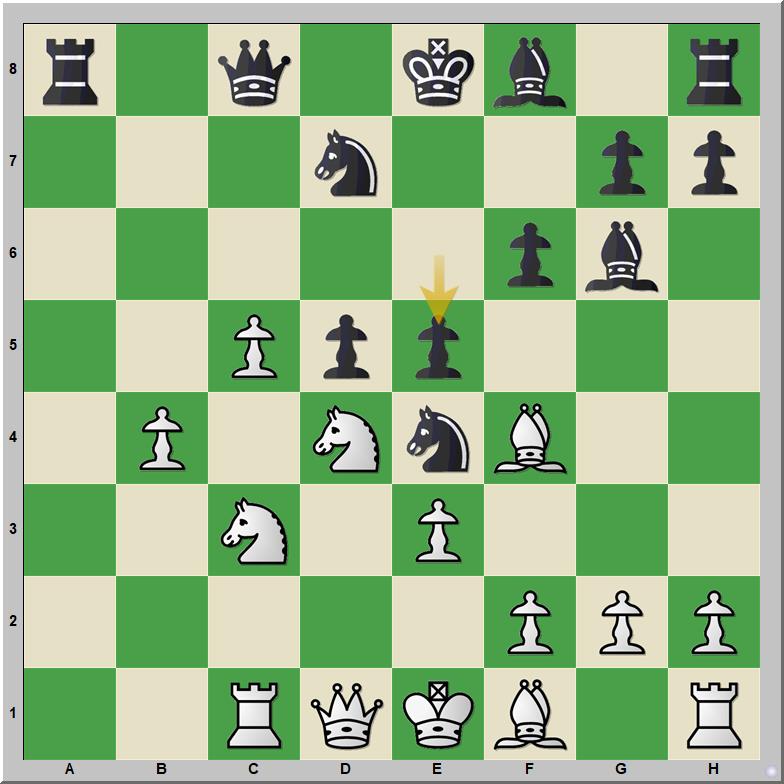
In each of these five positions, I had a better move than the one I played. Although I dominated most of the game and managed to win, I did concede the advantage and was even worse through part of the game.

White to move

I played 10.a3??

A couple of weeks ago, I was examining the tactics in a Grandmaster game that involved the type of position that occurs after the superior 10.b5!

White to move

15.Nd4?? walked into a fork, although that was not fatal and my pawns proved to be compensation for the knight. But 15.Nxe4 or 15.Bb5 were both better choices

White to move

16.Bg3?? turned out okay in the game, although Black now has a clear advantage. After 16.Nxd5 exf4 17.f3, White has a decisive advantage.

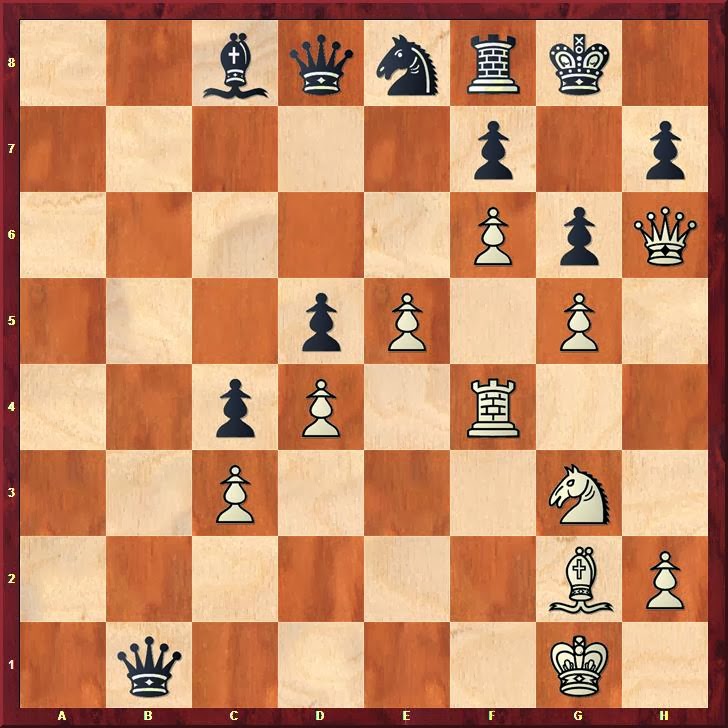
White to move

22.b5 Na4 23.Ra3 Nc2 leads to the next position, and I again have an advantage. However, 22.Re3 wins a piece. I also could have played 21.Re3, but 21.Bf3 was good enough to regain the advantage.

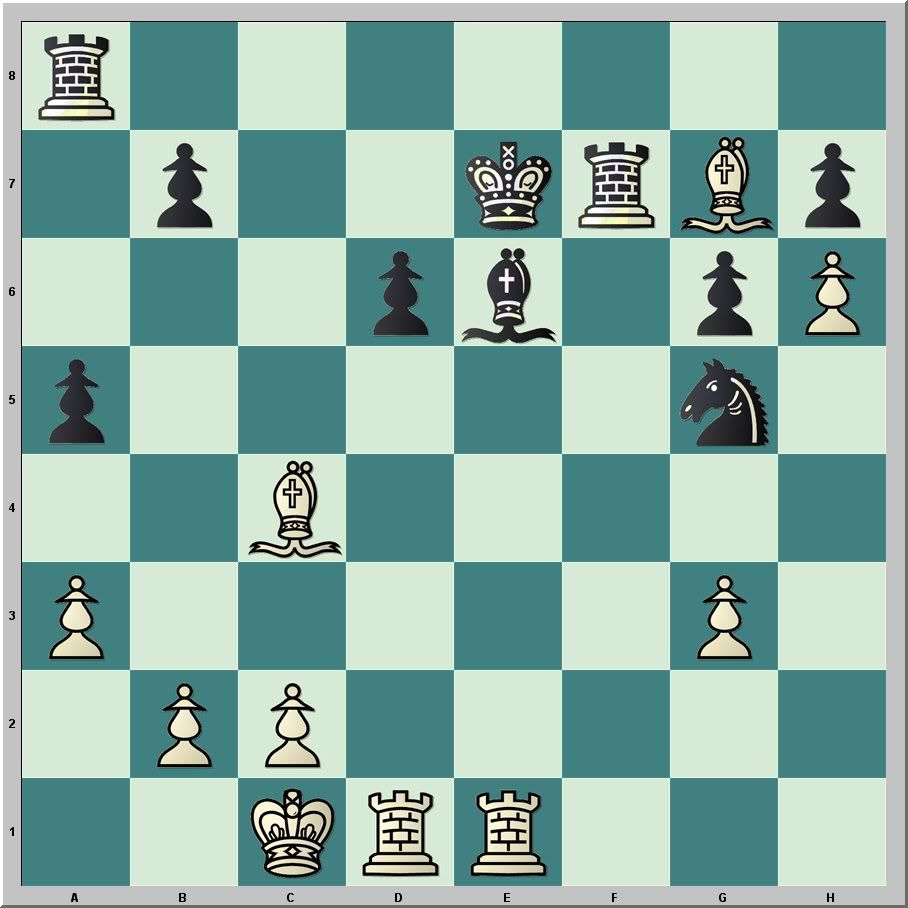
White to move

24.Rxa8! was a move that I considered, but without adequate calculation. Black is busted.

I played the seemingly safer 24.Qb3. A few moves later, my opponent returned the sacrificed piece which left me a clear pawn ahead. My bishops also controlled the squares my passed b-pawn needed.
I can play better.

09 September 2019

Floating Square

White to move

I had this position in a rapid game and spent a minute or more looking at the likely pawn ending before playing my move.

29 April 2017

Watching Fireworks

A couple of evenings ago, I played a blitz game online that seemed as though it turned bad in a hurry. My assessment was wrong. At the very moment when my opponent opened up the center and initiated exchanges, causing me to feel helpless, I had a clear win. My assessment, much to my delight, was completely wrong. I made the only moves that seemed sensible, and it turns out that most of them were the best possible move.

Stripes,J (1978) -- Internet Opponent (1921) [A33]
Live Chess Chess.com, 26.04.2017

1.d4 Nf6 2.c4 e6 3.Nf3 c5 4.g3 cxd4 5.Bg2

5.Nxd4 may be more accurate.

5...Nc6

5...e5

6.Nxd4 Bb4+ 7.Nc3 Bxc3+

7...d5

8.bxc3 0–0

8...Qa5 9.0–0 0–0 10.Qb3 d5 11.Rd1 Ne4 12.cxd5 exd5 13.Nxc6 bxc6 14.c4 Be6 15.cxd5 Bxd5 16.Qa3 Qb5 17.Bf3 Nf6 18.Bf4 Bxf3 19.exf3 Rfe8 20.Rd2 Re6 21.Rad1 ½–½ Schlosser,P (2485) -- Hracek,Z (2455), Brno 1991.

9.0–0 a6 10.Ba3 Re8

White to move

11.Rb1?

11.c5 Qc7 12.Rb1 Rb8 13.Qb3 Qe5 14.Bxc6 dxc6 15.Nxc6 Qh5 16.Nxb8 Ng4 17.h4 g5 18.c6 gxh4 19.c4 bxc6 20.Nxc6 Bd7 21.Ne7+ Kg7 22.gxh4 f5 23.Qg3 Kf6 24.Rb7 Rxe7 25.Bxe7+ Kxe7 26.Rd1 1–0 Schroll,G (2385) -- Kwatschewsky,L (2300), Gamlitz 1993.

11.Bd6!

11...d5

11...Ne5 and White's advantage is minimal.

12.cxd5 Nxd5?

12...exd5 hold White to a minimal advantage.

White to move

13.c4

13.Nxc6 is better 13...bxc6 14.c4+-.

13...Nc3?

13...Nde7±.

14.Nxc6

Only non-losing move.

14... Nxd1?

I saw and expected 14...bxc6 15.Qxd8 Nxe2+ 16.Kh1 Rxd8 but I didn't realize that I was winning here.

15.Nxd8+-

Only non-losing move.

White has an overwhelming advantage, but I did not yet know that. I thought I was fighting for a slightly worse position, thinking that I would be down an exchange. On ChessTempo, it is possible to train with tactics exercises labelled "counting pieces". That's where my assessment failed during this game.

Black to move

15...Nc3 16.Nxb7!

The best move.

16...Nxb1 17.Rxb1+-

The best move.

17...Bxb7

White to move

18.Rxb7

18.Bxb7 is better 18...Rab8 19.Bd6 Rbd8 20.c5.

18...Reb8

18...Red8 is also losing, but keeps the game going longer.

19.c5!

The best move.

19...Rxb7 20.Bxb7

The only non-losing move, of course, but easy.

20...Rb8 21.c6 1–0

Black must give up the rook to stop the pawn from queening.

12 February 2017

Patterns and Calculation

If we fail to make an idea work, we need to stop and ascertain the cause of the failure (i.e. answer the question 'why?'), and then attempt to correct our design.
Paata Gaprindashvili, Imagination in Chess (2004), 40.
A chess problem that cropped up in tactics training yesterday immediately reminded me of a game I had seen working through the compositions of Gioachino Greco, but the solution in Greco fails. Noting the failure, I considered why it failed and calculated the remedy. The whole process required about 23 seconds.

This elementary exercise serves to supplement my posts, "Patterns and Calculation" (23 December 2016), "Patterns: Some Evidence" (11 January 2017), and to highlight my endorsement of Paata Gaprindashvili, Imagination in Chess (see "Imagination in Chess").

White to move

The position arose in a correspondence game on Chess.com and was presented to me through the tactic trainer there. That game was a Ponziani in which Black blundered early.

Greco's game arose via a King's Gambit. I present it as it appears in Francis Beale, Royall Game of Chesse Play (1656).

Gambett LIII (Greco) [C37]
1656

1.e4 e5 2.f4 exf4 3.Nf3 g5 4.Bc4 h6 5.h4 f6 6.Ne5 fxe5 7.Qh5+ Ke7 8.Qf7+ Kd6 

White to move

9.Qd5+ Ke7 10.Qxe5# 1–0

The checkmate pattern in both games is the same, except that there is an alternative checkmate in the tactics problem if Black moves the king after White's initial move. The key difference, however, is that Black's knight guards e5 in the tactics problem. Hence, applying Gaprindashvili's advice, White must first lure this knight to e5, then execute the winning queen maneuver.

Instant recognition of patterns can be trained and aids in the development of chess strength. The same pattern often occurs in seemingly dissimilar games. Recognizing the pattern offers a plan, but calculation remains a necessary component to verify that the pattern has application.

08 January 2017

Worksheets

Much of my time preparing chess lessons for young students is invested in the creation of worksheets. These can be photocopied and distributed to groups of students at minimal cost. The young chess players can then work on their own or with others to find the correct answers. During a paper and pencil worksheet session, students bring partly or fully completed worksheets to me for correction. I can then tell them how many they have correct, which ones are wrong, or give other tips. My practice varies from day-to-day.

This week my beginning students completed the Beginning Tactics 1 worksheet. They had previously seen three of the problems from that worksheet two months ago (see "Patterns of Contacts"). Their memory of positions seen previously has not developed yet, so the positions seemed new. Even so, these problems are elementary and they needed only a little guidance.

My advanced students were presented with the worksheet I created for chess camp last week (see "Carlsen's Queen Sacrifice") and two additional problems on the demo board.

White to move

From Bogoljubow -- Mueller, Triberg 1934

The second position on the demo board was challenging and we did not complete our analysis. The first move, of course, is already known because all of the problems have the same first move.

White to move

From Keres -- Kurajica, Kapfenberg 1970

I made the point to the students that knowing the first move of a combination puts them in a position of struggling to calculate the entire sequence. In several positions, there is a simple checkmate in two if the defender accepts the sacrifice, but other moves are possible. The second move of the combination proved difficult in several cases.

09 October 2016

18 February 2016

Calculate

Lesson of the Week

My young chess students were presented with exercises this week that are designed to develop their calculation skills. For the advanced students, I culled six problems from a workbook that I created for my chess camp two years ago and that I updated this week so that other chess coaches might find it useful.

Problem 2 is from a game that I lost to an alum of the chess club where I now coach. He is our current city champion. The game from which the position is extracted was played when he was in high school.

Problem 6 asks the young players to find the move that I considered, but did not play, against IM John Donaldson in a simul in 2003. I managed a draw (Donaldson scored 26-2-2 in the simul), but had winning chances had I played the move that I had been aiming at for several moves prior. Donaldson was moving around the boards quickly and I did not have enough time to resolve my doubts concerning the sacrifice.

White to move (1-3)

1.

2.

3.


Black to move (4-6)

4.

5.

6.


I introduced my beginning students to the knight's tour exercise to develop their abilities to handle that piece. The worksheet had a sample with the first ten moves entered and three blank chess boards for them to write on. The image below displays part of this worksheet.


The Workbook

My workbook is titled "Basic Training for Chess Success: Lessons from Camp" and was created for my 2014 summer chess camp. I have been creating new workbooks each year for my summer chess camp since 2008, often reusing materials that were particularly useful. "Basic Training" uses a section from my 2010 workbook, which was wholly focused on Adolf Anderssen (see "Learning from Errors: Adolf Anderssen"). This is followed by a section drawing lessons from Paul Morphy that I created for my 2012 workbook and then a short lesson that has appeared in several workbooks that applies Dan Heisman's Elements of Positions Evaluation to Pillsbury -- Lasker, Nuremberg 1896. There is a short endgame section culled from my work on Vasily Smyslov that formed the core of my 2011 workbook. Finally, the workbook contains a "glossary of tactics" and 124 exercises with solutions.


18 December 2013

Calculate

Lesson of the Week

This position comes from an unplayed variation in the game previously referenced in "Pawn Wars". In the actual game, my opponent played 34...h5. Had he played 34...a5 or 34...c5, my position still would have been winning, but I would have needed to find a move I had not worked out when I exchanged the rooks several moves earlier.

In this position, after 34...c5, White has only one move that maintains the win. Black is able to force White to find several such only moves. It is thus a good position with which to practice calculation skills. I routinely replay such positions against the computer. In one that I played out yesterday, I chose a seemingly risky line in which both players promoted pawns. Then, I missed the forced exchange of queens, winning by a more clumsy route.

White to move

Both players seek to run the other out of pawn moves. Whoever is forced to move his king will lose.

11 December 2013

Consider the Consequences

Lesson of the Week

This week's lesson is not particularly complicated for young players who look at the board carefully. However, too many look at threats against pieces without looking at control of squares.

White to move

White can restore the material balance with Rxb7. What would be the consequences of this move?

This position is from the game Westernin, H -- Ivkov, B Palma de Mallorca 1968.

In the game, White played 41.Raf1, and after 41...R4c7, White resigned.

23 November 2013

FIDE World Championship 2013: Critical Positions

Magnus Carlsen is the new World Champion of chess. He takes his place in a line of official and quasi-official world champions that go back 127 years.* Most of these champions have taken their place at the top as a consequence of prevailing in a match of many games against the reigning champion. Carlsen defeated Viswanathan Anand 6.5-3.5 in a match scheduled for twelve games, with provisions for tie-break games if tied after twelve.

Chess is a game that requires the players to assess ever changing arrangements of the chess pieces on a board of sixty-four squares. There are an estimated 10^43 possible positions, the vast majority of which will never appear on a chess board. Each individual chess game contains dozens of chess positions, and most of the time a majority of these positions are new. Carlsen became world champion by correctly assessing more often than Anand the chess positions they created together. In excess of 850 positions appeared in their ten games. Assessment of these positions required considering many hundreds more that did not occur.

The positions presented here appear to have been the most significant in determining the outcome of the match.

White to move

The first game followed previously played games as far as White's twelfth move. In the diagram, Black has just played 12...Nd5 creating both the first unique position in the match and the first critical position. White is already worse, and Carlsen understood that. He played the best move 13.Qb3 and it led to a draw by repetition a few moves later.

White to move

In the second game, the critical position was one that had occurred before. 18.Qg4 offers White prospects for a slight advantage with complex play. Anand chose to play it safe with 18.Qxd5, and seven moves later the game was drawn by repetition in an equal position.

Black to move

World Champion Anand appears to have missed a second opportunity to gain an advantage in the third game. He played 29...Bd4 in this position. 29...Bxb2 might have given him chances for clear advantage.

White to move

Anand's 16.Ne1 appears inferior to 16.Ne2. The a-pawn eventually fell, but White was able to generate less play for the material than if he had permitted 16...Bxa2 (although Carlsen would not have been compelled to make this capture). Anand's plan from this stage in the early middlegame conceded the advantage to Black over a series of moves.

In the press conference after game 10, Carlsen pointed to games three and four as revealing to him that Anand was vulnerable. He was then able to relax and play his normal style of chess. Carlsen's style produced opportunities for Anand to err.

Black to move

45...Rc1+, which was played by Anand in this position was an error. 45...Ra1 saves the game. This ending is not simple. The g-pawn appears to be the dangerous one, and Anand went after it after the check.

White to move

Computers can find the draw that follows from 60.b4, but both Anand and Carlsen thought the critical moment in the game had come some time earlier, perhaps 38.Qg3. It is interesting to contemplate that if White's b- and c-pawns were not on the board, Anand's 60.Ra4 would be consistent with the manner than the weaker side can hold positions where the stronger side has g- and h-pawns.

White to move

Neither player made any notable errors in game 7. After Anand's 27.exf5 in this position, the game quickly ended in a repetition.

Black to move

Anand found the correct 23...Qd8 in this position, and all the pieces were swapped off a few moves later. After some cursory pawn moves by both players, the position was wholly locked.

White to move

In a desperate situation, Anand went all out for checkmate in the ninth game. Carlsen defended well, and having survived the assault gained the upper hand. Here, White can probably hold and settle for a draw after 28.Bf1, but Anand played 28.Nf1 and resigned after 28...Qe1. Anand's error was made ten moves earlier, perhaps, when he anticipated this position.

Chess players must assess most positions long before they appear on the board.

Black to move

Anand's 28...Qg5 gave Carlsen the chance to play for a fourth win. He chose a line that he thought was winning, and then found the knight ending complex enough that he decided to force a draw to end the match. After 29.e5, White had a clear advantage, although it might have been more significant with greater precision on Carlsen's part.

Carlsen's most significant errors cane in the final game, when they no longer mattered.


*The World Chess Champions have been:
Wilhelm Steinitz (1886-1894)
Emanuel Lasker (1894-1921)
Jose Capablanca (1921-1927)
Alexander Alekhine (1927-1935)
Max Euwe (1935-1937)
Alexander Alekhine (1937-1946)
Mikhail Botvinnik (1948-1957)
Vasily Smyslov (1957-1958)
Mikhail Botvinnik (1958-1960)
Mikhail Tal (1960-1961)
Mikhail Botvinnik (1961-1963)
Tigran Petrosian (1963-1969)
Boris Spassky (1969-1972)
Bobby Fischer (1972-1975)
Anatoly Karpov (1975-1985)
Garry Kasparov (1985-2000)
Vladimir Kramnik (2000-2007)
Viswanathan Anand (2007-2013)
Magnus Carlsen (2013-  )

FIDE World Champions (official classical title in dispute 1993-2006)
Anatoly Karpov (1993-1999)
Alexander Khalifman (1999-2000)
Viswanathan Anand (2000-2002)
Ruslan Ponomariav (2002-2004)
Rustam Kasimdzhanov (2004-2005)
Veselin Topalov (2005-2006)

14 October 2013

Calculation

The Eastern Washington Open was my worst tournament performance in the past several years. I lost one game to a much lower player because I blundered, overlooking simple checkmate threats. Earlier in the game, I twice rejected moves that were probably best because I perceived dangers that I neglected to calculate. Effort assessing the perceived dangers might have revealed that they were not credible threats. That loss gave my opponent the biggest upset prize for the event. My other loss stemmed from lack of opening preparation. Although I had White, my position was technically lost by move ten. Even so, it was my longest game.

Despite my poor performance, I was pleased with my play in round four. My longest think of the game was thirteen minutes considering my opponent's responses to the only move I examined seriously, and which I played. It was the best move in the position. Most gratifying was that my calculation of the critical line consistently found good moves for both sides. About half of these were best or only moves, and where I did not look at the best move, the best was only slightly better than ones in my line. My assessment that I would stand better in the resulting position eight moves deep also was accurate.

My deep calculation begins with this position.

Black to move

16...e5! is best. It makes sense positionally, but I had to verify that it was correct tactically.

I had spent some time preparing this move. This moment appeared the correct time to make it. If not now, White might play Ne5, which would then necessitate more preparation.

Calculation was simple and straight-forward if White replied 17.Nxe5 or if he replied 17.dxe5.

However, the zwischenzug 17.Bb5 creates complications. It was this line that I analyzed for thirteen minutes.

I briefly considered a) 17...Bd7, and spent a few minutes looking at b) 17...e4. I considered the latter as an unattractive, but safe option. Here, my analysis concluded in a position where I thought that I was better, but Stockfish evaluates as equal. However, I missed the best move half-way through this line.

The line that took the longest to calculate and assess begins with c) 17...exd4! It is the best move.

a) 17...Bd7 is Stockfish 4's second choice. I gave it only cursory examination, but realized that some of the ideas in the lines I did examine would be present.

b) 17...e4 is Stockfish 4's third choice.
I looked at 18.Ne5 Bxe5
     Unexamined was the correct 18...Ne5! 19.Bxe8 Nd3-+.
My analysis continued 19.dxe5 Rxe5

White to move
I assessed this position as better for Black. Black is two pawns ahead, but Stockfish sees the position as equal. Black can generate threats against h2, but White has sufficient defensive resources. Black's pawn center is fragile, and thus his material advantage is temporary.

My analysis did not extend to 20.c4, which is White's only move. Otherwise, Black has secured an advantage with subpar moves.

c) 17...exd4 occupied the longest portion of my thirteen minute think. It is the best move.

I did not look at 18.Qd1, 18.Qf1, nor 18.Qd3. 18.Qxe8 struck me as the critical line, as it is a direct effort to refute my idea. Black's back rank has weaknesses. These are not fatal, but White has several forcing moves. Moreover, there are some material imbalances to consider.

18...Nxe8 19.Rxe8+ Bf8 and now more branching occurs.

Examining branching in one of several possible lines four moves from the current position has not been the norm in my over the board play. It must become so. In correspondence chess, such analysis is easier to perform thanks to such tools as analysis boards, database software for recording and observing possible positions, and the old fashioned paper and pencil with a physical board. Doing this analysis under tournament conditions with the clock running while looking at a static board requires imagination. I closed my eyes several times in order to imagine the board.

c1) Bxc6 Qxc6 21.Ba3 (the computer prefers 1.Ne5, which I do not recall considering) 21...Bb7 22.Rxa8 Bxa8 23.Nxd4 Qxc3

White to move

Black's advantage is clear, but I thought that White had a more dangerous line.

c2) 20.cxd4 seemed less dangerous, and I did not go deeper.

c3) 20.Nxd4 seemed critical. Stockfish vacillates between this move and 20.cxd4 as best for White.

20...Bb7 (I do not recall looking at 20...Nxd4, which the engine considers best) 21.Rxa8 Bxa8 22.Nxc6 (Stockfish prefers 22.N2f3) 22...Bxc6 23.Bxc6 (23.Bd3 may be better) 23...Qxc6 24.Rxa7.

Black to move

Although I was not certain my advantage was overwhelming in this position, I thought that I would probably choose this line. I knew that I could spend more time examining it after playing 16...e5.

Our City Champion was watching our postgame analysis, and chimed in that he thought he might like White's position. Black could be in danger if White's bishop and rook could both be brought to bear against f8. We discussed these dangers briefly. White's problem is that Black's queen controls the rook's access to the back rank.

White has three pieces to Black's two, but the queen is a powerful piece and White's queenside pawns are vulnerable once Black shores up the dangers on f7.

Stockfish concurs that Black is winning.

After 16...e5!, my opponent replied 17.dxe5. His move is simplest and best, although it saved me from the dangerous and complicated line. I was relieved. The rest of the game presented one difficulty when my opponent found some tactical tricks to expose my king. Initially, I marched forward, only to see that he threatened a draw by repetition, so my king went back and I had to retreat a knight that I wanted to use in the final attack.

My opponent then missed a tactic that gave me checkmate in two.

17 August 2009

Reinforcing Error

Unlike Michael de la Maza (Rapid Chess Improvement [2002]), who quit chess, and his minions, my chess improvement stems from a varied approach. My tactics training encompasses periodic commitment to playing from the key position to the computer's resignation (see "Where the Rubber Meets the Road") interspersed with working a website's system, such as Chess Tactics Server or the Tactics Trainer at Chess.com (see "Milestones"). I also use training exercises that Fritz or Hiarcs creates during its automatic analysis of games, or that users can create with the assistance of this software. Claude Kaber's training exercises are exemplary for illustrating the potential of this feature (see "Good Luck").

The exercises created automatically by Fritz, however, should be greeted with skepticism. The engines like drama.


Fritz Training Flaws

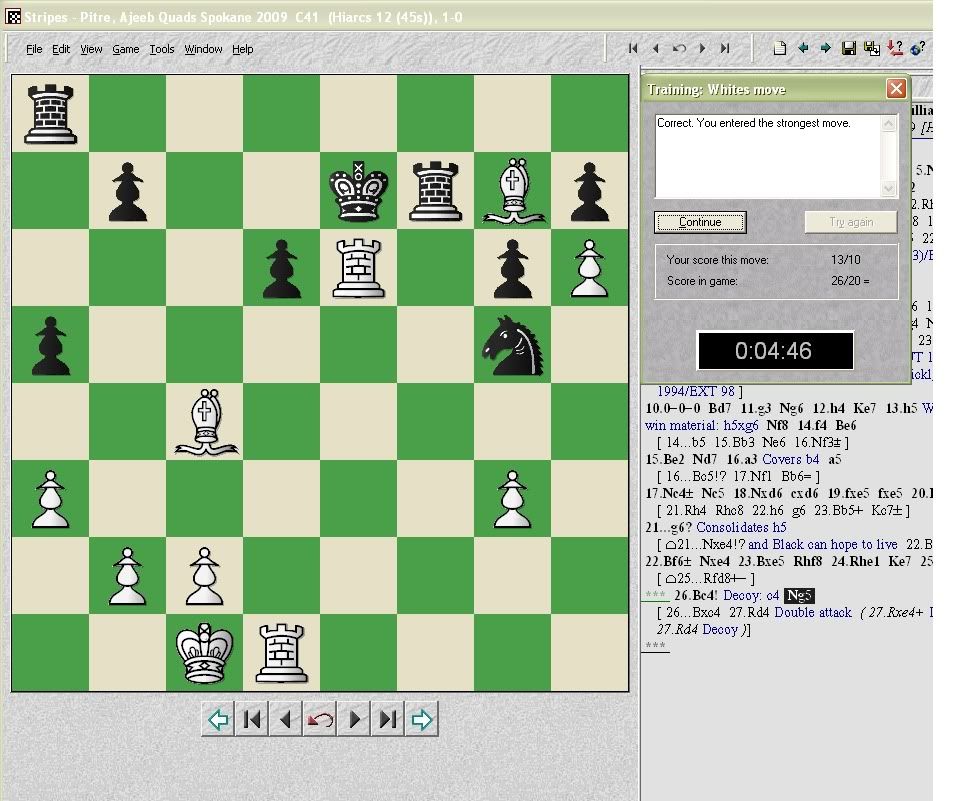
When I ran my game from last Thursday through full analysis by Hiarcs 12 (this engine uses the Fritz 11 interface), it created two training problems. The second is from this position awaiting my move 27.

White to move


During the game I looked at this position, found the dramatic 27.Rxe6+, and executed it. In my interior monologue I was telling myself that I was winning a piece through brilliant forcing play. Indeed, I was implementing that sage advice uttered by chess teachers everywhere, such as Peter Kurzdorfer, The Tao of Chess (2004).
The key to checking multimove combinations is to concentrate on the forcing moves: checks, captures, promotions, and the immediate threats to check, capture, and promote. By cutting it down to these forcing moves, you now have some manageable numbers to work with. The moves you look at are the ones that will likely affect the outcome of the game.
Kurtzdorfer, 108
Immediately after executing my "brilliant move," I found the antidote. My opponent had a defense that refutes my idea. Instead of winning a piece as I had thought, I would have a bishop and two pawns for a rook. My internal monologue became hypercritical, telling myself how I will never advance in chess if I keep making hasty moves that I have not fully calculated.

The rook check fails, and had I examined why it failed, I could have quickly found the much superior 27.Bd5. A fundamental element in tactical training and calculation is the process that Paata Gaprindashvili calls "reciprocal thinking" in his challenging Imagination in Chess: How to Think Creatively and Avoid Foolish Mistakes (2004).
After noticing an idea and briefly familiarizing ourselves with it, we proceed to its detailed examination. What do we do if we find that it doesn't work? ... If we fail to make an idea work, we need to stop and ascertain the cause of failure (i.e. answer the question "why?"), and then attempt to correct our design.
Gaprindashvili, 40
Without detailed examination, the failure goes unnoticed.

I was lucky. Under the pressure of my forcing move, my opponent cracked and offered the game losing blunder on move 28. It's no wonder that Hiarcs likes forcing moves. Carbon-based lifeforms capitulate to such deceptions with regularity. But the engine knows better, so why did it create this training exercise?


After executing the same move that I played in the game, I read, "Correct! You entered the strongest move." But this feedback is wrong. My move is not among the half-dozen best choices. Although forcing, and although successful in this case, it might have cost me the game.

According to the quantitative assessment of Hiarcs 12 from the problem position, White's advantage is greater than two pawns. 27.Bd5 is assessed at +2.29 with a depth of 16, and is slightly inferior to +2.39 for Re3. After executing the move from the game, the assessment drops to +0.85. When I annotated this game in the wee hours of Friday morning (see "Last Night"), I gave my move a single ?; I might have given it two, calling it an egregious blunder.

Tactics training with these automatically generated exercises, if they have not been checked for accuracy, will cultivate one's vision for forcing moves. Rather than improving the necessary abilities for calculation, however, such problems may reinforce error.

11 May 2009

Inaccurate Calculation

During a sixteen minute game on Playchess, I had White and move from this position.


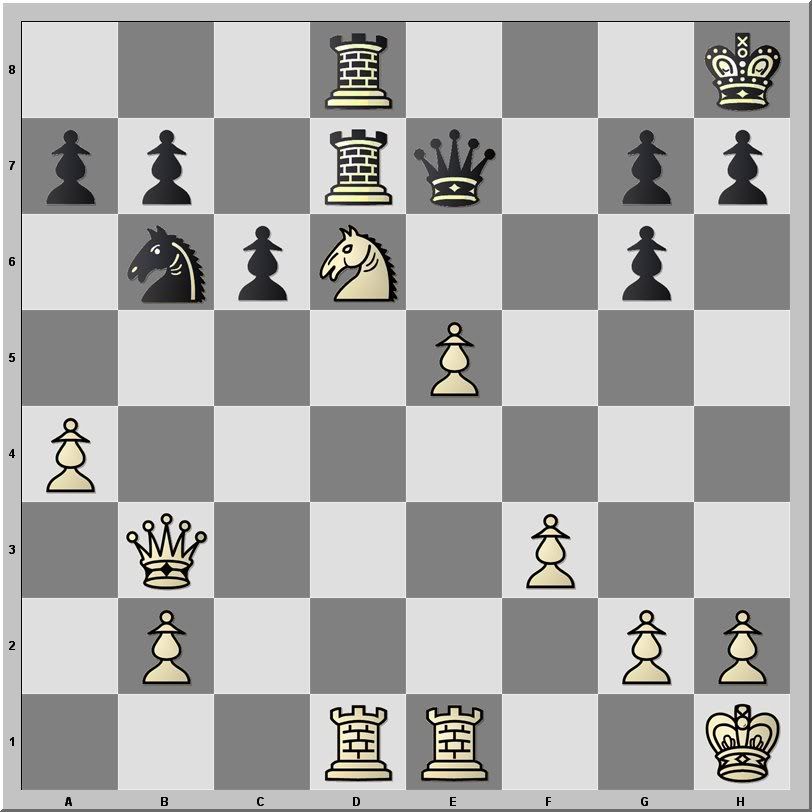
I wanted to play 30.Nf7+, but believed that my opponent could exploit a back rank weakness. I played 30.Kg1? My opponent's feeble 30...Nc8 almost forced me to play the correct move. Move 30 was the right moment, but it returned because of inadequate defense.

In chess, there is good enough and there is correct. Moves that are good enough work against weak opposition, correct moves always work. 30.Nf7! would have been correct. 30.Kg1 was good enough today, but will fail tomorrow.