Showing posts with label Rapid Chess Improvement. Show all posts

27 February 2012

Breaking Through 1900!

New Peak Rating
No more waffling will be permitted. I aim to become a USCF Expert. I had set the modest goal of pushing through the next rating level, 1900, and wrote my New Year's Resolutions to achieve that aim. My first tournament of 2012 was an astounding, and wholly unexpected success! I wanted to score 3.5 or better, believing that would propel me over 1900. I won all my games, took my usual third round bye, and finished in second place in the 20th Dave Collyer Memorial. My new rating is 1933! My head is reeling from the thin air.

Ironically, my winning strategy in two games was playing for a draw. I can neither pursue this strategy with plans for success, nor recommend it. Even so, there is something worthwhile in the efforts to become difficult to beat. In "Rating Estimation," one of the most popular posts on this blog, I mentioned increasing my drawing ratio as part of the path to improvement.
To get to A class, I've needed to learn tactics and endgames, and expanded my opening repertoire. But, more important, I've needed to reduce the obvious blunders made in haste, and I've needed to become far more consistent against lower rated players. I've also increased my drawing ratio.
"Rating Estimation"
I certainly made errors in my four games this past weekend, but these errors were far less severe than some that had been common. My game against Michael Cambareri in round four is a case in point. Just a bit over a year ago, I played a memorable game against Michael. I was talking with others on the nearby boards about this game before round one began. Michael often plays the opening extremely fast, and I became caught up in matching his speed one Thursday night. In the 2010 Turkey Quads, I instinctively pushed my c-pawn without the necessary preparation.

Cambareri, M (1884) -- Stripes, J (1841)
Turkey Quads, Spokane 2010

1.e4 e6 2.d4 d5 3.Nc3 Nf6 4.Bg5 Be7 5.e5 Nd7 6.Bxe7 Qxe7 7.f4 c5?? 8.Nb5 1-0

It was possible to play on and make my opponent prove his ability to convert the advantage gained from winning the exchange. I opted to go home and watch television with my wife. In previous games, Michael had demonstrated to my satisfaction his ability to convert such an advantage. Spending an hour or two suffering from slow strangulation did not strike me as the way that I wanted to spend the evening.

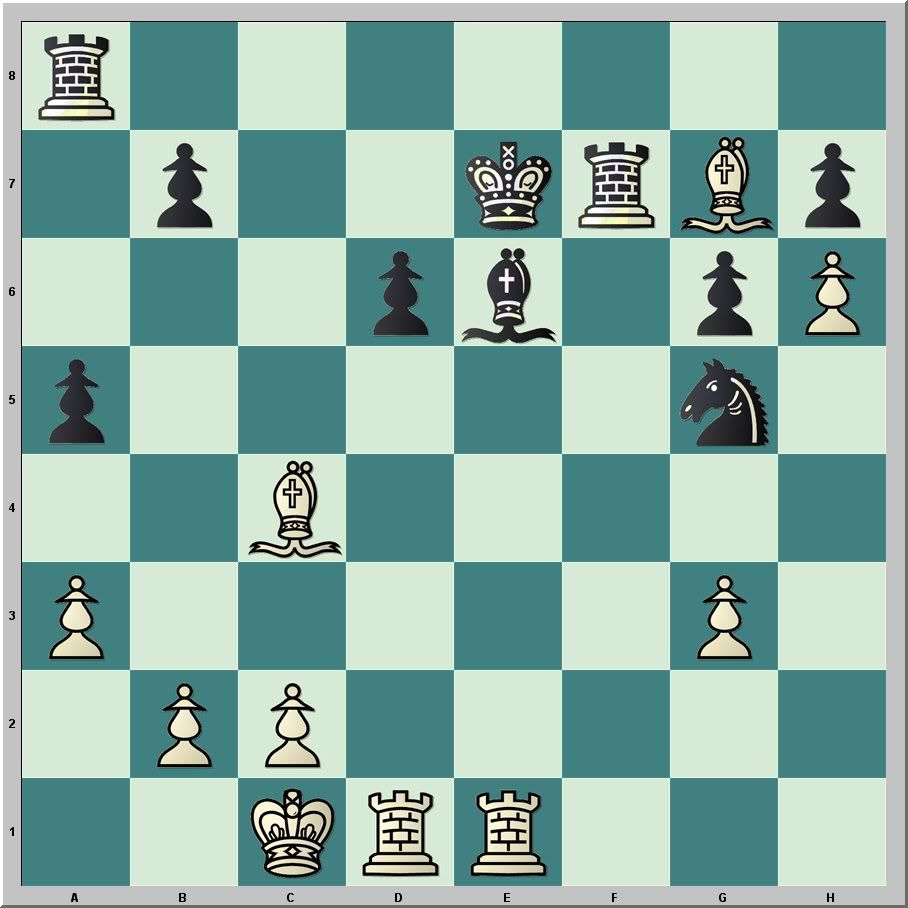
Black to move
Black must play 7...a6. When I played this move yesterday, Michael laughed. He, too, had clear memories of our previous game in the Classical French. This time, after a long think, Michael played an unusual move. It may have been an error. I was able to temporarily win a pawn, and might have taken two. I had a solid position with no clear weaknesses, but for a time was defending passively due to some positional errors. The opportunities that my opponent missed were far less obvious than his opportunity after my egregious tactical blunder in the Turkey Quads. In the end, under time pressure, he turned down my draw offer and then promptly walked into a mating net.

01 January 2012

2012 New Year's Resolutions

It is that time of year: time to make promises to oneself in a fit of motivation for self-improvement. And so, I have some concrete promises designed to lift me over 1900 USCF, and if Caissa has a warm heart, to lift me into the Expert class. In truth, I am unlikely to play the number and strength of events in 2012 that would make Expert a realistic goal, but that is the horizon in view.


The Resolutions

1. Solve a minimum of 50 tactics problems per week.

That should not be difficult, as most days I solve ten of those in the Shredder iPad app. In addition, from time to time I spend enough time with Chess.com's Tactics Trainer to rack up some numbers. Hence, the challenge in number 2.

2. Spend thirty minutes once per week solving problems in Lev Alburt, Chess Training Pocket Book II and Paata Gaprindashvili, Imagination in Chess.

The goal here will be to work through the whole of Chess Training Pocket Book II in 2012, as I did the original Chess Training Pocket Book several years ago. Over the course of the year, problems in the Shredder app and in Alburt's books become the warm-up for more challenging exercises. Over the course of the year, regular work with Imagination in Chess should become the norm. The easy success of quantities of basic tactics should give way to success in solving complex exercises.

3. Complete my Pawn Endgame flash card project.

Two years ago, I created cards that contain all the blue diagrams of the first chapter in Mark Dvoretsky, Dvoretsky's Endgame Manual. I review these cards regularly--they contain no answers--with the intention of being able to know in an instant when looking at each how the position should be played. See the last paragraph of "GM-RAM: Essential Knowledge."

These three resolutions are not too onerous. They demand no new behaviors, but rather greater consistency and purpose in productive activities. Doing these may mean there is less time for one-minute chess. That shift is vital to improving my over the board performance.

13 December 2011

Improving Tactics: Training Resources

For most players, improvement in chess skill will be slow to non-existent if their only chess activity is playing. Tactics training, on the other hand, leads to rapid chess improvement. Resources for tactics training include books, magazines, databases and other software, websites, and more.

At the present time, in any given week, I use the Tactics Trainer at Chess.com (more than 32 hours since joining the site), the problems in the Shredder iPad app, my pawn endgame flash cards, or one of several books.

Ten years ago, I spent 15-30 minutes nearly every morning for several months working through problems in Laszlo Polgar, Chess Training in 5334 Positions (1994), which is pictured at the bottom of a stack in the image. Polgar's book, which may have been assembled by his daughter Susan, consists mostly of checkmate problems. This collection draws from an extensive library of composed problems, and a smaller collection of positions from actual play. The effectiveness of the training stems from repetition of patterns. Problems 1-306 are checkmate in one; 307-3718 are mate in two; 3719-4462 are mate in three. I completed a bit more than the first 1500 problems.

The book also contains 600 miniature games, a bit more than 100 simple endgames, and more than 100 combinations from the Polgar sisters' games. Occasionally, this book shows up on sale tables for $10, which strikes me as an opportunity calling for action.


Art of the Checkmate

While Polgar's Chess teaches checkmate patterns through compositions and miniatures, Georges Renaud and Victor Kahn, The Art of the Checkmate (1953) employs real games. The organization of this classic text, and the quality of instruction it offers, are vastly superior to Murray Chandler, How to Beat Your Dad at Chess (1998). However, Chandler's book uses algebraic notation, while Renaud and Kahn is available only in descriptive. Other books with guides to basic checkmate patterns include Fred Reinfeld, How to Force Checkmate (1947); V. Vukovic, The Art of Attack in Chess (1965); and Jonathan Tisdall, Improve Your Chess Now (1997). My effort to extend the work naming, classifying, and organizing basic patterns by the authors of several of these texts resulted in a self-published pamphlet that I use in teaching, "Checklist of Checkmates: With Exercises" (2007). My pamphlet (pictured above) identifies 34 basic patterns sorted into six groups to aid learning, and offers 139 problems all from actual play. My study of The Art of the Checkmate, and the other books, followed by extensive database research to find examples in play, has done wonders for the development of my skill.


Basic Tactical Motifs

My library contains several terrific workbooks designed especially for youth who are beginning to intermediate players. These workbooks vary in method and content, but all stress basic tactical motifs--discovery, pins, skewers, removing the guard, etc.--through repetition. John A. Bain, Chess Tactics For Students (1993) uses fill-in-blank worksheets with clear diagrams. Chapter one offers 30 problems involving pins. Subsequent chapters are "Back Rank Combinations," "Knight Forks," "Other Forks/Double Attacks," and ten more chapters. After completing this workbook, young players might advance to Al Woolum, The Chess Tactics Workbook, 4th edition (2000); Todd Bardwick, Chess Workbook for Children (2006); or Dean Ippolito, Chess Tactics for Scholastic Players (2006). Each of these other three offer problems more challenging than Bain's, but also include very simple problems in the beginning. Those sensitive to patronizing language towards women and girls may find the prose in Bardwick's text distracting, but it offers good quality instruction otherwise.

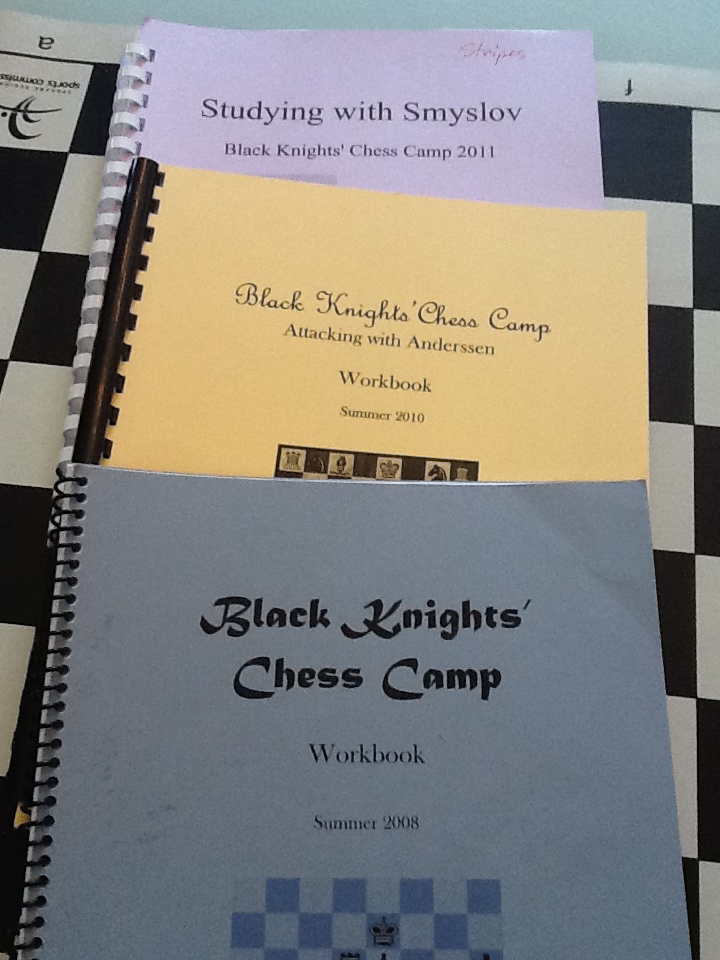
For my annual chess camp, I create workbooks with problems that teach and reinforce tactical motifs. In 2008 and 2009, I used the same workbook. In 2009, I sought tactical problems and strategic lessons exclusively from the games of Adolf Anderssen. See "Learning from Errors: Adolf Anderssen" for a sample strategic lesson from this workbook. In 2011, my tactical problems all came from the games of Vasily Smyslov, and emphasized advanced endgames a bit more. For several years I have been contemplating doing more with Gioachino Greco, but doubt there is enough there for all of what I usually put into a workbook.

While my chess students and their parents gain access to an abundance of free and inexpensive resources that I churn out as teaching materials, the research process improves my skills, too. When I am not solving problems, I am looking for problems to put in front of beginning players. Sometimes, these are more challenging than expected, as last week's lesson on pins proved to have been.


Tactics for Advanced Players

Prior to the explosion of youth chess, a standard beginning text was Fred Reinfeld, 1001 Winning Chess Sacrifices and Combinations (1955). It is organized by theme with dozens of problems in each chapter. Generations of masters have started with this book. Reinfeld wrote a few other 1001 texts, but this one seems most widely available. In "Where the Rubber Meet the Road," I detailed my training method with this text and a chess playing engine. Beyond finding Reinfeld's idea, I labor to convert the advantage gained through the tactic. I have not employed this training method in 2011, but expect to return  to such training for part of 2012.

Lev Alburt, Chess Training Pocket Book (1997) contains 300 positions, four to a page. The solutions are on the facing page, making self-discipline a necessary feature of using the text for training. These well-chosen 300 positions, most from practical play, include common tactical motifs, positional concepts, and endgame fundamentals. Over the course of several years, I went through the entire book both randomly and in sequence at least twice, and have also used the book as a reference when compiling lessons for others. This book spent several years on my bedside table. The book indexes the problems by themes and by players. Alburt, Chess Training Pocket Book II (2008) offers 320 new positions in the same format. This book will be a central component of my training in the near future. With such collections, I think it is best to go through all the problems, and then several months or a year later, go through them again.

Most club players should be able to solve the problems in Alburt's books in no more than a few minutes each, and errors will be easily corrected. A few times through these books should leave the student with a core knowledge of important positions. For more challenging tactical exercises, I turn to John Nunn's Chess Puzzle Book (1999) and Paata Gaprindashvili, Imagination in Chess: How to Think Creatively and Avoid Foolish Mistakes (2004). Both of these texts offer fresh positions. That is, the positions in these texts will not be found in Reinfeld. Some of those in Alburt's texts are in Reinfeld, as well as in dozens of other training texts. Alburt's books lay the foundation that helped me reach USCF Class A, and to secure my position there. As I struggle to move up to Expert Class, and possibly master, Nunn's and Gaprindashvili's texts offer resources of value. Imagination in Chess also offers suggestions for effective thought processes. Gaprindashvili's logical process may be considered an improvement over the famed analysis tree in Alexander Kotov's Think Like a Grandmaster (1971). Readers may differ in their assessments of these modes of systematic thinking.

Two other challenging texts offer exceptional insight into the nature of chess tactics, and plenty of training material. These are not collections of problems so much as treatises on the the middlegame. Yuri Averbakh, Chess Tactics for Advanced Players (1992) seeks to build a theoretical base for comprehension of chess tactics. Mark Dvoretsky, Secrets of Chess Tactics (1992) takes a more practical approach, but also contains much of theoretical value. The positions analyzed in both texts can be quite challenging, even for masters.


17 August 2009

Reinforcing Error

Unlike Michael de la Maza (Rapid Chess Improvement [2002]), who quit chess, and his minions, my chess improvement stems from a varied approach. My tactics training encompasses periodic commitment to playing from the key position to the computer's resignation (see "Where the Rubber Meets the Road") interspersed with working a website's system, such as Chess Tactics Server or the Tactics Trainer at Chess.com (see "Milestones"). I also use training exercises that Fritz or Hiarcs creates during its automatic analysis of games, or that users can create with the assistance of this software. Claude Kaber's training exercises are exemplary for illustrating the potential of this feature (see "Good Luck").

The exercises created automatically by Fritz, however, should be greeted with skepticism. The engines like drama.


Fritz Training Flaws

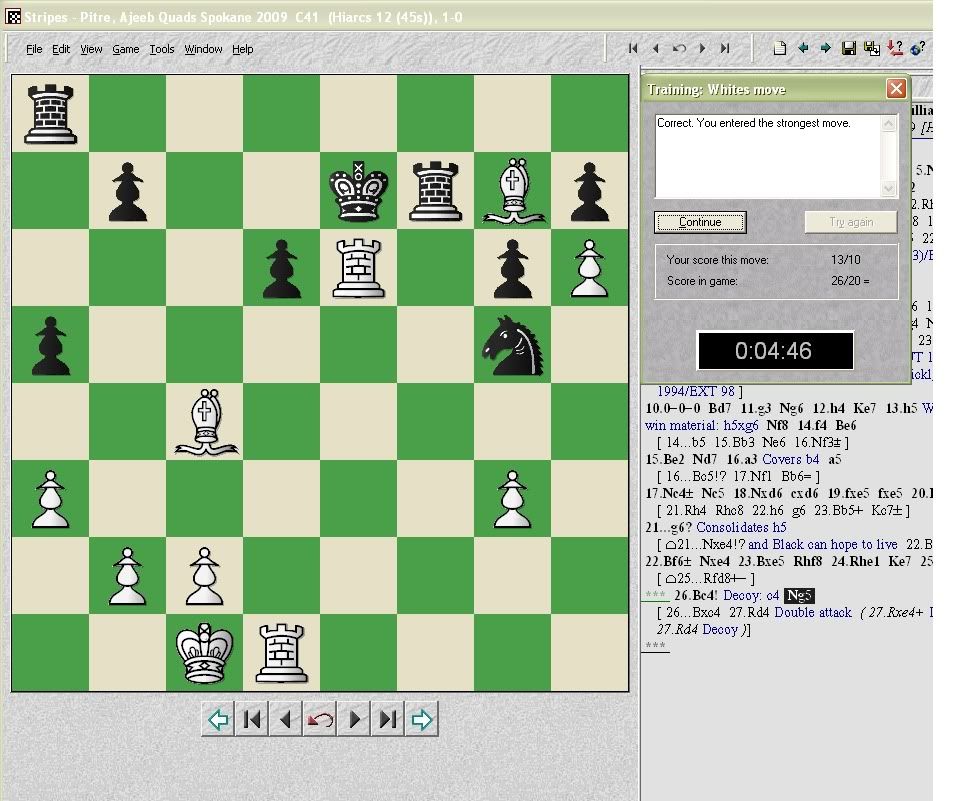
When I ran my game from last Thursday through full analysis by Hiarcs 12 (this engine uses the Fritz 11 interface), it created two training problems. The second is from this position awaiting my move 27.

White to move


During the game I looked at this position, found the dramatic 27.Rxe6+, and executed it. In my interior monologue I was telling myself that I was winning a piece through brilliant forcing play. Indeed, I was implementing that sage advice uttered by chess teachers everywhere, such as Peter Kurzdorfer, The Tao of Chess (2004).
The key to checking multimove combinations is to concentrate on the forcing moves: checks, captures, promotions, and the immediate threats to check, capture, and promote. By cutting it down to these forcing moves, you now have some manageable numbers to work with. The moves you look at are the ones that will likely affect the outcome of the game.
Kurtzdorfer, 108
Immediately after executing my "brilliant move," I found the antidote. My opponent had a defense that refutes my idea. Instead of winning a piece as I had thought, I would have a bishop and two pawns for a rook. My internal monologue became hypercritical, telling myself how I will never advance in chess if I keep making hasty moves that I have not fully calculated.

The rook check fails, and had I examined why it failed, I could have quickly found the much superior 27.Bd5. A fundamental element in tactical training and calculation is the process that Paata Gaprindashvili calls "reciprocal thinking" in his challenging Imagination in Chess: How to Think Creatively and Avoid Foolish Mistakes (2004).
After noticing an idea and briefly familiarizing ourselves with it, we proceed to its detailed examination. What do we do if we find that it doesn't work? ... If we fail to make an idea work, we need to stop and ascertain the cause of failure (i.e. answer the question "why?"), and then attempt to correct our design.
Gaprindashvili, 40
Without detailed examination, the failure goes unnoticed.

I was lucky. Under the pressure of my forcing move, my opponent cracked and offered the game losing blunder on move 28. It's no wonder that Hiarcs likes forcing moves. Carbon-based lifeforms capitulate to such deceptions with regularity. But the engine knows better, so why did it create this training exercise?


After executing the same move that I played in the game, I read, "Correct! You entered the strongest move." But this feedback is wrong. My move is not among the half-dozen best choices. Although forcing, and although successful in this case, it might have cost me the game.

According to the quantitative assessment of Hiarcs 12 from the problem position, White's advantage is greater than two pawns. 27.Bd5 is assessed at +2.29 with a depth of 16, and is slightly inferior to +2.39 for Re3. After executing the move from the game, the assessment drops to +0.85. When I annotated this game in the wee hours of Friday morning (see "Last Night"), I gave my move a single ?; I might have given it two, calling it an egregious blunder.

Tactics training with these automatically generated exercises, if they have not been checked for accuracy, will cultivate one's vision for forcing moves. Rather than improving the necessary abilities for calculation, however, such problems may reinforce error.

22 July 2008

Posers and Provocateurs

Of making books there is no end, and much study is a weariness of the flesh.
Ecclesiastes 12: 12

Some writers pump out books and articles as if writing is as easy as breathing. But not all these prolific writers put out good quality. It is well known in many circles, for example, that the great quantity of texts put out by Eric Schiller could use improvement in quality. His reputation is such that John Watson prefaced positive comments regarding a Schiller authored CD with the phrase, “At the risk of being controversial” (Chess CDs: Coming of Age?). Edward Winter’s criticism is more strident: he lists a Schiller text (written with Raymond Keene) among the “five worst chess books” (ChessBase News), and in “Copying” documents evidence of plagiarism in his books. Schiller’s The Big Book of Combinations (1994) not only originates almost in its entirety from The Encyclopedia of Chess Middlegames (1980), it reproduces errors from the original.

Bill Wall is another prolific writer whose work in chess history is nearly endemic in cyberspace. In the Endless Quiz at chess.com, for example, one of the top scorers has a mediocre percentage of correct answers, but has submitted a great many questions that appear to originate from Bill Wall’s Geocities site. Tryfon Gavriel asked about the accuracy of Wall’s “Correspondence (Postal) Chess” at The Correspondence Chess Message Board and received from Tim Harding the reply, “i would warn all readers that the byline on that page is not a guarantee of quality, rather the reverse in my opinion.”

Another category of “poser” might include the one book wonder, Michael de la Maza. His Rapid Chess Improvement (2002) is regularly stocked in bookstores, and has stimulated numerous clubs, blogs, and forum discussions. Jeremy Silman points out the grandiose nature of some of the claims of MDM (as he is often called in online forums), and notes that there is nothing new in MDM’s point that “tactical skill acquired by hard work will make you much stronger” (Review of Rapid Chess Improvement). It doesn’t take long looking at Michael de la Maza’s Member Details page at the USCF to notice a couple things. His claim that he started in the 1100s is misleading. His initial established rating was 1344, and he had some results that would suggest he might be stronger than that to start out. Many of his losses were to unrated or provisionally rated players that quickly rose into the B and C classes. De la Maza, for his part, rose quickly it would seem not only because he worked at chess an average of three hours per day, but because the level of his competition taught him many things. There’s no reason to believe he had acquired the bad habits that most adult players must correct in order to improve (the sort that online blitz reinforce, further hindering progress). Moreover, de la Maza no longer competes at chess—this fact alone should give pause to all those that wish to imitate his rise.