Showing posts with label Adams (Faneuil). Show all posts

16 June 2015

Applied Study

Correspondence Chess

Research is a central pleasure of correspondence chess. Using opening books, databases, and both print and electronic versions of Chess Informant elevates my play in the short run and expands my over the board repertoire in the long run.

As I was finishing high school and starting college, I played in a US Chess Federation Correspondence tournament in which moves were sent via postcard. My only opening book in those days was I. A. Horowitz, Chess Openings: Theory and Practice (1964). After finishing graduate school, I entered a few more USCF postal events. I bought the A volume of Encyclopedia of Chess Openings (ECO) and tried to steer my games to lines that were found therein. I also bought Informant 64. One of the games in that issue was especially helpful in a game against Faneuil Adams, Jr. (see "Playing by the Book").

In the early 2000s, I made the switch from postcard to email for correspondence chess. Then, in 2003, I started playing on websites where move transmission was a matter of clicking and dragging a chess piece on a computer screen. Record keeping is handled by the website. Move transmission in this new form of correspondence chess differs enough from postcards and email, that many players no longer think of it as correspondence chess.

I learned a lot playing in a Spanish Opening thematic on the first of these websites that I joined. I scored a nice victory on the Black side of the Chigorin variation and also made my first efforts with the Marshall Attack.

By the time I was playing turn-based chess, as some call this online correspondence chess, I had all five volumes of ECO and a library near 200 volumes, including many specialized texts on my favorite openings. Now I have ECO in both print and electronic editions, and I have all 123 Chess Informants in electronic versions (Informant 124 comes out next week--I've ordered book and CD).


The Study Regimen

Sitting at the table with a chess board and opening monograph and systematically working through the lines may be a worthwhile study technique. I am certain that is how many players learn their openings. That is also what I did in the late 1970s with Horowitz when I was supposed to be working on my high school homework. But, for me, such study is a rare activity.

My book study more often consists of working through entire games, such as those by Paul Morphy, or middle game books, or Dvoretsky's Endgame Manual, a book that I have as both print and Kindle (see Pawn Endings Flash Cards).

On the other hand, all of my opening resources come out during some of my correspondence games. Last week when I logged into ChessWorld.net, I discovered that a new team match had begun, adding eight new games to my load. It is time to hit the books.

Against one opponent, I am trying a new line against the Tarrasch French that is recommended in both The Flexible French (2008) by Viktor Moskalenko, and The Modern French (2012) by Dejan Antic and Branimir Maksimovic. Using my ChessBase database, I located games in this line played by Moskalenko and by Antic. I am studying these games.

Against another opponent, I opted to play the King's Gambit. I have been deploying the King's Gambit in many of my blitz and bullet games the past few weeks. I also played in in one of my worst tournament games ever (see "Knowing Better"). The King's Gambit has been an occasional weapon for me off and on since the 1970s. Because one of my top students plays it, I am studying it again. I watched Simon Williams' King's Gambit video series on Chess.com. John Shaw, The King's Gambit (2013) arrives tomorrow.

As I play through my correspondence games, I study the relevant portions of the opening lines in these books and others. I look up the positions in Chess Informant and examine some of the games. During one recent correspondence game, I went through every one of the more than one hundred games ever published in Informant that had reached the position I had at that moment. That work took the better part of a weekend. The game might have ended as a draw, but my opponent was banned for cheating and I won on time.

Sometimes I use Chess.com's Game Explorer or ChessBase to play the percentages, choosing lines that have scored well in the past for my side of the board. When I have the time, I look for lines that score well for my opponent, but that have a recent refutation in Informant or some other collection of annotated games. Knowing that many of my opponents use the same databases that I do, I try to beat them with better research.

27 March 2011

Playing by the Book

Among the attractive features in correspondence chess is the research element. In ancient times, serious correspondence players with the means and the space built up huge libraries of chess books and periodicals. When Chess Informant come into existence with its innovative opening classification system, this publication became the standard. Not everyone had equal access to information, naturally.

Kon Grivainis explained his strategy while playing in the World Correspondence Chess Federation's championship without the access to the latest theory that was available to his opponents:
Due to my travels I had discarded all my opening books. I did not have any. ... I had to find obscure variations! Remember Fischer--he used to do that to get away from the Russian research.
Grivainis, Winning Correspondence Chess (1997), 70.
He adopted the Trompowski Attack as part of his strategy to avoid the deep study of trendy opening manuals.

My first taste of correspondence play began with friends in the 1970s, and I entered one USCF tournament. My "extensive" chess library consisted of some one dozen books, including I.A. Horowitz, Chess Openings: Theory and Practice (1970). As college brought new activities into my life, chess play all but ceased. I returned to active chess after finishing graduate school, and entered some correspondence events in the late-1990s. It was then that I bought my first issues of Chess Informant, and the first two volumes of the Encyclopedia of Chess Openings.

One game that I played in the late 1990s became memorable because my research took me to one specific game in Chess Informant 64. My game had the same position as the reference game for a single move, but studying Chess Informant suggested an idea that carried me through to victory. Of course, notes in the printed copy of this volume, and in the margins of my printed ECO confirm that I looked at a great many games with similar ECO codes. In addition to CI and ECO, I had a copy of Zoltan Ribli and Gabor Kallai, Winning with the English (1992). The Informant reference game was a win by Ribli in the 1995 Hungarian Championship.

Ribli,Z - Sherzer,A [A12]
Magyarorszag 64/7, 1995

1.Nf3 Nf6 2.g3 d5 3.Bg2 Bf5 4.d3 e6 5.0–0 Be7 6.c4 c6 7.b3 0–0 8.Bb2 Nbd7 9.Nbd2 a5 10.a3 h6 11.Qc2 Bh7 12.Bc3 b5 13.cxb5 cxb5 14.Qb2 Qb6 15.b4 axb4 16.axb4 Rfc8 17.Rxa8 Rxa8 18.Nb3 Bd6 19.Ra1 Re8 20.Bd4 Qb8 21.Bc5 e5 22.Ra6 Nxc5 23.bxc5 Bc7 24.d4 e4 25.Ne5 Bxe5 26.dxe5 Nd7 27.Qd4 Nxe5 28.Qxd5 Nc4 29.Bh3 e3 30.f3 Rd8 31.Bd7 Qc7 32.Ra8 Bc2 33.Bf5 1–0

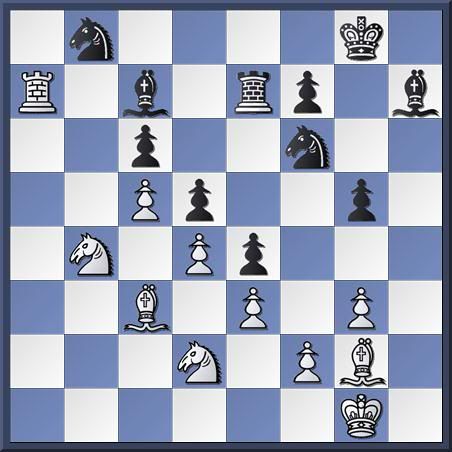
My opponent was Faneuil Adams, Jr., one of America's premier chess patrons. The game was played the two years prior to his death. We began early in 1997, and he resigned in November 1998. During the game we carried on a bit of conversation concerning scholastic chess on our move cards--I was a single father of a young boy who began showing an interest in chess at age four, and Adams helped found New York's Chess-in-the-Schools program. I remember the conversation as much as the game. It was a privilege to play this distinguished opponent.


Stripes,James - Adams,Faneuil [A12]
97 CA 17 USCF Class, 1998

1.c4 c6 2.Nf3 d5 3.b3 Bf5 4.g3 Nf6 5.Bg2 e6 6.Bb2 Nbd7 7.0–0 h6 8.d3 Be7 9.Nbd2 0–0 10.Qc2 Bh7 11.a3 a5


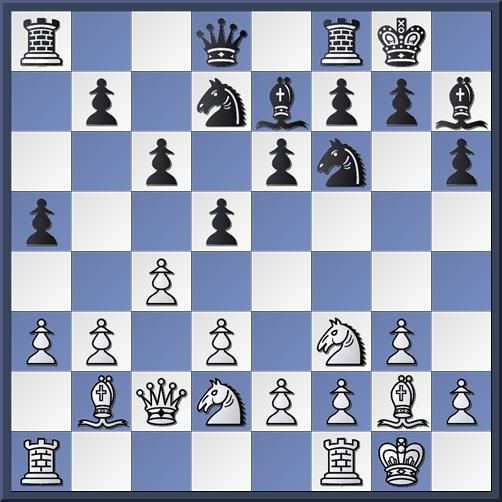
Through an entirely different move order, we have reached the same position as Ribli-Sherzer 1995 that I found in Informant 64/7.

12.Bc3!

Copying Ribli. Studying Ribli's game suggested reasons for this move: supporting b3-b4, and vacating b2 for the queen. From b2, the queen asserts her influence along the long diagonal and supports action along the a- and b-files. The flexibility of these two-pronged assaults and their facilitation by the quiet Bc3 was outside the scope of how I had been thinking about chess strategy prior to this game.

12... Qb8

12...b5 was played by Sherzer

13.b4 axb4 14.axb4 Rxa1 15.Rxa1

15.Bxa1? Bxb4 16.Rb1 c5 gives Black an edge.

15...e5 16.e3 Re8


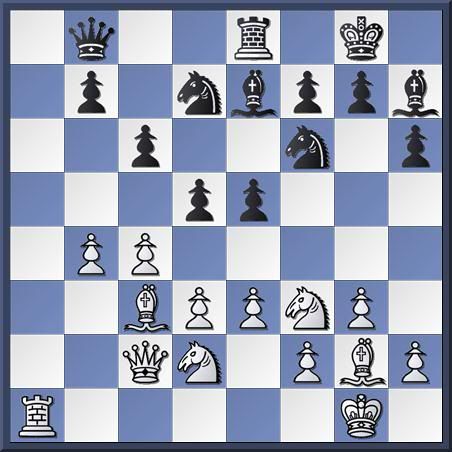
17.Qb2

White prepares the advance b5.

17...Bd6

Black plans e4.

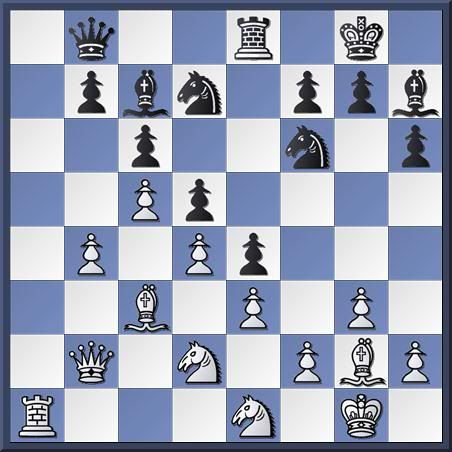
18.c5 Bc7 19.d4 e4 20.Ne1


20... h5

One of the small errors: failing to interfere with White's plan. 20...b5 21.Qa3 would have left White with a very slight edge.

21.b5 g5

Rybka prefers 21...Bf5 22.Nc2.

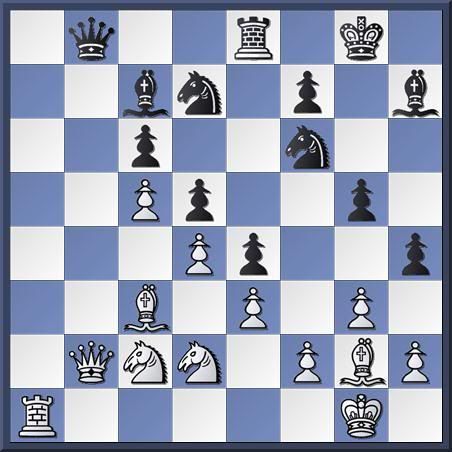
22.Nc2± h4

Another slight error.

22...Bd8!?±

23.bxc6+- bxc6


24.Qxb8

I might have built up pressure more effectively with 24.Nb4 Qb7 25.Ra6 Kg7 26.Rxc6 Rd8+-.

24...Nxb8± 25.Ra7 Re7 26.Nb4 hxg3 27.hxg3


27...g4?

One of only two moves given a question mark by Rybka 4 full analysis. It's an ugly move that reduces the mobility of Black's light-squared bishop. Such dynamic positional concepts within the algorithms of chess software, it seems to me, contributes in large measure to the current strength of Rybka, Hiarcs, Fritz, and other leading engines.

27...Bf5!? and Black is still in the game

28.Na6+- Nxa6 29.Rxa6 Re6 30.Nb3 Nh5?

The other move that Rybka deemed an error. But, the superior 30...Ne8+- does not change the game's evaluation. It is clear that White's penetration on the queenside will roll up Black's defenses. What can Black do to generate some play? My opponent seized on the idea of sacking a piece for two pawns, perhaps creating a vulnerability for my king.

31.Ba5 Bxg3 32.fxg3 Nxg3 33.Bc7 Nf5 34.Be5 f6 35.Ra8+ Kg7 36.Ra7+ Kg6 37.Bf4 Bg8 38.Bf1 Bf7 39.Ba6 1–0