Showing posts with label Spokane. Show all posts

29 September 2026

Blown Opportunities

On Saturday I played the first three rounds of the Eastern Washington Open in Spokane with no intention of playing on Sunday as I had told my wife we could watch football together while I smoked some ribs. All of my games were against youth players, presumably underrated. I won two and lost one, causing my rating to go down 12. In every game, the losing player had a decisive advantage at least once during the game. Those blown opportunities are presented below.

My first round opponent finished the event in seventh place with 3.0. He had a draw and win against the other two A Class players whom he faced. Our game was his only loss.

White to move
21.f5!?

Liam played a forcing sequence, although 21.e5 or 21.Ng5 would have offered a more sure route to advantage.

21...Nxe4 22.Nxe4 Qxd2??

22...Nxf5 is equal

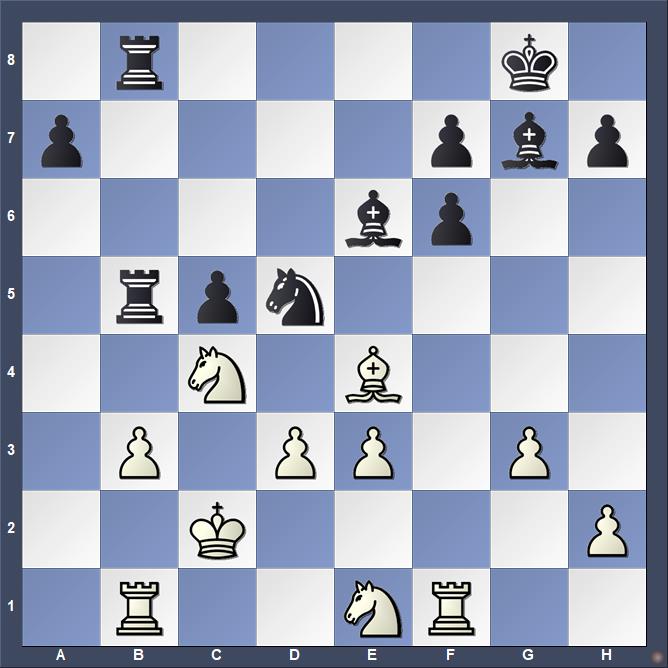
White to move
There are four ways to capture the queen.

23.Rxd2??

23.Bxd2 and White has a clear advantage.

The move played allowed me counterplay and a few moves later I had three pawns for a knight. In a minor piece ending with six pawns to three, my opponent erred again and gave up another pawn, then traded one of his bishops for my last piece, giving me an easy four pawns vs. bishop ending.

My second round opponent, Declan Pham, finished in third place with 3.5 and gained 141 rating points, lifting him over 1500, still well below his playing strength. The others with 3.5 were two A Class players and an expert. He beat another A Class player in round three and drew one in the final round. His only loss was to strong A Class player Michael Cambareri in round four.

He took advantage of my passive opening play to seize the initiative with Black, then he won a pawn. Things were looking grim for me, but he overestimated his control of the long diagonal when he snatched a second pawn.

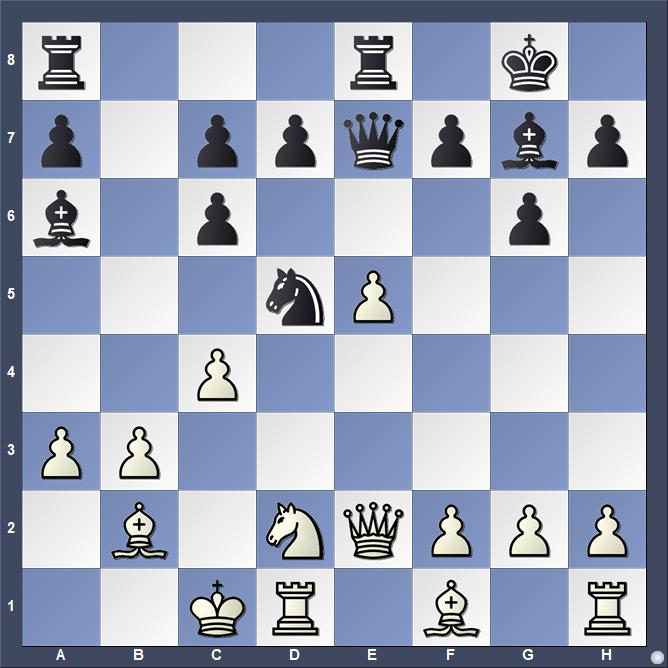
White to move
19.Bb2??

I also overestimated his control of the diagonal. He went on to win a long endgame where I never had a chance except throwing up some smokescreens that obscured his advantage.

19.Qxc3 was a winning move in light of of 19...e4 20.Qe1 Bxa1 (the move that I feared) 21.Bf4! Qe7 22.Qxa1

A bishop and knight for a rook and two pawns is still a material deficit, but Stockfish insists that I would have had a clear advantage. What I might have been able to perceive was that White also gains domination of the dark squares and that makes the Black king somewhat vulnerable.

My third round opponent, John, played a strong game against me in the Inland Classic last February, but I was able to get some initiative against his uncastled king. He remembered that loss and told me before our game, "I learned to castle." "Oh," I said, "so, you are better?" "Yes", he said. "So, you'll beat me?" "Yes." "Good to know."

He had several opportunities to do so.

White to move
My opponent offered a draw. I informed him that the rules required that he make his move first and that I would record the draw offer on my scoresheet.

22.Qc5

22.Bxa6+- wins a pawn and severely weakens my queenside.

He also missed some opportunities earlier in the game to disrupt the coordination of my pieces and pick up some material.

Beginning at move 29 we had a knight ending. The game lasted 83 moves. Along the way, I missed a clear advantage here.

Black to move
40...Kg8

I considered 40...exf5, but neither looked beyond nor accurately assessed the position after 41.Kf4 h4. Black would have had a decisive advantage. The game went on with me pressing for a win without a real advantage. John's last chance to hold the draw came with his 60th move.

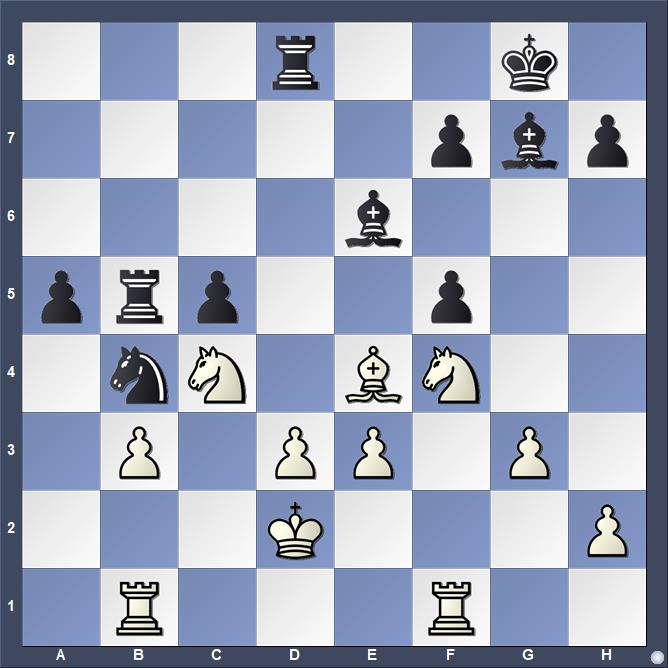
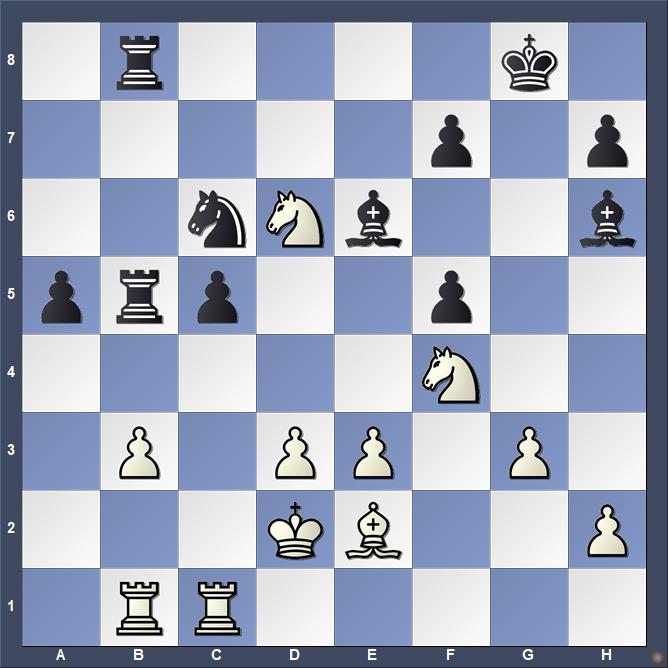
White to move
60.Nc5??

Both 60.Nb4 and Kd4 allow White to extinguish Black's remaining pawns with a knight sacrifice.

After 60...Nc4+ 61.Kd4 Nxa5, Black's win is only a matter of time, as White will eventually be forced to give up the knight for one pawn. John's rating also dropped in this event, but he will bounce back. He's getting good experience playing adults and learning from his errors.


15 July 2026

Groping in the Dark

At what level of play can someone be considered good at chess?

During his lecture at the Spokane Chess Club last on the eve of the Inland Classic, IM John Donaldson was discussing Bobby Fischer's remarkable rise after 1955. Donaldson has written several excellent books on Fischer, most recently Inside the Mind of Bobby Fischer: Revisiting His Writings and Annotations (2025). Fischer's rating in 1955 was mid-1700s. Donaldson mentioned some recent analysis of games from Fischer's first rated event that led to that rating and quipped, "he was not very good". 

In contrast to this critical historical assessment of the early career on one of the greatest chess players ever are innumerable threads in social media asking, for example, whether 1100 is a good rating. Most comments in such threads--this one has more than 350--note that 1100 is well above the average on the site. Similarly, a player near the bottom of the standings in the tournament that we played in this past weekend with a USCF rating in the 900s is at the 59th percentile. That player scored a 500+ point upset in the first round, then lost the rest of his games. These players are offered comfort in the knowledge that they are better than half of all rated players, and substantially better than the majority of casual chess enthusiasts who never enter competition.

My rating just above 1860 puts me at the 94th percentile. I told Donaldson on Sunday morning that his comment about Fischer was helping me come to terms with the fact that I'm not very good and never will be. John did not say much about this remark, but we had several conversations throughout the weekend, including him soliciting my insights into finding historic chess games online and a brief discussion of the writing of John Steinbeck, whose published books I am working my way through.

My perspective is grounded in comments I made last spring about the defects in the play of A-class players (see "Two Donner Quotes") and my sense in round two on Saturday that I was unable to comprehend and correctly assess the positions through much of the game. I believed that I was slightly worse early on, but had provoked some pawn structure weaknesses that were exploitable in the ending. When my B-class opponent blundered, I immediately recognized that my winning chances had become very good. In the brief post-game discussion, he immediately mentioned that terrible move that turned a roughly equal position into one where he was clearly worse.

From the point of view of the elementary students whom I coach, and that of the average USCF player, those of us in A-class are strong. Compared to masters and above, we are quite weak. Maybe we have some knowledge, but we also fall prey to bad habits, misevaluate positions through appalling ignorance, and fail to calculate with any precision.

Stripes,James (1865) -- Lopez,Francisco (1614) [A49]
Inland Classic Spokane Valley (2), 21.02.2026

1.d4 Nf6 2.Nf3 d6 3.g3 g6 4.Bg2 Bg7 5.Nbd2

Black to move

This move does not seem to me particularly strong, but I've been playing it in similar positions online the past few months. My idea is to maintain the flexibility to play e4 or c4, depending on how my opponent responds. Of course, blocking the mobility of the dark-squared bishop should be seen as a loss of tempi. 

I had the Black side of this position in round four, when my opponent played 5.c4 instead of my 5.Nbd2. That game continued 5...0-0 6.0-0 Nbd7 7.Nc3 c5 I was already feeling a bit lost in terms of my understanding of how Black should proceed here. 8...e5 is more common and scores much better.

5...Nc6 6.c3 0-0 7.0-0 e5 8.dxe5 Nxe5

8...dxe5 9.e4 a5 10.Qc2 Be6 11.Rd1 Qc8 0-1 Stavrianakis,I (2316) -- Stojanovic,D (2488) Belgrade Trophy 26th 2012

9.Nxe5 dxe5 10.Qb3 c6 11.Rd1 Qc7

White to move

Black's pieces are more mobile.

12.a4

12.Ne4 Nxe4 13.Bxe4 Be6 14.Qb4 Rfd8 15.Be3 Rxd1+ 16.Rxd1 Bf8 17.Qa4 a6 18.Qc2 Rd8 19.Rxd8 Qxd8 20.b4 f5 21.Bg2 Qd7 22.a4 ½-½ Lupinski,I -- Remenyi,B Wch U18 Girls 5th Guarapuava 1991 

12...Be6 13.Qc2 Bf5

Black should play 13...a5, neutralizing White's effort to create a weak point.

14.e4 Bg4 15.f3?!

Black to move

15...Be6=

15...Qb6+ 16.Kf1= (16.Kh1 Be6 17.a5 Qf2 18.Rf1 Qe2 19.Qd1 Qxd1 20.Rxd1 Rad8with a slight edge for Black)

16.Nf1

16.a5

16...h6

16...a5

17.a5 Rfd8 18.Be3

White to move

By this point, I was beginning to formulate a plan. When I played 12.a4, the intent was to provoke a weakness on the queenside. Now, the nature of that weakness is coming to light. Even so, this weakness offered me no advantage until my opponent's tactical error.

18...Kh7

18...b6 19.axb6 axb6=

19.Rxd8! Qxd8 20.Qf2 a6

I was optimistic that swapping the heavy pieces would leave Black with a vulnerable b-pawn that my king could threaten. However, if Black's king defends the pawn, it is not clear that I could make progress elsewhere.

20...b6 21.axb6 axb6 22.Rxa8 Qxa8 23.Bxb6 and White is slightly better; 
20...Bf8 21.Nd2=

21.Qe2?!

This move was rooted in shallow calculation and failure to understand the most important elements of the position

21.Nd2 would have been better with the idea of controlling c4.

21...Qe7 22.Bb6 Nd7|

Somehow I overlooked this move.

White to move

23.Be3 Rd8 24.Rd1 Nf8

I was happy for the opportunity to exchange the heavy pieces and continue with a minor piece struggle, thinking that I had some chances to exploit the hole on b6.

25.Rxd8 Qxd8 26.Bb6 Qd6

26...Qb8 27.b4=

27.Qd2 Qe7 28.Qd8

Forcing a minor piece ending (or is the resulting position still a middlegame?

28...Bf6 29.Qxe7

29.Qb8! Bg7 (29...Nd7 30.Qxb7) 30.b4 White may have a slight edge 30...Qd7 31.Bc5 Qc8 32.Qxc8 Bxc8 33.Kf2

29...Bxe7=

White to move

30.Ne3 Nd7 31.Ba7

31.Bc7 f6 32.b4 c5 33.Nd5 Bf8 34.Bf1

31...Bc5

31...Nc5 32.Nd1 Na4 33.Kf1

32.Bxc5 Nxc5 33.Bf1 f6

I expected 33...Nb3 when I tried to work out a line that could give me an advantage.

34...Bc8?!

34...Kg7; 
34...Bxc4 35.Nxc4=]

35.Kf2 White is playing for an advantage, but does not have much chance of winning.

35.b4 Ne6 36.Bxe6 Bxe6

35...Kg7 36.Ke2

36.b4 Na4 37.Nd1

36...Kf8 37.b4 Ne6 38.Ng4

38.Bxe6 might be best 38...Bxe6

38...Kg7 39.Kd3

39.Nf2!

39...Ng5 40.Ke3= 

Black to move
40...Nf7??

40...Bxg4 41.fxg4 Nf7 42.Bxf7 Kxf7 43.Kd3 Ke6 44.Kc4 Kd6 45.h4 h5 46.g5

Black to move
Analysis diagram

46...f5 (46...fxg5?? 47.hxg5 Kd7 48.Kc5 Kc7 49.c4 Kd7 50.Kb6 Kc8 51.b5 axb5 52.cxb5 cxb5 53.Kxb5 Kc7 54.Kc5+-) 47.Kd3 Ke6=

41.Bxf7+- h5

41...Kxf7 42.Nxh6+ Ke6 43.Ng4+-

42.Nxf6

42.Nxe5 fxe5 43.Be8! Bh3 44.f4+-; 
42.Bxg6 hxg4 43.Bh5 gxf3 44.Kxf3+-

42...Kxf7

42...Kxf6 43.Be8 (43.Bb3 was my intended move, but Be8 is better)

43.Nh7 Kg7 44.Ng5 Bd7 45.Kd3 Kf6 46.h4 Ke7 47.Kc4 Kd6 48.f4 exf4 49.gxf4 Bg4 50.Nf7+ Ke7 51.Ne5 Bh3 52.Nxg6+ Kd6 53.Kd4 Bc8 54.f5 Kc7 55.Kc5 Bd7 56.Nf4 Be8 57.e5 1-0

Once I had a clear advantage, I played as if I understood the game. But, my memory of this game lingers as several hours of confusion.

29 September 2025

Be Alert

It is one thing to solve tactical exercises, but quite another to seize such opportunities when they arise in our games. Often we get caught up in our plans to such an extent that we carry on with a sequence of moves unaware that an opportunity for advantage arose.

I noted in "Two Donner Quotes" that A Class players have defects in their game. Yesterday, in the last round of the Eastern Washington Open, my opponent, a strong A Class player, missed an opportunity after my 23...Ng4? I had considered 23...b5, which Stockfish sees as slightly better for Black.

White to move
Five moves later, it was my turn to miss a chance for a decisive advantage.

Black to move
What would you play in these two positions?


28 August 2025

National Grade Level Championships

A national youth event is coming to my city in December. Registration is open for the National K-12 Grade Chess Championships, which will be held 12-14 December 2025 at the Spokane Convention Center.

Website for the event: K-12 Championships.

18 May 2025

Seek the Truth

Many years ago I was going through a game played by two others at the Spokane Chess Club with the one who lost the game. We were looking for improvements in his play when his opponent stopped by, stating, "but, this is what happened in the game." That player who won that game never got his rating substantially above where it was then. The other player continued to improve. Both of them have far better records against me than anyone else rated 500 points lower, but that's another story.

Yesterday, at the Inland Empire Open, my second round opponent resigned at move 22. In the post game analysis, our task was to find his errors and improve upon them rather than celebrate my performance. Analyzing with Steve and other opponents is also one of the central pleasures of weekend chess tournaments.

In 2006, Steve and I tied for first in the Reserve (u1700) section of the Washington Challenger's Cup. It was my first significant success in a weekend Swiss (see "My Chess Journey"). Our game in that event had one of the longest chess moves ever played in one of my games--his 37 minutes and my 23 minutes. The last time we played, two years ago, the game was even until he made an endgame error (see "Bishop vs. Knight").

Stripes,James (1831) -- Brendemihl,Steve (1557) [A80]
Inland Empire Open Spokane (2), 17.05.2025

1.d4 f5 2.Nc3 Nf6 3.Bg5 e6 4.e4 h6?!

4...fxe4 5.Nxe4 Be7 6.Bxf6 Bxf6 is the normal continuation.

White to move

5.Bxf6 Qxf6 6.Nf3

6.exf5 appears in several games.
6.e5 Qf7 7.h4 d6 8.Nf3 Nc6 9.Bb5 Bd7 10.Qe2 0-0-0 11.0-0-0 and White won after a long struggle 1-0 Melkumyan,H (2640) -- Kamsky,G (2623) Titled Tuesday intern op 27th Feb Late Chess.com INT blitz 2024.

6...Bb4 7.exf5 Bxc3+

7...0-0 was worth considering 8.fxe6 Bxc3+ 9.bxc3 d6 White is slightly better.

8.bxc3

Black to move

8...exf5N

I expected 8...Qxf5, which my database shows me was played in a short draw in 2015.

8...0-0 is probably best 9.fxe6 Qxe6+ 10.Qe2 Qf7 11.Ne5 Qf6 12.Qf3 (White should have played 12.Qc4+ d5 13.Qxd5+ Be6 14.Qxe6+ Qxe6 15.Bc4) 12...d6 13.Bc4+ Be6 14.Qxf6 Rxf6 15.d5 Bf5 16.Nd3 Nd7 and Black won in 76 moves 0-1 Naegeli,O -- Diemer,E SUI-ch 57th Thun 1956.

9.Bc4 d6 10.0-0

White has a comfortable game

10...Nc6

10...Kf8 is a computer recommendation. 11.Re1 g5 12.Re3 f4 13.Re2

11.Re1+ Ne7

11...Kf8

12.Qe2

12.Qd3 might be better 12...g5 13.Re2 Rh7 (13...g4 14.Rae1 gxf3 15.Rxe7+ Qxe7 16.Rxe7+ Kxe7 17.Qe3+ Kd8 18.Qxf3+-) 14.h3 g4 15.hxg4 Rg7 16.Rae1 and White is slightly better.

12...Kd8

12...g5 and I might have played 13.d5 to open d4 for my knight.

White to move

13.Rad1!+/=

A move that the computer likes better after seeing it played.

13...Re8 14.Ne5

Hope chess: take my knight, please. 14.Bb3 is probably better.

14...d5

14...c6 15.Bf7 (15.Nf7+? Kc7) 15...Rf8 16.Bh5 Kc7 and Stockfish wants to sacrifice the knight
14...-- I had this fantasy 15.Nf7+ Kd7 16.Be6+ Kc6 17.Qc4+ Kb6 18.Rb1+ Ka5 19.Qb5#

15.Bb3

Before placing my knight on e5, I thought I could play 15.Bxd5 Nxd5 16.Nc6+ but after my opponent's move. I saw that 16...Qxc6 protects the rook.

Black to move

15...c6

It was difficult to find an improvement for Black at this point in the game. White's advantage is clear and the moves come easy.

15...a5 16.a3

16.c4+- Be6

16...dxc4 17.Bxc4 Kc7 18.d5+-

17.cxd5 Nxd5 18.Qd2

I almost played 18.c4?? Nc3 19.Qd2 Nxd1 20.Bxd1 and White may have compensation for the material wantonly thrown away.

18.Bxd5 Bxd5 19.c4 Bf7 20.d5+-

18...Kc7 19.c4

Black to move

19...Ne7

We looked at 19...Nb6 20.Qa5 Kc8 21.c5 Bxb3 22.axb3 Nd5 and White does not seem to have much of an attack, even though Black's positional difficulties remain.

20.d5 Red8

20...Rad8 21.Qa5+ Kb8 22.dxe6+-
20...cxd5 21.cxd5 Bxd5 22.Bxd5 Rad8 23.Qc1+ Kb8 24.Bf7+-

21.d6+ Kb8

We looked at 21...Kc8 22.dxe7 Qxe7 23.Qxd8+ (23.Ng6 is better) 23...Qxd8 24.Rxd8+ Kxd8 25.Nxc6+ White is a piece to the good.

White to move

22.dxe7!

It's nice to be able to play such a move. Black resigned.

22.dxe7 Rxd2 (22...Re8 23.Qd6+ Kc8 24.Nxc6; 22...Qxe7 23.Qxd8+ Qxd8 24.Rxd8+ Bc8 25.c5) 23.e8Q+ Kc7 (23...Rd8 24.Rxd8+ Kc7 25.Rxa8) 24.Qxa8
1-0

23 March 2025

Lessons from the Dragonslayer

The Dragonslayer is Spokane's oldest youth chess tournament, dating back to the late-1990s. I have been coaching at the host school since 2011. The prior coach was my opponent in the game featured in the inaugural post for Chess Skills in November 2007.

The 2025 Dragonslayer was held yesterday. There were 36 players representing 17 teams.

Some observations:

New players made a difference. A newcomer playing his first tournament led four 4.0 finishers to take home the second place trophy. Two of the second place team's top scorers were playing their first event as well.

Time management made a difference. One player won on time with only two pawns against two queens, a rook, and at least another pawn.

Basic checkmate skills mattered. One game ended in stalemate when the player with the queen did not see the mate in one and moved the queen to the wrong square. Another player in time pressure missed a mate in one. One player who drew a difficult game where both players in time pressure missed chances, did not see a forced mate in two with Nf6+ followed by Rg8# (Arabian mate).

Endgame skills made a difference. There were dozens of pawn promotions, many preventable by the opponent. There were as many as three queens in the possession of one side in games that I witnessed.

Many of my students this next week will see some positions that I recall or was able to capture with my phone.

White to move
Here or a few moves later, White brought the knight to g5. Also over several moves Black's rook on f8 went back to its starting square, Black's queen went to c8, and an exchange of bishops left White's queen on e7 with a mate in one. Black won the game.

I was called to the board by a player who was offered a draw and wanted to know whether acceptance was obligatory. I said it was not, and with the material on the board, the offer could be considered rude. This was the position.

Black to move
Black played Qc7?? instead of Qh6#.

In the last game of the tournament to finish, one of my students missed an opportunity here (creating the position from memory, I reversed the colors).

White to move
Earlier is this game, they had this position (reconstructed from a photograph, hence the colors are correct).

Black to move
Readers, especially young chess players, are encouraged to consider how they would play these positions. Any comments left with suggestions will receive a response.


24 February 2025

Endgame: Partly Remembered

It was with considerable interest that I was watching the round four endgame yesterday between Odysseus Rodriguez and Chase Rands. After the game, I showed both players wins that I thought they had missed. A strong move that I thought Rodriguez could have played occurred in a position that I remember partly. The position of White's king and Black's c-pawn both affect whether my idea would have been one of two winning moves or one of five ways to maintain equality.

Later in the game, Rands had a queen against an h-pawn two squares from promotion. It is a technical win for the queen, but Rands was desperately short of time. Nonetheless, he reached a position where he had a forced mate in two, but feeling harried with only three seconds left, he missed it. The game was drawn with lone kings when Rands had one second left.

I had been watching Rands' games with interest because he played an excellent game against me in round one, converting his clear advantage on the delay with three seconds remaining. I was rooting for the young player after he beat me.

Rodriguez may have missed a win from this position.

White to move
My idea is the best move, but Stockfish also finds one other idea that leads to victory. Rodriguez played Bc2, which gave Rands a key tempo with the king's move towards the a-pawn. But, this move is not losing as it seemed to be in the game, so perhaps the position is incorrect.

If Black's c-pawn was one square further, which I think it was and White's king on the g-file, which does not sit well in my memory, then Bc2 is a losing move, but my idea is one of five drawing possibilities. 

White to move
What would you do as White in either of these positions?

After watching a couple of moves, I thought Rands had good winning chances and directed my attention to another game, IM John Donaldson against Tilly Backstrom. It was difficult for me to anticipate how Donaldson was going to win the game. Both players had queens, Donaldson had a bishop to Backstrom's knight, and both had five pawns. Donaldson had a 4-2 majority on the kingside and was pressing with the e- and f-pawns. Backstrom had a 3-1 majority with a passed c-pawn on the queenside.

White to move

Donaldson eventually won in an ending I'd like to have a copy of (I do have a photo on my phone of the position above). I then faced Backstrom in the last round and was worried because she seemed to put up a great deal of resistance against Donaldson. She misplayed the Trompowsky against me and  I had a decisive advantage by move 17. I might post that game tomorrow.

The tournament was the Spokane Chess Club's Inland Classic, a five-round Swiss held February 22-23 in Rathdrum, Idaho.


21 December 2024

Endgame Gambit

Black is clearly worse in the position. While playing it, I remembered some discussion with Gary Younker, then president of the Spokane Chess Club, about the difficulties he faced with a rook against three connected passed pawns. I neither had seen the game not studied the ending.

This post is a continuation of yesterday's "Rook vs. Three Connected Passed Pawns".

Black to move
With the memory of Gary's comments, I opted for the rook exchange. My opponent was Phil Weyland, one of the strongest youth players in my city at the time. He was a B Class player; I was in C class. The game took place during our Taxing Quads event in April 2002.

46...Rxd4+ 47.Rxd4 g5 48.Ke3

The right idea. The rook cannot battle the pawns alone.

48...Kg6 49.Ke4 f5+

White to move
50.Ke5!

Phil finds the only winning move.

50...h4 51.Rd6??

This move spoils the win. White had to play 51.Rd3, putting Black in zugzwang.
Analysis after 51.Rd3

51...g4 and here the intuitive 52.Kf4 is premature, due to h3 and 53.Rd8 leads to a position similar to that in Sam Shankland, Theoretical Rook Endgames (see yesterday's post).

51...f4 and White has several possibilities. 52.Rh3 Kh5 53.Kf5 (only move) g4 54.Ra3 f3 55.Ra8 and facing a mate threat, Black must surrender a pawn.

51...Kh5 52.Kxf5 is easy to see, as is

51...h3 52.Rxh3

51...Kf7 also allows 52.Kxf5

Phil's move looks strong because it wins the f-pawn by force, but Black has a drawing resource.

51...Kh5 52.Kxf5 h3!=

White to move
53.Rd7 Kh4

The only move to avoid checkmate.

54.Rd4+ Kh5

I found the drawing idea, but not yet. Perhaps, 55.Rg4+ worried me somewhat.

55.Rd8 Kh4 56.Rh8+

Phil forced me to find the right idea.

Black to move
56...Kg3

Here, the only legal move is one I could have played two moves earlier.

57.Kxg5 h2 58.Rxh2 and we agreed to a draw.


23 March 2024

From a Youth Tournament

As tournament director for my city’s youth events, I see a lot of examples of basic skills not yet learned.

In one game today, I spent quite a bit of time watching a player with several pieces endlessly checking a lone king. The stronger side had a queen, bishop, and knight. Shortly after I began watching, he missed a mate in one. Thirty or forty checks later, his opponent captured the knight. Checks continued. Occasionally, I noticed that he seemed to be reaching for his king, but then grabbed the queen and checked again. After the bishop was captured, I began counting moves, thinking I might intervene at 50. As my counting got into the late 20s, there was a move of the king. The defending player did not try to stay in the middle of the board. When he was confined to the back rank, I could see a light come on in the mind of the player with the queen. He had some faint memory of lessons on how to checkmate with king and queen against lone king. With his opponent’s king confined to three squares on the eighth rank, he moved his king in closer. Although the king did not take the shortest route, he went in the correct direction. At the 35th move after the bishop was captured, checkmate was delivered.
Another game reached a somewhat more sophisticated ending after Black had thrown away a clear advantage.

White to move
With my phone, I took a photo of the position so that I could remember it. The young girl playing White thought for a few minutes and then played Bxf3. A few moves later, the game was drawn by insufficient material as White had only a bishop and Black only a knight.

From the diagram, I would have played Bc5. For young children, the direct attack (check, check, check,…) is easier to fathom than preventing the opponent’s plan by controlling the squares they want to use.
Another lopsided game reached this position.

White to move
White missed Qf1#, instead playing Kh3. After Kf2 and Qd1, the player of Black said that she could not find a move. After a few moments, they realized that Black was in stalemate.
The longest game was on the top board in round three. Two moves after offering a draw that was refused, Black captured White’s queen. 

White to move
Capturing with the pawn allows Ke4 and a trebuchet. White played Kxd4 and offered a draw, which was accepted.


02 October 2023

Slipping Away

The round four battle with Nikolay Bulakh was my most interesting game in the 2023 Eastern Washington Open. He surprised me with 1.c4! and we both made unusual moves that had us out of book by move five. After Nikolay chose to keep his king in the middle, my confidence in the strength of my position soared. After a sequence of parried threats that had us repeating a couple of positions, Nikolay offered a draw.

Black to move
My response to the draw offer was to push a pawn.

27...a5

My silicon friend suggests that 27...Ne7, threatening f6-f5, offered prospects of an advantage. I doubt either of us would have found the engine's line: 28.h3 Bxh3 29.Bxh7+ Kf8 30.Rf2 with a slight advantage for Black.

28.Ng2

28.Bxd5 was possible 28...Bxd5 and several lines that White can choose keep the balance.

28...Nb4+

I continue with the idea  I was pursuing before the draw offer, now with the a-pawn on a5 instead of a7.

I recall glancing at 28...a4, which deserved deeper calculation.

29.Kd2 Rd8 30.Nf4 f5

White to move
31.Bf3 Bh6

By attacking both knights, I threaten to win the d-pawn, but White's defensive resources are sufficient.

32.Be2 Rdb8 

I keep shifting targets, but cannot generate any tactics that Nikolay does not parry.

33.Rfc1

"A strong move", Nikolay said during our postgame analysis during lunch. I concurred.

33...Nc6 34.Nd6

Black to move
34...Rxb3

I had been trying to win this pawn since I opted to defer taking it with my bishop on move 15. After the game, I decided that this move was the critical mistake, suggesting to Nikolay that I should have played 34...Rfb6. Stockfish agrees my suggestion is better, but not decisively so. "Am I in trouble here," Nikolay asked. Our lunch break was coming to an end as round five would be starting in about ten minutes. We analyzed a couple of lines quickly.

35.Rxc5 Bf8 is better for Black. However, 35.Nxe6 fxe6 36.Nc4 maintains equality. I don't recall whether we looked at this line.

35.Rxb3 Rxb3 36.Rxc5

Black to move
36.Ne7?

It would have been wise to play 36...Rb2+ 37.Kc3 Rb3+ when White has nothing better than letting Black repeat the position. Blocking the check on the second rank with the rook keeps Black's outside passed pawn and a knight vs. bishop ending that should be drawn. We would have played it out, of course.

37.Rxa5

Now, White has an advantage. Any chances that I thought I had slipped away. I played another 14 moves as my position grew worse and worse. Then, I resigned and we went to lunch with 50 minutes before round five would begin.

In the last round, Nikolay drew the tournament's top seed on board two, finishing in a tie for second place. I won my round five game quickly (see "Checkmate Exercises"), then enjoyed watching the battles on boards two and three.


21 September 2023

My Chess Journey

When I was eight years old, my sister, a year younger, returned from the neighbor's house and taught me what she had learned there. This became my first lesson in a game neither of us would understand for several years to come. Chess joined Parcheesi, Monopoly, Go Fish, Connect Four, Life, Scrabble, and many other games that we played with our siblings, neighbor children our age, and sometimes with adults.

Seven years later, I was visiting a friend and saw a book on chess, Chess in 30 Minutes. The idea that someone would write a book on a game that children played was revolutionary to my thinking. Our family regularly visited the library. On the next visit, I found the chess books and borrowed a few. First step was learning to read: 1.P-K4, P-K4 2.N-KB3, P-Q3 3.B-B4, P-KN3 4.N-B3, B-N5 5.NxP BxQ?? Once these codes were deciphered with help from one of the books, reading began. There were several books, but the one that I remember most clearly was Irving Chernev, The 1000 Best Short Games of Chess (1955).

I played a game or two with the friend who had the chess book. We decided that we would play a match of twenty games or so. The year was 1975 and we had some sort of vague understanding of the battles then raging between Bobby Fischer and FIDE regarding his World Championship Defense against Anatoly Karpov. By the end of our match, I was much better than my friend. I’ve mentioned this story before (see “My First Chess Book”).

Over the next few years, I played a lot of games with a couple of friends. We played war games like Panzer Blitz, Luftwaffe, Highway to the Reich, Russian Campaign. The majority were World War II simulations. We also played Risk, of course, and we played chess. Matt Jessick liked 3D chess and always destroyed me. I preferred the classic game and increasingly favored it over other games. My sophomore year of high school, a group of students formed a chess club. I was near the top in strength. Jim Van Epps was clearly the best. He loaned me his copy of I.A. Horowitz, Chess Openings: Theory and Practice (1965). I studied the four pawns attack and finally beat his Pirc Defense. He introduced me to the Spokane Chess Club.

Our school’s chess club sent letters to all the other schools in the district, resulting in matches against the other schools that have clubs. My opponent in the match against Gonzaga Prep, Patrick Kirlin, remembers our game much better than I do. We played that team match in 1977 and he told me in 1995 that I had played the Sicilian Defense. None of these events were rated. I played in one tournament at the Spokane Chess Club, also not rated. Not everyone wrote their moves. I remember feeling almost embarrassed when I beat an older man with a bank rank checkmate. He was crushing me until leaving himself vulnerable to a mate in one.

As I was finishing high school and starting college, I played a USCF correspondence tournament. The game scores I have from this event are the oldest games in my personal database. There is a position in one of them that I use in teaching.

White to move

In college, there was a guy on my floor who liked to play chess with me. Sometimes we would start a game in the late morning and I would end up skipping my Philosophy of Religion class at 11:00. I won most of these games. Gradually, other priorities displaced chess. Occasionally I would play through some games in a book, but none of my friends were at my level and I did not seek out a chess club.

Interest in chess was revived almost ten years later when I bought my first computer and with it Chessmaster 2100. I was in graduate school.

I rejoined the Spokane Chess Club in late 1995 and played in my first rated OTB event in March 1996. In October, I played my sixth event and no longer had a provisional rating. By the end of the year, my rating had risen to 1495, but it would be several years before rising over 1500 in 2002. In early 1998, my worst event ever (I lost all five games) dropped me from 1472 to 1378 and it took me three events to bring my rating back into C Class.

In November 1996, I played in the Washington Class in Federal Way. I nearly won my section. I was on board one in round four tied with one other player, my opponent, 1/2 point ahead of the others. A win would secure at least a tie for first place. I had a winning position. I faltered, losing that game and the next, finishing the event with 3.0 and tied for 8th place.

Black to move

From my return to active play in the mid-1990s, active study of chess books has been a constant in my life. I also played correspondence chess (postcard, then email, and then websites like ChessWorld.net and Chess.com) continuously from 1996 through 2018, but only a few games since. Beginning in 1998, live play online also became a norm. I estimate that I have played more than 160,000 games.

My rating remained in C Class for nearly a decade, but in the 1500s for the second half. I was getting better, gaining both knowledge and skills, but progress was slow. Too much online blitz may have held me back.

In the summer of 2006, Curt Collyer gave me some lessons. He was my third round opponent in that terrible 0-5 event in 1998. Now in college and with a rating near 2200, he was the top player from my city and offering chess lessons during his summer break. In fall 2006 after this work with Curt, I crossed into B Class for the first time.

In 2008, I won the Spokane Contenders and played a four game match against FM David Sprenkle for the City Championship, losing 2 1/2 - 1/2. He beat me fairly quickly in the first game played on Thursday night. In the second game, I lost in 72 moves, learning while entering the game in my database that we had a three-fold repetition as I had suspected during the game. In the third game, he offered a draw when a repetition appeared best.

White to move

I was rated in the mid-1700s during the match with Sprenkle having risen rapidly through B Class. The Washington Open in May 2009 lifted me into A Class. I tied for fourth in the Premier section 1/2 point behind the top three.

My rating continued to rise, peaking after an astounding run of eleven consecutive wins.

My journey from wholly ignorant beginner in the late-1960s, to competitive high school player in the late-1970s, to active C Class club member in the mid-1990s involved a lot of book study. The journey from C Class in my 30s to high A Class in my early 50s (I peaked at 1982) included books, active play, private lessons, chess videos.

After peaking in 2012, I have struggled to stay in A Class. Through four events in 2016, my rating fell from 1886 to 1750. My last 2016 event lifted me back to 1791 and then I won the Winter Club Championship, my first event of 2017, lifting me back up to 1845. See "Home Preparation" for my win against the top rated player in the event, Michael Cambareri.

Since then, my rating has fallen and risen again within the range 1809 to 1875. Now in my 60s, the effects of aging impacts my ability to maintain focus during tournament games. Ambitions to reach expert no longer motivate me. However, I study chess regularly and continue to gain knowledge and experience. In the past year, I have solved more than 12,000 puzzles and exercises, including 7,262 on Chess.com alone.

During the Inland Empire Open in May and two events since then, I am enjoying the game whether I win or lose. After misplaying the opening in one game, I was enjoying watching how my opponent capitalized on his advantage while I struggled to put up resistance (see "The Saving Fork?"). Of course, I enjoyed even more pressing my advantage when my opponent missed the forced checkmate and then blundered two moves later.

Appended is a list of my best tournaments.

Weekend Swiss Events
2006 Washington Challenger’s Cup
Reserve 4.0/5 first—tie
2009 Washington Open
Premier 4.0/6 fourth—tie (1/2 point behind winners)
2012 Collyer Memorial
                4.5/5 second
2015 Spokane Falls Open
        4.5/5 first
2018 Eastern Washington Open
        4.5/5 first—tie
2023 Inland Empire Open
        4.5/5 first

Club Events
1996 Taxing Quads
        Quad 2 3.0/3 first
2006 Koz’s Quick Chaos
                3.0/3 first
2007 June Quick
                3.5/4 first
2008 Spokane Falls Action
        3.0/3 first
2008 Christmas Chaos
                3.5/4 first
2009 March Madness
        3.5/4 first
2009 Ajeeb Quads
        Quad A 2.3/3 first—tie
2009 Chaos
                4.0/4 first
2010 July Robin
                5.0/7 first—tie
2011 Turkey Quads
        Quad B 3.0/3 first
2011 December Quick
                3.0/3 first
2014 Blazing Heat Blitz
                8.0/9 first—tie
2016 Quick Night
                3.5/4 first
2016 Turkey Quads
        Quad B 3.0/3 first
2017 Winter Championship
        4.5/5 first

Closed Events

2008 City Championship Contenders
2.5/3 first
2010 City Championship Contenders
4.0/5 first—tie
2012 City Championship Contenders
4.5/5 first

Online Events

2016 US Chess Blitz on Chess.com (5-23)
4.0/5 first—tie
2016 US Chess Blitz on Chess.com (5-30)
4.5/5 first—tie
2016 US Chess Blitz on Chess.com (10-24)
4.5/5 first
2020 Morning Membership (8-14)
        4.0/4 first—tie
2020 Morning Membership (11-6)
        4.0/4 first
2020 Morning Membership (12-4)
        3.5/4 first
2020 Morning Membership (12-18)
4.0/4 first


23 August 2023

The Saving Fork?

In a game today, I played 24...Nd5 in a position that had been difficult for an hour.

White to move
How should White proceed?

04 August 2023

A Glass of Scotch

Isn't this a forced draw?
Ryan Ackerman

Computer moves.
Cam Leslie

Black to move
After 10.Ba3

After a game at the Spokane Chess Club where this position arose, there was some discussion among the top players, experts Ryan Ackerman and Cam Leslie. I looked up the position in ChessBase's iPhone app, finding quite a few games that followed Ackerman's recommendation.

10...Nb4! 11.Bb2

11.g3 has been played. The computer says Black is better, but White has managed to draw at the top levels.

11...Bg7 12.a3

12.f4 is another try the engine finds dubious where White managed to draw among players rated over 2400.

12...Nd5 13.Nd2 O-O 14.O-O-O Rfe8

White to move

15.Qf3 Nb6 16.Ne4 Bxe5

16...d5 would be a novelty, but also leads to a draw if players can find the engine's moves.

17.Bxe5 Qxe5 18.Nf6 Kf8 19.Nxe8 Qa1+

White to move

Checking The Week in Chess finds fifteen games that have followed this line, all drawn. This line may be a forced draw at the top levels, but a few inaccurate options for White could serve to complicate matters at the club level.

In my game from the diagram at the top of the post, my opponent played 10...Qe6. He resigned after 11.cxd5 cxd5 12.Qxa6

After returning home, I drank a glass of Scotch.


02 June 2023

Knockout Blow

With five minutes remaining on the clock, my opponent used a minute to think and then sacrificed a knight to expose my king. This error handed me the win because my defensive resources were fully adequate.

White to move
The game concluded 23.Nxe6? fxe6 24.Bxg5 Kd7 25.Bxe7 Qxe7 26.Ng5 Kc7 27.Bg4 Bd7 and with eleven seconds remaining plus the five second delay, my opponent resigned. His attack is over in any case.

What was White's best move? What other move would have maintained a decisive advantage.

This position arose in round four of the Inland Empire Open, held in Spokane 20-21 May 2023. After this bit of luck, and some more help in round five, I won the event.