Showing posts with label Reti (Richard). Show all posts

09 March 2025

300 Most Important Chess Positions

A Book Review

If you follow Chess Skills, then you know that I've been working through Thomas Engqvist, 300 Most Important Chess Positions (2018) at a pace far more accelerated than recommended by the author. When I announced this 60 day effort in December, I noted, “failure may be expected”. I worked through the last four positions this morning, the 74th day.

I heartily recommend this book. Studying five positions per week, as the author suggests, improves retention, and likely long-term benefits from study. Having raced through the book, I will be reviewing and deepening my study of many positions in the book over the coming months.

Engqvist’s 300 positions are selected from classical games, recent master practice, and compositions. Engqvist also includes some of his own most instructive losses. He is guided by a library of chess books, many years of playing, and experience coaching. The core idea of deep study of a limited number of positions developed from the way he was coached by Robert Danielsson while a young player. He studied positions from Ludek Pachman’s books on the middlegame and endgame.

Alekhine builds his gun
In the introduction, Engqvist makes a case for careful, disciplined study and focus on a limited number of positions per week. This contrasts markedly with Jeremy Silman's recollection that as a young chess player, he went through "200 to 500 games a day, every day" ("Studying Master Games and Berkmaster's First Over-the-Board Tournament Battle"). Silman claims that he absorbed tactical patterns and positional concepts in this manner. Engqvist advocates reflection and review with intent to "understand, grasp and assimilate the most important idea(s)" (9). He asserts that studying too many positions at once lead you to forget what you have learned. At the core of this learning process, he writes, is "to gain a deeper appreciation of the inner qualities of the pieces, their movements and their actual value in any specific position" (emphasis in original, 9).

By way of illustration, he offers this composition by Paul Rudolf von Bilguer from 1843.

White to move
This position appears in the introduction and as number 281 in the text. Both Ludek Pachman and André Chéron advocate 1.Qe6 and consider the position a draw, but tablebases show that it is a win. There is much to attempt to absorb in the tablebase moves that Engqvist annotates (274-276), but he notes that sometimes the queen works best when it does no more than a rook can do (9). 1.Qc7! is the only winning move. The queen's demotion explains the first move, but subsequent moves draw on the full mobility of the queen, leading Engqvist to marvel at "how the attacker uses the queen over practically the whole board" (276).

The positions that he chooses are interesting, challenging, instructive, and practical. Most of them were tested with chess players who subscribed to an email course where they were presented five positions per week. Rarely is a single move or short sequence the solution that one must find while examining the position. Only a few offer long computer solutions as in the Bilguer study. A considerable number of positions feature equal or near equal positions from games where strong moves and persistent maneuvers eventually provoked error.

Many of the positions are suitable for training with a study partner. Engqvist recommends playing both sides with another person, or against the computer. Teaching the position to someone else improves retention he notes, and in my experience also depth of understanding. My young students often vex me with moves that were not anticipated in master commentary or computer analysis. The positions in this book are excellent resources for coaches. The day that I acquired this book in February 2019, I took it to a lesson with my top student. We looked at six endgames and then the first position in the book (see "A New Book and a Morphy Game"). The next few weeks, this student and I will be playing some of the rook and queen endings.

Emphasis is on positional concepts, rather than tactical operations. The author notes that this emphasis distinguishes his book from Lev Alburt, Chess Training Pocket Book: 300 Most Important Positions and Ideas (1997), which emphasizes tactics. Alburt also limits the number of endgames. He states that becoming a "strong player" requires knowledge of 12 key pawn endings, not hundreds (9). These 12 are in his Pocket Book. Alburt's book is the second one that I list in "Ten Books to Achieve 1800+".

Some positions in 300 Most Important Chess Positions are surprising, such as White’s second move in the English Opening, Sicilian Reversed.

White to move

But this position is placed alongside others (both English Opening and Sicilian Defense) with references to several games played by top players. There is plenty of study material in these games. I might also note that Engqvist’s opening choices reflected in the positions chosen offer more variety than those in another collection of 300 positions that I’ve spent time working through: Rashid Ziyatdinov, GM-RAM: Essential Grandmaster Knowledge (2000). Ziyatdinov’s positions stem from games where 1.e4 is the overwhelming choice.

An instructive sequence of positions that I found highly motivating began with Bologan,V.--Frolov,A., Moscow 1991, a Sicilian Defense, then in a variation continued with Anand,V.--Illescas Cordoba,M., Linares 1992 and reference to Karpov,A.--Kasparov,G., Moscow 1985.  It continued with Bologan--Frolov for two more positions, then Marin,M.--Korneev,O., Capo d'Orso 2008 takes us through moves 2-4 through three positions in the English Opening, Sicilian Reversed.

The first position in the book is slightly less surprising, but with two book moves played by Adolf Anderssen and Paul Morphy, as well as many other players before and since, Engqvist’s preference for Morphy’s choice provokes reflection.

White to move
9.Nc3 and 9.d5 both get played by masters today. Adolf Anderssen favored 9.d5 and won many games from this position. Paul Morphy showed, Engqvist suggests, that 9.Nc3 is a better developing move.

As I consider Morphy’s 9.Nc3 in the Evans Gambit or Mihai Marin’s view that after 1.c4 e5, 2.g3 is the most precise, I am reminded of my tendency to blitz out opening moves by rote and only begin thinking after an inaccuracy. Engqvist’s positions from very early in the game should help me to develop better habits. Thinking should begin before the first move, even if positions at move 10 are well-studied.

There are positions in this book that I have used with students for many years and there are positions that are wholly new to me. There are many positions with several pages of analysis and variations. There are positions that should be drawn, but one player was able to present sufficient difficulties to provoke error.

Ziyatdinov advocates memorizing the 56 games from which he draws the middlegame positions; Engqvist is more selective in games that he suggests the student commit to memory. Schulten -- Morphy, New York 1857, a King's Gambit that Morphy won in 21 moves, appears in both and I'm close to having it in my long-term memory. I have not yet started the effort to memorize Karpov,A.--Unzicker,W., Nice 1974, which is another suggestion of Engqvist's.
One position that I studied in early January led me to improve my move order in a position that I frequently reach while playing against the Caro-Kann.

Several endgame positions that I played against Stockfish before or after reading Engqvist's notes drove me to dig into some of the volumes in Yuri Averbakh's eight-volume series.

Engqvist's analysis is fresh, lucid, and thought-provoking. Many of his memorable phrases guide me when they should--appropriate moments during play. For example, "Nimzowitsch tried to make his opponent tired and careless by doing nothing" (230). In Duras -- Nimzowitsch, San Sebastian 1912, more than twenty moves of rooks and kings were played in a completely equal endgame. Only when Duras erred did Nimzowitsch move a pawn.

I reflected on this lesson while playing online a completely drawn ending of bishop and knight versus bishop, and then nine moves prior to a draw by the 50-move rule, my opponent allowed a small combination that allowed me to win his bishop. That game, then, became my first opportunity to checkmate with bishop and knight that did not result from a deliberate underpromotion. Because of Engqvist's choice of positions, I had recently practiced that checkmate, too (see "Recognizing Known Positions").

300 Most Important Chess Positions was on my shelf nearly six years, serving as occasional study material and reference for finding positions suitable for some of my students. Now that I've been through every position, I will use it more actively.

I have a to do list that developed as I was going through the book. The list includes studying Jose Capablanca's analysis of a couple of his games in My Chess Career (1920), the only Capablanca authored book that I did not wholly read in 2021. Engqvist brought to my attention a game that Richard Reti analyzes in Master of the Chessboard (1930), which I intend to study. Some of Engqvist's analysis draws from Victor Bologan, Victor Bologan: Selected Games 1985-2004 (2007), and I added it to my library. The long rook endgames and queen endings are games worth reviewing periodically until I absorb their lessons.

Another task presented to me after racing through this book is that Engqvist has also published 300 Most Important Tactical Chess Positions (2020), 300 Most Important Chess Exercises (2022), and Chess Lessons from a Champion Coach (2023). Any or all of these books would be worth my time. Perhaps I'll continue to ignore Engqvist's advice on pacing, and race through his tactics book in the near future.

24 December 2020

Reti's Checkmate

The checkmate pattern know as Reti's Mate originates in a miniature played against none other than Saviely Tartakower. The game was played sometime in 1910 in Vienna. Both men were in their early 20s. Tartakower studied law in Geneva and Vienna; Reti came to Vienna to study mathematics. They had met in at least two tournament games prior to this game, which was a casual game played for a stake.

The mating combination itself has processors, including Morphy's Opera Game. Edward Winter's article, "Reti vs. Tartakower, Vienna 1910" is worth a look for some of these, as well as what little historical background exists. If Tartakower would have moved his king back to its starting square, the checkmate with rook and bishop would have been the same as Morphy's.

Reti,Richard -- Tartakower,Saviely [B15]
Vienna, 1910

1.e4 c6 2.d4 d5 3.Nc3 dxe4 4.Nxe4 Nf6 5.Qd3

This unusual move has been played a mere eight times in more than 3000 games reaching this position. This game is the earliest in MegaDatabase 2020 to feature this move. The same database contains fifteen games up to and including this one with 4...Nf6. In fact, the Caro-Kann Defense was relatively new at the time. Horatio Caro and Marcus Kann had published their analysis in 1886. Tartakower was born the following year; Reti two years after Tartakower.

Databases are incomplete. For example, we do not have all the games from the Second Trebitsch Memorial, played in Vienna in 1909-1910, which Reti won ahead of Tartakower. I have spent enough time reading old chess magazines from the last few decades of the nineteenth century to be confident that even published games played between those recognized as masters are more likely absent from databases than found there. 

Using the database as our point of reference, 5.Qd3 would be a novelty. But, there is a very good chance that Reti had seen it before.

5.Nxf6+ is played almost every time. 5.Ng3 is a distant second.

Black to move

5...e5?

Tartakower finds a clever idea that fails.

5...Nxe4 6.Qxd4 Qd5 appears equal.

5...Nbd7 6.Bd2 Nxe4 7.Qxe4 Nf6 8.Qd3 Bg4 9.f3 Be6 10.0-0-0 Qd6 11.Kb1 0-0-0 is given in an article on Chess.com by AksanAkhmad.

6.dxe5 Qa5+

6...Qxd3 seems reasonable, but is not the reason Tartakower played 5...e5. Perhaps he should have reassessed his plan. 7.Bxd3 Nxe4 (7...Ng4) 8.Bxe4 and White seems slightly better.

7.Bd2 Qxe5

It would seem that this was Tartakower's idea.

White to move

Reti's pinned knight is attacked twice.

8.0-0-0 Nxe4??

Tartakower has won a whole piece, but Reti saw further.

8...Be7 9.Nxf6+ Qxf6 (9...Bxf6 10.Re1) 10.Nf3 and White seems slightly better.

White to move

9.Qd8+! Kxd8 10.Bg5+

Tartakower resigned here, according to some accounts. Later, in his A Breviary of Chess (1937), he stated, "nothing could better illustrate the power of a double check" (as quoted by Winter, referenced above).

10...Kc7 11.Bd8# 1-0

If 10...Ke7, 11.Rd8#

The game is worthy of memorization, especially by chess teachers. It pairs nicely with the Opera Game.

22 February 2020

Rook vs. Pawn

The first rook ending in Thomas Engqvist, 300 Most Important Chess Positions (2018) is from a game that he won because his opponent did not know how to draw. I had an almost identical position in a blitz game twenty years ago with the same result.

White to move

57.Kb7??

57.Kd8 draws

57...Kd6 58.Ka7 Ra1+ 59.Kb8 Kc6 60.b7 Rb1 61.Kc8

61.Ka8 was worth a try, even though it leads to a faster checkmate. Maybe my opponent was hoping I could not checkmate with the rook in the time remaining.

61...Rxb7

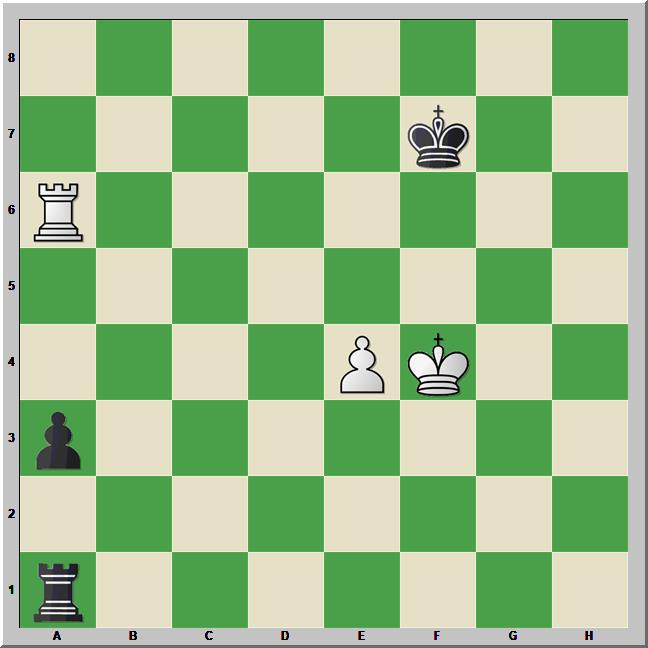
Further exploration of my database revealed another instructive rook ending that should have been drawn. After my opponent's blunder, my play was near perfect.

White to move

47.e5??

47.Ke5=;
47.Kf5 a2 48.Ra7+ Ke8 49.Ke6 Kd8 50.Ra8+ Kc7 51.e5=

47...a2 48.Ra7+ Ke6 49.Ra6+

Black to move

49...Ke7

49...Kd7 is slightly better.

50.Ra7+ Kd8 51.Ra8+ Kc7 52.Ra7+ Kb6 53.Ra3

Black to move

53...Rf1+ 54.Kg5 a1Q 55.Rxa1 Rxa1 56.e6 Re1

56...Kc5 also wins

57.e7

57.Kf6 Kc5 still wins 58.e7 Kd6

57...Rxe7 White resigns 0-1

The second rook ending in Engqvist's book is a gem from Richard Reti.

White to move

Can you win with White?

10 December 2018

One by Reti

This endgame composition by Richard Reti employs the same idea as his most famous one.

White to move

14 March 2017

Principle of Development: Early History

Morphy is sometimes credited with inventing the concept of development, or at least understanding it better than anyone else before those who followed him began to articulate it in their books and articles.
James Stripes, "Chess at the Opera" (2 February 2017)

Development Theory

Paul Morphy (1837-1884) is often credited with having been the first chess master to comprehend the principle of development. Richard Reti seems to credit him with practically inventing the concept.
[T]his is Morphy's most important discovery--it is essential to develop he pieces without delay, to bring them quickly into action and not to lose any time. Morphy's contemporaries on the contrary indulged all too frequently in premature attacks with their forces insufficiently developed, or in unnecessarily timid defensive moves.
Reti, Masters of the Chessboard (2012), 20.
Max Euwe expresses the point with slightly more nuance, and filtered through the writings of Wilhelm Steinitz.
Development, the centre, open lines; these, according to Steinitz, were the three leading principles which Morphy followed. They were for him prime objectives, absolutely fundamental factors in the battle, whereas for Anderssen they had real significance only insofar as they furthered some previously selected aim.
Euwe, The Development of Chess Style (1966), 23.
In Paul Morphy and the Evolution of Chess Theory (1993), Macon Shibut challenges Reti's claim, echoed by Euwe. Shibut analyzes Morphy's games with Anderssen, and Reti's analysis of them, demonstrating a tendency by Reti to force the facts of the games to conform to his thesis. Morphy's development was systematic and intentional. Anderssen's development was haphazard and incidental. Shibut argues that their games reveal otherwise.

Shibut states, "Whatever the date of its first explicit formulation, the principle of development was certainly understood in a practical sense long before Morphy" (29). Shibut advocates examining carefully eighteenth and nineteenth century master games. His view is that these games "at least manifest the principle of development" (29).


History of Development

The explicit formulation of this principle of development, as is well known, occurred after Morphy had given up chess. Wilhelm Steinitz gets credit. Hence, his name is associated with the Modern School, chess as a scientific enterprise with laws of strategy. Articulation of development in the late nineteenth century gave chess theory a solid foundation upon which to build, and thereafter the games of the masters before Morphy lost their instructive value.

Previously on Chess Skills, I have inquired into the origins and meaning of this term, development. In my reading of old classics of chess literature, I have attempted to trace how the term has been understood. I also have sought its first articulation in the writings of Steinitz and his predecessors. Two previous posts offers snippets of this ongoing research: "Thinking about Development" (August 2015) and "What is Development" (July 2016).

This morning's reading, however, revealed that articulation of the concept of development precedes Morphy's birth by more than half a century. It is found in an 1820 English translation of an 1869 Italian text. The Italian text is Il Giuoco Incomparabile degli Scacchi by Domenico Lorenzo Ponziani (1719-1796), but Ponziani's name does not appear in the English translation, which credits Dr. Ercole dal Rio (1718-1802) with authorship. The English book is by J. S. Bingham, a pen name for J. B. Smith, an English naval officer, according to David Hooper and Kenneth Whyld, The Oxford Companion to Chess (1996), 314.

Here, then, might be the earliest clear formulation of the principle of development. Credit the Modenese Masters--Dominico Ercole del Rio, Ponziani, and Giambattista Lolli (1698–1769). Ercole del Rio published La Guerra degli Scacchi (The War of the Chessmen) in 1750. Lolli expanded this work as Osservazioni Teorico-pratiche Sopra il Giuoco degli Scacchi (Theoretical-practical Views on the Game of Chess) in 1863, and then Ponziani's text appeared in 1769. A second edition of Ponziani's text appeared in 1782 and included his name. Nonetheless, Smith chose to translate Ponziani's earlier version and credit it to Ercole del Rio.

One hopes that Smith was a better linguist than he was a historian.

Whether the principle of development was articulated in earlier works by Ercole del Rio and Lolli must await further reading. Of course, some of my readers may be well ahead of me on this matter. Ercole del Rio's La Guerra degli Scacchi was translated into English by Christopher Becker and published alongside the Italian thirty years ago.

Here, then, is Ponziani's articulation of the principle of development, as translated by Smith.
The opening of the game ought to be made with the greatest possible development: that is to say, it is to be executed by the shortest method, chusing those moves which put in action the greatest number of combatants; that one Piece does not impede another, but can act with due promptitude; and that every Piece be so situated, that the adversary cannot annoy it, without danger to himself, or loss of time.--Whoever, at the beginning, has brought out his Pieces with greater symmetry, relatively to the adverse situation, may thence promise himself a fortunate issue in the prosecution of the battle.
Bingham, The Incomparable Game of Chess (1820), 32.
This formulation of the principle of development certainly bears a strong resemblance to the principle that guided Morphy's play, as Valeri Beim expressed it in Paul Morphy: A Modern Perspective (2005), he "sought the move that followed the principle of bringing into play the greatest number of pieces in the shortest possible time" (emphasis in original, 16).


10 May 2015

The Crooked Path

Most chess players are familiar with a famous pawn ending composed by Richard Reti in 1921. The Black king is in the square of White's pawn, but White's king is not in the square of Black's h-pawn. Nonetheless, White is able to draw by moving the king in a manner than both chases the enemy pawn and threatens to assist his own.

White to move

1.Kg7 h4 2.Kf6 Kb6 3.Ke5

If Black pushes the pawn, then White plays Kd6, supporting promotion of the c-pawn. If Black captures the pawn, then the White king enters the square of the pawn.

A similar idea is presented from a 1947 study by Ladislav Prokeš in Dvoretsky's Endgame Manual (2003).

White to move

White's actions towards support of the a-pawn creates threats that permit the king to reach c6 before Black plays h7-h5. Both pawns are stopped. Here Black has less choice because White queens first and the queen controls Black's promotion square.

1.Kc8 Kc6 2.Kb8 Kb5 3.Kb7 Kxa5 4.Kc6

The third position comes about from play against a computer from an ending that occurred in a game played by Paul Morphy.

White to move

1.Kxf4 draws easily. However, a single careless move here produces another instance of a king able to both support its passed pawn and deal with threats on the other side of the board.

1.Kxh4?? Ke5 2.Kg4 Ke4 49.a3 f3-+

If 2.Kh3 Kd4 49.Kg2 Kc3 and White will stop the f-pawn, but Black's a-pawn will promote.