Showing posts with label pawn race. Show all posts

25 October 2024

Poor Decisions

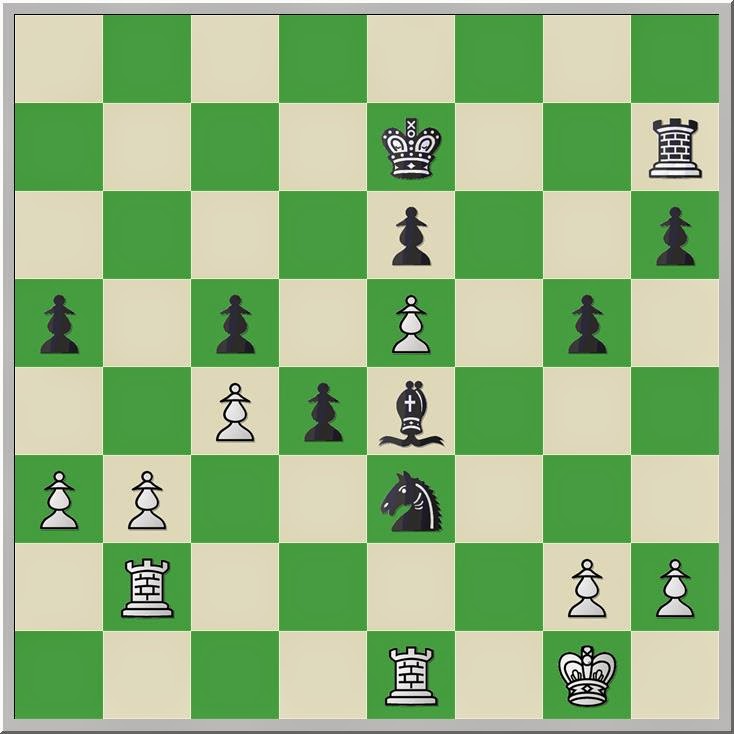
My first error was the decision to play chess on my phone while walking my dog. My sunglasses made it more difficult to see the phone's screen clearly in addition to other distractions. My opponent, rated 600 lower, held his own until I blundered from this position. In fact, there were several blunders as the advantage switched back and forth. 

White to move
58.Nc6??

58.Nb5 is how White stops the e-pawn. To my relief, this blunder was the game's second to the last.

58...e2?? Nd4+ and White has an unstoppable pawn.

What was the move Black should have played?

Knowledge of the square of the pawn and of the floating square is useful.

25 May 2022

One Queen Too Many

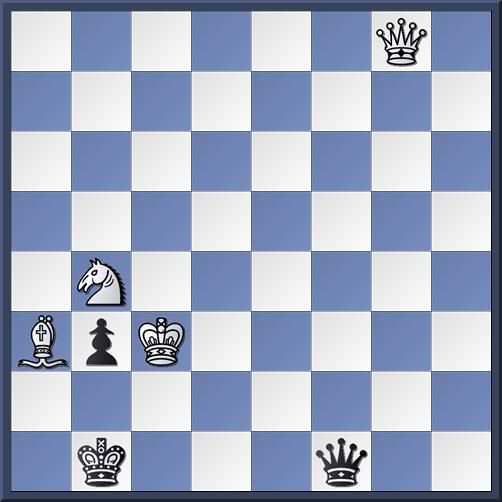
Four moves after my opponent promoted a second pawn, my rook and queen delivered checkmate while White's two queens idly watched.


How did this come about? Where did White go wrong?

We take up the game after White's 37.Kg5.

Black to move

Black's position seems hopeless.

37...Nxe6+ 38.Bxe6 Kxe6 39.Kh6 e3

White to move

40.Re1??

White needs to push another pawn. 40.g4+-

40...d4= 41.g4 Ke5??

The king is needed elsewhere.

41...Kf7= 42.Rf1+ (42.g5?? Rd6+ 43.Kh5 Kg7-+) 42...Ke6 43.Re1=

42.g5+-

White is back in control.

42...Ke4 43.g6 d3 44.g7 Rd6+ 45.Kg5 d2

White to move

46.Rxe3+??

White spent 31 seconds--half of their remaining time in this 3 2 blitz game on this blunder.

46.Rh1+-

The rook can always remove the first queen and White's pawns are promoting first.

46...Kxe3= 47.h8Q d1Q

White to move

48.Qe8+??

Stockfish offers a long line that essentially leads to a draw by repetition.

48.Qh3+ Kd2 49.Qg2+ Kd3 50.g8Q

Black to move
Analysis Diagram

50...Qc1+ 51.Kg4 Rd4+ 52.Kh5 Qd1+ 53.Kg5 Qc1+

48...Kd2-+

Now Black is winning.

49.g8Q Qg1+ 50.Kf5 Qf2+

White to move
51.Ke5?

White steps into checkmate.

After 51.Kg5 Black has a lot of work to do to convert a one pawn advantage in a queen ending after first forcing White to exchange the second queen for Black's rook. 51...Qg3+ 52.Kh5 Qh3+ 53.Kg5 Qh6+ 54.Kg4 (54.Kf5 Rf6+ 55.Ke5 Qf4+ 56.Kd5 Rd6+ 57.Kc5 Qd4+ 58.Kb5 Rb6+ 59.Ka5 Qb4#) 54...Rd4+ 55.Kg3 Qh4+ 56.Kg2 Rg4+ 57.Qxg4 Qxg4+ 58.Kf2 Qd4+ 59.Kg2 a5-+.

51...Qf6+ 52.Ke4 Rd4# 0-1

Maybe you will find this ending both informative and entertaining.

26 July 2019

Blunders in the Ending

These positions are from my game last night in the Spokane Contenders. Robert Fisette won the event with a score of 4-1 and will play Michael Cambareri in the City Championship August 17-18. I finished 3-2 in a tie for second place with one or two others. One game remains to be played, and it will determine who wins the second place prize (free entry to a tournament).

In each of the positions below, the player to move failed to find the correct move. In every case, the error shifted the evaluation towards his opponent's hopes for a win or draw. I had White.

1. White to move


2. Black to move


3. Black to move


4. White to move


5. Black to move


6. White to move


7. Black to move

10 November 2016

Pawns

Lesson of the Week

The after-school chess club that I run at a small private school in my city is divided into two groups--beginning and advanced. Acceptance into the advanced group requires participation in last year's scholastic tournaments or my permission. The beginning group includes children who want to learn chess and may begin knowing nothing about the game.

The lesson for both groups this week came from the same game, a blitz game that I played online Monday morning. For the beginning group, there was a lesson about trading into a pawn ending that was winning as well as basic rules concerning pawn promotion. For the advanced students, I focused on some elementary notions about imbalances. I drew their attention to a quote that I have on the wall in the club room.
[E]ach chess move begins in the head. If you attach importance to playing a good game of chess, you must first of all learn how to think properly.
Alexander Bangiev
Although this was a blitz game in which the players had minimal time for thinking, the positional ideas that are part of this week's lessons were part of my thought process during the game. Blitz games between strong class players offer excellent training materials for young children who are just beginning, as well as experienced tournament players with ratings up to 1200 Elo or even higher..

Internet Opponent (1814) -- Stripes,J (1891) [A46]
Live Chess Chess.com, 08.11.2016

Starting position for advanced students.

Black to move

Students come into the room, ask who has the move, and then start suggesting moves. I would not entertain move suggestions until the students could describe certain elements of the position. I wanted them to observe imbalances in the pawn structure, material, and space.

Both players have their rooks on half-open files. Black has a central and kingside pawn majority. White has a queenside majority. Black's king and rooks are prepared for action on the queenside and prevent most White activity there. White might be able to generate some play on the kingside.

21...a5

My move was designed to restrain White's pawns and make White's bishop an impotent piece. I want to put all or most of my pawns on dark squares.

Stockfish favors 21...Rxd3, which I considered during the game. 22.cxd3 Rc3 Although the engine says this is the clearest winning line, I know that pure rook and pawn endings give the weaker side excellent drawing chances.

22.f3

I suggested to the students that 22.f4 might be better as it does more to mobilize White's rook and helps restrain Black's central pawn advance.

22.Bxh7 does not help White's cause. 22...f5 attempts to trap the bishop. Play might proceed 23.g4 Rxc2 24.gxf5 Rc1 25.Kf1 Rxe1+ 26.Kxe1 Rc3 27.fxe6+ Kxe6 28.Kd2 Rxb3 29.Bc2 Rh3. I showed the students 22...f5, but not the rest of that line.

22...h6 23.Kf2 Kd6 24.Re2 e5 25.dxe5+ fxe5 26.Ke1 Re8 27.Kd2 Rc7 28.Bb5 Ree7

White to move

29.c4 

This move weakens b3, which Black now decides to go after with his king.

29.Bd3 might be better, as Black plans e5-e4.

29...Rc5 30.Kc3

30.cxd5 Rxd5+ 31.Kc3 Rd4

30...e4

This move reveals stubborn adherence to a plan without reconsidering after the position has changed. The plan is sufficient, however.

30...d4+ is better.

31.Kd4 b6

I was afraid of dropping the rook on c5. However, 31...exf3 32.Rxe7 Kxe7 33.Kxc5 fxg2 wins easily.

32.fxe4

32.f4 improved White's chances to hold on.

32...dxe4

32...Rxe4+ is simpler 33.Rxe4 dxe4 34.Kxe4 Rh5 35.h3 Kc5 going after b3.

33.Rxe4

White might have fought more stubbornly with 33.Ke3 Rf5 34.Rb2 Kc5.

33...Rxe4+ 34.Kxe4 Rg5

White to move

Observe the success of Black's plan to render the bishop impotent. From here, Black's plan is now to gobble some pawns with the king and then exchange rook for bishop to reach an easily winning pawn ending.

35.g3 Kc5 36.Bd7 Kb4 37.Kf4 Kxb3 38.h4

38.Bb5 is met by 38...Rxb5 39.cxb5 Kxa4 with an easy ending.

38...Rc5 39.Be6 Kxa4

Black could have played 39...Rxc4+ 40.Bxc4+ Kxc4 41.g4 b5 42.axb5 Kxb5. However, this line requires a little bit of calculation.

40.g4 Kb4 41.g5 hxg5+ 42.hxg5

Starting position for beginner's lesson.

Black to move

We discussed the rules of pawn promotion and I answered questions like, "What do you use for a second queen?" Then focused the students' attention on the possibilities for creating a pawn race that Black could win easily.

42...Rxc4+

My move is good enough and simple.

42...a4 is best 43.Bf5 a3 44.Bb1 Kb3.

43.Bxc4 Kxc4 44.Kf5 a4 45.Kg6 a3 46.Kxg7 a2 47.Kh7 a1Q 48.g6

Black to move 

Black's extra pawn makes it possible to give up the new queen for White's remaining pawn. Without Black's b-pawn, Black would still be winning in this position, but that is a lesson for another day.

48...b5 0–1

10 May 2015

The Crooked Path

Most chess players are familiar with a famous pawn ending composed by Richard Reti in 1921. The Black king is in the square of White's pawn, but White's king is not in the square of Black's h-pawn. Nonetheless, White is able to draw by moving the king in a manner than both chases the enemy pawn and threatens to assist his own.

White to move

1.Kg7 h4 2.Kf6 Kb6 3.Ke5

If Black pushes the pawn, then White plays Kd6, supporting promotion of the c-pawn. If Black captures the pawn, then the White king enters the square of the pawn.

A similar idea is presented from a 1947 study by Ladislav Prokeš in Dvoretsky's Endgame Manual (2003).

White to move

White's actions towards support of the a-pawn creates threats that permit the king to reach c6 before Black plays h7-h5. Both pawns are stopped. Here Black has less choice because White queens first and the queen controls Black's promotion square.

1.Kc8 Kc6 2.Kb8 Kb5 3.Kb7 Kxa5 4.Kc6

The third position comes about from play against a computer from an ending that occurred in a game played by Paul Morphy.

White to move

1.Kxf4 draws easily. However, a single careless move here produces another instance of a king able to both support its passed pawn and deal with threats on the other side of the board.

1.Kxh4?? Ke5 2.Kg4 Ke4 49.a3 f3-+

If 2.Kh3 Kd4 49.Kg2 Kc3 and White will stop the f-pawn, but Black's a-pawn will promote.

03 January 2015

Training Regimen

I am spending a little time each day working through Rashid Ziyatdinov, and Peter Dyson, GM-RAM: Essential Grandmaster Knowledge (2000).

One way that I am working through this book is to devote time to one of the 59 games each week. In late 2014, I went through a three of these games in some detail (see "Training with Anderssen," and "Anderssen -- Staunton 1851"). Understanding these 59 games lead to mastery of 120 middlegame positions (see "To Know a Position"). This week I am working through the Evergreen Game, which I have been through several times in the past. Several books on my shelf have detailed annotations of this classic game, including Graham Burgess, John Nunn, and John Emms, The World's Greatest Chess Games (1998). I am studying these annotations.

External works are essential to proper reading of Ziyatdinov's text. He explains:
This book presents the key positions which must be known to achieve chess mastery. It does not undertake an explanation of them. There are other authors who have adequately explained the positions presented here. A list of references is included. (13)
Studying the 133 endgame positions is another way that I am working through Ziyatdinov's text. Several years ago, I wrote a note in my copy of the text concerning diagram 16: "1-175 Dvoretsky presents more difficulties--kings on g5 and g7. White pawn on g4" (29).

GM-RAM Diagram 16
Yesterday, I set out to find what Yuri Averbakh had to say regarding this position. Ziyatdinov lists Averbakh's Comprehensive Chess Endings. I have access to the Chess Digest edition, so started going through "Two Pawns v. One" in Yuri Averbakh and Ilya Maizelis, Pawn Endings, trans. Mary Lasher (1974).

I did not get far enough to discover whether this position is in this text. Instead, I worked through several somewhat more elementary positions. First, I played them rapidly against Rybka 4 to test my instincts. Then, I read what Averbakh had to say about each one.

The first presented no difficulties.

Averbakh Pawn 145
Stripes,James -- Rybka 4 x64
Blitz 5m Spokane, 02.01.2015

1.g4+ Kxg4 2.Kg6 c5 3.h4 Kxh4 4.Kf5 Kh5 5.Ke5 c4 6.Kd4 c3 7.Kxc3 ½–½

The second one required a second attempt because I did not calculate. My instincts were close, but wrong. Alas, there is no partial credit in chess games. A wrong answer can be fatal.

Averbakh Pawn 146
Stripes,James -- Rybka 4 x64
Blitz 5m Spokane, 02.01.2015

1.Kg7 e5 2.g4+

My first effort: 2.Kf6?? e4 3.Kf5 e3 4.g4+ Kxh4 5.g5 e2 6.g6 e1Q-+.

2...Kxg4 3.Kg6 e4 4.h5 e3 5.h6 e2 6.h7 e1Q 7.h8Q Qe4+ 8.Kg7 Qd4+ 9.Kg8 Qd8+ 10.Kg7 Qd7+ 11.Kg8 Qd8+ 12.Kg7 Qd7+ 13.Kg8 Qd5+ 14.Kg7 Qd4+ 15.Kg8 Qd5+ 16.Kg7 Qd3 17.Kg8 Qd8+ ½–½

The third position employs the same idea.

Averbakh Pawn 147
Stripes,James -- Rybka 4 x64
Blitz 5m Spokane, 02.01.2015

1.Ke7 b5 2.Ke6 

2.d5?? Kxd5

Pawn race produces a queen ending
2...Kf3!

Rybka played the least obvious of three drawing moves.

I expected 2...b4 3.d5 b3 4.d6 b2 5.d7 b1Q 6.d8Q Qa2+.

3.d5 b4 4.d6 b3 5.d7 b2 6.d8Q b1Q 7.Qf6+ Ke2 8.e4 Qxe4+ 9.Qe5 Kd3 10.Qxe4+ Kxe4 ½–½

After these three, I went back to the previous page in Averbakh's text. The first position is a simple matter of triangulation if White is on move. He offers solutions with both White and Black to move. I played these out against Rybka.

Averbakh Pawn 143
After two pages of Averbakh's Pawn Endings, I pulled another book off the shelf, Lazlo Polgar, Chess Endgames (1999) and glanced through the "Elementary Positions" section looking for similar positions. I played these against the box.

One diagram appears twice--with Black to move first, and then with White to move several pages later.

Two in Polgar


06 November 2014

Memorable Games

Lesson of the Week

In Chess Training for Budding Champions (2001), Jesper Hall recommends creating a book or database with one's best games or combinations. In order to train well an aspiring chess player must have fun.
Everyone has his own moments of happiness, moments that must not be forgotten. My first piece of advice to any player is therefore to keep a little book, or as I do today, open a file in the computer, where personal experiences can be saved. (7)
Among my fond memories are three games in which I forced an exchange of pieces to reach a winning pawn ending. I posted a position from one of these memorable games in "Kings and Pawns" (2008). Another instance remains my highest rated tournament win (see "Pawn Wars" [2012]).

This week I have been reexamining a game from the Spokane Chess Club's 2007 Winter Championship. According to the chess engines, I had a clear advantage and several ways to win. I chose the route that simplified via sacrifice into an easily winning pawn ending. When me opponent understood that he was lost, he opted to make it interesting by letting one of my pawns queen in the hope that he, too could promote a pawn. In the final position, I checkmated him with two queens on the same move that he promoted a pawn.

Black to move

37...Bxg2 38.Rxe3 dxe3 39.Kxg2 Rf7 40.Re2

This position has been on the demonstration board several times this week, and I have set it up during individual lessons too.

Black to move

40...Rf2+ 41.Rxf2 exf2 42.Kxf2 a4!

My move, which is best, was difficult for Fritz 9 to find during postgame analysis. The engine required more than ten minutes to choose it as best. Stockfish DD finds this move in less than ten seconds. Engines have improved since 2007.

I do not recall whether I found this pawn sacrifice from the first diagram or the second, but I know that I worked out that my king would easily win the c-pawn after mopping up White's pawns on the a-file. At the same time, a pawn majority on the kingside should keep the White king busy.

This pawn sacrifice is the most important memory from this game, but I also enjoy the final position.

43.bxa4 Kd7 44.Kf3 h5 45.Kg3 Kc7 46.a5 Kb7 47.h4 g4 48.Kf4 Ka6

White to move

Here the game became a comedy of sorts.

49.Kg5 g3 50.Kf6 g2 51.Kxe6 g1Q 52.Kf7 Qg4 53.e6 Qxc4 54.Ke7 Qxh4 55.Kf7 c4 56.e7 Qf4+ 57.Kg7 Qe5+ 58.Kf8 Qf6+ 59.Ke8 c3 60.a4 c2 61.Kd7 Qf7 62.Kd8 c1Q 63.e8Q Qcc7#


06 May 2014

Blowing an Endgame

Yesterday morning, I shared on Facebook a link to an excellent article from The Chess World, "7 Chess Training Habits You Should Drop Now." The author, Yuri Markushin, highlights several practices that develop sloppy and lazy thinking. He begins with blitz and bullet.

Last night, I played a blitz game that illustrates this problem with blitz. In contrast to calculating the consequences of a rook exchange and then playing the pawn ending correctly, I intuitively guessed that I would benefit from an exchange of rooks and then threw away the pawn ending.

Black to move

32...Re3+ was the correct move. But then, 33.Kd4 Rxa3 34.bxa3, it was time to assess the resulting pawn position.

I played 34...f5, playing hope chess. I hoped that my opponent would facilitate my dreams of a passed pawn with 35.gxf5. He refused to cooperate, playing instead 35.a4.

Did I then seriously consider 35...e5+, a move that may at least hold the draw?

No. I played 35...fxg4 and quickly reached a position that was hopelessly lost. Several moves later, we reached the position below.

White to move

My opponent wins easily with 44.Kf5. However, 44.Kd4 was played. In the ensuing pawn race, we both promoted pawns. The queen ending was a dead draw. But, as often happens in blitz, a series of senseless checks were employed to run the other player out of time.

30 January 2014

Underpromotion

This position is from Kalnicky -- Charousek, Budapest 1896 and is another game found at Chessgames.com that is absent from the ChessBase Online database. As one of the knight forks yesterday, it requires promoting a pawn to something other than a queen. White has just promoted a pawn on h8, winning the pawn race but not the game.

Black to move

28 October 2013

Interference

Playing the White side of a French Advance, I find myself looking through some master games. These are neither won nor lost in the opening. In Vorobiov -- Volkov, Moscow 2004 White prevailed in the endgame.

White to move

White gave up a rook to assure that his pawn would promote.

57.Re4! Rd3+ 58.Kg4 dxe4 59.e7

Even then, however, Black had a pawn that threatened to complete its journey.

59...Kd2 60.e8Q e3 61.Kf3 Rxb3 62.Qd8+ Ke1 63.Qd5 Ra3 64.Qc5 1-0

Black to move

This fork of rook and pawn ends things. After White's queen is exchanged for rook and e-pawn, White's h-pawn will promote.

29 March 2011

A Little Endgame

With some time on my hands and my iPad nearby, I played a quick game against Shredder. The device is set to play weaker than full strength based on my previous performance. This game seemed all wrapped up until Shredder threw me a surprise.

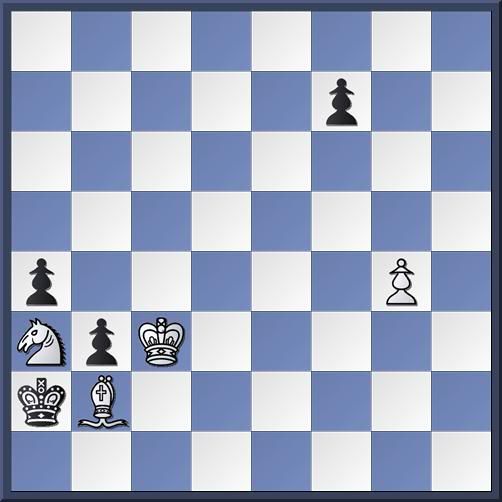
Black to move


42...f5!

If I capture this pawn, it is stalemate. But that is better than losing a pawn race, so I made a quick check to see that Shredder would not promote with check. I too will get a queen, so:

43.g5 f4 44.Nc2!

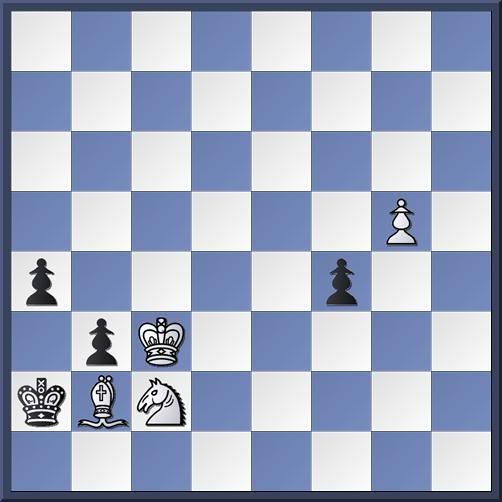
Black to move


I, too, have surprises. If 44...bxc2, then 45.Kxc2 and my pawn promotes with checkmate.

44...f3 45.g6 a6 46.Nb4+ Kb1 47.Bxa3 f2 48.g7 f1Q 49.g8Q

Black to move


49...Qf3+ 50.Nd3 Qc6+ 51.Bc5 Qf6+ 52.Kxb3

Black to move


Black has run out of useful checks.

52...Qf1 53.Qg1

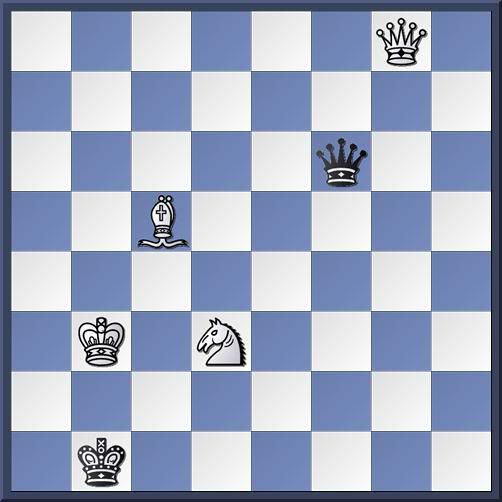
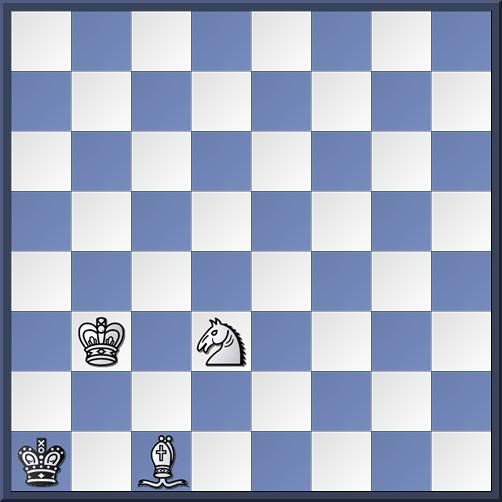
Bye-bye queens. Time to practice checkmate with knight and bishop, but not much practice. The Black king is already trapped in the right corner.

53...Qxg1 54.Bxg1 Ka1 55.Be3 Kb1 56.Bc1 Ka1

White to move


57.Ba3

I missed the quicker 57.Kc2 Ka2 58.Nb4+ Ka1 59.Bb2#.

57...Kb1 58.Nf4 Ka1 59.Nd5 Kb1 60.Nc3+ Ka1 61.Bb2#.