Showing posts with label Burn (Amos). Show all posts

20 April 2021

Lasker -- Capablanca, Game 14

On Wednesday and Thursday, 20-21 April 1921, Emanuel Lasker and José Raúl Capablanca contested the fourteenth game of their historic world championship match. Chess Skills has been following this match as a centennial celebration, and will continue doing so through the end of the month. Game 14 was to be Lasker's last world championship game after twenty-six years at the top. It was not known to be his last when it was played, nor for several days after. The match was scheduled for 24 games; more than a week transpired before it was determined that this game would indeed be the last.

As referenced in "Refuge from Havana's Sun" and "Lasker -- Capablanca, Game 8", after the match Lasker raised issues concerning distribution of the game scores by Hartwig Cassel, a journalist working for American Chess Bulletin and the New York Evening Post. The score for game one was published in the New York Evening Post on 18 March 1921, and that paper continued to provide news on the match with game scores as it progressed.

Near the end of Mein Wettkampf mit Capablanca (1922), Lasker addressed the differences between a responsible chess press, as he saw it, consisting mostly of master commentators, and the work of journalists with limited understanding.
The press in general has behaved worthily and meritoriously. The reporting and criticism have high responsibility. Messrs. Helms, Burn, Schelfhout, Mieses, Dr. Tarrasch--leaders of the chess press in the United States, England, Holland and Germany--made a factual, reasoned judgment. Good chess criticism includes, in addition to objectivity, a love of the game of chess and an understanding of master chess: that is why these chess writers stand out from the others. Mr. Hartwig Cassel is indifferent to the game of chess. (37)
In this post, number 23 in a series, I have placed commentary provided by Cassel to the New York Evening Post alongside that of Lasker, Capablanca, and Amos Burn.* Compare the contrasting perspectives at critical moments in the game. The juxtaposition will show that Cassel's understanding of the game lacks some depth. On the other hand, Cassel's worth as a journalist is not limited to these comments. He an introduction and other information to Capablanca's book on the match. Early in Capablanca's career, Cassel helped arrange some of his simultaneous exhibitions and related matters.

Lasker,Emanuel -- Capablanca,José Raúl [C66]
World Championship 12th Havana (14), 20.04.1921
[Capablanca, Lasker, Others]

1.e4 e5 2.Nf3 Nc6 3.Bb5 Nf6 4.0-0 d6 5.d4 Bd7 6.Nc3 Be7 7.Bxc6

Black to move
Having the white pieces again and being obliged to essay an opening which held out better chances than the drawish variations of the Queen's Gambit declined, Dr. Lasker, in the fourteenth game of the championship match at Havana, last night, resorted once more to his favorite Ruy Lopez, which had been previously adopted in the third, sixth, and twelfth games. All three of these had been drawn, to be sure, but, with a greater variety of safe lines of attack, Dr. Lasker evidently hopes to get his watchful opponent off the beaten track.
Hartwig Cassel, NYP, 21 April 1921
Amos Burn's commentary in The Field was reprinted in American Chess Bulletin. He comments that he recommended 7.Bxc6 in his "notes to the sixth game" (106).

7...Bxc6 8.Qd3 exd4 9.Nxd4 Bd7 10.Bg5 0-0 11.Rae1 h6 12.Bh4

Black to move
12...Nh7

Lasker and Burn both call this move a "favorite" of Capablanca.

12...Ng4 13.Bxe7 Qxe7 14.f4 Nf6  was drawn in 55 moves Schoenmann,W -- Bluemich,M, Berlin GER 1920.

13.Bxe7 Qxe7 14.Nd5 Qd8 15.c4

"White has now a powerful position and Black has to play with extreme care in order to avoid drifting into a hopeless position" (Capablanca, 28).

15...Re8 16.f4

Black to move
16...c6

"This weakens the d-pawn, but something had to be done to obtain maneuvering space for the Black pieces. Besides, with the advance of the f-pawn, White's e-pawn becomes also weak, which is somewhat of a compensation" (Capablanca, 28).

"Black is constrained and must weaken the queens' pawn in order to free himself" (Lasker, 29).

17.Nc3! Qb6 18.b3 Rad8

It is noteworthy that both Capablanca and Lasker balance self-criticism with insight into their opponent's critical errors.

18...Re7 "was the proper move" (Capablanca, 28).

White to move
19.Kh1

This move "already reveals the slackening of my abilities. I could have gone over to the attack with h2-h3 and g2-g4. From here on to the gross mistake in the 29th move, I played without ideas" (Lasker, 30).

19...Nf6 20.h3 Bc8 21.Rd1

"This is waste of time. In order to obtain an advantage, White will have to make an attack on the kingside, since Black's d-pawn, though weak, cannot be won through a direct attack against it" (Capablanca 28).

21...Re7 22.Rfe1 Rde8 23.Re2

Black to move

"It will be noticed that Lasker loses much time with his rooks in this game, playing them with strange indecision. Much better than the text-move would have been g4, restraining the movements of Black's bishop and knight and preventing his queen going over to the king's side via a5" (Burn, 106).

Cassel suggests that Lasker's rook shifting was a psychological ploy: "Capablanca was not to be disconcerted" (6).

As noted above, Lasker stated that from move 19 up to the blunder on move 29, "my game was without any ideas."

23...Qa5 24.Rf1

Burn thought g4 could still be played at this point.

24...Qh5 25.Kg1 a6 26.Rff2

"A simple a2-a4 would be better to prevent the possibility of b7-b5" (Lasker, 29).

26...Qg6 27.Rf3

Black to move

 "White has now made seven moves with his rooks, but could have had them in the same position in three moves. A serious loss of time" (Burn, 106).

27.Nf5 Bxf5 28.exf5 Qh5 29.Rxe7 Rxe7 and Black has a good game" (Capablanca 28).

27...Qh5

27...Nxe4 "would have cost a piece" 28.f5 (Cassel, 6).

28.f5

"Of doubtful value. While it shuts off the Bishop, it weakens furthermore the e-pawn and also creates a hole on e5 for Black pieces. The position, at first glance, looks very much in favor of White, but careful analysis will show that this is much more apparent than true" (Capablanca, 28-29).

"Hastiness, ruining the entire plan of attack. By playing b3-b4 or a2-a4, White would have a perfect position" (Lasker, 30).

28...Qh4

White to move
29.Kh2?

"A blunder, made under time pressure combined with difficulties attached to the position" (Capablanca, 29).

"Also, a serious mistake. It would better to play Rf3-e3. Possible was and a2-a4" (Lasker, 30).

29...Ng4+

"[B]oldly invited" by Lasker (Cassel, 6).

"Winning an exchange and the game" (Lasker, 30).
Dr. Lasker sacrificed his rook for Capablanca's knight, although superficially, it might appear that the Cuban had caught him napping. A glance at the position, however, will show that the black Queen, while not in immediate danger, has all too little scope and that great care must be exercised in order to bring about a wholly satisfactory state of affairs for the Cuban.
Herman Helms, Brooklyn Daily Eagle, 1.3
30.Kh1 Ne5 31.Qd2 Nxf3 32.Nxf3

Black to move

Capablanca sealed his 32nd move. The conclusion of the game will be presented tomorrow in "Lasker -- Capablanca, Game 14 (concluded)".

The article in the New York Post expressed optimism regarding Lasker's chances: "Dr. Lasker, although the exchange behind, had blocked off Capablanca's Bishop and altogether was left with excellent prospects, as the black Queen was none too comfortably placed."

*Edit (correction): I have credited assessments published in the newspapers to Hartwig Cassel, but that appears inaccurate. Lasker complained about Cassel's journalism, and others have noted that Cassel was on the scene in Havana. Cassel certainly provided the moves, but who wrote the commentary? Further research has shown that the unsigned articles in the New York Evening Post, which I relied upon for my narrative, are nearly identical to articles in the Brooklyn Daily Eagle. Herman Helms, publisher of American Chess Bulletin, and an accomplished player who had defeated both Frank Marshall and Harry Pillsbury, is the author. Collaboration between Cassel and Helms go back to the first issue of American Chess Bulletin in 1904.

Sources

Burn, Amos. "Fourteenth Game--Ruy Lopez." American Chess Bulletin, vol. 18, no. 5 (May-June 1921), 105-106.
Capablanca, José Raúl. World's Championship Matches, 1921 and 1927. New York: Dover, 1977.
"Dr. Lasker Resorts to Favorite Opening," New York Evening Post (21 April 1921), 6.
Helms, Herman. "Capablanca Exchange Ahead in Fourteenth Chess Game." Brooklyn Daily Eagle (21 April 1921), 1.3.
Lasker, Emanuel. Mein Wettkampf mit Capablanca. Berlin and Leipzig: Walter de Gruyter, and Co., 1922.

16 March 2021

Capablanca -- Lasker, Game 1 (continued)

Part 5 of a series recognizing the Centennial of Capablanca -- Lasker, World Chess Championship, Havana 1921.

At 9:00 pm, Wednesday 16 March 1921, Emanuel Lasker and José R. Capablanca sat down at the Union Club and Lasker's sealed move was opened so play could resume. Most annotators have viewed the endgame as did Amos Burn after White's 39th move, writing in The Field (and reprinted in American Chess Bulletin), "White now has a slight advantage, but not enough to win" (ACB, April 1921, 67). The critical position was reached ten moves into the day's session. In order to understand it more fully I played it out against Stockfish 13.

Black to move
After 32.g4

32...Qg5

The sealed move.

32...Qc8 might have been slightly better, according to my analysis with Stockfish 13.

33.g3 Rd6!

"Unquestionably the best move; with any other move Black would, perhaps, have found it impossible to draw" (Capablanca).

34.Kg2 g6 35.Qc4 Re6

"Also 35...Rd4 along with 36.-- Qxg4 would have been enough to equalize" (Lasker).

"Black cannot well avoid the exchange of Queens which results from this move; but though White remains with some positional advantage, any chance of winning is very remote" (Thomas, George A., British Chess Magazine).

36.Qxc5

Black to move

36...Qxg4 37.f3 Qg5

White to move

38.Qxg5 hxg5 39.Kf2 Rd6 40.Ke3 Re6+ 41.Kd4 Rd6+

White to move

42.Ke3

"The magazine of the Argentine Chess Federation made a win on 42.Kc5, but it is in the wrong position because it puts the a6 pawn on a5. Then 42.Kc5 Rd3 43.Kb6 Rxf3 44.g4 wins easily. But since the pawn is on a6, Rf6 is simple" (Lasker).

"42.Kc5 was too risky. The way to win was not at all clear and I even thought that with that move Black might win" (Capablanca).

"The only hope of winning seems to seems to lie in Kc5. But probably a draw is the legitimate outcome in any case. If 42.Kc5, there might follow 42...Rd3 43.Rf2 g4" (Thomas).

Lasker offers detailed analysis.

Lasker's Analysis

"Did White let go of the win on the 42nd move?"

42.Kc5 Rd3 43.Kb6

(for 43.Rf2!, see below, but also note above that Thomas saw this move.)

43...Rxf3 44.Kxa6

(44.g4 Rf6+ see Lasker's note above.)

44...Rxg3 45.b4 Ra3+ 46.Kb7 g4 47.b5 g3 48.b6 f5 49.Kc6!

Black to move
Analysis diagram

a) 49... Ra6 50.Kb5 Rxb6+ 51.Kxb6 f4 52.Rg2 only move Kf7 53.Kc5 g5

White to move
Analysis diagram

54.Kd4 g4 55.Kd3 Kg6 (Now 55...f3 is no longer possible) 56.a4 Kg5 57.Kd2

Black to move
Analysis diagram

57...Kh4

(Or 57...f3 58.Rxg3 Kf4 59.Rxg4+ Kxg4 60.Ke1)

58.Ke1 f3 59.Kf1 "It almost looks like White can win."

"Black still has sufficient defense."

b) 49... Ra8!

I might add that Stockfish 13 find this to be the only move that holds; kudos to Lasker for pointing it out.

50.b7 Rb8 (On 50...Rf8 there would be 51.Kd5)

White to move
Analysis diagram

b1) 51.a4 51...f4 52.a5 (Or 52.Rg2 Rf8 53.a5 f3 54.Rxg3 f2-+) 52...f3 53.a6 f2 54.a7 Rf8

White to move
Analysis diagram

55.b8Q f1Q 56.a8Q Qh1+ (Lasker)

b2) 51.Kc7 Rxb7+ 52.Kxb7 Now the white king is too far away. 52...f4 53.Rg2 Kf7

White to move
Analysis diagram

54.a4

(not  54.Kc6 Ke6 55.Kc5 Ke5 56.Re2+ Kf5 57.Kd4 f3 if the Black king comes into action more strongly than the White, White must be very content to get a draw.)

54...g5 55.a5 g4 56.a6 f3 "Black retains the preponderance." (Lasker)

Stockfish says the position is equal. 


Play Against Stockfish

42.Kc5 Rd3 43.Rf2 a5

(43...g4 Thomas 44.fxg4 Rxg3 45.Kb6 Rxg4 46.Kxa6)

44.Kb6 Rd5

White to move
Analysis diagram

45.a4

On the fourth try, I found a promising idea.

45...Kg7 46.b4! axb4 47.a5

Breakthrough

47...g4 

White to move
Analysis board

48.a6 Rd6+ 49.Kb7 Rd7+ 50.Kc6

(50.Kb8 Rd8+ 51.Kc7 is better)

50...Re7 51.f4 b3

White to move
Analysis diagram

52.Rb2 Re6+ 53.Kb5 Re7 54.Rxb3 g5 55.f5

Stockfish resigned here, which I thought was premature.

55...Kf6 56.Kb6 (56.Ka5 Kxf5 57.Rb7 is better) 56...Kxf5

White to move
Analysis diagram

57.Rb4!

I tried 57.a7 Rxa7 58.Kxa7, and then quit as it seems similar to Lasker's analysis that led to a draw.

57...Ke5 58.Rxg4 Re6+ 59.Kb5 Re8 60.Rxg5+ Kd6 61.Kb6 Rb8+

White to move
Analysis diagram

62.Ka5

(62.Ka7 Rb3 63.Rf5 Rxg3 64.Rxf7=)

62...Re8 63.Rb5 Kc7 64.Rb7+ Kc8 65.Rxf7

Black to move
Analysis diagram

After a check, I started walking my king towards the kingside, eventually reaching a Lucena position. 

I conclude that Capablanca had a technical win, but was probably correct to avoid the risk that he perceived and keep the draw in hand.


Return to the Game

Black to move


42...Re6+ 43.Kf2 Rd6 44.g4 Rd1

White to move

45.Ke2

"45.Ke3 was the right move. It was perhaps the only chance White had to win, or at least come near it" (Capablanca).

45...Ra1 46.Kd3

"Had the King been at e3 he could go to d4, which would have gained a very important move" (Capablanca).

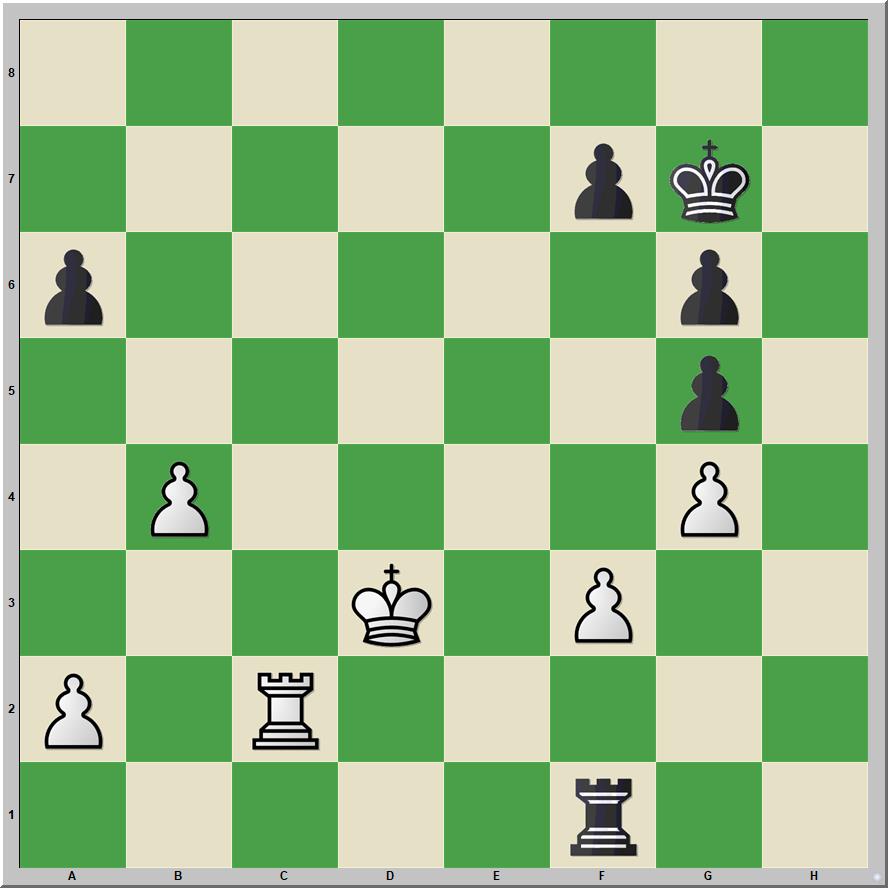
46...Kg7 47.b4 Rf1

"Best. Black, however, would have accomplished nothing with this move, had the White King been at d4" (Capablanca)

White to move

48.Ke3

"The remainder of the game needs no comments" (Capablanca).

48...Rb1 49.Rc6 Rxb4 50.Rxa6 Rb2 ½-½

Capablanca 2:44 - Lasker 2:35 

"After fifty moves in all had been recorded, the draw, which was pretty generally anticipated, was agreed upon." "Lasker-Capablanca Match at Havana", American Chess Bulletin, 18, no. 3 (March 1921), 45.

I do not find that the press does justice to the complexity of Capablanca's decision at move 42. Set up that position and train from it. 

15 March 2021

Capablanca -- Lasker, Game 1

Part 4 of a series recognizing the Centennial of Capablanca -- Lasker, World Chess Championship, Havana 1921.

On Tuesday, 15 March 1921, Emanuel Lasker and José R. Capablanca sat down at the table that had been used during the 1892 World Championship Match between Wilhelm Steinitz and Mikhail Chigorin. On the table was a new board and pieces created for the 1921 event. Just before the game, "Capablanca won the toss for first move."* This game was played at Havana's Union Club.

The Havana newspaper La Prensa declared Lasker a 4-1 favorite in the match, according to Hartwig Cassel, an American chess correspondent on the scene in Cuba. This match had been anticipated for more than a decade. Expectations were high.

The score below presents annotations compiled from British Chess Magazine, American Chess Bulletin, and the books on the match by the players.

Capablanca,Jose Raul -- Lasker,Emanuel [D63]
World Championship 12th Havana (1), 15.03.1921
[Capablanca/Lasker/Others]

1.d4 d5 2.Nf3 e6 3.c4 Nf6 4.Bg5

"...popularized by Pillsbury. Among a good many other experts, however, there seems to be a growing inclination to revert to the older method--so admirably handled by Zukertort--in which the QB is developed at b2. Probably, neither line is essentially and better that the other; though either may be better suited to a particular player. But the Pillsbury line of attack certainly seems to have lost much of its sting, the defence to it being so well understood nowadays; and it frequently follows, as in this game, the the bishop at g5 is soon exchanged, without having achieved anything" (George A. Thomas, British Chess Magazine).

Amos Burn, who wrote the chess column for The Field, also questions whether this move is as good as Zukertort's method. The American Chess Bulletin (April 1921) presented Burn's annotations on the first game, which are not extensive.

Zukertort won six games of six 1864-1883 when he played Bb2 in Queen's Gambit games, then he lost four straight in 1886-1887 beginning with game 1 in his World Championship match with Steinitz. 

4...Be7 5.e3 Nbd7 6.Nc3 0-0 7.Rc1

Black to move

"Here again experts differ. ... The latest edition of the Handbuch marked Qc2 as best; but in the supplement since published that opinion is changed in favour of Rc1, on account of the Duras continuation (9.Qa4). That continuation depends, however, on Black's 7...b6, which is now commonly regarded as inferior" (Thomas).

7...b6

Modern practice prefers 7...c6 or 7...Re8 (Thomas).

8.cxd5 exd5 9.Bb5

"Not nearly so difficult to meet as 9.Qa4. ...Obviously, Black will not allow White to establish his Bishop at c6. The text move leads naturally to exchanges and equality" (Thomas).

"A new move which has no merit outside of its novelty. I played it for the first time against Teichmann in Berlin in 1913. The normal move is 9.Bd3; but 9.Qa4 may be best, after all" (Capablanca).

9. Qa4 Bb7 10.Ba6 Bxa6 11.Qxa6 c5 12.0-0 Re8 1-0 (65) Duras,O. -- Marshall,F., Breslau 1912

9...Bb7 10.Qa4

Black to move

10...a6

"10...c5 at once is the proper continuation" (Capablanca)

Thomas thought the text was "soundest", while 10...c5 "would allow White a wider choice of continuation."

11.Bxd7

"Not 11.Bc6 because 11...b5" (Lasker).

11...Nxd7 12.Bxe7 Qxe7

White to move

13.Qb3

"With the idea of preventing ...c7-c5, but still better would have been to castle" (Capablanca).

Thomas references the Marshall game given below and also Capablanca -- Teichmann (Berlin 1914), which does not appear in my databases. Likely the date given is an error. As Capablanca noted, he had played 9.Bb5 against Teichmann in Berlin 1913. This game deviated from that predecessor with Capablanca's 10.Qa4. Capablanca annotated the game for Chess Fundamentals (1921).

13.0-0 c5 14.dxc5 bxc5 (14...Nxc5) 15.Rfd1 d4 16.exd4 Bxf3 17.gxf3 Qg5+ 18.Kh1 Qf5 19.Qc6 Nf6 20.Ne2 cxd4 21.Nxd4 Qf4 22.Ne2 Qe5 23.Nc3 Qf5 24.Ne2 Qe5 25.Rg1 Qxb2 26.Nc3 Nh5 27.Qh6 g6 28.Ne4 Qg7 29.Qg5 h6 30.Qh4 Rac8 31.Rcd1 Rc6 ½-½ (31) Marshall,F. -- Capablanca,J., New York 1915.

13...Qd6

"Black could have played 13...c5 In the many complications arising from this move, I think, Black would have come out all right" (Thomas).

Variations from BCM after 13...c5:

14.Nxd5 (14.dxc5 Nxc5 Black has gained an important tempo compared to the Capablanca -- Teichmann game quoted above 15.Qc2 [15.Qd1 is better for White] 15...d4 16.Nxd4 Bxg2 17.Rg1 Rad8 18.Nf5 Qe4)

14...Qd6 15.Nf4 (15.Nc3 cxd4 16.Nxd4 Bxg2; 15.e4 Rfe8) 15...Bxf3 16.gxf3 (16.dxc5) 16...cxd4. (Thomas)

14.0-0 Rfd8 15.Rfd1 Rab8

White to move

16.Ne1

"The object was to draw the Knight away from the line of the Bishop, which would soon be open, as it actually occurred in the game" (Capablanca).

16...Nf6 17.Rc2 c5

"Having delayed c5 so long, it might perhaps be as well to hold it back another move or so in favour of 17...Bc8, threatening to open an attack on the White Queen, or alternately to use the Bishop at f5" (Thomas).

18.dxc5 bxc5

"Now an attack threatens with d5-d4 and Nf6-g4" (Lasker).

19.Ne2

"The best kind of defense. If Black attacks now, he himself is at a disadvantage" (Lasker).

Black to move

19...Ne4

"All the attacks beginning either with 19...Ng4; or 19...d4 would have failed" (Capablanca).

19...c4 might lead to some interesting play, but the "hole" at d4 would be too serious a drawback. 20.Qc3 Bc6 21.b3 Ne4 22.Qd4 cxb3 23.axb3 Rxb3 24.Rxc6 wins. (Thomas)

20.Qa3 Rbc8 21.Ng3 Nxg3 22.hxg3 Qb6

White to move

23.Rcd2

"23.Rdc1 would not have been better, because of the rejoiner 23...d4 etc." (Capablanca)

"If White plays 23.Nd3, Black answers 23 ... c4 and then follows d5-d4. 24.Qb4 would not work because of 24...Qxb4 25.Nxb4 a5; On the other hand, if 23.Rdc1 d4 24.Rxc5 Rxc5 25.Rxc5 and now 25...d3 (or 25...dxe3 whereupon White has weak pawns and has no advantage at all.) 26.Nxd3 Rxd3 27.Qxd3 Qxc5 28 .Qd7 Ba8 So White plays Rc2-d2 to make the d-pawn more difficult." (Lasker)

23...h6 24.Nf3 d4

"Virtually suggesting a draw. There does not seem much else to be done; though after the ensuing simplification, Black remains with a slightly inferior Pawn position" (Thomas)

25.exd4 Bxf3 26.Qxf3

26.dxc5 Bxd1 27.cxb6 Rxd2 28.b7 Rb8 29.Qc3 Rd7 30.Qc8+ Rd8 31.Qc6 Be2 and Black's three pieces will beat the Queen. (Thomas)

Black to move

26...Rxd4

"Easier was 26...cxd4 Now Black keeps weak pawns" (Lasker).

27.Rc2 Rxd1+ 28.Qxd1 Rd8

Lasker spoke after this move, "I presume you are playing for a win." Capablanca affirmed that he was.*

White to move

29.Qe2 Qd6 30.Kh2 Qd5 31.b3 Qf5 32.g4

Black to move

After four hours of play, Lasker sealed his move.

Tomorrow, this game will continue.


*"Lasker-Capablanca Match at Havana." American Chess Bulletin 18, no. 3 (March 1921), 45.