Showing posts with label Evans (Larry). Show all posts

25 January 2019

Evans -- Larsen 1957

Game of the Week

After several people recommended J.H. Donner, The King: Chess Pieces (2006), I finally bought a copy. It arrived two days ago. This game is presented in one of the early essays in the book, "Fun and Seriousness" (26-28).

Evans,Larry Melvyn -- Larsen,Bent [D32]
Dallas, 1957

1.d4 d5 2.c4 e6 3.Nc3 c5

J.H. Donner notes, "Officially, the line is known to be unfavorable for Black" (27). Readers of Seigbert Tarrasch, on the other hand, know that in his opinion this move must be played sooner or later, and playing it without loss of tempo has its merits.

4.e3

4.cxd5

4...Nf6 5.Nf3 Nc6

Symmetry, it seems to me, should favor the first player.

6.cxd5

6.a3 has become the main line.

6...exd5

White to move


I have had this position at least 27 times in online play. Black scored over 60% in my games. I had White in 13 of these 27 and my record from both sides is +1.

7.Bb5 a6

This move has not been played by any of my opponents, nor by me.

7...Bd6 is slightly more popular. It seems sensible to prepare castling before the center opens further. I have faced this move once. I won that game after a long struggle.

8.Bxc6+

8.Be2 The handful of games with this move have favored Black.

8...bxc6 9.0–0 Bd6

9...c4 and Black won in 35 moves in Howard,G. -- Whitfield,K., Hamilton 1924.

10.dxc5 Bxc5

White to move

This position has been reached more than fifty times since this game.

11.e4

"It seems White is taking the initiative" (Donner 27). Three other moves are more popular. Trying to open the center before Black castles seems sensible.

11.b3;
11.Qc2;
11.Qa4

11...0–0 12.Bg5

12.e5 does not seem to offer White much 12...Nd7.

12...Be7 13.Nd4

Striking at an obvious target that is easily defended. Does this move provoke a concession as Black defends the pawn?

13.Qa4;
13.exd5 cxd5 Black has two isolated pawns 14.Nd4 (14.Qd3) 14...Qd6 15.Qd2 Ne4 and White went on to win after a long struggle (60 moves) in Barlocco,C (2144) -- Wohl,A (2362) Arco 2008.

13...Qd6 14.e5

14.Nf5 Bxf5 15.exf5

14...Qxe5 15.Nxc6 Qxg5 16.Nxe7+ Kh8 17.Nxc8 Raxc8

White to move

Donner, who was preparing to face Larsen over the board when he wrote this article states, "Black has easily parried all white threats, obtaining comfortable play. That is when Larsen is at his most dangerous" (28). Perhaps the point of White's move 13 was to eliminate the clergy.

18.Qd3 Rfd8

"If Evans thought even for a moment that Larsen would defend the a6 pawn, he didn't know whom he was up against" (Donner 28). It seems to me that now Black is seizing the initiative.

19.Qxa6

Donner gives this move !??. Does this annotation mean an interesting blunder?

19...d4 20.Ne2 Rc2

"Note that Black is no longer in danger of being mated on the back rank" (Donner 28).

21.Rad1 Qe5 22.Ng3

One alternative, 22.Nxd4, is the sort of move weak chess engines make when they are programmed to see three plies deep, as it appears that White is provoking a back-rank weakness. 22...Rxd4 23.Qa8+ Ng8 24.Rxd4 Qxd4. It's also the kind of move I might make in blitz.

Black to move
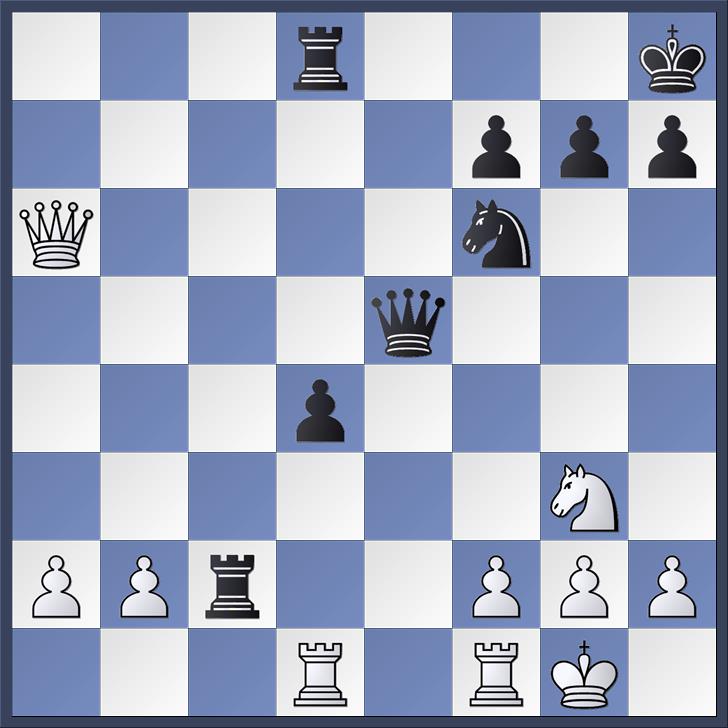
22...h5

Donner gives this move an explanation mark. The computer sees snatching the b-pawn as the only way for Black to maintain a slight edge.

23.Rfe1 Qd5 24.Re2

Quite possibly the decisive error.

24.Qd3 Rxb2

24...d3 25.Re3

A mistake, according to Donner.

25.Red2 Rxd2 26.Rxd2 h4 27.Nf1 Ne4 Black still has the upper hand. That's why I see the critical error as one move earlier than Donner's assessment.

Black to move

This position makes for a good tactics exercise.

25...Rxf2

Donner offers a double exclam and, "A most unexpected combination, with the point appearing soon" (28).

26.Ne4

26.Kxf2 Ng4+

26...Nxe4

The computer likes 26...Ng4. Perhaps Donner might have noted the role of luck in chess, because here Larsen lets it slip away, if only Evans, who has been under enormous pressure could have found the  correct response.

White to move

This position, also, could serve in a battery of tactics exercises. White might yet resist Black's attack.

27.Rexd3

Now, Larsen can finish.

27.Rdxd3 Qg5 28.Rxd8+ Qxd8 29.Rxe4 Rxb2 and this position should develop into a draw.

27...Rf1+

Another double exclam from Donner, and possibly a third tactics exercise.

28.Rxf1

28.Kxf1 Qf5+ 29.Rf3 (29.Kg1 Qc5+ 30.Rd4 Rxd4 31.Qa8+ Rd8+ with smother mate to follow) 29...Rxd1+ 30.Ke2 Nc3+ 31.Rxc3 Qf1+.

28...Qc5+

Evans resigned.

29.Kh1 Nf2+ 30.Rxf2 (30.Kg1 Nh3+ 31.Kh1 Qg1+ 32.Rxg1 Nf2#) 30...Qc1+ 31.Rd1 Rxd1+ 32.Rf1 Rxf1+ 33.Qxf1 Qxf1#

0–1

09 April 2012

Lesson of the Week

Grandmaster Tactics

The core lesson for my scholastic chess teams this week comes from a game played in 1962: Spassky -- Evans. The entire game, and thus the answer to the exercise, can be found at "Instructive Games Worthy of Memorizing."

Find Boris Spassky's move from this position. He played the strongest move.

White to move

A second chess problem may be needed in certain groups. It comes from the final position in Carlsen -- Wang, Wijk aan Zee 2011. Wang Hao resigned. How might Carlsen continue if, instead of resigning, Wang had played 29...gxf6? The entire game, but not the answer to this problem, is at "Carlsen -- Wang Hao, Tata Steel 2011."

White to move

29 March 2012

Instructive Games Worthy of Memorizing

Choosing to memorize whole chess games demands identifying games with instructive value. The miniatures that I committed to memory last week are useful to the chess teacher who works with beginning players (see "Memorizing Chess Games"). They are of less value to my objective of making Expert (see "Breaking Through 1900!"). Consider the most important elements in a brief game that I played during the course of a single minute during lunch a few months ago, and have been able to replay ever since. To this day, I have not checked my analysis with an engine. It was an entertaining disaster for White in a three minute blitz game.

Internet Opponent -- Stripes
Chess.com 2012

1.e4 e6 2.f4 c5 3.Nf3 Nc6 4.d4 cxd4 5.Nxd4 Nf6 6.e5 Ne4 7.Bd3 Qh4+ 8.g3 Nxg3 9.Nf3

Black to move

9...Qg4? 10.hxg3? Qxg3+ 11.Ke2 Qg2+ 12.Ke3 Bc5+ 13.Ke4 f5+ 14.exf6 d5#

Black should have played 9...Qh3 when the knight remains safe. After 9...Qg4, White should have played 10.Rg1!

It was a fast game, and I have not analyzed it in any depth. Likely, there is an improvement that I have overlooked. It serves to illustrate the en passant rule, to show the danger to a king drawn into the middle of the board, and to illustrate the sort of mating attack that often presents itself in games of weak players. Memorizing this game required no effort. I played it at lunch on my iPad, saved it to tChess Pro, and showed it to a group of elementary school students an hour later. It has remained lodged in my memory since because I have shown it to others.

What elements give this game instructive value?

1) The truth of the position. Both players made errors. Perhaps the diagram position is worth knowing because the next move was Black's most significant error, which was followed by White's missed opportunity to use a pin to win material. Does Black have a clear advantage before 9...Qg4? Does White gain the upper hand after the unplayed 10.Rg1?

2) Tactical motifs. The queen's attack along the e1-h4 diagonal can occur in many positions, and it particularly effective when supported by a knight. White's knight is also a factor that often refutes such attacks.

3) Opening ideas. The game began as a French Defense, but quickly transposed into something resembling the Sicilian Grand Prix Attack. Was 6.e5 a useful move for White?


Process of Memorizing

Many games of fifteen moves or less can be memorized with minimal effort. Even players who claim they have never memorized an entire game can demonstrate Fool's Mate and Scholar's Mate. Legall de Kermeur's only recorded game should present no difficulty for the average player. My process in rereading Chernev's 1000 Best Short Games of Chess is a slightly more difficult exercise, but not onerous. It is an exercise in translation. I read through a short game in descriptive without reference to a chess board, close the book, and then play through the game on a board. Later, I write the game in algebraic notation without looking at the board.  In the 1970s I played a few blindfold games using English Descriptive Notation, but have become rusty in its use since learning Algebraic Notation in the early 1990s. With Chernev, I am honing my reading skills in the ancient language that exists in dozens of chess books on my shelf.

It is possible to memorize a game without understanding, particularly a short game. With longer games, however, the ability to play through an entire game from memory is either the precondition or it is the natural consequence of understanding the strategic features and tactical possibilities in a particular struggle between two players. Two years ago, I began an effort to identify useful whole games and commit them to memory. This effort was suspended for reasons having nothing to do with chess.

Those games that seem worthy of learning whole are the games from which critical positions have been extracted. Rashid Ziyatdinov wrote, "In Russian folklore it is said that there are 300 positions which comprise the most important knowledge which an aspiring player must acquire" (GM-RAM, 12). Lev Alburt stated something similar, "To become a strong tournament player, you must indelibly carve into your chess memory a limited number of essential positions and concepts" (Chess Training Pocket Book, 7). The terms "aspiring player" and "strong tournament player" are imprecise. My goal is specific: become a USCF Expert.

Both Alburt and Ziyatdinov stress that the essential 300 differ from one player to another. I have three books that each present approximately 300 candidate positions for my own 300: Alburt, Chess Training Pocket Book; Alburt, Chess Training Pocket Book II; and Ziyatdinov, GM-RAM: Essential Grandmaster Chess Knowledge. Ziyatdinov compares critical middlegame positions to fingerprints, "from this fingerprint, the associated game can be identified" (77). See "Fingerprints" for more discussion of Ziyatdinov's ideas.


Adding Games to the List

Earlier this week, in "Problems in the English Opening," I annotated a game that I won. White made a series of small strategic errors that led to a theoretically lost position. I have made some effort to commit this game to memory. It is not the celebration of winning a miniature from the Black side of the English that has merit, but the struggle to identify White's errors. I, too, play the English Opening. White's play must be improved so that I never find myself on the losing end of such a game.

Yesterday and today, I am reviewing the first twenty positions in Chess Training Pocket Book II. Positions 5-8 all come from the game Spassky -- Evans 1962. One position is from the actual game. Three are hypothetical positions that follow from moves that Evans did not play. Looking at the game, I concluded that the final mating attack was also worthy of knowing.


Spassky,Boris V - Evans,Larry Melvyn [E80]
Varna ol (Men) fin-A Varna (10), 1962

1.d4 Nf6 2.c4 g6 3.Nc3 Bg7 4.e4 d6 5.f3 c6 6.Be3 a6 7.Qd2 b5 8.0–0–0

Black to move


This position is not uncommon, but Evans' move here has been repeated only a few times and with terrible results for Black.

8... bxc4 9.Bxc4 0–0 10.h4

Alburt's first problem is finding this move. The other there are variations involving tactical shots after  alternative moves that are worse than those played by Evans over the next few moves from this position, 15...Nh5 for instance.

10...d5 11.Bb3 dxe4 12.h5 exf3 13.hxg6 hxg6 14.Bh6 fxg2 15.Rh4 Ng4 16.Bxg7 Kxg7 17.Qxg2 Nh6 18.Nf3 Nf5 19.Rh2 Qd6 20.Ne5 Nd7 21.Ne4 Qc7 22.Rdh1

Black to move


Improvements for Black must be found before this position is reached. No matter what Black tries here, the aspiring player should have a clear plan of attack for White.

22...Rg8 23.Rh7+ Kf8 24.Rxf7+ Ke8 25.Qxg6 Nxe5 26.Rf8+ 1–0